- Product Description Description
- Table of Contents TOC
- List of Table & Figure LOT
- Get Free Sample PDF Sample PDF
Market Size, 2025
$7.83 BnMarket Estimate, 2026
$8.24 BnMarket Forecast, 2034
$12.13 BnCAGR, 2026–2034
5.20%North America Industrial Motors Market Size
The North America industrial motors market size was valued at USD 7.83 billion in 2025 and is anticipated to reach USD 8.24 billion in 2026 from USD 12.13 billion by 2034, growing at a CAGR of 5.20% during the forecast period from 2026 to 2034.
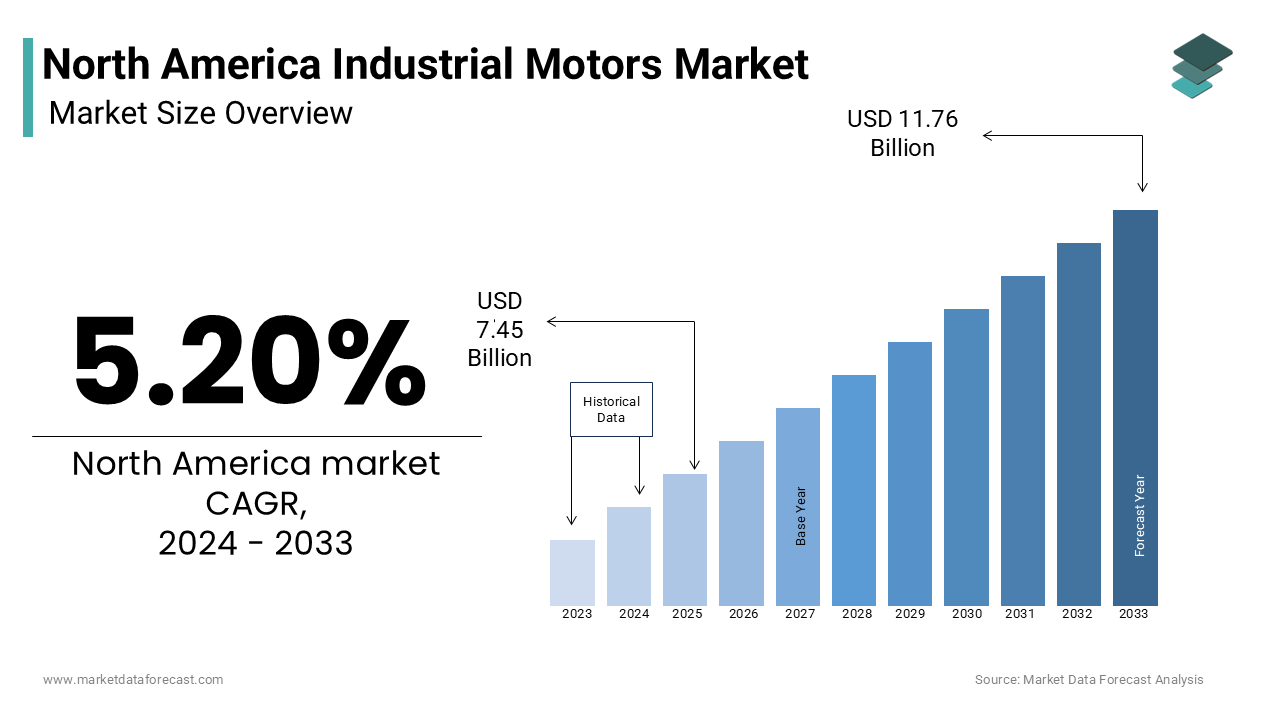
The industrial motors serve as essential components in driving pumps, compressors, fans, conveyors, and automation systems that support continuous industrial operations. According to the U.S. Department of Energy, electric motors account for nearly 54% of all electricity consumed in the industrial sector by making them a key focus area for energy conservation efforts. IoT-enabled motor monitoring, and integrated drive systems, the North America industrial motors market is undergoing a transformation. This shift not only enhances operational efficiency but also supports broader trends toward electrification, decarbonization, and intelligent energy management across the continent.
MARKET DRIVERS
Rising Demand for Energy-Efficient Industrial Equipment
The increasing demand for energy-efficient equipment driven by regulatory mandates and cost-saving imperatives is driving the growth of the North America industrial motors market. According to the U.S. Department of Energy, industrial electric motors consume over 50% of the total electricity used in the manufacturing sector, making them a focal point for energy optimization strategies. Additionally, state-level programs such as California’s Appliance Efficiency Program and New York State Energy Research and Development Authority (NYSERDA) offer financial incentives for companies upgrading to high-efficiency motors. These policies have encouraged manufacturers to phase out outdated models and invest in superior efficiency alternatives that reduce both operating costs and carbon emissions. Moreover, global sustainability commitments like the Paris Agreement are influencing corporate procurement decisions, with major industrial players prioritizing energy-efficient motors to meet internal ESG targets. Companies such as General Electric, Siemens, and ABB have reported increased inquiries for IE3 and IE4-rated motors from large-scale industrial clients seeking to align with green energy goals while improving long-term profitability.
Growth of Advanced Manufacturing and Automation Technologies
The rapid growth of advanced manufacturing and automation technologies is propelling the growth of the North America industrial motors market. The U.S. Census Bureau reports that capital expenditures on automated production equipment grew by 9.7% in 2023 compared to the previous year, which is reflecting increased reliance on precision-driven industrial systems requiring high-performance motor solutions.
Industrial robots, smart conveyors, CNC machines, and automated guided vehicles (AGVs) all depend on efficient and reliable motor systems to operate seamlessly. Furthermore, the integration of variable frequency drives (VFDs) and digitally controlled motor systems is enabling real-time performance monitoring and energy optimization.
MARKET RESTRAINTS
High Initial Investment and Cost Sensitivity Among Small Manufacturers
The high initial investment required for premium efficiency motors and associated control systems, which limits adoption among small and medium-sized enterprises (SMEs) is restraining the growth of the North America industrial motors market. According to the National Association of Manufacturers, approximately 68% of surveyed SMEs cited upfront costs as the primary barrier to upgrading to energy-efficient motor systems. Premium efficiency motors, particularly those meeting NEMA Premium or IEC IE4 standards, often come with price premiums of 15–30% over standard models. Additionally, integrating these motors with variable frequency drives (VFDs), smart sensors, and energy management software further increases project costs. Moreover, some industrial operators prioritize short-term cash flow over long-term energy savings in sectors with thin profit margins. In regions where electricity prices remain relatively low, the return on investment for high-efficiency motors may take several years, discouraging adoption.
Supply Chain Disruptions and Component Shortages
The ongoing supply chain disruptions and shortages of critical components such as semiconductors, copper, and rare earth materials used in motor production is additionally to hinder the growth of the North America industrial motors market. According to Deloitte’s 2023 Global Supply Chain Report, industrial equipment manufacturers experienced an average lead time extension of 8–12 weeks due to bottlenecks in raw material sourcing and logistics networks. The U.S. Geological Survey reports that global copper prices saw significant volatility in 2023 due to geopolitical tensions and fluctuating mine output, directly impacting motor production costs. These disruptions have affected both original equipment manufacturers (OEMs) and aftermarket service providers, leading to project delays and increased procurement costs for end users. Mid-sized motor producers, in particular, face difficulties competing with larger firms that benefit from vertical integration and global supplier partnerships.
MARKET OPPORTUNITIES
Integration with Smart Manufacturing and Predictive Maintenance Systems
The integration of motors with smart manufacturing and predictive maintenance technologies is creating new opportunities for the growth of the North America industrial motors market. There is a growing emphasis on real-time data analytics, remote diagnostics, and condition-based monitoring to optimize motor performance and minimize unplanned downtime. According to the Electric Power Research Institute, predictive maintenance using vibration analysis, thermal imaging, and current signature analysis can extend motor lifespan by up to 30% while reducing maintenance costs by 25%. Leading motor manufacturers such as Siemens, Rockwell Automation, and ABB have introduced IoT-enabled motor systems equipped with embedded sensors and cloud connectivity to enable continuous performance tracking. Additionally, collaborations between motor suppliers and digital platform providers are accelerating the development of integrated motor-drive ecosystems.
Expansion of Electrification Initiatives in Transportation and Process Industries
The expansion of electrification initiatives across transportation and process industries, which is driven by decarbonization goals and advancements in high-efficiency motor technology. According to the U.S. Department of Energy, the industrial sector accounts for nearly one-third of total U.S. energy-related carbon dioxide emissions, prompting a shift toward electrified industrial processes and zero-emission mobility solutions. In the transportation sector, electrification of freight handling equipment, cargo loaders, and rail systems is increasing demand for high-torque industrial motors capable of delivering consistent performance under heavy loads. Additionally, in chemical, food processing, and pharmaceutical industries, companies are replacing traditional hydraulic and pneumatic systems with electric motor-driven alternatives to improve precision, reduce maintenance, and lower environmental impact.
MARKET CHALLENGES
Regulatory Compliance and Evolving Efficiency Standards
is the complexity of evolving regulatory compliance requirements and continuously updated efficiency standards. At the federal level, the U.S. Department of Energy periodically revises motor efficiency regulations, mandating higher performance benchmarks that require manufacturers to redesign product lines and ensure compatibility with existing industrial infrastructure. Additionally, retrofitting older facilities with new-generation motors often necessitates modifications to electrical systems, control panels, and mechanical interfaces, adding complexity and cost.
Competition from Alternative Drive Technologies and Servo Systems
The growing competition from alternative drive technologies and servo-based motion control systems that offer enhanced precision, responsiveness, and energy efficiency is also to degrade the growth of the North America industrial motors market. Servo motors, known for their ability to deliver precise position control and dynamic response, are increasingly preferred in automated production lines where accuracy and repeatability are paramount. Additionally, direct-drive systems eliminate the need for gearboxes and belts by reducing mechanical complexity and maintenance requirements. Furthermore, advancements in permanent magnet synchronous motors (PMSMs) and reluctance motors are offering compelling alternatives to traditional induction motors, particularly in applications requiring high torque density and reduced energy consumption.
SEGMENTAL ANALYSIS
By Type of Motor Insights
The alternating current (AC) motors segment held a dominant share of the North America industrial motors market in 2024 with the widespread use across a broad range of industrial applications due to their reliability, efficiency, and compatibility with standard power grids. The high penetration of AC motors in manufacturing and process industries, where they are used extensively for pumps, compressors, fans, and conveyor systems. According to the U.S. Department of Energy, over 70% of industrial electricity consumption in the manufacturing sector is attributed to motor-driven equipment, with AC induction motors being the most commonly deployed type. Additionally, advancements in variable frequency drives (VFDs) have significantly improved speed control and energy efficiency of AC motors, making them more adaptable to modern automation systems.
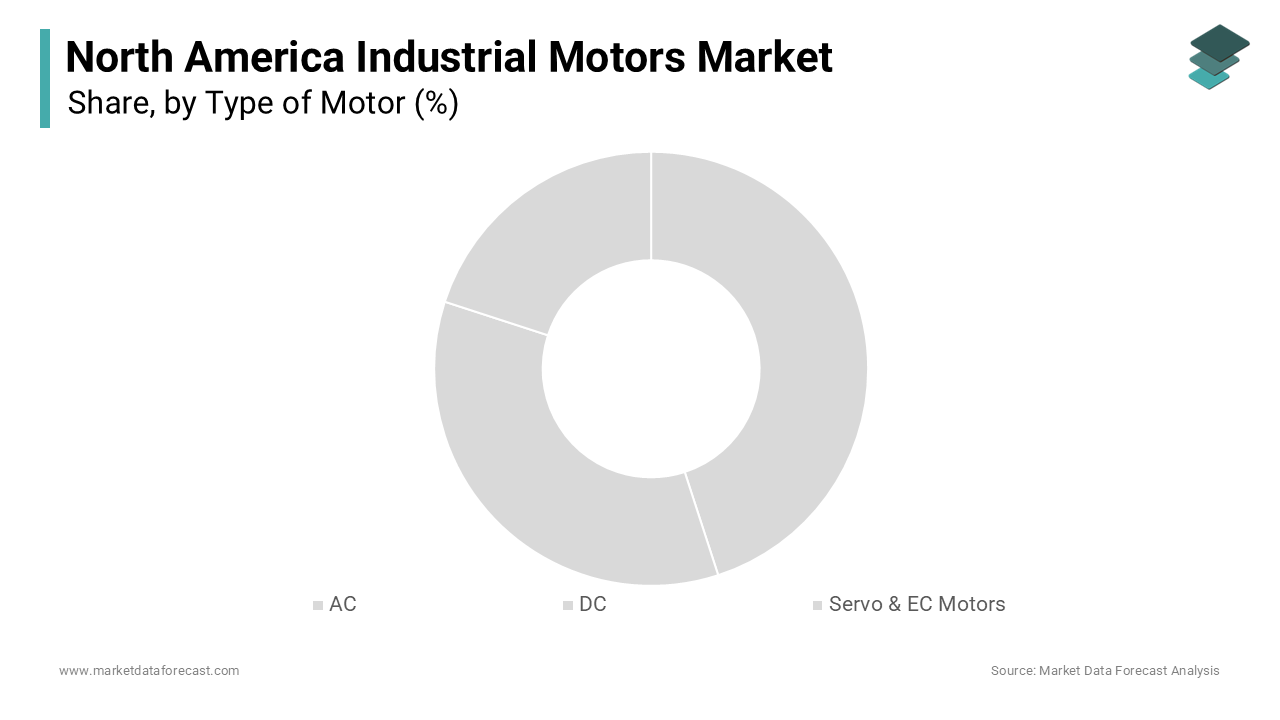
The "Other Types of Motors" segment is projected to grow with a CAGR of 9.1% from 2026 to 2034. The International Federation of Robotics reports that the deployment of industrial robots in North America increased by 17% in 2023, many of which rely on servo motors for accurate positioning and dynamic response. Additionally, electronically commutated (EC) motors are gaining traction in HVAC and cleanroom applications due to their superior efficiency and programmability. Moreover, manufacturers such as Rockwell Automation and Siemens are integrating these motor types into smart factory ecosystems, enabling real-time diagnostics and predictive maintenance.
By Voltage Insights
The low voltage industrial motors segment held 59.4% of the North America industrial motors market share in 2025 with the extensive deployment of low voltage motors in manufacturing, food processing, and commercial infrastructure. According to the U.S. Census Bureau, over 80% of newly installed industrial machinery in 2023 was equipped with low voltage motor drives with their suitability for general-purpose operations and ease of integration with existing electrical systems. Additionally, regulatory support for energy-efficient low voltage motors has accelerated adoption.
Furthermore, advancements in variable speed drives and smart motor controllers have enhanced performance and energy savings. The Electric Power Research Institute emphasizes that low voltage motors integrated with VFDs can achieve up to 30% energy savings in pump and fan applications.
The medium voltage industrial motors segment is likely to grow with an expected CAGR of 7.8% throughout the forecast period with the rising investment in large-scale industrial projects requiring high-capacity motor solutions. According to the U.S. Energy Information Administration, capital expenditures in upstream oil & gas and utility-scale renewable energy projects rose by 11% in 2023 compared to the previous year. Additionally, modernization of aging industrial infrastructure is boosting demand for high-efficiency medium voltage motors. Natural Resources Canada reports that several Canadian provinces are upgrading water treatment plants and mineral processing facilities with IEC IE4-rated medium voltage motors to improve reliability and reduce energy costs. Moreover, integration with digital monitoring and predictive maintenance platforms is enhancing operational efficiency. Leading manufacturers such as ABB and General Electric have introduced IoT-enabled medium voltage motor systems capable of real-time diagnostics and remote performance optimization.
By End-User Insights
The oil & gas industry segment in the North America industrial motors market by accounting for 28.3% of share in 205 with the ongoing expansion of shale oil and natural gas production in the United States, particularly in regions such as Texas, North Dakota, and Pennsylvania. Additionally, increased investments in offshore and midstream infrastructure are reinforcing demand for high-performance industrial motors. Moreover, the shift toward electrification in upstream operations is driving adoption of energy-efficient motors. Companies such as ExxonMobil and Chevron are incorporating IE4-rated motors and variable frequency drives to comply with environmental regulations while improving operational efficiency.
The power generation segment is expected to grow with a CAGR of 8.4% from 2025 to 2033 with the modernization of grid infrastructure, rising investments in renewable energy sources, and the need for auxiliary motor-driven systems in thermal, hydroelectric, and battery storage facilities. Additionally, grid modernization initiatives are increasing demand for high-efficiency motors in substation and transmission applications. Moreover, the expansion of battery energy storage systems (BESS) is creating new motor applications in thermal management and fluid circulation. The Electric Power Research Institute reports that BESS deployments grew by 72% in 2023 compared to the previous year, further boosting industrial motor adoption.
REGIONAL ANALYSIS
United States Industrial Motors Market Insights
The United States was the top performer in the North America industrial motors market by accounting for 76.3% of share in 2025 with the resurgence of domestic manufacturing and industrial automation in automotive, semiconductor, and pharmaceutical sectors. The U.S. Census Bureau recorded a 6.4% increase in industrial construction spending in 2023, with states like Texas, Ohio, and Tennessee leading in new plant developments that rely heavily on industrial motor systems. Additionally, federal and state-level incentives are accelerating the adoption of high-efficiency motors. Moreover, the rise of smart factories and digitally integrated motor systems is transforming industrial operations. Major motor suppliers such as Rockwell Automation and ABB are expanding their IoT-enabled motor offerings to support predictive maintenance and real-time performance analytics.
Canada Industrial Motors Market Insights
Canada industrial motors market held 16.2% of the share in 2025 with the progressive energy policies and expanding industrial sectors such as mining, pulp and paper, and clean technology manufacturing. The strong emphasis on energy efficiency and sustainability. Natural Resources Canada actively promotes the adoption of IE4-rated motors through its ENERGY STAR program and provincial incentive schemes. Additionally, the expansion of the mining and critical minerals sector is boosting demand for heavy-duty industrial motors. Moreover, growing investments in hydrogen and renewable energy infrastructure are creating new motor applications in electrolysis, air separation, and energy storage systems.
KEY MARKET PLAYERS
The key players in the North America Industrial Motors Market include
- ABB Ltd.
- Siemens AG
- Nidec Corporation
- WEG Electric Corp.
- Toshiba International Corporation
- Rockwell Automation Inc.
- Regal Rexnord Corporation
- General Electric Company
COMPETITVE LANDSCAPE
The competition in the North America industrial motors market is shaped by a mix of global conglomerates, regional manufacturers, and emerging technology-driven players striving to capture market share through differentiation, innovation, and strategic positioning. As industries increasingly prioritize energy efficiency, automation, and sustainability, motor suppliers are under pressure to deliver high-performance, compliant, and digitally integrated solutions. Product differentiation remains a central battleground, with companies investing in next-generation motor designs, including IE4 and IE5 efficiency-rated models, smart-enabled systems, and specialized variants for hazardous environments.
Customer engagement strategies have evolved beyond product sales to include lifecycle support, predictive analytics, and cloud-connected motor management platforms that ensure long-term performance and cost savings. Additionally, participation in federal and state incentive programs has become essential for expanding market access and improving affordability for end users. While multinational corporations dominate due to their R&D capabilities and brand recognition, mid-sized firms are gaining traction by focusing on niche applications, localized service offerings, and cost-effective solutions.
Top Players in the North America Industrial Motors Market
Rockwell Automation
Rockwell Automation is a leading global provider of industrial automation and digital transformation solutions, with a strong presence in the industrial motors market across North America. The company offers a comprehensive portfolio of motor control systems, variable frequency drives, and integrated motion control platforms designed for precision manufacturing and process industries. Rockwell plays a pivotal role in advancing smart motor technologies by integrating IoT-enabled monitoring, predictive maintenance, and energy optimization features into its product ecosystem, contributing to enhanced operational efficiency and sustainability worldwide.
ABB Ltd. (North American Operations)
ABB is a global leader in electrification and industrial automation, offering a wide range of high-efficiency industrial motors tailored for applications in oil & gas, power generation, and heavy industry. ABB’s North American operations focus on delivering IE4 and IE5 ultra-premium efficiency motors that align with evolving energy regulations and decarbonization goals. The company also develops advanced drive systems that enhance motor performance through real-time control and diagnostics with sustainable and intelligent motor-driven solutions across both domestic and international markets.
WEG Electric Corporation (U.S. Subsidiary)
WEG Electric, a subsidiary of Brazil-based WEG S.A., has established itself as a key player in the North American industrial motors market due to its competitive pricing, broad product range, and commitment to innovation. The company supplies a diverse array of AC and DC motors suitable for general-purpose and hazardous environments, serving industries such as mining, agriculture, and water treatment. WEG’s expansion strategy in North America includes localized production, strategic acquisitions, and partnerships aimed at enhancing service capabilities and accelerating the adoption of energy-efficient motor systems.
Top Strategies Used by Key Market Participants
One major strategy employed by leading industrial motor manufacturers is product innovation and digital integration, where companies are developing smart, IoT-enabled motor systems capable of real-time performance monitoring, predictive maintenance, and remote diagnostics. This enhances reliability, reduces downtime, and supports Industry 4.0 transformation across manufacturing and infrastructure sectors.
Expanding regional service networks and after-sales support by ensuring that customers receive timely technical assistance, retrofitting services, and spare parts availability. The market leaders improve customer retention and facilitate seamless integration of new motor technologies into existing industrial ecosystems by strengthening local distribution channels and service centers.
Firms are increasingly focusing on strategic collaborations and acquisitions to broaden technological capabilities and market reach. The industrial motor suppliers are creating integrated solutions that optimize energy use, improve system compatibility, and reinforce their competitive edge in North America’s evolving industrial landscape.
RECENT MARKET DEVELOPMENTS
- In February 2024, Rockwell Automation launched a new line of smart industrial motors embedded with AI-powered diagnostics by enabling real-time condition monitoring and predictive maintenance for manufacturing clients seeking higher uptime and energy efficiency.
- In May 2024, ABB expanded its motor service center network in Texas and Louisiana to better serve the growing oil & gas sector, offering rapid repair, retrofitting, and compliance certification services tailored to harsh-environment motor applications.
- In July 2024, WEG Electric announced a strategic partnership with a U.S.-based energy efficiency consulting firm to provide bundled motor upgrade packages for commercial and industrial clients participating in utility rebate programs.
- In October 2024, Siemens introduced an integrated motor-drive-software platform in North America, which is allowing industrial operators to centrally manage motor performance, energy consumption, and fault diagnostics through a unified digital interface.
- In December 2024, Baldor Electric, a subsidiary of ABB, unveiled a new line of explosion-proof industrial motors designed specifically for chemical processing and pharmaceutical facilities, by addressing stringent safety and hygiene requirements in regulated industries.
MARKET SEGMENTATION
This research report on the North America Industrial Motors Market is segmented and sub-segmented based on categories.
By Type of Motor
- AC
- DC
- Servo & EC Motors
By Voltage
- High Voltage
- Medium Voltage
- Low Voltage
By End-User
- Oil & Gas
- Power Generation
- Mining and Metals
- Others
By Country
- U.S.
- Canada
- Rest of North America