- Product Description Description
- Table of Contents TOC
- List of Table & Figure LOT
- Get Free Sample PDF Sample PDF
Market Size, 2025
$8.03 BnMarket Estimate, 2026
$8.27 BnMarket Forecast, 2034
$10.48 BnCAGR, 2026–2034
3%North America Ink Market Summary
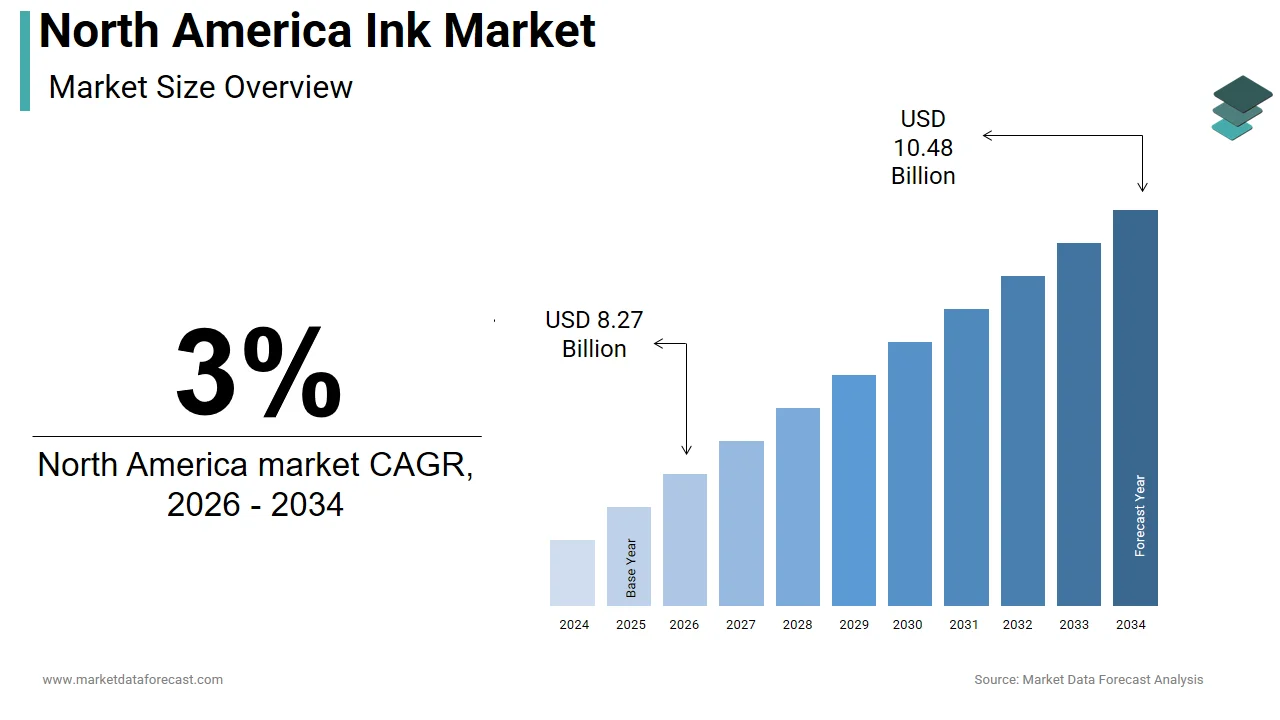
The North America Ink market was valued at USD 8.03 billion in 2025, is estimated to reach USD 8.27 billion in 2026, and is projected to reach USD 10.48 billion by 2034, growing at a CAGR of 3% from 2026 to 2034. The inks are composed of pigments or dyes, resins, solvents, and additives, engineered to meet performance criteria such as adhesion, drying time, durability, and regulatory compliance. Their applications span commercial printing, packaging, publishing, textiles, labels, and industrial marking. A key trend shaping the modern ink market is the shift toward sustainability, with rising demand for water-based, UV-curable, and bio-solvent formulations that reduce volatile organic compound (VOC) emissions.
Key Market Trends & Insights
- United States dominated the North America Ink market in 2025.
- Canada is expected to showcase steady growth throughout the forecast period.
- Based on technology, the lithographic (offset) printing segment held the largest market share in 2025.
- Based on ink type, the water-based ink segment was the leading segment in 2025.
- Based on application, the labeling and packaging dominated the market in 2025.
Market Size & Forecast
- 2025 Market Size: USD 8.03 Billion
- 2026 Estimated Size: USD 8.27 Billion
- 2034 Projected Market Size: USD 10.48 Billion
- CAGR (2026–2034): 3%
- United States: Largest market in 2025
- Canada: Steady growth region
North America Ink Market Size
The North America Ink market was valued at USD 8.03 billion in 2025, is estimated to reach USD 8.27 billion in 2026, and is projected to reach USD 10.48 billion by 2034, growing at a CAGR of 3% from 2026 to 2034.
The inks are composed of pigments or dyes, resins, solvents, and additives, engineered to meet specific performance criteria such as adhesion, drying time, durability, and regulatory compliance. Their application spans commercial printing, packaging, publishing, textiles, labels, and industrial marking. A defining characteristic of the modern ink landscape is the shift toward sustainability, with increasing demand for water-based, UV-curable, and bio-solvent formulations that reduce volatile organic compound (VOC) emissions. As per the U.S. Environmental Protection Agency, printing operations are responsible for approximately 9% of total VOC emissions from industrial sources, prompting regulatory scrutiny and technological adaptation.
MARKET DRIVERS
Surge in E-Commerce and Demand for Advanced Packaging Inks
The rapidly growing e-commerce platform for high-performance printing inks, particularly in flexible and corrugated packaging, is majorly prompting the growth of the North America ink market. According to the U.S. Department of Commerce, e-commerce sales in the United States reached $1.03 trillion in 2023, accounting for 15.6% of total retail sales, a significant increase from 11.8% in 2019. This shift has intensified the need for inks that offer superior adhesion, abrasion resistance, and print clarity on diverse substrates such as polyethylene, polypropylene, and biodegradable films. The rise of direct-to-consumer (DTC) models has further amplified demand for short-run, customizable digital inks that allow rapid design iteration. As per the Flexible Packaging Association, over 70% of new product launches in the U.S. now use flexible packaging, much of which requires advanced gravure or flexographic inks. Additionally, the proliferation of subscription boxes and personalized packaging has boosted the adoption of digital inkjet systems, which utilize pigment-based inks for high-resolution graphics. In Canada, Canada Post reported a 34% increase in parcel volume between 2020 and 2023, reinforcing the logistical demands on packaging integrity. Brands such as Amazon and Walmart have implemented strict print durability standards, requiring inks to resist smudging, fading, and moisture exposure.
Expansion of Digital Printing in Commercial and Industrial Applications
The growing demand for specialized inkjet and toner formulations across commercial, industrial, and decorative printing is additionally to fuel the growth of the North America ink market. Unlike conventional methods, digital printing enables on-demand production, variable data printing, and reduced setup times, making it ideal for personalized marketing, short-run packaging, and customized textiles. As per the International Digital Enterprise Alliance, digital print accounted for 21% of total print output in North America in 2023, up from 14% in 2018. The commercial printing sector has been a primary beneficiary, with print-on-demand books, photo albums, and promotional materials increasingly produced using aqueous and pigment-based inkjet inks. The U.S. Bureau of Labor Statistics notes that over 4,200 commercial printing firms have integrated digital presses since 2020, driven by client demand for faster turnaround and customization. In industrial applications, digital inkjet is being used for coding, marking, and decorating surfaces in manufacturing, including beverage cans, pharmaceutical blister packs, and building materials. The Food and Drug Administration now mandates unique device identification (UDI) on medical products, accelerating the use of high-resolution inkjet inks for permanent marking.
MARKET RESTRAINTS
Stringent Environmental Regulations Limiting Solvent-Based Ink Usage
The rising environmental regulations targeting volatile organic compound (VOC) emissions, which contribute to ground-level ozone and respiratory health issues, are restricting the growth of the North America ink market. The U.S. Environmental Protection Agency enforces National Emission Standards for Hazardous Air Pollutants (NESHAP) for printing operations, which mandates that facilities using solvent inks install vapor recovery systems or switch to compliant alternatives. As per the EPA, solvent-based inks can emit up to 80% VOCs by weight, compared to less than 10% for water-based or UV-curable formulations. In California, the South Coast Air Quality Management District (SCAQMD) has implemented Rule 1168, which limits VOC content in printing inks to 30 grams per liter for most applications, effectively phasing out traditional solvent systems. Similarly, Environment and Climate Change Canada regulates ink formulations under the Canadian Environmental Protection Act, requiring manufacturers to report and reduce VOC emissions. Compliance with these standards necessitates costly upgrades to ventilation, abatement equipment, and ink storage systems, deterring small and mid-sized printers. The American Coatings Association notes that VOC compliance investments can exceed $250,000 per printing facility, creating a financial barrier to entry. Additionally, the disposal of solvent-contaminated waste is subject to Resource Conservation and Recovery Act (RCRA) regulations, increasing operational complexity.
Volatility in Raw Material Supply and Pricing
The fluctuations in the availability and cost of critical raw materials, including petroleum-derived resins, pigments, and solvents, are also hindering the growth of the North America ink market. These inputs are subject to global supply chain dynamics, geopolitical tensions, and energy market volatility, directly impacting production costs and pricing stability. As per the U.S. Energy Information Administration, crude oil prices fluctuated between $73 and $97 per barrel in 2023, influencing the cost of aromatic hydrocarbons used in resin synthesis. Titanium dioxide, a key white pigment, saw prices rise by 22% in 2022 due to supply disruptions in Europe and China, as reported by the Minerals Information Institute. In 2023, port congestion at the Port of Los Angeles extended lead times for pigment shipments by up to eight weeks, according to the American Trucking Associations. Furthermore, regulatory restrictions on certain phthalates and heavy metals have forced formulators to seek alternative additives, increasing R&D expenses. The National Association of Printing Ink Manufacturers highlights that raw material costs account for 60–70% of total ink production expenses, leaving little margin for price absorption.
MARKET OPPORTUNITIES
Development of Functional and Smart Inks for Advanced Applications
The emergence of functional and smart inks is opening transformative avenues within the North America ink market, extending beyond aesthetics to enable electronic, security, and responsive capabilities. These inks incorporate conductive materials, thermochromic pigments, or RFID elements to serve applications in printed electronics, anti-counterfeiting, and interactive packaging. As per the U.S. Department of Energy, printed electronics—using silver, carbon, or graphene-based conductive inks could reduce manufacturing costs by up to 50% compared to traditional circuitry in devices like sensors and wearables. The healthcare sector is adopting conductive inks for disposable diagnostic strips and smart patches; for instance, Abbott’s glucose monitoring systems utilize inkjet-printed electrodes, as documented in its 2023 product innovation report. The second major driver is the demand for brand protection; the U.S. Chamber of Commerce estimates that counterfeiting costs American businesses over $30 billion annually, prompting the use of UV-fluorescent, infrared, and tamper-evident inks in pharmaceutical and luxury packaging.
Shift Toward Bio-Based and Sustainable Ink Formulations
The rising prominence of environmental sustainability with innovation in bio-based ink formulations is likely to create huge growth opportunities for the North America ink market. Manufacturers are reformulating traditional inks using renewable raw materials such as soy, linseed, and castor oil derivatives to reduce dependence on fossil fuels and lower carbon footprints. As per the U.S. Department of Agriculture’s BioPreferred Program, over 1,200 printing ink products were certified as bio-based in 2023, with soy-based inks now used in over 90% of U.S. newspaper printing, according to the Soy Ink Network. These inks offer comparable print quality while emitting fewer VOCs and enabling easier paper recycling. The second key driver is corporate sustainability commitments; Walmart, Target, and Amazon have all established packaging sustainability guidelines that prioritize low-impact inks. The Retail Industry Leaders Association reports that 78% of major retailers now require suppliers to disclose ink composition and environmental impact. Additionally, the Canadian government’s Green Procurement Policy mandates that federal agencies prioritize products with reduced environmental footprints, including printing inks. Innovations such as algal-based pigments and enzymatically synthesized resins are entering commercialization, supported by research at institutions like the University of Minnesota’s BioTechnology Institute. The American Coatings Association notes that bio-ink R&D funding increased by 40% between 2021 and 2023, reflecting industry momentum.
MARKET CHALLENGES
Technological Complexity in Matching Ink Performance Across Substrates
The increasing difficulty of ensuring consistent ink performance across a proliferating array of substrates in packaging and industrial printing is also hindering the growth of the North America ink market. Modern materials such as bioplastics, metallized films, and coated papers exhibit varying surface energies, porosity, and chemical resistance, complicating adhesion, drying, and curing processes. As per the Technical Association of the Pulp and Paper Industry, over 40% of print defects in flexible packaging are attributed to ink-substrate incompatibility. For example, polyethylene terephthalate (PET) and oriented polypropylene (OPP) require different primer treatments to achieve optimal ink adhesion, increasing process complexity. Additionally, UV-curable inks, while environmentally favorable, require precise wavelength matching and curing conditions, which vary by substrate thickness and composition. The U.S. Food and Drug Administration’s stringent requirements for ink migration in food packaging necessitate extensive testing to ensure compliance, delaying time-to-market. The National Institute for Occupational Safety and Health highlights that reformulating inks for new substrates often involves hazardous solvents or additives, raising worker safety concerns. With brands demanding high-gloss finishes, matte textures, and tactile effects on the same production line, ink manufacturers must balance aesthetics, functionality, and regulatory compliance.
Rapid Technological Obsolescence in Digital Printing Systems
The accelerated pace of innovation in digital printing technologies is creating a challenge of technological obsolescence for ink manufacturers and end-users alike. Digital presses are evolving rapidly in resolution, speed, and compatibility, rendering existing ink formulations obsolete within short timeframes. As per the International Digital Press Association, the average lifecycle of a commercial inkjet press has decreased from seven years in 2015 to just four years in 2023, forcing ink suppliers to continuously reformulate products to match new printhead designs and fluid dynamics. For example, piezoelectric printheads require inks with precise viscosity and surface tension profiles, while thermal inkjet systems demand low-volatility solvents to prevent clogging. The U.S. Patent and Trademark Office recorded over 1,400 patents related to digital ink formulation in 2023 alone, reflecting the intensity of innovation and the risk of intellectual property conflicts. Additionally, proprietary ink systems developed by OEMs like HP, Canon, and Epson lock customers into closed ecosystems, limiting third-party ink adoption and reducing market access for independent manufacturers. The National Bureau of Economic Research notes that proprietary ink pricing can be 30–50% higher than open-formulation alternatives, creating economic pressure on print shops. Furthermore, the integration of AI-driven color management and predictive maintenance in digital presses requires inks with consistent batch-to-batch performance with increasing quality control demands.
REPORT COVERAGE
| REPORT METRIC | DETAILS |
| Market Size Available | 2025 to 2034 |
| Base Year | 2025 |
| Forecast Period | 2026 to 2034 |
| Segments Covered | By Technology, Ink Type, Application, and Region. |
| Various Analyses Covered | Global, Regional and Country-Level Analysis, Segment-Level Analysis, Drivers, Restraints, Opportunities, Challenges; PESTLE Analysis; Porter’s Five Forces Analysis, Competitive Landscape, Analyst Overview of Investment Opportunities |
| Countries Covered | United States, Canada, Mexico, Rest of North America |
| Market Leaders Profiled | Sun Chemical Corporation (DIC Group), Flint Group, INX International Ink Co., Siegwerk Druckfarben AG & Co. KGaA, Toyo Ink America (Toyo Ink SC Holdings), Wikoff Color Corporation, Hubergroup (Huber Group), Sakata INX Corporation, Fujifilm North America (Graphics Systems), EFI (Electronics For Imaging), DuPont (Ink Jet Technologies), and CR/T (Quad Graphics). |
SEGMENTAL ANALYSIS
By Technology Insights
The lithographic (offset) printing segment was the largest and held 38.2% of the North America ink market share in 2024, with the technology’s widespread use in high-volume commercial printing applications such as brochures, magazines, and direct mail. Lithographic inks are favored for their superior print quality, color consistency, and compatibility with coated paper substrates commonly used in marketing and promotional materials. According to the Printing Industries of America, over 60% of all commercial print jobs in the U.S. are executed via offset technology due to its cost efficiency at scale. These facilities are equipped with advanced drying systems and color management tools that optimize ink performance, ensuring repeatability across long runs. Additionally, the development of energy-curable (UV and LED-UV) offset inks has enhanced sustainability by eliminating solvent emissions and enabling instant curing. As per the Environmental Protection Agency, UV offset inks reduce VOC emissions by up to 95% compared to conventional oil-based alternatives. The U.S. Government Publishing Office continues to rely on offset printing for official documents, further anchoring demand.
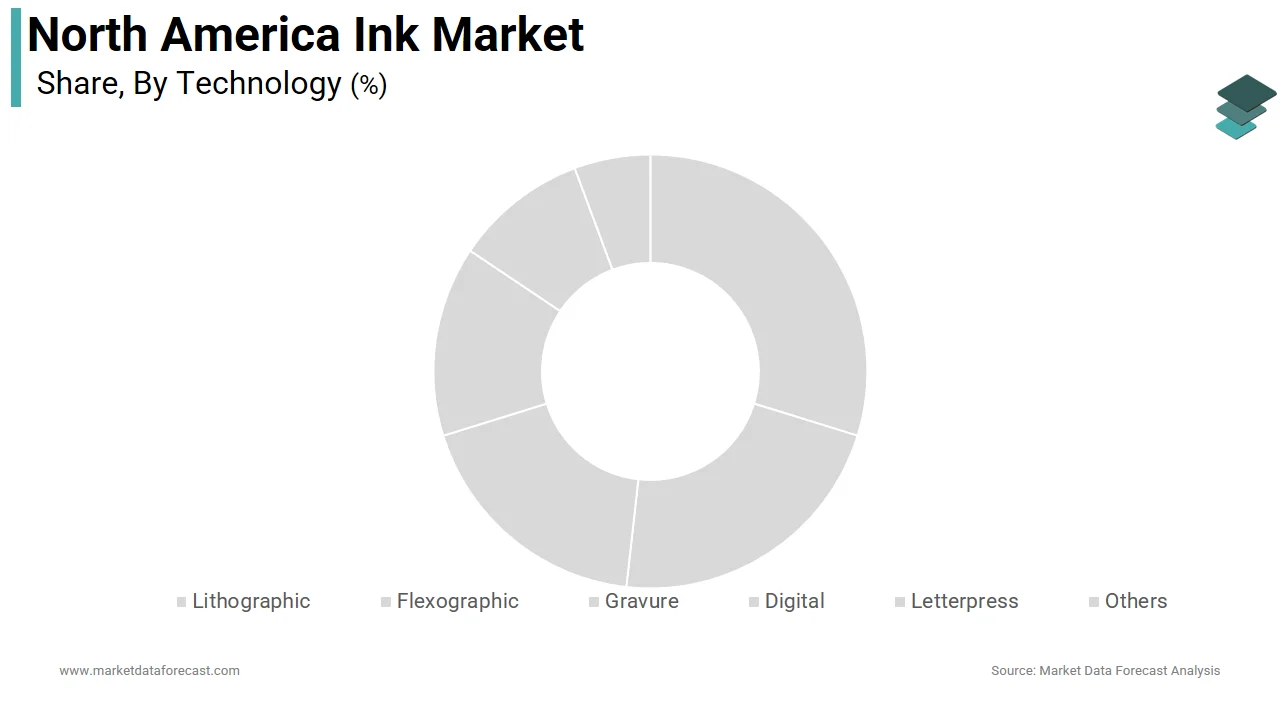
The digital printing segment is growing lucratively with an expected CAGR of 8.9% from 2026 to 2034, with the increasing demand for personalized, on-demand, and short-run printing across commercial, packaging, and industrial sectors. Digital inkjet systems eliminate the need for plates and lengthy setup times by enabling print shops to produce variable data prints such as customized direct mail, photo books, and product labels with minimal waste. As per the U.S. Census Bureau, the number of digital printing establishments in the United States increased by 27% between 2019 and 2023, reflecting a structural shift in production models. A second key driver is the integration of digital printing into packaging lines, particularly for e-commerce and regional branding. The Flexible Packaging Association notes that over 45% of new flexible packaging lines installed in 2023 included digital inkjet stations for versioning and promotional labeling. In the beverage industry, companies like Coca-Cola and Anheuser-Busch have adopted digital printing for limited-edition cans, using water-based and UV-curable inks to achieve vibrant, brand-consistent graphics. Additionally, the Food and Drug Administration’s Unique Device Identification (UDI) rule has accelerated the use of industrial inkjet systems for permanent coding on medical devices, which requires high-resolution, durable inks.
By Ink Type Insights
The water-based ink segment was the largest by occupying 44.3% of the North America ink market share in 2024, owing to the stringent environmental regulations and growing corporate sustainability mandates that favor low-VOC formulations. Water-based inks, which use water as the primary carrier, emit significantly fewer volatile organic compounds compared to solvent- or oil-based alternatives by making them compliant with air quality standards enforced by the U.S. Environmental Protection Agency and Environment and Climate Change Canada. According to the EPA, facilities using water-based inks can reduce VOC emissions by 70–90%, avoiding costly abatement systems and regulatory penalties. The second major factor is their widespread adoption in food packaging, where safety and non-toxicity are paramount. The U.S. Food and Drug Administration permits the use of specific water-based formulations in indirect food contact applications, provided they meet migration limits. As per the Institute of Packaging Professionals, over 80% of printed flexible packaging for snacks, confectionery, and beverages in North America now uses water-based inks.
The UV-curable ink segment is esteemed to grow with a CAGR of 9.2% throughout the forecast period with the technology’s ability to deliver instant curing, high durability, and exceptional print quality on non-porous substrates such as plastics, metals, and glass. UV inks leverage upon exposure to ultraviolet light, eliminating solvent evaporation and enabling high-speed production with minimal downtime. As per the U.S. Department of Energy, UV curing consumes 50% less energy than thermal drying methods used for solvent-based inks, which is contributing to lower carbon emissions. The second key driver is the expanding use of UV inks in industrial and decorative printing, including flooring, automotive interiors, and electronic displays. The National Association of Manufacturers reports that over 1,200 industrial printers adopted UV inkjet systems between 2021 and 2023 for coding, marking, and surface decoration. In packaging, UV inks are used to create tactile effects, high-gloss finishes, and anti-counterfeiting features such as invisible fluorescent markers. The FDA has approved several UV-curable systems for indirect food contact, expanding their use in label printing. Additionally, the development of LED-UV technology has reduced energy consumption and heat output, making it suitable for heat-sensitive films used in flexible packaging. Companies like Agfa and Fujifilm have introduced hybrid UV-ink systems that combine the benefits of free radical and cationic curing for improved adhesion.
By Application Insights
The labeling and packaging segment dominated the North America ink market with 52.3% of share in 2024, with the printed graphics in brand differentiation, regulatory compliance, and consumer engagement across food, beverage, pharmaceutical, and personal care industries. Packaging is no longer a passive container but a dynamic marketing tool, driving demand for high-resolution, durable, and visually striking inks. According to the U.S. Food and Drug Administration, all consumer product packaging must display legible labeling with expiration dates, ingredients, and usage instructions that necessitate reliable ink adhesion and resistance to smudging, moisture, and abrasion. The rise of flexible packaging used in stand-up pouches, sachets, and resealable bags has further amplified ink consumption, as these materials require specialized inks for polyethylene, metallized films, and laminates. The Grocery Manufacturers Association notes that over 70% of new product launches in 2023 featured premium packaging with metallic, matte, or textured finishes, all achieved through advanced ink formulations. Additionally, sustainability pressures are driving innovation in recyclable and compostable packaging, necessitating inks that do not contaminate recycling streams.
The commercial printing segment is projected to grow with a CAGR of 7.8% from 2026 to 2034, with the resurgence of targeted, high-impact print marketing in an increasingly digital world, where physical media stands out in consumer engagement. Despite the digital shift, businesses are leveraging print for direct mail, point-of-sale displays, and luxury branding, where tactile quality and visual richness are irreplaceable. The second key driver is the integration of digital printing into commercial workflows by enabling variable data printing, short runs, and rapid turnaround. The U.S. Bureau of Labor Statistics notes that over 3,800 commercial print shops adopted digital presses between 2020 and 2023, facilitating personalized campaigns for small and mid-sized businesses. Additionally, the return of in-person events and exhibitions post-pandemic has boosted demand for large-format graphics, banners, and signage applications that rely on UV-curable and latex inks. Institutions such as universities and government agencies continue to require printed reports, certificates, and forms, ensuring steady demand. The National Endowment for the Arts reports that print-based art and design projects received over $120 million in public funding in 2023, supporting high-end commercial print services.
COUNTRY-LEVEL ANALYSIS
United States Ink Market Insights
The United States was the largest contributor in the North America ink market with 88.3% of the share in 2024, with a vast and diversified printing industry, encompassing commercial, packaging, and industrial sectors that collectively consume over 300,000 tons of ink annually. The country hosts the majority of North America’s ink manufacturing facilities, including major operations by Sun Chemical, INX International, and Flint Group, ensuring a robust domestic supply chain. As per the National Association of Printing Ink Manufacturers, the U.S. produces over 90% of the region’s printing inks, supported by advanced R&D centers in New Jersey, Ohio, and California. The U.S. Food and Drug Administration’s strict regulations on ink migration in food packaging have spurred innovation in low-VOC and functional inks, positioning the country as a leader in formulation safety. Additionally, the concentration of digital printing hubs in cities like Chicago, Atlanta, and Los Angeles accelerates the adoption of next-generation inkjet technologies.
Canada Ink Market Insights
Canada was positioned second by holding 12.3% of the North America ink market share in 2024. The country’s market is characterized by a strong emphasis on environmental regulation, sustainability, and cross-border integration with U.S. supply chains. Environment and Climate Change Canada enforces strict VOC limits under the Canadian Environmental Protection Act, driving the adoption of water-based, UV-curable, and bio-ink formulations across printing sectors. As per the Canadian Printing Industries Association, over 65% of commercial printers in Ontario and Quebec have transitioned to low-emission inks since 2020. The second major driver is the country’s robust packaging industry, particularly in food and beverage, where bilingual labeling (English and French) increases ink usage per unit. The Canadian Institute of Food Science and Technology notes that over 90% of packaged goods require regulatory-compliant printing, including nutrition facts and allergen statements. Additionally, the rise of craft breweries, artisanal foods, and cannabis packaging has created demand for premium, short-run label inks, favoring digital and flexographic technologies. The Government of Canada’s Green Procurement Policy mandates that federal agencies prioritize eco-labeled printing products, further incentivizing sustainable ink adoption. Academic institutions like the University of British Columbia and Ryerson University are advancing research in bio-based pigments and recyclable ink systems.
COMPETITIVE LANDSCAPE
The competitive landscape of the North America ink market is defined by a blend of technological differentiation, regulatory agility, and strategic customer engagement. While a few global players dominate through scale and R&D capacity, regional manufacturers thrive by offering tailored solutions and rapid response to local market demands. Competition is increasingly centered on innovation in sustainability, with companies racing to develop bio-based, low-emission, and recyclable ink formulations that meet evolving environmental standards and brand requirements. The shift from commodity supply to performance partnership has redefined value, as customers now prioritize technical support, color consistency, and lifecycle impact over price alone. Digital transformation is further reshaping the arena, with ink makers aligning closely with digital press manufacturers to ensure compatibility and performance in high-speed, variable-data applications. Intellectual property in formulation chemistry and curing technologies has become a key differentiator, creating barriers for new entrants. Success in this environment requires not only formulation excellence but also foresight in anticipating consumer trends, material science advancements, and the convergence of printing with digital identity and sustainability.
KEY MARKET PLAYERS
Noteworthy Companies dominating the North America Ink market profiled in the report are
- Sun Chemical Corporation
- Flint Group
- INX International Ink Co.
- Siegwerk Druckfarben AG & Co. KGaA
- Toyo Ink America
- Wikoff Color Corporation
- Hubergroup
- Sakata INX Corporation
- Fujifilm North America
- EFI
- DuPont
- CR/T
TOP LEADING PLAYERS IN THE MARKET
- Sun Chemical stands as a dominant force in the North America ink market, renowned for its comprehensive portfolio spanning packaging, commercial, and industrial applications. A subsidiary of the DIC Corporation, the company leverages global R&D infrastructure to deliver innovative solutions in sustainable inks, functional coatings, and digital formulations. Its strength lies in deep collaboration with brand owners, converters, and regulatory bodies to anticipate market shifts and ensure compliance across food-contact, pharmaceutical, and e-commerce packaging. Sun Chemical has been instrumental in advancing bio-based, low-VOC, and recyclable ink technologies, positioning itself at the forefront of the industry’s sustainability transformation. With technical centers across the U.S. and Canada, the company provides localized support while maintaining global consistency. Its influence extends beyond supply, shaping industry standards in color management, print performance, and environmental stewardship.
- INX International Ink Co. is a leading North American-owned ink manufacturer with a strong presence in both conventional and digital printing sectors. The company has built its reputation on agility, customer-centric innovation, and a commitment to environmental responsibility. INX has pioneered the development of water-based, soy-based, and UV-curable inks that align with evolving regulatory and corporate sustainability goals. Its broad product range serves packaging, publication, and industrial markets, with a particular focus on flexible packaging and label printing, where performance and compliance are critical. The company operates multiple manufacturing facilities across the U.S. and Canada, enabling rapid response to regional demand and supply chain resilience. INX emphasizes technical collaboration, offering on-site support and color-matching services that strengthen client relationships. It has also invested heavily in digital ink formulations for inkjet and hybrid printing platforms, anticipating the shift toward short-run and personalized packaging.
- Flint Group is a globally integrated player with a significant footprint in the North American ink market, known for its technological sophistication and application-specific expertise. The company excels in packaging inks, particularly for flexographic and gravure printing, where precision, durability, and regulatory compliance are paramount. Flint Group has been a leader in developing migration-optimized inks for food packaging, ensuring safety and adherence to FDA and EFSA standards. Its digital division has made substantial advances in inkjet technologies for labels, corrugated, and industrial coding, supporting the transition to on-demand and smart packaging. The company’s global R&D network enables rapid innovation in sustainable formulations, including bio-resins and solvent-free systems. In North America, Flint Group maintains close ties with major consumer goods companies, providing tailored ink solutions that enhance brand integrity and supply chain efficiency. Its technical service teams work directly with converters to optimize print performance and reduce waste.
TOP STRATEGIES USED BY KEY MARKET PARTICIPANTS
A primary strategy among leading ink manufacturers is vertical integration of formulation, application engineering, and technical support to deliver end-to-end solutions. Companies are embedding their experts within client operations to optimize ink performance, reduce waste, and ensure regulatory compliance, transforming the supplier relationship into a strategic partnership. This approach enhances customer retention and enables faster adoption of new technologies.
Another strategy is the acceleration of sustainability-driven innovation, with firms investing in bio-based raw materials, low-VOC formulations, and recyclable ink systems. By aligning with corporate ESG mandates and regulatory trends, companies position themselves as enablers of circular economy models in packaging and printing, gaining preference among environmentally conscious brands and retailers.
Also, strategic collaboration with digital press OEMs and substrate developers to co-engineer inks that match next-generation printing platforms. These alliances ensure compatibility with advanced printheads, curing systems, and novel materials, which secures market access and reduces time-to-market for innovative products.
RECENT MARKET DEVELOPMENTS
- In March 2024, Sun Chemical launched an innovation center in Cincinnati, Ohio, dedicated to developing sustainable ink solutions for flexible packaging by focusing on recyclable substrates and low-migration formulations to support brand sustainability goals.
- In February 2024, INX International introduced a fully bio-based ink series for corrugated packaging, formulated with renewable resins and pigments, which marks a significant step toward fossil-fuel-free printing in the e-commerce and retail sectors.
- In May 2023, Flint Group partnered with a leading digital press manufacturer to co-develop a new line of UV inkjet inks optimized for high-speed label printing on polyolefin films by enhancing print quality and adhesion in demanding applications.
- In January 2024, Toyo Ink America expanded its manufacturing facility in Georgia to increase production capacity for water-based inks, which is responding to growing demand from food and beverage packaging converters seeking low-VOC alternatives.
- In April 2023, Siegwerk North America introduced a new deinking-friendly ink formulation for plastic packaging, which is designed to improve recyclability and support circular economy initiatives in collaboration with major brand owners.
MARKET SEGMENTATION
This North America Ink market research report is segmented and sub-segmented into the following categories.
By Technology
- Lithographic
- Flexographic
- Gravure
- Digital
- Letterpress
- Others
By Ink Type
- Oil Based
- Solvent Based
- Water Based
By Application
- Labeling and Packaging
- Commercial Printing
- Publishing
- Others
By Country
- United States
- Canada
- Mexico
- Rest of North America