- Product Description Description
- Table of Contents TOC
- List of Table & Figure LOT
- Get Free Sample PDF Sample PDF
Market Size, 2025
$0.58 BnMarket Estimate, 2026
$0.66 BnMarket Forecast, 2034
$1.78 BnCAGR, 2026–2034
13.28%North America Microsurgery Robot Market Size
The North America microsurgery robot market was valued at USD 0.58 billion in 2025, is estimated to reach USD 0.66 billion in 2026, and is projected to reach USD 1.78 billion by 2034, growing at a CAGR of 13.28% from 2026 to 2034.
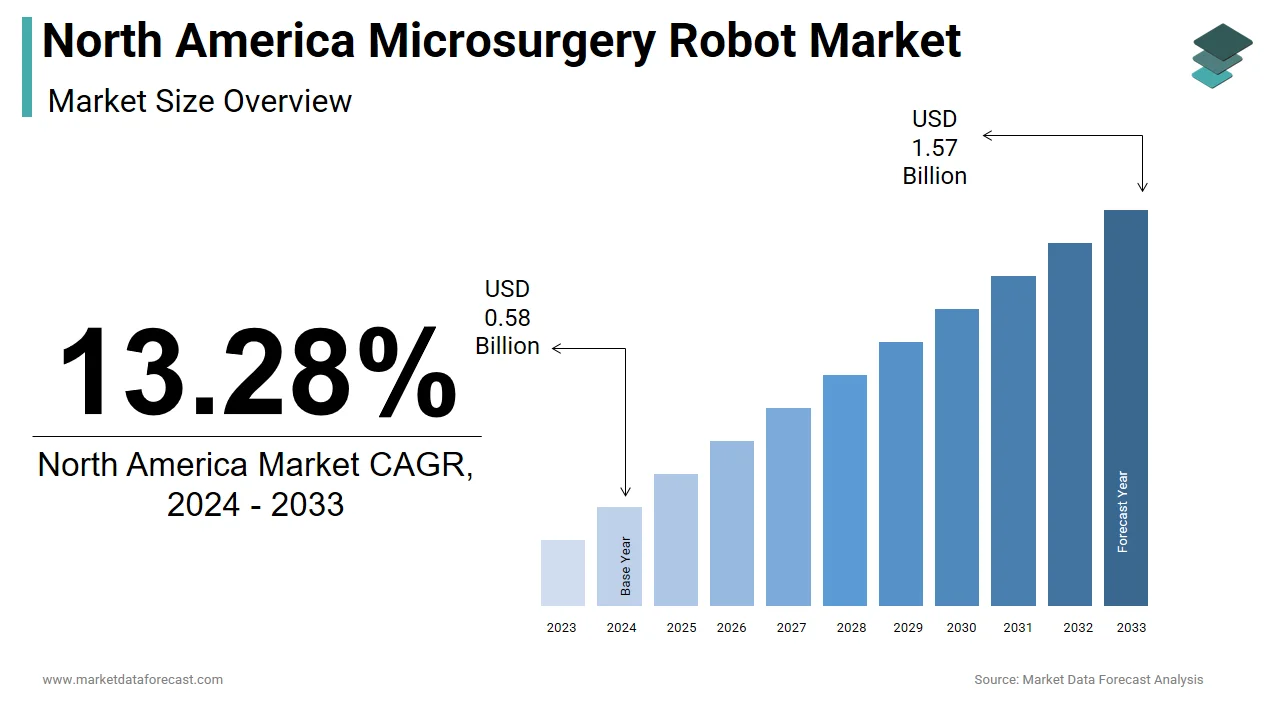
The microsurgery robotic platforms enhance surgical precision, reduce human tremor, and enable minimally invasive approaches in complex procedures such as reconstructive surgery, ophthalmology, neurosurgery, and otolaryngology. According to the American College of Surgeons, the demand for microsurgical procedures has increased significantly in recent years due to rising cases of trauma, cancer, and chronic diseases requiring intricate surgical interventions. In the U.S., the number of microsurgical procedures performed annually has grown steadily, driven by advancements in robotic-assisted surgery and the expansion of specialized surgical centers.
MARKET DRIVERS
Increasing Demand for Minimally Invasive Surgical Procedures
The growing preference for minimally invasive surgical (MIS) techniques across various medical specialties is escalating the growth of the North America microsurgery robot market. According to the Society of American Gastrointestinal and Endoscopic Surgeons (SAGES), over 70% of surgical procedures in the U.S. are now performed using minimally invasive approaches, a trend that has extended into microsurgery. Robotic platforms such as the da Vinci Surgical System and newer microsurgery-specific robots offer enhanced dexterity, precision, and visualization, making them ideal for delicate procedures in fields like reconstructive surgery, ophthalmology, and neurosurgery. The American Society of Plastic Surgeons (ASPS) reports that reconstructive procedures, particularly those involving microvascular anastomosis, have increased by 25% since 2020, with robotic assistance playing a growing role in flap surgeries and nerve repairs.
Technological Advancements and Integration of AI in Surgical Robotics
The rapid advancements in robotic technology in the integration of artificial intelligence (AI) and machine learning are amplifying the growth of North America microsurgery robot market. According to the National Institutes of Health (NIH), AI-enhanced robotic systems are now capable of real-time tissue recognition, adaptive motion scaling, and predictive movement correction, all of which enhance surgical precision in microsurgical applications. The U.S. Food and Drug Administration (FDA) has approved several next-generation robotic platforms with AI-driven capabilities, including autonomous suturing assistance and intraoperative decision support. As per the Journal of Robotic Surgery, leading research institutions such as Johns Hopkins University and the University of Toronto are developing microsurgery robots with sub-millimeter accuracy, enabling complex procedures that were previously challenging to perform manually. Additionally, the integration of augmented reality (AR) with robotic systems is improving surgical visualization and depth perception, particularly in ophthalmic and neurosurgical applications.
MARKET RESTRAINTS
High Cost of Robotic Surgical Systems
The high acquisition and operational costs associated with robotic surgical systems are a restraining factor for the growth of the North America microsurgery robot market. According to the Healthcare Cost and Utilization Project (HCUP), the average cost of acquiring a surgical robotic system ranges between $1 million and $2.5 million, with additional annual maintenance and disposable instrument costs exceeding $200,000. These expenses pose a major barrier for smaller hospitals, community surgical centers, and academic institutions with limited budgets. The American Hospital Association (AHA) reports that only 40% of U.S. hospitals have adopted robotic surgery platforms, primarily due to financial constraints.
Regulatory and Reimbursement Challenges
The regulatory complexity and inconsistent reimbursement policies are additionally limiting the growth of the North America microsurgery robot market. According to the U.S. Food and Drug Administration (FDA), the approval process for new robotic surgical systems involves extensive clinical validation and safety assessments, often delaying market entry by several years. Additionally, reimbursement coverage for robotic-assisted microsurgery remains inconsistent across private and public insurance plans. As per the Centers for Medicare & Medicaid Services (CMS), only a limited number of robotic-assisted procedures are currently covered under Medicare, restricting patient access and hospital adoption.
MARKET OPPORTUNITIES
Expansion of Tele-Microsurgery and Remote Surgical Applications
The emerging field of tele-microsurgery and remote surgical assistance is to greatly influence the growth of the North America microsurgery robot market. According to the National Institutes of Health (NIH), advancements in 5G connectivity and robotic haptics have enabled surgeons to perform complex microsurgical procedures from remote locations, expanding access to specialized care in rural and underserved areas. The U.S. Department of Defense (DoD) has been actively investing in remote robotic surgery for battlefield applications, demonstrating the feasibility of real-time microsurgical interventions from distant command centers.
Integration with Medical Imaging and Real-Time Surgical Navigation
The convergence of robotic microsurgery with advanced medical imaging and real-time surgical navigation is additionally to further escalate the growth of the North America microsurgery robot market. According to the Radiological Society of North America (RSNA), robotic platforms are increasingly being integrated with intraoperative imaging modalities such as optical coherence tomography (OCT), fluorescence imaging, and high-resolution MRI to enhance surgical precision. The U.S. Food and Drug Administration (FDA) has approved several robotic systems that incorporate real-time imaging feedback, allowing surgeons to visualize microstructures with submillimeter accuracy. As per the Journal of Neurosurgery, institutions like the Mayo Clinic and the University of Toronto are utilizing robotic systems with integrated imaging to perform delicate procedures such as retinal surgery and cranial nerve repair with improved outcomes.
MARKET CHALLENGES
Limited Surgeon Training and Skill Development Programs
The limited availability of structured training and skill development programs for surgeons is restricting the growth of the North America microsurgery robot market. According to the Accreditation Council for Graduate Medical Education (ACGME), only a small percentage of surgical residency programs in the U.S. include formal training in robotic-assisted microsurgery. The American College of Surgeons (ACS) notes that mastering robotic techniques requires extensive hands-on experience, yet many hospitals lack dedicated training facilities or simulation labs for microsurgery-specific robotic platforms.
Ethical and Legal Implications of Robotic-Assisted Surgery
The increasing use of robotic systems in microsurgery raises complex ethical and legal considerations that pose a challenge to market growth in North America. According to the Hastings Center, a leading bioethics research institution, concerns around surgical autonomy, liability in case of system malfunctions, and informed patient consent remain unresolved in the context of robotic-assisted procedures. The American Medical Association (AMA) has highlighted that determining responsibility in the event of surgical errors, whether attributed to the surgeon, the robotic system, or software algorithms, remains a gray area in legal frameworks. As per the Journal of Law and the Biosciences, several malpractice lawsuits have emerged in recent years involving robotic surgical complications, prompting calls for clearer regulatory guidelines.
REPORT COVERAGE
| REPORT METRIC | DETAILS |
| Market Size Available | 2025 to 2034 |
| Base Year | 2025 |
| Forecast Period | 2026 to 2034 |
| Segments Covered | By Application, End-use, and Region. |
| Various Analyses Covered | Global, Regional and Country-Level Analysis, Segment-Level Analysis, Drivers, Restraints, Opportunities, Challenges; PESTLE Analysis; Porter’s Five Forces Analysis, Competitive Landscape, Analyst Overview of Investment Opportunities |
| Countries Covered | India, China, Japan, South Korea, Australia, New Zealand, Thailand, Malaysia, Vietnam, Philippines, Indonesia, Singapore, Rest of APAC |
| Market Leaders Profiled | Asensus Surgical, Avateramedical, CMR Surgical, Distalmotion, Intuitive Surgical, Johnson & Johnson (Ethicon), Medical Microinstruments, Medtronic, meerecompany, MicroSure, Siemens Healthineers, Smith & Nephew, Stryker Corporation, Titan Medical, and Zimmer Biomet. |
SEGMENTAL ANALYSIS
By Application Insights
The oncology surgery segment accounted in holding 28.3% of the North America microsurgery robot market share in 2024, with the increasing incidence of cancer and the growing need for precision in tumor resection and reconstructive procedures. According to the National Cancer Institute (NCI), over 1.9 million new cancer cases were diagnosed in the U.S. in 2023, with breast, prostate, and head and neck cancers being among the most commo,n requiring microsurgical interventions. Robotic platforms enable precise dissection and microvascular anastomosis, which are in oncological reconstructive surgeries such as free flap breast reconstruction following mastectomy.

The neurovascular surgery segment is likely to grow with an anticipated CAGR of 24.5% from 2026 to 2034, with the increasing prevalence of neurological disorders such as aneurysms, arteriovenous malformations, and ischemic strokes that require highly precise microsurgical interventions. According to the American Stroke Association, over 795,000 stroke cases occur annually in the U.S., with a growing number of patients undergoing microsurgical treatments for vascular repair. Robotic systems offer enhanced precision and stability, which are crucial in operating on delicate cerebral blood vessels. As per the Journal of Neurosurgery, leading academic medical centers such as Johns Hopkins and the University of Toronto are integrating robotic platforms into complex neurovascular procedures, improving surgical outcomes and reducing intraoperative complications.
By End Use Insights
The hospitals and clinics was the largest and held a significant share of the North America microsurgery robot market with the high volume of complex surgical procedures performed in hospital settings and the availability of specialized surgical teams trained in robotic-assisted techniques. According to the Centers for Medicare & Medicaid Services (CMS), over 50% of all robotic surgeries in the U.S. are performed in hospital-based operating rooms, particularly in academic and tertiary care centers. The integration of robotic microsurgery platforms in major hospitals such as Mayo Clinic, Cleveland Clinic, and Massachusetts General Hospital has significantly enhanced surgical precision in oncology, reconstructive, and neurovascular procedures.
The research institutes segment is projected to grow with an estimated CAGR of 23.8% from 2026 to 2034, with the increasing investment in surgical robotics R&D and the development of next-generation microsurgery platforms. Leading academic institutions such as Johns Hopkins University, the University of Toronto, and Stanford Medicine are actively engaged in robotic surgery innovation, particularly in AI-assisted microsurgical techniques and tele-microsurgery applications.
COUNTRY-LEVEL ANALYSIS
United States Microsurgery Robot Market Insights
The United States was the top performer in the North America microsurgery robot market with 85.4% of the share in 2024, with the country’s high healthcare expenditure, advanced surgical infrastructure, and strong presence of leading robotic surgery companies. According to the Centers for Disease Control and Prevention (CDC), over 50 million surgical procedures are performed annually in U.S. hospitals, many of which now incorporate robotic assistance. The American College of Surgeons (ACS) notes that the U.S. has the highest adoption rate of robotic-assisted microsurgery globally, with leading hospitals investing in next-generation platforms to enhance precision and patient outcomes. Additionally, the U.S. benefits from a robust regulatory framework that supports rapid approval and integration of new robotic technologies. Government funding through agencies like the National Institutes of Health (NIH) and private-sector investments from companies such as Intuitive Surgical and Stryker further drive innovation and market expansion.
Canada Microsurgery Robot Market Insights
Canada is projected to have a significant CAGR during the forecast period in the North America microsurgery robot market. Canada is experiencing steady growth driven by academic research, government funding, and increasing adoption in major hospitals. According to the Canadian Medical Association (CMA), several academic medical centers, including the University of Toronto, McGill University, and the University of Calgary, are integrating robotic-assisted microsurgery into both clinical and research settings. The Canadian Institutes of Health Research (CIHR) has allocated significant funding for robotic surgery innovation, particularly in neurovascular and reconstructive applications. Additionally, provincial health authorities are expanding access to robotic-assisted procedures in tertiary care centers, with Ontario and British Columbia leading in adoption.
COMPETITIVE LANDSCAPE
The North America microsurgery robot market is characterized by intense competition driven by rapid technological innovation, increasing clinical demand, and strategic positioning by global players. Established medical device giants dominate the market, leveraging their extensive distribution networks, strong brand recognition, and deep integration into hospital systems. However, the landscape is also evolving with the entry of emerging robotics companies focused on niche microsurgical applications and cost-effective solutions. Competitive differentiation is increasingly based on technological sophistication, including integration with artificial intelligence, real-time imaging, and remote surgical capabilities. Companies are also emphasizing surgeon training, clinical validation, and regulatory compliance to gain a foothold in academic and hospital settings. In parallel, strategic acquisitions and partnerships are shaping the market dynamics, as firms seek to enhance their technological portfolios and expand into new surgical specialties.
KEY MARKET PLAYERS
Noteworthy Companies dominating the North America microsurgery robot market are
- Asensus Surgical
- Avateramedical
- CMR Surgical
- Distalmotion
- Intuitive Surgical
- Johnson & Johnson
- Medical Microinstruments
- Medtronic
- meerecompany
- MicroSure
- Siemens Healthineers
- Smith & Nephew
- Stryker Corporation
- Titan Medical
- Zimmer Biomet
TOP LEADING PLAYERS IN THE MARKET
- Intuitive Surgical is a global leader in robotic-assisted surgery and holds a dominant position in the North America microsurgery robot market. The company is best known for its da Vinci Surgical System, which has been widely adopted across multiple surgical specialties, including microsurgery. Its contributions extend beyond product development to include extensive training programs, surgeon certification, and integration of robotic systems into academic and clinical settings. The company’s focus on precision, ergonomics, and minimally invasive techniques has made its platform a standard in many leading hospitals across the U.S. and Canada.
- Medtronic plays a pivotal role in advancing robotic-assisted microsurgery through its Hugo Surgical Robotic System. The company is actively expanding its presence in microsurgical applications by integrating advanced imaging, haptics, and modular platform designs. Medtronic collaborates with leading research institutions and healthcare providers to refine robotic applications in complex microsurgical procedures. Its global distribution network and strong regulatory engagement have enabled it to introduce innovative robotic solutions tailored for microsurgical specialties such as neurovascular and reconstructive surgery.
- Stryker has emerged as a key player in the North America microsurgery robot market through its acquisition of robotic technology platforms and strategic investments in surgical innovation. The company focuses on developing robotic systems tailored for orthopedic and microsurgical applications, emphasizing user-friendly design and seamless integration into existing surgical workflows. Stryker supports clinical training and collaborates with academic institutions to expand the use of robotics in microsurgery. Its emphasis on continuous improvement and surgeon feedback has strengthened its position in the evolving robotic surgery landscape.
TOP STRATEGIES USED BY KEY MARKET PARTICIPANTS
Expansion of Surgical Training and Education Programs. Leading companies are investing heavily in comprehensive training initiatives to ensure surgeons are proficient in using robotic systems for microsurgical procedures. These programs include simulation-based learning, hands-on workshops, and partnerships with medical institutions to build a skilled user base.
Development of Specialized Robotic Platforms for Microsurgery Market participants are focusing on designing and launching robotic systems tailored specifically for microsurgical applications, incorporating features such as high-precision control, enhanced visualization, and miniaturized instruments to meet the unique demands of delicate surgical procedures.
Strategic Collaborations with Academic and Research Institutions. Key players are forming alliances with universities, hospitals, and research organizations to drive innovation, validate clinical applications, and accelerate the adoption of robotic-assisted microsurgery in both clinical and educational settings.
RECENT MARKET DEVELOPMENTS
- In March 2024, Intuitive Surgical announced a collaboration with a leading academic medical center to develop a microsurgery-specific robotic module for the da Vinci Surgical System by enhancing precision in nerve and vascular procedures.
- In May 2024, Medtronic launched an updated version of its Hugo Surgical Robotic System with integrated haptic feedback and micro-instrument compatibility, which is specifically designed for complex microsurgical interventions.
- In July 2024, Stryker acquired a robotics startup specializing in microsurgical tools, aiming to expand its surgical robotics portfolio and improve integration with existing operating room systems.
- In September 2024, Zimmer Biomet introduced a new robotic microsurgery training initiative in partnership with several U.S. medical schools to increase surgeon proficiency and adoption of robotic-assisted techniques.
- In November 2024, Asensus Surgical launched a next-generation AI-powered microsurgery platform, designed to assist with real-time tissue recognition and autonomous suturing support in delicate surgical procedures.
MARKET SEGMENTATION
This North America microsurgery robot market research report is segmented and sub-segmented into the following categories.
By Application
- Oncology surgery
- Urology surgery
- Obstetrics and gynecology surgery
- Micro anastomosis
- Reconstructive surgery
- ENT surgery
- Gastrointestinal surgery
- Cardiovascular surgery
- Ureterorenoscopy
- Neurovascular surgery
- Ophthalmology surgery
- Other applications
By End Use
- Hospitals and clinics
- Ambulatory surgical centers
- Research institutes
- Other end-users
By Country
- United States
- Canada
- Mexico
- Rest of North America