North America Native Starch Market Size, Share, Trends & Growth Forecast Report By Source (Maize, Tapioca), Form, Application, And Country (US, Canada, And Rest Of North America), Industry Analysis From 2025 To 2033
North America Native Starch Market Size
The North America Native Starch Market Size was calculated to be USD 7.66 billion in 2024 and is anticipated to be worth USD 11.74 billion by 2033, from USD 8.04 billion in 2025, growing at a CAGR of 4.85% during the forecast period.
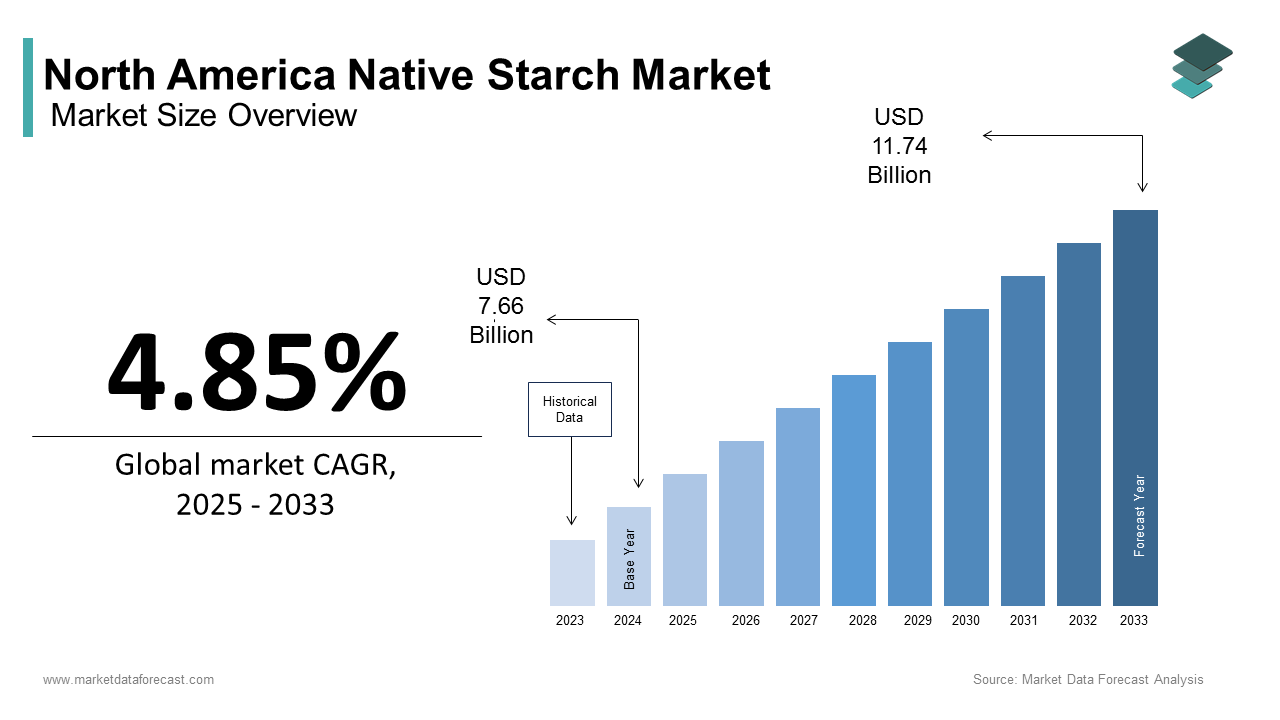
Native starch is a starch derived directly from botanical sources without chemical modification and retaining its natural molecular structure and functional properties. Native starch, sourced primarily from corn, potato, wheat, and tapioca, exhibits distinct characteristics including granular integrity, specific gelatinization temperatures, and unique rheological behaviors that differentiate them from modified starch variants. The market's significance extends beyond traditional food applications into paper manufacturing, textile processing, pharmaceutical formulations, and biodegradable materials development. Canada's agricultural sector contributes substantially through potato starch production, with Prince Edward Island and New Brunswick accounting for significant processing capacity that serves both domestic and export markets. The material science underlying native starch functionality encompasses amylose and amylopectin ratios that determine gel strength, viscosity profiles, and film-forming capabilities essential for diverse industrial applications. Processing technologies require precise temperature control and moisture management to preserve native granular structure while achieving desired extraction yields. Regulatory frameworks governing food-grade applications mandate stringent quality control measures and traceability systems that ensure product safety and consistency. The convergence of sustainability imperatives and functional performance requirements positions native starch as critical raw material in North America's transition toward bio-based and renewable resource utilization across multiple industrial sectors.
MARKET DRIVERS
Food Processing Industry Expansion and Functional Ingredient Demand
The food processing industry expansion and growing demand for functional ingredients serve as primary catalysts driving North America's native starch market growth, as manufacturers seek natural solutions for texture modification, moisture retention, and product stability in increasingly sophisticated food formulations. The trend toward clean label products has intensified preference for native starch over chemically modified alternatives. Bakery and snack food manufacturers represent significant consumption segments, with native corn starch utilization increasing in gluten-free product formulations. The prepared foods sector, including frozen meals and ready-to-eat products, relies heavily on native potato starch for its superior freeze-thaw stability and texture retention properties that maintain product quality throughout distribution channels. Ethnic food popularity has increased demand for specialized native starch applications, with tapioca starch consumption growing annually to meet requirements for Asian cuisine preparations and Latin American food products. The trend toward portion-controlled and convenience foods creates opportunities for native starch in single-serve packaging applications that require precise functionality and consistent performance. These factors combine to create sustained demand growth that positions native starch as essential components in modern food processing operations.
Biodegradable Materials Development and Sustainable Packaging Solutions
The development of biodegradable materials and sustainable packaging solutions represents a significant growth driver for North America's native starch market, as environmental consciousness and regulatory pressures accelerate demand for renewable resource-based alternatives to petroleum-derived plastics. Government regulations supporting single-use plastic reduction have created substantial market opportunities. The food service industry's shift toward sustainable packaging has intensified. E-commerce growth has increased demand for protective packaging solutions. Agricultural applications for biodegradable mulch films and seed coatings create additional opportunities. These sustainability-driven factors create expanding market opportunities that position native starch as a fundamental component in the transition toward circular economy principles.
MARKET RESTRAINTS
Raw Material Price Volatility and Agricultural Supply Chain Disruptions
Raw material price volatility and agricultural supply chain disruptions present significant constraints on North America's native starch market growth, creating cost uncertainty and supply reliability challenges that impact profitability and operational planning for manufacturers and end-users. Potato starch production faces particular vulnerability to seasonal supply variations. Climate change impacts have intensified supply chain disruptions, with extreme weather events including droughts, floods, and early frosts reducing crop yields and quality consistency across major starch-producing regions. The trend toward ethanol production has increased competition for corn feedstock. Transportation infrastructure limitations, particularly rail service disruptions and truck driver shortages, have increased inbound raw material costs. International trade dynamics introduce additional volatility factors, with import tariffs and trade policy changes affecting cross-border supply chain economics and creating uncertainty for multinational operations. Currency exchange rate fluctuations impact procurement costs for imported raw materials, with Canadian processors experiencing cost variations due to USD-CAD exchange rate movements. These supply chain constraints limit operational flexibility and constrain production expansion capabilities, forcing companies to prioritize efficiency improvements over capacity additions.
Competition from Modified Starch and Synthetic Alternatives
Competition from modified starch products and synthetic alternatives creates significant market constraints for North America's native starch industry, as end-users increasingly evaluate performance characteristics, cost considerations, and functional versatility when selecting starch-based ingredients for diverse applications. Modified starch products offer enhanced functionality including improved freeze-thaw stability, extended shelf life, and customized viscosity profiles that address specific processing requirements and product performance objectives. Also, modified starch consumption in North America exceeds native starch usage in industrial applications, with manufacturers preferring chemically altered formulations for their consistent performance and reduced variability compared to natural starch alternatives. Synthetic polymer alternatives including polyvinyl alcohol and polyethylene glycol provide cost-competitive solutions for specific applications. The trend toward specialized functionality has intensified competition, with modified starch formulations offering precise control over gelatinization temperatures, viscosity development, and film-forming properties that native starch cannot match without chemical intervention. Cost considerations favor modified alternatives in price-sensitive applications, with synthetic polymers offering cost advantages in non-food industrial uses according to industry pricing surveys. Performance consistency concerns drive preference for modified starch in critical applications, with pharmaceutical manufacturers specifying chemically modified formulations for their predictable behavior and regulatory compliance characteristics. The convergence of performance requirements and economic pressures creates market share pressure for native starch suppliers while requiring substantial investment in product development and application-specific solutions to maintain competitive positioning.
MARKET OPPORTUNITIES
Plant-Based Food Alternatives and Vegan Product Development
The expanding plant-based food alternatives market and vegan product development initiatives present substantial growth opportunities for North America's native starch market, as manufacturers seek natural, functional ingredients that provide texture, binding, and sensory characteristics essential for successful plant-based product formulations. The trend toward clean label positioning has intensified preference for native starch in plant-based applications, with many of plant-based product developers specify native starch formulations to support marketing claims regarding natural ingredients and minimal processing. Meat alternative manufacturers rely heavily on native potato and tapioca starch for their superior binding properties and texture development capabilities. Dairy substitute production creates opportunities for native corn starch in yogurt alternatives, cheese analogs, and cream substitutes that require precise functionality and consistent performance characteristics. The trend toward allergen-free formulations has increased demand for native starch from non-wheat sources, with tapioca and potato starch consumption growing annually to meet gluten-free and allergen-conscious consumer requirements. Ethnic cuisine popularity has created opportunities for specialized native starch applications in plant-based Asian and Latin American food products, with restaurant chains increasingly incorporating native starch formulations to achieve authentic texture and mouthfeel characteristics. These factors combine to create expanding market opportunities that position native starch as an essential component in the plant-based food revolution.
Pharmaceutical Excipient Applications and Drug Delivery Systems
The pharmaceutical industry's demand for natural excipients and advanced drug delivery systems presents significant growth opportunities for North America's native starch market, as manufacturers seek biocompatible, regulatory-compliant materials for tablet binding, capsule filling, and controlled release applications. The trend toward personalized medicine and targeted drug delivery has increased demand for native starch in specialized applications including microencapsulation, enteric coating, and sustained release formulations that require precise functionality and consistent performance characteristics. Generic drug manufacturers prefer native starch excipients due to their cost advantages and established regulatory history, with a notable share of generic drug formulations incorporating native starch as primary excipient materials. Nutraceutical and dietary supplement production creates additional opportunities. The trend toward pediatric and geriatric formulations has intensified demand for natural excipients that provide easy swallowability and improved patient compliance, with native starch offering superior palatability and dissolution characteristics compared to synthetic alternatives. Regulatory harmonization initiatives have simplified approval processes for native starch excipients. These pharmaceutical applications command premium pricing and provide stable demand visibility, positioning native starch suppliers for long-term growth in high-value market segments.
MARKET CHALLENGES
Quality Control Standards and Regulatory Compliance Requirements
Quality control standards and regulatory compliance requirements present significant operational challenges for North America's native starch market, as manufacturers navigate complex approval processes and evolving standards that govern material use in food, pharmaceutical, and industrial applications. The Food and Drug Administration imposes stringent regulations on food-grade starch materials, requiring comprehensive safety assessments, allergen control measures, and Good Manufacturing Practice compliance that extend product development timelines and increase operational costs. Pharmaceutical excipient applications require extensive documentation and regulatory approval processes, with the United States Pharmacopeia establishing specific standards for native starch purity, particle size distribution, and microbiological control that necessitate expensive testing protocols and quality assurance systems. International trade regulations complicate cross-border commerce, with differing safety standards and certification requirements between U.S. and Canadian jurisdictions creating operational inefficiencies and increased compliance costs for multinational suppliers. Organic certification requirements create additional challenges, with the USDA National Organic Program mandating strict sourcing and processing standards that limit raw material options and increase production complexity for certified organic native starch products. Allergen control requirements have intensified, with the Food Allergen Labeling and Consumer Protection Act necessitating comprehensive traceability systems and cross-contamination prevention measures that require specialized facility design and operational procedures. Environmental regulations governing wastewater discharge and air quality create additional compliance burdens, with the Environmental Protection Agency establishing specific standards for starch processing operations that require expensive treatment systems and monitoring equipment. These regulatory complexities require substantial investment in compliance infrastructure and specialized expertise while creating barriers to market entry for smaller suppliers lacking regulatory experience.
Technological Advancement and Processing Innovation Requirements
Technological advancement and processing innovation requirements create significant operational challenges for North America's native starch market, as manufacturers must continuously invest in modernization and capability enhancement to maintain competitive positioning and meet evolving customer requirements. Advanced extraction technologies including enzymatic processing, membrane filtration, and spray drying require substantial capital investment and specialized technical expertise that smaller processors may lack, creating competitive disadvantages and limiting market participation. The trend toward customized particle size distributions and specialized functionality requires sophisticated processing equipment and quality control systems that increase operational complexity and cost structures. Automation and digital integration initiatives demand significant investment in control systems, data management platforms, and cybersecurity measures that protect operational integrity and ensure regulatory compliance. Energy efficiency requirements have intensified, with the Department of Energy establishing specific standards for industrial processing operations that necessitate equipment upgrades and process optimization investments. The convergence of Industry 4.0 technologies including artificial intelligence, machine learning, and Internet of Things connectivity creates opportunities for operational improvement while requiring substantial investment in new capabilities and workforce training. Sustainable processing initiatives require adoption of renewable energy sources, water recycling systems, and waste minimization technologies that align with environmental objectives while maintaining economic viability. Supply chain digitization and real-time monitoring capabilities become essential for maintaining quality consistency and customer satisfaction, necessitating integration of advanced tracking systems and predictive maintenance technologies. These technological challenges require strategic planning and substantial investment while creating operational risks that must be carefully managed to ensure sustainable business operations.
REPORT COVERAGE
| REPORT METRIC | DETAILS |
| Market Size Available | 2024 to 2033 |
| Base Year | 2024 |
| Forecast Period | 2025 to 2033 |
| CAGR | 4.85% |
| Segments Covered | By Source, Form, Application And Region |
| Various Analyses Covered | Global, Regional & Country Level Analysis; Segment-Level Analysis; DROC, PESTLE Analysis; Porter’s Five Forces Analysis; Competitive Landscape; Analyst Overview of Investment Opportunities |
| Regions Covered | Us, Canada, and the Rest of North America |
| Market Leaders Profiled | Cargill, Ingredion Incorporated, Tate & Lyle PLC, Archer Daniels Midland Company, Roquette Frères, Grain Processing Corporation, AGRANA Beteiligungs-AG, Kent Corporation, Manildra Group, Tereos Group |
SEGMENTAL ANALYSIS
By Source Insights
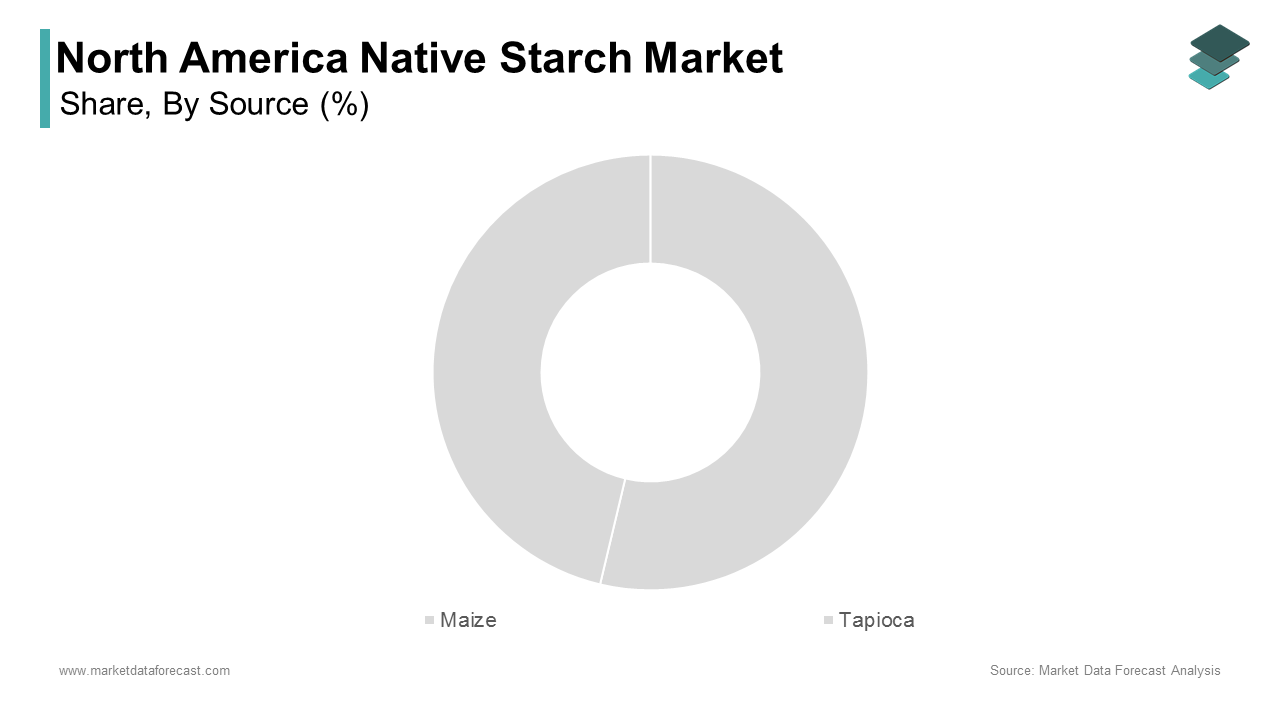
The maize segment dominated the North America native starch market by commanding a 53.6% of total share in 2024. North America's exceptional agricultural production capacity and sophisticated processing infrastructure serve as primary catalysts for maize starch dominance in the native starch market, providing the foundation for consistent supply and competitive pricing that supports widespread commercial adoption. The concentration of corn production in the Midwest Corn Belt, including Iowa, Illinois, and Nebraska, provides geographic advantages for processing facilities that minimize transportation costs and reduce environmental impact through optimized logistics networks. Advanced extraction technologies including wet milling, centrifugation, and spray drying have increased processing efficiency over the past decade, enabling cost-effective production that supports competitive market positioning. The trend toward integrated biorefinery operations has enhanced value extraction from corn processing, with companies investing substantial funds in modernization projects that improve yield optimization and quality consistency. Regional clustering of processing facilities in areas such as Decatur, Illinois and Cedar Rapids, Iowa has created specialized industrial ecosystems that support innovation, workforce development, and supply chain optimization. These infrastructure advantages enable rapid response to market demands while maintaining quality consistency, supporting the segment's continued market leadership position.
The functional versatility and application diversity of maize starch create fundamental drivers for market dominance, enabling utilization across multiple end-user industries including food processing, paper manufacturing, textiles, and pharmaceutical applications that generate consistent demand and revenue stability. Industrial applications including paper coating and textile sizing represent significant consumption segments. Pharmaceutical excipient applications create premium value opportunities, with many of tablet formulations incorporate native corn starch as primary binding agents due to their biocompatibility and regulatory acceptance. The trend toward clean label positioning has intensified preference for native maize starch in food applications, with a notable share of North American consumers actively seek products with recognizable ingredient lists and minimal processing interventions. These diverse application opportunities provide revenue stability and reduce market risk while supporting sustained growth across multiple economic cycles.
The tapioca segment represents the fastest-growing source category in North America's native starch market and is expanding at a compound annual growth rate of 9.4% between 2025 and 2033. The proliferation of gluten-free and allergen-free diet trends serves as the primary catalyst driving tapioca starch market expansion in North America, as health-conscious consumers and food manufacturers seek natural alternatives that accommodate dietary restrictions while maintaining functional performance characteristics. The trend toward clean label positioning has intensified preference for tapioca starch in allergen-free formulations. Ethnic cuisine popularity has increased tapioca starch consumption. Bakery and snack food manufacturers have increased tapioca starch utilization annually, particularly in gluten-free bread, cracker, and pastry applications where native corn and wheat starch cannot provide adequate binding and structure. The trend toward pediatric and geriatric nutrition has intensified demand for easily digestible starch sources, with tapioca starch offering superior digestibility and reduced allergenic potential compared to cereal starch alternatives.
The accelerating popularity of ethnic cuisines and associated authentic texture requirements serve as fundamental drivers for tapioca starch market growth in North America, as food service operators and retail manufacturers seek ingredients that provide genuine sensory characteristics and cultural authenticity in diverse culinary applications. Latin American food popularity has increased tapioca starch demand for arepa, empanada, and pupusa preparations. The trend toward fusion cuisine has created opportunities for tapioca starch in innovative applications that combine traditional preparation techniques with contemporary flavor profiles, with culinary schools reporting increase in tapioca-based recipe development courses. Food service operators prefer tapioca starch for its consistent performance in high-volume cooking applications. Retail food manufacturers have increased tapioca starch utilization in frozen ethnic food products annually, particularly in dumpling, spring roll, and rice noodle applications that require freeze-thaw stability and texture retention.
By Form Insights
The powder form segment commanded the North America native starch market by representing a substantial of total share in 2024. Storage stability and extended shelf life characteristics serve as primary catalysts for powdered native starch dominance in North America's market, providing significant logistical advantages and cost benefits that support widespread commercial adoption across multiple end-user industries. The reduced water activity in powdered formulations eliminates microbial growth concerns and prevents enzymatic degradation that compromises functional properties. Packaging advantages include reduced shipping weights, optimized container utilization, and elimination of cold chain requirements that reduce transportation costs. Industrial applications benefit from powder form's compatibility with automated dispensing systems and bulk handling equipment. The trend toward just-in-time inventory management has intensified preference for powdered starch due to extended storage capabilities that reduce stockout risks and enable flexible procurement scheduling. Food service and retail applications favor powdered starch for its ease of storage in standard dry warehouse conditions and reduced spoilage risks that minimize waste and operational costs.
Versatile handling characteristics and processing compatibility create fundamental drivers for powdered native starch market dominance, enabling utilization across diverse manufacturing processes, equipment configurations, and application methods that generate consistent demand and operational efficiency benefits. The precise particle size control achievable in powdered formulations enables consistent flow properties and uniform dispersion in liquid systems. Pharmaceutical applications favor powdered starch for its compatibility with tablet compression equipment, capsule filling machinery, and dry blending operations. The trend toward customized formulations has increased demand for powdered starch that can be precisely blended with other dry ingredients. Food service operations prefer powdered starch for its ease of portion control, reduced storage space requirements, and elimination of refrigeration needs that support efficient kitchen operations and cost management. These handling advantages provide operational flexibility and reduce complexity while supporting sustained market leadership across multiple application sectors.
The liquid form segment is the fastest-growing category in North America's native starch market and is expanding at a CAGR of 11.2% between 2025 and 2033. Convenience and immediate functionality requirements serve as primary catalysts driving liquid native starch market expansion in North America, as end-users seek ready-to-use solutions that eliminate preparation time and reduce operational complexity in time-sensitive applications. The trend toward automated food preparation systems has intensified demand for liquid formulations that integrate seamlessly with dispensing equipment, programmable mixing systems, and continuous processing lines that require consistent viscosity and immediate functionality without hydration delays. Small-scale food manufacturers and artisanal producers prefer liquid starch for its ease of use and elimination of dust control requirements, with many of small food processors utilize liquid starch formulations to reduce operational complexity and improve workplace safety. Ready-to-eat food production has increased liquid starch demand. The convergence of labor shortages and operational efficiency requirements has intensified preference for liquid formulations that reduce manual intervention and support consistent quality outcomes.
Specialized industrial applications and process integration requirements serve as fundamental drivers for liquid native starch market growth in North America, as manufacturers seek customized solutions that provide precise functionality and seamless integration with existing production systems. Also, liquid native starch formulations enable precise viscosity control and consistent performance in continuous processing applications including paper coating, textile printing, and adhesive manufacturing that require stable rheological properties and immediate functionality. The trend toward closed-loop processing systems has increased demand for liquid formulations that eliminate dust generation and provide controlled dispensing capabilities. Pharmaceutical manufacturing applications favor liquid starch for its compatibility with sterile processing requirements and automated filling systems. The convergence of Industry 4.0 technologies and digital manufacturing has intensified demand for liquid formulations that integrate with automated dispensing systems, real-time monitoring equipment, and quality control sensors that ensure consistent performance and regulatory compliance. Adhesive and coating applications have increased liquid starch demand. These specialized applications command premium pricing and provide stable demand visibility, positioning liquid native starch suppliers for long-term growth in high-value market segments.
By Application Insights
The food and beverage application segment led the North America native starch market by commanding 65.3% of total share in 2024. Processed food industry expansion and convenience food demand serve as primary catalysts for food and beverage application dominance in North America's native starch market, creating sustained volume requirements and diverse functional applications that drive consistent market growth across multiple economic cycles. The trend toward convenience foods has intensified starch consumption, with a notable share of North American households purchase prepared meals weekly, creating substantial demand for native starch in frozen dinners, ready-to-eat soups, and instant dessert applications. Ethnic cuisine popularity has increased native starch utilization in authentic food preparations. Bakery and snack food manufacturing represents significant consumption segments. The convergence of busy lifestyles and changing consumer preferences has intensified demand for portion-controlled and single-serve food products. These demand drivers create predictable revenue streams and support sustained market leadership across diverse economic conditions.
Functional performance requirements and texture modification applications create fundamental drivers for food and beverage segment dominance in North America's native starch market, as manufacturers seek natural solutions that provide precise control over viscosity, gel strength, and sensory characteristics in increasingly sophisticated food formulations. Sauce and gravy manufacturing represents significant consumption segments, with many of commercial sauce producers utilize native starch for thickening and stability enhancement, particularly in applications requiring freeze-thaw stability and extended shelf life. Meat processing applications have increased native starch demand. The trend toward clean label positioning has intensified preference for native starch over chemically modified alternatives. Dairy product manufacturing creates opportunities for native starch in yogurt, pudding, and dessert applications. These functional advantages provide competitive differentiation and support premium pricing while reducing market risk through diversified application opportunities.
The pharmaceutical application segment is the fastest-growing category in North America's native starch market and is expanding at a CAGR of 13.6% between 2025 and 2033. Natural excipient demand and regulatory acceptance serve as primary catalysts driving pharmaceutical application growth in North America's native starch market, as manufacturers seek biocompatible, regulatory-compliant materials that provide functional performance while supporting clean label positioning and consumer preference for natural ingredients. The trend toward generic drug development has intensified native starch utilization, with several generic drug formulations incorporate native starch as primary excipient materials due to their cost advantages and established regulatory history. Regulatory harmonization initiatives have simplified approval processes for native starch excipients, with the International Council for Harmonisation establishing standardized testing protocols that reduce development timelines and costs for pharmaceutical manufacturers. The convergence of personalized medicine and targeted drug delivery has increased demand for native starch in specialized applications including microencapsulation, enteric coating, and sustained release formulations that require precise functionality and consistent performance characteristics. These regulatory and market-driven factors combine to create sustained demand growth that positions native starch as essential components in modern pharmaceutical development.
Drug delivery system innovation and nutraceutical applications serve as fundamental drivers for pharmaceutical segment growth in North America's native starch market, as manufacturers seek advanced formulation solutions that provide controlled release, enhanced bioavailability, and targeted delivery capabilities for next-generation therapeutic products. The trend toward pediatric and geriatric formulations has intensified demand for natural excipients that provide easy swallowability and improved patient compliance, with native starch offering superior palatability and dissolution characteristics compared to synthetic alternatives. Nutraceutical and dietary supplement production creates additional opportunities. The convergence of precision medicine and personalized healthcare has increased demand for specialized starch formulations that enable customized dosing and targeted delivery mechanisms, with pharmaceutical companies investing a portion of R&D budgets in delivery system innovation according to industry surveys. Biodegradable implantable devices and temporary medical applications have created opportunities for native starch in surgical materials and temporary fixation devices, with the Biomedical Engineering Society documenting emerging applications in orthopedic and cardiovascular procedures. These advanced applications command premium pricing and provide stable demand visibility, positioning native starch suppliers for long-term growth in high-value pharmaceutical market segments.
REGIONAL ANALYSIS
United States Native Starch Market Insights
The United States remained absolute dominance in the North America native starch market by commanding a 91.5% of total regional share in 2024. This overwhelming market position reflects the country's extensive agricultural production capabilities, sophisticated processing infrastructure, and diverse industrial base that drives demand across multiple end-user sectors. The U.S. market benefits from favorable regulatory environments, substantial investment in food processing technologies, and established supply chains that enable efficient distribution and integration of native starch across diverse applications.
The United States native starch market demonstrates robust performance supported by diverse industrial applications and supportive policy frameworks that encourage food processing innovation and sustainable manufacturing practices. Pharmaceutical applications represent significant growth opportunities. The trend toward clean label positioning has intensified preference for native starch in food applications, with a notable share of North American consumers actively seek products with recognizable ingredient lists and minimal processing interventions. Industrial applications including paper coating and textile sizing contribute to market diversity. Regional manufacturing hubs in the Midwest Corn Belt have developed specialized capabilities for starch extraction and processing, supporting domestic supply chain development and reducing import dependence. The convergence of sustainability imperatives and functional performance requirements positions the U.S. market as the global leader in native starch development and commercialization.
Canada Native Starch Market Insights
Canada holds a crucial position in the North America native starch market. The Canadian market exhibits distinct characteristics influenced by agricultural production patterns, regulatory frameworks, and growing demand for sustainable food processing solutions that address environmental consciousness and health-conscious consumer preferences.
Canada's native starch market demonstrates steady growth supported by potato starch production capabilities and increasing adoption of sustainable food processing practices throughout diverse economic sectors. Pharmaceutical applications represent significant growth opportunities, with Health Canada regulations supporting the use of natural excipients in drug formulations and creating demand for domestically produced native starch materials. The trend toward clean label positioning has intensified preference for native starch in Canadian food applications, with a notable share of Canadian consumers actively seek products with recognizable ingredient lists and minimal processing interventions. Industrial applications including paper coating and textile sizing contribute to market diversity. Government initiatives supporting sustainable agriculture and clean technology development have accelerated investment in native starch processing capabilities, with Innovation, Science and Economic Development Canada allocating funding for starch extraction technology advancement. Regional supply chain development and local manufacturing capabilities are emerging to support growing market demands while reducing import dependence and transportation costs.
Mexico Native Starch Market Insights
Mexico represents a significant emerging market within North America's native starch landscape. The Mexican market demonstrates unique characteristics shaped by agricultural diversification, food processing expansion, and growing awareness of functional ingredient benefits that drive demand for native starch across multiple applications.
Mexico's native starch market exhibits strong growth potential supported by corn and cassava production capabilities and expanding food processing sector throughout key economic regions. Traditional cuisine applications create unique opportunities for native starch utilization, with corn-based masa production requiring specialized starch properties that support authentic texture and cooking characteristics. Pharmaceutical applications represent emerging growth opportunities, with COFEPRIS regulations supporting the use of natural excipients in drug formulations and creating demand for domestically produced native starch materials. The trend toward convenience foods has intensified native starch consumption. Industrial applications including paper coating and textile sizing contribute to market diversity. Regional supply chain development and local manufacturing capabilities are emerging to support growing market demands while reducing import dependence and transportation costs.
Costa Rica Native Starch Market Insights
Costa Rica maintains a developing position within Central America's native starch market. The Costa Rican market reflects the country's commitment to sustainable agriculture, organic food production, and environmentally conscious processing practices that influence demand for native starch in specialized applications.
Costa Rica's native starch market demonstrates controlled growth supported by sustainable agriculture practices and selective industrial applications throughout the country's economic zones. The food processing industry consumes a notable share of total native starch production. Organic food production creates unique opportunities for native starch utilization. Tourism sector growth drives demand for authentic cuisine preparations, with the Costa Rican Tourism Board reporting increasing visitor interest in traditional foods that utilize native starch for texture development and cultural authenticity. Pharmaceutical applications represent emerging opportunities, with health-conscious consumers seeking natural health products that utilize native starch as functional ingredients and delivery systems. The trend toward sustainable packaging has created opportunities for native starch in biodegradable film applications, with environmental regulations supporting bio-based material adoption in food service and retail sectors. Regional trade relationships with neighboring Central American markets provide export opportunities, supporting integrated supply chain development and market expansion initiatives.
Guatemala Native Starch Market Insights
Guatemala holds an emerging position within North America's native starch market. The Guatemalan market reflects the country's agricultural heritage, growing food processing sector, and increasing adoption of functional ingredient applications that create opportunities for native starch utilization across diverse economic activities.
Guatemala's native starch market demonstrates emerging growth potential supported by corn and cassava production capabilities and expanding food processing sector throughout key economic regions. Traditional cuisine applications create unique opportunities for native starch utilization, with corn-based tortilla and tamal production requiring specialized starch properties that support authentic texture and cooking characteristics. Industrial applications including paper coating and textile sizing contribute to market diversity, with Guatemalan manufacturing sectors increasingly specifying bio-based materials that support sustainability objectives. The trend toward convenience foods has intensified native starch consumption, with urban population growth creating demand for processed food products that require functional ingredients for texture development and shelf life extension. Regional supply chain development and local manufacturing capabilities are emerging to support growing market demands while reducing import dependence and transportation costs. Import substitution opportunities exist for specialized materials currently sourced from international suppliers, with domestic production capabilities improving through technology transfer and investment initiatives.
LEADING PLAYERS IN THE NORTH AMERICA NATIVE STARCH MARKET
Archer Daniels Midland Company
Archer Daniels Midland Company maintains a prominent position in the North America native starch market through extensive corn processing operations and specialized product development capabilities that serve diverse end-user industries. The company's integrated biorefinery approach enables efficient utilization of corn feedstock for starch extraction while optimizing value extraction through co-product development and waste minimization. Their comprehensive product portfolio includes native corn, wheat, and potato starch formulations designed for food processing, pharmaceutical, and industrial applications. Strategic focus on research and development drives continuous innovation in extraction technologies and application-specific formulations that maintain competitive advantages. Global supply chain networks provide reliable material availability and consistent quality standards that support customer operations across multiple geographic regions. Technical collaboration with major food manufacturers and pharmaceutical companies enables co-development of specialized solutions that address unique functional requirements and regulatory compliance needs. Investment in sustainable processing technologies supports environmental objectives while maintaining operational efficiency and cost competitiveness.
Cargill Incorporated Cargill
Cargill Incorporated Cargill Incorporated operates as a leading global provider of native starch solutions, maintaining significant market presence in North America through specialized processing facilities and comprehensive technical expertise in starch science and application development. The company's extensive agricultural sourcing network ensures consistent feedstock availability and quality standards that support reliable production and customer satisfaction. Their diversified product portfolio spans native corn, wheat, and tapioca starch formulations designed for food, pharmaceutical, and industrial applications with precise functionality and performance characteristics. Strategic focus on customer collaboration enables development of customized solutions that address specific application requirements and regulatory compliance needs. Investment in advanced processing technologies and quality control systems ensures consistent product reliability and performance consistency across diverse applications. Global manufacturing footprint provides supply chain flexibility and regional market access that supports customer operations throughout North America and international markets. Commitment to sustainable development drives innovation in renewable resource utilization and environmental stewardship that aligns with customer sustainability objectives and regulatory requirements.
Ingredion Incorporated Ingredion
Ingredion Incorporated Ingredion Incorporated stands as a specialized provider of native and modified starch solutions, maintaining strong market presence in North America through innovative product development and comprehensive application expertise across diverse end-user industries. The company's extensive research and development capabilities enable creation of specialized native starch formulations that address unique functional requirements and emerging market opportunities. Their focused approach on food and beverage applications has established strong relationships with major food manufacturers, restaurant chains, and retail brands throughout North America. Strategic partnerships with agricultural producers ensure consistent feedstock quality and supply chain reliability that support customer operations and growth objectives. Investment in advanced processing technologies and encapsulation capabilities enables production of specialized products for emerging applications including clean label foods and functional ingredients. Technical collaboration with customers facilitates development of application-specific solutions that optimize performance while reducing formulation complexity and operational costs. Global supply chain networks provide reliable material availability and consistent quality standards that support customer operations across multiple geographic regions and application sectors.
TOP STRATEGIES USED BY KEY MARKET PARTICIPANTS
Vertical Integration and Supply Chain Optimization Leading players in the North America native starch market pursue vertical integration and supply chain optimization strategies to ensure feedstock security, cost control, and quality consistency while reducing dependency on external suppliers and market volatility. Companies establish direct relationships with agricultural producers through contract farming arrangements, long-term procurement agreements, and strategic acquisitions of farming operations that provide reliable raw material sources and price stability. Integrated processing facilities colocated with agricultural production centers minimize transportation costs while ensuring freshness and quality of feedstock materials. Advanced logistics networks incorporating real-time tracking, predictive maintenance, and automated inventory management systems optimize distribution efficiency and reduce operational costs. Supply chain digitization initiatives enable comprehensive visibility across procurement, processing, and distribution operations that support proactive decision-making and risk management. Strategic partnerships with transportation providers and warehousing operators create specialized handling capabilities for starch materials while ensuring compliance with food safety and quality standards. These integration strategies provide competitive advantages through cost reduction, quality control, and supply chain resilience that support long-term market positioning and customer satisfaction.
Product Innovation and Application Development Market participants increasingly focus on product innovation and application development to address emerging market requirements, create differentiated value propositions, and capture premium pricing opportunities across diverse end-user industries. Companies invest significantly in research and development to create specialized native starch formulations with enhanced functionality, improved processing characteristics, and customized performance properties that meet exacting industry standards and customer requirements. Technical collaboration with end-user customers facilitates development of application-specific solutions that optimize performance while reducing formulation complexity and operational costs. Investment in advanced processing technologies including enzymatic modification, particle size control, and encapsulation capabilities enables production of specialized products for emerging applications including clean label foods, pharmaceutical excipients, and biodegradable materials. Innovation in sustainable processing methods and renewable resource utilization supports environmental objectives while maintaining operational efficiency and cost competitiveness. The trend toward personalized nutrition and functional foods creates opportunities for specialized starch formulations that provide health benefits and consumer appeal. These innovation strategies enable companies to command premium pricing while reducing commodity market exposure and maintaining competitive differentiation.
Sustainability Integration and Environmental Stewardship Key market participants integrate sustainability practices and environmental stewardship into core business operations to address regulatory requirements, stakeholder expectations, and emerging market opportunities while creating long-term competitive advantages. Companies develop renewable resource-based starch formulations that reduce environmental impact while maintaining performance characteristics that meet industry requirements. Investment in life cycle assessment capabilities enables comprehensive evaluation of environmental impacts and supports sustainable product development decisions. Carbon footprint reduction initiatives include renewable energy adoption, transportation optimization, and process efficiency improvements that align with broader climate goals and customer sustainability commitments. Waste minimization and circular economy initiatives focus on by-product utilization, water recycling, and energy recovery that support resource conservation and operational efficiency. Regulatory compliance programs ensure adherence to evolving environmental standards and safety requirements across multiple jurisdictions and application sectors. Collaboration with environmental organizations and academic institutions advances best practices and technological innovation in sustainable materials development. Transparent reporting mechanisms communicate environmental performance to stakeholders and support corporate sustainability commitments. These sustainability strategies enhance corporate reputation, ensure regulatory compliance, and create competitive differentiation in environmentally conscious markets.
KEY MARKET PLAYERS AND COMPETITION OVERVIEW
Major Players of the North America Native Starch Market include Cargill, Ingredion Incorporated, Tate & Lyle PLC, Archer Daniels Midland Company, Roquette Frères, Grain Processing Corporation, AGRANA Beteiligungs-AG, Kent Corporation, Manildra Group, Tereos Group
The North America native starch market exhibits dynamic competitive dynamics characterized by the presence of established multinational corporations alongside regional processors and specialized ingredient suppliers that compete across diverse application sectors. Market competition is primarily driven by product quality differentiation, application expertise, and supply chain reliability rather than simple price competition due to the specialized nature of native starch applications and their integration complexity. Large integrated players leverage extensive agricultural sourcing networks, advanced processing technologies, and established customer relationships to maintain market leadership positions across multiple end-user industries. Regional processors focus on niche market segments and local customer relationships where geographic proximity and personalized service provide competitive advantages. The competitive landscape is increasingly influenced by sustainability considerations and clean label requirements that create opportunities for companies with natural ingredient capabilities and responsible manufacturing practices. Customer concentration in key end-user industries creates significant negotiating leverage that influences supplier selection and pricing strategies while requiring comprehensive technical support and application development services. Innovation in product development and application expansion creates opportunities for market share growth while commoditization pressures in traditional segments force consolidation among smaller operators. Strategic partnerships and acquisitions have become common competitive strategies as companies seek to expand technical capabilities, enhance market reach, and achieve operational synergies. Market entry barriers related to regulatory compliance, quality control requirements, and customer qualification processes limit new competitor emergence while established players focus on continuous innovation and customer intimacy to maintain competitive positions.
RECENT HAPPENINGS IN THE MARKET
- In March 2024, Archer Daniels Midland Company announced the completion of a new native starch processing facility in Iowa specifically designed for producing high-purity corn starch formulations for pharmaceutical excipient applications. This expansion strengthens their position in the high-value pharmaceutical market while diversifying revenue streams beyond traditional food applications.
- In February 2024, Cargill Incorporated partnered with a major food service operator to develop specialized native tapioca starch formulations for gluten-free menu item preparation, incorporating advanced processing technologies and customized functionality specifications. This strategic collaboration expands their presence in the rapidly growing gluten-free food market.
- In January 2024, Ingredion Incorporated acquired a specialized potato starch processing company to enhance their native starch portfolio and expand production capacity for food and beverage applications. This acquisition strengthens their competitive position while reducing supply chain dependencies.
- In December 2023, Archer Daniels Midland Company invested in advanced sustainability technologies at their corn processing facilities, incorporating renewable energy systems and water recycling capabilities that reduce environmental impact while achieving operational cost savings. This program enhances corporate responsibility credentials while supporting long-term operational viability.
- In November 2023, Cargill Incorporated launched a comprehensive digital platform providing real-time supply chain tracking and quality monitoring services for native starch customers, enabling enhanced visibility and control over ingredient sourcing and performance consistency. This service innovation differentiates their offerings while creating recurring value opportunities.
MARKET SEGMENTATION
This research report on the North America native starch market has been segmented and sub-segmented based on source, form, application and region.
By Source
- Maize
- Tapioca
By Form
- Powder
- Liquid
By Application
- Food and Beverage
- Pharmaceutical
By Region
- US
- Canada
- Rest of North America
Frequently Asked Questions
1. What are the key drivers of growth in the North America native starch market?
Rising demand from food & beverage, paper, and textile industries, along with growing preference for clean-label and natural ingredients, are key drivers.
2. Which countries in North America are the major contributors to the native starch market?
The United States and Canada are the major contributors, with the U.S. holding the largest market share.
3. What are the main applications of native starch in North America?
Food & beverages, pharmaceuticals, paper, textiles, and adhesives are the primary application areas.
4. Which source of native starch is most commonly used in North America?
Corn is the most commonly used source of native starch in the region.
5. Who are the leading manufacturers in the North America native starch market?
Cargill, Ingredion, ADM, Tate & Lyle, and Roquette are some of the leading manufacturers.
6. What trends are shaping the native starch market in North America?
Increasing demand for clean-label products, plant-based diets, and sustainable sourcing is are key trend.
7. How does native starch benefit food product formulation?
It acts as a thickener, binder, stabilizer, and texture enhancer in a variety of food products.
8. What are the challenges faced by the native starch market in North America?
Competition from modified starches and price volatility of raw materials are major challenges.
9. What role does sustainability play in the native starch market?
There is increasing focus on sustainable and eco-friendly production practices among manufacturers.
10. What is the future outlook for the North America native starch market?
The market is expected to witness stable growth driven by clean-label trends and expansion into non-food applications.
Related Reports
Access the study in MULTIPLE FORMATS
Purchase options starting from
$ 2000
Didn’t find what you’re looking for?
TALK TO OUR ANALYST TEAM
Need something within your budget?
NO WORRIES! WE GOT YOU COVERED!
Call us on: +1 888 702 9696 (U.S Toll Free)
Write to us: sales@marketdataforecast.com