- Product Description Description
- Table of Contents TOC
- List of Table & Figure LOT
- Get Free Sample PDF Sample PDF
Market Size, 2025
$6.63 BnMarket Estimate, 2026
$6.92 BnMarket Forecast, 2034
$9.74 BnCAGR, 2026–2034
4.36%Executive Summary: North America Pasta Market
- Market Scope: Comprehensive North America pasta market analysis covering product types, ingredient categories, distribution channels, country-level leadership frameworks, and consumer dietary metrics.
- Market Valuation: Valued at USD 6.63 billion (2025), estimated at USD 6.92 billion (2026), and projected to reach USD 9.74 billion by 2034, registering a steady CAGR of 4.36% (2026–2034).
- Primary Growth Drivers: Convenience trends, high domestic consumption, and demand for specialty variations. Key dietary and agricultural highlights include average Americans consuming ~20 pounds of pasta annually, U.S. production exceeding 1.8 million metric tons per year, 78% of consumers prioritizing “easy to prepare” attributes in grocery purchasing, 43% of adults aged 18–34 cooking dinner at home more than five times weekly, and over 1.9 million acres of durum wheat cultivation across the U.S. and Canada.
Key Market Segment Metrics (2026–2034)
| Category | Leading Segment (2025 Position) | Fastest-Growing Segment |
|---|---|---|
| By Product Type | Dried Pasta (91% of American households purchase dried pasta at least once every three months) | Fresh Pasta (projected to grow at a robust CAGR of 8.9%) |
| By Ingredient Base | Wheat-Based Pasta (supported by over 1.9 million acres of durum wheat cultivation) | Legume-Based & Specialty Gluten-Free Pasta (forecasted at an 11.6% CAGR) |
| By Distribution Channel | Supermarkets & Hypermarkets (dominated regional retail purchasing) | Online Retail & E-Commerce Grocery Platforms (projected to grow at a 12.4% CAGR) |
| By Region / Country | United States (accounted for 89.3% of the regional market in 2025), followed by Canada (11.2%) | North American Digital Grocery and Alternative-Grain Specialty Markets |
Major Market Players & Market Structure
Market Structure: Highly competitive North American food and packaged goods landscape featuring major international food corporations and domestic pasta manufacturers competing intensely on protein-enriched formulas, gluten-free and legume-based options, sustainable sourcing, and product differentiation.
Key Companies: Barilla G. e R. Fratelli S.p.A., General Mills Inc., Borges International Group S.L.U., De Cecco, Kraft Heinz, Armanino Foods, Philadelphia Macaroni Company, Winland Foods, Italpasta, 8th Avenue Food & Provisions, and La Molisana.
 Download Free Sample Report
North America Pasta Market Size
The pasta market size in North America was valued at USD 6.63 billion in 2025 and is predicted to be worth USD 9.74 billion by 2034 from USD 6.92 billion in 2026, growing at a CAGR of 4.36% from 2026 to 2034.
The pasta is durum wheat-based and alternative grain products designed for culinary use across household, foodservice, and institutional settings. According to the U.S. Department of Agriculture, the average American consumes approximately 20 pounds of pasta annually, a figure that has remained resilient despite shifting dietary trends. Geographically, pasta consumption is supported by extensive domestic production; the U.S. produces over 1.8 million metric tons of pasta annually, with facilities concentrated in Pennsylvania, Illinois, and California, as reported by the National Pasta Association. The integration of pasta into school lunch programs, military rations, and disaster relief supplies further underscores its functional value.
MARKET DRIVERS
Rising Demand for Convenience-Oriented Meal Solutions
The escalating consumer preference for convenient, time-efficient meal options amid increasingly fast-paced lifestyles is propelling the growth of the North America pasta market. Pasta aligns seamlessly with this behavioral shift, requiring an average cooking time of 8 to 12 minutes and integrating effortlessly into one-pot meals, baked dishes, and cold salads. The National Restaurant Association observes that 78% of consumers prioritize “easy to prepare” as a key factor in grocery purchasing decisions, a trend amplified by the post-pandemic normalization of home cooking. Ready-to-serve pasta meals, such as shelf-stable entrées and boil-in-bag formats, have gained traction, particularly among urban millennials and Gen Z consumers. According to the Hartman Group, 43% of adults aged 18–34 prepare dinner at home more than five times a week, often opting for pasta due to its adaptability and low cognitive load in meal planning.
Cultural Fusion and Culinary Innovation in Ethnic Cuisines
The growing popularity of fusion cuisines and the reinterpretation of pasta within diverse cultural contexts is additionally surging the growth of the North America pasta market. Italian-American staples like spaghetti and meatballs now coexist with Korean-inspired gochujang-infused pasta bowls, Thai-style peanut noodle salads, and Mexican pasta bakes incorporating chipotle and black beans. According to Pew Research Center, 56% of Americans report trying a new cuisine in the past year, with pasta-based dishes among the most accessible entry points due to familiarity and low ingredient complexity. In Canada, the influence of multiculturalism is equally pronounced; Statistics Canada indicates that 23% of the population identifies as a visible minority, fostering demand for hybrid dishes in both home and commercial kitchens. Supermarket chains like Loblaws and Kroger have responded by curating global sauce pairings and ethnic pasta shapes, including udon-style durum wheat noodles and casarecce for thick curries. This culinary democratization elevates pasta from a static staple to a dynamic culinary medium, sustaining its relevance across evolving taste preferences.
MARKET RESTRAINTS
Persistent Low-Carb and Gluten-Sensitive Dietary Movements
The enduring influence of low-carbohydrate and gluten-averse dietary regimens, which position traditional pasta as nutritionally incongruent with certain health goals is hampering the growth of the North America pasta market. The ketogenic diet, which restricts carbohydrate intake to less than 10% of daily calories, is followed by an estimated 4.5 million adults in the United States, according to the National Health and Nutrition Examination Survey (NHANES) 2022–2023 data. Additionally, the prevalence of self-diagnosed gluten sensitivity distinct from celiac disease has led 21% of American consumers to actively avoid gluten-containing foods, as reported by the NPD Group’s 2023 Food and Beverage Consumption Trends. While celiac disease affects only about 1 in 141 individuals, per the Center for Celiac Research and Treatment, the broader perception of gluten as a dietary antagonist has disproportionately impacted wheat-based product sales. Retail scanner data from IRI shows that pasta category growth lags behind alternative grain products, with cauliflower rice and zucchini noodles experiencing a 33% year-over-year sales increase in 2023 compared to a 2.1% rise for dried pasta. Moreover, high-profile wellness influencers and digital health platforms frequently promote “pasta swaps” using spiralized vegetables or legume-based noodles, further normalizing substitution behaviors.
Volatility in Wheat Supply and Input Cost Pressures
The fluctuations in durum wheat availability and escalating input costs, which directly affect production scalability and retail pricing is additionally hampering the growth of the North America pasta market. Durum wheat is the primary raw material for pasta that is highly sensitive to climatic conditions, with North American yields heavily concentrated in the northern plains of the U.S. and the Canadian Prairies. According to Agriculture and Agri-Food Canada, the 2023 durum harvest declined by 18% year-on-year due to prolonged drought in Saskatchewan and Alberta, reducing domestic supply and increasing reliance on imports from the European Union and Turkey. The U.S. Department of Agriculture confirms that durum prices reached $9.40 per bushel in mid-2023, a 37% increase from the five-year average, driven by supply chain disruptions and elevated energy costs for milling and transportation.
MARKET OPPORTUNITIES
Expansion of Protein-Enriched and Functional Pasta Variants
The development and commercialization of protein-fortified, nutrient-enhanced, and functionally optimized pasta products tailored to evolving health expectations is all set to create new opportunities for the growth of the North America pasta market. Consumers are increasingly seeking foods that deliver measurable nutritional benefits beyond satiety, prompting manufacturers to innovate beyond traditional durum semolina. The market for legume-based pasta grew by 22% in 2023, as reported by NielsenIQ, driven by demand from fitness-oriented consumers and parents seeking high-protein options for children. Additionally, fortified pastas enriched with iron, B vitamins, and omega-3 fatty acids are gaining traction in clinical nutrition and school feeding programs. The U.S. Department of Agriculture includes fortified pasta in its MyPlate recommendations for grain consumption, recognizing its role in addressing micronutrient deficiencies.
Strategic Penetration into Institutional and Foodservice Channels
The deepening integration of pasta products into institutional and foodservice ecosystems, including schools, hospitals, corporate cafeterias, and quick-service restaurants (QSRs) is additionally to enhance the growth of the North America pasta market. Pasta’s cost-efficiency, ease of bulk preparation, and allergen-friendly profiles make it ideal for large-scale meal programs. For instance, whole grain pasta is now mandated in 85% of U.S. public school districts to comply with federal nutrition standards, according to the School Nutrition Association.
MARKET CHALLENGES
Intensifying Competition from Alternative Grain and Plant-Based Noodles
The escalating competitive pressure from non-traditional noodle categories derived from rice, mung bean, seaweed, and vegetable purées, which are increasingly positioned as healthier or more sustainable alternatives is to slowly degrade the growth of the North America pasta market. Brands such as Miracle Noodle (shirataki), Explore Cuisine (lentil and edamame noodles), and Banh Mi Boys (rice vermicelli kits) have captured consumer attention through aggressive digital marketing and alignment with clean-label, low-calorie, and eco-conscious values. According to the Plant Based Foods Association, sales of plant-based pasta substitutes grew by 28% in 2023, outpacing traditional pasta growth by a factor of ten. Retailers are responding by expanding alternative noodle sections; Walmart and Costco now dedicate 30–40% of their pasta aisles to non-wheat options, according to in-store category audits by Kantar. Moreover, private-label expansion in this space has intensified price competition, with store brands offering legume-based pasta at 20% lower cost than national brands. Consumer perception further tilts toward substitutes: a 2023 survey by the International Food Information Council found that 49% of respondents believed vegetable-based noodles were “more nutritious” than regular pasta, despite comparable macronutrient profiles in many cases.
Sustainability Scrutiny Across the Pasta Supply Chain
The encountering growing scrutiny over its environmental footprint by concerning water usage, carbon emissions, and agricultural sustainability in durum wheat cultivation is also to hinder the growth of the North America pasta market in the coming years. Durum wheat farming is water-intensive, requiring approximately 4,000 liters of water to produce one kilogram of grain, according to the United Nations Food and Agriculture Organization’s AquaCrop model, a figure that raises concerns in drought-prone regions like the U.S. Great Plains and Canadian Prairies. Additionally, conventional wheat farming contributes to soil degradation and nitrous oxide emissions; the Environmental Working Group estimates that nitrogen fertilizer runoff from durum fields affects water quality in 17 major U.S. watersheds. Consumers are increasingly factoring sustainability into purchasing decisions: a 2023 study by NielsenIQ reveals that 64% of North American shoppers consider environmental impact when buying packaged foods, with pasta brands lacking sustainability certifications losing favor. Furthermore, packaging remains an issue; most dried pasta is sold in non-recyclable polypropylene-lined bags, contributing to plastic waste. The Canadian Council of Ministers of the Environment has identified flexible plastic packaging as a top priority for reduction under the country’s zero-plastic-waste strategy.
REPORT COVERAGE
| REPORT METRIC | DETAILS |
| Market Size Available | 2025 to 2034 |
| Base Year | 2025 |
| Forecast Period | 2026 to 2034 |
| CAGR | 4.36% |
| Segments Covered | By Type, Ingredients, Distribution Channel, and Region |
| Various Analyses Covered | Regional & Country Level Analysis, Segment-Level Analysis, DROC, PESTLE Analysis, Porter’s Five Forces Analysis, Competitive Landscape, Analyst Overview on Investment Opportunities |
| Regions Covered | The United States, Canada, Mexico, and Rest of North America |
| Market Leaders Profiled | Barilla G. e R. Fratelli S.p.A, General Mills Inc., Borges International Group S.L.U, F.lli De Cecco di Filippo S.p.A, Kraft Heinz Company, Armanino Foods of Distinction Inc., Philadelphia Macaroni Company, Winland Foods Inc., Italpasta Ltd., 8th Avenue Food & Provisions (Ronzoni), La Molisana S.p.A, and others |
SEGMENTAL ANALYSIS
By Type Insights
The dried pasta segment was the largest and held a dominant share of the North America pasta market in 2025 owing to its unmatched shelf stability and logistical efficiency, which make it a staple in both household pantries and large-scale foodservice operations. According to the U.S. Department of Agriculture’s Economic Research Service, 91% of American households purchase dried pasta at least once every three months, with average household stockpiling reaching 3.2 pounds. Its resilience in supply chains was particularly evident during the 2020–2022 pandemic period, when dried pasta sales surged by 28% due to panic buying and home cooking trends, as documented by IRI. Additionally, dried pasta remains the most cost-effective format, retailing at an average of $1.40 per pound compared to $3.80 for fresh pasta, according to NielsenIQ’s 2023 retail pricing analysis. Institutional buyers, including school districts and military commissaries, rely almost exclusively on dried formats due to standardized procurement and long-term storage needs.
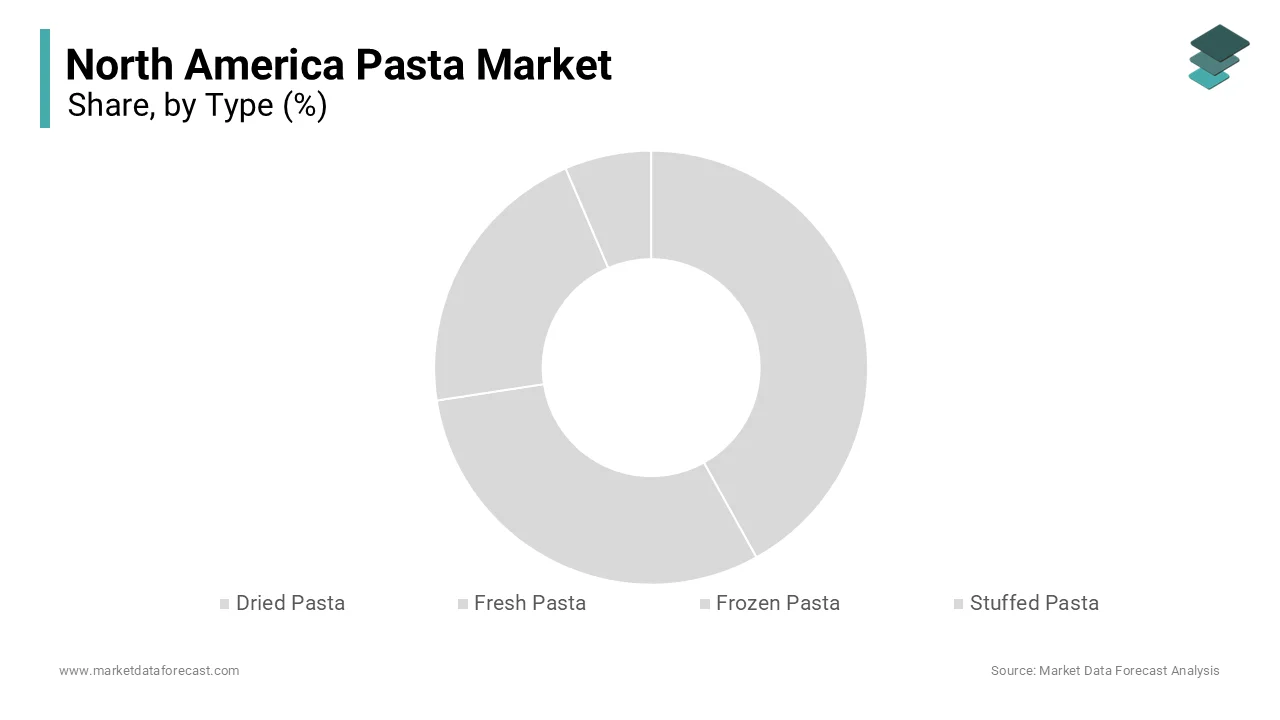
The fresh pasta segment is expected to grow with an expected CAGR of 8.9% in the next coming years owing to the rising consumer demand for premium, artisanal, and minimally processed foods perceived as higher in quality and taste. Unlike dried pasta, fresh pasta contains eggs and higher moisture content, yielding a softer texture and richer flavor profile that appeals to discerning palates.
By Ingredients Insights
The wheat-based pasta segment was the largest by capturing a significant share of the North America pasta market in 2025. Durum wheat semolina offers optimal gluten structure for extrusion and boiling resilience, making it the gold standard for pasta production. The North American durum wheat supply chain is highly developed, with over 1.9 million acres dedicated to its cultivation in the U.S. and Canada, as reported by Agriculture and Agri-Food Canada. This agricultural foundation supports a robust domestic manufacturing base, with facilities in North Dakota, Montana, and Saskatchewan supplying major brands like Barilla and Ronzoni. Furthermore, federal dietary guidelines recognize enriched wheat pasta as a source of B vitamins and iron, reinforcing its inclusion in balanced diets.
The legume-based pasta segment is anticipated to grow lucratively with a CAGR of 11.6% in the next coming years with rising consumer focus on plant-based protein intake and functional nutrition. Banza, a leading chickpea pasta brand, expanded its retail presence from 5,000 to over 22,000 stores between 2020 and 2023, as confirmed by the company’s public distribution reports. Another driver is the alignment with clean-label and allergen-friendly trends. Legume pastas are naturally gluten-free and free from artificial additives, which is appealing to parents and individuals with dietary restrictions.
By Distribution Channel Insights
The supermarkets segment was the largest and held a dominant share of the North America pasta market with their ability to offer a comprehensive product range, competitive pricing, and one-stop shopping convenience. Additionally, supermarkets leverage promotional strategies such as bundling, loyalty discounts, and in-aisle sampling to drive volume. The U.S. Department of Agriculture notes that 76% of grocery spending occurs in brick-and-mortar supermarkets, with pasta frequently featured in weekly circulars and digital coupons. The physical layout of supermarkets also supports habitual buying; pasta is typically placed in high-traffic center aisles, increasing visibility and impulse purchases.
The online retail segment is expected to register a CAGR of 12.4% in the next coming years owing to the shifting consumer behavior toward digital grocery shopping, accelerated by the normalization of e-commerce during and after the pandemic. According to the U.S. Census Bureau, online grocery sales reached $148 billion in 2023, with pantry staples like pasta among the most frequently ordered items. Another key factor is the availability of niche and specialty products not found in physical stores. Online platforms like Thrive Market and Vitacost offer extensive selections of organic, gluten-free, and international pasta varieties, attracting health-focused and culturally diverse consumers.
REGIONAL ANALYSIS
United States Pasta Market Insights
The United States was the largest contributor in the North America pasta market by accounting for 89.3% of share in 2025. The average American consumes 20.2 pounds of pasta annually, a figure that has remained stable despite dietary fluctuations, according to the National Pasta Association. Domestic production exceeds 1.8 million metric tons per year, with major facilities operated by Barilla, New World Pasta, and Ebro Foods concentrated in the Midwest and Northeast. The U.S. Department of Agriculture supports this ecosystem through standardized grain grading and food safety regulations under the FDA’s Food Safety Modernization Act (FSMA). Consumer demand is further amplified by institutional procurement; the National School Lunch Program serves pasta in over 1.8 billion meals annually, ensuring consistent baseline demand. The rise of ethnic cuisines and fusion cooking has also expanded pasta’s culinary footprint beyond Italian-American fare, with retailers like Kroger and Target dedicating expanded shelf space to global pasta formats.
Canada Pasta Market Insights
Canada was positioned second by holding 11.2% of the North America pasta market share in 2025 with the country maintains a high per capita pasta consumption rate of 16.7 pounds annually, reflecting the product’s deep integration into everyday meals across urban and rural households. The Canadian pasta industry is tightly linked to domestic agriculture, with Saskatchewan and Alberta producing over 80% of North America’s durum wheat, according to Agriculture and Agri-Food Canada. This proximity to raw materials supports cost-effective manufacturing and export capabilities, with Canadian-made pasta increasingly supplied to U.S. private-label brands. Retail distribution is highly consolidated, with Loblaw Companies, Sobeys, and Metro controlling 74% of grocery sales by enabling efficient product placement and promotional reach.
COMPETITIVE LANDSCAPE
The competitive environment in the North America pasta market is characterized by a layered dynamic between global multinationals, regional producers, and niche specialty brands, each vying for relevance in an evolving food landscape. Established players leverage brand equity, extensive distribution networks, and economies of scale to maintain dominance in the dried pasta segment, where familiarity and affordability remain paramount. However, their position is increasingly challenged by agile, mission-driven entrants focused on health, sustainability, and culinary innovation. These challengers operate in premium and alternative ingredient spaces, capturing attention through clean-label positioning, eco-conscious packaging, and digital-native marketing. The market is further fragmented by private-label expansion, with major retailers developing high-quality store brands that compete directly on taste and price. Differentiation now extends beyond the product itself to encompass sustainability credentials, cultural authenticity, and alignment with lifestyle values such as plant-based eating and time efficiency. Competition is no longer confined to shelf space but spans digital influence, supply chain transparency, and consumer education. While large corporations maintain structural advantages, the pace of innovation is increasingly set by smaller brands that anticipate and shape consumer trends, creating a fluid and responsive market where adaptability and narrative strength are as crucial as scale.
KEY MARKET PLAYERS
The key players in the North America pasta market are
- Barilla G. e R. Fratelli S.p.A.
- General Mills Inc.
- Borges International Group S.L.U.
- F.lli De Cecco di Filippo S.p.A.
- Kraft Heinz Company
- Armanino Foods of Distinction Inc.
- Philadelphia Macaroni Company
- Winland Foods Inc.
- Italpasta Ltd.
- 8th Avenue Food & Provisions (Ronzoni)
- La Molisana S.p.A.
TOP PLAYERS IN THE MARKET
- Barilla stands as a defining force in the North America pasta market, renowned for its unwavering commitment to quality, culinary authenticity, and consumer trust. Originating in Italy, the brand has successfully localized its presence in the U.S. and Canada by blending traditional production methods with North American taste preferences. Its expansive portfolio spans classic dried pasta, whole grain variants, protein-enriched lines, and ready-to-serve meals, positioning it as a household staple across diverse demographics. Beyond product excellence, Barilla actively shapes food culture through educational initiatives, recipe development, and partnerships with chefs and nutritionists.
- New World Pasta, operating under the Spanish multinational Ebro Foods, plays an important role in the North American dried pasta landscape through its extensive manufacturing footprint and strong private-label presence. Known for brands such as Ronzoni, San Giorgio, and Prince, the company excels in large-scale production and supply chain efficiency, serving both branded and retail-exclusive channels. Its strategic integration within Ebro’s global network allows for shared R&D, sustainability practices, and ingredient sourcing, amplifying its competitive reach. The company has been instrumental in advancing whole grain and gluten-free formulations to meet evolving dietary demands, while maintaining cost-effective production for mass-market appeal. In Canada, its products are widely distributed through major grocery chains, often as store-brand alternatives.
- Rana Foods has redefined the premium fresh and stuffed pasta segment in North America by introducing authentic Italian refrigerated pasta to mainstream consumers. Specializing in ravioli, tortellini, and gnocchi, the company emphasizes artisanal quality, natural ingredients, and convenience, bridging the gap between home cooking and restaurant-grade meals. Its products are widely available in the refrigerated sections of major supermarkets, appealing to time-conscious consumers seeking elevated dining experiences without compromise. Rana’s success lies in its ability to maintain traditional flavors while adapting to North American palates by offering fillings such as lobster bisque, butternut squash, and plant-based ricotta. The brand’s focus on freshness, portion control, and elegant packaging has made it a leader in the high-margin refrigerated pasta space.
TOP STRATEGIES USED BY KEY MARKET PARTICIPANTS
A primary strategy employed by leading pasta manufacturers is product differentiation through health-centric innovation. Companies are reformulating traditional pasta with added protein, fiber, and functional ingredients while expanding into gluten-free, organic, and legume-based categories to align with wellness-driven consumer preferences. This shift allows brands to position themselves as enablers of balanced diets rather than mere carbohydrate sources.
Another key approach is vertical integration and sustainable sourcing. Major players are deepening partnerships with durum wheat farmers, investing in regenerative agriculture, and reducing environmental footprints across production cycles. These efforts enhance supply chain resilience, improve brand equity, and respond to growing consumer and regulatory demands for transparency and ecological responsibility.
A third pivotal strategy is culinary storytelling and consumer engagement. Brands are leveraging digital platforms, chef collaborations, and recipe-driven marketing to reframe pasta as a dynamic, culturally rich food. By associating their products with authenticity, tradition, and modern gastronomy, companies foster emotional connections that transcend price and functionality, building long-term loyalty in a competitive marketplace.
RECENT HAPPENINGS IN THE MARKET
- In January 2023, Barilla launched a new line of legume-based pasta in the United States and Canada, featuring chickpea and lentil blends fortified with protein and fiber, aimed at health-conscious consumers and those following plant-based diets.
- In June 2023, Rana Foods expanded its refrigerated pasta production facility in Wisconsin to increase output and meet rising demand for fresh stuffed pasta in grocery chains across the Midwest and Northeast regions.
- In October 2023, New World Pasta introduced a sustainable packaging initiative for its Ronzoni brand, which is replacing traditional polypropylene-lined bags with recyclable mono-material film across all major retail markets.
- In February 2025, Barilla partnered with a network of North American durum wheat farmers to pilot regenerative agriculture practices by focusing on soil health and water conservation to strengthen its sustainable sourcing claims.
- In May 2025, Rana Foods debuted a plant-based ravioli line in collaboration with a Canadian food tech startup, which is leveraging pea protein and traditional Italian recipes to appeal to flexitarian consumers.
MARKET SEGMENTATION
This research report on the North America pasta market has been segmented and sub-segmented based on the following categories.
By Type
- Dried Pasta
- Fresh Pasta
- Frozen Pasta
- Stuffed Pasta
By Ingredients
- Wheat
- Rice
- Legumes
- Vegetable-Based
By Distribution Channel
- Supermarkets
- Online Retail
- Convenience Stores
- Specialty Stores
By Country
- The United States
- Canada
- Rest of North America