North America Residential Furnace Market Size, Share, Trends & Growth Forecast Report, By Product Type (Gas furnace, Oil furnace, Electric furnace, Wood furnace, Hybrid furnace), Application, And Country (US, Canada, Mexico & Rest of North America) - Industry Analysis From (2026 To 2034)
Market Size, 2025
$5.81 BnMarket Estimate, 2026
$6.09 BnMarket Forecast, 2034
$8.92 BnCAGR, 2026–2034
4.88%North America Residential Furnace Market Report Summary
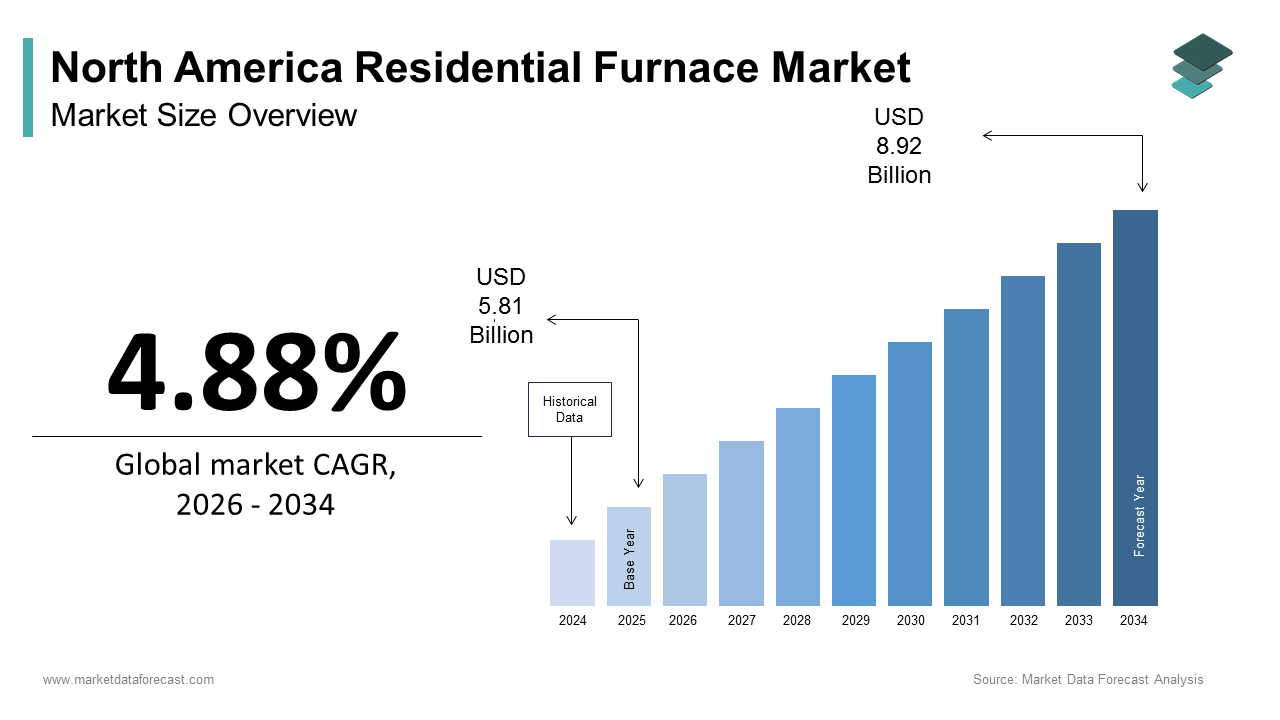
The North America residential furnace market was valued at USD 5.81 billion in 2025 and is projected to reach USD 8.92 billion by 2034, growing from USD 6.09 billion in 2026 at a CAGR of 4.88% during the forecast period. Market growth is driven by replacement demand for aging heating systems, rising residential construction, and increasing adoption of energy-efficient and low-emission heating technologies. Stringent energy efficiency regulations, growing awareness of indoor comfort, and advancements in smart and connected furnace systems are further supporting market expansion across North America.
Key Market Trends
- Rising demand for high-efficiency gas furnaces is driven by cost-effectiveness and widespread natural gas availability.
- Increasing replacement of legacy heating systems with ENERGY STAR–certified furnaces
- Growing adoption of smart thermostats and connected HVAC systems in residential applications
- Strong focus on decarbonization and energy efficiency supported by government incentives
- Seasonal demand fluctuations are influencing sales across colder regions
Segmental Insights
- Based on product type, the gas furnaces segment dominated the North American residential furnace market in 2024, supported by high heating efficiency, lower operating costs, and established gas infrastructure.
- Based on application, the single-family residential units segment held a prominent share in 2024, driven by suburban housing growth and higher furnace replacement rates in detached .homes
Regional Insights
- The United States led the North American residential furnace market by accounting for 85.3% of the total market share in 2024
- Market dominance in the United States is supported by cold-climate regions, a large installed base of furnaces, and continuous product upgrades.
- Canada accounted for 15.3% of the market share in 2024, driven by severe winter conditions in northern provinces and strong government incentives promoting energy-efficient heating systems.
Competitive Landscape
The North American residential furnace market is moderately consolidated, with leading manufacturers focusing on product innovation, high-efficiency gas furnaces, and integration of smart HVAC technologies. Companies are strengthening their market presence through dealer networks, after-sales services, and compliance with evolving energy standards.
Prominent players in the North America residential furnace market include Carrier, Trane Technologies, Lennox International, Johnson Controls, Rheem Manufacturing Company, Daikin Industries, York, Goodman Manufacturing, American Standard, and Bryant.
North America Residential Furnace Market Size
The North America residential furnace market size was calculated to be USD 5.81 billion in 2025 and is anticipated to be worth USD 8.92 billion by 2034, growing from USD 6.09 billion in 2026 at a CAGR of 4.88% during the forecast period.
The residential furnace is primarily driven by the need for efficient and reliable space heating solutions in residential buildings. According to the U.S. Energy Information Administration (EIA), approximately 48% of American households rely on natural gas furnaces as their primary space heating technology, with the continued dominance of gas-fired heating systems. In Canada, natural gas and electric furnaces share a more balanced presence, with Statistics Canada indicating that about 43% of Canadian households use natural gas for home heating. As per the American Council for an Energy-Efficient Economy (ACEEE), over 85% of newly installed furnaces in the U.S. now meet or exceed the 90% AFUE threshold. These developments, combined with retrofitting initiatives and growing awareness around indoor air quality, continue to define the operational contours of the North American residential furnace market.
MARKET DRIVERS
Increasing Penetration of High-Efficiency Furnaces
The rising adoption of high-efficiency furnaces is eventually propelling the growth of the North American residential furnace market. As energy costs continue to escalate and environmental regulations tighten, homeowners are increasingly prioritizing energy-efficient heating systems. The U.S. Department of Energy mandates that all new gas furnaces installed in the northern U.S. must achieve a minimum AFUE rating of 90%, which has accelerated the transition from older, less efficient models. Additionally, federal and state-level incentives, such as tax credits under the Inflation Reduction Act, are encouraging homeowners to invest in energy-efficient HVAC systems. Natural Resources Canada has also reported a 15% increase in the installation of high-efficiency furnaces across the country since 2020. Furthermore, consumer awareness regarding long-term energy savings and environmental impact has led to a preference for condensing furnaces, which can achieve efficiency ratings of up to 98% AFUE. These models, while initially more expensive, offer substantial utility bill reductions, making them an attractive investment.
Aging Residential HVAC Infrastructure and Replacement Demand
The residential heating systems are nearing the end of their operational lifespan, creating a robust replacement demand that drives the growth of the North American residential furnace market. According to the National Association of Home Builders (NAHB), the average lifespan of a residential furnace ranges between 15 and 20 years, and nearly 35% of existing furnaces in the U.S. were installed prior to 2005. The EIA estimates that over 5 million residential furnaces reach the end of their useful life annually across North America, necessitating replacement. This trend is particularly pronounced in regions with harsh winters, where continuous operation places additional strain on heating systems. In Canada, Statistics Canada reports that approximately 1.2 million residential heating units require replacement each year. The replacement cycle is further accelerated by the increasing prevalence of smart home technologies, prompting homeowners to upgrade to compatible, modern furnace systems. Manufacturers are responding by integrating smart thermostats, variable-speed blowers, and Wi-Fi-enabled controls into new models. Additionally, the rising incidence of extreme weather events, as documented by the Insurance Bureau of Canada, has heightened awareness about the importance of reliable heating systems, further stimulating replacement demand.
MARKET RESTRAINTS
High Initial Cost of Advanced Furnace Systems
The substantial upfront investment required for advanced furnace systems is restricting the growth ofthe North America residential furnace market. Modern high-efficiency furnaces, especially condensing units with AFUE ratings above 95%, often cost between $4,000 and $8,000, significantly more than conventional models priced at $2,000 to $4,000. As per the National Association of Realtors, nearly 40% of homeowners cite cost as the main barrier to upgrading their heating systems. This financial burden is particularly acute for low- and middle-income households, which constitute a large segment of the residential market. While long-term energy savings and tax incentives help offset the initial expense, many consumers remain hesitant to make such capital investments. Additionally, the complexity of installing high-efficiency furnaces, which often requires modifications to existing ductwork and venting systems, adds to the overall cost. A study by the Canadian Centre for Housing Technology found that installation-related expenses can account for up to 40% of the total system cost.
Fluctuating Natural Gas Prices and Supply Concerns
Natural gas is the dominant fuel source for residential furnaces, with the EIA reporting that over 60% of U.S. homes use natural gas for space heating. This is one of the major factors restraining the growth of the North American residential furnace market. However, volatility in natural gas prices poses a notable restraint on furnace demand and operational affordability. In 2022, the Henry Hub natural gas spot price averaged $6.64 per million British thermal units (MMBtu), nearly double the 2021 average, as per the EIA. Price surges, such as these, can significantly increase heating costs for homeowners, leading some to delay furnace replacements or opt for alternative heating methods. Furthermore, geopolitical tensions and infrastructure vulnerabilities, such as pipeline disruptions, have raised concerns about supply reliability. The North American Energy Security Act has highlighted the region’s dependence on stable gas imports, particularly in the northeastern U.S. and parts of eastern Canada. According to the Canadian Gas Association, supply disruptions in key producing regions like Alberta and Texas have led to temporary shortages, affecting furnace usage during peak winter months. Additionally, growing environmental concerns and policy shifts toward decarbonization may reduce long-term investment in natural gas infrastructure.
MARKET OPPORTUNITIES
Smart Furnace Integration and IoT-Based Solutions
The integration of Internet of Things (IoT) technology into residential furnaces is certainly creating new opportunities for the growth ofthe North America residential furnace market. Smart furnaces equipped with Wi-Fi-enabled thermostats, remote monitoring capabilities, and predictive maintenance features are gaining traction among tech-savvy consumers. As per a 2023 report by Statista, over 65 million smart thermostats were installed in North American homes, with a projected annual growth rate of 12% through 2027. Leading HVAC manufacturers, such as Lennox and Carrier, have introduced smart furnace models that integrate with home automation ecosystems like Google Nest and Amazon Alexa. These systems enable users to optimize energy consumption, monitor system performance, and receive real-time alerts for maintenance needs. According to the Consumer Technology Association, households using smart HVAC systems report an average energy savings of 10–15% annually. Additionally, the rise of connected homes, supported by expanding broadband infrastructure and 5G networks, is facilitating broader adoption. Government initiatives promoting energy-efficient technologies, such as Canada’s Greener Homes Grant, further incentivize smart furnace installations.
Expansion of Green Building and Energy Retrofit Programs
The growing emphasis on sustainable construction and energy retrofitting initiatives is also to fuel the growth ofthe North America residential furnace market. Green building certifications such as LEED and ENERGY STAR are increasingly influencing HVAC equipment choices, with high-efficiency furnaces being a key component. As per the U.S. Green Building Council, over 1.2 million residential units were certified under LEED standards between 2020 and 2023. Similarly, Natural Resources Canada reports that the EnerGuide Retrofit Program has supported over 300,000 home energy upgrades since 2021, many of which included furnace replacements. These programs often provide rebates and incentives, making it financially viable for homeowners to invest in advanced furnace systems. The federal government’s commitment to carbon neutrality by 2050, as outlined in both the U.S. Climate Action Plan and Canada’s Net-Zero Emissions Accountability Act, further supports long-term market growth. In addition, the increasing adoption of renewable energy sources such as solar and geothermal systems creates a complementary demand for hybrid furnace technologies. Manufacturers are responding with dual-fuel systems that integrate seamlessly with renewable energy setups.
MARKET CHALLENGES
Skilled Labor Shortage in HVAC Installation and Maintenance
The persistent shortage of skilled HVAC technicians, which impacts both installation and maintenance services, is one of the challenges for the growth of the North American residential furnace market. According to the Air Conditioning Contractors of America (ACCA), the HVAC industry is expected to face a shortfall of over 100,000 qualified technicians by 2027. This shortage is driven by an aging workforce, with nearly 40% of HVAC professionals nearing retirement age, and insufficient new entrants into trade programs. The National Center for Construction Education and Research (NCCER) reports that only 30% of HVAC training programs meet current industry demand. The scarcity of skilled labor leads to longer installation times, increased labor costs, and service delays, particularly during peak heating seasons. In Canada, the Canadian Home Builders’ Association has noted a 25% increase in labor costs for HVAC installations since 2020. Furthermore, the complexity of modern furnace systems, which often include smart controls and high-efficiency components, requires specialized training that many technicians lack. This labor constraint not only affects customer satisfaction but also limits the market’s ability to scale effectively.
Regulatory Complexity and Compliance Costs
The complexity and stringency of regulatory requirements governing energy efficiency, emissions, and product safety are likely to be one of the challenging factors for the growth ofthe North American residential furnace market. Compliance with these standards often necessitates costly redesigns and testing, particularly for manufacturers serving multiple jurisdictions. As per the American Society of Heating, Refrigerating, and Air-Conditioning Engineers (ASHRAE), compliance costs for furnace manufacturers have risen by 18% over the past five years. Similarly, Canada’s ENERGY STAR certification process requires extensive third-party verification, increasing production lead times and expenses. The introduction of new regulations, such as updated venting standards by the National Fire Protection Association (NFPA), further complicates manufacturing and installation processes. Small and medium-sized enterprises (SMEs) are particularly affected, as they often lack the resources to navigate complex regulatory frameworks. These regulatory hurdles not only increase costs but also slow innovation and market responsiveness, posing a significant obstacle to sustainable growth in the residential furnace sector.
REPORT COVERAGE
| REPORT METRIC | DETAILS |
| Market Size Available | 2025 to 2034 |
| Base Year | 2025 |
| Forecast Period | 2026 to 2034 |
| CAGR | 4.88% |
| Segments Covered | By Product Type, Application, And Region |
| Various Analyses Covered | Global, Regional & Country Level Analysis; Segment-Level Analysis; DROC, PESTLE Analysis; Porter’s Five Forces Analysis; Competitive Landscape; Analyst Overview of Investment Opportunities |
| Regions Covered | US, Canada, and the rest of North America |
| Market Leaders Profiled | Carrier, Trane Technologies, Lennox International, Johnson Controls, Rheem Manufacturing Company, Daikin Industries, York, Goodman Manufacturing, American Standard, and Bryant |
SEGMENTAL ANALYSIS
By Product Type Insights
The gas furnaces segment was the largest by accounting for a dominant share of the North America residential furnace market in 2024, with its superior cost-effectiveness, widespread availability of natural gas infrastructure, and exceptional heating efficiency compared to alternative fuel sources. The U.S. Energy Information Administration confirms that nearly 48% of American households utilize natural gas furnaces, while Statistics Canada indicates that 43% of Canadian homes rely on natural gas for heating purposes. The extensive natural gas pipeline network spanning across North America provides the foundational infrastructure supporting this market dominance. The economic superiority of natural gas as a heating fuel compared to electricity and oil alternatives is another factor propelling the growth of the segment. According to the U.S. Energy Information Administration, residential natural gas prices averaged $12.50 per thousand cubic feet in 2023, translating to significantly lower heating costs than electric resistance heating, which can cost two to three times more per unit of energy delivered. Furthermore, the stable pricing structure of natural gas, supported by domestic production increases from shale formations, provides consumers with predictable long-term heating expenses. The American Council for an Energy-Efficient Economy reports that high-efficiency gas furnaces installed since 2020 account for 72% of all new gas furnace installations in the United States. The U.S. Department of Energy's mandatory minimum efficiency standards, requiring 90% AFUE for new installations in northern states, have accelerated the adoption of advanced gas furnace technologies. Additionally, manufacturers have integrated smart controls and variable-speed blowers into modern gas furnaces by enhancing comfort while reducing operational costs.
The hybrid furnace segment is more likely to grow at an anticipated CAGR of 8.2% from 2025 to 2033, as the technology combines traditional gas furnace functionality with electric heat pump capabilities, offering optimal energy efficiency across varying seasonal conditions. Hybrid systems automatically switch between gas and electric operation based on outdoor temperatures and energy cost fluctuations, maximizing efficiency while minimizing operating expenses. The increasing consumer awareness regarding environmental sustainability and energy conservation has accelerated adoption rates in regions with moderate climates where electric heat pumps can effectively operate for extended periods. Their exceptional ability to minimize heating costs through intelligent fuel source selection is also escalating the growth of the segment. Hybrid systems can reduce heating expenses by 30-40% compared to conventional gas furnaces. During mild weather conditions, these systems operate as electric heat pumps, achieving coefficient of performance ratings exceeding 3.0, while automatically switching to gas operation during extreme cold when electric efficiency declines. The Electric Power Research Institute reports that hybrid furnace users experience average annual heating cost savings of $420 compared to traditional gas systems. This cost advantage becomes particularly pronounced in regions with time-of-use electricity pricing, where hybrid systems can optimize operation during off-peak hours. Additionally, the integration of smart home technologies enables real-time energy price monitoring by allowing hybrid furnaces to select the most economical heating source based on current utility rates. Natural Resources Canada studies indicate that hybrid systems achieve 25% better overall efficiency in mixed climate zones compared to single-fuel alternatives, which is making them increasingly attractive to environmentally conscious consumers seeking both economic and environmental benefits. The growing emphasis on reducing residential carbon emissions has positioned hybrid furnaces as a preferred solution for environmentally responsible heating. The dual-fuel approach allows homeowners to maximize renewable electricity usage while maintaining gas backup for peak heating demands, supporting broader decarbonization objectives. Government initiatives are actively promoting hybrid technology adoption. Similarly, Canada's Greener Homes Grant program offers incentives up to $5,000 for hybrid heating system installations. The California Energy Commission has mandated that new residential construction in certain climate zones must consider hybrid heating systems to meet building energy standards. These regulatory developments, combined with utility-sponsored rebate programs, have created favorable market conditions for hybrid furnace expansion.
By Application Insights
The single-family residential units segment was the largest by holding a prominent share of the North America residential furnace market in 2024 w, with the prevalence of detached housing stock across North America, where individual furnace installations are standard practice. The U.S. Census Bureau reports that single-family homes account for 82% of all housing units in the United States, while Statistics Canada indicates that detached dwellings represent 67% of Canadian residential construction. The preference for single-family housing, particularly in suburban and rural areas, has historically driven furnace market dynamics, with each household requiring dedicated heating solutions tailored to their specific space heating requirements. The fundamental driver behind single-family segment dominance is the strong preference for homeownership and detached housing among North American consumers. The U.S. Census Bureau reports that the homeownership rate stood at 65.5% in 2023, with single-family detached homes representing the preferred housing choice for families seeking privacy, space, and property ownership benefits. This housing preference directly translates to individual furnace requirements, as single-family homes typically necessitate dedicated heating systems rather than shared infrastructure common in multi-family developments. Additionally, the post-pandemic shift toward suburban living, accelerated by remote work opportunities, has further strengthened single-family housing demand. Single-family residential properties exhibit higher furnace replacement frequencies and upgrade rates compared to multi-family applications. The National Association of Realtors reports that single-family homeowners replace their heating systems every 16-18 years on average, compared to 20-25 years for multi-family units, where centralized systems serve multiple dwellings. Individual homeowners demonstrate greater willingness to invest in system upgrades for improved comfort, efficiency, and control, driving premium product adoption within this segment. Additionally, the increasing prevalence of home improvement projects, supported by rising home equity values, has created additional upgrade opportunities.
The multi-family residential segment is projected to register a CAGR of 6.8% from 2025 to 2033, owing to the increasing urbanization trends, changing demographic preferences, and the development of energy-efficient centralized heating solutions for apartment complexes and condominium buildings. The shift toward multi-family living, particularly among younger demographics and urban professionals, has created new market opportunities for furnace manufacturers developing scalable heating solutions suitable for shared residential environments. The primary driver behind multi-family application growth is the accelerating trend of urbanization and changing demographic preferences across North America. The United Nations Department of Economic and Social Affairs reports that 83% of the U.S. population and 81% of the Canadian population reside in urban areas as of 2023, with continued migration toward metropolitan regions driving multi-family housing demand. Millennials and Generation Z consumers, who represent 65% of new rental market entrants according to the National Multifamily Housing Council, demonstrate strong preferences for urban living with access to employment centers, public transportation, and amenities. Additionally, the rising cost of single-family homeownership in major metropolitan areas has made multi-family rental housing increasingly attractive to middle-income households. The implementation of stringent energy efficiency standards and building codes for multi-family residential developments has accelerated furnace technology adoption within this segment. The International Energy Conservation Code now requires new multi-family buildings to achieve 15% greater heating efficiency compared to previous standards, driving demand for advanced furnace technologies. Additionally, utility-sponsored energy efficiency programs specifically target multi-family buildings due to their potential for large-scale energy savings. The Database of State Incentives for Renewables & Efficiency indicates that 45 U.S. states and 10 Canadian provinces offer rebates and incentives for multi-family furnace upgrades, with average incentives covering 30% of installation costs. The Environmental Protection Agency's ENERGY STAR program for multi-family buildings has certified over 15,000 residential units since 2022, requiring participating developments to install furnaces with ma inimum 95% AFUE ratings. These regulatory and incentive frameworks have created favorable conditions for furnace manufacturers developing products specifically designed for multi-family applications, contributing to the segment's accelerated growth rate.
REGIONAL ANALYSIS
United States Residential Furnace Market Analysis
The United States was the largest contributor to the North American residential furnace market by occupying 85.3% of the share in 202,4 with the vast residential housing stock, diverse climatic conditions requiring robust heating solutions, and well-established HVAC distribution networks. The U.S. market benefits from mature supply chains, extensive natural gas infrastructure, and strong consumer demand for energy-efficient heating technologies. The U.S. Census Bureau reports that there are over 128 million housing units in the United States as of 2023, with approximately 1.5 million new residential units completed annually. This extensive housing stock creates substantial replacement demand, as the National Association of Home Builders estimates that 4.2 million residential furnaces require replacement each year due to aging infrastructure and efficiency improvements. Regional variations in heating requirements, from the harsh winters of the Northeast to the variable climate conditions of the Midwest, drive diverse furnace technology adoption across different states. This regulatory diversity creates opportunities for manufacturers to develop specialized products for different market segments. Additionally, the strong presence of home improvement retailers such as Home Depot and Lowe's, which collectively account for over 40% of residential furnace sales according to the National Retail Hardware Association, facilitates widespread consumer access to heating equipment.
Canada Residential Furnace Market Analysis
Canada's residential furnace market held 15.3% of the share in 2024, with the distinct seasonal heating requirements in northern provinces and strong government support for energy efficiency initiatives. Canada's residential furnace market benefits from progressive environmental policies, robust natural gas infrastructure in key provinces, and increasing consumer awareness regarding sustainable heating solutions. The Canadian Centre for Housing Technology indicates that furnace replacement rates average 1.2 million units annually, driven by equipment aging and efficiency upgrade incentives. Provincial variations in heating requirements create diverse market opportunities, with provinces like Alberta and Saskatchewan requiring robust heating systems capable of operating in extreme cold conditions. Additionally, the Pan-Canadian Framework on Clean Growth and Climate Change has established building code requirements mandating minimum 93% AFUE ratings for new furnace installations in all provinces. Provincial utility programs in Ontario and British Columbia offer rebates covering up to 50% of high-efficiency furnace costs. These policy-driven factors, combined with Canada's geographic heating requirements, establish the country's significant position in the regional furnace market.
COMPETITION OVERVIEW
The North AAmericanresidential furnace market exhibits intense competition characterized by the presence of established multinational corporations alongside regional manufacturers and emerging technology-focused companies. Market leaders compete primarily on product quality, energy efficiency, technological innovation, and customer service excellence rather than solely on price. The competitive landscape is shaped by continuous product development cycles, with manufacturers regularly introducing updated models featuring enhanced efficiency ratings, smart connectivity options, and improved comfort controls. Brand reputation and contractor relationships play crucial roles in market positioning, as professional installers significantly influence consumer purchasing decisions. Regional variations in climate conditions, building codes, and consumer preferences create opportunities for specialized manufacturers to compete effectively against larger corporations. The market also experiences competition from alternative heating technologies, including heat pumps and hybrid systems, which are gaining popularity due to environmental considerations and changing regulatory environments. Customer loyalty programs, comprehensive warranty offerings, and responsive technical support services have become essential competitive differentiators. The increasing importance of digital marketing and e-commerce channels has altered traditional distribution models, creating new competitive dynamics between manufacturers and their distribution partners.
KEY MARKET PLAYERS
A few major players of the North American residential furnace market include
- Carrier
- Trane Technologies
- Lennox International
- Johnson Controls
- Rheem Manufacturing Company
- Daikin Industries
- York
- Goodman Manufacturing
- American Standard
- Bryant
Top Strategies Used by Key Market Participants
Leading furnace manufacturers are heavily investing in research and development to create advanced heating solutions that incorporate smart technologies and enhanced efficiency features. These companies are developing furnaces with variable-speed blowers, modulating gas valves, and intelligent control systems that adapt to changing weather conditions and occupancy patterns. The integration of Internet of Things connectivity allows homeowners to remotely monitor and control their heating systems through smartphone applications. Additionally, manufacturers are focusing on improving heat exchanger designs and combustion technologies to achieve higher Annual Fuel Utilization Efficiency ratings while reducing environmental impact. This strategy enables companies to differentiate their products in a competitive market and command premium pricing for technologically advanced solutions.
Key players are forming strategic alliances with contractors, distributors, and retail chains to strengthen their market reach and improve customer accessibility. These partnerships involve collaborative marketing initiatives, joint training programs for installation technicians, and coordinated product development efforts that address specific regional requirements. Manufacturers are also investing in expanding their authorized dealer networks to ensure comprehensive geographic coverage and timely product availability. Strategic acquisitions of regional distributors and service companies help establish stronger local market presence and enhance after-sales support capabilities. These collaborative approaches enable manufacturers to leverage partner expertise and infrastructure while reducing operational costs associated with direct market penetration.
Leading furnace manufacturers are prioritizing environmental sustainability and energy efficiency as core business strategies to align with evolving regulatory requirements and consumer preferences. Companies are developing products that exceed minimum efficiency standards and qualify for government incentive programs and utility rebates. Investment in renewable energy compatible technologies, such as hybrid heating systems that integrate with solar panels and geothermal sources, represents a growing strategic focus. Manufacturers are also implementing sustainable manufacturing processes and using eco-friendly materials in product construction. Corporate sustainability initiatives include carbon footprint reduction targets and participation in industry-wide environmental certification programs. This strategic approach not only addresses regulatory compliance but also appeals to environmentally conscious consumers and supports long-term market growth.
Leading Players in the North America Residential Furnace Market
- Carrier Corporation stands as a leading innovator in the North American residential furnace market, leveraging its extensive research and development capabilities to deliver advanced heating solutions. The company's commitment to energy efficiency and smart home integration has positioned it as a preferred choice among contractors and homeowners alike. Carrier's comprehensive product portfolio spans from basic gas furnaces to high-efficiency condensing models with variable-speed technology. Their focus on sustainable heating solutions aligns with evolving environmental regulations while maintaining competitive pricing structures. The company's strong distribution network and technical support infrastructure enable widespread market penetration across diverse geographic regions. Carrier's continuous investment in digital technologies and IoT-enabled systems has enhanced user experience through remote monitoring and intelligent temperature control capabilities.
- Lennox International Inc. has established itself as a premium player in the residential furnace market through consistent quality manufacturing and innovative engineering solutions. The company's dedication to producing high-efficiency furnaces with exceptional durability has earned strong customer loyalty and contractor preference. Lennox's research-driven approach to product development focuses on optimizing energy consumption while maximizing comfort levels in residential applications. Their comprehensive warranty programs and extensive dealer network provide customers with reliable after-sales support and maintenance services. The company's strategic emphasis on smart home compatibility and integration with popular home automation platforms has strengthened its market position. Lennox's commitment to environmental sustainability through reduced emissions and improved energy efficiency continues to drive product innovation and market expansion.
- Rheem Manufacturing Company maintains a strong presence in the North American residential furnace market through its diverse product offerings and competitive pricing strategy. The company's ability to cater to various market segments, from budget-conscious consumers to premium homeowners, has enabled broad market coverage and sustained growth. Rheem's focus on manufacturing excellence and quality control ensures reliable performance across its furnace product lines. Their commitment to technological advancement includes the development of modulating furnaces and two-stage heating systems that provide enhanced comfort and efficiency. The company's extensive network of authorized dealers and service technicians facilitates easy product access and professional installation services. Rheem's proactive approach to regulatory compliance and energy efficiency standards has positioned them favorably in markets with stringent environmental requirements.
MARKET SEGMENTATION
This research report on the North American residential furnace market has been segmented and sub-segmented based on product type, application, and region.
By Product Type
- Gas furnace
- Oil furnace
- Electric furnace
- Wood furnace
- Hybrid furnace
By Application
- Single family
- Multi family
By Region
- US
- Canada
- Mexico
- Rest of North America
Frequently Asked Questions
1. What fuels are commonly used in residential furnaces in North America?
Natural gas is the most commonly used fuel, followed by electricity, oil, and propane.
2. Which fuel type dominates the North America residential furnace market?
Natural gas furnaces dominate the market due to their affordability, efficiency, and extensive gas pipeline infrastructure.
3. What are the main types of residential furnaces?
The primary types include gas furnaces, electric furnaces, oil furnaces, and propane furnaces.
4. How is furnace efficiency measured?
Furnace efficiency is measured using Annual Fuel Utilization Efficiency (AFUE), which indicates the percentage of fuel converted into usable heat.
5. What AFUE rating is considered energy efficient?
An AFUE rating of 90 percent or higher is considered high efficiency.
6. What factors are driving the North America residential furnace market?
Key drivers include cold climatic conditions, replacement of aging heating systems, rising energy-efficiency regulations, and residential construction growth.
7. What challenges does the market face?
High upfront installation costs, volatile fuel prices, and increasing adoption of alternative heating technologies such as heat pumps are major challenges.
8. How do government regulations affect the market?
Energy efficiency standards and emission regulations are pushing manufacturers and consumers toward high-efficiency and low-emission furnace systems.
9. What role does smart technology play in residential furnaces?
Smart technology allows furnaces to integrate with smart thermostats and home automation systems to improve comfort, monitoring, and energy savings.
10. Which countries dominate the North America residential furnace market?
The United States holds the largest market share, followed by Canada, due to colder climates and higher heating demand.
11. What is the average lifespan of a residential furnace?
A residential furnace typically lasts between 15 and 20 years when properly maintained.
12. What are the key trends in the residential furnace market?
Major trends include the adoption of condensing furnaces, smart heating systems, and environmentally friendly heating solutions.
13. How does the residential furnace market compete with heat pumps?
Furnaces remain preferred in colder regions for reliable high-heat output, while heat pumps are gaining traction in milder climates.
14. What is the future outlook for the North America residential furnace market?
The market is expected to witness steady growth, supported by replacement demand, technological innovation, and increased focus on energy efficiency.
Related Reports
Access the study in MULTIPLE FORMATS
Purchase options starting from
$ 2000
Didn’t find what you’re looking for?
TALK TO OUR ANALYST TEAM
Need something within your budget?
NO WORRIES! WE GOT YOU COVERED!
Call us on: +1 888 702 9696 (U.S Toll Free)
Write to us: sales@marketdataforecast.com