- Product Description Description
- Table of Contents TOC
- List of Table & Figure LOT
- Get Free Sample PDF Sample PDF
Market Size, 2025
$87.86 BnMarket Estimate, 2026
$91.90 BnMarket Forecast, 2034
$131.70 BnCAGR, 2026–2034
4.60%Global Oxygen Market Summary
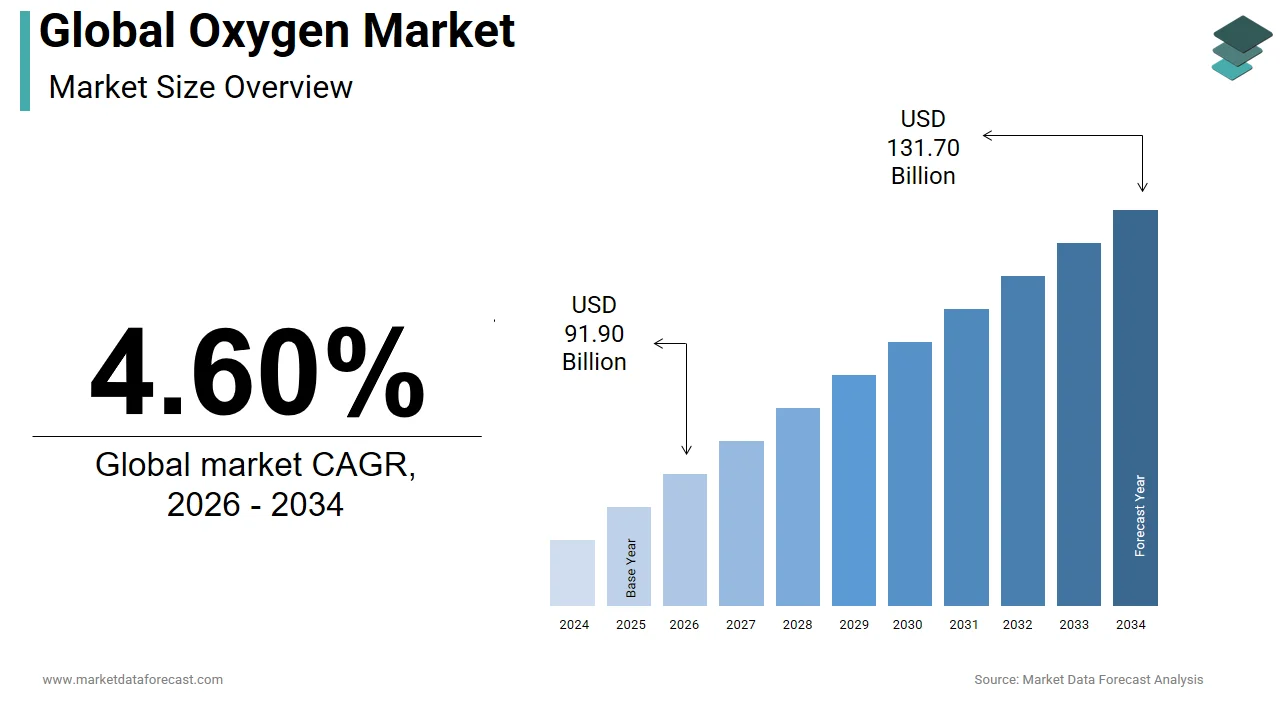
The global oxygen market was valued at USD 87.86 billion in 2025, is estimated to reach USD 91.90 billion in 2026, and is projected to reach USD 131.70 billion by 2034, growing at a CAGR of 4.60% from 2026 to 2034. The growth of the global oxygen market is attributed to the rising demand from industrial applications, increasing use of oxygen in the healthcare sector, advancements in metal processing, and growing requirements in chemical production and water treatment.
Key Market Trends
- Rising consumption of oxygen in steel and metallurgy industries.
- Increasing use of medical-grade oxygen in healthcare facilities.
- Expanding demand from wastewater treatment and chemical industries.
- Growing integration of on-site oxygen generation systems.
- Strong demand across emerging economies with industrial expansion.
Segmental Insights
- Based on form, the gaseous oxygen segment held the largest share of 57.5% of the global oxygen market in 2024.
- Based on type and application, the industrial oxygen segment dominated the market with a significant share in 2024.
Regional Insights
- Asia-Pacific was the top performer in the global oxygen market in 2024, accounting for 48.3% of the total share, driven by rapid industrialization and healthcare infrastructure growth in China, India, and Southeast Asia.
- North America maintained steady demand due to its strong healthcare sector and established manufacturing base.
- Europe contributed significantly with the increasing use of metal refining, energy, and environmental applications.
- Latin America and the Middle East & Africa are witnessing gradual growth with rising industrial and medical needs.
Competitive Landscape
Major players dominating the global oxygen market include Linde PLC, Air Liquide, Air Products and Chemicals, Inc., NIPPON SANSO HOLDINGS CORPORATION, and Messer SE & Co. KGaA. These companies are actively expanding production capacities, adopting on-site generation technologies, and investing in healthcare oxygen supply chains to strengthen their market position.
Global Oxygen Market Size
The global oxygen market was valued at USD 87.86 billion in 2025, is estimated to reach USD 91.90 billion in 2026, and is projected to reach USD 131.70 billion by 2034, growing at a CAGR of 4.60% from 2026 to 2034.
Oxygen is used in gaseous and liquid forms across healthcare, industrial, and environmental sectors, with medical oxygen constituting an important subset. Millions of patients globally rely on long-term oxygen therapy (LTOT) for chronic respiratory conditions, as per a study. In hospitals, oxygen is indispensable during anesthesia, critical care, and emergency interventions. The surge in respiratory disease burden, particularly in aging populations, has intensified demand for reliable oxygen infrastructure. Apart from these, industrial applications such as metal cutting, wastewater treatment, and semiconductor manufacturing require high-purity oxygen, which further expands its operational footprint. The integration of on-site generation systems in remote clinics and steel plants reflects a shift toward decentralized supply models. This enhances efficiency and accessibility.
MARKET DRIVERS
Rising Prevalence of Chronic Respiratory Diseases
The increasing prevalence of chronic respiratory diseases has been a major driver of the oxygen market. Chronic obstructive pulmonary disease (COPD) affects approximately millions of people worldwide, which makes it the third leading cause of death globally, according to research. This escalating health burden directly fuels demand for medical oxygen, particularly in low- and middle-income countries where air pollution and tobacco use remain high. In India alone, over 50 million individuals suffer from COPD, as per the Indian Council of Medical Research (ICMR), necessitating widespread deployment of oxygen concentrators and cylinders. The aging global population further amplifies this trend; by 2030, the number of people aged 60 and above is projected to reach 1.4 billion, as per the United Nations, which increases susceptibility to respiratory failure. Home-based oxygen therapy usage has risen annually in Europe, driven by patient preference for ambulatory devices, according to research.
Expansion of Industrial Gas Applications in Emerging Economies
The steel and chemical industries in Asia and Africa are increasingly adopting high-purity oxygen to enhance combustion efficiency and reduce emissions, which is accelerating the growth of the oxygen market. In China, oxygen-based basic oxygen furnaces (BOFs) account for a portion of crude steel production, with each ton of steel requiring cubic meters of oxygen, as per a study. Similarly, South Africa’s Sasol operates one of the world’s largest coal-to-liquids plants, consuming over 4,000 tons of oxygen daily for gasification processes, according to company disclosures. The push for cleaner industrial operations has led to wider use of oxygen in wastewater treatment. Like, modern activated sludge plants using pure oxygen can reduce aeration energy, as per research. Industrialization is increasing in Southeast Asia and Sub-Saharan Africa.
MARKET RESTRAINTS
High Costs and Infrastructure Limitations in Remote Healthcare Settings
High costs and infrastructure limitations in remote healthcare settings impede the growth of the oxygen market. In sub-Saharan Africa, a portion of healthcare facilities lack consistent access to medical oxygen, despite high burdens of pneumonia and hypoxemia, according to a study. The absence of reliable electricity, trained technicians, and maintenance networks hampers the operation of oxygen concentrators and cylinder refilling stations. In Nigeria, only a portion of primary healthcare centers are equipped with functional oxygen delivery systems, as per research. These systemic gaps lead to preventable mortality, and hypoxemia contributes to the number of deaths annually in children under five, as per a study, which emphasizes how infrastructural deficits severely constrain market penetration despite clinical need.
Regulatory and Safety Challenges in Oxygen Transportation and Storage
Liquid oxygen must be stored at cryogenic temperatures (−183°C) and transported in vacuum-insulated containers, which poses logistical and safety risks and is impeding the expansion of the oxygen market. In the U.S., it recorded many incidents involving hazardous gas shipments, including leaks and pressure-related failures, as per a study. Regulatory compliance for oxygen storage facilities varies widely, while the European Industrial Gases Association (EIGA) promotes strict zoning and fire clearance protocols, enforcement remains inconsistent in developing nations. In India, only a portion of oxygen cylinder filling stations meet national safety standards, according to the research. Besides, cylinder theft and black-market resale have been reported in countries like Brazil and Indonesia. This disrupts supply chains. These operational hazards increase liability and insurance costs, which discourages private investment in distribution networks and limits market scalability in high-risk regions.
MARKET OPPORTUNITIES
Integration of AI-Driven Oxygen Management Systems in Hospitals
Smart oxygen delivery systems equipped with real-time monitoring and predictive analytics are gaining traction in critical care units, which is generating fresh opportunities for the oxygen market. These systems integrate with electronic health records to adjust flow rates based on SpO₂ trends by minimizing wastage and hyperoxia risks. The global business for smart respiratory devices is projected to grow in the coming years, driven by digital health adoption, according to research. Thus, intelligent oxygen management offers a transformative opportunity to enhance clinical outcomes and operational efficiency in healthcare facilities worldwide by optimizing usage and reducing dependency on manual oversight.
Growth of On-Site Oxygen Generation in Decentralized Industrial Units
The shift toward on-site oxygen generation via pressure swing adsorption (PSA) and vacuum swing adsorption (VSA) technologies is generating new opportunities for the growth of the oxygen market. These systems offer lower operating costs compared to delivered liquid oxygen over the years. In India, it has promoted on-site oxygen plants for all district hospitals with more beds. The global PSA system installations are growing annually. The convergence of cost efficiency, supply security, and sustainability is unlocking new deployment pathways across geographically dispersed industries.
MARKET CHALLENGES
Vulnerability of Supply Chains During Public Health Emergencies
Weakness of supply chains during public health emergencies is a key factor hampering the growth of the oxygen market. The COVID-19 pandemic exposed vital fragilities in global oxygen supply networks. During India’s second wave in April–May 2021, daily oxygen demand surged to notable metric tons, exceeding production capacity, as per the study. Hospitals in Delhi and Maharashtra faced acute shortages, which led to preventable fatalities. The centralized production model, where oxygen is manufactured at steel plants and transported via cryogenic tankers, proved inadequate during sudden demand spikes. In Brazil, ICU bed occupancy reached 92% in early 2021, overwhelming oxygen distribution systems, as per data from the Oswaldo Cruz Foundation (Fiocruz). These events revealed a lack of buffer storage, redundant transport routes, and emergency coordination protocols. Rebuilding resilient and demand-responsive oxygen infrastructure remains a persistent challenge. This requires sustained public-private investment and contingency planning.
Environmental Impact of Cryogenic Air Separation Units
Large-scale oxygen production through cryogenic distillation is energy-intensive, which stands as a hindrance to the expansion of the oxygen market. It consumes notable kWh per ton of oxygen produced. A single air separation unit (ASU) operating at full capacity can emit significant tons of CO₂ annually, which depends on the grid’s carbon intensity. In China, where coal accounts for a portion of electricity generation, the carbon footprint of oxygen production is disproportionately high, according to research. PSA systems offer lower energy consumption. But their efficiency drops at high purity levels required for medical use. Furthermore, argon and nitrogen byproduct utilization remains suboptimal in many regions, which leads to wasted resources. Global industries face tightening carbon regulations under frameworks like the EU’s Carbon Border Adjustment Mechanism (CBAM). Hence, decarbonizing oxygen production has become a strategic imperative by compelling producers to explore renewable-powered ASUs and carbon capture integration.
REPORT COVERAGE
| REPORT METRIC | DETAILS |
| Market Size Available | 2025 to 2034 |
| Base Year | 2025 |
| Forecast Period | 2026 to 2034 |
| Segments Covered | By Form, Type, Application, and Region. |
| Various Analyses Covered | Global, Regional, and Country-Level Analysis, Segment-Level Analysis, Drivers, Restraints, Opportunities, Challenges; PESTLE Analysis; Porter’s Five Forces Analysis, Competitive Landscape, Analyst Overview of Investment Opportunities |
| Regions Covered | North America, Europe, Asia-Pacific, Latin America, Middle East and Africa |
| Market Leaders Profiled | Linde PLC, Air Liquids, Air Products and Chemicals, Inc., NIPPON SANSO HOLDINGS CORPORATION, Messer SE and Co. KGaA, and Others |
SEGMENTAL ANALYSIS
By Form Insights
The gaseous oxygen segment held the largest share of 57.5% of the global oxygen market in 2024. Factors such as widespread use in industrial and medical applications, where continuous and low-to-medium volume supply is required, have significantly contributed to the growth of the gaseous oxygen segment in the global market. The global metal fabrication industry consumed millions of tons of gaseous oxygen, primarily for oxy-fuel cutting and welding, according to a study. In steel manufacturing, gaseous oxygen is injected into basic oxygen furnaces to reduce carbon content, with each ton of steel requiring notable cubic meters of oxygen. The process remains indispensable due to its cost efficiency and compatibility with existing infrastructure. In small and medium enterprises (SMEs) across India, Brazil, and Southeast Asia, portable oxygen cylinders are the preferred form due to limited access to cryogenic storage.
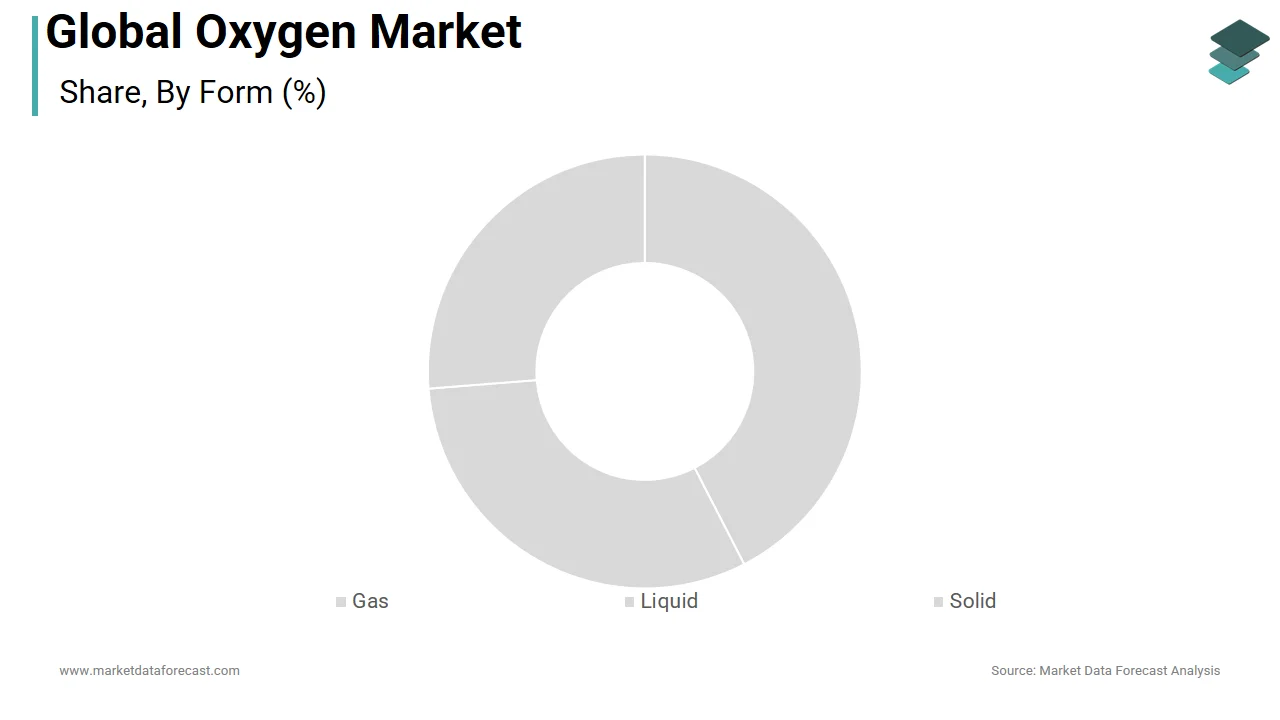
The liquid oxygen segment is predicted to witness the highest CAGR of 7.6% from 2025 to 2033 due to high-density storage and large-scale industrial and medical applications. Major hospitals with several beds increasingly rely on liquid oxygen due to its high storage efficiency; one liter of liquid oxygen expands a significant liters of gas, as per research. This makes it ideal for high-demand environments like ICUs and operating theaters. So, liquid oxygen infrastructure is being prioritized in new healthcare construction projects because hospital bed capacity is expanding in China and India, which ensures sustained demand growth. Liquid oxygen is essential in gasification processes used in coal-to-liquids and hydrogen production. Liquid oxygen’s ability to be transported via cryogenic tankers and stored in vacuum-insulated vessels makes it the only viable form for such massive, continuous feed requirements. This cements its role in heavy industrial transformation.
By Type and Application Insights
The industrial oxygen dominated the oxygen market with a significant share in 2025. The domination of the industrial oxygen segment is due to the extensive application across metals, chemicals, and energy sectors. This volume far exceeds medical demand. The global steel industry consumed millions of tons of oxygen, with a percentage of primary steel production relying on oxygen-based processes, according to a study. In basic oxygen furnaces (BOFs), oxygen injection reduces melting time and improves yield by minimizing impurities. China, producing notable tons of crude steel, accounts for a portion of global industrial oxygen demand, as per the study. The integration of oxygen in electric arc furnaces (EAFs) for scrap-based steelmaking is also rising. This deep integration into metallurgical processes ensures industrial oxygen remains the backbone of large-scale metal production.
The medical oxygen segment is expected to experience a swift rise with a CAGR of 8.3% over the forecast period due to healthcare modernization. Chronic respiratory diseases affect millions of people globally, with COPD alone causing a significant number of deaths annually, as per the research. The number of individuals over 65 is expected to increase by 2050, which increases susceptibility to pneumonia and hypoxemia, according to the study. In Japan, a portion of the population will be over 65 by 2030, as per research. This drives demand for long-term oxygen therapy. The U.S. sees a notable volume of hospitalizations annually for COPD exacerbations, and many require supplemental oxygen, as per research. These demographic and epidemiological shifts are fueling structural demand for medical oxygen across acute and home care settings.
REGIONAL ANALYSIS
Asia-Pacific Oxygen Market Insights
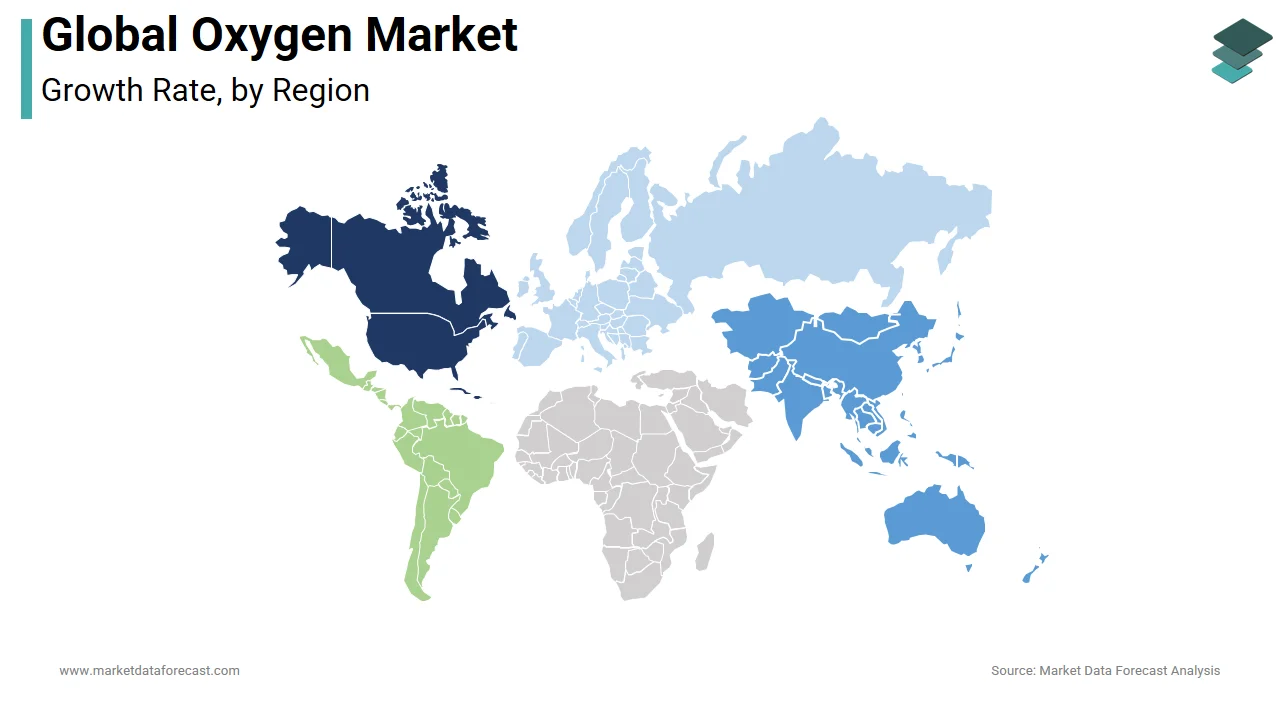
Asia-Pacific was the leading region in the oxygen market in 2024 and accounted for 48.3% of the global market share in 2024. Industrial scale and population density are primarily driving the growth of the Asia Pacific. China and India are the primary engines of demand. China’s industrial sector consumed millions of tons of oxygen, primarily for steel, chemicals, and electronics manufacturing, as per research. India’s healthcare-driven demand surged after 2021, with the government installing on-site oxygen generation plants in public hospitals, as per a study. Japan maintains high per-capita medical oxygen usage due to its aging population. Hence, the region’s oxygen consumption is projected to grow owing to rapid urbanization, expanding industrial parks, and rising healthcare access.
North America Oxygen Market Insights
North America is the next dominant player in the global oxygen market with a 22.7% share of the global market in 2024. The expansion of North America in the global market is mainly attributed to advanced healthcare infrastructure and stringent industrial safety standards. The U.S. healthcare system spends a substantial amount annually on oxygen therapy, including home care and hospital use, according to research. Industrial demand is led by the Gulf Coast petrochemical complex, where oxygen is used in ethylene oxide and propylene oxide production. The Air Products facility in Texas consumes over tons of oxygen daily, as per research. Hence, North America remains a high-value and innovation-driven market because of strong R&D in oxygen concentrators and AI-driven delivery systems.
Europe Oxygen Market Insights
Europe grew steadily in the oxygen market with established industrial and healthcare systems. Germany, France, and the UK are the largest consumers, with Germany operating a number of air separation units (ASUs), as per the study. The steel industry in Europe uses millions of tons of oxygen annually, with ArcelorMittal and ThyssenKrupp integrating oxygen into decarbonization strategies. The EU’s Green Deal is accelerating the use of oxygen in carbon capture and hydrogen production. In healthcare, a large number of Europeans use long-term oxygen therapy. Regulatory push for cleaner industrial processes is reshaping oxygen demand, which favours sustainable production methods and advanced applications.
Middle East & Africa Oxygen Market Insights
Middle East & Africa oxygen market growth is likely due to the demand concentrated in GCC countries and South Africa. Saudi Arabia and the UAE are investing heavily in petrochemical expansion. Saudi Aramco’s gas program will require tons of oxygen daily for gas processing, as per research. South Africa’s Sasol remains one of the world’s largest single-site oxygen consumers. On the medical front, Egypt launched the Comprehensive Health Insurance Program, aiming to millions of citizens, including oxygen therapy access, as per research. In sub-Saharan Africa, only a portion of children with severe pneumonia receive oxygen, according to a study, which emphasizes both gaps and opportunities. Hence, the region is transitioning from fragmented supply to structured and scalable oxygen infrastructure due to rising public health investments and industrial diversification.
Latin America Oxygen Market Insights
Latin America is likely to grow in the global oxygen market, with Brazil and Mexico leading consumption. Brazil’s steel industry, centered in Minas Gerais, consumes notable tons of oxygen annually. Petrobras uses oxygen in offshore gas refining. The prevalence of COPD in urban centers like São Paulo and Bogotá is rising, with millions affected, as per a study. Therefore, increasing industrial modernization and public health reforms are laying the foundation for steady oxygen market growth, while economic volatility limits rapid scaling.
COMPETITIVE LANDSCAPE
The oxygen market is marked by a concentrated yet dynamic competitive landscape, dominated by multinational industrial gas giants that leverage technological superiority, global infrastructure, and long-term supply contracts. Competition is less about price and more centered on reliability, purity, and service integration, particularly in high-stakes environments like hospitals and semiconductor fabs. While European and American firms lead in innovation and sustainability, regional players in Asia are gaining ground through localized production and cost-efficient logistics. The entry of national champions in China and India, supported by government policies, is intensifying regional rivalry. Differentiation is achieved through digital monitoring, decarbonization roadmaps, and hybrid oxygen-hydrogen solutions. The competitive edge increasingly lies in integrated and future-ready gas ecosystems rather than standalone product offerings.
KEY MARKET PLAYERS
Some of the companies that are playing a dominating role in the global oxygen market include
- Linde PLC
- Air Liquids
- Air Products and Chemicals, Inc.
- NIPPON SANSO HOLDINGS CORPORATION
- Messer SE and Co. KGaA
Top Players in the Oxygen Market
- Air Liquide, headquartered in France, is a global leader in industrial and medical gases, with deep integration across the Asia-Pacific oxygen market. The company operates many production facilities in the region, which serve sthe teel, electronics, and healthcare sectors. Air Liquide is positioning itself at the forefront of clean industrial transformation in the region through sustainability initiatives like carbon-neutral ASUs and hydrogen-oxygen co-production.
- Linde operates an extensive gas infrastructure across Asia-Pacific, delivering industrial and medical oxygen to heavy industries and healthcare providers. The company supplies oxygen to major steelmakers, including Nippon Steel and POSCO, through long-term on-site contracts. The company is advancing decarbonization through projects, where oxygen is used in gasification with CO₂ capture. Its dual focus on reliability and innovation strengthens its strategic footprint across industrial and healthcare value chains in the region.
- Messer, one of the largest privately owned industrial gas companies, has significantly expanded its oxygen operations in Asia-Pacific, particularly in Southeast Asia and India. Messer is strengthening its competitive edge in both industrial and healthcare oxygen segments, particularly in emerging markets with rising industrialization and healthcare demand, by combining localized production with advanced supply chain technology.
Top Strategies Used by Key Market Participants
Key players in the oxygen market are prioritizing on-site gas generation to secure long-term contracts with industrial and healthcare clients, reducing dependency on logistics and enhancing supply reliability. Companies are investing in large-scale air separation units (ASUs) integrated directly into steel mills, refineries, and hospitals, which ensures continuous, high-volume delivery. Digitalization is another core strategy; firms are deploying IoT-enabled monitoring systems to track oxygen consumption, predict maintenance, and optimize usage in real time.
MARKET SEGMENTATION
This research report on the global oxygen market has been segmented and sub-segmented into the following categories.
By Form
- Gas
- Liquid
- Solid
By Type
- Medical
- Industrial
By Application
- Metals and Mining
- Chemical Industry
- Oil and Gas
- Healthcare
- Pharmaceutical
- Other Applications
By Region
- North America
- Europe
- Asia Pacific
- Latin America
- The Middle East and Africa