- Product Description Description
- Table of Contents TOC
- List of Table & Figure LOT
- Get Free Sample PDF Sample PDF
Market Size, 2025
$1.99 BnMarket Estimate, 2026
$2.15 BnMarket Forecast, 2034
$4 BnCAGR, 2026–2034
8.08%Executive Summary: Global Portable Oxygen Concentrators Market
- Market Scope: Global assessment of portable oxygen concentrators (POCs) tracking medical devices designed to extract ambient air, filter nitrogen, and deliver concentrated oxygen to support patient mobility and chronic respiratory care.
- Market Valuation: Valued at USD 1.99 billion in 2025, reaching USD 2.15 billion in 2026, and projected to scale up to USD 4 billion by 2034, registering a compound annual growth rate (CAGR) of 8.08% from 2026 to 2034.
- Primary Growth Drivers: Rising global prevalence of chronic respiratory conditions (like COPD and pulmonary fibrosis) within aging populations, combined with an increasing emphasis on patient mobility, active lifestyles, and regulatory travel approvals.
Key Market Segment Metrics (2026–2034)
| Category | Leading Segment / Core Focus | Fastest-Growing / Key Segments |
|---|---|---|
| By Product | Portable Oxygen Concentrator & Cylinders (held a prominent share in 2025 due to dual functionality combining on-the-go mobility with backup oxygen supply) | Stationary Oxygen Concentrator & Cylinders (projected to grow at a CAGR of 8.7% driven by home healthcare adoption for round-the-clock support) |
| By Technology | Continuous Flow (occupied the largest share in 2025 driven by severe respiratory conditions and sleep apnea care requirements) | Pulse Flow / Continuous Flow (Pulse flow prioritized for superior energy efficiency and ambulatory mobility; Continuous flow registering a 9.1% CAGR for steady delivery needs) |
| By Region | North America (outperformed globally with a 43.2% share in 2025 anchored by high chronic lung disease prevalence, Medicare coverage, and FAA approvals) | Asia-Pacific & Europe (expanding rapidly due to aging demographics, government health programs, and national home oxygen reimbursement policies) |
Major Market Players & Industry Landscape
Competitive Structure: Highly competitive and innovation-driven environment featuring established medical device manufacturers and specialized respiratory firms competing on battery efficiency, digital telehealth integration, noise reduction, and lightweight design.
Key Companies Profiled: Koninklijke Philips N.V., Inogen Inc., Chart Industries Inc., ResMed Inc., Invacare Corporation, Drive DeVilbiss Healthcare, Precision Medical Inc., Foshan Keyhub Electronic Industries Co., Ltd., O2 Concepts LLC, and GCE Group.
Global Portable Oxygen Concentrators Market Size
The global portable oxygen concentrators market was valued at USD 1.99 billion in 2025 and is expected to reach USD 4 billion by 2034 from USD 2.15 billion in 2026, growing at a CAGR of 8.08%. From 2026 to 2034.
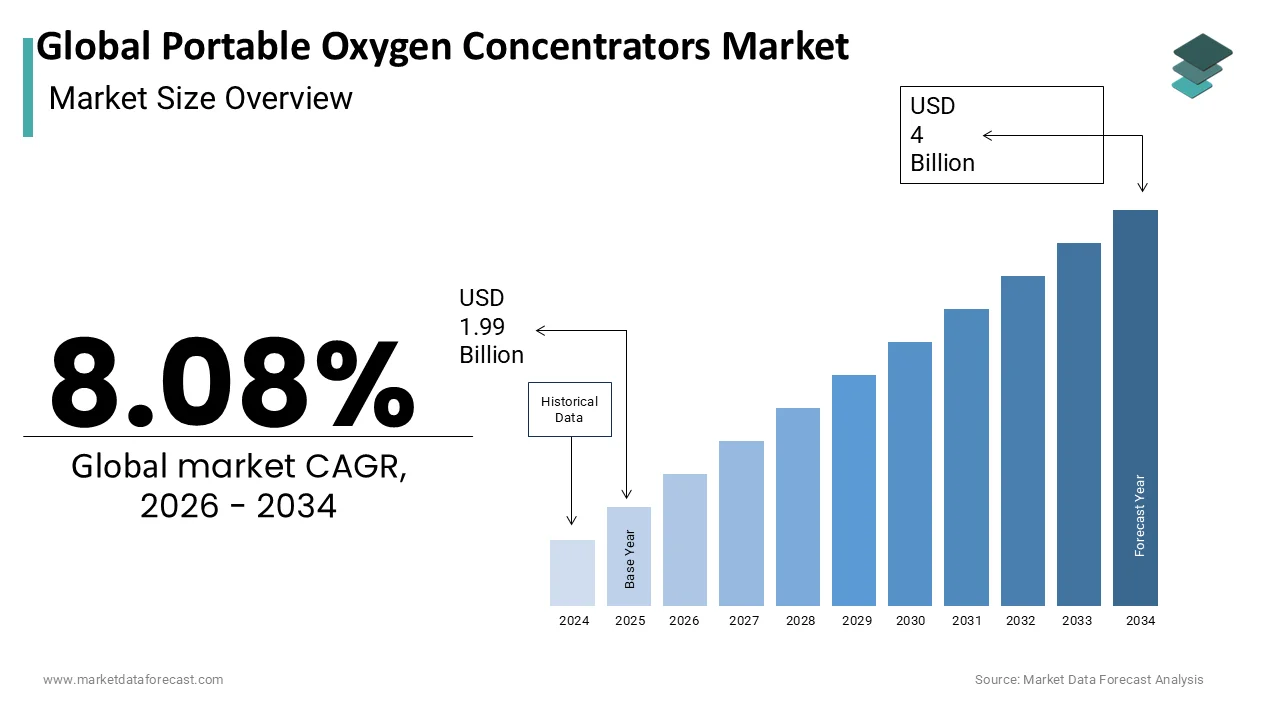
Current Introduction and Definition of the Portable Oxygen Concentrators Market Portable oxygen concentrators (POCs) are compact medical devices that extract ambient air, filter out nitrogen, and deliver concentrated oxygen to individuals with chronic respiratory insufficiency, enabling mobility and improved quality of life.
MARKET DRIVERS
Rising Prevalence of Chronic Respiratory Diseases in Aging Populations
The escalating global burden of chronic respiratory conditions, particularly COPD and pulmonary fibrosis, is a primary factor driving the growth of the portable oxygen concentrators market. According to the Global Burden of Disease Study 2023, COPD alone accounts for over 3.2 million deaths annually, with prevalence rates rising in tandem with aging demographics. According to the U.S. Centers for Disease Control and Prevention, approximately 16 million Americans have been diagnosed with COPD, though the actual number may be higher due to underdiagnosis.
Increasing Emphasis on Patient Mobility and Quality of Life
The respiratory care philosophy is patient autonomy and active lifestyles, fueling demand for portable oxygen solutions. As per the European Lung Foundation, over 70% of oxygen-dependent patients express a strong preference for devices that allow participation in daily activities, travel, and social engagement. Regulatory support further reinforces this trend, with the U.S. Federal Aviation Administration (FAA) having approved over 20 POC models for in-flight use by enabling air travel for oxygen-reliant individuals.
MARKET RESTRAINTS
Limited Reimbursement Coverage in Low- and Middle-Income Countries
Access to portable oxygen concentrators in many low- and middle-income countries due to inadequate insurance coverage and high out-of-pocket costs is limiting the growth of the Portable Oxygen Concentrators Market. As per the World Health Organization’s Global Diffusion of Respiratory Technologies report, fewer than 15% of patients in sub-Saharan Africa and South Asia receive long-term oxygen therapy despite clinical need. In India, where COPD prevalence exceeds 30 million, government health schemes cover only stationary oxygen concentrators, excluding portable variants from reimbursement lists.
Battery Life Limitations and Operational Constraints in Remote Settings
The battery performance in off-grid or rural environments is also hindering the growth of the Portable Oxygen Concentrators Market. In high-altitude regions such as the Andes or Himalayas, device efficiency declines due to reduced atmospheric oxygen, which is requiring higher power consumption to maintain output. The U.S. Department of Veterans Affairs reports that 32% of POC users experience disruptions during extended travel due to insufficient charging infrastructure. Additionally, extreme temperatures common in regions like the Middle East or Arctic climates can degrade battery integrity and shorten lifespan.
MARKET OPPORTUNITIES
Integration of Smart Technology and Remote Patient Monitoring
The adoption of digital health and respiratory care through embedded connectivity and real-time monitoring is lucratively to propel the growth of the Portable Oxygen Concentrators Market. As per a 2025 assessment by the Mayo Clinic Center for Digital Health, over 60% of chronic respiratory patients are willing to use devices with Bluetooth-enabled telemetry for remote clinical oversight. Companies like Inogen and Philips have introduced POCs with integrated sensors that track oxygen saturation, usage patterns, and battery status, transmitting data to mobile applications and clinician dashboards.
Expansion of Home Healthcare Infrastructure in Emerging Economies
The rapid development of home-based medical services in emerging countries is prompting the growth of the Portable Oxygen Concentrators Market. Similarly, India’s Ayushman Bharat Digital Mission is integrating home oxygen therapy into its telemedicine framework, with state governments distributing concentrators to high-risk patients in rural zones. A joint initiative by Thailand’s Ministry of Public Health and private providers has already deployed over 15,000 POCs in community health centers.
MARKET CHALLENGES
Regulatory Heterogeneity Across Global Markets
The stringent regulatory standards and approval timelines across jurisdictions are posing a challenging factor for the growth of the Portable Oxygen Concentrators Market. As per the Global Harmonization Task Force on Medical Devices, only 38 countries fully recognize the International Electrotechnical Commission’s (IEC) safety standards for oxygen-generating devices, leading to fragmented compliance requirements. Additionally, aviation compliance varies; while the FAA maintains a standardized list, airlines in Africa and parts of Asia lack uniform policies for in-flight POC use.
Risk of Device Misuse and Inadequate Patient Training
Improper use of portable oxygen concentrators due to insufficient patient education poses significant clinical and safety risks. As per a 2023 study published in Respiratory Care, nearly 45% of new POC users fail to operate their devices correctly within the first month, leading to suboptimal oxygen delivery and increased risk of hypoxemia. In home settings, caregivers often lack formal training; a Canadian Thoracic Society survey found that only 30% of patients receive structured education before POC initiation.
REPORT COVERAGE
| REPORT METRIC | DETAILS |
| Market Size Available | 2025 to 2034 |
| Base Year | 2025 |
| Forecast Period | 2026 to 2034 |
| Segments Covered | By Product, Technology, End-Use, and Region |
| Various Analyses Covered | Global, Regional & Country Level Analysis, Segment-Level Analysis, DROC, PESTLE Analysis, Porter’s Five Forces Analysis, Competitive Landscape, Analyst Overview of Investment Opportunities |
| Regions Covered | North America, Europe, APAC, Latin America, Middle East & Africa |
| Market Leaders Profiled | Koninklijke Philips N.V., Inogen Inc., Chart Industries Inc., ResMed Inc., Invacare Corporation, Drive DeVilbiss Healthcare, Precision Medical Inc., Foshan Keyhub Electronic Industries Co., Ltd., O2 Concepts LLC, and GCE Group |
SEGMENTAL ANALYSIS
By Product Insights
The portable oxygen concentrator & cylinders segment accounted in holding a prominent share of the Portable Oxygen Concentrators Market in 2025, with its dual functionality, combining on-the-go mobility with backup oxygen supply during battery depletion. According to the U.S. Department of Health and Human Services, over 1.8 million Americans rely on ambulatory oxygen therapy, with 72% citing travel preparedness as a factor in device selection. The inclusion of lightweight cylinders as emergency reserves enhances patient confidence, particularly during air travel or outdoor activities. Furthermore, clinical guidelines from the British Thoracic Society emphasize the importance of fail-safe oxygen delivery in chronic respiratory patients, reinforcing the preference for systems that combine continuous concentrator output with cylinder-based redundancy.

The stationary oxygen concentrator & cylinders segment is likely to grow with an expected CAGR of 8.7% during the forecast period, owing to the increasing adoption in home healthcare settings, particularly in aging populations requiring round-the-clock oxygen support. Additionally, hybrid systems that link stationary concentrators to portable cylinders enable seamless transitions between indoor and outdoor use, a feature increasingly prioritized by caregivers.
By Technology Insights
Based on technology, the continuous flow segment occupied the largest share of the global portable oxygen concentrators market in 2025, and the segment’s domination is anticipated to continue during the forecast period. The segmental growth is driven by the growing patient population suffering from respiratory diseases, the increasing aging population, and the rapid adoption of technological developments. Patients suffering from sleep apnea require a continuous oxygen supply, and the increasing patient count suffering from sleep apnea disease is boosting the growth of continuous portable oxygen concentrators. The benefits of continuous portable oxygen concentrators, such as being user-friendly and easier to transport, are contributing to the segmental growth.
The pulse flow segment is estimated to witness a steady CAGR during the forecast period. Factors such as increasing usage of pulse flow oxygen concentrators by travelers, increased portability, and energy efficiency are driving the segmental growth.
By End-User Insights
The pulse flow technology segment was the largest and held a dominant share of the portable oxygen concentrator market in 2025, with its superior energy efficiency and patient-centric design, making it ideal for ambulatory users. Pulse-dose systems deliver oxygen only during inhalation, conserving battery life by up to 50% compared to continuous flow, as validated in clinical testing at the Cleveland Clinic. Additionally, the compact size of pulse-flow devices enhances portability.
The continuous flow segment is anticipated to register a CAGR of 9.1% in the coming years, with the increasing demand from patients with severe respiratory conditions who require steady oxygen delivery, especially during sleep or at rest. Moreover, advancements in miniaturization have reduced the size and power consumption of continuous-flow POCs; the Philips SimplyGo Mini now delivers up to 2 L/min in continuous mode on a single charge. Regulatory approvals for home ventilator integration are further expanding its application in complex respiratory care.
REGIONAL ANALYSIS
North America Portable Oxygen Concentrators Market
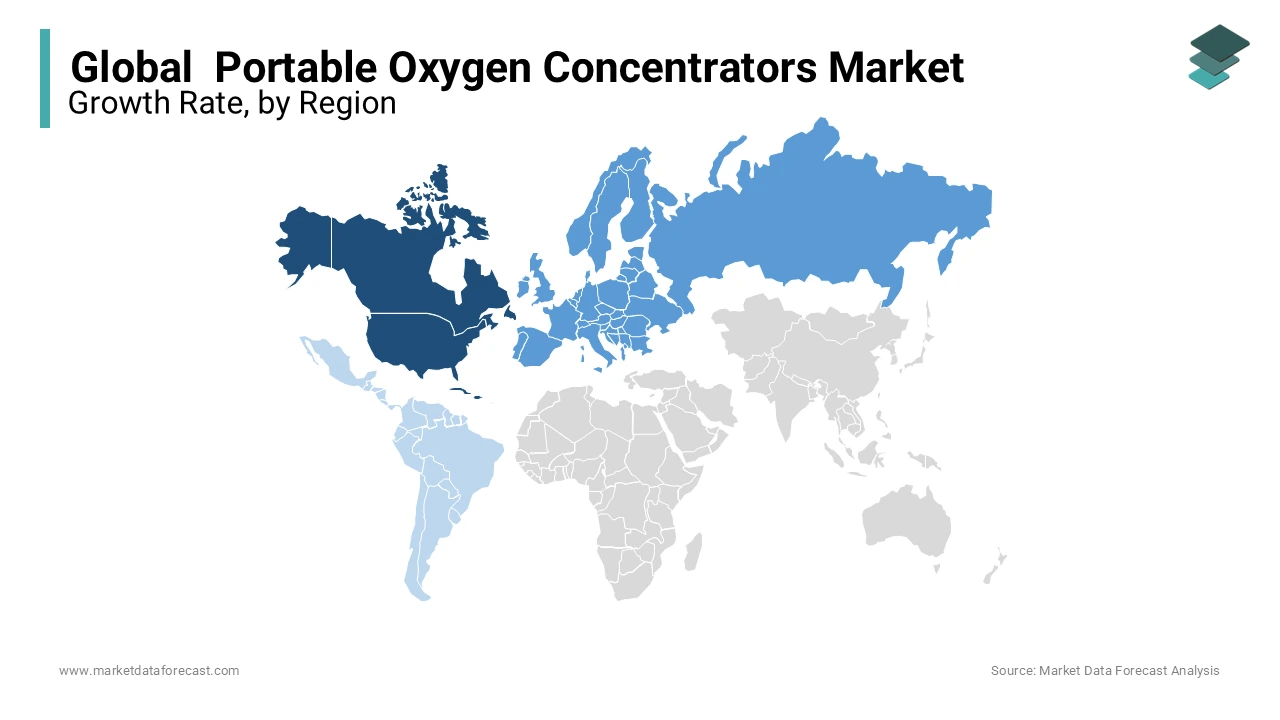
North America outperformed in the global portable oxygen concentrators market by occupying 43.2% of the share in 2025, with a high prevalence of chronic lung diseases and robust reimbursement frameworks that support home oxygen therapy. According to the U.S. Centers for Disease Control and Prevention, 16 million Americans have been diagnosed with COPD, with over 1.5 million actively using portable oxygen devices. Medicare covers POCs under its durable medical equipment program, contributing to widespread adoption. Additionally, the Federal Aviation Administration’s approval of 22 POC models for air travel has normalized mobile oxygen use by encouraging manufacturers to prioritize innovation and compliance.
Europe Portable Oxygen Concentrators Market
Europe portable oxygen concentrators market held 35.45 of the share in 2025. According to the European Respiratory Society, over 20 million Europeans suffer from moderate to severe COPD, with national programs in Germany, France, and the UK providing subsidized access to POCs. In the United Kingdom, NHS England dispenses over 250,000 oxygen prescriptions annually, with portable units accounting for nearly 40% of new allocations. Regulatory alignment under the EU Medical Device Regulation ensures high safety standards, while initiatives like the European Innovation Partnership on Active and Healthy Ageing promote independent living for respiratory patients. The growing integration of telehealth with oxygen monitoring further enhances the value proposition of portable systems across the continent.
Asia-Pacific Portable Oxygen Concentrators Market
The Asia-Pacific portable oxygen concentrator market is likely to grow with the rising respiratory disease burden and healthcare modernization. China reports over 100 million individuals with COPD, according to the Chinese Medical Association, while India faces a growing epidemic of indoor air pollution-related lung damage, affecting over 30 million rural residents, as noted by the Public Health Foundation of India. Japan, with 28% of its population aged 65 or older, has implemented national programs to distribute oxygen devices to elderly patients with chronic respiratory failure. South Korea’s Ministry of Health and Welfare has expanded insurance coverage for POCs since 2021, leading to a 40% increase in prescriptions.
Latin America Portable Oxygen Concentrators Market
Latin America portable oxygen concentrator market growth is ascribed to have significant and steady pace in the coming years. Brazil and Mexico report the highest COPD prevalence in the region, with the Brazilian Ministry of Health estimating over 7 million affected individuals. Public-private partnerships, such as Argentina’s collaboration with international NGOs to deploy solar-powered concentrators in remote areas, are beginning to bridge gaps.
Middle East and Africa Portable Oxygen Concentrators Market
The Middle East and Africa portable oxygen concentrator market is expected to have a steady pace in the coming years. In Saudi Arabia, the Ministry of Health has integrated POCs into its national COPD management strategy by aiming to reduce hospital admissions through home-based care.
COMPETITIVE LADNSCAPE
The competitive environment in the portable oxygen concentrators market is marked by technological differentiation, strategic regional expansion, and a growing emphasis on patient experience. Established medical device manufacturers compete with specialized respiratory firms, each leveraging unique strengths in engineering, connectivity, and service delivery. Innovation in battery efficiency, noise reduction, and compact design has become a key differentiator, particularly for ambulatory users. The market is also witnessing a shift toward integrated care models, where POCs serve as nodes in broader digital health networks.
KEY MARKET PLAYERS
Some of the companies that are playing a dominating role in the Global Portable Oxygen Concentrators Market include
- Koninklijke Philips N.V.
- Inogen Inc.
- Chart Industries Inc.
- ResMed Inc.
- Invacare Corporation
- Drive DeVilbiss Healthcare
- Precision Medical Inc.
- Foshan Keyhub Electronic Industries Co., Ltd.
- O2 Concepts LLC
- GCE Group
TOP LEADING PLAYERS IN THE MARKET
- Philips Respironics has established a significant footprint in the Asia Pacific portable oxygen concentrator market through its focus on integrated respiratory care ecosystems. The company’s SimplyGo and SimplyGo Mini devices combine pulse and continuous flow capabilities, catering to diverse patient needs across urban and semi-urban healthcare settings. In Japan, Philips collaborates with national health institutions to support home-based oxygen therapy programs for aging populations. In 2023, the company launched a telehealth-enabled POC model in Australia, allowing remote monitoring of usage and device performance. It also partnered with Indian distributors to expand access in tier-2 and tier-3 cities, where demand for home respiratory care is rising.
- Inogen has intensified its engagement in the Asia Pacific market by leveraging its reputation for lightweight, high-efficiency portable oxygen concentrators. The Inogen One G5, known for its extended battery life and FAA approval, has gained traction in countries like South Korea and Singapore, where regulatory standards align closely with U.S. benchmarks. In 2022, Inogen initiated clinical validation studies in collaboration with respiratory centers in Taiwan to assess device performance in Asian patient demographics. The company also introduced multilingual user interfaces and localized customer support to enhance adoption. In Australia, it expanded its direct-to-consumer distribution model, reducing reliance on traditional medical supply chains.
- BD has strengthened its presence in the Asia Pacific portable oxygen concentrator space through strategic partnerships and a focus on infection-safe oxygen delivery systems. While traditionally known for medical devices and diagnostics, BD has expanded into respiratory support by integrating concentrators with its oxygen administration accessories, such as nasal cannulas and humidification systems. In India, BD collaborated with government health programs to supply concentrators during post-pandemic respiratory care expansion, enhancing its visibility in public health procurement. In 2023, it launched a training initiative for healthcare providers in Indonesia and the Philippines on optimal oxygen delivery techniques.
TOP STRATEGIES USED BY KEY MARKET PARTICIPANTS
Key players in the portable oxygen concentrators market are deploying multifaceted strategies to consolidate their influence, including product innovation, regulatory expansion, and digital integration. Companies are investing heavily in lightweight, energy-efficient designs with dual-flow capabilities to meet diverse clinical needs. Strategic collaborations with healthcare providers and government agencies are enabling broader distribution, particularly in emerging markets. Firms are also enhancing device intelligence through Bluetooth connectivity and mobile applications for real-time monitoring and patient adherence tracking. Regulatory approvals across multiple jurisdictions, including aviation compliance, are being prioritized to expand usability. Additionally, companies are strengthening after-sales support, offering training programs and remote troubleshooting to improve patient outcomes and brand loyalty in an increasingly competitive and patient-driven market landscape.
RECENT MARKET DEVELOPMENTS
- In March 2023, Philips Respironics launched the SimplyGo Mini with integrated telehealth capabilities in Australia by enabling clinicians to remotely monitor oxygen usage and device performance.
- In July 2023, Inogen initiated clinical validation trials in Taiwan in collaboration with local respiratory institutes to evaluate the efficacy of its G5 concentrator in Asian patient populations with future regulatory submissions and market entry strategies in high-growth East Asian markets.
- In November 2023, BD partnered with India’s National Health Mission to supply portable oxygen concentrators equipped with infection-control accessories to rural health centers by expanding its footprint in public health infrastructure and strengthening its presence in low-resource settings across South Asia.
- In January 2025, Philips secured regulatory approval for its SimplyGo devices in South Korea, aligning with the country’s expanded home oxygen therapy reimbursement policy and enabling broader adoption among elderly patients with chronic respiratory conditions.
- In May 2025, Inogen introduced a localized customer support platform in Singapore, offering multilingual service and direct-to-consumer sales, reducing dependency on traditional distributors and improving accessibility for patients seeking ambulatory oxygen solutions in Southeast Asia.
MARKET SEGMENTATION
This market research report on the global portable oxygen concentrators market has been segmented and sub-segmented based on the product, technology, end-user, and region.
By Product
- Portable Oxygen Concentrator & Cylinders
- Stationary Oxygen Concentrator & Cylinders
- Oxygen Concentrator & Cylinders
By Technology
- Continuous Flow
- Pulse Flow
By End-User
- Home Care
- Non-Home Care
- Others
By Region
- North America
- Europe
- Asia-Pacific
- Latin America
- The Middle East and Africa