- Product Description Description
- Table of Contents TOC
- List of Table & Figure LOT
- Get Free Sample PDF Sample PDF
Market Size, 2025
$66.84 BnMarket Estimate, 2026
$72.76 BnMarket Forecast, 2034
$143.50 BnCAGR, 2026–2034
8.86%Global Pediatric Vaccines Market Size
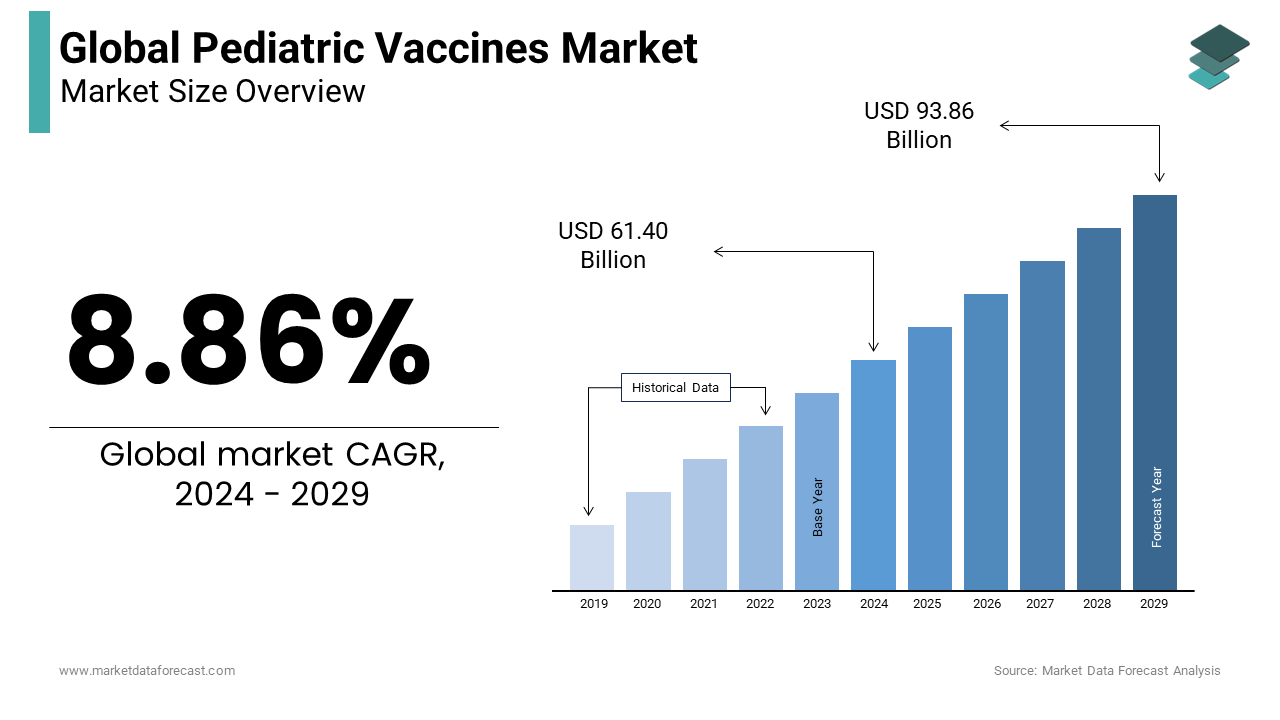
The global pediatric vaccines market was valued at USD 66.84 billion in 2025, is estimated to reach USD 72.76 billion in 2026, and is projected to reach USD 143.50 billion by 2034, growing at a CAGR of 8.86% from 2026 to 2034.
MARKET DRIVERS
Growing R&D activities is one factor propelling the growth of the pediatric vaccines market.
For many years, there have been increased R&D activities on vaccines due to the outbreak of various diseases and infections. Continued research for the invention of newly developed vaccines is anticipated to showcase a favorable impact on the pediatric vaccines market growth over the forecast period. Increasing research activities would bring on enhanced quality in the vaccines and helps the immune system fight infections more effectively by activating the immune response, invading the virus to open its entry in the future. This safe way of creating immunity against certain diseases is significant for children, which is the primary reason behind the growth of the global pediatric vaccines market.
Growing awareness regarding the importance of vaccines further boosts the market’s growth rate.
Vaccines play a crucial role in saving lives. The risks of vaccines are negligible compared to the risks of the diseases that can cause severe harm or death, especially in people with developing immune systems, such as babies, who must be immunized against highly contagious diseases such as diphtheria, measles, and poliomyelitis. Furthermore, the vaccines save families time and prevent them from entering financial burdens since some long-term disability-causing diseases, such as polio, also protect future generations. Moreover, it has been declared by UNICEF that vaccination has led to the virtual disappearance of poliomyelitis, a deadly viral disease responsible for paralyzing children, whose incidence has been reduced to 99% since 1988. Such huge benefits of vaccines acting as life saviors are further anticipated to drive market growth.
Furthermore, each vaccine goes through rigorous safety testing and clinical trials to get eligibility for usage by the people. Vaccines must also get government approval to distribute and market the drug and make it available for the public, ensuring rigorous quality and safety standards. This overcomes the concern for children from parents for safety and efficiency, thereby driving market growth.The growing need and increasing awareness among the population regarding the benefits of pediatric vaccines are further promoting market growth.
The increased awareness about the benefits of vaccination in disease prevention among the population, such as HPV (human papillomavirus, polio, tetanus, and rubella), hepatitis A, and hepatitis B, mainly affecting the pediatric population owing to their weak immune system, especially in low and middle-income countries in the rural areas, through additional government support and non-profitable organizations are foreseen to augment the growth of the pediatric vaccines market. The growing efforts of the major market participants to develop next-generation vaccines and to increase R&D activities are anticipated to offer growth opportunities to the pediatric vaccines market. In addition, the strategies adopted by the market participants, such as collaborations and partnerships, have increased the accessibility of vaccines in rural areas. With the help of favorable reimbursement policies and increasing government support, pediatric vaccine manufacturers are focussing on creating combination vaccines for diseases.
MARKET RESTRAINTS
The major restraints faced by the global pediatric vaccines market are poor accessibility of vaccines to remote areas and the increasing availability of low-cost biosimilars in most rural and low-income countries. However, the primary factor that is highly responsive to act as a massive drawback for the global pediatric vaccines market would be parents' reluctance to vaccinate their children for fear of its side effects. Some common signs and symptoms include an inability to make eye contact, lack of response to loud sounds, inability to learn new words, and many others, even though these occur in rare cases. Moreover, it has been reported by the CDC that at least 1 in 68 children is affected by a mental disorder, autism spectrum disorder, resulting in a loss of communication skills. These factors lead to an overall decline in the growth of the market.
REPORT COVERAGE
| REPORT METRIC | DETAILS |
| Market Size Available | 2025 to 2034 |
| Base Year | 2025 |
| Forecast Period | 2026 to 2034 |
| Segments Covered | By Type, Technology, Application & Region |
| Various Analyses Covered | Global, Regional, and Country-Level Analysis, Segment-Level Analysis, Drivers, Restraints, Opportunities, Challenges; PESTLE Analysis; Porter’s Five Forces Analysis, Competitive Landscape, Analyst Overview of Investment Opportunities |
| Regions Covered | North America, Europe, Asia Pacific, Latin America, Middle East & Africa |
| Market Leaders Profiled | Merck Sharp & Dohme Corp., Zydus Cadila, Sinovac Biotech Ltd., GlaxoSmithKline plc., Bio-Med Pvt. Ltd., SANOFI, Pfizer, Inc., Mitsubishi Tanabe Pharma Corporation, Panacea Biotec and AstraZeneca. |
SEGMENTAL ANALYSIS
By Vaccine Type Insights
The monovalent segment is expected to be the most significant contributor to the pediatric vaccine market during the forecast period owing to its safety and stability. It immunizes a person against a single antigen or a particular pathogen. Moreover, the efficiency of uptake of a monovalent vaccine is higher than that of multivalent vaccines, eliciting a rapid immune response. ATTENUVAX, MUMPSVAX, and MERUVAX, like monovalent vaccines, specifically target one of the pathogens to protect against mumps, measles, and rubella. In addition, improved healthcare services increased awareness of the immunization programs among the people, and increased research and development activities would further help the market grow.
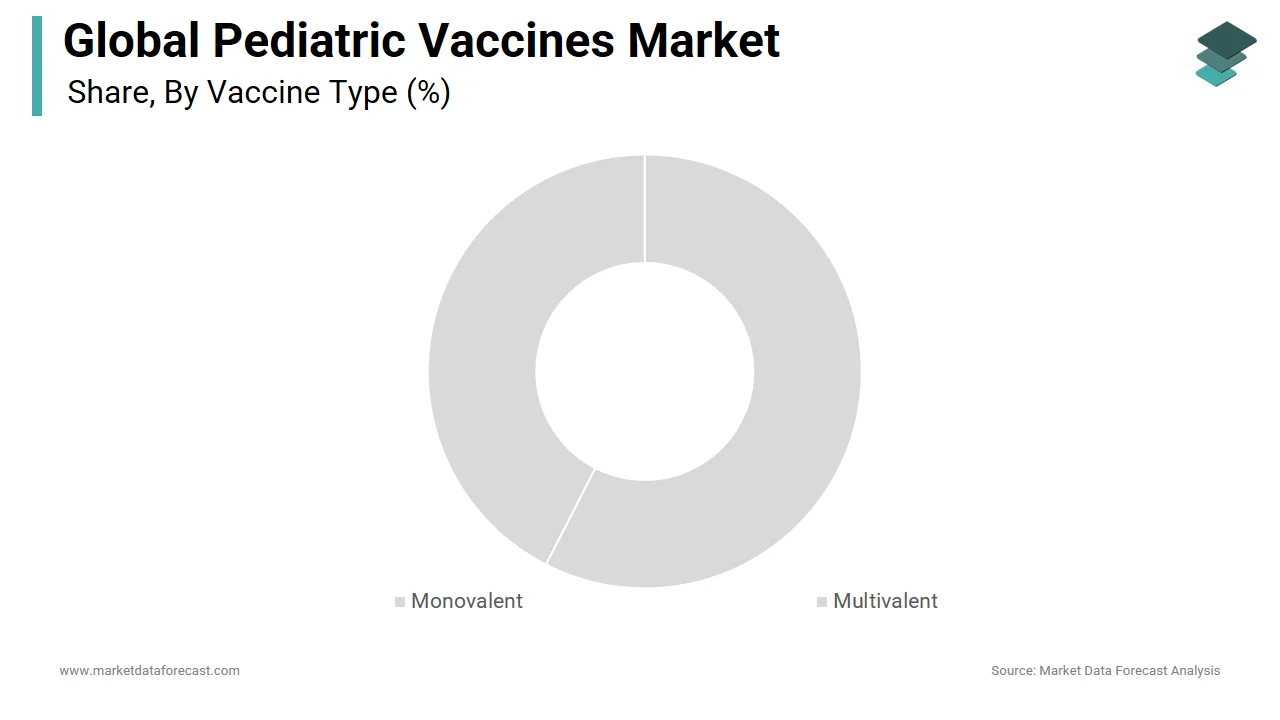
On the other hand, the multivalent segment is expected to show the fastest market growth during the forecast period due to improved diagnostic procedures, an increase in the prevalence of infectious diseases among children, rapid economic growth in developing countries, and a high focus on significant players on the development of hexavalent, tetravalent and pentavalent vaccines since these multivalent or polyvalent vaccines protect hosts against infections caused by two or more pathogens, reducing the need for multiple injections, unlike in the case of a monovalent vaccine. Furthermore, these vaccines are expected to provide immunity for complex diseases such as malaria and HIV in children, leading to their further adoption.
By Technology Insights
The conjugate vaccines segment is anticipated to hold the largest share of the pediatric vaccines market over the forecast period. This is because conjugate vaccines are more effective than other technologies, eliciting a significant immune response against bacterial capsular polysaccharides. In addition, these also help develop herd immunity since they generate immunological memory and reduce the asymptomatic carriage of the bacteria, further helping the growth of these vaccines.
The inactivated vaccines segment is anticipated to account for a substantial market share during the forecast period owing to the increasing adoption. Inactivated vaccines consist of killed particles such as viruses, bacteria, and other pathogens, which are introduced into the body as an antigenic substance. They are prepared by culturing these pathogens and heat-killed by formaldehyde.
By Application Insights
The infectious disease segment is anticipated to dominate the pediatric vaccines market during the forecast period. Growing awareness of vaccination against several infectious diseases to avoid mortality and morbidity, coupled with improved government initiatives to prevent this disease, especially in young children and infants, is driving the segment's growth. The vaccines potentially protect pediatrics from many severe, even fatal infections such as pneumococcal meningitis and pneumonia, affecting the tissues covering the brain and spinal cord, and lungs, respectively.The measles, mumps, and rubella segment is also predicted to hold a substantial market share due to implementing a top-notch monitoring system in various countries to protect against these diseases in children.
REGIONAL ANALYSIS
The North American region is anticipated to hold a promising share of the global market over the forecast period due to the presence of advanced healthcare infrastructure, increased investments in R&D by the key market players, rising awareness among the public of various diseases regarding the importance of giving pediatric vaccines to children, increased government support for childhood immunization and vaccine development from North American countries, presence of key market participants, increasing pediatric population, and high demand for better vaccination facilities. Furthermore, the growing awareness in this region is also due to the American Academy of Paediatrics (AAP) initiative, which recommends receiving combination vaccines for pediatrics. The combination helps reduce the number of vaccines a child receives, preventing the need to vaccinate frequently. These factors further drive market growth.
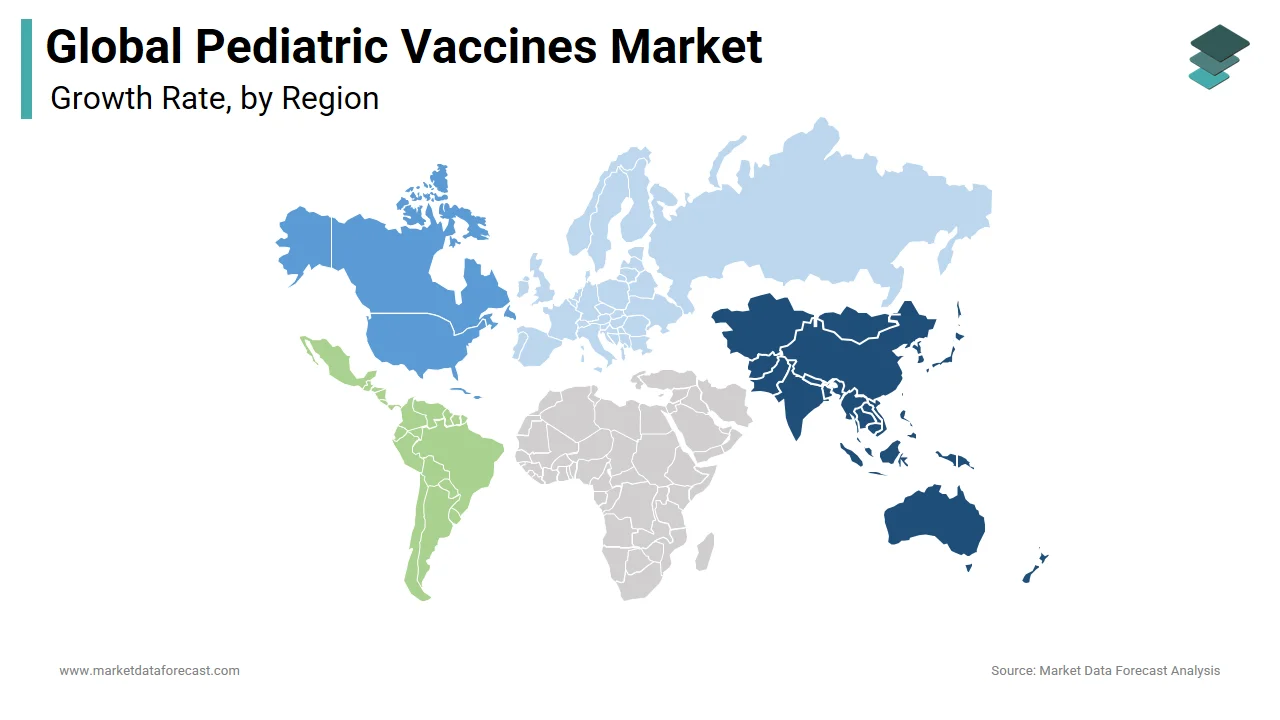
The region of Europe is expected to grow at a healthy CAGR over the forecast market. The UK is expected to play a vital role in the European market owing to the growing vaccination programs in the UK, which are especially beneficial for the pediatric population. The UK Health Security Agency helped people by creating a timeline for every vaccine development. This also helps in the timely delivery of the vaccine to children without any burden on the parents. Furthermore, increased spending by the UK government on introducing a series of pediatric group vaccination programs and developing pharmaceutical and medical industries is anticipated to drive the UK pediatric vaccine market.
Asia-Pacific is expected to grow at the highest CAGR over the forecast period due to improved government initiatives to improve healthcare, especially in emerging economies such as India and China. Moreover, the COVID-19 outbreak and the presence of market players in China, along with its high population, are expected to raise the production of vaccines for the pediatric age group, driving the overall market growth in the region.
The Latin America, Middle East, and Africa region is expected to grow steadily, owing to significant development of healthcare infrastructure, in addition to high awareness of pediatrics vaccination among the population and delivery of free vaccination at various camps set with the help of the government to make it available in the developing countries. These factors would further drive the regional market.
KEY MARKET PLAYERS
Some of the companies that are playing a dominating role in the global pediatric vaccines market include
- Merck Sharp & Dohme Corp.
- Zydus Cadila
- Sinovac Biotech Ltd.
- GlaxoSmithKline plc
- Bio-Med Pvt. Ltd.
- Sanofi
- Pfizer Inc.
- Mitsubishi Tanabe Pharma Corporation
- Panacea Biotec
- AstraZeneca
GLOBAL PEDIATRIC VACCINES MARKET NEWS
- In November 2022, Pfizer Inc. released MATISSE Phase 3 clinical trial results of the bivalent RSV perfusion vaccine, which had been seen to protect babies from RSV disease after birth when given to pregnant participants. It has also been investigated that the vaccine is well tolerated with no safety concerns for vaccines and their neonates.
- In July 2022, Ohio State University scientists researched the COVID-19 vaccine to advance it using a modified live attenuated mumps virus for delivery by incorporating a coronavirus antigen into the MMR vaccine to gain immunity against the COVID-19 virus in children.
MARKET SEGMENTATION
This research report on the global pediatric vaccines market has been segmented and sub-segmented into the following categories.
By Vaccine Type
-
Monovalent
- Multivalent
By Technology
-
Live Attenuated
- Inactivated
- Subunit
- Toxoid
- Conjugate
- Other Technologies
By Application
- Infectious Disease
- Cancer
- Allergy
- Pneumococcal Disease
- Influenza
- Measles, Mumps, and Rubella (MMR)
- Other Applications
By Region
- North America
- Europe
- Asia-Pacific
- Latin America
- Middle East and Africa