- Product Description Description
- Table of Contents TOC
- List of Table & Figure LOT
- Get Free Sample PDF Sample PDF
Market Size, 2025
$3.54 BnMarket Estimate, 2026
$4.28 BnMarket Forecast, 2034
$19.47 BnCAGR, 2026–2034
20.85%Global Phase Change Materials Market Size
The global phase change materials market size was valued at USD 3.54 billion in 2025 and is anticipated to reach USD 4.28 billion in 2026 and USD 19.47 billion by 2034, growing at a CAGR of 20.85% during the forecast period from 2026 to 2034.
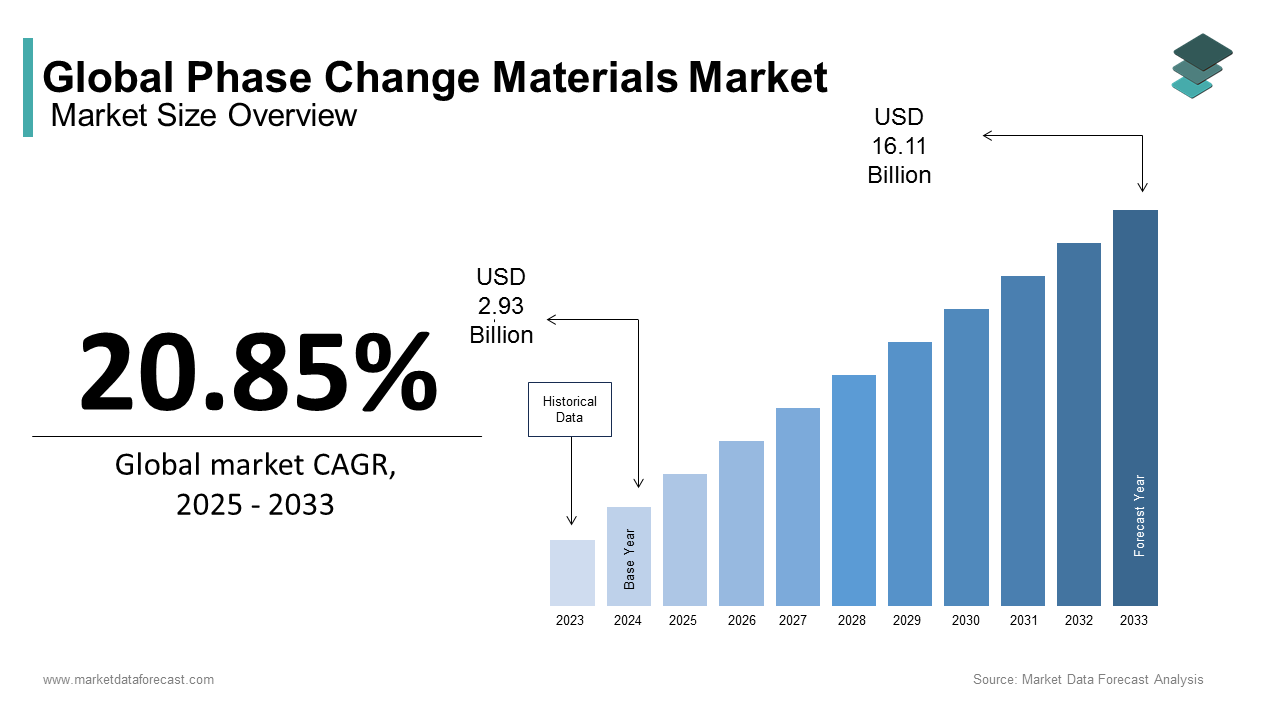
The Phase Change Materials (PCMs) are engineered to absorb, store, and release thermal energy during transitions between solid and liquid states through latent heat. These materials are increasingly deployed in applications that require passive temperature regulation, including building envelopes, cold chain logistics, electronic thermal management, and wearable technology. As per the International Energy Agency, buildings account for nearly 30% of global final energy consumption, with space heating and cooling representing over 50% of that demand, intensifying the need for advanced thermal storage solutions.
MARKET DRIVERS
Escalating Demand for Energy-Efficient Building Technologies
The global construction sector’s pivot toward energy-efficient and net-zero buildings is driving the growth of the Phase Change Materials (PCMs) market. According to the United Nations Environment Programme, buildings are responsible for 37% of global CO₂ emissions from energy use, which is prompting governments to enforce stricter thermal performance standards. In response, architects and developers are incorporating PCMs into gypsum boards, concrete, and insulation panels to enhance thermal inertia. Similarly, Japan’s Ministry of Economy, Trade, and Industry mandates the use of dynamic insulation materials in public buildings, accelerating PCM deployment. These regulatory and performance-driven shifts are transforming PCMs from niche additives into mainstream components of sustainable building design.
Expansion of Temperature-Sensitive Logistics in Healthcare and Pharmaceuticals
The proliferation of biologics, vaccines, and personalized medicines requiring strict thermal control is escalating the growth of the Phase Change Materials (PCMs) market. As per the World Health Organization, up to 50% of vaccines are wasted globally due to temperature deviations during transport, with the need for reliable passive cooling. PCMs with phase transition ranges between 2°C and 8°C, such as salt hydrates and organic compounds, are now embedded in insulated shipping containers to maintain stability without refrigeration units. Pfizer reported that its use of PCM-lined containers during the global distribution of mRNA vaccines achieved a failure rate of less than 0.3% in maintaining the required –70°C environment when combined with dry ice.
MARKET RESTRAINTS
High Material and Integration Costs in Commercial Applications
The widespread PCM adoption is hindered by elevated production and implementation costs, which are hampering the growth of the Phase Change Materials (PCMs) market. Additionally, encapsulation processes necessary to prevent leakage and enhance durability can increase final product costs by 40–70%, according to the National Renewable Energy Laboratory. In developing economies, where construction budgets are tightly constrained, these premiums limit feasibility.
Limited Long-Term Stability and Degradation Under Thermal Cycling
The susceptibility to performance degradation after repeated phase transitions additionally hinders the growth of the Phase Change Materials (PCMs) market. As per the Journal of Energy Storage, certain salt hydrates exhibit up to 18% reduction in latent heat capacity after 1,000 freeze-thaw cycles due to phase separation and supercooling. Organic PCMs, while chemically stable, can experience leakage when containment systems fail in microencapsulated forms subjected to mechanical stress. These durability and safety issues necessitate additional engineering safeguards, increasing system complexity and deterring adoption in safety-critical or long-life infrastructure projects.
MARKET OPPORTUNITIES
Integration into Electric Vehicle Battery Thermal Management Systems
The rapid growth of electric mobility is likely to promote the growth of the Phase Change Materials (PCMs) market. Lithium-ion batteries operate optimally between 20°C and 40°C, with temperatures exceeding 60°C accelerating degradation and posing safety risks. PCMs with transition points around 45°C, such as fatty acid composites, are being embedded between battery cells to absorb excess heat during charging and discharging. Tesla has also filed patents for PCM-enhanced battery packs, indicating industry-wide interest.
Adoption in Textiles and Personal Thermal Regulation Wearables
The emergence of smart textiles and performance apparel is driving innovation in PCM-infused fabrics for personal thermal comfort, which is set to enhance the growth of the Phase Change Materials (PCMs) market. Microencapsulated PCMs are now being integrated into fibers, coatings, and linings to buffer body temperature fluctuations in extreme environments. According to the American Society for Testing and Materials, PCM-treated fabrics can absorb up to 120 J/g of thermal energy, delaying heat stress in firefighters, military personnel, and industrial workers. Outlast Technologies, a leading supplier, claims its adaptive textiles are used in over 30 million garments annually, including NASA space suits and high-end outdoor gear.
MARKET CHALLENGES
Standardization and Certification Gaps Across Applications
The absence of universal performance standards for PCMs is likely to inhibit the growth of the Phase Change Materials (PCMs) market. As per the International Organization for Standardization, only ISO 11855-5 provides limited guidance on PCM use in radiant heating systems, which leaves critical applications in electronics and transportation without benchmark criteria.
Supply Chain Constraints for High-Purity and Bio-Based PCMs
The production of high-performance PCMs, particularly bio-based and eutectic formulations, faces supply chain disruptions due to limited raw material availability and specialized processing requirements, which further degrade the growth of the Phase Change Materials (PCMs) market. According to the U.S. Department of Agriculture, only 12 commercial facilities globally produce pharmaceutical-grade fatty acids suitable for encapsulated PCMs. Additionally, purification processes for paraffin waxes require energy-intensive distillation, increasing carbon footprint and cost.
REPORT COVERAGE
| REPORT METRIC | DETAILS |
| Market Size Available | 2025 to 2034 |
| Base Year | 2025 |
| Forecast Period | 2026 to 2034 |
| CAGR | 20.85% |
| Segments Covered | By Type, Application, and Region |
| Various Analyses Covered | Global, Regional, and Country Level Analysis; Segment-Level Analysis; DROC; PESTLE Analysis; Porter’s Five Forces Analysis; Competitive Landscape; Analyst Overview of Investment Opportunities |
| Regions Covered | North America, Europe, APAC, Latin America, Middle East & Africa |
| Market Leaders Profiled | BASF SE, Honeywell International Inc., Croda International Plc, Rubitherm Technologies GmbH, Chemours Company, Outlast Technologies LLC, Entropy Solutions LLC, PCM Products Ltd, Climator Sweden AB, Henkel AG & Co. KGaA, Cold Chain Technologies Inc., PureTemp LLC, Laird PLC, Pluss Advanced Technologies Pvt. Ltd. |
SEGMENTAL ANALYSIS
By Type Insights
The organic segment accounted for 48.2% of the phase change materials market share in 2025, with the widespread use of paraffin-based and fatty acid PCMs in building and construction applications due to their excellent chemical stability, non-corrosiveness, and compatibility with common construction matrices. As per the American Society of Heating, Refrigerating and Air-Conditioning Engineers (ASHRAE), over 60% of PCM-integrated wallboard systems in North America utilize microencapsulated paraffins due to their predictable phase transition between 20°C and 28°C, aligning with human thermal comfort zones. The European Polymer Federation confirms that global production of refined paraffin wax for PCM applications reached 180,000 metric tons in 2023, supported by established refining capacity in the U.S. and Germany.
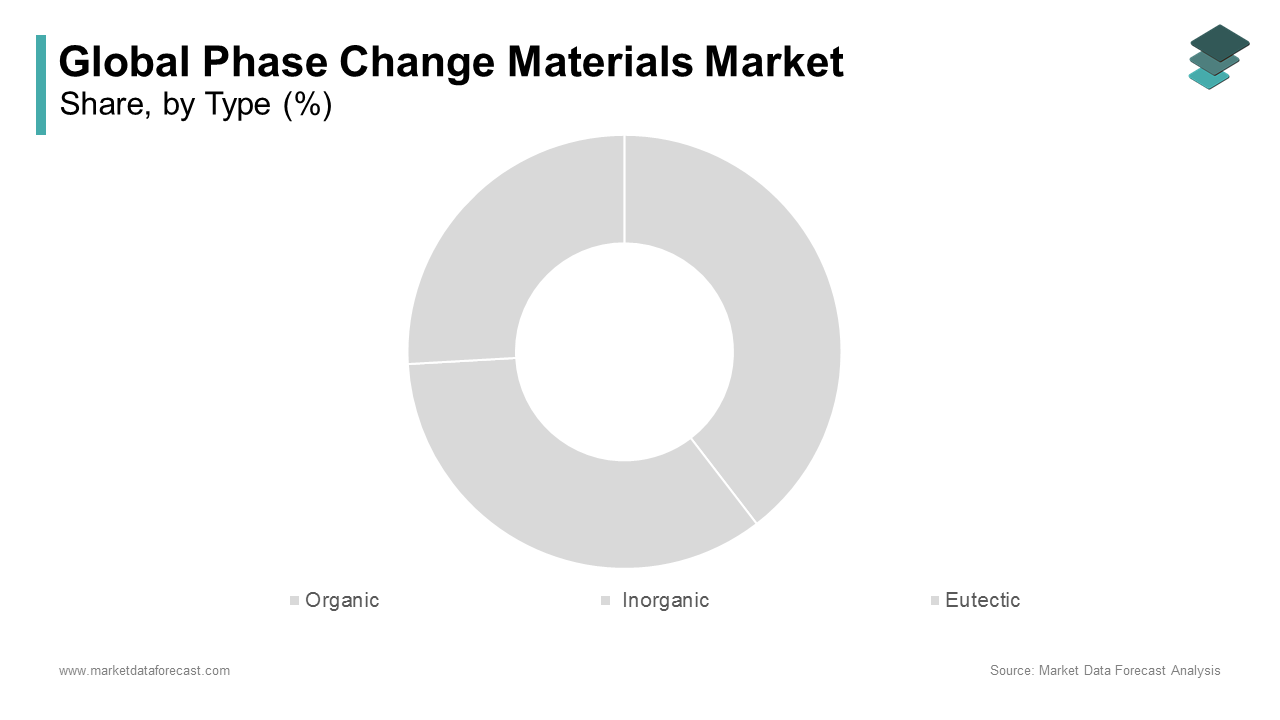
The eutectic PCM segment is projected to grow at a CAGR of 12.4% during the forecast period, with the increasing demand for precisely tuned phase transition temperatures across specialized industrial and medical applications. According to the World Health Organization, eutectic PCMs are now used in over 40% of WHO-prequalified cold boxes for immunization programs, which is significantly reducing temperature excursions during last-mile delivery in tropical climates. Furthermore, the International Institute of Refrigeration reports that eutectic salt hydrate blends are being adopted in next-generation district heating networks in Scandinavia, where they store excess thermal energy from waste incineration plants at exact discharge temperatures of 55°C.
By Application Insights
The building and construction segment was the largest and held 37.3% of the global phase change materials market share in 2025, with the integration of PCMs into passive thermal regulation systems designed to reduce energy consumption in residential and commercial structures. In Germany, over 9,000 new and retrofitted buildings have incorporated PCM-loaded gypsum boards since 2020, as documented by the Fraunhofer Institute for Building Physics, reducing peak cooling loads by up to 30%. The U.S. General Services Administration reports that PCM-integrated ceilings in federal office buildings have achieved HVAC energy savings of 22% annually.
The electronics application segment is anticipated to grow at a CAGR of 13.6% during the forecast period with the escalating thermal management challenges in compact, high-performance electronic devices, including 5G base stations, data centers, and consumer electronics.. PCMs with phase transitions around 50–60°C are now embedded in printed circuit boards and battery compartments to absorb transient heat pulses. Samsung Electronics reported in 2023 that integrating paraffin-based PCMs into its Galaxy smartphone series reduced internal temperature spikes by 6.8°C during intensive gaming sessions.
REGIONAL ANALYSIS
Europe Market Analysis
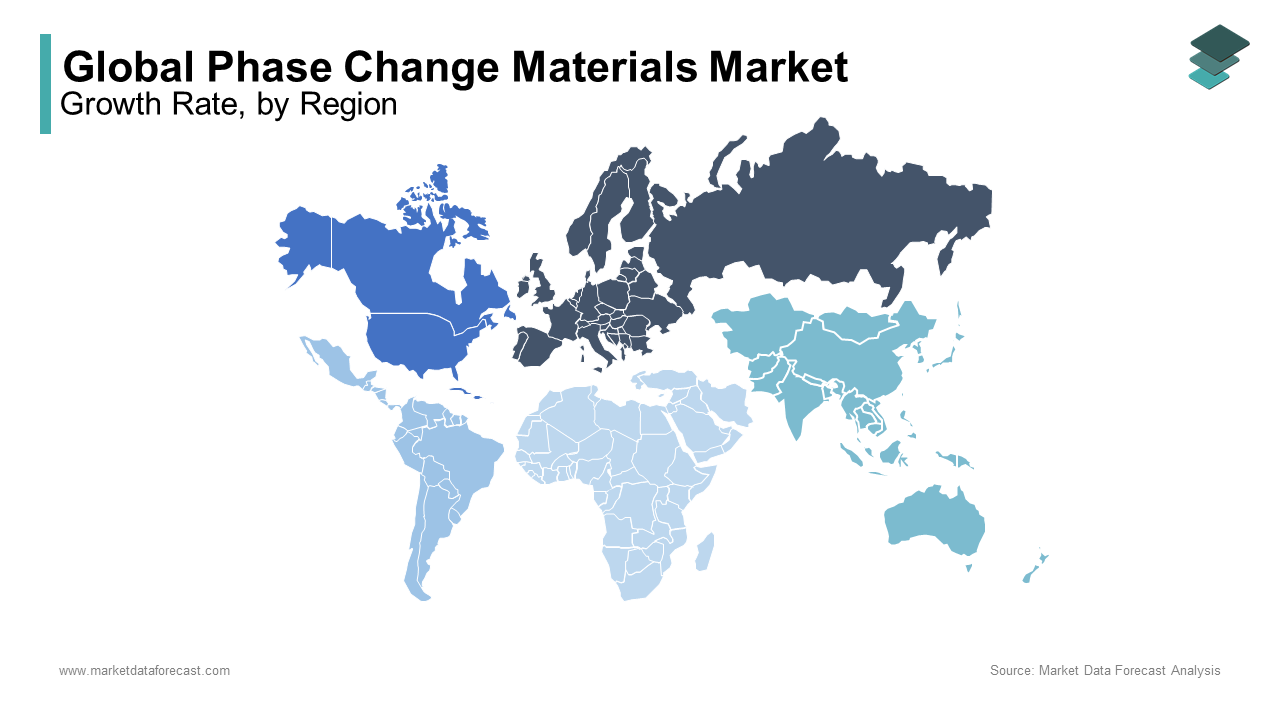
Europe was the top performer of the global phase change materials market by capturing 34.2% the market share in 2025 with its stringent energy efficiency regulations and advanced building retrofit programs. Sweden’s district heating networks utilize PCM-based thermal buffers to store surplus heat from biomass plants, with the Swedish Energy Agency reporting a 20% improvement in seasonal storage efficiency. France’s RE2020 building code incentivizes passive temperature stabilization, driving demand for PCM-infused insulation. Additionally, the UK’s Building Research Establishment has certified over 45 PCM products under its BES 6001 framework for sustainable materials, reinforcing market credibility.
North America Market Analysis
North America held 29.3% of the phase change materials market share in 2025, with the United States being the largest contributor. The region’s growth is fueled by federal energy reduction targets and increasing investments in smart infrastructure. Canada’s National Research Council reports that PCM-enhanced wall systems in northern communities have reduced heating fuel consumption by up to 28% during winter months.
Asia Pacific Market Analysis
Asia Pacific Phase Change Materials (PCMs) market growth is swiftly emerging with rapid urbanization and industrial modernization. China leads the regional market, with the Ministry of Housing and Urban-Rural Development mandating energy-saving materials in all new public buildings, including PCM-integrated panels. Japan’s New Energy and Industrial Technology Development Organization (NEDO) has invested in PCM-based thermal storage for hydrogen refueling stations, supporting its carbon neutrality goals. India’s Bureau of Energy Efficiency has included PCM use in its Perform, Achieve, and Trade (PAT) scheme, encouraging adoption in commercial real estate.
Middle East and Africa Market Analysis
Middle East & Africa Phase Change Materials (PCMs) market growth is likely to grow as the daytime temperatures frequently exceed 45°C, creating a compelling case for passive cooling technologies. Saudi Arabia’s Vision 2030 includes NEOM, a $500 billion smart city project, which mandates the use of advanced thermal management systems in all buildings, including PCM-based façades and ceilings. The King Abdullah City for Atomic and Renewable Energy reports that PCM-integrated insulation in pilot residential units reduced indoor temperatures by 5.3°C compared to conventional materials.
Latin America Market Analysis
Latin America phase change materials market growth is likely to grow, with Brazil and Mexico emerging as early adopters. Brazil’s National Institute of Metrology, Quality, and Technology (INMETRO) has initiated pilot programs to test PCM-lined refrigerated trucks for transporting perishable goods, reducing diesel consumption by 12% in field trials. Mexico’s Ministry of Energy reports that PCM-enhanced building materials are being used in social housing projects in Sonora and Chihuahua to mitigate extreme heat, improving indoor comfort without air conditioning.
COMPETITION OVERVIEW
The phase change materials market features a competitive landscape marked by technological differentiation and niche specialization rather than broad market dominance. Competition centers on material performance, long-term reliability, and integration ease across diverse applications. While multinational chemical firms leverage R&D scale and global distribution, regional innovators are gaining ground through climate-specific formulations and localized compliance expertise. Intellectual property plays a critical role, with over 1,200 active patents in PCM encapsulation and composite design as recorded by the World Intellectual Property Organization. The absence of standardized testing protocols allows for varied performance claims, increasing the importance of third-party validation. Strategic alliances with construction firms, HVAC manufacturers, and logistics providers are becoming decisive in securing commercial contracts.
KEY MARKET PLAYERS
A few of the dominating players in the global phase change materials market include
- BASF SE
- Honeywell International Inc.
- Croda International Plc
- Rubitherm Technologies GmbH
- Chemours Company
- Outlast Technologies LLC
- Entropy Solutions LLC
- PCM Products Ltd
- Climator Sweden AB
- Henkel AG & Co. KGaA
- Cold Chain Technologies Inc.
- PureTemp LLC
- Laird PLC
- Pluss Advanced Technologies Pvt. Ltd.
TOP STRATEGIES USED BY THE KEY MARKET PARTICIPANTS
Key players in the phase change materials market are deploying advanced material engineering, strategic partnerships, and application-specific customization to strengthen their competitive edge. Companies are investing in nano- and micro-encapsulation technologies to enhance PCM stability and compatibility with construction and polymer matrices. Collaborations with research institutions and government agencies are accelerating product certification and regulatory acceptance. Expansion into high-growth sectors such as electric vehicles, data centers, and vaccine logistics is diversifying revenue streams. Geographic scaling through localized production and technical support centers is improving responsiveness in emerging markets.
LEADING PLAYERS IN THE PHASE CHANGE MATERIALS MARKET
ClimaCell (India)
ClimaCell, headquartered in Pune, is a pioneering developer of bio-based phase change materials tailored for tropical climates in the Asia Pacific region. The company specializes in fatty acid-derived PCMs engineered to stabilize indoor temperatures between 24°C and 30°C, addressing the region’s high cooling demand. ClimaCell has integrated its materials into precast concrete panels and ceiling tiles used in commercial buildings across India, Bangladesh, and Sri Lanka. In 2023, it launched a PCM-enhanced roofing solution for low-income housing, reducing indoor heat gain by up to 6°C, as validated by the Indian Institute of Science. The company collaborates with public infrastructure agencies under India’s Smart Cities Mission to deploy passive thermal regulation in community centers and clinics.
Mitsubishi Chemical Corporation (Japan)
Mitsubishi Chemical Corporation has emerged as a key innovator in advanced thermal storage materials, with a strong focus on industrial and electronics applications across the Asia Pacific. The company’s proprietary ENVIROGREEN® PCM line includes paraffin and salt hydrate formulations used in building insulation, cold chain packaging, and data center cooling systems. In 2023, Mitsubishi launched a flame-retardant PCM composite for high-rise residential buildings in Tokyo, meeting Japan’s stringent fire safety codes under the Building Standard Law. The company also supplies phase change sheets to major electronics manufacturers, including Sony and Panasonic, for thermal buffering in 5G routers and power inverters.
Encentiv Materials (Australia)
Encentiv Materials, based in Melbourne, is a leading provider of encapsulated phase change materials designed for seamless integration into construction and HVAC systems across the Asia Pacific. The company’s MICROPCMTM technology enables dispersion of PCMs into plaster, paint, and duct lining materials, offering retrofit-friendly thermal mass enhancement. Encentiv’s products are widely used in educational and healthcare facilities in Australia, New Zealand, and Singapore, where passive temperature stability is critical for occupant comfort. In 2022, it supplied PCM-infused ceiling panels for the National University Hospital in Singapore, achieving a 23% reduction in chiller load during peak summer months, as verified by the Building and Construction Authority. The company has also partnered with Daikin and Hitachi to embed PCMs into air handling units for improved thermal inertia.
MARKET SEGMENTATION
This research report on the global phase change materials market is segmented and sub-segmented into the following categories.
By Type
- Organic
- Inorganic
- Eutectic
By Application
- Building & Construction
- HVAC
- Thermal Energy Storage
- Cold Chain Packaging
- Textiles
- Electronics
- Others
By Region
- North America
- Europe
- Latin America
- Asia Pacific
- Middle East & Africa