- Product Description Description
- Table of Contents TOC
- List of Table & Figure LOT
- Get Free Sample PDF Sample PDF
Market Size, 2025
$27.38 BnMarket Estimate, 2026
$28.70 BnMarket Forecast, 2034
$41.76 BnCAGR, 2026–2034
4.8%Global Phenol Market Summary
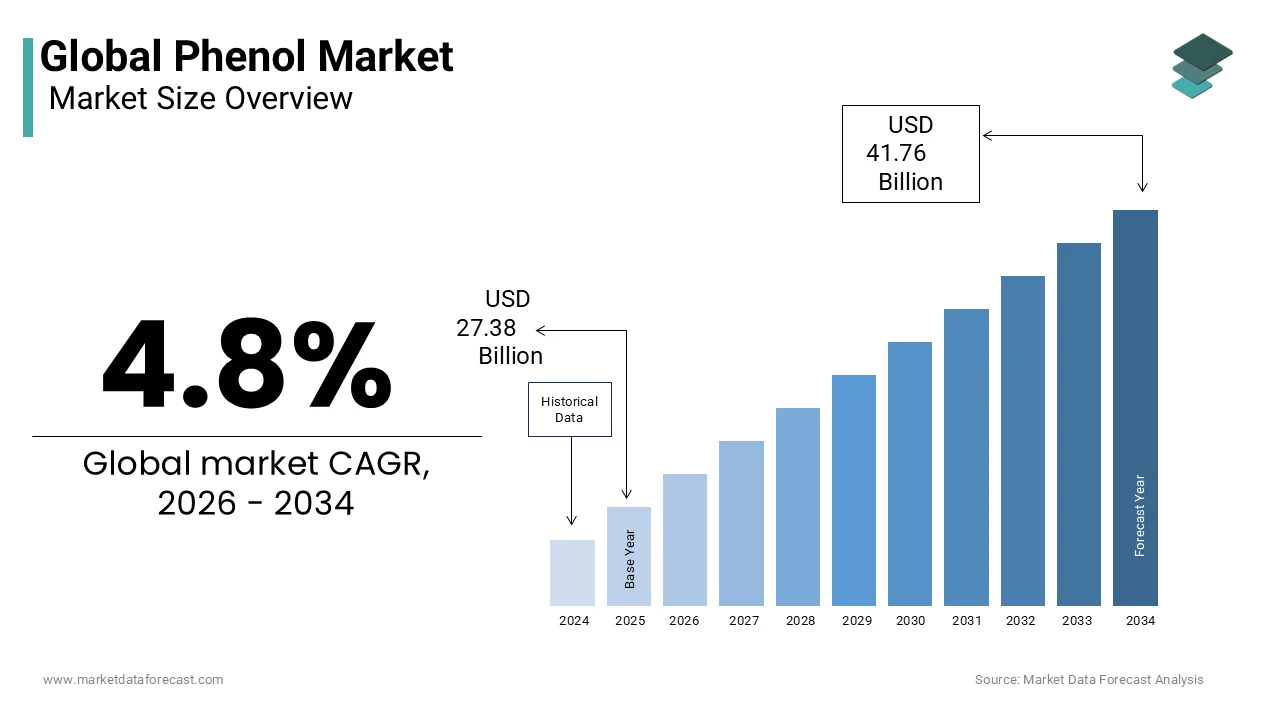
The global phenol market, valued at USD 27.38 billion in 2025, is projected to reach USD 41.76 billion by 2034, expanding at a CAGR of 4.8% driven by polycarbonate plastics, phenolic resins, and renewable energy infrastructure demand.
Market Snapshot
- 2025 Market Size: USD 27.38 billion
- 2026 Estimate: USD 28.7 billion
- 2034 Forecast: USD 41.76 billion
- CAGR (2026–2034): 4.8%
- Base Year: 2025
- Forecast Period: 2026–2034
Quick Growth Drivers
- Rising polycarbonate demand in automotive and electronics
- Expansion of phenolic resins in foundry and friction materials
- Growth in epoxy resins for wind turbine blades
- Infrastructure modernization in Asia Pacific
- Increasing industrial resin consumption in construction
Principal Restraints
- Regulatory pressure on BPA under European Food Safety Authority
- Volatility in benzene and crude oil feedstock prices
- Environmental compliance costs in phenol production
- Weak acetone demand affecting cumene process economics
High-Value Opportunities
- Bio-based phenol production via microbial and lignin routes
- Renewable energy expansion (wind turbine epoxy systems)
- Specialty high-purity phenol for semiconductor encapsulation
- Corrosion-resistant epoxy linings in water infrastructure
- Lightweight phenolic composites for EV applications
Key Market Challenges
- Toxicity and occupational exposure regulations
- Energy-intensive cumene process dependency
- Limited commercialization of alternative oxidation routes
- Margin pressure from acetone oversupply
Fastest-Growing Segments
- Bisphenol-A (BPA) – 6.7% CAGR driven by epoxy and polycarbonate growth
- Epoxy Resins for Wind Energy – strong structural composites demand
- High-Purity Electronic Grades – semiconductor encapsulation
Leading Players
Some of the companies that are playing a dominating role in the global phenol market include:
- Shell plc
- Solvay S.A.
- Mitsubishi Chemical Group
- Mitsui Chemicals Inc.
- LG Chem Ltd.
- Deepak Nitrite Limited
- AdvanSix Inc.
- Formosa Plastics Corporation
Global Phenol Market Size
The global phenol market was valued at USD 27.38 billion in 2025 and is estimated to reach USD 28.7 billion in 2026, and is projected to reach USD 41.76 billion by 2034, growing at a CAGR of 4.8% from 2026 to 2034.
The phenol is an essential aromatic organic compound widely utilized as a foundational chemical in the synthesis of resins, plastics, pharmaceuticals, and agrochemicals. Phenol, also known as carbolic acid, serves as a precursor in the production of bisphenol A (BPA), which in turn is integral to polycarbonate plastics and epoxy resins. According to the U.S. Environmental Protection Agency, global industrial phenol consumption exceeds 11 million metric tons annually, with over 65% directed toward polymer manufacturing.
MARKET DRIVERS
Expansion of the Polycarbonate Plastics Industry
The growing demand for lightweight, impact-resistant, and optically clear polycarbonate plastics is driving phenol market growth. Polycarbonate, synthesized using bisphenol A derived from phenol, is extensively used in automotive glazing, electronic enclosures, construction sheeting, and consumer goods. According to the International Council of Chemical Associations, global polycarbonate production reached 6.2 million metric tons in 2023, with Asia Pacific accounting for 58% of output. In the automotive sector, the shift toward electric vehicles has increased the use of polycarbonate in headlamp lenses and interior components, reducing vehicle weight and improving energy efficiency. Additionally, the construction industry in China has adopted polycarbonate roofing in over 120,000 commercial buildings since 2020, as reported by the China Building Materials Federation.
Rising Production of Phenolic Resins for Industrial Applications
The phenolic resins, formed by the reaction of phenol with formaldehyde, are witnessing heightened demand across the foundry, aerospace, and insulation sectors due to their thermal stability and mechanical strength. As per the American Foundry Society, over 90% of metal castings in North America utilize phenolic-based binders in sand molds, with annual resin consumption exceeding 1.4 million tons globally. These resins enable high-precision casting in automotive and turbine components, where dimensional accuracy and heat resistance are paramount. In India, the Ministry of Heavy Industries reports that phenolic resin usage in railway brake pads and friction materials grew by 11% year-on-year from 2021 to 2023, driven by fleet modernization.
MARKET RESTRAINTS
Regulatory Restrictions on BPA-Containing Products
The use of bisphenol A is a primary derivative of phenol that faces increasing regulatory scrutiny due to health and environmental concerns, which is limiting the growth of the phenol market. As per the European Food Safety Authority, BPA is classified as an endocrine disruptor, prompting the European Union to ban its use in food contact materials such as infant bottles and thermal paper. In 2023, the EU further reduced the tolerable daily intake of BPA to 0.2 nanograms per kilogram of body weight, a 20,000-fold reduction from prior limits. The U.S. Food and Drug Administration has also restricted BPA in infant formula packaging, which is leading manufacturers like Nalgene and Playtex to shift to BPA-free alternatives. These regulatory shifts are compelling formulators to explore alternative phenol-free chemistries, limiting expansion in key end-use segments.
Volatility in Crude Oil and Benzene Feedstock Prices
The phenol is predominantly produced via the cumene process that relies on benzene with a petrochemical derivative, which makes its cost structure highly sensitive to crude oil price fluctuations. According to the U.S. Energy Information Administration, benzene prices surged by 41% in 2022, following geopolitical disruptions in supply chains, directly increasing phenol production costs. In Asia, where over 75% of phenol capacity is integrated with aromatics complexes, refiners faced margin compression when crude volatility decoupled benzene from refined product values.
MARKET OPPORTUNITIES
Development of Bio-Based Phenol from Renewable Feedstocks
Emerging biotechnological pathways to produce phenol from non-petroleum sources are opening new avenues for sustainable production, which is expected to bolster the growth of the phenol market. Researchers at the University of California, Berkeley, have engineered microbial strains of E. coli capable of synthesizing phenol from lignin-derived compounds, achieving yields of 1.3 grams per liter in pilot bioreactors. The U.S. Department of Energy’s Bioenergy Technologies Office has funded multiple projects aiming to commercialize bio-phenol by 2027, which is targeting a 50% reduction in carbon footprint compared to conventional methods. In France, biotech firm Carbios has developed an enzymatic depolymerization process to extract aromatic monomers from PET waste, with phenol as a potential co-product.
Growth in Epoxy Resin Demand for Wind Energy Infrastructure
The global transition to renewable energy, particularly offshore and onshore wind power, is expected to pose new opportunities for the growth of the phenol market. Each megawatt of wind turbine capacity requires approximately 2.5 tons of epoxy resin for blade manufacturing, as documented by the Global Wind Energy Council. The blades are often exceeding 80 meters in length, and rely on phenol-derived epoxies for their high strength-to-weight ratio and resistance to fatigue. Siemens Gamesa reports that its latest offshore turbines use vacuum-infused epoxy systems containing over 18 tons of resin per rotor.
MARKET CHALLENGES
Environmental and Occupational Hazards in Phenol Production
Phenol is classified as a hazardous substance due to its toxicity, corrosiveness, and environmental persistence, which is a challenging factor for the growth of the phenol market. According to the National Institute for Occupational Safety and Health, exposure to airborne phenol concentrations above 5 parts per million can cause respiratory irritation, headaches, and long-term organ damage. The U.S. Occupational Safety and Health Administration mandates strict ventilation, personal protective equipment, and emergency response protocols in production facilities.
Technological Lock-In and Limited Process Innovation
The limited process innovation is specifically challenging the growth of the phenol market. According to the International Council of Chemical Associations, in 2023, global acetone inventories rose by 14% due to weak solvent demand, which is forcing phenol producers to operate below capacity or sell acetone at a loss. Alternative processes, such as the direct oxidation of benzene or toluene-based routes, remain commercially unviable due to low selectivity and high catalyst costs.
REPORT COVERAGE
| REPORT METRIC | DETAILS |
| Market Size Available | 2025 to 2034 |
| Base Year | 2025 |
| Forecast Period | 2026 to 2034 |
| Segments Covered | By Product Type and Region. |
| Various Analyses Covered | Global, Regional, and Country-Level Analysis, Segment-Level Analysis, Drivers, Restraints, Opportunities, Challenges; PESTLE Analysis; Porter’s Five Forces Analysis, Competitive Landscape, Analyst Overview of Investment Opportunities |
| Countries Covered | Asia Pacific North America Europe Latin America Middle East & Africa |
| Market Leaders Profiled | Shell PLC – United Kingdom, Solvay SA – Belgium, Mitsubishi Chemical Corporation – Japan, Mitsui Chemicals Inc. – Japan, Cepsa – Spain, Kumho P&B Chemicals Inc. – South Korea, LG Chem – South Korea, Honeywell International Inc. – United States, Deepak Nitrite Limited – India, Aditya Birla Chemicals – India, PTT Phenol Company Limited – Thailand, Bayer AG – Germany, AdvanSix Inc. – United States, Formosa Plastics Corporation – Taiwan, Altivia – United States |
SEGMENTAL ANALYSIS
By Product Type Insights
The phenolic resins segment dominated the global phenol market by capturing 38.2% of the market share in 2025, with the compound’s irreplaceable role in producing thermosetting resins used in foundry binders, friction materials, and industrial laminates. The American Foundry Society confirms that 95% of ductile iron and steel castings in the United States utilize phenolic urethane binders due to their precision and thermal stability. Additionally, the construction industry in India and Southeast Asia has increasingly adopted plywood and particleboard bonded with phenol-formaldehyde resins, with the Food and Agriculture Organization noting that formaldehyde-based wood adhesives account for over 70% of engineered wood production in Asia.
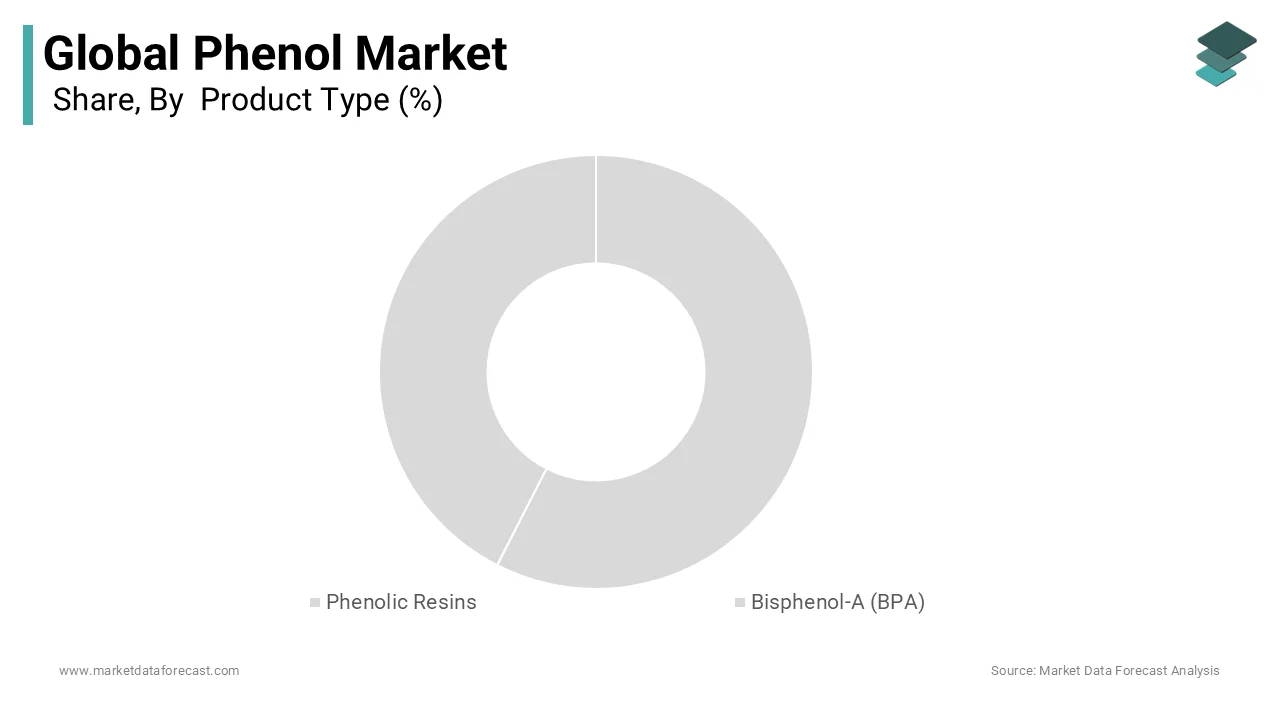
The bisphenol-A (BPA) segment is projected to register a CAGR of 6.7% during the forecast period, with the rising demand for polycarbonate plastics and epoxy resins in emerging economies and high-performance sectors. In infrastructure, epoxy linings made from BPA protect over 60% of water and oil pipelines in North America from corrosion, as reported by the National Association of Corrosion Engineers. Furthermore, the electronics sector relies on BPA-based epoxies for encapsulating semiconductors and printed circuit boards, with the Semiconductor Industry Association noting a 12% year-on-year increase in encapsulant demand in 2023.
REGIONAL ANALYSIS
Asia Pacific Phenol Market Analysis
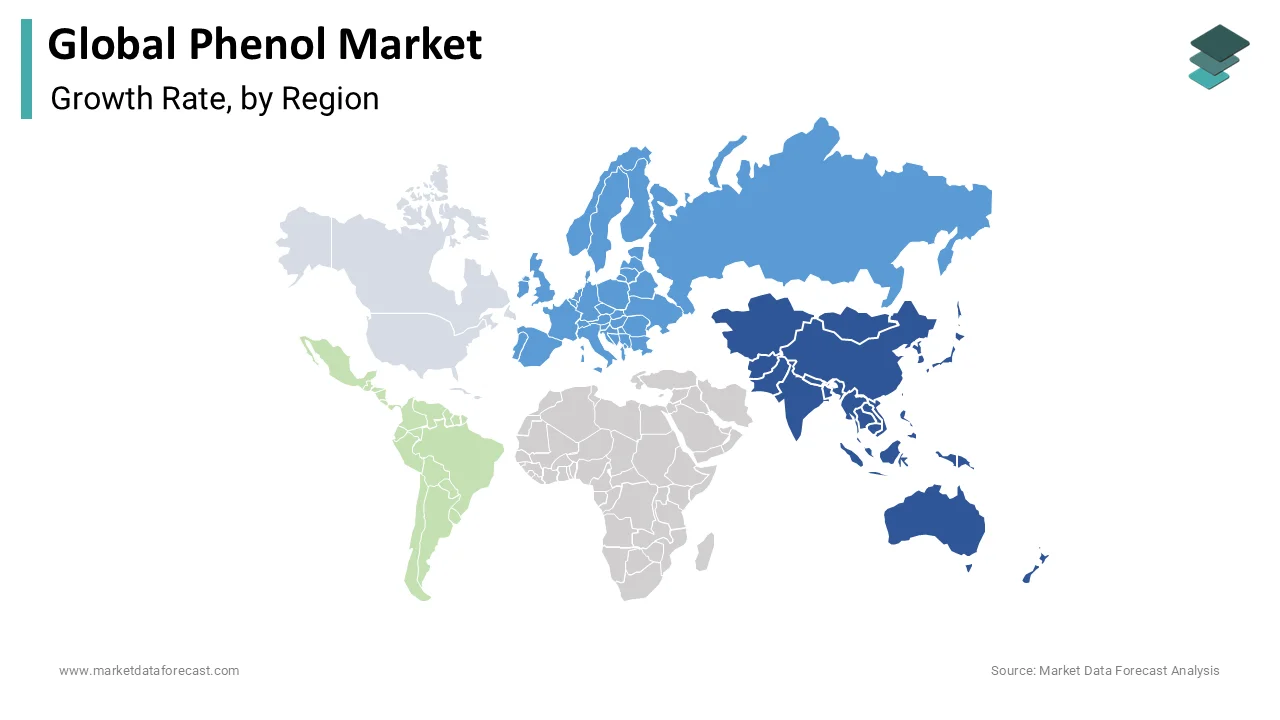
Asia Pacific was the top performer of the global phenol market by accounting for 47.2% the market share in 2025 with its vast manufacturing base, rapid urbanization, and expanding infrastructure networks. India’s demand for phenolic resins in the automotive and construction sectors grew by 9.3% annually between 2020 and 2023, as reported by the Indian Chemical Council, driven by government-led industrialization and housing programs. Japan’s high-tech manufacturing sector continues to rely on BPA-based polycarbonates for electronics and optical media, while South Korea’s shipbuilding industry uses phenolic composites in fire-resistant insulation.
North America Phenol Market Analysis
North America held 22.3% of the global phenol market share in 2025, with the United States serving as the primary hub for advanced chemical processing and specialty applications. The region hosts several world-scale phenol plants integrated with aromatics complexes in Texas and Louisiana, where access to benzene feedstock and pipeline infrastructure ensures operational efficiency. Canada’s oil sands operations utilize phenolic binders in sand core casting for turbine and pump components, as noted by Natural Resources Canada.
Europe Phenol Market Analysis
Europe market held 12.3% of the share in 2025, with Germany, Belgium, and France serving as key production and innovation centers. The region’s chemical industry emphasizes sustainability and circularity, with BASF, INEOS, and TotalEnergies operating integrated phenol-acetone facilities in Ludwigshafen, Antwerp, and Lavéra. According to the European Chemical Industry Council (CEFIC), over 75% of phenol in Europe is used in epoxy and polycarbonate applications compliant with REACH and RoHS regulations. The EU’s Green Deal and Construction Products Regulation are also promoting the use of durable, high-performance resins in energy-efficient buildings.
Middle East & Africa Phenol Market Analysis
The Middle East & Africa phenol market growth is likely to grow in the coming years. Saudi Arabia is emerging as a strategic player, which is leveraging low-cost feedstock from its crude oil and naphtha streams to expand downstream chemical production. The Kingdom’s Vision 2030 includes a $20 billion investment in the petrochemical sector, aiming to double chemical exports by 2030. In South Africa, Sasol produces phenol for domestic resin and pharmaceutical applications, with the Council for Scientific and Industrial Research noting rising demand in mining equipment manufacturing.
Latin America Phenol Market Analysis
Latin America's phenol market growth, with Brazil and Mexico leading regional consumption. Brazil’s automotive and construction sectors are the primary drivers, with the National Confederation of Industry reporting that phenolic resin usage in brake linings and foundry binders reached 180,000 metric tons in 2023. Mexico’s proximity to the U.S. market has enabled integration into North American supply chains, with companies like Alpek producing polycarbonates for export. Chile’s mining industry employs phenolic composites in conveyor systems and protective linings due to their wear resistance.
COMPETITIVE LANDSCAPE
The phenol market features a consolidated yet dynamic competitive environment dominated by large, integrated petrochemical companies with access to aromatics feedstock and advanced production technologies. Competition is shaped by operational efficiency, product purity, reliability of supply, and compliance with environmental regulations. While a few multinational firms control major production assets, regional players in Asia are expanding capacity to meet local demand, increasing competitive pressure. Differentiation occurs through downstream integration, with leaders offering formulated resins and specialty grades rather than commoditized phenol. Intellectual property in process optimization and emission control plays a growing role in maintaining margins.
KEY MARKET PLAYERS
Some of the leading companies in the global phenol market are
- Shell PLC – United Kingdom
- Solvay SA – Belgium
- Mitsubishi Chemical Corporation – Japan
- Mitsui Chemicals Inc. – Japan
- Cepsa – Spain
- Kumho P&B Chemicals Inc. – South Korea
- LG Chem – South Korea
- Honeywell International Inc. – United States
- Deepak Nitrite Limited – India
- Aditya Birla Chemicals – India
- PTT Phenol Company Limited – Thailand
- Bayer AG – Germany
- AdvanSix Inc. – United States
- Formosa Plastics Corporation – Taiwan
- Altivia – United States
TOP LEADING PLAYERS IN THE PHENOL MARKET
- INEOS Phenol operates as a leading integrated producer with significant influence across Europe and the Asia Pacific through its global supply network and technology partnerships. The company supplies high-purity phenol to Asian markets, particularly Japan and South Korea, supporting electronics, polycarbonate, and specialty resin manufacturers. INEOS has strengthened its foothold in the region by forming long-term supply agreements with Japanese polymer producers and investing in logistics infrastructure to ensure reliable delivery. In 2023, it upgraded its phenol oxidation technology at its European facilities to enhance yield and reduce energy consumption, indirectly benefiting Asian customers through improved cost efficiency and sustainability credentials. The company also collaborates with regional formulators to develop low-emission phenolic resins tailored for automotive and construction applications.
- Mitsubishi Chemical Corporation is a dominant force in the Asia Pacific phenol landscape, operating integrated production facilities in Japan that serve both domestic and export markets. The company produces phenol primarily for downstream conversion into bisphenol-A and epoxy resins used in electronics, automotive coatings, and industrial adhesives. Mitsubishi supplies materials to Japan’s semiconductor industry, where ultra-pure phenol derivatives are essential for encapsulating advanced chips. In 2022, the company launched a new purification line at its Kawasaki plant to meet the stringent contamination thresholds required by semiconductor manufacturers. It also collaborates with automakers to develop lightweight, heat-resistant phenolic composites for EV components.
- SABIC has expanded its presence in the Asia Pacific phenol market by leveraging its cost-advantaged production base in the Middle East and establishing strategic distribution alliances with Asian chemical processors. The company operates one of the largest phenol plants in the Gulf region, supplying bulk phenol to resin manufacturers in India, China, and Southeast Asia. SABIC has intensified its engagement with regional customers by launching technical service centers in Singapore and Shanghai to support formulation optimization and application testing. In 2023, it introduced a new grade of phenol designed for high-clarity polycarbonate used in consumer electronics and medical devices, catering to growing demand in high-value sectors. The company also participates in joint development programs with Indian automotive suppliers to improve the thermal stability of phenolic friction materials.
TOP STRATEGIES USED BY THE KEY MARKET PARTICIPANTS
Key players in the phenol market are focusing on vertical integration, technological optimization, and sustainability-driven innovation to maintain a competitive advantage. Companies are strengthening downstream linkages by producing bisphenol-A, epoxy resins, and phenolic molding compounds in-house to capture added value. Investment in process efficiency, such as advanced cumene oxidation and distillation technologies, reduces energy consumption and improves yield. Strategic partnerships with end-users in automotive, electronics, and renewable energy sectors enable co-development of tailored formulations.
MARKET SEGMENTATION
This research report on the global phenol market is segmented and sub-segmented into the following categories.
By Product Type
- Phenolic Resins
- Bisphenol-A (BPA)
- Others
By Region
- Asia Pacific
- North America
- Europe
- Latin America
- Middle East & Africa