- Product Description Description
- Table of Contents TOC
- List of Table & Figure LOT
- Get Free Sample PDF Sample PDF
Global Platelet Concentration Systems Market Size
The global platelet concentration systems market size was valued at USD 402.6 million in 2024 and is estimated to reach USD 2,587.5 million by 2033 from USD 497.2 million in 2025, growing at a CAGR of 22.46% from 2025 to 2033.
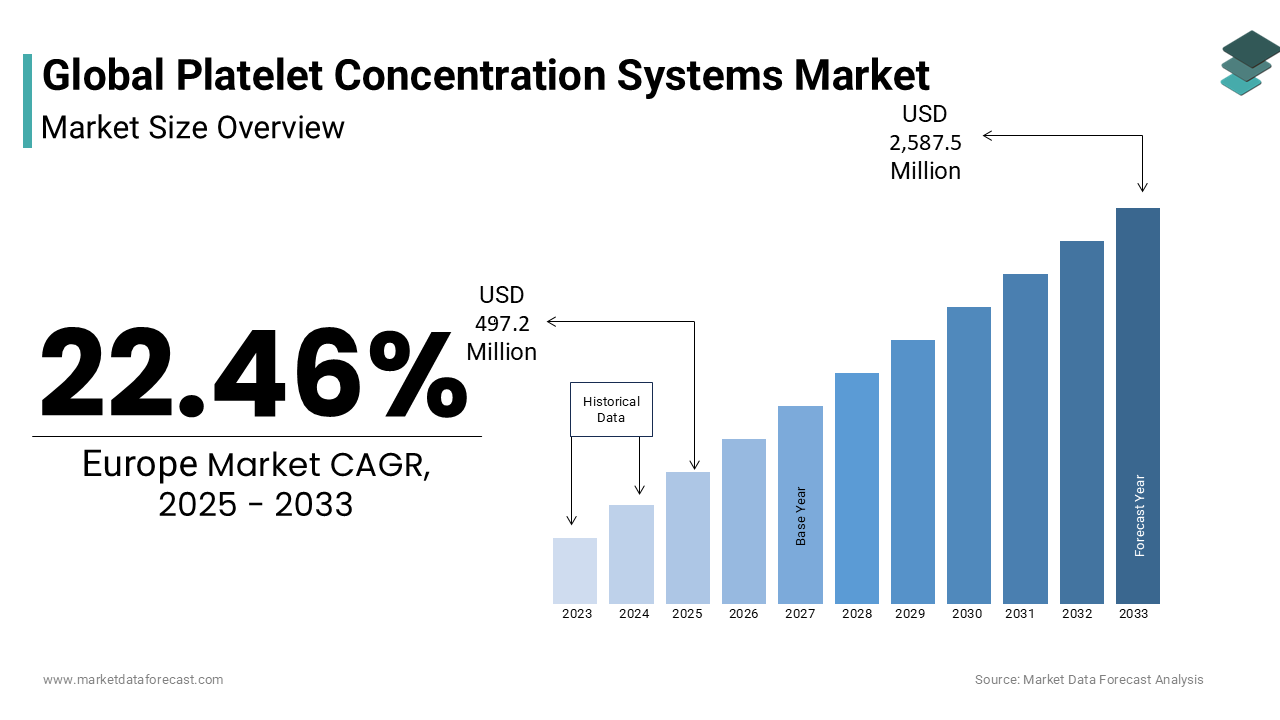
Platelet concentration systems are medical devices and kits designed to isolate, concentrate, and activate autologous platelets from whole blood to produce platelet rich plasma or platelet rich fibrin for therapeutic use in tissue regeneration and wound healing. These systems employ centrifugation, filtration, or gravitational separation to achieve platelet concentrations typically more than baseline levels, preserving growth factors such as PDGF, TGF beta, and VEGF that modulate cellular repair. Most orthopedic practices widely offer platelet-rich plasma injections for tendinopathies and early stage osteoarthritis. Standardized protocols for platelet concentration have greatly reduced variability in platelet yield between clinics. As per sources, hundreds of thousands of platelet concentration procedures are performed annually in outpatient surgical centers, primarily for musculoskeletal conditions. The majority of professional football clubs in Europe now include platelet-rich plasma as a standard part of player recovery protocols, as per studies. Their clinical adoption reflects a paradigm shift toward biologic augmentation over synthetic intervention.
MARKET DRIVERS
Rising prevalence of sports related musculoskeletal injuries is accelerating clinical adoption of platelet therapies
The global surge in sports participation and high intensity physical activity is directly increasing the incidence of tendon, ligament, and cartilage injuries, which propels the growth of the platelet concentration systems market. This creates sustained demand for biologic repair solutions such as platelet concentration systems. According to Elite athletes in major competitions experience a significant number of overuse musculoskeletal injuries during their competitive seasons. Millions of sports-related injuries occur annually, with soft tissue damage being a prominent type, as per sources. There has been an increase in the use of platelet-rich plasma injections among professional footballers in Europe. Recreational athletes over the age of typically experience chronic tendon injuries more often than their younger counterparts and generally show a greater preference for biologic therapies over corticosteroid injections. This demographic and behavioral shift is embedding platelet concentration into mainstream sports medicine protocols.
MARKET RESTRAINTS
Reimbursement ambiguity and lack of standardized coding are inhibiting widespread institutional adoption
The absence of uniform insurance reimbursement pathways and procedure specific billing codes remains a restraint to the platelet concentration systems market. This is a barrier to the scalable integration of platelet concentration systems in hospital and outpatient settings. Platelet-rich plasma injections are generally classified under miscellaneous unlisted procedure codes in most U.S. commercial payer contracts. The primary federal health services agency in the U.S. does not provide reimbursement for platelet-rich plasma treatments for osteoarthritis or tendinopathy conditions. In Europe, a key German regulatory body requires robust comparative data for each specific anatomical use case before considering coverage by statutory health insurance. The relevant health ministry in Japan limits reimbursement exclusively to platelet-rich fibrin used in dental bone grafting, explicitly excluding all uses within the musculoskeletal system, as per research. This fragmented reimbursement landscape compels clinics to operate on cash pay models, limiting access to affluent patient segments and constraining volume growth even as clinical demand expands.
MARKET OPPORTUNITIES
Expansion into dental and maxillofacial regeneration presents a high compliance, high margin application corridor
The dental and oral surgery sector is emerging as a key opportunity for the platelet concentration systems market. This is due to established reimbursement, procedural standardization, and high clinician acceptance of biologic augmentation. According to Most bone grafting procedures for dental implants now incorporate platelet rich fibrin. Platelet concentration has become a mandatory component in nearly all accredited implantology training programs across Europe. Platelet rich fibrin use is widely covered for alveolar ridge preservation procedures. According to studies, applying platelet rich fibrin has been shown to reduce post-extraction complications significantly. Unlike musculoskeletal applications, dental use faces minimal payer resistance and benefits from well-defined protocols, which enables predictable revenue streams and lower market entry friction for device manufacturers.
MARKET CHALLENGES
Inter system variability in platelet yield and leukocyte content undermines clinical reproducibility and evidence generation
Significant heterogeneity persists across platelet concentration systems in terms of final platelet recovery, leukocyte inclusion, and growth factor profile, which impedes the expansion of the platelet concentration systems market. This directly impacts clinical outcomes and complicates comparative research. According to a study, platelet yields vary widely across commercially available systems. Many evaluated systems do not consistently meet the minimum threshold of one million platelets per microliter needed for therapeutic efficacy. Adverse events have been recorded related to under concentrated or contaminated platelet preparations. This lack of standardization impedes meta analysis, confounds clinical trial results, and erodes physician confidence forcing practitioners to rely on anecdotal experience rather than evidence based selection, thereby fragmenting the market and delaying regulatory consensus.
REPORT COVERAGE
| REPORT METRIC | DETAILS |
| Market Size Available | 2024 to 2033 |
| Base Year | 2024 |
| Forecast Period | 2025 to 2033 |
| Segments Covered | By Technology, End-User and Region |
| Various Analyses Covered | Global, Regional & Country Level Analysis, Segment-Level Analysis; DROC, PESTLE Analysis; Porter's Five Forces Analysis, Competitive Landscape, Analyst Overview of Investment Opportunities |
| Regions Covered | North America, Europe, APAC, Latin America, Middle East & Africa |
| Market Leaders Profiled | Terumo Corporation, Arteriocyte Medical Systems, Inc., Zimmer Biomet Holdings, Inc., Johnson & Johnson Services, Inc., Curasan AG, EmCyte Corporation, Exactech, Inc., Arthrex, Inc., Cesca Therapeutics, Inc. and Stryker Corporation |
SEGMENTAL ANALYSIS
By Technology Insights
The double spin technology segment held the leading share of 53.5% of the global platelet concentration systems market. The growth of the double spin technology segment is driven by its superior ability to isolate and concentrate platelets while minimizing red blood cell and leukocyte contamination. Its adoption as the gold standard in orthopedic and sports medicine for treating chronic tendinopathies and early osteoarthritis also fuels the growth of this segment. According to Most orthopedic practices utilizing platelet rich plasma prefer double spin protocols for achieving higher platelet concentrations. Double spin systems yield significantly higher platelet concentrations than single spin methods and reduce leukocyte contamination. Many clinical guidelines and health authorities recognize and often mandate double spin preparation for reimbursed or registry-listed platelet therapies. This clinical endorsement, backed by reproducible laboratory performance, ensures sustained dominance despite higher procedural time and cost.
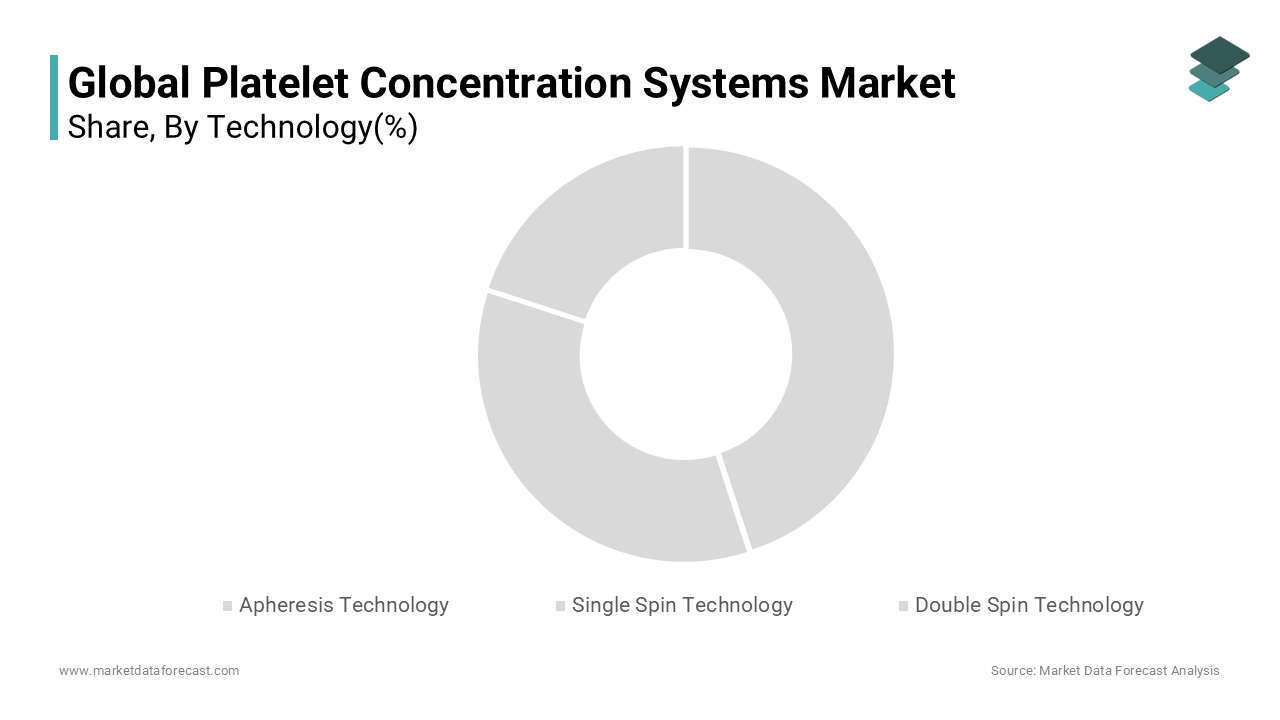
The single spin technology segment is on the rise and is expected to be the fastest growing segment in the market by witnessing a CAGR of 14.7% from 2025 to 2033 owing to its simplicity, speed, and suitability for chairside use in dental and outpatient surgical environments. Unlike double spin systems requiring multiple centrifugation steps and technical expertise, single spin devices enable clinicians to prepare therapeutic platelet concentrates in under fifteen minutes with minimal training. According to sources, most oral surgeons and periodontists in private practice now integrate single spin systems into their procedures, finding the workflow benefits and patient convenience to be significant advantages. The majority of implantologists in several countries express a clear preference for single spin kits when performing immediate grafting, noting how well these kits fit within busy clinical schedules, as per research. National health regulatory bodies have expanded the approval and use of several single spin devices, making them available in public dental clinics and broadening access to advanced care in various regions. Governing health agencies have expedited the clearance process for multiple new single spin systems by categorizing them as products requiring only minimal manipulation, which has simplified their path to market. This segment’s growth is not driven by superior biology but by operational practicality, which aligns with the global shift toward decentralized, clinician controlled biologic preparation.
By End User Insights
The hospitals led the global platelet concentration systems market and accounted for a 38.3% share in 2024. The expansion of the hospitals segment is attributed to its capacity to integrate platelet therapies across orthopedics, plastic surgery, wound care, and maxillofacial departments under centralized purchasing and regulatory oversight. An additional driver of this segment is institutional standardization, large hospital systems mandate uniform protocols to ensure reproducibility and mitigate liability. This institutional gravity ensures hospitals remain the anchor customer segment, dictating specifications, pricing, and compliance requirements for the broader market.
The sports injury centers segment is expected to exhibit a noteworthy CAGR of 18.2% during the forecast period due to rising athlete investment in biologic recovery and the proliferation of specialized clinics catering to recreational and professional sports populations. Unlike hospitals, these centers operate on cash pay or direct insurance billing models, bypassing institutional procurement delays and enabling rapid adoption of emerging technologies. This segment’s growth is structurally decoupled from reimbursement constraints, anchored instead in performance economics and direct consumer demand.
REGIONAL ANALYSIS
North America Platelet Concentration Systems Market Analysis
North America was the top performer in the global platelet concentration systems market and captured a 42.5% share in 2024. The supremacy of the North American market is primarily driven by its concentration of early adopting clinicians, permissive regulatory environment, and high out of pocket spending on regenerative therapies. The United States alone accounts for a significant share of regional demand. The U.S. Food and Drug Administration’s enforcement discretion policy for minimally manipulated autologous products enables rapid device commercialization without full premarket approval. Major professional sports leagues, including the NFL and NBA, fund internal biologics programs that validate clinical protocols and drive downstream adoption. North America’s leadership stems not from reimbursement but from entrepreneurial clinical practice and direct to consumer marketing of biologic therapies.
Europe Platelet Concentration Systems Market Analysis
Europe was the second-largest region in the platelet concentration systems market and held a 31.4% share in 2024 because of nationally endorsed clinical guidelines and selective public reimbursement for evidence backed indications. Germany remains the regional anchor, with the Federal Joint Committee reimbursing platelet rich plasma for knee osteoarthritis under strict protocol adherence. Europe’s influence lies in its methodological rigor, its clinical protocols and regulatory frameworks are adopted globally, even in markets without public funding.
Asia Pacific Platelet Concentration Systems Market Analysis
Asia Pacific grew steadily in the platelet concentration systems market due to medical tourism, rising middle class expenditure on elective procedures, and aggressive adoption in dental implantology. South Korea leads regional growth. India’s Dental Council mandated inclusion of platelet concentration training in postgraduate curricula in 2023, accelerating clinical adoption. International patients frequently receive platelet therapies as part of bundled orthopedic care packages when seeking treatment in certain global medical hubs. Regulatory bodies have recently approved new platelet systems designed specifically for use in single-spin dental applications. The region’s growth is fragmented but accelerating, driven by consumer demand rather than institutional policy.
Latin America Platelet Concentration Systems Market Analysis
Latin America expanded moderately in the platelet concentration systems market owing to private orthopedic groups and sports medicine centers catering to urban professional and recreational athletes. Brazil dominates regional consumption. A significant volume of platelet-rich plasma injections are being performed, primarily in key urban centers of Brazil. Government bodies in Mexico have partnered with private clinics to provide platelet therapies for national team athletes, which helps legitimize the clinical use of the treatment. Chile’s private insurance providers began covering platelet injections for chronic tennis elbow, creating a new payment pathway. Colombia’s Antioquia region launched a pilot program integrating platelet therapies into public sports injury clinics. Though small in scale, Latin America’s growth is policy catalyzed and structurally aligned with global clinical trends.
Middle East and Africa Platelet Concentration Systems Market Analysis
The Middle East and Africa region is likely to accelerate in the platelet concentration systems market, with growth concentrated in sovereign backed sports medicine initiatives and private hospital expansions. A national program in one Middle Eastern country has funded the establishment of several new sports injury centers. These facilities are equipped with systems designed to prepare platelet concentrates for athlete recovery. The health authority in a major UAE city has licensed numerous new regenerative medicine clinics, all of which offer platelet therapies as core services. A leading South African sports institute noted a significant increase in the use of platelet rich plasma therapies among professional athletes in major local sports like rugby and cricket. Though starting from a low base, the region’s combination of state investment and medical tourism positioning creates a unique and high visibility growth vector.
COMPETITVE LANDSCAPE
The gasoline fuel additives market is characterized by intense competition among multinational chemical companies and specialty formulation providers These firms compete on product performance regulatory compliance and pricing strategies Innovation remains central as manufacturers develop additives that improve engine efficiency reduce emissions and meet evolving fuel standards Regional players often focus on niche applications or localized formulations to carve out market space Major corporations leverage global supply chains and established distribution networks to maintain dominance Strategic acquisitions and partnerships are common as companies seek to broaden their product portfolios and enter new geographic markets Regulatory pressures particularly around environmental impact drive continuous reformulation efforts Competition also stems from alternative fuel technologies which challenge traditional additive demand forcing incumbents to adapt and diversify their offerings to sustain relevance and growth
KEY MARKET PLAYERS
Some of the companies that are playing a dominating role in the global platelet concentration systems market include
- Terumo Corporation
- Arteriocyte Medical Systems, Inc.
- Zimmer Biomet Holdings, Inc.
- Johnson & Johnson Services, Inc.
- Curasan AG
- EmCyte Corporation
- Exactech, Inc.
- Arthrex, Inc.
- Cesca Therapeutics, Inc.
- Stryker Corporation
Top Players in the Platelet Concentration Systems Market
Arthrex Inc
Arthrex Inc is a global leader in orthopedic surgical solutions with deep expertise in regenerative medicine and platelet concentration technologies The company designs and manufactures advanced systems that enable clinicians to prepare autologous platelet rich plasma at the point of care Its recent product enhancements focus on automation and workflow efficiency to meet rising clinical demand Arthrex has expanded its training programs and clinical education initiatives to support global adoption The company collaborates with research institutions to validate therapeutic outcomes reinforcing its commitment to evidence based innovation and long term market leadership
Harvest Technologies Corporation
Harvest Technologies Corporation specializes in cell and tissue processing systems with a strong emphasis on platelet concentration for regenerative applications The company’s platforms are widely used in hospitals and outpatient clinics for their reliability and reproducibility Recent upgrades to its centrifugation systems include integrated sensors and digital interfaces to ensure consistent platelet yields Harvest Technologies actively engages in global regulatory compliance efforts to facilitate market access It also partners with distributors and healthcare providers to enhance service delivery and technical support strengthening its presence across emerging and established medical markets worldwide
EmCyte Corporation
EmCyte Corporation develops compact and user friendly platelet concentration systems tailored for sports medicine clinics and ambulatory surgical centers The company focuses on portability and ease of use enabling broader access to regenerative therapies outside traditional hospital settings EmCyte recently launched a next generation device with simplified operation and faster processing times to meet clinician and patient expectations The company obtained regulatory approvals in key Asian markets to expand its international reach It also invests in physician training and clinical case studies to build credibility and drive adoption across diverse healthcare environments globally
Top Strategies Used by the Key Market Participants
Key players in the platelet concentration systems market prioritize innovation through continuous product development and technological upgrades They invest heavily in research and clinical validation to substantiate therapeutic efficacy and gain physician trust Strategic geographic expansion especially into Asia and Latin America is a common approach supported by regulatory approvals and local partnerships Companies also focus on enhancing user experience via intuitive design and workflow integration Training and education programs for clinicians are widely deployed to ensure proper utilization Collaborations with hospitals and research centers generate real world evidence that supports product credibility and market acceptance
RECENT MARKET HAPPENINGS
-
In February 2023, Royal Biologics, an orthobiologics firm, commercialized Bioincyte, a novel platelet-rich plasma system that converts typical platelet-rich plasma to platelet-rich fibrin matrix, preventing red and white blood cell contamination. Bioincyte converts PRP in a controlled procedure that protects and maintains platelets. It provides a stable environment for platelets to release growth factors.
MARKET SEGMENTATION
This research report on the global platelet concentration systems market has been segmented and sub-segmented based on the technology, end-user and region.
By Technology
- Apheresis Technology
- Single Spin Technology
- Double Spin Technology
By End User
- Hospitals
- Orthopedic clinics
- Sports injury centers
- Ambulatory surgical centers
By Region
- North America
- Europe
- Asia Pacific
- Middle East & Africa
- Latin America