- Product Description Description
- Table of Contents TOC
- List of Table & Figure LOT
- Get Free Sample PDF Sample PDF
Market Size, 2025
$10.02 BnMarket Estimate, 2026
$10.63 BnMarket Forecast, 2034
$17.07 BnCAGR, 2026–2034
6.10%Global Poultry Feed Market Size, Growth, Trends & Forecast (2026–2034)
The global poultry feed market size was valued at USD 10.02 billion in 2025, is anticipated to reach USD 10.63 billion in 2026, and is projected to scale up to USD 17.07 billion by 2034, registering a compound annual growth rate (CAGR) of 6.10% during the forecast period from 2026 to 2034. Driven by rapid urbanization, rising disposable incomes, shifting dietary preferences toward animal protein, and a critical regional relocation of feed demand from west to east, the global poultry feed industry continues to grow at a steady pace.
Key Executive Metrics (At-a-Glance)
- 2025 Base Valuation: USD 10.02 Billion
- 2026 Current Valuation: USD 10.63 Billion
- 2034 Forecast Valuation: USD 17.07 Billion
- Compound Annual Growth Rate (CAGR): 6.10% (2026–2034)
- Dominant Production Segment: Broilers & Layers (holding major consumption shares driven by commercial meat and egg production)
- Dominant Feed Additive Type: Feed Acidifiers (capturing the largest share among all poultry additive segments globally)
- Dominant Region: North America (holding the largest regional market share)
- Fastest-Growing Region: Asia-Pacific (surging as the fastest-growing market backed by the eastward shift in poultry consumption and production)
Core Market Drivers
- Rising Animal Protein Demand: Increased consumption of poultry meat and eggs propelled by population growth, urbanization, and rising disposable incomes.
- Eating-Out Trends: Growing consumer fondness for dining out at food service establishments and fancy restaurants supporting poultry supply chains.
- Nutritional Enhancements: Continuous research and developments in feed formulations incorporating amino acids, enzymes, and acidifiers for enhanced livestock productivity.
Primary Market Restraints & Challenges
- Disease Outbreaks: Periodic occurrences of poultry-related diseases creating market concerns and temporary shifts in consumer demand patterns.
- Input Cost Pressures: Fluctuating raw material costs required for synthesizing high-grade nutritional feed additives.
Global Poultry Feed Market Segmentation Breakdown
| Segment Category | Leading Sub-Segment (2025 Base) | Fastest-Growing Sub-Segment (2026–2034) |
|---|---|---|
| By Poultry Production | Broilers (dominant consumer sector for commercial meat production) | Layers & Turkeys (fastest-growing specialized feed segments) |
| By Feed Additives | Feed Acidifiers (dominant market share leader among feed additives) | Feed Enzymes & Amino Acids (fastest-growing functional additives) |
| By Region | North America (dominant regional market holding the largest valuation share) | Asia-Pacific (fastest-growing regional market driven by the eastwards relocation of feed demand) |
Major Industry Players Profiled
Key enterprises shaping the competitive global poultry feed market include JBS S.A., Tyson Foods, BRF, CP Group (Charoen Pokphand Foods), Wen’s Food Group, Royal DSM N.V., and Archer Daniels Midland Company (ADM).
Global Poultry Feed Market Size
The global poultry feed market size was valued at USD 10.02 billion in 2025 and is anticipated to reach a valuation of USD 10.63 billion in 2026 and USD 17.07 billion by 2034, growing at a CAGR of 6.10%, from 2026 to 2034.
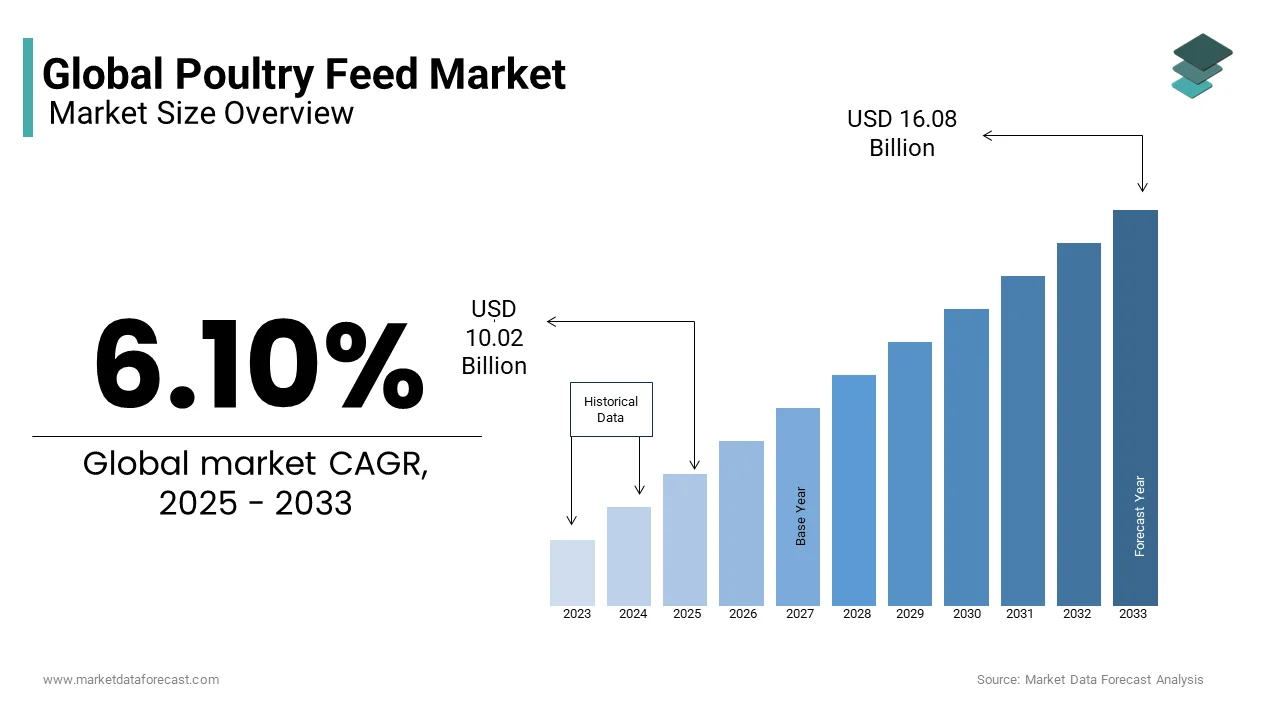
Globally, there has been an increase in the poultry feed market and this market is showing great potential in the forecast period. Poultry feed is the food given to farm animals, mainly chickens, turkeys, or any other animals that give meat. The objective of poultry feed is to make the farm animals healthier so that they can provide better meat or other products, like eggs.
For poultry feed to be healthy, it should contain lots of protein and carbohydrates, along with a sufficient amount of vitamins, minerals, and an adequate amount of water. With the increase in demand for meat and eggs, the market has also grown a lot. Hence, the research to make better poultry feed has increased and there have been many developments since the early 2000s. The critical relocation of feed demand from west to east in the 2000s led to increased outputs of formulated compound feed.
MARKET DRIVERS
With the increase in spending capabilities of people due to increased incomes of people, more urbanization, mainly drivers moving to big cities, and increasing population, there has been a huge increase in demand for animal protein, especially meat, and eggs, hence triggering the increase in demand of poultry feed and additives. In addition, people’s increasing fondness for eating outside at fancy restaurants is also driving this market. There has also been an increase in poultry-related diseases in the recent past, so it is the factor that is concerning people and taking away from poultry products that affect the poultry feed market.
REPORT COVERAGE
| REPORT METRIC | DETAILS |
| Market Size Available | 2025 to 2034 |
| Base Year | 2025 |
| Forecast Period | 2026 to 2034 |
| CAGR | 6.10% |
| Segments Covered | By Poultry Production, Feed additives, and Region |
| Various Analyses Covered | Global, Regional & Country Level Analysis; Segment-Level Analysis, DROC, PESTLE Analysis, Porter’s Five Forces Analysis, Competitive Landscape, Analyst Overview of Investment Opportunities |
| Regions Covered | North America, Europe, APAC, Latin America, Middle East & Africa |
| Market Leaders Profiled | JBS S.A. (Brazil), Tyson Foods (U.S.), BRF (Brazil), CP Group (Thailand), Wen’s Food Group (China), Royal DSM N.V. (The Netherlands) |
SEGMENTAL ANALYSIS
By Feed Additives Insights
Feed acidifiers are attributed to the largest share among all other poultry additive segments globally.
REGIONAL ANALYSIS
With the shift in demand for poultry products from west to east, the Asia-Pacific region is the fastest-growing region among all the other regions mentioned while North America is having the largest share of the market.
KEY MARKET PLAYERS
Some of the major companies dominating the market, by their products and services, include JBS S.A. (Brazil), Tyson Foods (U.S.), BRF (Brazil), CP Group (Thailand), Wen’s Food Group (China), Royal DSM N.V. (The Netherlands), Charoen Popkhand Foods (Thailand) and ADM (Archer Daniels Midland Company) (U.S).
MARKET SEGMENTATION
This research report on the global poultry feed market is segmented and sub-segmented into the following categories.
By Poultry Production
- Broilers
- Turkeys
- Layers and others
By Feed additives
- Amino acids
- Feed enzymes
- Antioxidants
- Vitamins
- Antibiotics
- Feed acidifiers
By Region
- North America
- Europe
- Asia-Pacific
- Latin America
- The Middle East & Africa