- Product Description Description
- Table of Contents TOC
- List of Table & Figure LOT
- Get Free Sample PDF Sample PDF
Market Size, 2025
$316.7 BnMarket Estimate, 2026
$328 BnMarket Forecast, 2034
$434 BnCAGR, 2026–2034
3.56%Global Poultry Market Summary
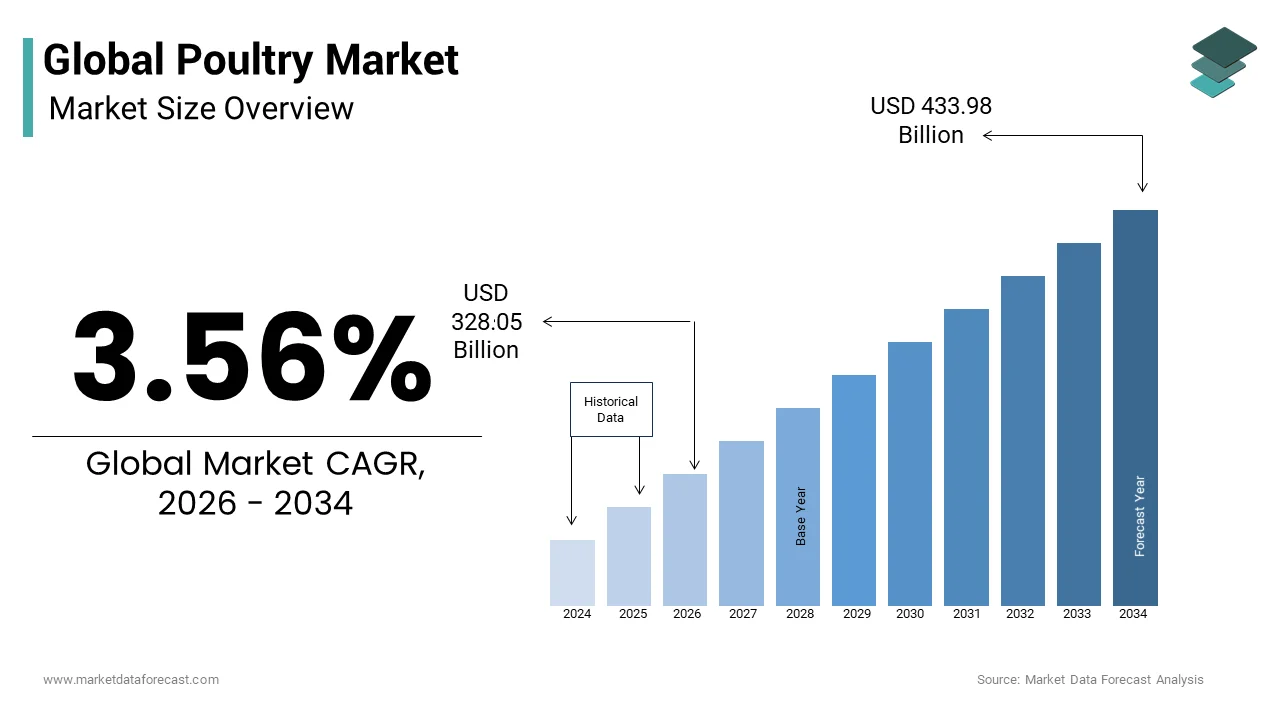
The global poultry market was valued at USD 316.77 billion in 2025 and is expected to reach USD 328.05 billion in 2026 and USD 433.98 billion by 2034, growing at a CAGR of 3.56% during the forecast period from 2026 to 2034. Growth is driven by rising demand for affordable lean protein, rapid expansion of retail and QSR chains, and advancements in breeding, biosecurity, and feed technology. Disease outbreaks, environmental impacts from feed cultivation, and labor shortages in processing remain key challenges. Opportunities are emerging in ready-to-cook products, sustainable feed alternatives, and antibiotic-free poultry systems. Asia Pacific leads global consumption, while North America and Latin America are major producers.
Key Market Trends in the Global Poultry Market
- Rising adoption of antibiotic-free and organic poultry, Consumer preference for clean-label, hormone-free, and responsibly sourced poultry is reshaping production systems worldwide.
- Growth of value-added and convenience-focused poultry products, Ready-to-cook, marinated, portioned, and fully cooked meals are expanding rapidly in urban markets.
- Integration of automation and digital monitoring in poultry farming, AI-driven disease detection, smart climate control, and automated hatcheries is improving yield and reducing biosecurity risks.
- Expansion of alternative and sustainable feed solutions, Insect protein, algae-based feed, and fermentation-derived proteins are emerging to reduce dependence on soy and corn.
- Strong rise in QSR and modern retail consumption, Global fast-food chains and e-grocery platforms are increasing demand for standardized, processed poultry.
- With growing regulatory focus on animal welfare and environmental impact, Producers are transitioning to higher-welfare systems, enhanced waste management, and reduced ammonia emissions.
Segmental Insights
- Chicken is the dominant species segment, driven by short production cycles, low cost, and high feed conversion efficiency.
- Duck is the fastest-growing species, supported by rising demand in Asia and gourmet applications in Western markets.
- Supermarkets lead distribution, offering consistent quality, traceability, and premium ready-to-cook formats.
- Online channels show the highest growth, fueled by last-mile delivery, digital grocery adoption, and cold-chain investments.
Regional Highlights
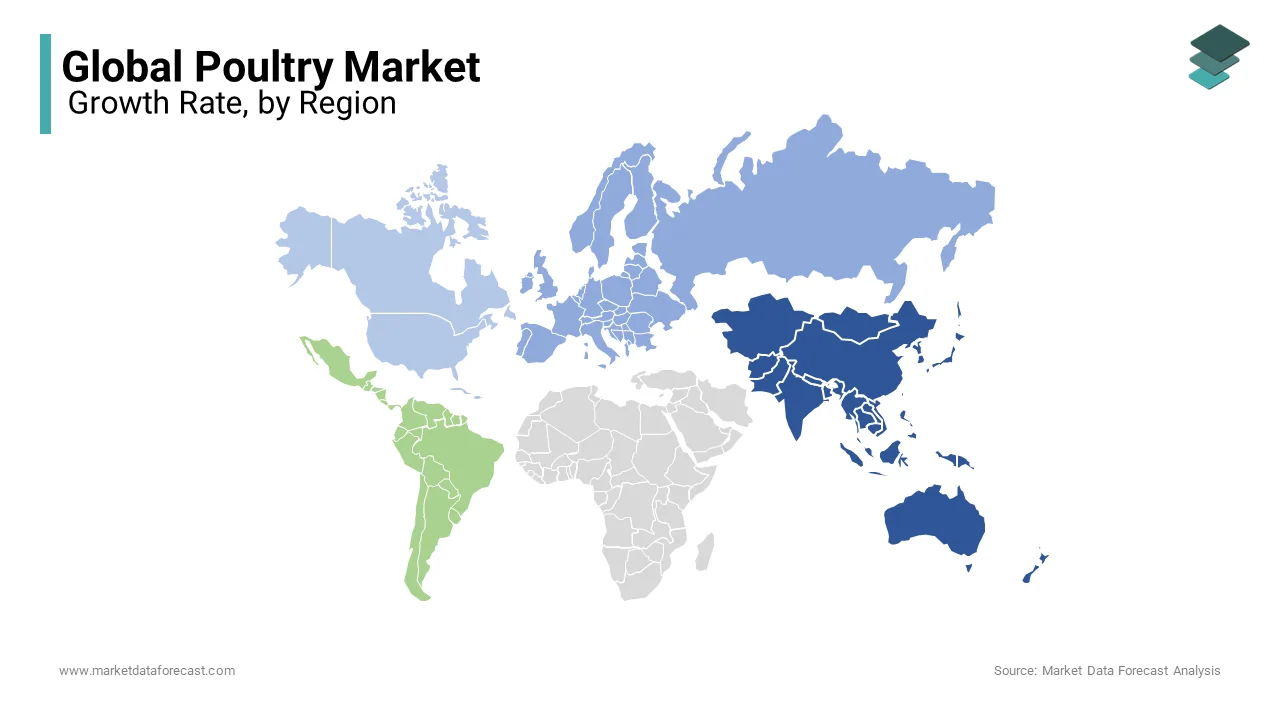
- Asia Pacific holds the largest market share, driven by massive production in China and India and rising protein consumption.
- North America is a leading producer, supported by integrated supply chains and strong per capita consumption.
- Europe focuses on regulated, high-welfare poultry systems, influenced by strict environmental and antibiotic rules.
- Latin America, led by Brazil, dominates global exports, supplying major import markets across the Middle East and Asia.
- The Middle East & Africa show rising demand, driven by population growth, affordability of poultry, and reliance on imports.
Competitive Landscape
Key companies dominating the global poultry market include Tyson Foods, Inc., JBS S.A., Pilgrim's Pride Corporation, Wens Foodstuff Group Co., Ltd., BRF S.A., Perdue Farms, Sanderson Farms, Baiada Poultry, Bates Turkey Farm, and Amrit Group. These players focus on expanding production capacity, ensuring supply chain resilience, and introducing processed poultry products to meet evolving consumer demand.
Global Poultry Market Size
The global poultry market size was valued at USD 316.77 billion in 2025 and is anticipated to reach USD 328.05 billion in 2026 and USD 433.98 billion by 2034, growing at a CAGR of 3.56% during the forecast period from 2026 to 2034.
Poultry are primarily chickens, ducks, turkeys, and geese, for meat and egg production. It is an important component of global food security, which serves as the most efficient source of animal protein as it requires less feed and generates lower greenhouse gas emissions per kilogram of meat compared to ruminants. According to the Food and Agriculture Organization (FAO) of the United Nations, global poultry meat production surpassed 140 million metric tons in 2023, with broiler chickens accounting for over 85% of output. The market supports millions of smallholder farmers and rural workers, particularly in developing nations, as per the study. Urbanization, rising disposable incomes, and shifting dietary preferences toward lean protein have elevated poultry’s role in both traditional and modern diets. Technological advancements in breeding, biosecurity, and feed formulation continue to enhance productivity and sustainability across the value chain.
MARKET DRIVERS
Rising Global Demand for Affordable and Lean Animal Protein
Poultry has emerged as the preferred source of animal protein due to its affordability, low fat content, and high biological value, which is driving the growth of the poultry market. According to the study, poultry is a significant protein source, especially in developing countries where it is more affordable than red meat. In India, per capita poultry meat consumption increased in 2023, up from that in 2018, as per research, driven by urbanization and health awareness. According to the U.S. Department of Agriculture (USDA), chicken has surpassed beef as the most-consumed meat in the United States, with per capita consumption having surged over several decades. This widespread accessibility and nutritional efficiency make poultry a cornerstone of global dietary transitions.
Expansion of Organized Retail and Quick-Service Restaurant Chains
The proliferation of supermarkets, hypermarkets, and fast-food outlets is accelerating the growth of the poultry market. This has significantly amplified demand for processed and ready-to-cook poultry products. According to Euromonitor International, organized retail accounts for a portion of packaged chicken sales in China, with chilled and marinated variants gaining traction. In Southeast Asia, KFC, Jollibee, and local QSR chains have expanded aggressively. In India, quick-service brands like McDonald’s and Domino’s have introduced region-specific chicken-based menus, increasing poultry procurement from integrated producers such as Suguna and Venky’s. Moreover, the rise of e-grocery platforms like BigBasket and Amazon Fresh has further enabled doorstep delivery of fresh and frozen poultry.
MARKET RESTRAINTS
Outbreaks of Avian Influenza and Biosecurity Vulnerabilities
Avian influenza (bird flu) remains a threat to poultry production, leading to mass culling, trade restrictions, and consumer panic, and additionally enhances the growth of the poultry market. According to the study, millions of birds were culled globally due to highly pathogenic H5N1 outbreaks, the highest on record. In the United States, the 2022 outbreak affected 50.54 million birds across 46 states, prompting the USDA to declare a federal emergency and suspend exports to several countries. These events disrupt supply chains, increase production costs, and erode consumer confidence. Small-scale farms, which often lack biosecurity infrastructure, are disproportionately affected, which is constraining market-wide resilience and scalability.
Environmental Impact and Land Constraints from Feed Crop Cultivation
The poultry production is heavily dependent on feed, which contributes to deforestation and land degradation in key agricultural regions, and additionally restricts the growth of the poultry market. According to the research, soybean cultivation in South America has led to the loss of hectares of forest and savanna, largely to meet global demand for animal feed. In Brazil, a portion of soy production is used for livestock, with poultry being a major consumer, as per a study. Apart from these, manure runoff from large-scale poultry farms contributes to water pollution and eutrophication. In the U.S., the Environmental Protection Agency (EPA) identified poultry operations as a leading source of nitrogen and phosphorus in the Chesapeake Bay watershed. These environmental externalities are prompting stricter regulations and consumer backlash by compelling producers to adopt sustainable sourcing and alternative feed solutions.
MARKET OPPORTUNITIES
Growth of Value-Added and Ready-to-Cook Poultry Products
The rising consumer demand for convenience and time-saving meals has spurred innovation in value-added poultry, including marinated cuts, portion-controlled packs, and fully cooked meals, which is majorly boosting the growth of the poultry market. According to the study, sales of processed poultry grew, outpacing raw meat sales in urban markets. In Japan, ready-to-grill and microwaveable chicken products accounted for a portion of retail poultry sales, as per the research. In India, brands offer vacuum-sealed, spice-marinated chicken with 24-hour delivery, capturing a growing urban customer base. These products command premium pricing and reduce preparation waste. Apart from these, private-label and gourmet variants, such as herb-infused, organic, and halal-certified cuts, are expanding market segmentation.
Adoption of Alternative Feeds and Sustainable Farming Practices
The growing investment in sustainable feed alternatives to reduce reliance on soy and corn is additionally enhancing the growth of the poultry market. In the Netherlands, companies operate commercial-scale insect farms to supply poultry feed, reducing land and water use compared to traditional crops. Apart from these, fermentation-derived proteins and algae-based feeds are being piloted by companies. The European Union approved the use of insect protein in poultry feed, opening a new regulatory pathway.
MARKET CHALLENGES
Antibiotic Resistance and Regulatory Burden on Growth Promoters
The routine use of antibiotics in poultry farming to prevent disease and promote growth has raised global concerns about antimicrobial resistance (AMR), which is challenging the growth of the poultry market. According to the World Health Organization (WHO), resistant strains of Salmonella and Campylobacter linked to poultry are responsible for a large number of human infections annually. In the European Union, the ban on antibiotic growth promoters has reduced overall veterinary antimicrobial use, as reported by the European Medicines Agency (EMA). In the U.S., the FDA’s Guidance for Industry led to a decline in medically important antibiotic sales for livestock. Producers now face the need to adopt alternatives such as probiotics, prebiotics, and enhanced biosecurity. However, transitioning to antibiotic-free systems increases production costs and mortality rates, particularly in high-density farms.
Labor Shortages and Rising Operational Costs in Poultry Processing
The poultry processing remains labour-intensive, with manual evisceration, cutting, and packaging, which is challenging the growth of the poultry market. This accounts for a portion of operational costs in many countries. According to the research, the U.S. poultry processing sector faced a workforce shortage in 2023 due to high turnover and declining interest in physically demanding roles. In Thailand, labor costs in poultry plants increased between 2020 and 2023, as per a study, driven by minimum wage hikes and migration restrictions. These burdens are exacerbated by rising energy and feed prices, which squeeze margins for mid-sized producers. Automation is limited due to the irregular shape of birds and high capital costs. Therefore, the market struggles to maintain productivity due to the absence of scalable mechanization. This leads to supply barriers and reduced competitiveness, particularly in export-oriented markets dependent on cost efficiency.
REPORT COVERAGE
| REPORT METRIC | DETAILS |
| Market Size Available | 2025 to 2034 |
| Base Year | 2025 |
| Forecast Period | 2026 to 2034 |
| CAGR | 3.56% |
| Segments Covered | By Species, Distribution Channel, and Region |
| Various Analyses Covered | Global, Regional, and Country Level Analysis; Segment-Level Analysis; DROC; PESTLE Analysis; Porter’s Five Forces Analysis; Competitive Landscape; Analyst Overview of Investment Opportunities |
| Regions Covered | North America, Europe, APAC, Latin America, Middle East & Africa |
| Market Leaders Profiled | Tyson Foods, Inc., JBS S.A., Pilgrim's Pride Corporation, Wens Foodstuff Group Co., Ltd., BRF S.A., Perdue Farms, Sanderson Farms, Baiada Poultry, Bates Turkey Farm, and Amrit Group. |
SEGMENTAL ANALYSIS
By Species Insights
The chicken segment was the largest and held a prominent share of the poultry market in 2024. The growth of the chicken segment is primarily driven by its cost-efficiency, short growth cycle, and high feed conversion ratio. Broiler chickens reach market weight in just weeks, requiring kilograms of feed per kilogram of live weight, according to the research, making it the most resource-efficient meat source. In India, chicken accounts for a notable share of poultry meat consumption, with annual production exceeding in metric tons, as per a study. In sub-Saharan Africa, smallholder chicken farming supports a portion of rural households, according to the research, serving both nutritional and income-generating purposes.
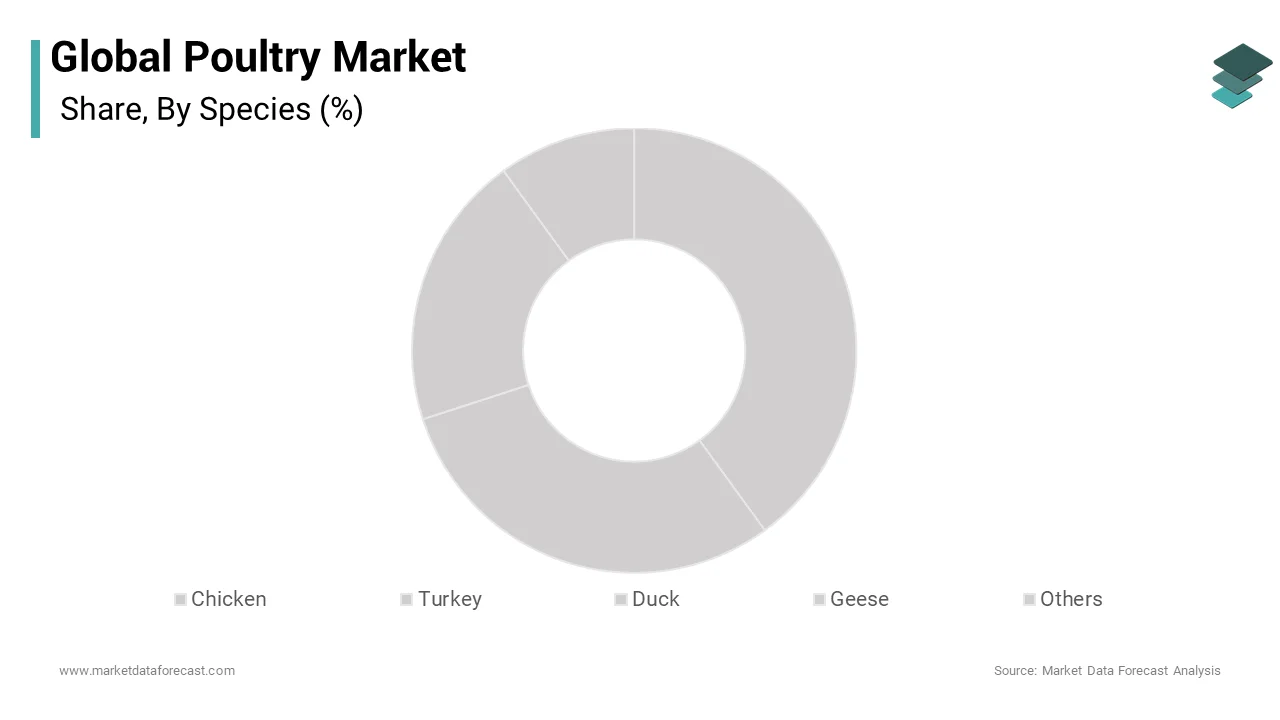
The duck segment is estimated to register a CAGR of 6.8% over the forecast period, owing to the rising demand for specialty meats in Asia and gourmet applications in Western markets. In China, annual duck consumption is significant, with Peking duck and roasted duck being cultural staples, as per a study. Vietnam and Thailand have also expanded duck farming for both domestic use and export. In France, duck meat is a key ingredient in foie gras and confit. The species’ rich flavour and suitability for premium culinary applications make it attractive to high-end restaurants and specialty processors.
By Distribution Channel Insights
The supermarkets segment led the poultry distribution market by capturing a 42.1% share in 2024, with consumer preference for hygienic, temperature-controlled, and traceable poultry products in urban centers. In China, supermarkets distribute a portion of packaged chicken, with chilled and marinated variants dominating chilled counters, according to a study. In addition, supermarkets offer consistent branding, cold-chain integrity, and private-label options, which build consumer trust. Apart from these, partnerships with integrated poultry producers such as JBS and BRF ensure supply reliability. The expansion of refrigerated logistics and consumer demand for ready-to-cook formats have strengthened supermarkets as the primary conduit for modern poultry retail, particularly in middle- and upper-income urban households.
The online channels segment is predicted to witness the highest CAGR of 11.4% from 2025 to 2033 due to digital adoption, last-mile delivery infrastructure, and shifting urban consumption patterns. In India, online poultry sales grew, with platforms like Licious, FreshtoHome, and BigBasket delivering a notable number of orders monthly, as per the study. In the UAE, Talabat and Instashop have integrated fresh poultry into their grocery offerings, with same-day delivery in Dubai and Abu Dhabi. The integration of vacuum sealing, real-time tracking, and QR-code-based traceability enhances consumer confidence.
REGIONAL ANALYSIS
Asia Pacific Market Analysis
Asia Pacific was the top performer in the poultry market by holding 36.3% of the share in 2024, with India and China, where rising incomes and urbanization are reshaping protein consumption. The Asia-Pacific is expected to be the most lucrative region in the poultry market. India produces large metric tons of poultry meat annually, with per capita consumption growing, according to the research. China, a major poultry importer, consumed significant metric tons, driven by demand for processed and fast-food chicken, as stated by China Customs. Moreover, Indonesia and Vietnam are expanding commercial broiler farms to meet domestic needs. Apart from these, religious preferences, such as Halal certification in Indonesia and Malaysia, shape production standards.
North America Market Analysis
The North American poultry market, with the United States serving as the dominant producer and innovator. The growth of North America in the global market is driven by advanced processing, cold-chain logistics, and foodservice integration. The U.S. produces notable metric tons of poultry meat annually. Chicken consumption surged per capita, surpassing beef for the first time in history, as per the study. Moreover, integrated production systems operated by Tyson Foods, Pilgrim’s Pride, and Perdue ensure efficiency and scale. Furthermore, the rise of antibiotic-free, organic, and air-chilled chicken reflects evolving consumer preferences. Canada complements the regional market with strong export capabilities by shipping metric tons.
Europe Market Analysis
The European market is growing steadily, with France, Germany, and Poland as key production and consumption centers. The EU produced notable metric tons of poultry meat, with broiler chicken accounting for a notable share of output, as per research. In France, poultry is the most consumed meat. Poland is the largest poultry exporter in the EU, shipping notable metric tons to African and Asian markets. In addition, stringent animal welfare regulations and rising demand for free-range and organic poultry are reshaping production. The European Green Deal and Farm to Fork strategy are pushing producers toward sustainable feed and lower emissions, which positions Europe as a leader in regulated and high-integrity poultry systems.
Latin America Market Analysis
Latin America grew steadily in the poultry market, with Brazil, Argentina, and Mexico as dominant players. The growth of Latin America in the global market is driven by its production efficiency and export-oriented model. Brazil is the world’s largest exporter of poultry meat, shipping metric tons, primarily to China, the Middle East, and Japan, as per a study. The country’s competitive advantage lies in low feed costs, large-scale farms, and efficient processing. In Mexico, domestic consumption of chicken has grown annually due to its affordability and integration into traditional dishes like tacos and soups, according to a study. Argentina has expanded value-added exports, including marinated and ready-to-cook cuts.
Middle East and Africa Market Analysis
The Middle East & Africa are likely to grow in the poultry market, with the Gulf Cooperation Council (GCC) nations and South Africa driving structured demand. In Saudi Arabia, poultry accounts for a notable share of meat consumption due to religious preference and affordability, with annual imports exceeding hundreds of thousands of metric tons, as per the study. The UAE relies on imports for a portion of its poultry supply, sourcing from Brazil, India, and the EU. In South Africa, commercial farms produce million metric tons annually, according to the study. Egypt has invested in domestic broiler production to reduce import dependency. At the same time, informal markets dominate in sub-Saharan Africa.
COMPETITIVE LANDSCAPE
Competition in the poultry market is intensifying as large integrated producers, regional champions, and specialty brands vie for dominance across fragmented geographies. Incumbents face difficulties from rising feed costs, disease outbreaks, and shifting consumer preferences toward transparency and sustainability. Differentiation is achieved through product quality, processing technology, and branding, particularly in value-added and organic segments. In the Asia Pacific, local players dominate fresh and traditional markets, while multinationals lead in export and processed categories. Price sensitivity remains high in rural areas, whereas urban consumers prioritize convenience, safety, and ethical sourcing. Regulatory scrutiny over antibiotics, animal welfare, and environmental impact is reshaping operational standards. The convergence of technology, sustainability, and culinary innovation is redefining competitive advantage, favoring agile, vertically integrated, and consumer-responsive operators.
KEY MARKET PLAYERS
A few of the market players in the global antimony market include
- Tyson Foods, Inc.
- JBS S.A.
- Pilgrim's Pride Corporation
- Wens Foodstuff Group Co., Ltd.
- BRF S.A., Perdue Farms
- Sanderson Farms
- Baiada Poultry
- Bates Turkey Farm
- Amrit Group
Top Players In The Market
- JBS is a Brazilian multinational that plays a transformative role in the Asia Pacific poultry market through strategic investments and export expansion. The company supplies premium frozen and value-added chicken products by aligning with regional demand for processed and Halal-certified meat. It has strengthened traceability by implementing blockchain technology across its supply chain, which enables Asian importers to verify animal welfare and food safety standards. Its focus on sustainable sourcing, antibiotic-free production, and compliance with Chinese and Gulf food regulations has strengthened its reputation as a reliable international supplier in one of the world’s most demanding poultry markets.
- Charoen Pokphand Foods is a dominant force in the Asia Pacific’s poultry sector, operating one of the most integrated farm-to-fork systems in Thailand, Indonesia, and Vietnam. The company produces large metric tons of chicken annually, which supplies both domestic markets and export destinations such as Japan, South Korea, and the EU. It has invested in automated hatcheries and AI-driven disease monitoring to improve biosecurity and yield. Its strong retail presence through CP Fresh shops and partnerships with e-grocers like Lazada has enhanced consumer access, which strengthens its position in both conventional and innovative poultry solutions.
- Venky’s is a cornerstone of India’s organized poultry market, significantly shaping the country’s transition from backyard farming to commercial production. The company operates large-scale breeding, feed, and processing facilities across Andhra Pradesh, Maharashtra, and Karnataka, supplying fresh, frozen, and value-added chicken to retail chains, hotels, and exporters. It has expanded its e-commerce footprint through partnerships with BigBasket and Swiggy, offering doorstep delivery within four hours of processing. The company adheres to FSSAI and GlobalG.A.P. standards, ensuring export readiness. Venky’s R&D center in Pune focuses on disease-resistant breeds and feed efficiency, and is strengthening its role as a technology-driven leader in India’s rapidly modernizing poultry sector.
Top Strategies Used By Key Market Participants
Key players in the poultry market are deploying integrated strategies to maintain competitiveness amid rising consumer expectations and operational challenges. Vertical integration is widely adopted, with companies controlling breeding, feed production, farming, and processing to ensure quality and traceability. Investment in biosecurity and antibiotic-free production is increasing to meet regulatory and consumer demands. Product innovation focuses on value-added formats such as marinated cuts, ready-to-cook meals, and plant-based hybrids. Expansion into e-commerce and cold-chain logistics enhances distribution efficiency and urban reach. Sustainability initiatives, including alternative feeds, manure management, and carbon footprint reduction, are becoming central to brand equity. Strategic exports to high-demand regions like the Middle East and Asia are pursued through Halal certification and regulatory compliance, ensuring global market access.
RECENT MARKET NEWS
In June 2024, Venky’s launched an air-chilled, no-water-retention chicken range in Indian metropolitan cities, targeting health-conscious consumers and differentiating from conventional ice-chilled competitors.
MARKET SEGMENTATION
This research report on the global poultry market is segmented and sub-segmented into the following categories.
By Species Type
- Chicken
- Turkey
- Duck
- Geese
- Others
By Distribution Channel
- Hypermarkets
- Supermarkets
- Online Channels
- Specialty Stores
- Others
By Region
- North America
- Europe
- Asia-Pacific
- Latin America
- Middle East and Africa