- Product Description Description
- Table of Contents TOC
- List of Table & Figure LOT
- Get Free Sample PDF Sample PDF
Market Size, 2025
$40.53 BnMarket Estimate, 2026
$42.88 BnMarket Forecast, 2034
$67.32 BnCAGR, 2026–2034
5.8%Executive Summary: Global Power Substation Automation and Integration Market
- Market Scope: Comprehensive analysis of the global power substation automation and integration sector, examining modules (IED, RTU, BCU, SCADA), communication technologies (wired vs. wireless), substation types (transmission vs. distribution), end-users (utilities vs. industries), and regional performance across North America, Europe, APAC, Latin America, and MEA.
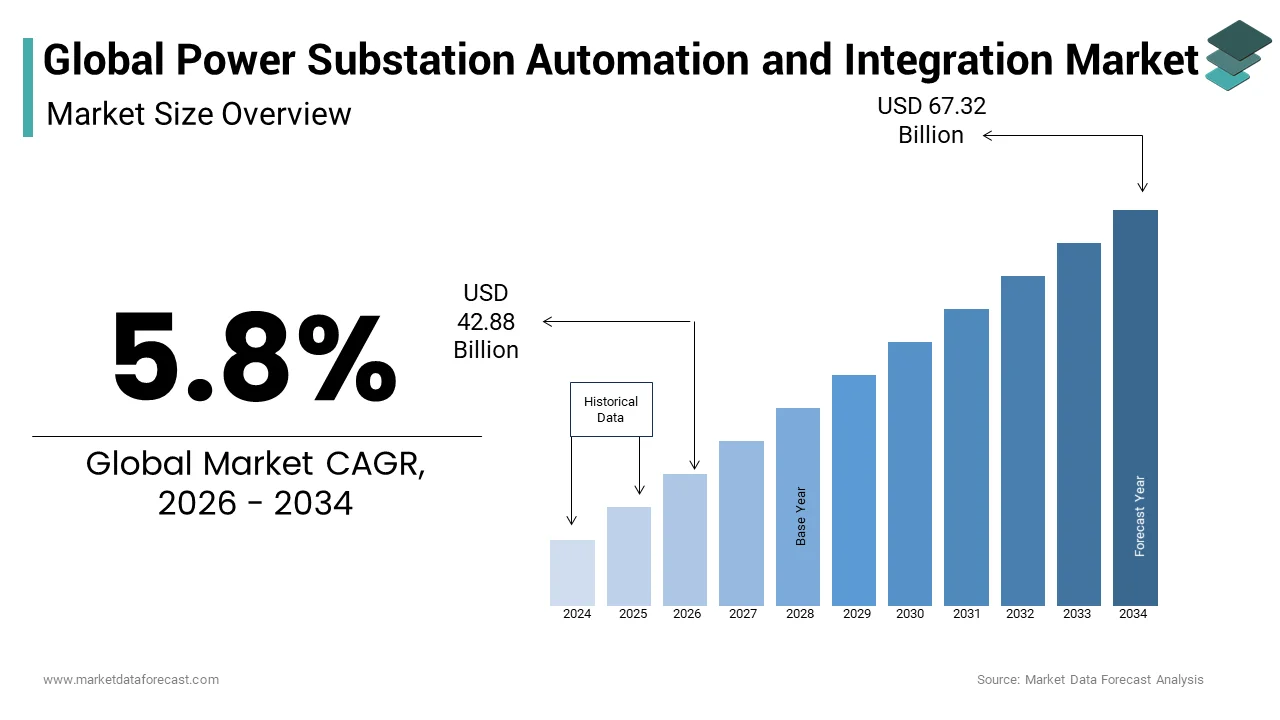
- Market Valuation: Valued at USD 40.53 billion in 2025, reaching USD 42.88 billion in 2026, and projected to expand to USD 67.32 billion by 2034, growing at a steady CAGR of 5.8% over the forecast period from 2026 to 2034.
- Primary Growth Drivers: Escalating global electricity consumption, rapid integration of renewable energy projects and electric/hybrid vehicles, smart grid modernization, and the operational necessity for real-time fault detection and remote automation.
Key Market Segment Metrics
| Category | Leading Segment (Base Year Position) | Fastest-Growing / High-Impact Segment |
|---|---|---|
| By Module & Communication | Intelligent Electronic Devices (IEDs) & Wired Networks (dominant baseline shares for automatic transformer control and reliable data telemetry) | Wireless Communication (high-impact growth segment eliminating expensive trenching and lowering network installation barriers during substation reconstruction) |
| By Substation Type & End-User | Utility Sector & Distribution Substations (leading baseline volumes driven by widespread smart grid installations, network modernizations, and end-user proximity) | Commercial/Industrial End-Users & Transmission Networks (fast-expanding application areas propelled by heavy manufacturing power demand and infrastructure upgrades) |
| By Region | North America (leading regional market share backed by strong federal funding, smart energy initiatives, and advanced grid infrastructure across the US and Canada) | Asia-Pacific (fast-growing regional market led by massive rural electrification programs in India, extensive smart grid projects in China, and regional industrialization) |
Major Market Players & Market Structure
Market Structure: Consolidated industrial technology ecosystem featuring global power grid giants, automation specialists, and networking enterprises driving digital transformation and smart grid expansions.
Key Companies: Hitachi ABB Power Grids, Siemens Energy, General Electric, Schneider Electric, Eaton Corporation, Cisco, Schweitzer Engineering Laboratories, Honeywell, Nova-Tech Automation, Industrial Solutions, and CG Power.
Global Power Substation Automation and Integration Market Size
The global power substation automation and integration market size was valued at USD 40.53 billion in 2025 and is anticipated to reach USD 42.88 billion in 2026 to reach USD 67.32 billion by 2034, growing at a CAGR of 5.8% during the forecast period from 2026 to 2034.
Power substation automation and integration is a collection of components that are used to collect and monitor the system. This automatic system increases the efficiency and productivity of the substation. Earlier, the individuals were responsible for collecting the faults manually, which resulted in a lack of service to the clients. But with the automation of the substations, the records and faults are easily available and can be rectified without any delay. The introduction of intelligent electronic devices made the substations more intelligent. They can collect and record data in a few seconds, process complex situations, and analyze the problem. After that, the commands are sent to the required department to clear the fault. Furthermore, these devices can store information in their internal storage for a certain duration of time and transfer this information when required for further study and analysis.
MARKET DRIVERS
Global electricity consumption has continued to go up rapidly, so power substation automation is the need of the hour, and companies need to provide services to the customers without any delay. The power substation automation and integration market is growing rapidly with demand for renewable energy projects, as well as increased usage of electric and hybrid vehicles. With an increase in infrastructure developments and power consumption in industries, the oil and gas industry is contributing to the global market growth. The benefits of power substation automation and integration, which include local and global alarm warnings, fault detection without any manual intervention, intelligent energy devices, diagnostics of disturbances, and storage of data for future use, are key factors fuelling the growth of the power substation automation and integration market. Moreover, the use of modern technology, such as smart grids,n solve complex operations and management expenses, resulting in cheaper power bills for consumers both in commercial and industrial settings. Previously, many power companies were incurring huge losses, which impacted power supply quality, but with automation, this has changed.
The wide range of applications and the benefits derived from power substation automation and integration are the significant factors propelling the growth of the market globally. The growing demand for higher efficiency and minimum delay of services is driving the use of automated substations in a variety of sectors, including Industries, oil and gas, and railways.
MARKET RESTRAINTS
The lack of suitable investments is a significant barrier to market expansion because the installation cost of the automated substation is higher. There is also the additional burden of maintaining and operating these powerplantsts which is a major concern for the government as well as private power companies.
REPORT COVERAGE
| REPORT METRIC | DETAILS |
| Market Size Available | 2025 to 2034 |
| Base Year | 2025 |
| Forecast Period | 2026 to 2034 |
| CAGR | 5.8% |
| Segments Covered | By Types, Module, Communication, End User, and Region |
| Various Analyses Covered | Global, Regional & Country Level Analysis, Segment-Level Analysis, DROC, PESTLE Analysis, Porter’s Five Forces Analysis, Competitive Landscape, Analyst Overview of Investment Opportunities |
| Regions Covered | North America, Europe, APAC, Latin America, Middle East & Africa |
| Market Leaders Profiled | Hitachi ABB Power Grids, Industrial Solutions, Siemens Energy, Schweitzer Engineering Laboratories, General Electric, Cisco, Schneider Electric, Eaton Corporation, Honeywell, Nova-Tech Automation, CG Power, and Others. |
SEGMENTAL ANALYSIS
By Module Insights
Based on the module segment, the intelligent electronic devices segment is growing in the power substation automation and integration market. IEDs provide many benefits, such as automatic control of the transformers and timely checking of the overloading of the transformers, and analyzing and storing the information. Due to this, many companies have started using IEDs in automated substations to reduce costs and increase productivity.
By Communication Insights
According to communication, the wireless segment is expected to grow because it allows for more cost-effective network installation during substation reconstruction. There is no trenching expense as compared to the wired communication and enabling network access for workers at the substation.
By Types Insights
Throughout the anticipated period, the distribution segment is expected to have a high market share. Distribution substations are used for shorter distances and lower voltage electricity transportation and are generally located near the end users. As a result, it has the potential for commercial growth.
By End-User Insights
At present, the utilities segment occupies the largest share of the market and is projected to grow throughout the forecast period. Because of the enormous imbalance between power demand and supply in most developing and developed industries, the utility business is one of the leading application areas for power substation automation and integration. In the utility industry, power substation integration and automation systems have a wide range of applications. Energy is generated, transmitted, and distributed via substation automation and integration. The utility sector comprises network modernization and smart grid installation.
REGIONAL ANALYSIS
Geographically, North America has the largest market share and is projected to grow in the power substation automation and integration market. Installing power automated substations requires financial initiatives because of the high cost, and the governments in the USA and Canada are funding the power and energy.
Asia-Pacific and Europe are the second and third largest markets for power automation substations and integration, respectively. In addition, India has also started the initiative to electrify all its villages, which has resulted in the growth of the market.
KEY MARKET PLAYERS
Companies playing a major role in the global power substation automation and integration market include
- Hitachi ABB Power Grids (Switzerland)
- Industrial Solutions (India)
- Siemens Energy (Germany)
- Schweitzer Engineering Laboratories (US)
- General Electric (US)
- Cisco (US)
- Schneider Electric (France)
- Eaton Corporation (Ireland)
- Honeywell (US)
- Nova-Tech Automation (US)
- CG Power.
RECENT MARKET NEWS
In January 2021, SEL launched the new SEL-3350 Automation Controller, which provides a lower price point and a smaller 1U form factor.
- Grid Solutions from GE Renewable Energy and BOND Civil & Utility Construction from New York created a consortium to install a digital onshore substation for the 816 MW Empire Wind 1, which is one of the first projects in New York for wind farms.
MARKET SEGMENTATION
This research report on the global power substation automation and integration market has been segmented and sub-segmented based on module, type, communication, end-use, and region.
By Module
- IED
- RTU
- BCU
- SCADA
By Communication
- Wired
- Wireless
By Types
- Transmission
- Distribution
By End-User
- Utility
- Industry
By Region
- North America
- Europe
- The Asia Pacific
- Latin America
- The Middle East and Africa