- Product Description Description
- Table of Contents TOC
- List of Table & Figure LOT
- Get Free Sample PDF Sample PDF
Global Radar Market Summary
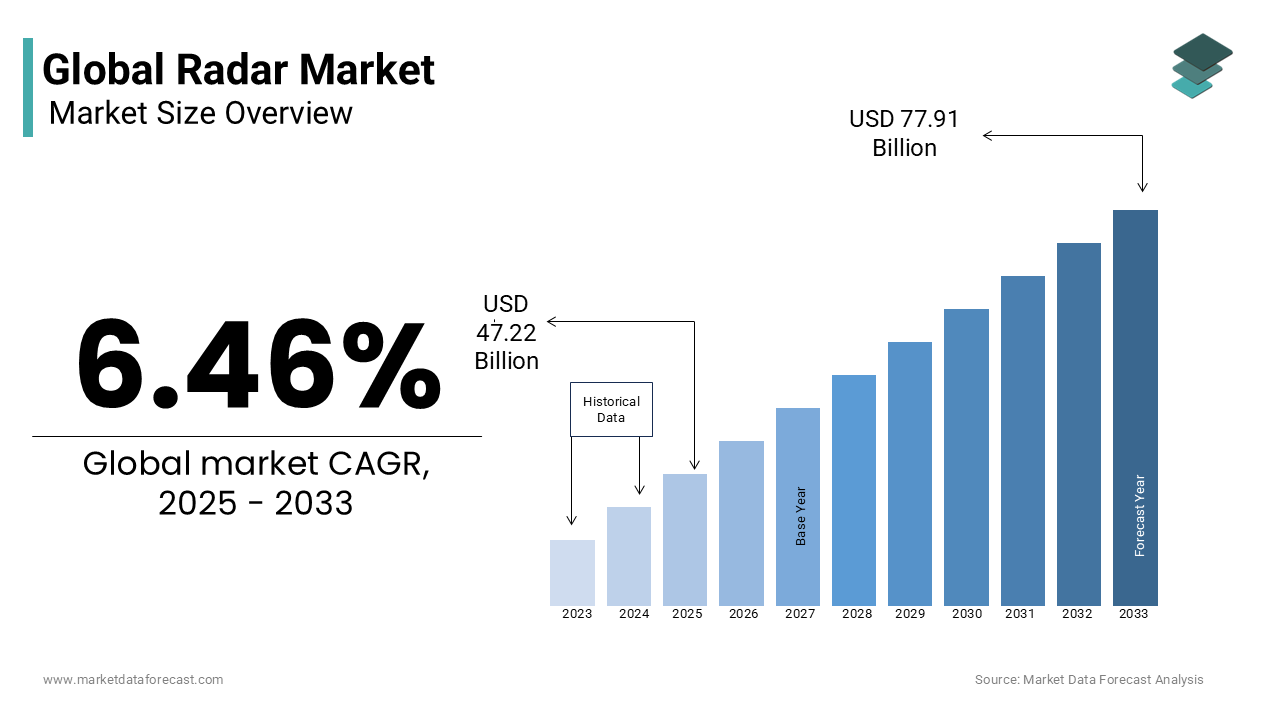
The global radar market was valued at USD 44.35 billion in 2024, is estimated to reach USD 47.22 billion in 2025, and is projected to expand to USD 77.91 billion by 2033, growing at a CAGR of 6.46% from 2025 to 2033. The growth of the global radar market is driven by rising demand for advanced surveillance and defense systems, increasing applications in air traffic control and automotive safety, and the growing need for weather monitoring and navigation systems. Continuous technological advancements in radar components, such as phased array systems and solid-state modules, further support market expansion.
Key Market Trends
- Rising adoption of radar systems in military and defense for surveillance, targeting, and missile guidance.
- Increasing use of automotive radars for collision avoidance, adaptive cruise control, and autonomous vehicles.
- Expansion of weather monitoring radars to improve disaster preparedness and forecasting.
- Growing integration of radar technology in aerospace and maritime navigation.
- Advancements in phased array and solid-state radar systems are enhancing accuracy and reliability.
Segmental Insights
- Based on offering, the components segment dominated the global radar market in 2024, supported by high demand for transmitters, antennas, and receivers across defense and commercial applications.
- Based on end use, the military and defense segment accounted for the largest market share in 2024, reflecting strong investments in radar-based surveillance and security systems.
Regional Insights
- North America was the top-performing region, holding 41.5% of the global radar market in 2024, driven by strong defense budgets, advanced aerospace infrastructure, and early adoption of radar innovations.
- Europe shows steady growth, supported by NATO modernization programs and investments in air traffic management.
- Asia-Pacific is expected to register the fastest growth, fueled by rising defense expenditures in China and India and expanding automotive radar adoption.
- Latin America and the Middle East & Africa are emerging markets, with demand primarily driven by defense upgrades and border security initiatives.
Competitive Landscape
Leading players in the global radar market include Lockheed Martin Corporation, Raytheon Technologies Corporation, Thales Group, Leonardo S.p.A., BAE Systems plc, Northrop Grumman Corporation, Saab AB, HENSOLDT AG, Israel Aerospace Industries (IAI), and Mitsubishi Electric Corporation. These companies are focusing on R&D investments, defense partnerships, and next-generation radar system development to strengthen their global presence.
Global Radar Market Size
The Radar Market was valued at USD 44.35 billion in 2024, is estimated to reach USD 47.22 billion in 2025, and is projected to reach USD 77.91 billion by 2033, growing at a CAGR of 6.46% from 2025 to 2033.
Radar utilizes radio waves to detect, track, and characterize objects at a distance, serving vital functions across defense, aviation, maritime, automotive, and meteorological domains. In civil aviation, the Federal Aviation Administration operates more than 600 primary and secondary radar installations across the United States to ensure airspace surveillance. Weather services in Europe rely on a network of 230 C-band Doppler radars coordinated through the European Meteorological Infrastructure (EUMETNET), enabling real-time storm tracking and flood forecasting. Apart from these, as per NASA, planetary radar systems such as the Arecibo Observatory legacy and NASA’s Goldstone Deep Space Communications Complex have been instrumental in tracking near-Earth asteroids, with over 27,000 identified objects monitored using radar ranging techniques.
MARKET DRIVERS
The escalating demand for advanced air defense and missile detection systems amid rising global geopolitical tensions is accelerating the growth of radar market. Nations are modernizing their surveillance infrastructure to counter evolving threats such as hypersonic glide vehicles, stealth aircraft, and drone swarms. The United States has deployed over 70 AN/TPY-2 radar units as part of its Terminal High Altitude Area Defense (THAAD) system, capable of detecting ballistic missiles at ranges exceeding 1,000 kilometers, as documented by the U.S. Missile Defense Agency. Israel’s Iron Dome system, which relies on the EL/M-2084 multi-mission radar, achieved a 90% interception rate during conflict scenarios, according to the Israel Ministry of Defense. Similarly, India has commissioned over 20 indigenously developed Rajendra and Swordfish radars to enhance its air defense coverage along volatile borders.
The Integration into autonomous and advanced driver-assistance systems (ADAS) in the automotive sector, where reliability under adverse conditions is paramount that propels the growth of radar market. Modern vehicles employ radar for adaptive cruise control, automatic emergency braking, blind-spot detection, and cross-traffic alert functions. As of 2023, over 65 million vehicles were equipped with 77 GHz millimeter-wave radar sensors, according to the Automotive Electronics Council. Tesla, despite its camera-centric approach, retains radar in select models for redundancy, while BMW, Mercedes-Benz, and Toyota have standardized radar across their premium and mid-tier lines. The European New Car Assessment Programme mandates radar-based safety systems for top safety ratings, accelerating adoption.
MARKET RESTRAINTS
The increasing spectrum congestion and regulatory limitations on frequency allocation hinders the growth of radar market. The radio frequency bands used by radar, particularly C, X, and Ku bands, are under growing push or force from 5G telecommunications, satellite networks, and IoT devices. In the United States, the National Oceanic and Atmospheric Administration warned that 5G transmissions near 23.8 GHz could interfere with passive satellite sensors used to detect atmospheric water vapor, indirectly affecting radar-based weather prediction accuracy. The Federal Communications Commission has recorded interference incidents between commercial wireless systems and military radar operations.
High development and lifecycle costs associated with advanced radar systems, especially those incorporating AESA and gallium nitride (GaN) semiconductor technology, is restraining the growth of the radar market. For instance, the Eurofighter Typhoon’s Captor-E AESA radar required a substantial share in R&D investment before operational deployment, according to the study. These costs extend beyond procurement to include maintenance, software updates, and operator training. In India, the development of the indigenous Active Array Radar for the Tejas MK-2 fighter spanned years and incurred delays due to material sourcing and testing obstructions, as per the research. For smaller nations and commercial operators, such financial and technical barriers limit access to cutting-edge capabilities.
MARKET OPPORTUNITIES
The application of synthetic aperture radar (SAR) for environmental monitoring and disaster response, particularly in regions with persistent cloud cover where optical imaging fails, is setting up new opportunities for the growth of radar market. SAR satellites, such as those in the European Space Agency’s Copernicus program, provide high-resolution ground imagery regardless of weather or daylight. The Sentinel-1 constellation conducts global observations every six days, enabling monitoring of deforestation, glacier retreat, and land subsidence. According to the United Nations Platform for Space-based Information for Disaster Management (UN-SPIDER), SAR data was instrumental in assessing flood extents during the 2022 Pakistan floods, covering over 30,000 square kilometers of inundated areas. Thus, the demand for all-weather Earth observation is surging as climate change is intensifying extreme weather events whish positions SAR-equipped radar systems as essential tools for sustainable development and crisis management.
The miniaturization of radar systems for integration into unmanned aerial vehicles (UAVs) and robotics, enabling autonomous navigation and obstacle avoidance in GPS-denied environments, is likely to drive the growth of the radar market. Micro-radar modules, some measuring less than 2 cm³, are now being deployed in commercial drones for terrain mapping, precision landing, and collision mitigation. As per the study, a portion of industrial UAVs used in energy inspections and disaster reconnaissance incorporated onboard radar for enhanced situational awareness. In Japan, it has approved drone-based radar surveys for bridge and tunnel inspections, reducing human risk and improving data accuracy.
MARKET CHALLENGES
The vulnerability of systems to electronic warfare (EW) and adversarial jamming, which can degrade or neutralize detection capabilities in contested environments, is degrading the of the radar market. Modern electronic attack platforms are designed to emit high-power noise or deceptive signals to overwhelm radar receivers. According to the U.S. Air Force Research Laboratory, a portion of radar disruptions in recent conflict zones was attributed to coordinated jamming campaigns. As per the NATO Electronic Warfare Advisory Committee, legacy radar systems lack sufficient frequency agility and adaptive filtering to counter dynamic threats. Even advanced AESA radars, while more resilient, require sophisticated electronic protection algorithms that increase software complexity. The integration of AI-driven cognitive radar, capable of learning threat patterns and autonomously shifting frequencies, is still in experimental stages, with limited field deployment.
The technical complexity involved in signal processing for multi-target tracking in cluttered environments in urban and maritime domains is propelling the growth of the radar market. Radar systems must distinguish between genuine threats and false returns caused by buildings, sea waves, birds, or atmospheric anomalies. In dense urban canyons, multipath reflections can create ghost targets, complicating situational awareness for autonomous vehicles and surveillance platforms. According to the Institute of Navigation, a portion of false alerts in maritime radar systems is due to sea clutter and weather phenomena. Advanced algorithms such as Constant False Alarm Rate (CFAR) and Kalman filtering are employed, but they demand high computational power and real-time processing.
REPORT COVERAGE
| REPORT METRIC | DETAILS |
| Market Size Available | 2024 to 2033 |
| Base Year | 2024 |
| Forecast Period | 2025 to 2033 |
| Segments Covered | By Platform, Offering, Frequency Band, Range, End-Use, and Region |
| Various Analyses Covered | Global, Regional, & Country Level Analysis; Segment-Level Analysis, Drivers, Restraints, Opportunities, Challenges, PESTLE Analysis, Porter’s Five Forces Analysis, Competitive Landscape, Analyst Overview of Investment Opportunities |
| Regions Covered | North America, Europe, Asia Pacific, Latin America, Middle East, and Africa |
| Key Market Players | Lockheed Martin Corporation, Raytheon Technologies Corporation, Thales Group, Leonardo S.p.A., BAE Systems plc, Northrop Grumman Corporation, Saab AB, HENSOLDT AG, Israel Aerospace Industries (IAI), Mitsubishi Electric Corporation |
SEGMENTAL ANALYSIS
By Offering Insights
The components segment dominated the radar market by capturing significant share in 2024. The capital-intensive nature of radar deployment, where initial procurement of hardware represents the largest expenditure, is propelling the growth of the components segment. In military platforms, the radar suite alone can account for a portion of an aircraft’s total cost, as per study. The widespread integration of gallium nitride (GaN)-based amplifiers which offeres higher power density and thermal efficiency has further elevated component value, with GaN adoption increasing in new AESA radars, according to the study.
The services segment is predicted to witness the highest CAGR of 8.9% from 2025 to 2033 due to the rising demand for system integration, maintenance, software updates, and cybersecurity hardening, particularly for advanced phased array and cognitive radar platforms. As radar systems become more software-defined and networked, ongoing technical support is essential to ensure operational readiness. The U.S. Air Force, for instance, allocates substantial amount annually for radar sustainment and modernization, including firmware upgrades and electronic protection enhancements, as per study. In Europe, NATO’s Alliance Ground Surveillance (AGS) program relies on continuous contractor-led support for its RQ-4D Phoenix drones equipped with MP-RTIP radar.
By End Use Insights
The military and defense segment led the radar market by capturing substantial share in 2024. The growth of the military and defense segment is escalated by the pivotal role of radar in national security, including air defense, missile warning, battlefield surveillance, and naval navigation. The United States operates numerous military radar installations worldwide, from ground-based AN/TPS-80 G/ATOR systems to Aegis-equipped naval vessels with SPY-1 phased array radars, according to the U.S. Naval Institute. Russia has deployed many Nebo-M mobile radar units capable of detecting stealth aircraft, while China has expanded its over-the-horizon radar network to monitor the South China Sea, as per the study. Apart from these, India commissioned many Long Range Surveillance Radars (LRSR) along its northern borders to enhance early warning capabilities, as per the study. The increasing sophistication of aerial threats, including drones, hypersonic vehicles, and low-observable platforms, is driving continuous investment in next-generation radar systems which ensures the defense sector remains the primary consumer of advanced radar technology.
The automotive segment is estimated to register the fastest CAGR of 10.3% during the forecast period owing to the mandatory integration of advanced driver-assistance systems (ADAS) and the pursuit of higher autonomy levels in passenger vehicles. Modern cars now deploy multiple radar units, typically operating at 24 GHz and 77 GHz, for functions such as adaptive cruise control, automatic emergency braking, and blind-spot monitoring. In addition, millions of vehicles were equipped with at least one radar sensor, according to the study. In China, a portion of electric vehicles launched in 2023 included 4D imaging radar for enhanced object detection, as per the research. Apart from these, the development of corner and front radar fusion architectures enables 360-degree environmental perception by forming the foundation for Level 3 and Level 4 autonomous driving.
REGIONAL ANALYSIS
North America was the top performer in the radar market with 41.5% of share in 2024 with its technological advancements and robust financial position. The United States drives innovation through massive defense spending and strategic R&D initiatives. In addition, the U.S. allocated significant amount for national defense. The country operates one of the most integrated radar networks globally, spanning NORAD’s early warning systems, FAA air traffic radars, and Navy Aegis combat systems. Apart from these, private-sector innovation in automotive radar is led by companies which are pioneering 4D imaging and AI-enhanced signal processing. Canada complements this ecosystem with investments in Arctic surveillance radars to monitor northern airspace. This confluence of military necessity, technological dominance, and commercial application strengthens North America’s dominance in radar development and deployment.
Europe radar market held 25.4% of share in 2024 with collaborative defense programs and high-precision engineering, with nations pooling resources to develop next-generation systems, are majorly driving the growth of Europe in the global market. The region maintains a strategic and highly integrated presence in the market. The Eurofighter Typhoon’s Captor-E AESA radar, developed jointly by Germany, Italy, Spain, and the UK, exemplifies this cooperative model, offering electronic warfare and air-to-ground mapping capabilities. France operates GRAVES space surveillance radars to track orbital debris and satellites, as per the study. Apart from these, the UK’s Meteorological Office uses a network of C-band Doppler radars to forecast severe weather, covering a portion of the national territory.
Asia Pacific is expected to be the most lucrative region in the radar market. The growth of Asia pacific in the global market can be attributed to rising territorial tensions and a push for self-reliance in defense electronics. The region is the most dynamic and rapidly expanding region in this market. China leads the regional market with a comprehensive indigenous radar development program, producing AESA systems for the J-20 stealth fighter and YJ-21 hypersonic missile guidance radars. India has accelerated radar modernization through projects like the Indian Doppler Radar (INDRA) and the Rajendra fire-control system, with a substantial amount allocated for radar procurement, according to study. Japan has deployed the FPS-7 and FPS-3ME early warning radars to monitor regional airspace, while South Korea operates the Green Pine radar for ballistic missile detection. Hence, countries across the region are prioritizing radar sovereignty which drives both domestic
The Middle East grew steadily in the radar market. The United Arab Emirates has emerged as a regional technology hub, investing in advanced air defense radars such as the THAAD AN/TPY-2 and the indigenous Falcon Eye satellite-radar fusion system. Saudi Arabia operates Lockheed Martin-built AN/FPS-117 long-range radars, which have been integrated into the national air defense network known as the Peace Shield system.
Latin America is likely to grow in the global radar market during the forecast period. The region is undergoing a quiet transformation in surveillance infrastructure. Brazil leads the regional market, operating a network of S-band primary radars managed by the Department of Airspace Control (DECEA), covering millions of square kilometers of airspace, as per research. The country is modernizing its Amazon Surveillance System (SIVAM) with synthetic aperture radar (SAR)-equipped aircraft to combat illegal mining and deforestation. Argentina has upgraded its coastal radar network to monitor Exclusive Economic Zones, while Chile has integrated radar data from its Antarctic research stations into continental weather models.
COMPETITIVE LANDSCAPE
KEY MARKET PLAYERS
Some of the companies that are playing a dominating role in the global radar market include
- Lockheed Martin Corporation
- Raytheon Technologies Corporation
- Thales Group
- Leonardo S.p.A.
- BAE Systems plc
- Northrop Grumman Corporation
- Saab AB
- HENSOLDT AG
- Israel Aerospace Industries (IAI)
- Mitsubishi Electric Corporation
The competition in the radar market is characterized by a concentrated oligopoly dominated by a few multinational defense and aerospace firms, yet marked by intense technological rivalry and geopolitical influence. Legacy players such as Lockheed Martin, Raytheon, and Thales compete not only on hardware performance but on system integration, software intelligence, and long-term supportability. Emerging national champions in China, India, and Turkey are challenging Western dominance by developing indigenous AESA and phased array systems, reducing dependency on foreign suppliers. The battlefield has shifted from raw detection range to resilience against electronic warfare, adaptability via AI, and interoperability within network-centric operations.
Top Players in the Radar Market
Lockheed Martin
Lockheed Martin has established a formidable footprint in the Asia Pacific radar market through the deployment of advanced defense and surveillance systems tailored to regional security dynamics. The company’s AN/TPY-2 transportable radar, integral to ballistic missile defense, is operational in Japan and South Korea, providing early warning against regional missile threats. The company also supports India’s air defense modernization through technology transfer initiatives linked to its Aegis combat system. Its radar solutions are embedded in F-35 fighter jets operated by Japan and Singapore, enhancing interoperability among allied forces.
Raytheon Technologies (now RTX Corporation)
Raytheon has strengthened its presence in the Asia Pacific radar market through the widespread adoption of its Gallium Nitride (GaN)-based AESA radar systems across military and civil applications. The company’s AN/SPY-6(V) radar is being integrated into Japan’s Maya-class destroyers, offering enhanced sensitivity and resistance to electronic jamming in high-threat environments. In India, Raytheon has collaborated with Bharat Electronics Limited to localize the production of radar components, supporting the government’s Make in India initiative. The company’s Patriot air defense system, equipped with the AN/MPQ-65 radar, remains a cornerstone of air defense in South Korea and Taiwan. Apart from these, its automotive radar division is supplying 77 GHz sensors to Japanese and South Korean EV manufacturers for ADAS integration.
Thales Group
Thales has emerged as a key contributor to the Asia Pacific radar ecosystem by delivering cutting-edge civil and military systems with a strong emphasis on digital architecture and multi-functionality. The company also supplies Doppler weather radars to Indonesia and Vietnam for typhoon tracking and flood prediction, aligning with regional climate resilience efforts. Thus, Thales is supporting its role as a technology enabler in Asia Pacific’s evolving radar landscape by investing in localized R&D and forming strategic alliances with national defense agencies.
Top Strategies Used by Key Market Participants
Key players in the radar market are employing a range of strategic initiatives to maintain technological superiority and expand their global footprint. A primary strategy is vertical integration, particularly in semiconductor development, to control the production of important components such as GaN amplifiers and RFICs. Companies are also investing heavily in software-defined radar architectures that allow reconfigurable functionality across air, land, and maritime domains. Strategic partnerships with national defense agencies and local manufacturers enable technology transfer and compliance with sovereign security requirements. Expansion into dual-use applications—such as integrating military-grade radar into autonomous vehicles and drone navigation—is diversifying revenue streams. Apart from these, firms are prioritizing lifecycle support services, including cybersecurity hardening, remote diagnostics, and over-the-air updates, to enhance customer retention. Investment in AI and machine learning for clutter suppression, target classification, and electronic warfare adaptation is becoming a differentiator.
MARKET SEGMENTATION
The research report on the radar market has been segmented and sub-segmented based on categories.
By Platform
- Ground-based
- Naval
- Airborne
- Space based
By Offering
- Components
- Antenna
- Transmitter
- Receiver
- Others
- Service
- Installation/ Integration
- Support & Maintenance
- Training & Consulting
By Frequency Band
- L-Band
- S-Band
- C-Band
- X-Band
- Ku-Band
- Ka-Band
- Others
By Range
- Long Range
- Medium Range
- Short Range
By End Use
- Automotive
- Military and Defense
- Aviation
- Weather Forecasting and Monitoring
- Telecommunications
- Others
By Region
- North America
- Europe
- Asia-Pacific
- Latin America
- Middle East and Africa