- Product Description Description
- Table of Contents TOC
- List of Table & Figure LOT
- Get Free Sample PDF Sample PDF
Market Size, 2025
$52.31 BnMarket Estimate, 2026
$54.45 BnMarket Forecast, 2034
$75.04 BnCAGR, 2026–2034
4.09%Global Rail Infrastructure Market Size, Growth, Trends & Forecast (2026–2034)
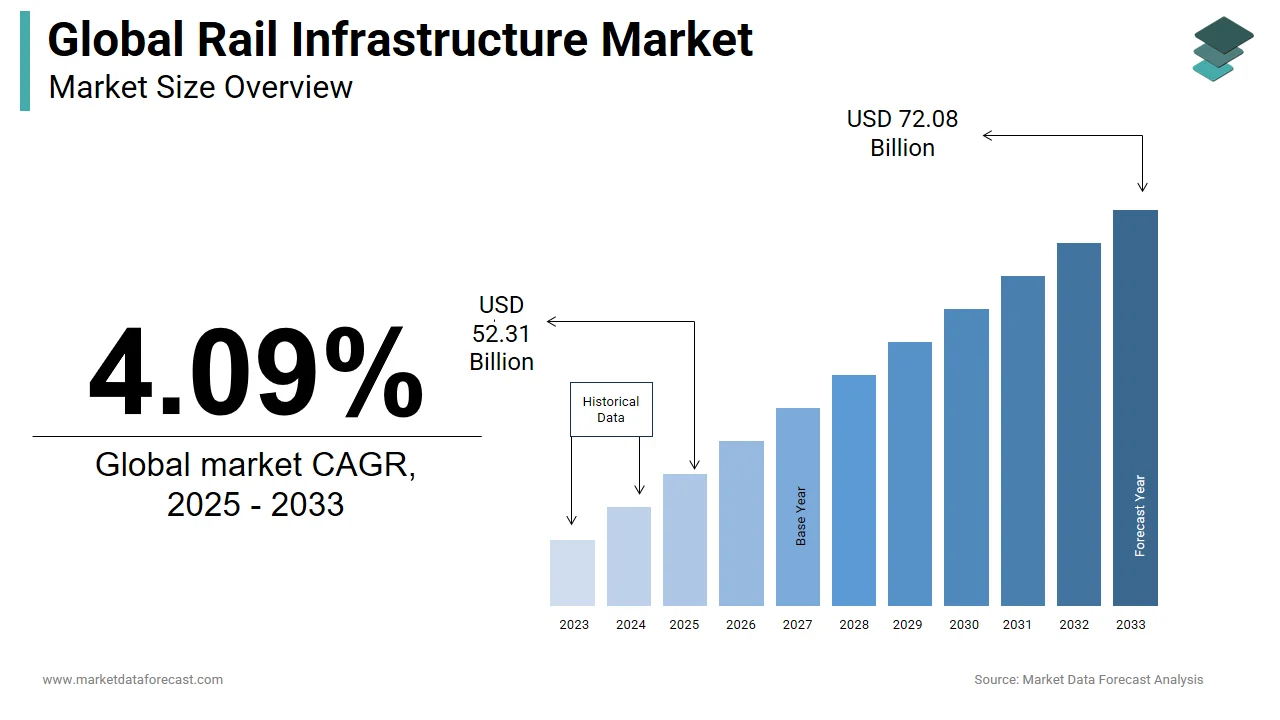
The global rail infrastructure market size was valued at USD 52.31 billion in 2025, is estimated to reach USD 54.45 billion in 2026, and is projected to scale up to USD 75.04 billion by 2034, registering a compound annual growth rate (CAGR) of 4.09% during the forecast period from 2026 to 2034. Driven by stringent decarbonization mandates accelerating electrification and modal shifts, supply chain resilience imperatives for freight corridor modernization, and massive investments in high-speed expansion and digital signaling, the market continues to expand robustly worldwide.
Key Executive Metrics (At-a-Glance)
- 2025 Base Valuation: USD 52.31 Billion
- 2026 Current Valuation: USD 54.45 Billion
- 2034 Forecast Valuation: USD 75.04 Billion
- Compound Annual Growth Rate (CAGR): 4.09% (2026–2034)
- Dominant Construction Segment: Renovation Segment (accounting for 45.3% share in 2025 due to aging networks and critical safety/maintenance backlogs)
- Fastest-Growing Construction Segment: Expansion Segment (projected at an 8.7% CAGR fueled by high-speed rail buildouts in emerging economies)
- Dominant Equipment Segment: Track Equipment (foundational substrate requiring perpetual asset renewal and high-volume steel/sleeper procurement)
- Fastest-Growing Equipment Segment: Signaling Equipment (projected at an 11.2% CAGR driven by global digital migrations like ETCS)
- Dominant Maintenance Segment: Repair Activities (48.2% share in 2025; addressing continuous component failures and reactive fault responses)
- Fastest-Growing Maintenance Segment: Inspection Segment (projected at a 14.3% CAGR via sensor-trained drones, LiDAR, and automated surveillance trains)
- Dominant Regional Market: Asia-Pacific (capturing 48.3% share in 2025 backed by China's high-speed network and India's modernization agenda)
Core Market Drivers
- Decarbonization Mandates: Government climate commitments directing capital toward rail electrification and modal shifts (rail emits significantly less CO2 per passenger kilometer than cars or aviation).
- Supply Chain Resilience: Geopolitical disruptions and maritime vulnerabilities stimulating massive overland freight corridor modernization and capacity upgrades.
Primary Market Restraints & Challenges
- Capital Intensity & Labor/Climate Constraints: Enormous upfront capital outlays, protracted land acquisition delays, specialized workforce shortages, and rising climate adaptation lifecycle costs.
Global Rail Infrastructure Market Segmentation Breakdown
| Segment Category | Leading Sub-Segment (Largest) | Fastest-Growing Sub-Segment |
|---|---|---|
| By Construction Type | Renovation (45.3% share in 2025; essential for safety, maintenance, and structural upkeep) | Expansion (8.7% CAGR; driven by high-speed rail buildouts in emerging markets) |
| By Equipment Type | Track Equipment (foundational rails, sleepers, and fasteners requiring regular renewal) | Signaling Equipment (11.2% CAGR; digital migration to ETCS and advanced train controls) |
| By Maintenance Type | Repair Activities (48.2% share in 2025; addressing continuous component defects and faults) | Inspection (14.3% CAGR; real-time automated condition assessment via drones and LiDAR) |
| By Region | Asia-Pacific (48.3% share in 2025; led by extensive Chinese and Indian rail networks) | North America (fastest-growing CAGR fueled by federal stimulus and private investments) |
Major Industry Players Profiled
Key enterprises shaping the global rail infrastructure market include China Railway Group Limited, Siemens, Alstom, Bombardier, Hitachi, CRRC Corporation, General Electric, Thales Group, Kawasaki Heavy Industries, Balfour Beatty, and Toshiba.
Global Rail Infrastructure Market Size
The global rail infrastructure market was worth USD 52.31 billion in 2025. The global market is predicted to reach USD 54.45 billion in 2026 and USD 75.04 billion by 2034, growing at a CAGR of 4.09% from 2026 to 2034.
The rail infrastructure is physical assets, engineering services, and digital systems required to construct, maintain, and modernize railway networks for passenger and freight transportation. This sector extends beyond mere track laying to include signaling, electrification, station development, and intelligent traffic management systems that collectively determine network capacity and safety. Furthermore, as per the Organisation for Economic Co-operation and Development, member countries invested over 280 billion dollars in rail infrastructure during 2024, reflecting intensified public commitment to modal shift policies aimed at reducing road congestion and aviation dependency. Consequently, this market functions as a critical enabler of economic integration and decarbonization where capital allocation decisions are increasingly driven by environmental mandates, supply chain resilience requirements, and urbanization pressures rather than traditional cost-benefit analyses alone.
MARKET DRIVERS
Decarbonization Mandates Accelerating Electrification and Modal Shift Investments
Government climate commitments are fundamentally reshaping rail infrastructure priorities by directing capital toward electrification and capacity expansion as primary decarbonization levers. The decarbonization mandates are accelerating electrification and modal shift investments, which is propelling the growth of the rail infrastructure market. According to the study, rail emits 14 grams of CO2 equivalent per passenger kilometer compared to 104 grams for cars and 285 grams for aviation, making it indispensable for achieving net zero targets. The European Union’s Sustainable and Smart Mobility Strategy mandates doubling high-speed rail traffic by 2030 and tripling it by 2050, triggering infrastructure investments exceeding 550 billion euros across member states through the Connecting Europe Facility. China’s National Railway Administration commissioned 2800 kilometers of new high-speed lines in 2024 alone, expanding the world’s largest network to 46000 kilometers and diverting an estimated 45 million annual air passengers to lower carbon rail alternatives. These policy-driven programs transform rail infrastructure from discretionary spending into mandatory climate infrastructure, ensuring sustained funding cycles independent of short term economic fluctuations because emission reduction targets carry legal enforceability and political accountability mechanisms absent in previous transport planning eras.
Supply Chain Resilience Imperatives Stimulating Freight Corridor Modernization
Geopolitical disruptions and logistics vulnerabilities have elevated freight rail infrastructure, as strategic national security assets requiring redundancy and capacity upgrades. The supply chain resilience imperatives stimulating freight corridor modernization are additionally accelerating the growth of the rail infrastructure market. As per the study, maritime shipping disruptions during 2023 and 2024 increased average transit times by 25% and freight costs by 180%, prompting governments to invest in overland rail alternatives to reduce port dependency. Kazakhstan’s national railway operator KTZ invested 2.8 billion dollars in 2024 to expand Middle Corridor capacity through Caspian Sea ports, increasing container throughput by 65% year on year, as shippers sought Russia-bypass routes connecting China to Europe. This reclassification of freight rail as essential supply chain infrastructure ensures capital allocation prioritizes resilience metrics alongside traditional commercial returns by creating durable demand drivers anchored in national security doctrines rather than cyclical commodity volumes alone.
MARKET RESTRAINTS
Capital Intensity and Fiscal Constraints Delaying Project Delivery
Rail infrastructure projects require enormous upfront capital outlays with extended payback periods that strain public budgets and deter private participation amid competing fiscal priorities. The capital intensity and fiscal constraints delaying project delivery is hindering the growth of the rail infrastructure market. According to the study, average construction costs for new high-speed rail lines range from 25 million to 85 million dollars per kilometer depending on terrain and land acquisition complexity, making even modest network extensions fiscally prohibitive for many jurisdictions. Brazil’s planned Sao Paulo Rio de Janeiro high-speed line has been postponed three times since 2010 due to budget reallocations during successive fiscal crises, with the latest feasibility studies indicating a 35 billion dollar price tag exceeding available federal transport allocation by a factor of 4. Even wealthy nations face constraints, as Germany’s Deutsche Bahn reported a 30 billion euro maintenance backlog in 2024, while simultaneously managing an 86 billion euro modernization program, forcing difficult tradeoffs between renewal and expansion. These financial realities create persistent gaps between announced ambitions and delivered infrastructure, as multi-decade funding commitments prove vulnerable to electoral cycles, debt ceiling negotiations, and emergency spending reprioritizations that consistently disadvantage long-horizon rail projects versus immediate social expenditures.
Land Acquisition Complexity and Community Opposition Stalling Implementation
Securing right of way for new rail corridors involves protracted legal processes and community resistance that can delay projects by decades or force costly redesigns is hindering the growth of the rail infrastructure market. As per the study, land acquisition accounts for 20 to 40% of total rail project costs in densely populated regions and causes average delays of 5 to 8 years across Southeast Asian infrastructure programs. United Kingdom’s HS2 northern leg was cancelled in October 2023 after local opposition and parliamentary challenges inflated costs to 100 billion pounds for reduced scope, demonstrating how democratic accountability mechanisms can terminate mega projects mid-implementation. California’s Central Valley segment encountered 230 separate eminent domain proceedings between 2018 and 2024, adding 1.2 billion dollars in legal and administrative expenses according to state auditor findings. These socio-political frictions transform technical engineering challenges into governance problems where stakeholder consent becomes as important as geotechnical feasibility, creating uncertainty premiums that inflate financing costs and compress viable project pipelines to politically safe brownfield upgrades rather than transformative greenfield networks.
MARKET OPPORTUNITIES
Digital Signaling Modernization Unlocking Latent Capacity without Civil Works
Advanced train control systems to increase network throughput by 30 to 50% through software and communications upgrades rather than expensive track duplication, which is likely to promote new opportunities for the growth of the rail infrastructure market. According to the research, European Train Control System Level 2 deployment on existing corridors reduces minimum headways from 4 minutes to 2.5 minutes, effectively adding capacity equivalent to new lines at 15% of civil construction costs. Italy’s Rete Ferroviaria Italiana completed ETCS Level 2 installation on 3800 kilometers of core network in 2024 by enabling 25% more freight trains on saturated Alpine crossing routes without tunnel boring or viaduct construction. This digital layer transforms fixed infrastructure into flexible assets where capacity gains derive from intelligence rather than concrete by creating addressable markets for technology providers independent of Greenfield construction cycles and enabling faster returns on investment aligned with political time horizons.
Brownfield Station Redevelopment Generating Non Fare Revenue Streams
Transit-oriented development around existing stations creates self-financing mechanisms for infrastructure renewal through value capture and commercial monetization is also fuel new opportunities for the rail infrastructure market. London’s Old Oak Common station redevelopment approved in 2024 will deliver 24000 homes and 65000 square meters of commercial space atop a new HS2 interchange, generating 3.8 billion pounds in land value uplift earmarked for Crossrail 2 funding, according to the study. Tokyo Station City renovation completed in 2024 added 120000 square meters of retail and office space, generating annual rental income of 280 million dollars that subsidizes heritage structure maintenance and seismic retrofitting. This emergence of real estate and transport finance transforms stations from cost centers into profit engines by creating bankable revenue streams that attract private capital and reduce sovereign balance sheet burdens, while accelerating urban regeneration objectives aligned with broader municipal development strategies.
MARKET CHALLENGES
Workforce Shortages Constraining Project Execution and Maintenance Quality
The critical deficits in specialized rail engineering and skilled trades personnel limit industry capacity to deliver planned infrastructure programs safely and on schedule is a major challenge for the growth of the rail infrastructure market. According to the study, the United States rail sector faces a shortage of 25000 signal technicians, electricians, and track workers needed to execute Bipartisan Infrastructure Law projects, causing 35% of funded initiatives to experience delays exceeding 18 months as of 2024. Japan’s railway operators collectively lost 18000 experienced maintenance staff to retirement between 2020 and 2024, while recruiting only 11000 replacements, creating knowledge transfer gaps that manifested in 3 major derailments attributed to inspection oversights during fiscal year 2024. Australian Rail Track Corporation documented a 40% increase in contractor day rates between 2022 and 2025 due to labor scarcity inflating project costs beyond indexed escalation assumptions. These human capital constraints act as binding limits on physical infrastructure expansion regardless of funding availability, because sophisticated systems cannot be built or maintained safely without adequate skilled personnel whose training pipelines require 5 to 8 years to mature and cannot be accelerated through technology substitution alone.
Climate Adaptation Requirements Inflating Lifecycle Costs Beyond Historical Norms
Infrastructure designed for historical climate baselines faces accelerating degradation and failure risks requiring unplanned adaptation investments that strain maintenance budgets. The climate adaptation requirements inflating lifecycle costs beyond historical norms are additionally degrading the growth of the rail infrastructure market. As per the Intergovernmental Panel on Climate Change, extreme heat events exceeding rail steel thermal tolerance thresholds increased 3-fold globally between 2000 and 2024 by causing widespread speed restrictions and buckling incidents that reduce network reliability. Amtrak spent 180 million dollars on emergency track repairs following the July 2024 Northeast heatwave that caused 47 sun kinks and 3 days of service suspension across the Boston-Washington corridor, according to the study. Network Rail allocated 1.8 billion pounds in 2024 specifically for climate resilience measures, including drainage upgrades, embankment stabilization and heat-resistant rail alloys, representing 25% of total maintenance budget diverted from routine renewal to adaptive hardening. Queensland Rail in Australia implemented a continuous welded rail replacement program costing 450 million dollars in 2025 after cyclone-induced flooding destroyed 120 kilometers of track in 2024, exceeding annual disaster recovery allocation by a factor of 3. These climate stressors transform predictable depreciation schedules into volatile risk exposures where infrastructure must be redesigned for conditions not anticipated in original specifications, creating perpetual catch-up dynamics where adaptation spending competes with expansion priorities and erodes asset productivity through preventive service interruptions.
SEGMENTAL ANALYSIS
By Construction Type Insights
The renovation segment was the largest, accounting for 45.3% of the global rail infrastructure market share in 2025, as developed economies require systematic renewal to maintain safety and operational viability. Network Rail in the United Kingdom reported a 30 billion pound maintenance backlog in 2024, accumulated over decades of underinvestment by forcing prioritization of asset renewal over network expansion to prevent catastrophic failures on lines serving 5 million daily passengers. Japan’s Ministry of Transport documented that 40% of Shinkansen viaducts and tunnels constructed during the 1960s bullet train rollout now require seismic retrofitting and structural strengthening, triggering a 15-year renovation program valued at 28 billion dollars to extend service life by another half century. Unlike new construction, which faces land acquisition delays and political uncertainty, renovation projects operate within existing rights of way with established funding streams tied to regulatory safety mandates rather than discretionary growth budgets.
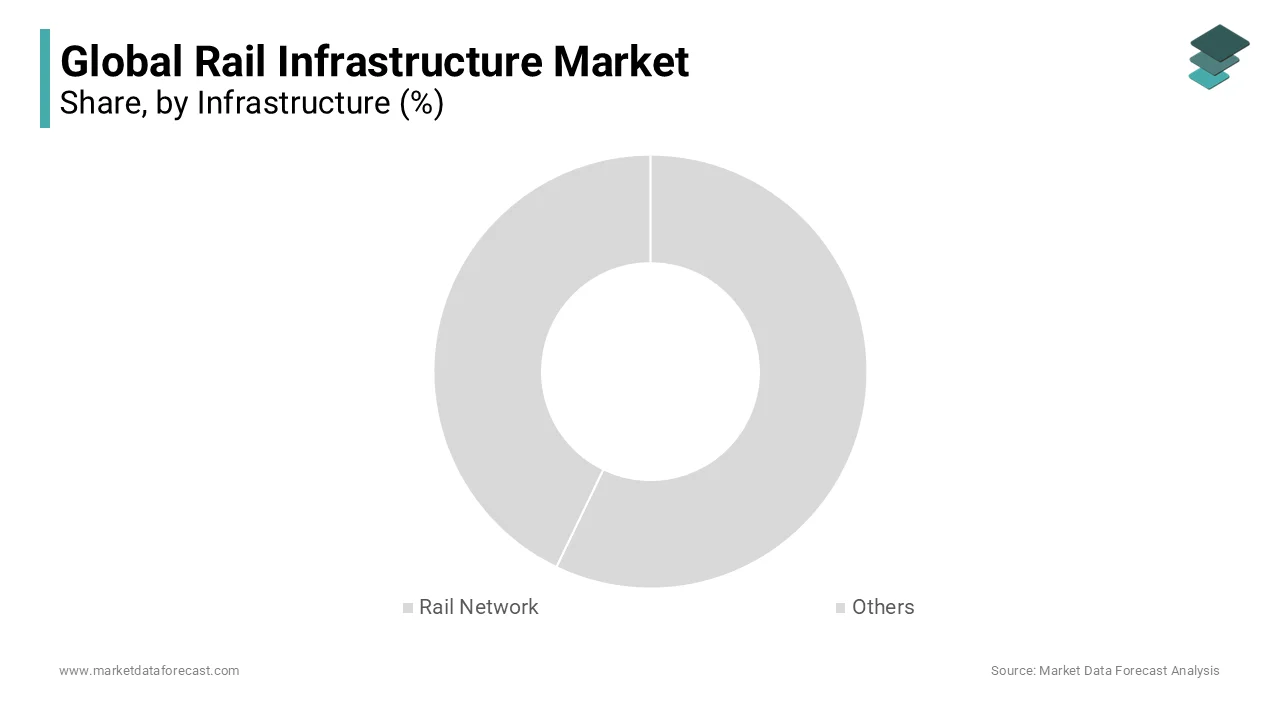
The expansion segment is likely to grow at the fastest CAGR of 8.7% throughout the forecast period, with the unprecedented high-speed rail buildouts in emerging economies seeking to leapfrog road-dependent development models. According to the study, the country commissioned 2800 kilometers of new high-speed lines in 2024 alone, expanding the world’s largest network to 46000 kilometers and connecting 95% of cities with populations exceeding 500000 residents. Saudi Arabia’s Vision 2030 transport strategy includes 3500 kilometers of new passenger and freight rail linking NEOM Red Sea tourism zones and industrial cities, with 18 billion dollars committed in 2024 for land acquisition and preliminary engineering. Unlike renovation constrained by existing alignments and operating railways, expansion projects benefit from sovereign wealth financing, geopolitical strategic value, and nation-building narratives that attract capital even when commercial returns remain uncertain. This convergence of developmental state capitalism, regional integration objectives and technological catch-up aspirations creates exponential growth trajectories in sectors where rail networks are being built from scratch rather than incrementally upgraded.
By Equipment Type Insights
The track equipment segment held a significant share of the rail infrastructure market in 2025, with rails, sleepers, fasteners and ballast constituting the foundational substrate upon which all other systems depend and require perpetual renewal due to mechanical degradation. Union Pacific Railroad replaced 1200 miles of rail and 2.8 million concrete ties in 2024 alone, as part of a scheduled asset renewal program representing 55% of total capital expenditure, according to the study. Indian Railways procured 1.2 million tons of steel rails and 18 million prestressed concrete sleepers during fiscal year 2024 to maintain a 68000 route kilometer network under mixed traffic conditions combining 25 ton axle freight trains with 160 kilometer per hour passenger services accelerating wear rates. Unlike signals or electrification, which can be deferred during budget constraints, track deterioration directly compromises safety and imposes mandatory speed restrictions that cascade into network-wide capacity losses and revenue erosion. This physical inevitability ensures track maintains market leadership as the minimum investment required to keep any railway operational regardless of technological sophistication or service quality aspirations.
The signaling equipment segment is likely to grow at the fastest CAGR of 11.2% throughout the forecast period with the global migration from legacy mechanical and analog systems to digital communications-based train control platforms. According to the study, ETCS deployment accelerated to 8500 kilometers of new installations in 2024, across 18 member states as part of a mandatory interoperability timeline requiring full core network coverage by 2030. India’s Kavach indigenous train protection system was deployed on 1500 route kilometers in 2024 with plans to cover the entire high-density network by 2028, representing a 6 billion dollar domestic signaling modernization program reducing import dependency while enhancing safety. Unlike track renewal following predictable depreciation schedules, signaling upgrades are event-driven by regulatory deadlines, technology obsolescence, and capacity optimization imperatives, creating lumpier but higher-value investment waves. As railways transition from fixed block to moving block architectures and integrate satellite positioning with 5G communications, each kilometer converted requires exponentially more sophisticated onboard and wayside equipment than legacy systems it replaces, driving revenue growth disproportionate to physical network expansion.
By Maintenance Type Insights
The repair activities segment held 48.2% of the rail infrastructure market share in 2025, with maintenance spending because component failures and defect rectifications occurring continuously across vast networks. According to the study, reactive repair work accounted for 58% of total maintenance expenditure, totaling 7.2 billion pounds, driven by 28000 unplanned fault responses, including signal failures, track geometry defects, and overhead line equipment malfunctions. Amtrak spent 890 million dollars on emergency repairs in fiscal year 2024, addressing 47 sun kinks, 12 bridge strikes, and countless signal interruptions across the Northeast Corridor, representing 42% of the maintenance budget consumed by corrective actions rather than preventive programs. Unlike inspections, which can be batched for efficiency, repairs are inherently unpredictable and time-sensitive, commanding premium pricing for after-hours response, expedited parts delivery, and specialized crews standing ready for emergencies.
The inspection segment is likely to grow at the fastest CAGR of 14.3% from 2026 to 2034 with the deployment of sensor-equipped measurement trains, drones, and wayside detectors, enabling continuous condition assessment at scale. BNSF Railway deployed 3500 wayside wheel impact load detectors and acoustic bearing monitors across 32000 mile network in 2024, according to a study. Indian Railways commissioned 18 MEMU-based inspection cars with LiDAR and machine vision systems in 2025, automating clearance measurements and structure gauging on 15000 kilometers of electrified routes previously requiring manual surveys during traffic blocks. Unlike traditional visual inspections limited by human fatigue, access constraints, and daylight hours, automated systems operate continuously at line speed, capturing millimeter-precision data unaffected by weather or visibility. This technological transformation converts inspection from a periodic sampling exercise to comprehensive real-time surveillance, creating exponential data generation and analytics demand driving segment growth far exceeding linear network expansion rates.
REGIONAL ANALYSIS
Asia Pacific Rail Infrastructure Market Analysis
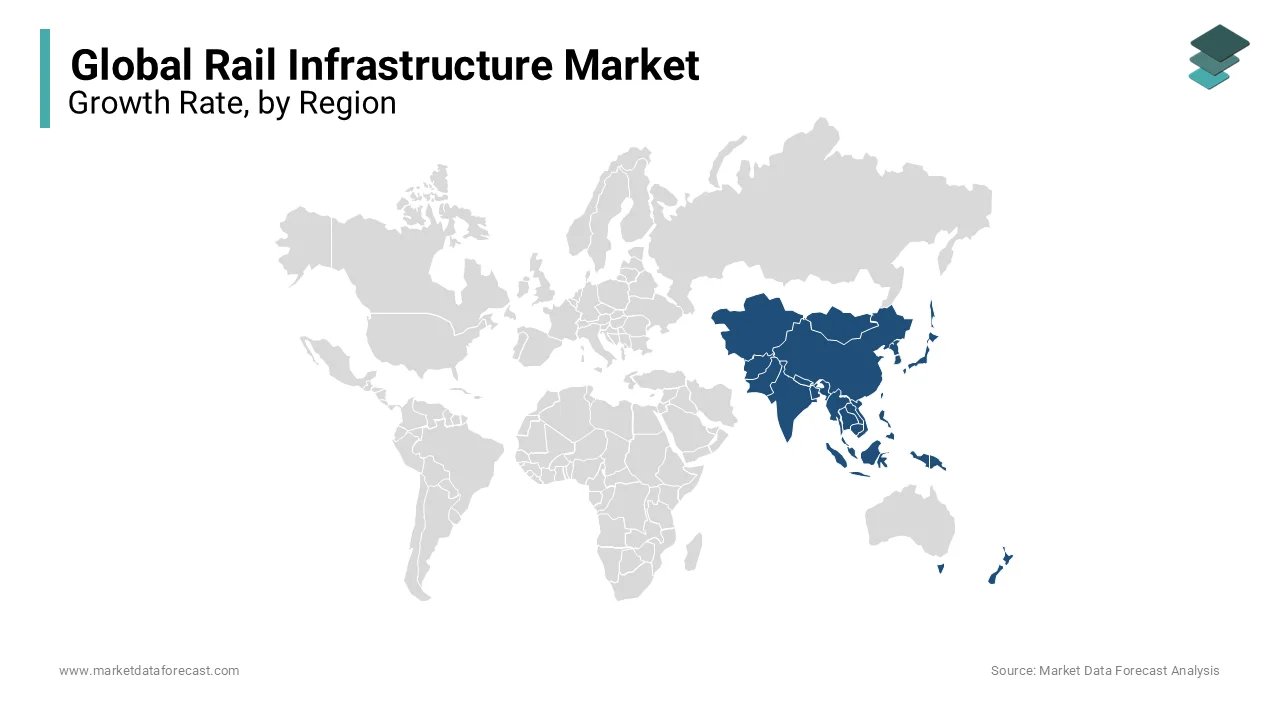
Asia Pacific was the top performer in the global rail infrastructure market by capturing 48.3% of share in 2025 due to China’s unparalleled construction velocity and India’s transformative modernization agenda. According to the study, the country invested 110 billion dollars in rail infrastructure during 2024, commissioning 2800 kilometers of new high-speed lines and upgrading 15000 kilometers of conventional routes to support 4.2 billion annual passenger trips and 5.2 billion tons of freight. Japan’s third Shinkansen extension phase received 18 billion dollars in 2024 funding, connecting the Hokuriku region to the national network, while simultaneously investing 12 billion dollars in seismic retrofitting of aging Tokaido corridor assets. This regional concentration reflects developmental state models where rail infrastructure serves as a primary instrument for urbanization management, regional integration, and industrial competitiveness enhancement rather than purely commercial transport provision.
Europe Rail Infrastructure Market Analysis
Europe rail infrastructure market was ranked second, holding 24.3% of the share in 2025, with the intensive renovation programs, cross-border integration initiatives, and sustainability-driven modal shift policies. Germany’s Deutsche Bahn launched an 86-billion-euro modernization program in 2024 targeting 18000 kilometers of track renewal, and ETCS Level 2 deployment on all mainlines by 2030, representing the largest single-country rail investment in European history. Rail Baltica project received 4.5 billion euros in 2024 Connecting Europe Facility funding to construct 870 kilometers of standard gauge line linking Baltic states to the European network, eliminating Soviet era gauge incompatibility barriers. Europe’s market position reflects maturity dynamics, where infrastructure spending focuses on optimizing existing networks by enhancing interoperability and achieving climate targets rather than greenfield expansion dominant in Asia.
North America Rail Infrastructure Market Analysis
North America rail infrastructure market growth is likely to grow at the fastest CAGR throughout the forecast period, with freight railroad private investment dominance, passenger rail public funding constraints, and recent federal stimulus unlocking long-deferred modernization. Federal Railroad Administration distributed 18 billion dollars in Bipartisan Infrastructure Law grants in 2024, funding 650 passenger rail projects, marking the largest federal rail investment since the creation of the Interstate Highway System. Canada’s VIA Rail received 3.2 billion CAD in 2024 for Quebec City Windsor corridor frequency improvements and fleet replacement, addressing decades of underinvestment causing 30% decline in ridership since 2010. Mexico’s Tren Maya project completed 1500 kilometer tourist railway in 2024 with 20 billion-dollar public investment despite environmental controversies and cost overruns, demonstrating political will to expand passenger rail despite limited commercial rationale. North America’s market trajectory reflects bifurcation between profitable private freight networks sustaining themselves through reinvestment and politically contested passenger systems dependent on episodic federal largesse, creating uneven modernization patterns across the continent.
Middle East and Africa Rail Infrastructure Market Analysis
Middle East and Africa rail infrastructure market growth is likely to grow with the strategies and African continental integration ambitions. According to the study, the Kingdom committed 45 billion dollars to rail infrastructure between 2023 and 2027, including the completion of the Riyadh Metro, Haramain High Speed Railway extensions, and 3500 kilometer national freight network linking NEOM Red Sea ports to mining regions, as a cornerstone of Vision 2030 post-oil economic transformation. African Union’s Programme for Infrastructure Development in Africa broke ground on 2800 kilometer Abidjan Lagos coastal railway in 2025 with 15 billion-dollar multilateral financing linking 5 West African economies and creating the first standardized-gauge cross-border corridor in the region. Tanzania’s Standard Gauge Railway reached Dodoma in 2024, completing 1200 kilometer first phase of 2500 kilometer network intended to serve landlocked Rwanda, Burundi, and DRC. This regional dynamism reflects late mover advantage, where greenfield networks incorporate the latest technologies without legacy constraints, while serving nation-building and geopolitical objectives transcending narrow transport economics.
COMPETITIVE LANDSCAPE
Competition in the global rail infrastructure market features intense rivalry among multinational engineering conglomerates, state-owned enterprises, and specialized technology providers vying for mega projects spanning decades and continents with divergent risk profiles and return expectations. Chinese SOEs leverage subsidized financing, integrated supply chains, and diplomatic backing to dominate emerging market greenfield construction, while European firms compete through technological sophistication, interoperability expertise, and sustainability credentials preferred in developed economy modernization tenders. Consolidation accelerates as companies seek scale advantages, portfolio complementarities, and geographic diversification to absorb massive R&D costs and withstand cyclical demand fluctuations inherent in infrastructure sectors dependent on political budget cycles. Differentiation increasingly derives from digital capabilities, lifecycle services, and decarbonization solutions rather than civil engineering competence alone, transforming competition from lowest bid construction contests to value-based technology partnerships evaluated on total cost of ownership and environmental performance metrics. Barriers to entry remain extremely high due to certification requirements, safety case approvals, reference project prerequisites, and balance sheet capacities needed to secure performance bonds, limiting viable competitors to established incumbents with proven track records. Regional protectionism and domestic content mandates fragment the global market into semi-autonomous zones where local champions enjoy structural advantages despite inferior technology or higher costs challenging pure meritocratic competition assumptions. Success ultimately depends on balancing global scale with local adaptation, technological leadership with financial resilience, and commercial ambition with geopolitical navigation across heterogeneous institutional landscapes, where uniform strategies fail without contextual customization reflecting national priorities, industrial policies, and stakeholder expectations unique to each jurisdiction.
KEY MARKET PLAYERS
The leading companies operating in the global rail infrastructure market include:
- Siemens
- Alstom
- Bombardier
- China Railway Group Limited
- Hitachi
- CRRC Corporation
- General Electric
- Thales Group
- Kawasaki Heavy Industries
- Balfour Beatty
- Toshiba
TOP PLAYERS IN THE MARKET
- China Railway Group Limited maintains dominant involvement in global rail infrastructure through unparalleled construction capacity and international project execution spanning Asia, Africa and Latin America. The company completed 2800 kilometers of high-speed rail domestically in 2024, while simultaneously advancing the Jakarta-Bandung line in Indonesia and the Hungary-Serbia railway in Europe, demonstrating cross-continental delivery capabilities. Recent strategic initiatives include establishing regional engineering centers in Saudi Arabia and Brazil to localize design adaptation and workforce development, aligning with host nation industrialization objectives. Technology transfer agreements with Indian and African partners enable knowledge diffusion, strengthening long term relationships beyond transactional contracting. These actions reinforce positioning as an integrated solutions provider combining financing, engineering construction and operational support for complex mega projects requiring sovereign-level coordination and multi-decade commitment horizons that few competitors can match across diverse regulatory and geographic contexts worldwide.
- Siemens Mobility GmbH contributes significantly to global rail infrastructure through digital signaling, electrification, and intelligent traffic management systems deployed across 60 countries. Strategic partnerships with Alstom and Hitachi on open architecture platforms reduce vendor lock-in concerns, facilitating public procurement acceptance. Local manufacturing facilities in Egypt, Thailand, and the United States enable tariff avoidance and supply chain resilience amid geopolitical fragmentation. The digital services division launched an AI-powered predictive maintenance platform in 2025, integrating inspection data with asset management systems, creating recurring revenue streams beyond capital equipment sales. These initiatives strengthen market position through technology leadership, ecosystem collaboration, and geographic diversification, ensuring sustained relevance as railways transition from hardware-centric to software-defined infrastructure paradigms requiring continuous innovation and service integration capabilities.
- Alstom SA plays a vital role in global rail infrastructure through a comprehensive portfolio spanning rolling stock, signaling, track systems, and turnkey solutions delivered across 70 countries. The company completed the acquisition of Bombardier Transportation integration in 2024, consolidating its North American and European footprint, while expanding its Asian manufacturing base through joint ventures in India and Kazakhstan. Digital mobility solutions, including MaaS platforms and autonomous train operation systems, create differentiation in urban transit tenders increasingly evaluating lifecycle value over lowest bid price. Sustainability commitments achieved Science Based Targets initiative validation in 2025, enhancing eligibility for green finance and ESG-focused procurement. These actions demonstrate a balanced approach combining scale advantages, technological diversification, and sustainability dominance to navigate competitive pressures, regulatory evolution, and customer expectations shifting toward integrated low-carbon mobility ecosystems rather than isolated infrastructure components.
TOP STRATEGIES USED BY KEY MARKET PARTICIPANTS
Key players in the global rail infrastructure market prioritize vertical integration strategies combining engineering, procurement, construction, and maintenance capabilities to capture full project lifecycle value and mitigate interface risks inherent in fragmented contracting models. Companies invest heavily in digitalization, developing proprietary signaling platforms, predictive analytics tools, and asset management software, creating sticky ecosystems where switching costs increase customer retention beyond initial hardware installation. Geographic diversification through local joint ventures, manufacturing facilities, and engineering centers reduces currency exposure, tariff vulnerability, and political risk while satisfying domestic content requirements increasingly mandated by national industrial policies. Strategic acquisitions target complementary technologies such as hydrogen propulsion, autonomous operations, or specialized inspection systems, filling portfolio gaps faster than organic R&D cycles permit amid accelerating decarbonization and automation timelines. Public-private partnership participation enables early engagement in project conception, shaping technical specifications and commercial terms favorably while securing long-term revenue visibility through concession agreements. Sustainability alignment, including science-based targets, circular economy commitments, and renewable energy integration, enhances eligibility for green bonds, ESG-focused investors, and environmentally conditioned procurement criteria, becoming decisive factors in tender evaluations. Workforce development initiatives addressing skilled labor shortages through apprenticeship programs, university partnerships, and immigration advocacy ensure human capital availability matches physical infrastructure expansion ambitions, preventing execution hurdles that undermine growth strategies regardless of financial or technological readiness.
MARKET SEGMENTATION
This global rail infrastructure market research report has been segmented and sub-segmented based on the infrastructure, type and region.
By Construction
- New Construction
- Expansion
- Renovation
By Equipment
- Tracks
- Bridges
- Tunnels
- Signals
- Rolling Stock
By Electrification
- Overhead Contact Systems
- Third Rail Systems
- Batteries
By Maintenance
- Inspection
- Repair
- Replacement
By Operation
- Train Scheduling
- Traffic Management
- Safety Systems
By Region
- North America
- Europe
- Asia Pacific
- Latin America
- Middle East and Africa