- Product Description Description
- Table of Contents TOC
- List of Table & Figure LOT
- Get Free Sample PDF Sample PDF
Market Size, 2025
$2.18 BnMarket Estimate, 2026
$2.61 BnMarket Forecast, 2034
$11.08 BnCAGR, 2026–2034
19.8%Executive Summary: Global Smart Luggage Market
- Market Scope: Comprehensive global analysis of the smart luggage sector, detailing technology connectivity integrations, real-time tracking features, remote applications, regional market dynamics, and compliance factors from 2026 to 2034.
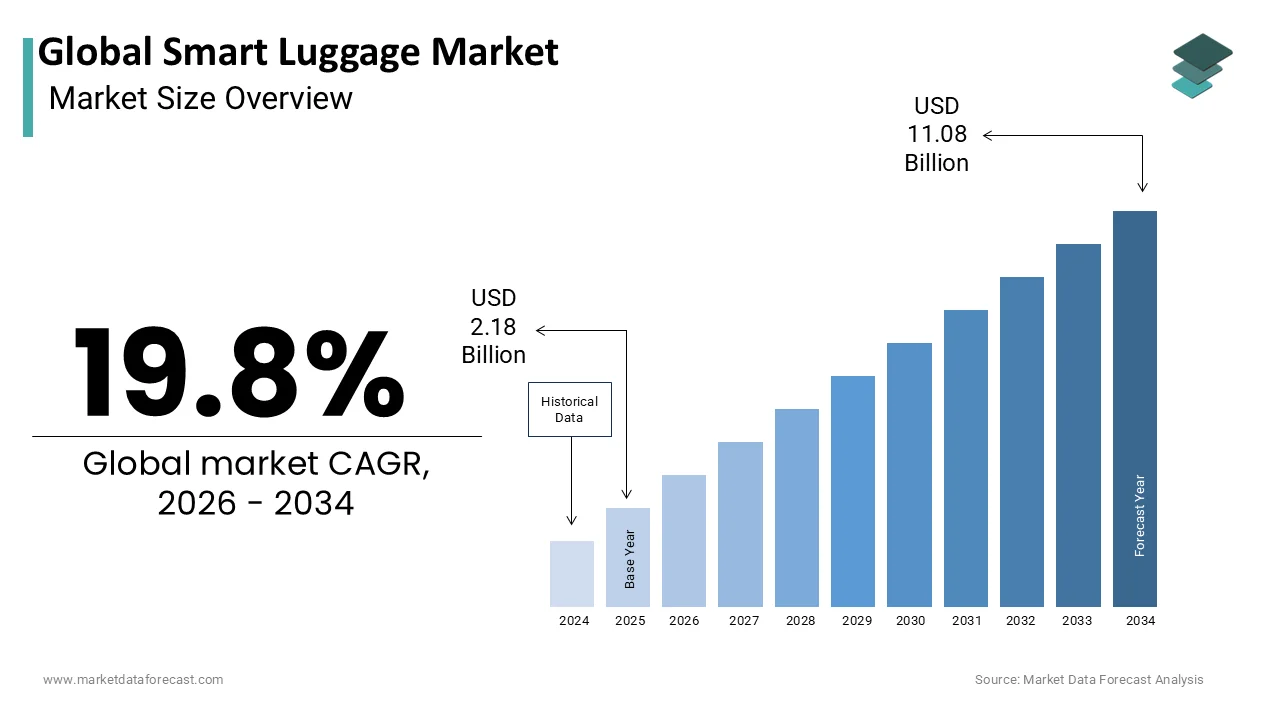
- Market Valuation: Valued at USD 2.61 billion in 2026, and projected to expand to USD 11.08 billion by 2034, growing at a robust CAGR of 19.80% from 2026 to 2034.
- Primary Growth Drivers: Rising global air passenger traffic and frequent mobility, widespread integration of IoT and Bluetooth connectivity features, and increasing consumer demand for tech-enabled travel accessories.
Key Market Segment Metrics (2026-2034)
| Category | Leading Segment (Base Position) | Fastest-Growing / High-Growth Segment |
|---|---|---|
| By Technology | Connectivity / Bluetooth (commanded strong historical adoption, backed by companion app sync and proximity alerts) | RFID & SIM-based Tracking (projected at high growth rates due to existing airport scanning infrastructure and global IoT tracking expansion) |
| By Application | Remote Locking (held the leading share, supported by heightened security needs, automated locking systems, and loss prevention) | Real-Time Tracking (projected at rapid growth, fueled by global airline bag tracking resolutions and live location updates) |
| By Region | North America (captured the major market share, backed by tech-savvy travelers, high disposable incomes, and advanced airport infrastructure) | Asia-Pacific (fastest-growing regional hub driven by rising middle-class disposable incomes, tourism booms, and e-commerce expansion) |
Major Market Players & Industry Landscape
Market Structure: Rapidly evolving competitive landscape characterized by luggage innovators and tech partnerships focusing on removable TSA-compliant battery solutions, IoT integration, and mobile ecosystems.
Key Companies: Samsonite, Horizn Studios, Delsey, TraxPack, Raden, Modobag, Away, Trunkster, and Bluesmart.
 Download Free Sample Report
Global Smart Luggage Market Size
The global smart luggage market was valued at USD 2.18 billion in 2025, is expected to have a 19.8% CAGR from 2026 to 2034, and be worth USD 11.08 billion by 2034 from USD 2.61 billion in 2026.
Current Scenario of the Global Smart Luggage Market
Smart luggage refers to bags or suitcases that incorporate advanced technologies such as GPS tracking, automated locking systems, USB charging ports, and digital scales.
These bags not only serve the purpose of carrying belongings but also offer innovative features such as storage compartments for clothing and accessories. Some key features of smart luggage include GPS locators, USB charging outlets, solar-powered batteries, and remote lock systems. These features enable travelers to conveniently charge their devices without the need for separate chargers and provide added security and peace of mind with tracking and locking capabilities.
MARKET DRIVERS
The growth of global smart luggage is primarily driven by evolving customer needs and desires, aiming to provide innovative and user-friendly solutions.
The smart luggage market is witnessing rapid growth and is expected to continue expanding in the future. Smart luggage is available in various colors and sizes, catering to the preferences of different travelers. It can be a valuable companion for both experienced and inexperienced travelers, offering convenience, security, and peace of mind. The aim is to enhance the travel experience by integrating technology into luggage, making it a versatile and user-friendly travel companion.
The integration of IoT and Bluetooth connectivity, GPS tracking, and other technological features into smart luggage designs has significantly increased customer demand for these products. The technological advancements enhance the overall user experience and contribute to the growing demand for smart luggage. The expanding global population's engagement in leisure activities is another factor driving the long-term demand for smart baggage and propelling global market growth. As more people participate in travel and tourism, the need for innovative and convenient luggage solutions increases. Additionally, the development of infrastructure in popular tourist destinations contributes to the potential market growth for smart luggage. Furthermore, the rise in online consumer purchases of baggage items plays a significant role in the long-term expansion of the smart luggage market.
Smart luggage has the potential to integrate with analytics, offering new insights for companies and consumers and driving further innovation and advanced features. Expanding into different categories like business travel, tour travel, trekking, and hiking can attract a broader range of consumers. Technological advancements in features like remote locking, digital scaling, real-time tracking, and proximity sensors can lead to more sophisticated smart luggage products. Although the pandemic has impacted travel, the corporate and leisure travel market is expected to recover, suggesting continued growth in demand for smart luggage in the future. This shift towards online shopping indicates the changing consumer behavior and preferences, creating opportunities for the continued growth of the smart luggage market.
MARKET RESTRAINTS
The presence of lithium batteries in smart baggage is one of the key restraints to the growth of the smart luggage market. Airlines have prohibited smart baggage with non-removable lithium batteries due to safety concerns and the potential risk of fire, as stated in airline lithium regulations and this limitation in airline regulations is hindering the expansion of the smart luggage market. Furthermore, the lack of understanding about smart baggage among consumers, coupled with the relatively high cost of smart luggage, can pose challenges to the growth rate of the smart luggage market. The advanced features and technology incorporated into smart luggage often result in higher price points, making them less accessible to a wide range of consumers. Limited availability of smart luggage in the market can also contribute to slower growth in the global smart luggage market throughout the forecast period.
REPORT COVERAGE
| REPORT METRIC | DETAILS |
| Market Size Available | 2025 to 2034 |
| Base Year | 2025 |
| Forecast Period | 2026 to 2034 |
| Segments Covered | By Type, Application, Delivery Mode, End-User, and Region |
| Various Analyses Covered | Global, Regional & Country Level Analysis, Segment-Level Analysis, Drivers, Restraints, Opportunities, Challenges, PESTLE Analysis, Porter’s Five Forces Analysis, Competitive Landscape, Analyst Overview on Investment Opportunities |
| Regions Covered | North America, Europe, Asia Pacific, Latin America, Middle East and Africa |
| Market Leaders Profiled | Samsonite, Bluesmart Black Edition, Horizn Studios, Delsey, TraxPack, Bluesmart, Raden, Modobag, Away and Trunkster. |
SEGMENTAL ANALYSIS
By Technology Insights
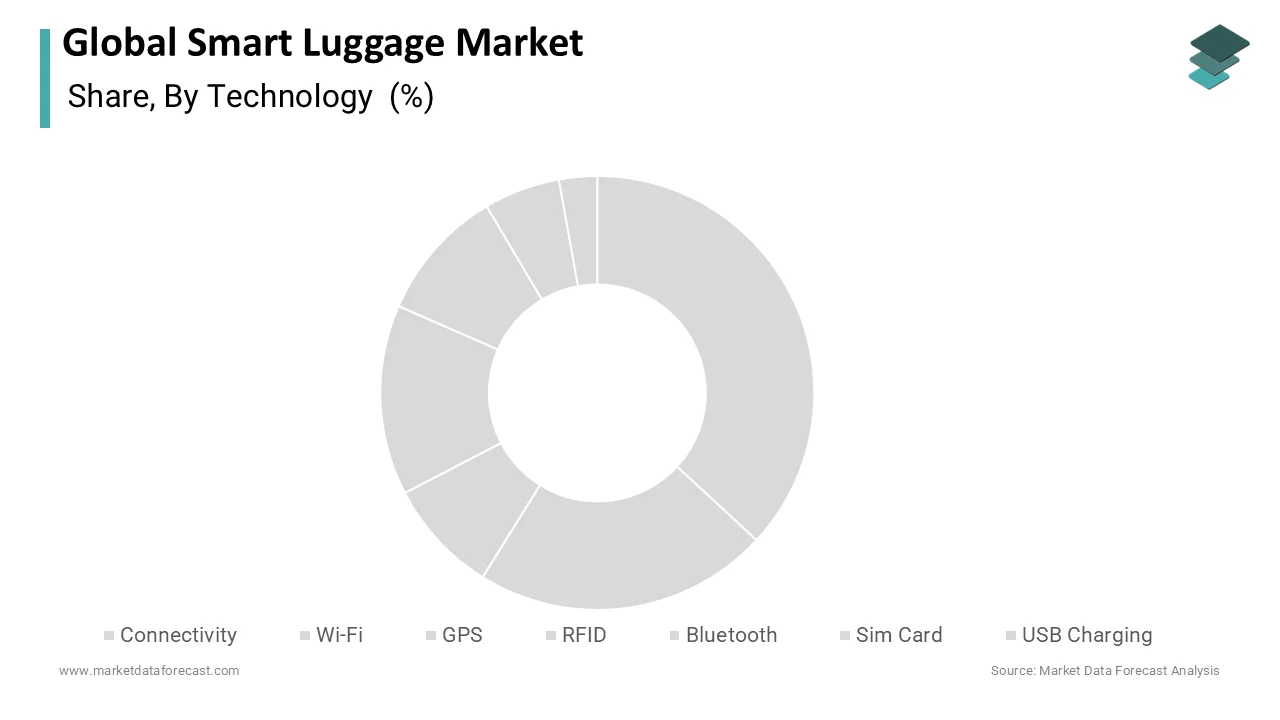
An abundance of sensor-based smart baggage products contributes to the massive demand for the smart connectivity technology segment in the forecast period. During the forecast period, the RFID sub-segment is expected to showcase promising growth due to the existing infrastructure of RFID scanning in airports. Also, the rising penetration of IoT devices and comparatively low costs & maintenance needs of the sensors used in smart luggage are further contributing to the growth of the RFID market. RFID is expected to grow rapidly, owing to the existing infrastructure of RFID scanning at airports. Because of the rising penetration of IoT devices and the comparatively low prices and maintenance needs of the sensors, the proliferation of sensor-based smart luggage items is predicted to be a major trend. A companion application connects the smart luggage to the user. These apps provide users with an easy travel experience while giving information such as flight schedules, currency exchange, destination, gates, and weather. The SIM card segment is expected to grow at a steady pace during the forecast period owing to the growing adoption of SIM cards to access the internet.
By Application Insights
The remote locking segment held the leading share of the global smart luggage market in 2023 and is expected to witness a prominent growth rate during the forecast period due to the increasing instances of luggage loss by airlines. Moreover, luggage theft and security breaches have encouraged customers to buy smart luggage equipped with remote locking proximity alerting capabilities and escort interpretation, contributing to the remote locking segment growth in the forecast period.
REGIONAL ANALYSIS
North America captured the major share of the worldwide market in 2023 and is anticipated to continue to lead in the global market throughout the forecast period.
The growing number of tech-savvy travelers, increasing desire from people to have smart features and advancements in the airport infrastructure are augmenting the growth of the smart luggage market in the North American region. People in North America like technologically sophisticated items; public awareness of the benefits of these products is augmenting the demand for smart baggage products. The growing trend of connected luggage in the North American region is further contributing to the North American market growth. For instance, the number of connected luggage units in the North American region is anticipated to reach 5 million by 2032.
The Asia-Pacific region was the second-largest regional segment in the worldwide market in 2023 and is expected to grow exponentially during the forecast period.
The growing disposable income and the presence of developing economies across the Asia-Pacific region are driving the primary growth of the APAC market. The rising adoption of smart technologies in various industries, the e-commerce boom, and the presence of several manufacturers who are part of the global smart luggage market are further promoting regional market growth. China occupied the major share of the APAC smart luggage market in 2023.
Europe is another noteworthy regional market for smart luggage worldwide and is expected to grow at a healthy CAGR during the forecast period.
The growing luxury smart luggage culture is one of the major factors propelling the European market growth. The growing urbanization, increasing awareness among people regarding the useful features of smart luggage, and rising preference from people for premium travel experiences are fuelling the growth of the European market. The growing tourism industry and increasing number of collaborations with airlines are further supporting the European market growth.
KEY MARKET PLAYERS
Companies playing a promising role in the global smart luggage market include Samsonite, Bluesmart Black Edition, Horizn Studios, Delsey, TraxPack, Bluesmart, Raden, Modobag, Away and Trunkster.
RECENT HAPPENINGS IN THE MARKET
- In January 2025, Samsora Baggage Inc. partnered with Monogoto, a technology services provider, to offer their customers connect with their smart luggage through a built-in Wi-Fi hotspot feature.
- In May 2025, Porsche SE, an Australian lifestyle firm, teamed with Bric store to manufacture high-performance, lightweight travel solutions for the Italian market.
- In September 2025, Samsonite IP Holdings S.AR.L. collaborated with Panasonic Corporation to create a new product called 'EVOA Tech,' which allows consumers to identify and monitor baggage using their cell phones, Bluetooth, and IoT technologies incorporated in the luggage.
MARKET SEGMENTATION
This research report on the global smart luggage market has been segmented and sub-segmented based on type, application, delivery, end user, and region.
By Technology
- Connectivity
- Wi-Fi
- GPS
- RFID
- Bluetooth
- Sim Card
- USB Charging
By Application
- Real-Time Tracking
- Proximity Sensors
- Remote Locking
- Digital Scaling
By Region
- North America
- Europe
- Asia Pacific
- Latin America
- Middle East and Africa