- Product Description Description
- Table of Contents TOC
- List of Table & Figure LOT
- Get Free Sample PDF Sample PDF
Market Size, 2025
$21.63 BnMarket Estimate, 2026
$22.53 BnMarket Forecast, 2034
$31.19 BnCAGR, 2026–2034
4.15%Global Soda Ash Market Size
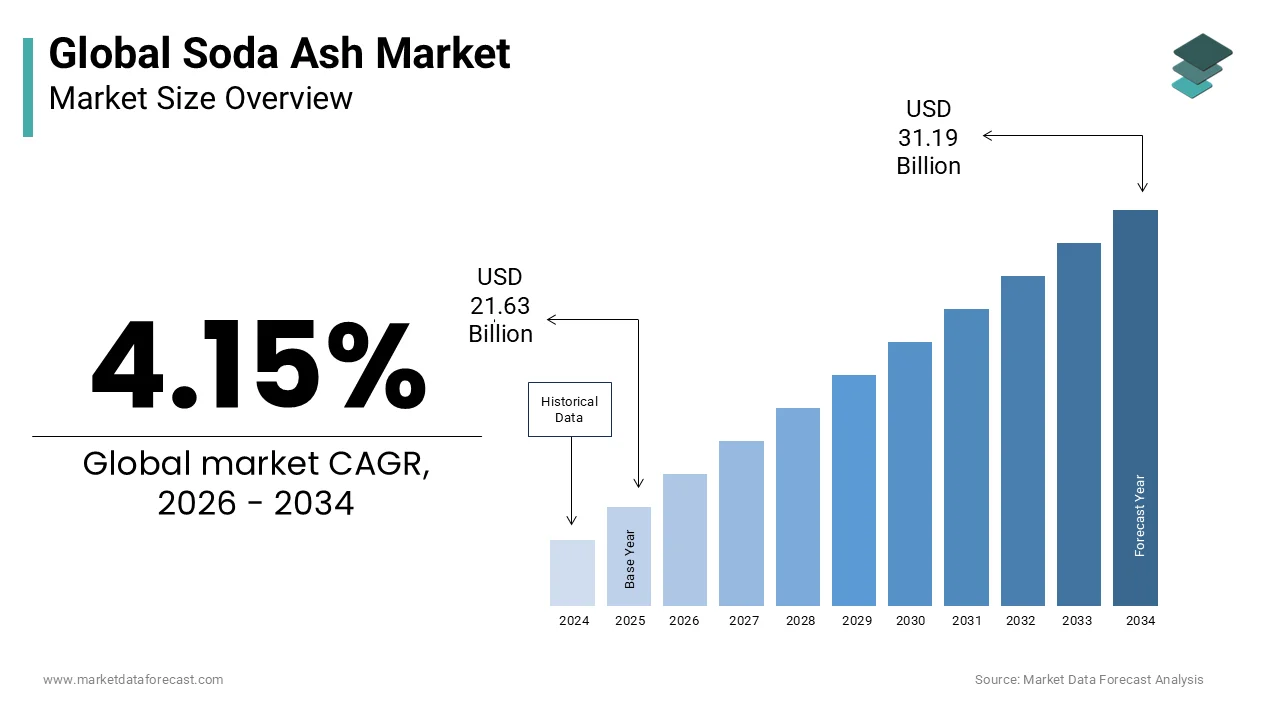
The global soda ash market was valued at USD 21.63 billion in 2025. The global market size is expected to grow at a CAGR of 4.15% from 2026 to 2034 and be worth USD 31.19 billion by 2034 from USD 22.53 billion in 2026.
Soda ash is also known as sodium carbonate and is an essential industrial alkali primarily synthesized via the Solvay process or extracted from trona ore deposits. Its molecular structure enables high reactivity in glass batch formulations, pH stabilization in detergents, and metallurgical fluxing. As per the United States Geological Survey, global natural soda ash reserves exceed 25 billion metric tons, with the Green River Basin in Wyoming alone holding more than 100 years of extractable supply at current production rates. The mineral’s role as a fluxing agent reduces melting temperatures in silicate matrices, making it indispensable in flat glass manufacturing, where each metric ton of glass requires approximately 0.2 metric tons of soda ash. Production methods remain bifurcated between synthetic and natural pathways, with environmental footprints differing substantially.
MARKET DRIVERS
Rising Flat Glass Demand Fuels Soda Ash Market Growth
Its irreplaceable function in flat glass production for architectural and automotive sectors boost the growth rate of the soda ash market. Soda ash is used as a flux to lower the melting temperature of silica in glass manufacturing, conserving energy and furnace integrity. As per the International Commission on Glass, total glass production (including flat glass, container glass, and specialty glass) was approximately 150 million metric tons globally in 2022, with flat glass making up about 40% of that total. Urbanization in Southeast Asia and India, where construction floor area expanded annually, directly correlates with increased glass demand, and thereby tightens soda ash procurement cycles across integrated supply chains.
Growing Detergent Usage Strengthens Global Soda Ash Demand
The persistent reliance on soda ash in powdered detergent formulations, particularly in emerging economies lacking advanced wastewater infrastructure, accelerates the expansion of the soda ash market. According to the World Health Organization, significant number of people still use non-automated laundry methods, where sodium carbonate’s water-softening properties remain unmatched by liquid alternatives. In Sub-Saharan Africa and South Asia, detergent-grade soda ash consumption grew year-over-year through. Regulatory tolerance for phosphate-free detergents further entrenches soda ash’s dominance, especially where zeolite adoption remains economically unviable for low-income households.
MARKET RESTRAINTS
Carbon Emission Regulations Limit Synthetic Soda Ash Output
Intensifying regulatory burden on carbon-intensive synthetic production, particularly in China, which accounts for nearly half of global synthetic output, is a major restraint confronting the growth of the soda ash market. As per studies, each metric ton of synthetic soda ash emits approximately 1.0 metric tons of CO₂, contributing to China’s total industrial emissions. Chinese provinces like Shandong and Hebei are a focus for industrial emissions. National and regional policies on carbon intensity and overall emissions do exist This regulatory tightening constrains supply elasticity despite sustained downstream demand.
Logistics Barriers Restrict Natural Soda Ash Distribution
logistical inflexibility of natural soda ash, which is predominantly mined in remote, landlocked regions such as Wyoming and Botswana, hinders the expansion of the soda ash market. According to sources, Wyoming's natural soda ash exports heavily rely on rail infrastructure and have been impacted by congestion and delays is correct in principle. Also, supply chain bottlenecks and shipping congestion were prevalent during 2022 and earlier, which leading to high spot rates and shipping volatility. Unlike synthetic plants that can be sited near consumption hubs, natural producers face immutable geographic constraints, which limits their ability to respond dynamically to regional demand shocks.
MARKET OPPORTUNITIES
Green Glass Manufacturing Unlocks New Soda Ash Potential
The decarbonization of glass manufacturing through electric melting technologies, which paradoxically increase soda ash’s thermal efficiency, sets up new opportunities for the soda ash market growth. As per the European Container Glass Federation, hybrid technology has the potential to cut furnace emissions by 60%, with an overall 50% reduction in the installation, which means soda ash demand per ton of glass remains stable even as emissions drop. The EU has a legally binding target to reduce net greenhouse gas emissions by at least 55% by 2030, compared to 1990 levels. So, significant amount in glass sector retrofitting is underway, which indirectly secures soda ash’s volume stability. This transition locks in long-term alkali demand despite broader industrial electrification trends.
Circular Economy Practices Drive Efficiency in Soda Ash Use
Circular economy integration, wherein post-consumer glass cullet reintroduces soda ash into production loops without virgin material input, provides major opportunities for the expansion of the soda ash market. According to the Glass Packaging Institute, every increase in cullet usage reduces batch soda ash requirements, but simultaneously extends furnace campaign life by 18 months due to lower corrosivity. In Germany, where cullet recovery exceeds notably, soda ash procurement strategies have shifted toward just-in-time replenishment rather than bulk stocking. This enables producers to monetize supply chain agility, particularly as reverse logistics infrastructure matures in North America and Southeast Asia by unlocking latent efficiency gains.
MARKET CHALLENGES
Alternative Flux Materials Threaten Soda Ash Applications
The accelerating substitution threat posed by alternative fluxing agents in specialty glass segments slows down the rise of the soda ash market. Borosilicate and aluminosilicate formulations, gaining traction in pharmaceutical and electronics packaging, reduce soda ash content by up to 70% as per technical bulletins from Schott AG. These glasses, while niche, are growing annually, according to research, which weakens soda ash’s dominance in high-margin applications. Manufacturers lacking R&D partnerships with glass innovators risk marginalization as material science advances decouple performance from traditional alkali dependence.
Geopolitical Instability Disrupts Global Soda Ash Supply
The geopolitical fragility of export corridors, particularly for landlocked producers, is an obstacle hampering the expansion of the soda ash market. As per studies, a portion of global soda ash seaborne trade transits through the Suez or Panama Canals, both subject to climate-induced closures and tariff escalations. Soda ash exports were slightly higher in 2023 than in 2022. Simultaneously, China’s export controls on critical minerals indirectly affect soda ash logistics, as container allocation prioritizes higher-value commodities. This structural vulnerability affects pricing predictability and forces buyers into fragmented, regionalized sourcing, a destabilizing trend for global supply chains.
REPORT COVERAGE
| REPORT METRIC | DETAILS |
| Market Size Available | 2025 to 2034 |
| Base Year | 2025 |
| Forecast Period | 2026 to 2034 |
| CAGR | 4.15% |
| Segments Covered | By Application, and Region |
| Various Analyses Covered | Global, Regional & Country Level Analysis, Segment-Level Analysis, DROC, PESTLE Analysis, Porter’s Five Forces Analysis, Competitive Landscape, Analyst Overview on Investment Opportunities |
| Regions Covered | North America, Europe, APAC, Latin America, Middle East & Africa |
| Market Leaders Profiled | Solvay AS, Tronox Ltd, Solvents, Zagros Petrochemical Company, Croda International, BASF SE |
SEGMENT ANALYSIS
By Application Insights
The glass manufacturing segment remained dominant by accounting for 52.7% share of the soda ash market in 2025. Soda ash’s irreplaceable role as a fluxing agent in silicate melt chemistry, where no commercially scalable substitute exists for lowering viscosity and melting point, has majorly contributed to the growth of the glass manufacturing segment in the global market. The construction boom across Asia and North America, which collectively added notable square meters of glazed surface area in 2023 according to sources, directly correlates with soda ash procurement intensity, each ton of float glass requiring kilograms of soda ash. Automotive glazing, expanding annually, further entrenches this segment’s structural lead, particularly as panoramic and laminated safety glass gain regulatory favor.
The water treatment segment is likely to experience the fastest CAGR of 6.8% from 2026 to 2034. The municipal mandates to neutralize acidic wastewater and soften hard water without introducing toxic residuals are boosting the expansion of the water treatment segment. In India, the Jal Jeevan Mission has commissioned over rural water treatment plants, each consuming notable metric tons of soda ash monthly to maintain pH. Simultaneously, regulate publicly owned treatment works (POTWs), including issuing standards under the Clean Water Act and requirements for industrial discharges into POTWs, driving a year-over-year increase in industrial-grade soda ash procurement for tertiary treatment. This regulatory tailwind, paired with cost-efficiency against caustic alternatives, supports the segment’s velocity.
REGIONAL ANALYSIS
North America Market Analysis
North America grew steadily in the soda ash market in 2025. The growth of the North America is primarily driven by vertically integrated glass producers and a mature water infrastructure base. The region’s position is also supported by Wyoming’s geological advantage, home to the world’s largest trona reserves, which enables cost-competitive, low-carbon extraction. According to studies, natural soda ash production in the state emits less CO₂ per ton than synthetic equivalents, granting North American exporters a sustainability premium in transatlantic trade. Automotive glass demand, spurred by EV production scaling to notable number of units, sustains industrial offtake, while municipal utilities in drought-prone states like California increasingly deploy soda ash for aquifer recharge pH stabilization.
Latin America Market Analysis
Latin America is likely to expand in the soda ash market, with Brazil and Mexico emerging as dual engines of regional demand. Brazil’s flat glass sector expanded output, as per sources, driven by residential construction incentives under the program that added significant housing units with mandatory glazing standards. Mexico, meanwhile, leverages proximity to U.S. automotive supply chains, with glass component exports to Detroit rising year-over-year. Water treatment adoption is accelerating in Andean nations, which creates latent demand for alkalinity correction agents.
Europe Market Analysis
Europe was the second-largest region in the soda ash market by capturing 22.5% share in 2025. The growth of the Europe is fuelled by stringent circular economy mandates and decarbonization imperatives. The European glass industry uses recycled glass (cullet) to save energy and raw materials. Using recycled glass lowers the melting temperature, which reduces energy consumption and carbon dioxide emissions. The use of cullet in container glass manufacturing is well-established and an important part of the circular economy. Germany is among the European countries with a high glass recycling rate. In 2022, Germany recycled millions of metric tons of waste glass. This is used for new products, primarily containers like bottles and jars. Simultaneously, there have been regulations limiting or banning phosphates in household detergents based on EU regulations. The European Commission began efforts in this area as far back as 2011.
Asia Pacific Market Analysis
Asia Pacific was the top performer in the soda ash market in 2025 and accounted for 45.7% of the global market share in 2025. The domination of the Asia Pacific is primarily driven by China’s glass manufacturing colossus and India’s infrastructural surge. China produced substantial million metric tons of flat glass in 2023, as per research, translating to millions metric tons of soda ash consumed. India’s was launched by the government of India with a targeted investment of approximately $1.4 trillion (₹111 lakh crore) on infrastructure from the fiscal years 2020 to 2026. The spending is aimed at supporting India's goal of becoming a $5 trillion economy. Southeast Asia’s detergent sector, particularly in Indonesia and Vietnam, is expanding annually, driven by urbanization and rising hygiene consciousness post-pandemic.
Middle East & Africa Market Analysis
The Middle East & Africa is expected to grow gradually in the global soda ash market, with divergent trajectories shaping regional dynamics. The Gulf Cooperation Council nations, led by Saudi Arabia and the UAE, are investing in solar-powered glass manufacturing under Vision 2030 initiative, requiring high-purity soda ash for photovoltaic panel substrates. Sub-Saharan Africa, meanwhile, exhibits grassroots demand growth. Egypt’s flat glass output rose, fueled by Suez Canal Economic Zone export incentives targeting European construction markets, which creates a north-south demand corridor previously untapped.
COMPETITIVE LANDSCAPE
KEY MARKET PLAYERS
Some of the key players dominating the global soda ash market are
- Solvay AS
- Tronox Ltd.
- Solvents
- Zagros Petrochemical Company
- Croda Inter
TOP STRATEGIES USED BY KEY MARKET PLAYERS
Leading soda ash producers prioritize vertical integration, securing trona reserves or co-locating synthetic plants with salt and limestone quarries to control input costs. They invest in decarbonization technologies, such as oxy-fuel furnaces and carbon capture pilots, to comply with tightening emissions regulations in Europe and North America. Strategic offtake agreements with glass and detergent multinationals lock in multi-year volumes, reducing spot market exposure. Companies deploy technical service teams to co-engineer batch formulations, which embedding themselves into customer production workflows. Export-focused players optimize logistics via port-adjacent warehousing and rail-to-vessel transloading to mitigate canal transit risks.
COMPETITION OVERVIEW
The soda ash market exhibits moderate concentration, with natural producers holding cost and emissions advantages over synthetic counterparts, especially in export corridors. Competition pivots on reliability of supply, purity consistency, and embedded technical support rather than price alone. European players compete on sustainability credentials, while Asian producers leverage scale and state-backed infrastructure. North American firms exploit geographic proximity to end-users and low-carbon extraction. New entrants face prohibitive capital barriers due to mine development lead times exceeding seven years and regulatory hurdles in water-scarce regions. Innovation now centers on circular integration, which recovers alkali from glass cullet streams and licensing efficiency algorithms to downstream users.
TOP PLAYERS IN THE MARKET
- Ciner Resources LP leverages its Wyoming-based trona reserves to supply high-purity natural soda ash globally, prioritizing low-carbon production. The company signed long-term offtake agreements with glass manufacturers, which embeds itself into Asia’s supply chain. It also launched a technical advisory division to assist glassmakers in optimizing batch chemistry by enhancing customer retention through value-added services rather than price competition.
- Solvay SA, a European chemical titan, operates synthetic soda ash facilities integrated with chlorine and caustic soda production, enabling circular material flows. Solvay co-developed alkali-stabilized detergent formulations with Unilever for phosphate-free markets in Africa. Its R&D center in Lyon now licenses fluxing efficiency algorithms to flat glass producers, which monetizes intellectual property while deepening industrial partnerships.
- Tata Chemicals Limited dominates India’s domestic demand while expanding export reach to ASEAN and East Africa. The company partnered with to deploy soda ash in rural water purification kiosks, creating new demand vectors.
MARKET SEGMENTATION
This research report on the global soda ash market has been segmented and sub-segmented based on application and region.
By Application
- Glass
- Soaps & Detergents
- Water Treatment
- Chemicals
- Pulp & Paper
- Metallurgy
By Region
- North America
- Latin America
- Europe
- Asia Pacific
- Middle East & Africa