- Product Description Description
- Table of Contents TOC
- List of Table & Figure LOT
- Get Free Sample PDF Sample PDF
Market Size, 2025
$2.84 BnMarket Estimate, 2026
$3.47 BnMarket Forecast, 2034
$17.27 BnCAGR, 2026–2034
22.21%Executive Summary: Global Structured Light 3D Scanner Market
- Market Scope: Comprehensive global structured light 3D scanner market analysis covering product types, application verticals, industrial end-user segments, distribution networks, and advanced optical measurement metrics.
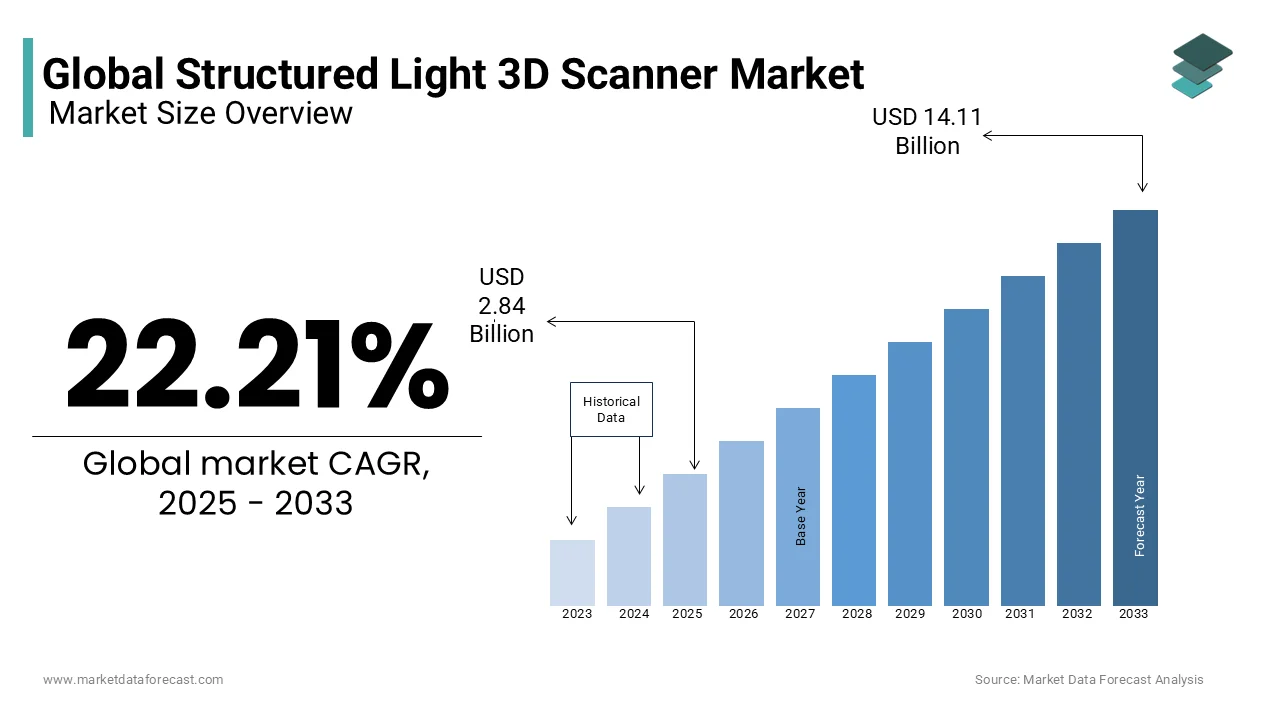
- Market Valuation: Valued at USD 2.84 billion (2025), estimated at USD 3.47 billion (2026), and projected to reach USD 17.27 billion by 2034, registering an exceptional CAGR of 22.21% (2026–2034).
- Primary Growth Drivers: Expanding applications in automotive and aerospace design, increasing demand for wearable devices and realistic immersive interactions, reduced manufacturing times, and rising requirements for non-contact quality control and product inspection.
Key Market Segment Metrics (2026–2034)
| Category | Leading Segment (2025 Position) | Fastest-Growing Segment |
|---|---|---|
| By Product Type | Industrial 3D Scanners (dominated market adoption for heavy industrial manufacturing and inspection) | Handheld 3D Scanners (projected to expand rapidly due to portability and ease of complex surface capture) |
| By Application | Quality Control & Inspection (led utilization across production lines to verify component tolerances) | Reverse Engineering & Rapid Prototyping (surging alongside smart manufacturing and design integration) |
| By End User | Automotive (held the largest market share owing to rigid quality assurance and design workflows) | Healthcare & Aerospace (accelerating due to demand for body implantation modeling and high-precision parts) |
| By Distribution Channel | Direct Sales (primary channel for high-value industrial systems and enterprise software integration) | Online Platforms & Distributors (expanding quickly, facilitating accessible procurement for professional users) |
| By Region | North America & Europe (established dominant regional install bases supported by advanced manufacturing and aerospace sectors) | Asia-Pacific (fastest-growing regional market driven by extensive infrastructure projects, automotive expansion, and dental restorations) |
Major Market Players & Market Structure
Market Structure: Highly competitive global metrology and optical scanning landscape featuring major international technology corporations competing on measurement resolution, software automation (such as RevEng platforms and automated cells), portability, and cross-industry applications.
Key Companies: Hexagon AB, FARO Technologies Inc., Nikon Metrology NV, Trimble Inc., Topcon Corporation, 3D Systems Corporation, Perceptron Inc., Kreon Technology, Shapegrabber, Shining 3D Tech, RangeVision, and Creaform Inc.
Global Structured Light 3D Scanner Market Size
The global structured light 3D scanner market was valued at USD 2.84 billion in 2025. The global market is projected to grow at a CAGR of 22.21% from 2026 to 2034 and be worth USD 17.27 billion by 2034 from USD 3.47 billion in 2026.
Structured light 3D scanners are advanced optical measurement systems that project precise light patterns onto objects to capture high-resolution three-dimensional geometry with exceptional accuracy. This technology is pivotal in industries requiring meticulous digital replication, such as aerospace, automotive manufacturing, and healthcare, for creating digital twins and quality control protocols. As per the National Institute of Standards and Technology, manufacturing defects cost the global economy approximately 2 trillion dollars annually due to inadequate quality inspection methods. Structured light scanners mitigate these losses by enabling micron-level precision in part verification. As per the Society of Manufacturing Engineers, companies implementing automated optical inspection systems reduced their scrap rates by 30% within the first year of deployment. These statistics demonstrate the critical role of high-precision scanning in enhancing production efficiency and minimizing material waste. As industries transition toward Industry 4.0 standards, the demand for non-contact measurement tools that integrate seamlessly with digital workflows intensifies. Consequently, manufacturers prioritize investments in structured light technology to ensure product consistency, accelerate time to market, and maintain competitive advantage in an era where tolerances are increasingly stringent and complex geometries are more prevalent in modern design.
MARKET DRIVERS
Expansion of Additive Manufacturing and Rapid Prototyping Industries
The rapid expansion of additive manufacturing and rapid prototyping sectors directly fuels the structured light 3D scanners market due to the need for precise digital models and post-production validation. Additive manufacturing relies heavily on accurate computer-aided design files, which are often generated or verified using high-resolution scanning technologies. As per Wohlers Associates, the global additive manufacturing industry grew by 19%, reaching a total value of 18 billion dollars, indicating a robust increase in production activities that require detailed digitization. This growth creates a parallel demand for scanning solutions that can reverse engineer existing parts or inspect printed components for dimensional accuracy. As per the American Society for Testing and Materials, 65% of industrial 3D printing applications require post-process inspection to ensure compliance with strict engineering tolerances. Structured light scanners provide the necessary speed and resolution to perform these inspections efficiently without damaging delicate printed structures. The ability to quickly iterate designs by scanning physical prototypes and comparing them against digital models accelerates the product development cycle. Manufacturers utilize these scanners to detect warping, shrinkage, or layer misalignment in real time. Consequently, the symbiotic relationship between additive manufacturing and precision metrology sustains strong demand for structured light scanning systems as they become integral to the digital thread of modern production workflows.
Stringent Quality Control Standards in Aerospace and Automotive Sectors
Strict quality control mandates in the aerospace and automotive industries significantly propel the structured light 3D scanners market expansion. These sectors operate under rigorous safety regulations that require every part to meet exact dimensional specifications to prevent catastrophic failures. As per the Federal Aviation Administration, over 80% of aircraft maintenance issues are related to component wear or manufacturing deviations, which necessitates regular and precise inspection protocols. Structured light scanners enable non-contact measurement of complex curved surfaces and internal features that traditional tactile probes cannot access easily. As per the International Organization for Standardization, compliance with ISO 9001 quality management standards requires documented evidence of dimensional accuracy, which digital scanning provides through detailed color map reports. Automotive manufacturers use these systems to inspect body panels, engine components, and interior assemblies for fit and finish issues before assembly. The speed of structured light scanning allows for 100% inspection rather than sample-based checks, ensuring higher quality output. As vehicles become more electric and lightweight materials like carbon fiber are used more frequently, the need for precise scanning increases. Consequently, the regulatory pressure and operational necessity for zero-defect manufacturing drive sustained investment in high-precision structured light scanning technologies across these critical industrial verticals.
MARKET RESTRAINTS
High Initial Investment and Operational Costs
Substantial financial requirements for acquiring and maintaining structured light 3D scanning systems restrict market penetration among small and medium-sized enterprises. High-end industrial scanners equipped with advanced optics and processing units command premium prices that are often prohibitive for smaller workshops or startups. As per the National Association of Manufacturers, 45% of small manufacturing firms cite capital expenditure constraints as the primary barrier to adopting advanced metrology technologies. This financial limitation forces many organizations to rely on less accurate manual measurement methods or outsource scanning services, which increases lead times and reduces control over quality data. As per the Society of Plastics Engineers, the total cost of ownership, including software licenses, calibration, maintenance, and specialized training, can exceed the initial hardware cost by 40% over five years. The need for controlled lighting environments and vibration-free setups further adds to the infrastructure costs. Small businesses often lack the budget to create such optimized scanning cells. The high return on investment threshold means that only high-volume or high-value production lines justify the expense. Consequently, the significant upfront and ongoing financial burden limits the widespread adoption of structured light scanners, particularly in price-sensitive markets and emerging economies where cost efficiency is prioritized over precision automation.
Sensitivity to Environmental Conditions and Surface Properties
The inherent sensitivity of structured light technology to ambient lighting conditions and object surface characteristics impedes its effectiveness in diverse industrial environments. Structured light scanners rely on the projection and capture of specific light patterns, which can be disrupted by bright ambient light reflections or transparent surfaces. As per the Optical Society, scanning accuracy decreases by up to 50% when operating in environments with uncontrolled natural light or strong artificial illumination. This limitation requires users to invest in additional shielding or dark rooms, which complicates integration into busy factory floors. Furthermore, reflective or shiny surfaces, such as polished metals or glass, cause pattern distortion, leading to data gaps and measurement errors. As per the American Foundry Society, 30% of scanning attempts on untreated metal castings fail due to surface reflectivity issues, requiring time-consuming application of matte sprays. These preparatory steps add labor costs and delay the inspection process. Dark or absorptive materials also pose challenges as they do not reflect enough light for the sensors to capture accurate data. Consequently, the need for ideal environmental conditions and surface preparation restricts the versatility of structured light scanners, making them less suitable for rugged or dynamic production settings compared to more robust laser-based alternatives.
MARKET OPPORTUNITIES
Integration with Artificial Intelligence for Automated Defect Detection
The incorporation of artificial intelligence and machine learning algorithms into structured light scanning software presents a significant opportunity for enhancing automated quality control capabilities. AI-driven analysis can process vast amounts of 3D point cloud data to identify subtle defects and anomalies that human inspectors might miss. As per the National Institute of Standards and Technology, AI-enhanced inspection systems can reduce false positive rates by 60% while increasing detection speed by 40% compared to traditional rule-based methods. This efficiency gain encourages manufacturers to upgrade their existing scanning infrastructure with intelligent software modules. As per the Manufacturing Extension Partnership, 70% of industrial firms plan to implement AI-powered visual inspection systems within the next three years to improve yield rates. Structured light scanners provide the high-resolution data necessary for training these AI models effectively. The ability to learn from historical data allows the system to adapt to new product variations without extensive reprogramming. Vendors offering AI-integrated scanning solutions can differentiate themselves by demonstrating measurable improvements in quality assurance and operational efficiency. The growing acceptance of smart factory initiatives facilitates the seamless integration of these intelligent scanning tools into broader production monitoring systems. Consequently, the convergence of optical metrology and artificial intelligence creates new revenue streams for vendors developing specialized analytical software for automated defect recognition.
Growth in Medical and Dental Digital Workflows
The rapid digitization of medical and dental practices generates substantial demand for high-precision structured light scanners for creating custom implants, prosthetics, and orthodontic devices. These applications require extreme accuracy to ensure patient comfort and functional correctness, which structured light technology delivers reliably. As per the American Dental Association, 85% of dental laboratories have adopted digital scanning workflows, replacing traditional impression materials with intraoral and desktop scanners. This shift drives demand for compact, high-resolution structured light scanners capable of capturing fine details of teeth and gums. As per the Food and Drug Administration, the number of 3D-printed medical devices approved for clinical use increased by 25%, many of which rely on scanned patient data for customization. Structured light scanners are preferred in this sector due to their safety, as they use non-ionizing visible light unlike some other scanning modalities. The ability to quickly generate accurate digital models reduces patient chair time and improves workflow efficiency for clinicians. Vendors can capitalize on this trend by developing specialized medical-grade scanners with ergonomic designs and hygiene-friendly features. The need for personalized medicine and custom surgical guides further expands the application scope. Consequently, the alignment of structured light scanning with digital health trends creates sustained growth opportunities in the medical and dental sectors.
MARKET CHALLENGES
Competition from Alternative Scanning Technologies
The presence of established alternative scanning technologies, such as laser triangulation and computed tomography, poses a major challenge to the structured light 3D scanner market. Laser scanners are often perceived as more robust for outdoor or large-scale applications due to their immunity to ambient light interference. As per the International Society for Optics and Photonics, laser scanning holds a 55% share of the industrial metrology market due to its versatility in harsh environments. This dominance makes it difficult for structured light vendors to penetrate segments where durability and range are prioritized over resolution. Additionally, computed tomography offers superior internal feature inspection capabilities, which structured light cannot match as it is limited to surface geometry. As per the Aerospace Industries Association, 60% of complex aerospace component inspections still rely on CT scanning for internal void detection. Structured light vendors struggle to convince customers to switch from familiar technologies unless the specific benefits of higher resolution and speed are clearly demonstrated. The learning curve associated with optimizing structured light systems for different materials also deters adoption. Customers often prefer single-solution providers who offer multiple scanning modalities. Consequently, the strong foothold of competing technologies limits the market expansion of structured light scanners, forcing vendors to continuously innovate to prove their unique value proposition in niche, high-precision applications.
Complexity of Data Processing and Software Integration
The complexity involved in processing large volumes of 3D scan data and integrating it with existing computer-aided design and manufacturing software challenges widespread adoption. Structured light scanners generate massive point clouds that require significant computational power and specialized software skills to align, clean, and analyze. As per the Society of Manufacturing Engineers, 40% of engineering teams face delays in product development due to bottlenecks in 3D data processing and mesh generation. This technical hurdle discourages smaller firms from investing in scanning technology as they lack the IT infrastructure and expertise to handle the data efficiently. Furthermore, interoperability issues between different scanner brands and CAD platforms create friction in digital workflows. As per the Industrial Internet Consortium, 35% of manufacturers experience data compatibility problems when integrating new metrology tools with legacy systems. Users often need to purchase additional software licenses or develop custom scripts to bridge these gaps. The steep learning curve for operators to master scanning strategies and software tools also increases training costs. Consequently, the technical complexity and integration challenges strain resources and limit the practical utility of structured light scanners for organizations without dedicated metrology departments, thereby hindering broader market penetration.
REPORT COVERAGE
| REPORT METRIC | DETAILS |
| Market Size Available | 2025 to 2034 |
| Base Year | 2025 |
| Forecast Period | 2026 to 2034 |
| Segments Covered | By Product Type, Application, End User, Distribution Channel, and Region. |
| Various Analyses Covered | Global, Regional, and Country-Level Analysis, Segment-Level Analysis, Drivers, Restraints, Opportunities, Challenges; PESTLE Analysis; Porter’s Five Forces Analysis, Competitive Landscape, Analyst Overview of Investment Opportunities |
| Regions Covered | North America, Europe, APAC, Latin America, Middle East & Africa |
| Market Leaders Profiled | Hexagon AB, FARO Technologies, Inc., Nikon Metrology NV, Trimble Inc., Topcon Corporation, 3D Systems Corporation, Perceptron Inc., Kreon Technology, Shapegrabber, Fuel 3D, Artec 3D, Next Engine, Shining 3D Tech, RangeVision, Exact Metrology, Trimet, 3D Scanco, Maptek Pty Ltd, True Point Laser Scanning LLC, Basis Software Inc., Capture 3D, Creaform, Inc., and Others. |
SEGMENTAL ANALYSIS
By Product Type Insights
The industrial 3D scanners segment accounted for a dominant share of the global structured light 3D scanners market in 2025 due to their ability to deliver micron-level accuracy required for critical manufacturing and quality assurance processes. These systems are designed for stationary use in controlled environments, allowing for the highest-resolution data capture of complex geometries. As per the Society of Manufacturing Engineers, 75% of automotive manufacturers utilize industrial-grade structured light scanners for final part inspection to ensure compliance with tight tolerances. This widespread adoption is driven by the need to eliminate manual measurement errors and accelerate production lines. As per the National Institute of Standards and Technology, industrial scanning reduces inspection time by 60% compared to traditional coordinate measuring machines while maintaining superior data density. This efficiency gain justifies the higher initial investment for large-scale production facilities. Industries such as aerospace and energy rely on these scanners for verifying turbine blades, engine components, and structural parts where failure is not an option. The robustness of industrial systems ensures consistent performance over long operational cycles. Consequently, the critical role of industrial scanners in maintaining product quality and operational efficiency sustains their market dominance as the preferred choice for high-value manufacturing applications.
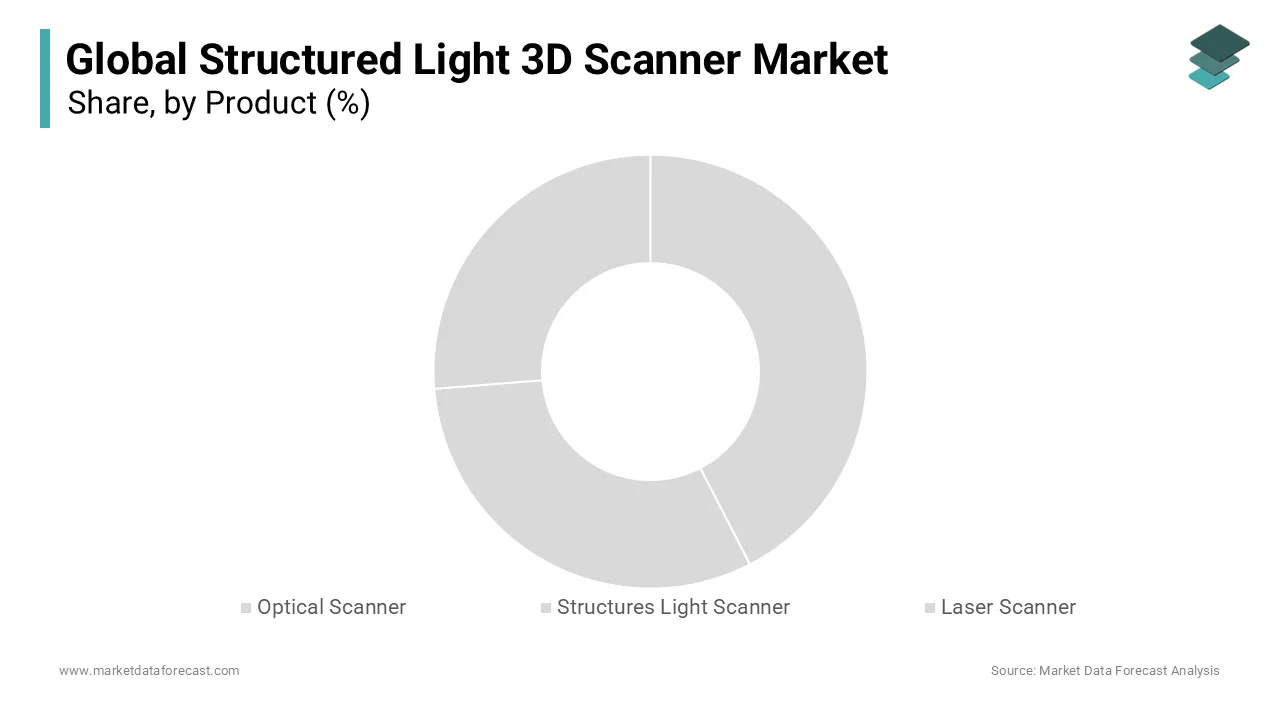
However, the handheld 3D scanners segment is expected to showcase the fastest CAGR of 17.4% over the forecast period in the global market as users prioritize flexibility and ease of use in diverse field applications. Unlike stationary systems, handheld devices allow operators to scan large objects or hard-to-reach areas without moving the object itself. As per the American Society for Testing and Materials, 65% of field service engineers prefer handheld scanners for reverse engineering and maintenance tasks due to their portability. This preference drives demand in sectors such as heritage preservation, forensic analysis, and on-site repair. As per the Occupational Safety and Health Administration, handheld scanning reduces physical strain on workers by eliminating the need to transport heavy parts to inspection rooms. This ergonomic benefit improves worker productivity and safety. The advancement in battery technology and wireless connectivity further enhances the usability of handheld devices in remote locations. Users appreciate the quick setup time and intuitive interfaces that require minimal training. As the technology becomes more compact and affordable, small and medium enterprises are adopting handheld scanners for various applications. Consequently, the convenience and adaptability of handheld structured light scanners fuel their rapid expansion across multiple industries.
By Application Insights
The quality control and inspection segment held the largest share of the global market in 2025 because manufacturers must adhere to strict regulatory standards and minimize defect rates to remain competitive. Structured light scanners provide the high-resolution data necessary to verify dimensional accuracy and surface finish of produced parts. As per the International Organization for Standardization, 90% of certified manufacturing facilities require documented evidence of dimensional inspection for every batch of critical components. This regulatory mandate drives the consistent use of scanning technology in production environments. As per the Automotive Industry Action Group, implementing automated optical inspection reduced customer complaints by 35% by catching defects before shipment. This improvement in quality protects brand reputation and reduces warranty costs. The speed of structured light scanning allows for 100% inspection rather than statistical sampling, ensuring higher confidence in product quality. Industries such as medical device manufacturing and aerospace rely heavily on this capability to ensure patient and passenger safety. The ability to generate detailed color map reports facilitates easy communication of quality issues to production teams. Consequently, the critical need for rigorous quality assurance sustains the dominance of this application segment as a fundamental requirement for modern manufacturing.
However, the reverse engineering segment is experiencing the fastest growth in the global structured light 3D scanners market and is estimated to showcase a CAGR of 16.8% over the forecast period as industries face challenges in replacing obsolete or discontinued parts. Many older machines and infrastructure components no longer have available CAD models or original manufacturers, making scanning essential for reproduction. As per the Maintenance Reliability and Physical Asset Management Society, 60% of industrial facilities struggle with spare parts availability for equipment older than 10 years. This scarcity drives demand for accurate digitization services to recreate parts from physical samples. As per the Department of Energy, reverse engineering of legacy infrastructure components is critical for maintaining national energy grid reliability. Structured light scanners provide the precision needed to capture complex geometries of worn or damaged parts accurately. The resulting digital models can be modified and optimized before manufacturing via additive or subtractive methods. This capability extends the lifespan of critical assets and reduces downtime. As supply chain disruptions continue to affect global manufacturing, the ability to produce parts locally through reverse engineering becomes strategically important. Consequently, the urgent need to maintain aging infrastructure and machinery fuels the rapid expansion of the reverse engineering application segment.
By End User Insights
The automotive segment had the largest share of the global market in 2025 due to the high volume of production and the increasing complexity of vehicle designs. Modern vehicles incorporate intricate curves, aerodynamic features, and lightweight materials that require precise measurement for quality assurance. As per the International Organization of Motor Vehicle Manufacturers, global vehicle production reached 85 million units, each requiring thousands of individual component inspections. This massive scale drives substantial demand for fast and accurate scanning solutions. As per the Society of Automotive Engineers, 70% of new car models utilize complex sheet metal and composite parts that are difficult to measure with traditional tools. Structured light scanners excel in capturing these freeform surfaces quickly and accurately. The industry also relies on scanning for tooling verification and assembly fit checks to prevent costly rework. The shift toward electric vehicles introduces new battery pack and motor housing geometries that further increase scanning requirements. Automakers prioritize scanning to maintain brand quality and meet safety regulations. Consequently, the sheer volume and technical complexity of automotive manufacturing sustain the sector's dominance in the structured light scanner market.
However, the healthcare segment is estimated to record a promising CAGR of 17.4% over the forecast period in the global market owing to the increasing demand for customized prosthetics, orthotics, and surgical implants. Personalized medical devices require precise anatomical data to ensure proper fit and function, which structured light scanning provides safely and accurately. As per the American Academy of Orthotists and Prosthetists, 80% of custom prosthetic sockets are now designed using digital scanning methods instead of traditional plaster casting. This shift improves patient comfort and reduces fabrication time significantly. As per the Food and Drug Administration, the number of 3D-printed medical devices approved for clinical use increased by 25%, many of which rely on scanned patient anatomy. Structured light scanners are preferred in this sector because they use non-ionizing visible light, making them safe for repeated use on patients. The ability to capture soft tissue details accurately is crucial for designing effective orthotic devices. Hospitals and clinics are investing in desktop and handheld scanners to bring digitization in-house. Consequently, the move toward personalized medicine and digital dentistry drives exceptional growth in the healthcare end user segment.
REGIONAL ANALYSIS
North America Structured Light 3D Scanner Market Analysis
North America accounted for the dominant share of the global market in 2025 and is likely to maintain robust expansion and technological leadership in advanced manufacturing infrastructure over the next few years. The region accounts for the largest share of global revenue due to the presence of major aerospace, automotive, and healthcare industries that rely on precision metrology. As per the National Institute of Standards and Technology, the United States invested 150 billion dollars in manufacturing innovation, much of which supported digital inspection technologies. This funding drives adoption of advanced scanning solutions. As per the Society of Manufacturing Engineers, 70% of North American manufacturers have implemented automated quality control systems, including structured light scanners. The presence of leading scanner manufacturers and technology providers fosters innovation and competition. High labor costs encourage automation to improve efficiency. Regulatory standards in healthcare and aerospace require rigorous inspection protocols. Consequently, North America’s mature industrial base and technological leadership sustain its market dominance while setting trends for global adoption.
Europe Structured Light 3D Scanner Market Analysis
Europe is projected to experience steady, quality-driven growth underpinned by stringent industrial standards and public digitalization funding over the next few years. Europe occupies the second-largest position in the Structured Light 3D Scanner Market, characterized by strong engineering traditions, stringent quality standards, and significant government support for digitalization. Countries like Germany, France, and Italy are leaders in automotive and machinery manufacturing, driving demand for high-precision inspection tools. As per the European Commission, Horizon Europe allocated 2 billion euros to advanced manufacturing technologies, including metrology. This investment supports the development and adoption of structured light scanning. As per the German Engineering Federation, 80% of German manufacturing companies use optical inspection systems to maintain their reputation for quality. Strict ISO standards necessitate precise measurement capabilities. The region has a dense network of small and medium-sized enterprises that are increasingly adopting digital tools. Research institutions collaborate closely with industry to validate new technologies. Consequently, Europe’s focus on quality and innovation sustains its significant market share despite slower overall economic growth.
Asia Pacific Structured Light 3D Scanner Market Analysis
Asia Pacific represents the fastest-growing regional market for structured light 3d scanners owing to the rapid industrialization, expanding manufacturing bases, and increasing government initiatives to promote smart factories. China, India, Japan, and South Korea are investing heavily in upgrading their manufacturing capabilities to compete globally. As per the Asian Development Bank, manufacturing output in Asia Pacific grew by 8%, outpacing other regions. This growth creates substantial demand for quality control and reverse engineering solutions. As per the Ministry of Industry and Information Technology in China, the country aims to have 50 percent of its manufacturing enterprises digitized. This policy drives adoption of scanning technologies. The rising middle class increases demand for consumer goods, automobiles, and healthcare services, which require precise manufacturing. Low labor costs are decreasing, making automation more attractive. Consequently, Asia Pacific offers the highest growth potential as it transitions from low-cost production to high-value manufacturing.
Latin America Structured Light 3D Scanner Market Analysis
Latin America is expected to see moderate and progressive growth driven by nearshoring trends and industrial modernization efforts over the next few years. Latin America holds an emerging position in the Structured Light 3D Scanner Market, characterized by gradual adoption in key industries such as automotive and aerospace in countries like Brazil and Mexico. The region benefits from nearshoring trends as companies move production closer to North America. As per the Inter-American Development Bank, foreign direct investment in Latin American manufacturing increased by 15%. This investment brings advanced technologies, including structured light scanners. As per the Brazilian Association of Machinery and Equipment, local manufacturers are upgrading equipment to meet international quality standards. Economic volatility remains a challenge, but large multinational corporations drive demand. Government incentives for industrial modernization are beginning to take effect. The mining and oil & gas sectors also use scanning for equipment maintenance. Consequently, Latin America presents moderate growth opportunities as it integrates into global supply chains and adopts higher manufacturing standards.
Middle East and Africa Structured Light 3D Scanner Market Analysis
The Middle East and Africa are positioned for gradual long-term advancement driven by economic diversification strategies and massive infrastructure investments over the next few years. The Middle East and Africa region displays nascent but growing interest in Structured Light 3D Scanners driven by diversification efforts in Gulf countries and infrastructure development in Africa. Saudi Arabia and the United Arab Emirates are investing in advanced manufacturing and healthcare as part of their economic vision plans. As per official development strategies, the Saudi Vision 2030 initiative allocated 50 billion dollars to industrial development, including digital technologies. This funding creates opportunities for metrology solutions. As per the African Union, infrastructure spending in Africa increased by 10% annually, driving demand for construction and engineering scanning applications. The healthcare sector in South Africa and Egypt is adopting digital dentistry and prosthetics. However, limited local expertise and infrastructure hinder widespread adoption. International vendors are focusing on key hubs for initial market entry. Consequently, the Middle East and Africa represent long-term growth potential as economic diversification and infrastructure projects mature.
COMPETITIVE LANDSCAPE
The competition in the Structured Light 3D Scanner Market is characterized by intense rivalry among established industrial metrology giants and innovative specialized startups striving to offer superior precision and usability. Major players leverage their extensive resources to develop integrated hardware and software ecosystems that provide end-to-end solutions for quality control and reverse engineering. These vendors compete on the basis of scanning speed, resolution accuracy, and ease of integration with existing manufacturing workflows. Smaller niche firms differentiate themselves by offering highly portable and user-friendly devices tailored for specific applications such as dental scanning or artistic preservation. The market sees frequent technological advancements as companies strive to overcome limitations related to surface reflectivity and ambient light sensitivity. Strategic partnerships with software developers and industrial equipment manufacturers are crucial for enhancing product capabilities and market reach. Customer retention relies heavily on providing robust technical support and continuous software updates that improve functionality over time. Price competition is moderate in the high-end industrial segment but intensifies in the entry-level and prosumer categories. The entry of new competitors with novel optical technologies challenges traditional vendors to accelerate their innovation cycles. Overall, the competitive landscape drives rapid improvements in performance and accessibility, ensuring that users have access to increasingly powerful and versatile structured light scanning solutions.
KEY MARKET PLAYERS
The leading companies operating in the global structured light 3D scanner market include:
- Hexagon AB
- FARO Technologies, Inc.
- Nikon Metrology NV
- Trimble Inc.
- Topcon Corporation
- 3D Systems Corporation
- Perceptron Inc.
- Kreon Technology
- Shapegrabber
- Fuel 3D
- Artec 3D
- Next Engine
- Shining 3D Tech
- RangeVision
- Exact Metrology
- Trimet
- 3D Scanco
- Maptek Pty Ltd
- True Point Laser Scanning LLC
- Basis Software Inc.
- Capture 3D
- Creaform, Inc.
TOP PLAYERS IN THE MARKET
- Hexagon AB significantly contributes to the Structured Light 3D Scanner Market by providing high-precision industrial metrology solutions that integrate seamlessly with manufacturing workflows. The company leverages its extensive portfolio of hardware and software to offer comprehensive quality control systems for automotive and aerospace sectors. Recent actions include the launch of advanced structured light sensors with enhanced resolution and speed capabilities tailored for automated production lines. These innovations enable manufacturers to perform real-time inspections with greater accuracy and efficiency. Hexagon actively collaborates with industrial partners to develop customized scanning applications that address specific measurement challenges. The company also invests heavily in artificial intelligence-driven analytics to automate defect detection and data interpretation. By focusing on digital reality solutions, Hexagon strengthens its position as a leader in smart manufacturing technologies. Its continuous improvement in sensor technology and software integration ensures that customers achieve optimal productivity and quality standards in complex industrial environments.
- Artec 3D plays a pivotal role in the Structured Light 3D Scanner Market by specializing in portable and handheld scanning devices known for their ease of use and versatility. The company serves diverse industries, including healthcare, entertainment, and engineering, with user-friendly solutions that require minimal training. Recent efforts involve expanding its global distribution network and introducing new handheld models with improved texture capture and processing speeds. Artec 3D actively engages with professional communities through educational programs and technical support initiatives to enhance user proficiency. The company emphasizes innovation in algorithm development to ensure accurate scanning of challenging surfaces such as dark or reflective materials. Its commitment to customer satisfaction drives the creation of intuitive software interfaces that streamline the scanning workflow. By maintaining a strong focus on portability and performance, Artec 3D enables professionals to capture high-quality 3D data in various field conditions. This strategic approach solidifies its reputation as a preferred provider for mobile scanning applications.
- Creaform strengthens its presence in the Structured Light 3D Scanner Market through its robust industrial scanning platforms designed for demanding metrology and reverse engineering tasks. The company offers a range of portable and automated systems that deliver reliable performance in harsh industrial environments. Recent actions include the integration of advanced lighting technologies and optical components to improve scanning accuracy and speed for large-scale objects. Creaform collaborates closely with aerospace and automotive manufacturers to validate its solutions against rigorous industry standards. The company also enhances its software suite with powerful tools for data processing and analysis, which simplifies complex inspection workflows. By focusing on durability and precision, Creaform addresses the needs of engineers who require dependable measurement results. Its dedicated technical support team ensures seamless implementation and ongoing maintenance for clients. Consequently, Creaform maintains a strong competitive edge by delivering high-value scanning solutions that meet the exacting requirements of professional industrial users.
TOP STRATEGIES USED BY KEY MARKET PARTICIPANTS
Key players in the Structured Light 3D Scanner Market primarily employ product innovation strategies to enhance scanning speed, accuracy, and ease of use for diverse applications. Companies frequently invest in research and development to integrate artificial intelligence and machine learning algorithms into their software suites, enabling automated defect detection and smarter data processing. This technological advancement allows vendors to offer superior value propositions that differentiate their products from competitors. Another major strategy involves expanding into emerging markets such as Asia Pacific and Latin America, where industrialization and digital transformation are accelerating demand for precision metrology tools. Vendors establish local partnerships and distribution networks to navigate regulatory landscapes and provide better customer support. Additionally, companies focus on developing specialized solutions for niche sectors like healthcare and heritage preservation to capture untapped revenue streams. Marketing efforts emphasize the return on investment and operational efficiency gains achieved through structured light scanning. By combining technological leadership with strategic geographic expansion and sector-specific customization, key participants effectively strengthen their market positions and drive sustainable growth in the global structured light 3D scanner industry.
MARKET SEGMENTATION
This research report on the global structured light 3D scanner market has been segmented and sub-segmented into the following categories.
By Product Type
- Handheld 3D Scanners
- Desktop 3D Scanners
- Industrial 3D Scanners
By Application
- Reverse Engineering
- Quality Control & Inspection
- Rapid Prototyping
- Body Scanning
- Others
By End User
- Automotive
- Aerospace & Defense
- Healthcare
- Architecture & Construction
- Entertainment & Media
By Distribution Channel
- Direct Sales
- Distributors
- Online Platforms
By Region
- North America
- Europe
- Asia-Pacific
- South America
- Middle East & Africa