- Product Description Description
- Table of Contents TOC
- List of Table & Figure LOT
- Get Free Sample PDF Sample PDF
Market Size, 2025
$2.86 BnMarket Estimate, 2026
$3.22 BnMarket Forecast, 2034
$8.39 BnCAGR, 2026–2034
12.7%Global 3D Bioprinting Market Size
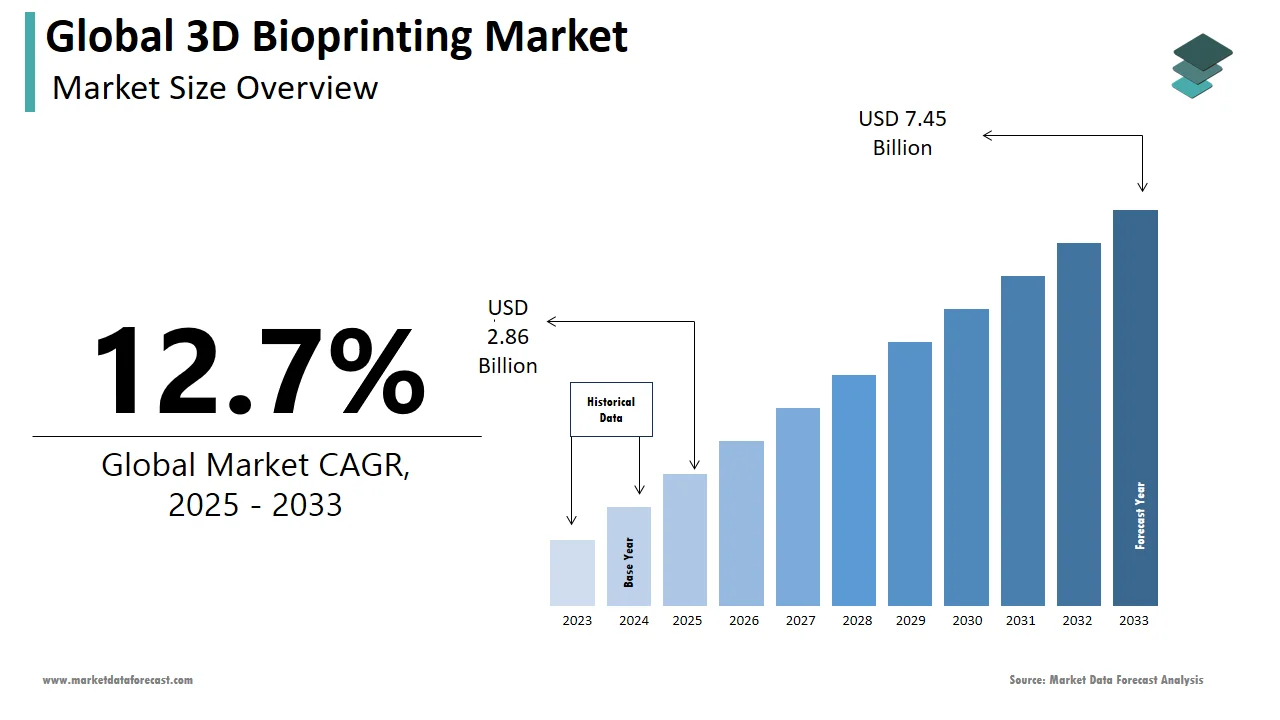
The global 3D bioprinting market was worth US$ 2.86 billion in 2025 and is anticipated to reach US$ 8.39 billion by 2034, up from US$ 3.22 billion in 2026, with a CAGR of 12.7% during the forecast period 2026 to 2034.
MARKET DRIVERS
The technological advancements drive the 3D bioprinting market along with increased research and development and government funding in the area.
The scarcity of organ donors, the rising geriatric population, and chronic diseases that need organ transplantation drive the 3D bioprinting market growth. It was mentioned in organdonor.gov each day, 17 people die waiting for an organ transplant. Additionally, the production of medicinal equipment and several support products during the COVID-19 pandemic led the market to grow further. Furthermore, the rising acceptance and Application of 3D bioprinting technologies in cosmetology and pharmaceuticals are expected to promote market growth.
The increasing demand for 3D bioprinting in the healthcare industry drives market growth.
The growing number of complex organ transplantations, such as heart, kidneys, and lungs, are favoring the 3D bioprinting market growth. Sometimes, the immune system of the body rejects organ transplantation when taken from another body. The chances for rejections are very less when using 3D bioprinting in the process. A 3D rating standard is required in bone fractures where tissue engineering is needed during the procedure. Therefore, the growing penetration of 3D bioprinting in the healthcare industry is boosting the growth rate of the worldwide 3D bioprinting market.
Furthermore, the growing advancements in 3D bioprinting, increasing investments for R&D and rising adoption of regenerative medicine are supporting the growth rate of the 3D bioprinting market.
MARKET RESTRAINTS
However, the complexity of the 3D bioprinting procedure and the high costs of production and management associated with the field, along with a lack of skilled and knowledgeable professionals in the study, will prove to be a hindrance to the market.
REPORT COVERAGE
| REPORT METRIC | DETAILS |
| Market Size Available | 2025 to 2034 |
| Base Year | 2025 |
| Forecast Period | 2026 to 2034 |
| Segments Covered | By Component, Application, Material, End-user, and Region. |
| Various Analyses Covered | Global, Regional, and Country-Level Analysis, Segment-Level Analysis, Drivers, Restraints, Opportunities, Challenges; PESTLE Analysis; Porter’s Five Forces Analysis, Competitive Landscape, Analyst Overview of Investment Opportunities |
| Regions Covered | North America, Europe, Asia Pacific, Latin America, Middle East & Africa |
| Market Leaders Profiled | Aspect Biosystems, CELLINK, GeSiM, Bio3D Technologies Pte. Ltd., Regenovo Biotechnology Co. Ltd., Optomec Inc., GE Healthcare, ExOne, Electro-Optical Systems, Renishaw Ltd., Stratasys Ltd., EnvisionTEC, Cyfuse Biomedical K.K., Formlabs, Inc., Organovo Holdings Inc., Allevi Inc., and Others. |
SEGMENTAL ANALYSIS
By Component Insights

The 3D bioprinters segment is expected to dominate the market during the forecast period due to the Inkjet and Magnetic Bioprinting subsegments and their wide usage across the industry. The growth of the Ink-jet 3D bioprinting technology is due to its wide applications in the healthcare sector and usage in tissue engineering and drug delivery systems. Ink-jet systems help print complex living cells quickly and accurately, driving segmental growth.
However, due to their comparatively lower prices and precise results, the magnetic 3d bioprinting segment is also expected to witness growth during the forecast period. In addition, they help eradicate any errors in 3d bioprinting and can help in tissue regeneration projects promoting the segment's growth. However, the invention of newer technologies may slow the segment's growth.
By Application Insights
Based on the Application, the clinical application segment accounted for the leading share of the 3D bioprinting market in 2024. It is expected to expand at a growing CAGR during the forecast period. In addition, the expanding demand for pharmaceuticals and the efficient bio-drug service in this technology boosts the growth rate of the segment.
The fastest CAGR in the market is anticipated for the tissue and organ generation sub-segment during the forecast period. The most common application of 3D bioprinting in medicine is regenerating organs and tissue suitable for transplantation. In addition, the need for tissue and organ creation is growing as the COVID-19 disease is becoming more common. Therefore, the tissue and organ generation segment is anticipated to experience exponential expansion throughout the forecast period.
By Material Insights
Based on Material, the living cells segment accounted for the largest market share due to the increased R&D in this sector and rising governmental and private expenditure on research. Additionally, living cells 3d bioprinting has a wide range of applications in the healthcare sector and is used for research and treatment purposes, supporting the segment's growth.
However, the hydrogels segment is also expected to show significant growth in the market during the forecast period due to the several advantages of hydrogels in 3d bioprinting. One advantage is that hydrogels can generate a flexible and hydrated cross-linked network. Like the natural extracellular matrix in which cells may live, hydrogels are therefore regarded as the gold standard materials for 3D bioprinting. Furthermore, the polymers used to make hydrogels can be divided into synthetic and natural polymers expanding the uses of the Material and promoting segment growth.
By End User Insights
Based on the end-user, the biopharmaceutical companies segment has a huge demand for 3D bioprinting. One of the key factors supporting the segment's growth is the increasing demand for implants for treatment and a rise in the number of chronic diseases worldwide. As a result, the segment will represent more than 45% of the market throughout the forecast period.
However, the research organizations and academic institutes segment is also expected to dominate the market during the forecast period due to the rising support from the government toward research through funding and the spread of awareness. Additionally, the growing availability of resources for students and researchers to continue research promotes segment growth.
REGIONAL ANALYSIS
North America 3D Bioprinting Market Analysis
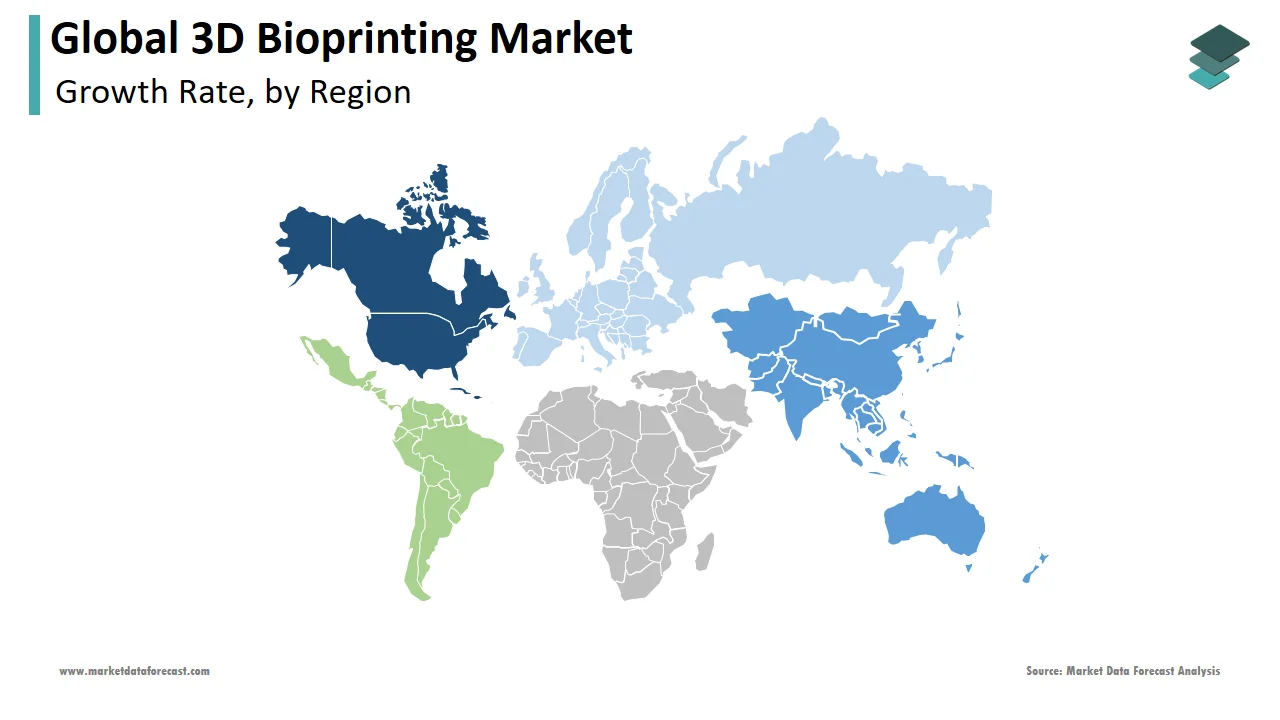
Geographically, the North American market had the highest share of the global market in 2024 and is anticipated to hold the most significant share of the worldwide market during the forecast period owing to the growing adoption of healthcare IT in the North American region. The growing investments from North American countries to conduct R&D to develop effective medical devices, vaccines and drugs are favoring the 3D bioprinting market growth in North America. Due to the growing penetration of drug testing and organ transplantation, the demand for 3D bioprinting is growing significantly and is also providing lucrative growth opportunities to the market participants of 3D bioprinting.
Asia Pacific 3D Bioprinting Market Analysis
The market in the Asia Pacific had a substantial share of the global 3D bioprinting market in 2024 and is anticipated to register the fastest CAGR during the forecast period among all the regions. China, India and Japan held the major share of the APAC market in 2024 and the domination of these countries is likely to be continuing during the forecast period. The increasing R&D spending by the APAC countries is one of the major factors fuelling the regional market growth. The growing penetration of technology in the APAC healthcare industry and increasing incidence of organ transplantations are further promoting the growth rate of the APAC bioprinting market. During the forecast period, the Chinese market is expected to have a healthy CAGR.
KEY MARKET PLAYERS
Some of the companies that are playing a dominating role in the global 3D bioprinting market include
- Aspect Biosystems
- CELLINK
- GeSiM
- Bio3D Technologies Pte. Ltd.
- Regenovo Biotechnology Co. Ltd.
- Optomec Inc.
- GE Healthcare
- ExOne
- Electro-Optical Systems
- Renishaw Ltd.
- Stratasys Ltd.
- EnvisionTEC
- Cyfuse Biomedical K.K.
- Formlabs, Inc.
- Organovo Holdings Inc.
- Allevi Inc.
MARKET SEGMENTATION
This research report on the global 3D Bioprinting market has been segmented and sub-segmented based on the component, application, material, end-user, and region.
By Component
- 3D Bioprinters
- Microextrusion bioprinting
- Inkjet 3D Bioprinting
- Laser-assisted Bioprinting
- Magnetic 3D Bioprinting
- Other technologies
- Bio inks
- Natural Bio inks
- Hybrid Bio inks
- Synthetic Bio inks
By Application
- Research Applications
- Drug Research
- Regenerative Medicine
- 3D Cell Culture
- Clinical Application
- Skin
- Bone & Cartilage
- Blood Vessels
- Other Clinical Applications
By Material
- Living Cells
- Hydrogels
- Extracellular Matrices
- Other Biomaterials
By End User
- Research Organization & Academic Institutes
- Biopharmaceuticals Companies
- Hospital
By Region
- North America
- Europe
- Asia Pacific
- Latin America
- Middle East and Africa