- Product Description Description
- Table of Contents TOC
- List of Table & Figure LOT
- Get Free Sample PDF Sample PDF
Market Size, 2025
$5.14 BnMarket Estimate, 2026
$5.56 BnMarket Forecast, 2034
$10.45 BnCAGR, 2026–2034
8.20%Global Tungsten Market Summary
The global tungsten market was valued at USD 5.14 billion in 2025, is estimated to reach USD 5.56 billion in 2026, and is projected to reach USD 10.45 billion by 2034, growing at a CAGR of 8.20% from 2026 to 2034. The growth of the global tungsten market is attributed to the rising demand for tungsten in the automotive, aerospace, electronics, and mining sectors, where its exceptional strength, density, and resistance to heat and wear make it indispensable for high-performance applications. Additionally, growing utilization in cutting tools, military equipment, and semiconductors is supporting the market’s expansion.
Key Market Trends
- Increasing use of tungsten carbide in industrial machining and cutting applications.
- Rising demand for high-performance alloys in the aerospace and defense industries.
- Growing adoption of tungsten-based electrodes in electronics and energy sectors.
- Technological advancements are promoting the recycling and recovery of tungsten materials.
- Expanding manufacturing and infrastructure investments in emerging economies are driving demand.
Segmental Insights
- Based on type, the tungsten wire segment dominated the global tungsten market by capturing 42.3% of the share in 2024, owing to its extensive use in electrical, lighting, and heating applications due to its high conductivity and melting point.
- Based on product, the carbides segment dominated the global tungsten market share in 2024, primarily driven by the rising use of tungsten carbide in cutting, drilling, and wear-resistant applications.
- Based on end-user industry, the machine tools and equipment sector held 54.3% of the tungsten market share in 2024, as tungsten-based components are critical in producing durable industrial tools and precision machinery.
Regional Insights
- Asia Pacific was the top performer in the global tungsten market, holding 78.3% of the share in 2024, driven by strong industrial manufacturing activity in China, Japan, and South Korea, along with rising demand from automotive and electronics sectors.
- North America exhibited steady growth due to increasing tungsten use in aerospace and defense applications.
- Europe showed notable expansion fueled by industrial automation and advanced material research.
- Latin America demonstrated emerging potential with growth in the mining and metal fabrication sectors.
- Middle East & Africa witnessed gradual development supported by ongoing infrastructure and industrial investments.
Competitive Landscape
The global tungsten market is moderately consolidated, with leading companies focusing on expanding production capacity, securing raw material sources, and adopting sustainable recycling technologies to strengthen competitiveness. Prominent players in the global tungsten market include Umicore N.V., L.M.T. Corp., Wolfram, ATI - Allegheny Technologies Incorporated, and Buffalo Tungsten Inc.
Global Tungsten Market Size
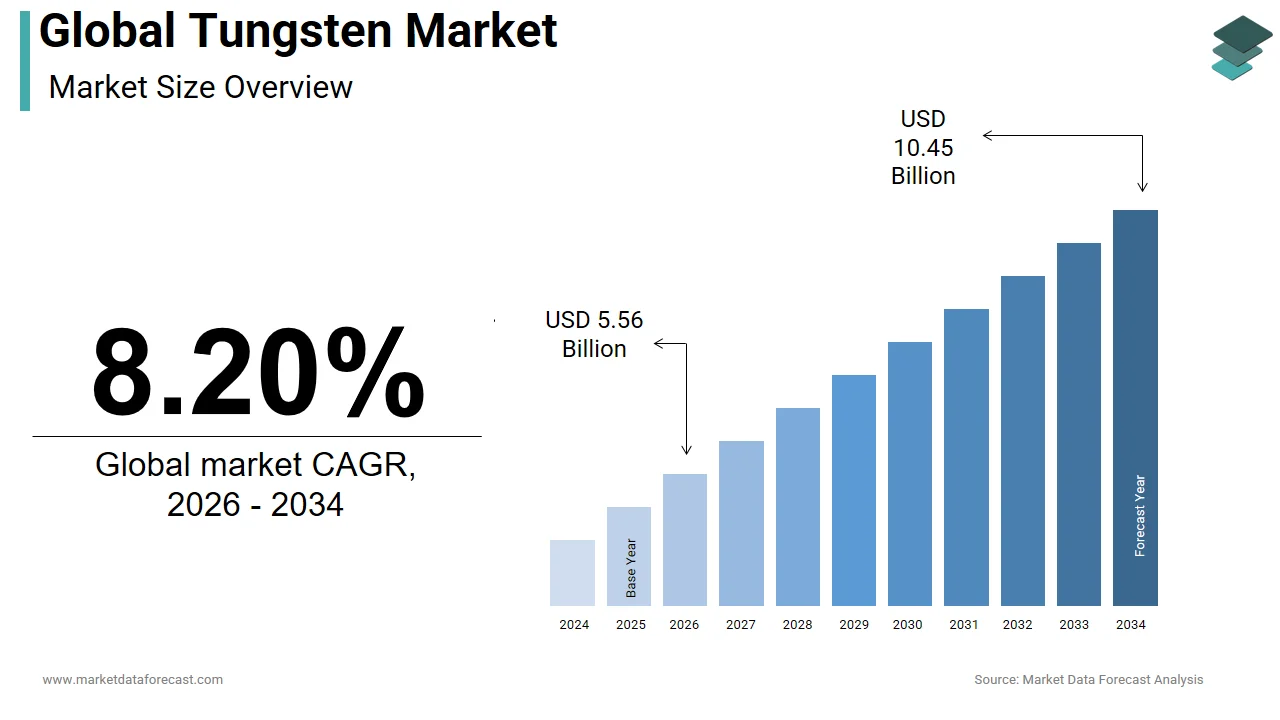
The global tungsten market was valued at USD 5.14 billion in 2025, is estimated to reach USD 5.56 billion in 2026, and is projected to reach USD 10.45 billion by 2034, growing at a CAGR of 8.20% from 2026 to 2034.
Tungsten is a dense, refractory metal renowned for its exceptional hardness, high melting point of 3,422°C, and resistance to thermal deformation. Predominantly extracted as scheelite and wolframite ores, tungsten is an enabler in high-performance industrial applications, including cemented carbides, aerospace components, and defense systems. As per the United States Geological Survey, global tungsten production in 2023 amounted to approximately 84,000 metric tons, with China contributing over 75% of total output, followed by Vietnam and Russia.
MARKET DRIVERS
Expansion of Hard Metal and Cemented Carbide Industries
The proliferation of cemented carbide manufacturing, which consumes nearly 60% of the world’s tungsten supply, is driving the growth ofthe tungsten market. Cemented carbides, composed of tungsten carbide particles bound in a cobalt matrix, are indispensable in precision machining, mining tools, and oil & gas drilling equipment due to their wear resistance and durability at elevated temperatures. According to the International Tungsten Industry Association, global cemented carbide production surpassed 65,000 metric tons in 2023, with Asia accounting for over 50% of output, driven by industrial expansion in India and Southeast Asia. The rise in smart manufacturing and automated machining across automotive and aerospace sectors has intensified demand for high-performance cutting tools, directly increasing tungsten consumption.
Growth in Aerospace and Defense Applications
Tungsten’s unique properties is high density, radiation shielding capability, and thermal stability that make it vital in aerospace and defense technologies in kinetic energy penetrators, counterweights, and missile components. Tungsten alloys are increasingly replacing depleted uranium in armor-piercing munitions due to environmental and safety concerns, with the U.S. Department of Defense actively funding research into tungsten-based composites.
MARKET RESTRAINTS
Geopolitical Concentration and Export Restrictions
The extreme geographical concentration of mining and processing is restricting the growth of the tungsten market. As per the United States Geological Survey, China not only produces over 75% of global tungsten but also controls approximately 85% of downstream refining capacity, creating a supply bottleneck for other industrialized nations. In 2022, China’s Ministry of Industry and Information Technology revised its rare and strategic mineral export guidelines, indirectly affecting tungsten shipments, prompting the European Commission to classify tungsten as a material with high supply risk.
Environmental and Regulatory Compliance Costs
Tungsten mining and processing are associated with significant environmental challenges, including acid mine drainage, heavy metal leaching, and habitat disruption, which have prompted stringent regulatory oversight. According to the World Bank, compliance with environmental standards in mining operations can increase capital expenditures by 20–30%, particularly in jurisdictions enforcing water protection and tailings management protocols. Additionally, the International Council on Mining and Metals reports that new tungsten projects face average permitting timelines of 7–10 years due to ecological assessments and community consultations. These regulatory hurdles delay project commissioning and deter investment, particularly in regions like South America and Central Africa, where tungsten deposits exist but lack infrastructure and environmental safeguards.
MARKET OPPORTUNITIES
Adoption in Green Energy and Fusion Technologies
The next-generation clean energy systems in nuclear fusion reactors and high-efficiency solar thermal plants are likely to enhance the growth of the tungsten market. According to the International Atomic Energy Agency, over 30 tokamak and stellarator projects worldwide, including ITER in France and China’s EAST reactor, utilize tungsten diverters and first-wall components. ITER alone is expected to consume over 10,000 kg of high-purity tungsten during assembly. Furthermore, concentrated solar power (CSP) plants employ tungsten-based high-temperature alloys in receivers operating above 1,000°C, enhancing thermal efficiency. As per REN21, global CSP capacity reached 6.8 GW in 2023, with major expansions in Morocco, China, and Chile.
Development of Additive Manufacturing with Tungsten Alloys
The integration of tungsten into metal additive manufacturing (AM), or 3D printing with high-value industrial sectors is also to leverage the growth of the tungsten market. Traditional manufacturing struggles with tungsten’s brittleness and high melting point, but advancements in laser powder bed fusion now allow complex geometries in tungsten-matrix composites. Companies like Siemens and GE Additive are experimenting with tungsten-heavy alloys for turbine components and radiation shielding in medical imaging devices. In 2023, researchers at the Karlsruhe Institute of Technology successfully printed tungsten components for fusion reactor mock-ups, which achieved 95% density.
MARKET CHALLENGES
Substitution by Alternative Materials in Industrial Applications
The increasing substitution with alternative materials in response to cost volatility and supply insecurity is restricting the growth of the tungsten market. In cutting tools, ceramics, polycrystalline diamond (PCD), and titanium aluminum nitride (TiAlN) coatings are being adopted for specific high-speed machining tasks, reducing reliance on tungsten carbide. According to the Freedonia Group, demand for non-carbide cutting inserts grew by 4.3% annually from 2020 to 2023 in aluminum and composite machining. In radiation shielding, depleted uranium and lead composites remain cheaper options despite environmental concerns. Moreover, in counterweight applications, recycled steel and tungsten-free alloys are being developed to meet aerospace specifications at lower cost.
Limited Recycling Infrastructure and Recovery Efficiency
The complexity of separating tungsten from cobalt binders in cemented carbide scrap and the lack of standardized collection systems hinder circularity. Additionally, pyrometallurgical recovery processes consume significant energy and yield lower purity compared to direct recycling methods. While hydrometallurgical techniques show promise, they remain limited to pilot-scale operations. The absence of regulatory mandates for tungsten recovery in the EU’s battery or electronics directives further impedes infrastructure development.
REPORT COVERAGE
| REPORT METRIC | DETAILS |
| Market Size Available | 2025 to 2034 |
| Base Year | 2025 |
| Forecast Period | 2026 to 2034 |
| Segments Covered | By Type, Product, End-User Industry, and Region. |
| Various Analyses Covered | Global, Regional and Country-Level Analysis, Segment-Level Analysis, Drivers, Restraints, Opportunities, Challenges; PESTLE Analysis; Porter’s Five Forces Analysis, Competitive Landscape, Analyst Overview of Investment Opportunities |
| Regions Covered | North America, Europe, Asia-Pacific, Latin America, Middle East and Africa |
| Market Leaders Profiled | Umicore N.V., A.L.M.T. Corp., Wolfram, ATI - Allegheny Technologies Incorporated, Buffalo Tungsten Inc. |
SEGMENTAL ANALYSIS
By Type Insights
The tungsten wire segment was the largest and held 42.3% of the tungsten market share in 2024, with its irreplaceable role in high-temperature industrial applications. According to the Semiconductor Industry Association, global semiconductor fabrication facilities (fabs) invested over USD 180 billion in 2023, necessitating reliable high-temperature processing environments where tungsten wires operate continuously above 2,200°C without deformation. Additionally, the proliferation of advanced glass manufacturing for OLED and foldable displays has intensified demand for tungsten filament-based annealing systems. As per Corning Incorporated’s 2023 technology outlook, over 70% of flexible display production lines now employ tungsten-heated zone furnaces, reinforcing structural demand.

The tungsten tube segment is projected to register a CAGR of 9.6% during the forecast period, with the increasing deployment in nuclear fusion and concentrated solar power (CSP) systems. In fusion reactors such as Germany’s Wendelstein 7-X and the ITER project in France, tungsten tubes serve as components in plasma-facing cooling systems due to their ability to withstand neutron flux and thermal cycling. As per the International Atomic Energy Agency, 14 new fusion pilot plants were initiated between 2022 and 2024, each requiring several hundred kilograms of high-purity tungsten tubing. Concurrently, CSP plants in arid regions like Chile’s Atacama Desert utilize tungsten-lined heat exchanger tubes capable of enduring 1,100°C thermal loads.
By Product Insights
The carbides segment dominated the global tungsten market share in 2025, with the indispensable role of tungsten carbide in industrial tooling. Cemented carbide tools are composed of tungsten carbide particles bound in cobalt or nickel matrices, offering superior hardness and wear resistance, enabling high-speed precision manufacturing. The automotive sector alone consumes over 12,000 metric tons of tungsten carbide annually for engine component machining, as noted by the International Organization of Motor Vehicle Manufacturers.
The tungsten chemicals segment is projected to grow with an expected CAGR of 11.3% during the forecast period, with expanding applications in catalysis, flame retardants, and specialty coatings. Ammonium paratungstate (APT) and tungsten trioxide are increasingly used as catalysts in hydrodesulfurization processes within refineries to meet stringent sulfur emission standards. Additionally, tungsten compounds are being integrated into intumescent fire retardants for construction materials, with the European Construction Industry Federation reporting a 15% increase in tungsten-based flame retardant usage in fire-resistant cables and coatings between 2021 and 2023.
By End-User Industry Insights
The machine tools and equipment sector held 54.3% of the tungsten market share in 2024, with the universal reliance on tungsten carbide inserts, drills, and milling cutters in metal removal processes. As per Deloitte’s 2023 Global Manufacturing Outlook, CNC machine tool installations grew by 6.8% year-on-year, with China and India leading capacity expansion. Each modern CNC machine utilizes an average of 8–12 kg of tungsten carbide tooling, as documented by Sandvik Coromant’s technical inventory. Additionally, the rise of hard materials such as titanium and Inconel in aerospace and energy equipment has increased wear on conventional tools, which is necessitating more durable tungsten-based solutions.
The aerospace and defense industry segment is likely to grow with a CAGR of 10.8% from 2025 to 2033, with tungsten’s function in high-density counterweights, radiation shielding, and kinetic energy penetrators. Modern commercial aircraft such as the Boeing 787 and Airbus A350 employ tungsten counterweights in flight control surfaces to ensure balance and stability, with each wide-body aircraft containing up to 150 kg of tungsten alloys.
REGIONAL ANALYSIS
Asia Pacific Tungsten Market Analysis
Asia Pacific was the top performer in the global tungsten market with 78.3% of the share in 2024. China alone accounts for more than 75% of global output, supported by extensive reserves in Jiangxi and Hunan provinces. According to China’s Ministry of Industry and Information Technology, the country produced 63,000 metric tons of tungsten concentrate in 2023, despite maintaining strict production quotas to prevent over-extraction. Vietnam and South Korea also contribute significantly, with Vietnam emerging as a secondary supplier after expanding its Nui Phong mine operations.

Europe Tungsten Market Analysis
Europe held 12.3% of the global market share in 2024. Germany and Sweden lead in carbide tool manufacturing, with companies like Ceratizit and Sandvik operating advanced processing facilities. According to the Fraunhofer Institute, over 25% of Europe’s tungsten supply now comes from recycled cemented carbide scrap, a figure expected to rise to 35% by 2030. Additionally, the EU’s Green Deal and push for clean hydrogen production have spurred demand for tungsten in electrolyzer components and high-temperature reactors, which is creating new industrial demand vectors beyond traditional tooling applications.
North America Tungsten Market Analysis
North America is anticipated to have significant growth opportunities throughout the forecast period. The United States tungsten market growth is driven by heavy imports, with domestic production limited to a single active mine. However, the region leads in high-performance applications in defense and aerospace. According to the National Defense Industrial Association, tungsten demand in defense systems grew by 9% in 2023 amid geopolitical tensions. Furthermore, the rise of semiconductor manufacturing under the CHIPS and Science Act has increased demand for tungsten wires and foils in fabrication equipment.
Latin America Tungsten Market Analysis
Latin America is likely to grow with steady opportunities in the coming years. Brazil and Bolivia hold undeveloped tungsten resources, primarily in scheelite-bearing pegmatites, but face challenges in extraction due to regulatory delays and infrastructure deficits. However, Chile has begun pilot-scale extraction of by-product tungsten from copper mines in the Atacama region, leveraging existing processing facilities. According to Chile’s National Geology and Mining Service, over 300 metric tons of tungsten content were recovered as a by-product in 2023, a 12% increase from the previous year.
Middle East & Africa Tungsten Market Analysis
Middle East & Africa are driven by the underdeveloped exploration and processing capabilities. However, Rwanda and the Democratic Republic of the Congo possess artisanal tungsten (wolframite) deposits, often mined alongside tin and tantalum.
COMPETITIVE LANDSCAPE
The tungsten market exhibits a highly asymmetric competitive structure, characterized by concentrated supply and fragmented application. While Chinese entities dominate upstream production, Japanese, German, and U.S. firms lead in high-value downstream sectors such as precision tools, aerospace components, and semiconductor equipment. Competition is less price-driven and more focused on technological differentiation, material purity, and reliability under extreme conditions. The strategic nature of tungsten in defense and clean energy technologies has prompted national stockpiling and supply diversification efforts, altering traditional trade dynamics. Companies are increasingly differentiated by their ESG compliance, recycling capabilities, and ability to provide application-specific engineering support.
KEY MARKET PLAYERS
Some of the companies that are playing a dominating role in the global tungsten market include
- Umicore N.V.
- L.M.T. Corp.
- Wolfram
- ATI - Allegheny Technologies Incorporated
- Buffalo Tungsten Inc.
Top Strategies Used by the Key Market Participants
Key players in the tungsten market are prioritizing vertical integration to secure raw material access and ensure supply chain resilience amid geopolitical uncertainties. Companies are investing in advanced recycling technologies to recover tungsten from spent carbide tools and industrial scrap, reducing reliance on primary mining. Strategic partnerships with aerospace, defense, and semiconductor firms enable co-development of specialized tungsten components. Expansion into high-growth applications such as fusion energy and additive manufacturing is accelerating R&D in tungsten alloys and powders. Digitalization of production processes enhances quality control and traceability, meeting stringent ESG standards.
Top Players in the Tungsten Market
- China Minmetals plays a pivotal role in the global tungsten landscape through its extensive control over mining, processing, and downstream product manufacturing in the Asia Pacific region. As a state-owned enterprise, it operates integrated tungsten facilities across Jiangxi and Hunan provinces, supplying high-purity tungsten oxide, carbide powders, and fabricated components to industrial clients. The company has intensified its focus on sustainable extraction methods, implementing closed-loop water recycling systems and tailings reprocessing technologies to align with China’s green mining directives. In 2023, it launched a digital traceability platform for tungsten concentrates, enhancing transparency for international buyers concerned with ESG compliance.
- C. Starck, now under Japanese ownership following Mitsui’s acquisition, remains a technological leader in high-performance tungsten powders and mill products, with significant influence across the Asia Pacific. Its facility in Goslar, Germany, produces ultra-fine and doped tungsten powders used in filaments, electrical contacts, and additive manufacturing, many of which are exported to advanced manufacturing hubs in Japan, South Korea, and Taiwan. The company has expanded its R&D collaboration with semiconductor equipment manufacturers in Asia to develop tungsten components resistant to plasma erosion in etching tools.
- Mitsubishi Materials is a dominant force in the tungsten value chain, particularly in cemented carbide tools and wear-resistant components, with deep integration intothe Asia Pacific’s industrial ecosystems. The company operates advanced manufacturing plants in Japan and Thailand, producing tungsten-based cutting tools, dies, and wear parts for automotive, electronics, and energy sectors. It has pioneered micro-grain carbide formulations that enhance tool life and precision in high-speed machining, widely adopted in EV motor and battery production lines.
MARKET SEGMENTATION
This research report on the global tungsten market has been segmented and sub-segmented into the following categories.
By Type
- Foils
- Ribbons
- Wires
- Tubes
By Product
- Carbides
- Tungsten Alloys
- Tungsten Mill Products
- Tungsten Chemicals
By End-user Industry
- Automotive
- Aerospace
- Electrical and Electronics
- Machine Tools and Equipment
- Other End-user Industries
By Region
- North America
- Europe
- Asia Pacific
- Latin America
- The Middle East and Africa