- Product Description Description
- Table of Contents TOC
- List of Table & Figure LOT
- Get Free Sample PDF Sample PDF
Market Size, 2025
$21.42 BnMarket Estimate, 2026
$23.33 BnMarket Forecast, 2034
$46.14 BnCAGR, 2026–2034
8.90%U.S. Home Infusion Therapy Market Report Summary
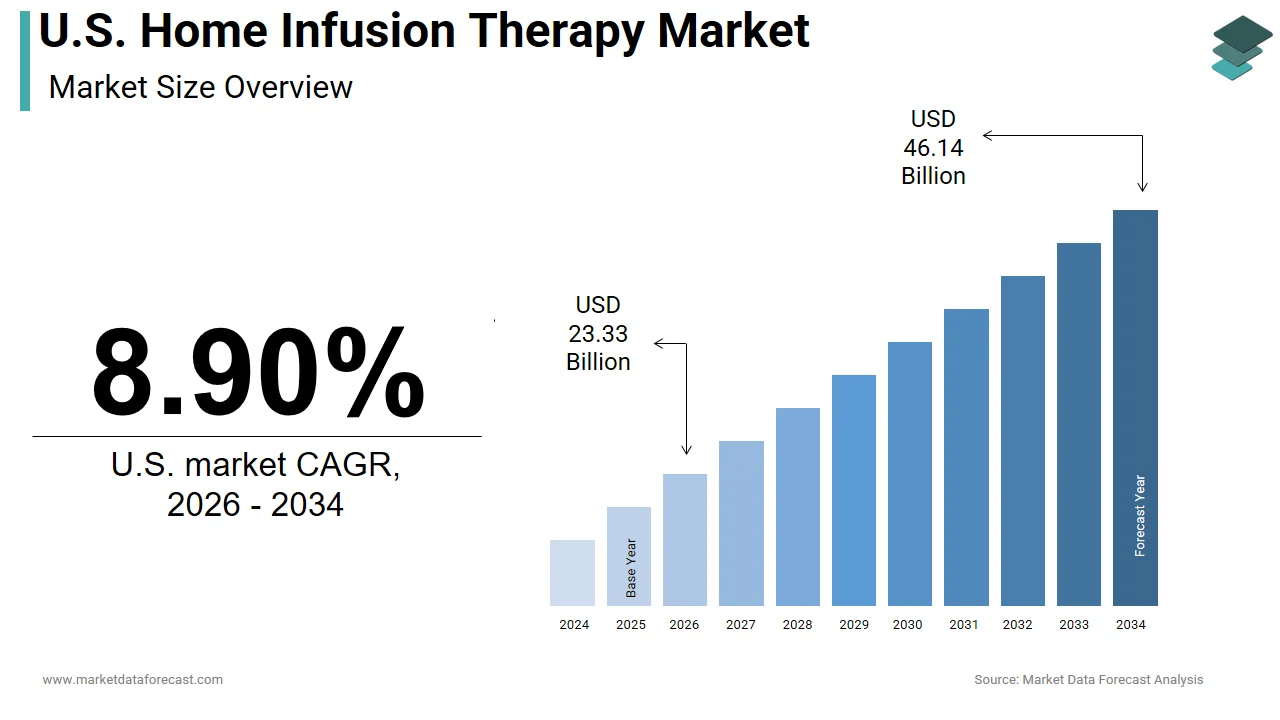
The U.S. home infusion therapy market was valued at USD 21.42 billion in 2025, is estimated to reach USD 23.33 billion in 2026, and is projected to reach USD 46.14 billion by 2034, growing at a CAGR of 8.90% from 2026 to 2034. The growth of the U.S. home infusion therapy market is driven by the increasing prevalence of chronic diseases, rising preference for at-home healthcare solutions, and advancements in infusion devices and delivery systems. Additionally, the growing aging population, coupled with the cost-effectiveness of home-based care compared to hospital settings, continues to propel market expansion across the country.
Key Market Trends
- Rising demand for home-based treatment options is driven by patient comfort, convenience, and reduced hospital stays.
- Increasing prevalence of chronic and autoimmune diseases such as cancer, diabetes, and primary immunodeficiency disorders.
- Rapid adoption of advanced infusion pumps and remote monitoring technologies to ensure patient safety and treatment accuracy.
- Growing emphasis on value-based healthcare and cost reduction, encouraging insurers to cover home infusion therapies.
- Expansion of service networks and home healthcare providers offering specialized infusion services.
Segmental Insights
- Based on product, the services segment was the largest, holding 54.3% of the U.S. home infusion therapy market share in 2024, driven by the growing number of patients requiring professional nursing and at-home infusion support for chronic conditions.
- Based on the indication, the immunoglobulin therapy segment was the largest, accounting for 31.2% of the U.S. home infusion therapy market share in 2024, supported by the rising prevalence of immunodeficiency disorders and increased adoption of immune globulin infusions in home settings.
Regional Insights
- The U.S. home infusion therapy market demonstrates widespread growth, supported by advancements in healthcare infrastructure and strong adoption of home-based care models.
- The Northeast region, led by states such as New York and Massachusetts, shows significant growth due to well-established healthcare systems and insurance coverage for infusion therapies.
- The South region dominates the market, driven by an expanding patient base, growing elderly population, and increasing prevalence of chronic illnesses.
- The Midwest exhibits consistent growth, supported by rising awareness of home healthcare services and expanding networks of infusion providers.
- The Western region, particularly California, is witnessing strong adoption due to high healthcare expenditure, availability of advanced home care technologies, and favorable reimbursement policies.
Competitive Landscape
- The U.S. home infusion therapy market is moderately consolidated, with key players focusing on expanding service coverage, improving clinical quality, and integrating digital health solutions.
- Companies are investing in technology-enabled care models, telehealth integration, and strategic acquisitions to strengthen their presence.
- Prominent players in the U.S. home infusion therapy market include Option Care Health Inc. (Illinois, U.S.), Optum, Inc. (Eden Prairie, U.S.), CareCentrix, Inc. (Hartford, U.S.), CVS Health (Woonsocket, Rhode Island, U.S.), KabaFusion (Cerritos, U.S.), PromptCare (New Jersey, U.S.), Baxter International Inc. (Deerfield, U.S.), and InfuSystem (Michigan, U.S.).
- These companies are emphasizing partnerships with healthcare providers, expansion of therapy portfolios, and patient-centric care models to meet the rising demand for convenient and cost-effective infusion therapy services across the U.S.
U.S. Home Infusion Therapy Market Size
The size of the U.S. home infusion therapy market was worth USD 21.42 billion in 2025. The market is anticipated to grow at a CAGR of 8.90% from 2026 to 2034 and be worth USD 46.14 billion by 2034 from USD 23.33 billion in 2026.
Home infusion therapy is the clinical delivery of intravenous medications that are administered in residential or ambulatory settings under professional oversight. According to the National Home Infusion Association, over 4.2 million Americans received home-based infusion services in 2023, avoiding prolonged hospitalization while maintaining therapeutic continuity. As per the Agency for Healthcare Research and Quality, home infusion reduces nosocomial infection risk by 63% compared to inpatient settings.
MARKET DRIVERS
Shift Toward Home-Based Care Enhancing Demand for Infusion Therapies
The accelerating migration of complex therapies from inpatient facilities to home environments that propelled by payer incentives and patient autonomy preferences, is propelling the growth ofthe U.S. home infusion therapy market. As per the American Society of Health-System Pharmacists, 89% of surveyed patients receiving home infusion for autoimmune conditions reported higher treatment adherence and improved quality of life compared to clinic-based alternatives.
Growing Use of Specialty IV Drugs Supporting Home Infusion Expansion
The expansion of specialty pharmaceuticals requiring prolonged or frequent intravenous administration, many of which are incompatible with traditional outpatient infusion centers due to scheduling or sterility constraints, is boosting the growth of the U.S. home infusion therapy market. As per the Immune Deficiency Foundation, over 250,000 Americans with primary immunodeficiency now rely on weekly or biweekly home-administered immunoglobulin infusions to prevent life-threatening infections. Additionally, the National Cancer Institute estimates that 38% of oncology regimens initiated in 2024 involve monoclonal antibodies compatible with home delivery, particularly for maintenance-phase therapies.
MARKET RESTRAINTS
Reimbursement Fragmentation Hindering Consistent Home Infusion Delivery
The persistent reimbursement fragmentation across public and private payers, which is creating administrative friction that impedes consistent service delivery, is hampering the growth of the U.S. home infusion therapy market. As per the American Medical Association, CPT codes for nursing oversight and supply logistics remain ambiguously defined, which is forcing providers to absorb overhead or restrict patient eligibility.
Workforce Shortages Limiting Access to Home Infusion Services
The acute shortage of credentialed infusion nurses and pharmacists capable of managing complex home-based regimens in rural and underserved urban corridors is also hampering the growth of the U.S. home infusion therapy market. As per the Infusion Nurses Society, only 18% of its certified members practice in home health settings, which is citing inadequate reimbursement for travel time and documentation burden. In 2023, the ECRI Institute documented 142 near-miss events linked to delayed nursing response in home infusion cases, primarily in regions with clinician scarcity.
MARKET OPPORTUNITIES
Smart Infusion Technologies: Enhancing Safety and Compliance
The integration of smart infusion pumps with real-time remote monitoring platforms to enhance safety and compliance without increasing clinician burden is expected to bolster the growth of the U.S. home infusion therapy market. As per the National Institute of Biomedical Imaging and Bioengineering, three university-led projects are being developed to develop AI algorithms that predict infiltration or occlusion events 15 minutes before clinical manifestation.
Value-Based Partnerships Driving Home Infusion Market Expansion
The strategic alignment of home infusion providers with risk-bearing entities such as Medicare Advantage plans and Accountable Care Organizations to share in cost savings from avoided hospitalizations is prompting the growth of the U.S. home infusion therapy market.
MARKET CHALLENGES
Regulatory Uncertainty in Sterile Compounding Hindering Home Infusion Safety
The regulatory ambiguity surrounding the compounding and storage of sterile IV medications in non-pharmacy home environments for biologics with narrow stability windows is challenging the growth of the U.S. home infusion therapy market. According to the United States Pharmacopeia, Chapter <797> standards for sterile compounding are inconsistently enforced across state lines, with 23 states lacking explicit home infusion pharmacy inspection protocols as of 2024. The Food and Drug Administration has issued four safety communications since 2022, warning against off-label repackaging of single-dose vials for home use.
Low Digital and Health Literacy Hindering Safe Adoption of Home Infusion Systems
The patient-level digital and health literacy barriers that impede adoption of technology-enabled infusion systems among elderly and low-income populations which is degrading the growth of the U.S. home infusion therapy market. As per the Agency for Healthcare Research and Quality, patients with limited health literacy were 3.2 times more likely to experience infusion-related adverse events due to misinterpretation of instructions.
REPORT COVERAGE
| REPORT METRIC | DETAILS |
| Market Size Available | 2025 to 2034 |
| Base Year | 2025 |
| Forecast Period | 2026 to 2034 |
| Segments Covered | By Product, Indication, and Region. |
| Various Analyses Covered | Global, Regional, and Country-Level Analysis, Segment-Level Analysis, Drivers, Restraints, Opportunities, Challenges; PESTLE Analysis; Porter’s Five Forces Analysis, Competitive Landscape, Analyst Overview of Investment Opportunities |
| Countries Covered | New York, Massachusetts, Pennsylvania, Illinois, Ohio, Michigan, Texas, Florida, Georgia, California, Washington, Colorado. |
| Market Leaders Profiled | Option Care Health Inc. (Illinois, U.S.), Optum, Inc. (Eden Prairie, U.S.), CareCentrix, Inc. (Hartford, U.S.), CVS Health (Woonsocket, Rhode Island, U.S.), KabaFusion (Cerritos, U.S.), PromptCare (New Jersey, U.S.), Baxter International Inc. (Deerfield, U.S.), InfuSystem (Michigan, U.S.) |
SEGMENTAL ANALYSIS
By Product Insights
The services segment was the largest and held 54.3% of the U.S. home infusion therapy market share in 2024, with the labor-intensive nature of therapy delivery. Additionally, as per the Centers for Medicare & Medicaid Services, 72% of home infusion reimbursement claims filed in 2023 were attributed to nursing visits, clinical oversight, and patient education rather than drug or device costs.

The devices segment is likely to witness a CAGR of 12.8% throughout the forecast period with the proliferation of smart, connected infusion pumps and wearable reservoirs designed for ambulatory use.
By Indication Insights
The immunoglobulin therapy segment was the largest and held 31.2% of the U.S. home infusion therapy market share in 2024, with the chronic, lifelong nature of primary immunodeficiency disorders. Unlike episodic antibiotics or chemotherapy, immunoglobulin regimens demand an uninterrupted, long-term delivery infrastructure.
The chemotherapy segment is significantly to register a CAGR of 14.2% in next coming years, owing to the oncology field’s strategic pivot toward maintenance and oral-to-infusion regimen conversions suitable for home environments. Simultaneously, Medicare’s Oncology Care Model now incentivizes practices that reduce facility-based visits, with 137 participating oncology groups reporting 33% higher home chemo adoption since 2022.
COMPETITIVE LANDSCAPE
The U.S. home infusion therapy market is characterized by intensifying rivalry among vertically integrated national providers, regional specialty pharmacies, and hospital-affiliated infusion networks, each competing on clinical reliability, payer contract sophistication, and technological enablement rather than price. Talent acquisition focuses on infusion-certified nurses and reimbursement specialists. Mergers target complementary logistics or data platforms.
KEY MARKET PLAYERS
Some of the companies that are playing a dominating role in the U.S. home infusion therapy market include
- Option Care Health Inc. (Illinois, U.S.)
- Optum, Inc. (Eden Prairie, U.S.)
- CareCentrix, Inc. (Hartford, U.S.)
- CVS Health (Woonsocket, Rhode Island, U.S.)
- KabaFusion (Cerritos, U.S.)
- PromptCare (New Jersey, U.S.)
- Baxter International Inc. (Deerfield, U.S.)
- Infusystem (Michigan, U.S.)
Top 3 Players in the Market
- Option Care Health operates the nation’s largest clinically integrated home infusion network, delivering therapies ranging from immunoglobulins to oncology biologics across all 50 states. In the Asia Pacific, it collaborates with regional hospital chains in Australia and Singapore to co-develop nurse training curricula aligned with U.S. certification standards. The company also partnered with a Tokyo-based home care consortium to pilot U.S.-style reimbursement models for chronic infusion therapies, adapting its operational playbook to Japan’s aging demographic and public insurance constraints.
- Coram CVS Specialty Infusion Services leverages its integration with CVS Health to streamline pharmacy-to-patient logistics and medication adherence support. In the Asia Pacific, Coram has initiated clinical exchange programs with South Korea’s National Health Insurance Service to demonstrate cost avoidance through home-based antibiotic and nutrition therapy. It also introduced a multilingual patient education module compliant with California’s language access laws, now being adapted for use in Malaysia and the Philippines to address health literacy gaps in diverse populations.
- Diplomat Pharmacy, now operating under Optum Infusion Services, focuses on high-complexity therapies, including gene therapies and orphan disease infusions requiring ultra-cold chain handling. In the Asia Pacific, Diplomat collaborates with Taiwan’s National Biotechnology Research Park to establish temperature-controlled logistics protocols for novel biologics.
Top Strategies Used by Key Market Participants
Leading players prioritize five core strategies: vertically integrating specialty pharmacy with nursing delivery to control end-to-end care, embedding predictive analytics to preempt adverse events and reduce hospital transfers, forging risk-sharing contracts with Medicare Advantage and ACOs to align incentives, investing in cold-chain and smart device logistics for biologics, and expanding multilingual clinical education to overcome literacy barriers. Companies increasingly co-develop protocols with academic institutions to validate safety in decentralized settings. They also lobby state legislatures for standardized licensure reciprocity to ease workforce mobility. Training simulations for rare adverse events reduce liability exposure. Modular service bundles allow payers to customize coverage without renegotiating entire contracts.
MARKET SEGMENTATION
This research report on the U.S. home infusion therapy market has been segmented and sub-segmented into the following categories.
By Product
- Devices
- Drugs
- Services
By Indication
- Anti-Infective
- Chemotherapy
- Hydration Therapy
- Enteral Nutrition
- Total Parenteral Nutrition
- Immunoglobulin Therapy
- Others
By Country
- New York
- Texas
- Florida
- Georgia
- California
- Rest of U.S.