- Product Description Description
- Table of Contents TOC
- List of Table & Figure LOT
- Get Free Sample PDF Sample PDF
Market Size, 2025
$36.24 BnMarket Estimate, 2026
$40.70 BnMarket Forecast, 2034
$103.10 BnCAGR, 2026–2034
12.32%UK Computer Games Market Size, Growth, Trends & Forecast (2026–2034)
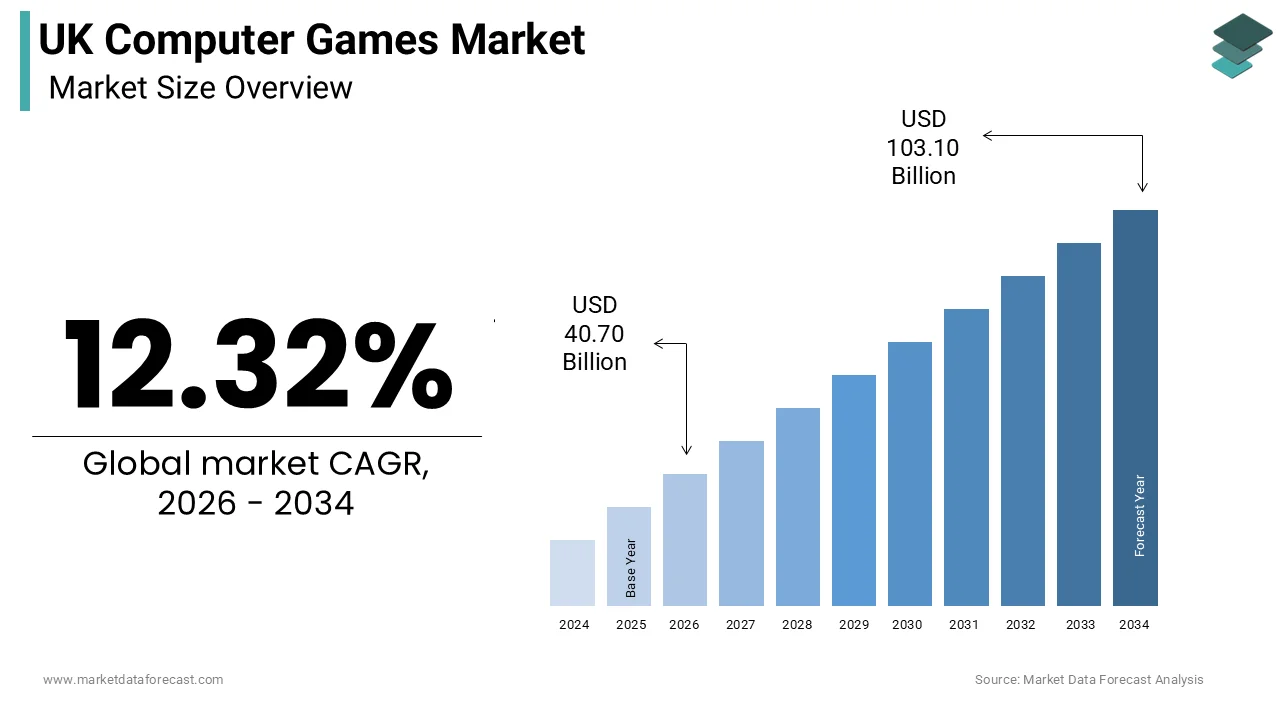
The UK computer games market size was valued at USD 36.24 billion in 2025, is anticipated to reach USD 40.70 billion in 2026, and is projected to be worth USD 103.10 billion by 2034, registering a compound annual growth rate (CAGR) of 12.32% during the forecast period from 2026 to 2034. Driven by the widespread adoption of high-speed broadband infrastructure, growing cultural acceptance, demographic diversification, and the expansion of cloud gaming services, the market continues robust expansion.
Key Executive Metrics (At-a-Glance)
- 2025 Base Valuation: USD 36.24 Billion
- 2026 Current Valuation: USD 40.70 Billion
- 2034 Forecast Valuation: USD 103.10 Billion
- Compound Annual Growth Rate (CAGR): 12.32% (2026–2034)
- Dominant Game Type Segment: Shooter games segment (accounting for 28.2% of the market share in 2025)
- Fastest-Growing Game Type Segment: Role-playing games segment (growing at a CAGR of 9.2% from 2026 to 2034)
- Dominant Device Type Segment: TV and console gaming segment (holding 44.3% of the market share in 2025)
- Fastest-Growing Device Type Segment: Mobile phone gaming segment (growing at a CAGR of 7.8%)
- Dominant End-User Segment: Male users segment (holding 52.8% of the market share in 2025)
- Fastest-Growing End-User Segment: Female users segment (growing at a CAGR of 6.5% from 2026 to 2034)
Core Market Drivers
- Broadband Infrastructure: Extensive deployment of full-fiber broadband and 5G enabling seamless online multiplayer and digital downloads.
- Demographic Diversification: Broadening consumer profiles with nearly equal participation across genders and expanding engagement from older age groups.
Primary Market Restraints & Challenges
- Cost of Living & Regulatory Pressure: Rising inflation constricting discretionary spending alongside regulatory scrutiny surrounding loot boxes and microtransactions.
UK Computer Games Market Segmentation Breakdown
| Segment Category | Leading Sub-Segment (Base Year) | Fastest-Growing Sub-Segment |
|---|---|---|
| By Game Type | Shooter (28.2% share in 2025) | Role-Playing Games (CAGR of 9.2%) |
| By Device Type | TV and Console (44.3% share in 2025) | Mobile Phone Gaming (CAGR of 7.8%) |
| By End User | Male (52.8% share in 2025) | Female (CAGR of 6.5%) |
Major Industry Players Profiled
Key market leaders shaping the United Kingdom computer games industry include Microsoft Corporation (Xbox Game Studios), Sony Interactive Entertainment, Nintendo Co., Ltd., Electronic Arts Inc., Ubisoft Entertainment SA, Activision Publishing, Inc., Take-Two Interactive Software, Inc., Bandai Namco Entertainment, SEGA Corporation, Square Enix Holdings Co., Ltd., Warner Bros. Games, Epic Games, Riot Games, Tencent Games, and Embracer Group AB.
UK Computer Games Market Size
The UK Computer Games market size was valued at USD 36.24 billion in 2025 and is projected to reach USD 103.10 billion by 2034 from USD 40.70 billion in 2026, growing at a CAGR of 12.32%.
Computer games are digital entertainment with interactive software, available across personal computers, consoles, and mobile devices. As per data from the Department for Culture, Media, and Sport, the creative industries, including gaming, contribute over 124.6 billion pounds to the national economy with their substantial economic footprint. Consumer participation is widespread, with approximately 36 million people in the UK playing video games regularly, according to surveys conducted by the Interactive Software Federation of Europe. The demographic profile has broadened significantly beyond traditional stereotypes, with nearly equal participation rates among men and women and increasing engagement from older age groups. The integration of gaming into mainstream culture is evident through esports tournaments, educational applications, and social platforms that utilize game mechanics. High-speed broadband penetration exceeding 90% of households facilitates seamless online multiplayer experiences and digital distribution. The regulatory environment supports innovation while addressing concerns regarding loot boxes and player protection.
MARKET DRIVERS
Widespread Adoption of High-Speed Broadband Infrastructure
The extensive deployment of high-speed broadband infrastructure, particularly for online multiplayer and cloud gaming services, is amplifying the growth of the United Kingdom computer games market. The communications regulator's average download speeds have increased significantly, with full-fiber broadband now available to over 75% of UK premises. This connectivity enables seamless streaming of high-resolution content and reduces latency, which is essential for competitive gaming experiences. The rollout of 5G networks further enhances mobile gaming capabilities, allowing for console-quality graphics on handheld devices without the need for powerful local hardware. Consumers are increasingly subscribing to game pass services that rely on constant internet connectivity for library access and cloud saves. The reliability of home networks has shifted consumer preference toward digital downloads rather than physical media, with over 80% of game sales occurring digitally as per industry retail data. This shift reduces distribution costs for publishers and allows for immediate access to updates and downloadable content. The infrastructure also supports the rise of live service games, which require persistent online connections for real-time events and community interaction. Households with multiple connected devices benefit from bandwidth management technologies that prioritize gaming traffic, ensuring smooth performance. The government's commitment to achieving nationwide gigabit-capable broadband by 2030 promises to further eliminate geographic disparities in access.
Growing Cultural Acceptance and Demographic Diversification
The increasing cultural acceptance of video games as a legitimate form of entertainment and social interaction is additionally driving the growth of the United Kingdom computer games market. Gaming is no longer viewed solely as a niche hobby for young males but as a mainstream activity enjoyed by individuals of all ages and backgrounds. Women constitute nearly 48% of the gaming population, challenging historical gender stereotypes and influencing game design toward more inclusive narratives and characters. Social gaming has become a primary mode of connection, especially following periods of social isolation, where platforms like Fortnite and Minecraft served as virtual gathering spaces. Parents are increasingly recognizing the cognitive benefits of gaming, such as problem-solving and strategic thinking, leading to higher acceptance within family units. Educational institutions are integrating gamified learning tools into curricula, further normalizing interactive software usage. The rise of streaming platforms like Twitch and YouTube Gaming has created celebrity gamers who influence purchasing decisions and normalize gaming as a career path. This cultural shift reduces stigma and encourages older adults to explore gaming as a leisure activity. Retailers and marketers have responded by targeting broader audiences with diverse advertising campaigns. The normalization of gaming in popular media and news coverage reinforces its status as a central pillar of modern culture, driving consistent engagement and expenditure.
MARKET RESTRAINTS
Rising Cost of Living and Discretionary Spending Pressure
The ongoing cost-of-living crisis on household budgets, constraining discretionary spending on non-essential items, including computer games and related hardware, is limiting the growth of the United Kingdom computer games market. Inflation rates have remained elevated, affecting energy bills, food prices, and mortgage interest rates, which forces consumers to prioritize essential expenditures over entertainment. The real household disposable income has declined in recent years, reducing the financial capacity for frequent game purchases. The price of new AAA titles has increased to 70 pounds, creating a higher barrier to entry for casual gamers, who may delay purchases or wait for deep discounts. Hardware costs for next-generation consoles and high-end gaming PCs have also risen due to component shortages and manufacturing expenses limiting upgrades for many users. Subscription fatigue is becoming an issue as consumers evaluate the value of multiple gaming services alongside other streaming subscriptions. Pre-owned game markets and rental services see increased activity as budget-conscious players seek cheaper alternatives. Developers face challenges in monetizing free-to-play titles as players reduce in-game purchases of cosmetic items and battle passes. The economic uncertainty leads to longer decision-making processes and reduced impulse buying behavior. Retailers report slower turnover of premium titles compared to previous years, indicating a more cautious consumer approach.
Regulatory Uncertainty Regarding Loot Boxes and Microtransactions
The regulatory scrutiny surrounding loot boxes and microtransactions creates uncertainty for developers and publishers operating, potentially impacting revenue models and game design, which is impeding the growth of the United Kingdom computer games market. Loot boxes, which offer randomized virtual items for real money, have drawn criticism from lawmakers and consumer groups who argue they resemble gambling mechanisms. This potential legislative change forces companies to reconsider monetization strategies that rely heavily on random reward systems. Industry bodies warn that overly restrictive rules could stifle innovation and reduce funding for free-to-play games, which depend on microtransactions for sustainability. The lack of clear guidelines creates a compliance risk where developers must navigate evolving standards across different jurisdictions. Consumer trust is eroding as players become more aware of predatory practices, leading to backlash against aggressive monetization tactics. Some major publishers have already removed loot boxes from their titles in anticipation of regulations affecting revenue streams. The debate involves complex considerations of player protection versus creative freedom, making policy formulation challenging. Legal challenges and parliamentary inquiries keep the issue in public discourse, creating an unstable operating environment. Companies must invest in legal counsel and ethical design frameworks to mitigate risks.
MARKET OPPORTUNITIES
Expansion of Cloud Gaming and Subscription Services
The expansion of cloud gaming technology and subscription-based models by lowering barriers to entry and enhancing accessibility for consumers is certainly expected to create new opportunities for the growth of the United Kingdom computer games market. Cloud gaming allows users to stream high-quality games directly to devices without needing expensive hardware, leveraging server-side processing power. Services like Xbox Cloud Gaming and NVIDIA GeForce Now are gaining traction as broadband infrastructure improves, enabling smooth playback on tablets, smartphones, and smart TVs. Subscription bundles offer vast libraries of games for a monthly fee, providing better value perception compared to individual purchases. This model encourages experimentation with diverse genres and indie titles that users might not otherwise buy. Publishers benefit from recurring revenue streams and deeper engagement metrics that inform future development decisions. The integration of cloud saves ensures seamless transitions between devices, enhancing the user experience. Partnerships between telecom providers and gaming platforms offer bundled packages that attract new subscribers through discounted rates. The environmental benefit of reduced hardware production aligns with sustainability goals appealing to eco-conscious consumers.
Integration of Esports and Competitive Gaming Ecosystems
The rapid growth of esports and competitive gaming ecosystems for monetization and brand engagement is another factor that is expected to escalate the growth of the United Kingdom computer games market in the coming years. Esports has transitioned from a niche interest to a mainstream spectator sport with major tournaments attracting millions of viewers and significant sponsorship investment. It hosts several prominent esports events and teams, contributing to a vibrant competitive scene that drives game sales and in-game purchases. Major esports titles see sustained player bases due to regular competitive seasons and community events. Brands outside the gaming industry, such as automotive and fashion companies, are entering the space seeking to connect with younger people through sponsorships and activations. This influx of capital supports professional leagues, training facilities, and content creation by enhancing the overall quality of the ecosystem. Universities are offering esports scholarships and degrees, formalizing career paths and legitimizing the sector. Streaming platforms enable amateur players to build audiences and generate income through ads and donations, fostering a creator economy. Game developers design titles with competitive balance and spectator features in mind, ensuring long-term viability. Local grassroots tournaments engage communities and drive hardware upgrades among participants. The social aspect of team-based competition fosters loyalty and retention. Media rights deals for broadcasting esports events create additional revenue streams.
MARKET CHALLENGES
Intense Global Competition and Talent Retention Issues
The intense global competition for both consumer attention and skilled development talent to domestic studios is a key challenge for the growth of the United Kingdom's computer games market. International giants from North America and Asia dominate global charts, making it difficult for UK developers to achieve visibility without substantial marketing budgets. The war for talent is particularly acute as experienced programmers, artists, and designers are recruited by larger companies offering higher salaries and remote work flexibility. This brain drain weakens local development capacity and increases recruitment costs for smaller independent studios. The rise of remote work has globalized the labor meaning UK companies compete with employers worldwide, who may offer lower costs or higher pay. Maintaining company culture and collaboration in distributed teams presents operational challenges. Intellectual property theft and cloning by overseas competitors undermine innovation incentives for UK creators. Marketing costs have escalated as user acquisition becomes more expensive on social media platforms. Smaller studios struggle to secure funding against the proven track records of larger entities. This competitive pressure forces consolidation where independent studios are acquired by publishers, reducing diversity in the market.
Cybersecurity Threats and Data Privacy Concerns
The cybersecurity threats and data privacy concerns, as digital distribution and online connectivity become ubiquitous, are also limiting the growth of the United Kingdom's computer games market. Game servers and user accounts are frequent targets for cyberattacks, including distributed denial of service attacks, credential stuffing, and ransomware, which disrupt services and compromise player data. The gaming industry experiences billions of attempted breaches annually, requiring constant vigilance and investment in defense mechanisms. The collection of extensive user data for personalization and analytics raises privacy issues under the UK General Data Protection Regulation. Compliance with strict data protection laws necessitates a robust security infrastructure and transparent privacy policies, which increase operational costs. Breaches can lead to severe reputational damage, loss of consumer trust, and substantial fines from regulatory bodies. Players are becoming more aware of privacy risks, demanding greater control over their data and opting out of tracking features. This limits the effectiveness of targeted advertising and analytics for developers. The complexity of securing cross-platform ecosystems, involving consoles, PCs, and mobile devices, creates multiple vulnerability points. Cheat detection and fair play enforcement require sophisticated anti-tamper technologies that must balance security with performance.
REPORT COVERAGE
| REPORT METRIC | DETAILS |
| Market Size Available | 2025 to 2034 |
| Base Year | 2025 |
| Forecast Period | 2026 to 2034 |
| CAGR | 12.32% |
| Segments Covered | By Game Type, Device Type, End User, and Region. |
| Various Analyses Covered | Global, Regional and Country-Level Analysis, Segment-Level Analysis, Drivers, Restraints, Opportunities, Challenges; PESTLE Analysis; Porter’s Five Forces Analysis, Competitive Landscape, Analyst Overview of Investment Opportunities |
| Market Leaders Profiled | Microsoft Corporation (Xbox Game Studios), Sony Interactive Entertainment, Nintendo Co., Ltd., Electronic Arts Inc., Ubisoft Entertainment SA, Activision Publishing, Inc., Take-Two Interactive Software, Inc., Bandai Namco Entertainment, SEGA Corporation, Square Enix Holdings Co., Ltd., Warner Bros. Games, Epic Games, Riot Games, Tencent Games, Embracer Group AB |
SEGMENTAL ANALYSIS
By Game Type Insights
The shooter games segment accounted in holding 28.2% of the United Kingdom computer games market share in 2025. The growth of the segment is propelled by the intense competitive nature and strong esports ecosystem surrounding titles, such as Call of Duty, Valorant, and Counter-Strike, which maintain massive active player bases. The social aspect of team-based multiplayer modes fosters community building and long-term retention as players coordinate strategies and communicate during matches. The frequent release of seasonal content, battle passes, and map updates keeps the gameplay experience fresh and encourages recurring microtransactions. High-performance hardware manufacturers often partner with shooter game developers to optimize performance, making these titles benchmarks for PC and console capabilities. The skill ceiling in shooter games provides a sense of progression and mastery that appeals to dedicated gamers, who invest significant time in improving their abilities. Cross-platform play features have expanded the potential opponent pool, reducing wait times and enhancing matchmaking quality. The cultural prevalence of military and tactical themes resonates with a broad demographic, particularly among male players aged 18 to 35.
The role-playing games segment is expected to grow at the fastest CAGR of 9.2% from 2026 to 2034, with the increasing consumer demand for immersive narrative experiences and character customization that allow players to escape into richly detailed virtual worlds. Titles have demonstrated commercial success by offering deep storytelling and complex decision-making mechanics. The rise of open-world designs enables players to explore vast environments at their own pace, fostering a sense of agency and discovery. The integration of online multiplayer elements in traditional single-player RPGs has created hybrid genres that combine social interaction with narrative depth. Streaming influencers play a crucial role in popularizing these games as audiences enjoy watching story-driven playthroughs and character builds. The development of modding communities extends the lifespan of RPGs by allowing users to create custom content and scenarios. Advances in graphics technology enable more realistic character expressions and environmental details, enhancing immersion. The demographic appeal of RPGs spans across age groups as mature themes and complex plots attract older gamers seeking substantive entertainment.
By Device Type Insights
The TV and Console gaming segment was the largest by holding 44.3% of the United Kingdom computer games market share in 2025, with the ease of use plug-and-play functionality, and high-quality exclusive titles available on platforms such as PlayStation, Xbox, and Nintendo Switch. Consoles offer a standardized hardware environment that ensures optimal performance and graphical fidelity without the technical complexity associated with PC building or maintenance. Family households prefer consoles for their local multiplayer capabilities and parental control features, which facilitate shared gaming experiences in living rooms. The subscription services offered by console manufacturers, such as Game Pass and PlayStation Plus, provide exceptional value by granting access to large libraries of games for a monthly fee. Exclusive franchises like FIFA Grand, Theft Auto, and Mario drive hardware sales and create brand loyalty that sustains long-term engagement. The integration of multimedia functions, including streaming apps and Blu-ray playback, enhances the utility of consoles beyond gaming. Regular hardware iterations every five to seven years create upgrade cycles that stimulate renewed interest and spending.
The mobile phone gaming segment is more likely to grow at a faster CAGR of 7.8% in the coming years, owing to the ubiquity of smartphones and the increasing sophistication of mobile hardware, which now supports console-quality graphics and complex gameplay mechanics. The convenience of playing anywhere and anytime appeals to casual gamers who fit short sessions into daily commutes or breaks. Free-to-play models with in-app purchases lower the barrier to entry, allowing millions of users to download and try games without upfront cost. The integration of social features, such as friend lists and leaderboards, encourages viral growth and retention through peer competition. Improvements in mobile internet speeds, including 5G rollout, enable seamless multiplayer experiences and cloud gaming streaming on handheld devices. Advertising revenues within mobile games provide a sustainable monetization model for developers targeting non-paying users. The expansion of mobile esports tournaments legitimizes competitive play on smartphones, attracting sponsorships and media attention. Cross progression features allow players to continue their progress across devices, enhancing flexibility and engagement.
By End-User Insights
The male users segment accounted in holding 52.8% of the United Kingdom computer games market share in 2025. Traditional genres, such as shooters, sports, and strategy games, which have large male followings, continue to drive significant revenue and engagement metrics. Male gamers tend to invest more heavily in high-end hardware peripherals and premium game titles, contributing disproportionately to overall value. The competitive nature of many popular titles appeals to male social dynamics where status and skill are valued within peer groups. Esports participation remains predominantly male, although this is gradually changing with increased inclusivity initiatives. Marketing campaigns often feature male protagonists and themes of action and conquest, which resonate with this demographic. However, the gap is narrowing as female participation increases across all genres. Male gamers also dominate the content creation space on streaming platforms, influencing trends and purchasing decisions among their followers. The established community networks and clans provide social support and retention mechanisms that keep male players engaged over long periods.
The female users segment is lucratively growing at an anticipated CAGR of 6.5% from 2026 to 2034, with the diversification of game genres and the removal of gender stereotypes in marketing and character design. Mobile gaming has been a significant entry point for many female players due to its accessibility and social nature, but women are increasingly engaging with console and PC titles, including role-playing games and simulations. Developers are creating more inclusive narratives and customizable characters that reflect diverse identities, attracting a broader audience. Social deduction games and cooperative multiplayer experiences appeal to female players who prioritize communication and teamwork over pure competition. The rise of female streamers and esports professionals provides role models and fosters a welcoming community environment. Safety measures against harassment and toxic behavior are being prioritized by platforms to retain female users. Marketing strategies are shifting to highlight emotional storytelling and creative gameplay elements that resonate with female interests. The purchasing power of female gamers is substantial, with high engagement in cosmetic items and narrative-driven expansions.
COMPETITION OVERVIEW
The competition in the United Kingdom computer games market is intense and characterized by a mix of global publishing giants and innovative independent studios. Large corporations leverage extensive financial resources to acquire talent and intellectual property, while smaller developers focus on niche genres and creative experimentation. Competitive advantage is derived from brand recognition, technical excellence, and the ability to maintain active player communities through regular content updates. Price competition is evident during digital sales events where deep discounts drive volume but compress margins. Talent acquisition is a battleground with studios competing for skilled programmers and artists in a tight labor market. Regulatory scrutiny regarding loot boxes and data privacy adds complexity to business operations, requiring careful compliance management. Platform holders exert significant influence over distribution terms and visibility, affecting how games reach consumers. The rise of cloud gaming introduces new competitors from the technology sector, blurring traditional industry boundaries. Consumer loyalty is increasingly tied to ecosystem integration and social features rather than single title purchases.
KEY MARKET PLAYERS
A few major players of the UK computer games market include
- Microsoft Corporation
- Sony Interactive Entertainment
- Nintendo Co., Ltd
- Electronic Arts Inc
- Ubisoft Entertainment SA
- Activision Publishing, Inc
- Take-Two Interactive Software, Inc
- Bandai Namco Entertainment
- SEGA Corporation
- Square Enix Holdings Co., Ltd
- Warner Bros. Games
- Epic Games
- Riot Games
- Tencent Games
- Embracer Group AB
Major Strategies Used by Key Market Participants
Key players in the United Kingdom computer games market prioritize live service models to generate recurring revenue through seasonal content and battle passes. Companies invest heavily in cross-platform compatibility, allowing gamers to play together across consoles, PCs, and mobile devices. Strategic acquisitions of independent studios enable larger publishers to diversify their portfolios and access innovative intellectual property. Digital distribution platforms are leveraged to reduce physical retail costs and offer direct consumer relationships with frequent sales events. Marketing efforts focus on influencer partnerships and esports sponsorships to reach younger demographics and build community hype. Developers utilize data analytics to monitor player behavior and optimize game balance and monetization mechanics continuously. Cloud gaming integration expands accessibility by allowing users to stream high-fidelity games without expensive hardware upgrades. Subscription services are expanded to provide value bundles that retain customers within specific ecosystems. Intellectual property protection is strengthened to prevent piracy and ensure fair compensation for creative efforts.
Leading Players in the United Kingdom Computer Games Market
- Rockstar Games is a premier developer and publisher based in Edinburgh that significantly influences the global gaming landscape through its critically acclaimed open-world titles. The company contributes to the UK market by maintaining large development studios that employ thousands of skilled professionals in programming, art, and design. Recent actions to strengthen its position include the ongoing development and anticipated release of Grand Theft Auto VI, which has generated immense consumer anticipation and pre-order interest. Rockstar continues to update Grand Theft Auto Online with fresh content, keeping the existing player base engaged and generating sustained revenue. The company invests heavily in motion capture technology and narrative design to set industry standards for realism and storytelling. Its commitment to quality over quantity ensures that each release becomes a cultural event, driving hardware sales and media attention. Rockstar also supports local talent through internships and partnerships with UK universities, fostering the next generation of game developers.
- Electronic Arts operates major studios in the United Kingdom, including Criterion Games and DICE Edinburgh, contributing significantly to the racing and shooter genres. The company strengthens its market position by leveraging popular sports franchises such as FIFA, now EA Sports FC, which dominate annual sales charts in the UK. The rebranding of its football simulation series to secure long-term licensing agreements and expand global reach beyond traditional partnerships. EA invests in live service models that provide continuous updates and seasonal content, ensuring player retention throughout the year. The company utilizes advanced data analytics to personalize user experiences and optimize in-game monetization strategies. EA also focuses on cross-platform play, allowing users on different devices to compete together, enhancing community engagement. Strategic acquisitions of smaller studios enable EA to diversify its portfolio and integrate innovative gameplay mechanics into established franchises.
- Creative Assembly is a renowned strategy game developer headquartered in Horsham, best known for the Total War series, which blends turn-based strategy with real-time tactics. The company contributes to the UK market by producing high quality PC titles that have a dedicated global following and strong modding communities. Creative Assembly invests in proprietary engine technology to deliver large-scale battles and detailed historical settings that distinguish its products from competitors. The studio actively engages with its community through beta tests and feedback loops, ensuring that updates address player concerns and enhance gameplay balance. It also collaborates with historical experts to ensure authenticity in its strategy games, adding educational value.
MARKET SEGMENTATION
This research report on the UK Computer Games market is segmented and sub-segmented into the following categories.
By Game Type
- Shooter
- Action
- Sports
- Role Playing
- Others
By Device Type
- PC/MMO
- Tablet
- Mobile Phone
- TV/Console
By End User
- Male
- Female