- Product Description Description
- Table of Contents TOC
- List of Table & Figure LOT
- Get Free Sample PDF Sample PDF
Market Size, 2025
$45.35 BnMarket Estimate, 2026
$47.40 BnMarket Forecast, 2034
$67.51 BnCAGR, 2026–2034
4.52%UK Consumer Electronics Market Size, Growth, Trends & Forecast (2026–2034)
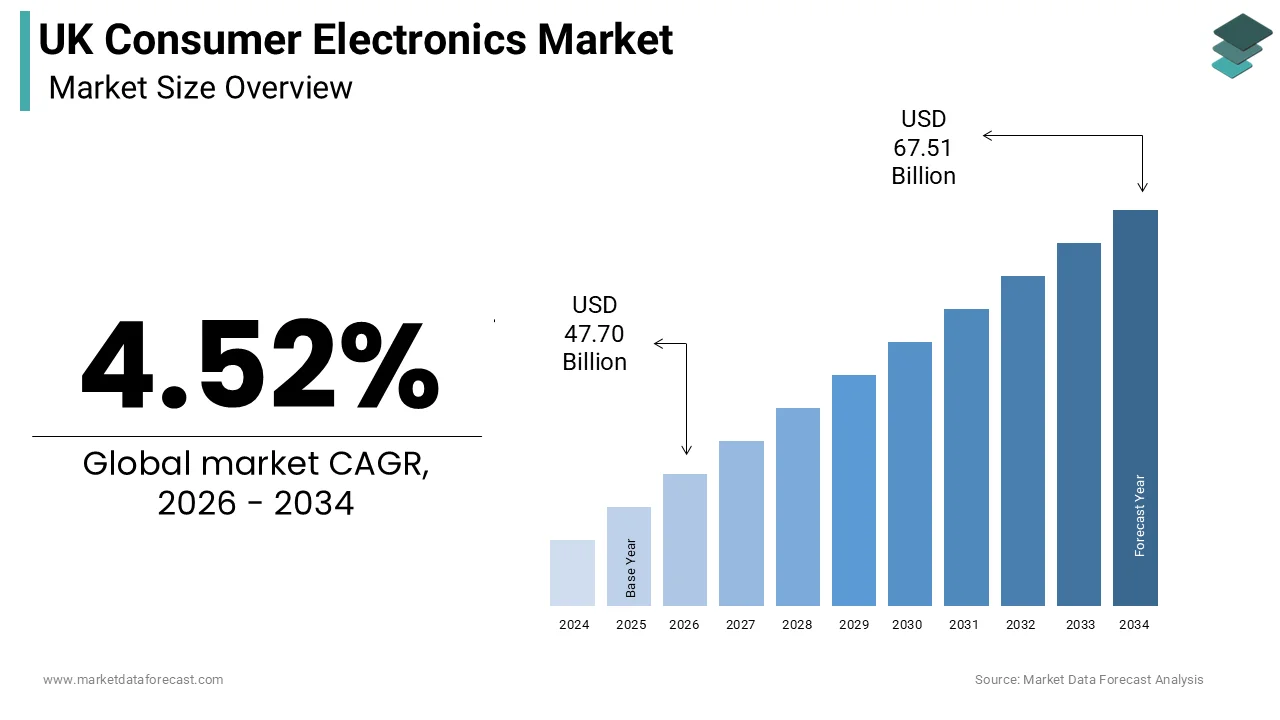
The UK consumer electronics market size was valued at USD 45.35 billion in 2025, is anticipated to reach USD 47.40 billion in 2026, and is projected to be worth USD 67.51 billion by 2034, registering a compound annual growth rate (CAGR) of 4.52% during the forecast period from 2026 to 2034. Driven by remote work culture, smart home technology adoption, and artificial intelligence integration, the market continues steady expansion.
Key Executive Metrics (At-a-Glance)
- 2025 Base Valuation: USD 45.35 Billion
- 2026 Current Valuation: USD 47.40 Billion
- 2034 Forecast Valuation: USD 67.51 Billion
- Compound Annual Growth Rate (CAGR): 4.52% (2026–2034)
- Dominant Product Type Segment: Computer devices segment (holding the largest share in 2025)
- Fastest-Growing Product Type Segment: Wearable technology and smart accessories segment (growing at a CAGR of 9.2% during the forecast period)
- Dominant Distribution Channel Segment: Offline segment (holding the major share in 2025, accounting for approximately 60% of total retail sales)
- Fastest-Growing Distribution Channel Segment: Online retail segment (growing at a CAGR of 8.3% during the forecast period)
Core Market Drivers
- Remote & Hybrid Work Culture: Entrenched work-from-home models driving sustained demand for reliable laptops, webcams, and home office infrastructure.
- Smart Home Integration: Accelerated adoption of IoT devices, smart meters, and energy management tools for convenience and cost savings.
Primary Market Restraints & Challenges
- Inflationary Pressures & Compliance Costs: Cost-of-living constraints reducing discretionary big-ticket spending alongside stringent electronic waste management (WEEE) regulations.
UK Consumer Electronics Market Segmentation Breakdown
| Segment Category | Leading Sub-Segment (Base Year) | Fastest-Growing Sub-Segment |
|---|---|---|
| By Product Type | Computer Devices (Largest share in 2025) | Wearable Technology & Smart Accessories (CAGR of 9.2%) |
| By Distribution Channel | Offline (Major share in 2025) | Online Retail (CAGR of 8.3%) |
Major Industry Players Profiled
Key market leaders shaping the UK consumer electronics industry include Samsung Electronics, Apple, Sony, LG Electronics, Panasonic, HP, Dell Technologies, Lenovo, Microsoft, and Huawei.
UK Consumer Electronics Market Size
The UK consumer electronics market size was valued at USD 45.35 billion in 2025, and is projected to reach USD 67.51 billion by 2034 from USD 47.40 billion in 2026, growing at a CAGR of 4.52%.
According to the Office for National Statistics, approximately 96% of households in Great Britain had access to the internet in 2020, reflecting the foundational infrastructure necessary for robust consumer electronics adoption. As per data from a study published in Dialogues in Clinical Neuroscience, the average person in the UK spends 24 hours a week online, driving continuous demand for high-performance computing and communication devices. The cultural inclination toward early technology adoption is evident in the rapid uptake of 5 G-enabled devices and artificial intelligence-integrated appliances. Regulatory frameworks governed by the Department for Science, Innovation, and Technology ensure strict standards for energy efficiency and electronic waste management, influencing product design and lifecycle strategies. Consumers increasingly prioritize sustainability and durability, prompting manufacturers to innovate with recyclable materials and modular designs. The presence of a highly skilled workforce and strong research and development capabilities within the nation further supports the evolution of this dynamic market. Economic factors, such as disposable income levels and inflation rates, play pivotal roles in shaping purchasing behaviors, while retail channels evolve to offer seamless omnichannel experiences. This interplay of technological advancement, regulatory compliance, and shifting consumer values defines the current landscape of the UK consumer electronics industry.
MARKET DRIVERS
Pervasive Remote Work Culture and Digital Connectivity Needs
The entrenched remote and hybrid work models in the UK are majorly fuelling the expansion of the UK consumer electronics market, as individuals invest heavily in home office setups and high-performance connectivity solutions. The shift away from traditional office environments has necessitated the purchase of reliable laptops, high-resolution webcams, noise-cancelling headsets, and ergonomic peripherals to maintain productivity and professional communication standards. According to the Office for National Statistics, approximately 41% of workers in the UK still work from home at least sometimes, creating sustained demand for personal computing devices. This trend has elevated the importance of device specifications, with consumers prioritizing processing power, battery life, and display quality over aesthetic considerations alone. According to the Department for Business and Trade, digital skills are now essential for over 80% of jobs, reinforcing the need for up-to-date hardware capable of running complex software applications. As per data from Ofcom, the expansion of broadband infrastructure, with full fibre coverage reaching 45% of UK premises, enables seamless cloud computing and video conferencing, which rely on robust endpoint devices. Employers often provide stipends for home office equipment, further stimulating sales in the premium segment. The normalization of virtual collaboration tools has also driven demand for secondary monitors and docking stations that enhance multitasking capabilities. This structural change in work dynamics ensures that consumer electronics remain critical investments rather than discretionary purchases for a significant portion of the workforce.
Rising Adoption of Smart Home Technologies and Internet of Things
The accelerating integration of Internet of Things devices into residential spaces drives substantial growth in the UK consumer electronics market, as homeowners seek convenience, security, and energy efficiency through automated systems. Smart speakers, connected lighting, intelligent thermostats, and security cameras have transitioned from niche luxuries to mainstream household essentials, supported by improved interoperability and user-friendly interfaces. According to the Department for Energy Security and Net Zero, there were 31.3 million smart and advanced meters in Great Britain at the end of 2022, providing the foundational infrastructure for broader home energy management systems that connect to various electronic devices. As per data from a government-commissioned meta-analysis, consumers are increasingly motivated by the potential for cost savings on utility bills, with smart thermostats capable of reducing domestic electricity consumption by an average annual reduction of 2.3%. The proliferation of voice-assisted assistants, such as Amazon Alexa and Google Home, has simplified the control of multiple devices, encouraging ecosystem lock-in and repeat purchases of compatible products. According to the Home Office, a rise in property crimes has prompted homeowners to invest in smart doorbells and surveillance systems that offer real-time monitoring via smartphones. Retailers report strong sales growth in smart plugs and sensors that allow users to automate routine tasks and monitor appliance usage. The desire for a seamless connected living experience, combined with tangible economic benefits, ensures that smart home electronics remain a high priority for UK consumers upgrading their domestic infrastructure.
MARKET RESTRAINTS
Persistent Inflationary Pressures and Reduced Disposable Income
High inflation rates and the consequent erosion of disposable income are primarily impeding the consumer electronics market growth in the UK, which is forcing households to prioritize essential spending over discretionary technology upgrades. The cost-of-living crisis has led many consumers to extend the lifecycle of their existing devices, rather than purchasing new models when older units remain functional. According to the Office for National Statistics, the annual inflation rate remained elevated above 4% for much of 2023 and 2024, impacting household budgets and reducing confidence in big-ticket purchases. As per data from the GfK Consumer Confidence Index, sentiment regarding major purchases reached historic lows, as families curtailed spending on non-essential items, including the latest generation smartphones and televisions. Retailers have observed a shift toward mid-range and budget-friendly devices, as consumers become more price sensitive and less willing to pay premiums for marginal improvements in features. According to the Bank of England, higher interest rates have increased borrowing costs, further dampening demand for financed electronics purchases through credit agreements. As per reports from industry analysts, this financial strain has resulted in delayed replacement cycles, with the average smartphone upgrade period extending from 24 months to over 30 months. Manufacturers face pressure to offer competitive pricing and flexible payment options to sustain sales volumes in a constrained economic environment. The uncertainty surrounding future income prospects leads to cautious spending behavior, limiting the overall growth potential of the consumer electronics sector in the short to medium term.
Complex Regulatory Compliance and Electronic Waste Management Costs
Stringent environmental regulations and the associated costs of compliant electronic waste management impose significant operational burdens on manufacturers and retailers in the UK, which further hinders the consumer electronics market expansion in the UK. The government’s commitment to achieving net zero emissions has led to rigorous standards under the Waste Electrical and Electronic Equipment Regulations, which mandate producers to finance the collection, recycling, and recovery of discarded devices. According to the Department for Environment, Food and Rural Affairs, the UK generates approximately 1.5 million tonnes of electronic waste annually, requiring sophisticated logistics and processing infrastructure to handle safely. Compliance with these regulations involves substantial administrative overhead and financial investment in take-back schemes and recycling partnerships, which can erode profit margins, particularly for smaller market participants. The introduction of extended producer responsibility frameworks requires companies to track and report on the environmental impact of their products throughout their lifecycle, adding complexity to supply chain operations. Additionally, the Right to Repair legislation mandates that manufacturers make spare parts and repair manuals available to independent technicians for up to 10 years, increasing production and inventory costs. While these measures promote sustainability, they also raise the initial cost of devices, as manufacturers pass on compliance expenses to consumers. According to the Environmental Agency, improper disposal remains a challenge despite these efforts, indicating that regulatory enforcement requires continuous resources. These regulatory pressures constrain market flexibility and incentivize slower innovation cycles, as companies navigate the balance between compliance and competitiveness.
MARKET OPPORTUNITIES
Expansion of Refurbished and Circular Economy Models
The growing consumer acceptance of refurbished and pre-owned electronics presents a lucrative opportunity for market participants to tap into the circular economy, while addressing affordability and sustainability concerns. Shoppers are increasingly recognizing the value proposition of certified refurbished devices, which offer near-new performance at significantly lower prices, accompanied by warranties and quality guarantees. According to a survey by YouGov, approximately 40% of UK consumers are open to buying refurbished smartphones and laptops, citing environmental benefits and cost savings as primary motivators. Major retailers and specialized platforms have expanded their refurbished offerings, with rigorous testing protocols ensuring reliability and building consumer trust in second-hand markets. According to the Waste and Resources Action Programme, extending the life of a laptop by just one year can reduce its carbon footprint by up to 25%, appealing to eco-conscious buyers. Brands are launching official trade-in programs that incentivize customers to return old devices for credit toward new purchases, creating a closed-loop system that secures supply for refurbishment operations. This model also allows companies to reach price-sensitive segments that were previously excluded from the premium market. Government initiatives promoting circular economy principles further support this trend, with tax incentives for businesses engaging in repair and reuse activities. By embracing refurbishment, manufacturers and retailers can differentiate themselves through sustainability credentials, while maintaining revenue streams in a saturated primary market.
Integration of Artificial Intelligence in Personal Devices
The integration of artificial intelligence capabilities into personal consumer electronics offers a potential opportunity for the UK market. AI-driven features, such as predictive text, advanced photography modes, personalized health monitoring, and voice recognition, are becoming key selling points that justify premium pricing and upgrade cycles. According to Tech Nation, the UK is a global leader in AI adoption, with significant investment in machine learning technologies that are increasingly being embedded into everyday devices. Smartphones equipped with neural processing units can optimize battery usage and performance in real time, while smart TVs utilize AI to upscale content and recommend viewing habits tailored to individual preferences. Wearable devices leverage AI algorithms to provide deeper insights into health metrics, such as sleep patterns, heart rate variability, and stress levels, attracting health-conscious consumers. The Department for Science, Innovation and Technology supports AI innovation through funding and policy frameworks, encouraging local tech firms to collaborate with hardware manufacturers. Consumers are willing to pay a premium for devices that offer proactive assistance and automation, reducing manual input and enhancing convenience. As AI models become more efficient and capable of running locally on devices without cloud dependency, privacy concerns are mitigated, further boosting appeal. This technological evolution creates new revenue streams through subscription-based AI services and accessories, positioning AI-enabled electronics as the next frontier for market growth.
MARKET CHALLENGES
Global Supply Chain Volatility and Component Shortages
The UK consumer electronics market faces persistent challenges related to global supply chain instability and shortages of critical components, such as semiconductors and rare earth metals. Geopolitical tensions, trade disputes, and logistical bottlenecks disrupt the flow of essential parts, leading to production delays and increased manufacturing costs. According to the Semiconductor Industry Association, global chip shortages have impacted various sectors, with lead times for certain components extending beyond 50 weeks during peak disruption periods. The UK’s reliance on imported electronics makes it particularly vulnerable to these international fluctuations, affecting availability and pricing for end consumers. According to the Office for Budget Responsibility, supply-side constraints contribute to inflationary pressures, limiting the ability of retailers to offer competitive discounts. Manufacturers struggle to forecast demand accurately amidst uncertain supply conditions, leading to either excess inventory or stockouts that damage brand reputation. The concentration of semiconductor production in specific regions, such as East Asia, exacerbates risks associated with natural disasters or political instability in those areas. Diversifying supply chains is a costly and time-consuming process that many companies are still undertaking, leaving them exposed in the interim. Additionally, the rising cost of raw materials, including lithium for batteries and copper for wiring, further squeezes margins. These supply chain complexities require agile management strategies and robust risk mitigation plans to ensure consistent product availability and maintain consumer trust in the face of ongoing global uncertainties.
Rapid Technological Obsolescence and Consumer Skepticism
The accelerated pace of technological innovation leads to rapid obsolescence of consumer electronics, further challenging the consumer electronics market expansion in the UK. Many users perceive recent product iterations as offering only incremental improvements rather than transformative changes, reducing the urgency to replace functioning devices. According to a study by Deloitte, the percentage of consumers who feel that new smartphone models do not offer significant advantages over their current devices has risen to 35%, indicating growing satisfaction with existing technology. This skepticism is compounded by the high initial cost of flagship devices, which makes the value proposition of annual upgrades less compelling. Manufacturers face the difficulty of balancing innovation with practical utility, ensuring that new features address genuine user needs rather than serving as mere marketing gimmicks. The environmental impact of frequent disposal also contributes to consumer hesitation, as awareness of electronic waste issues grows. Regulatory pressures for longer software support and repairability further extend the usable life of devices, challenging the traditional planned obsolescence business model. Companies must invest heavily in marketing and education to communicate the tangible benefits of new technologies, such as enhanced security or productivity gains. Failure to demonstrate clear value leads to prolonged replacement cycles and stagnant sales volumes. Navigating this landscape requires a shift toward service-based revenue models and ecosystem integration that retain customer loyalty beyond hardware transactions.
REPORT COVERAGE
| REPORT METRIC | DETAILS |
| Market Size Available | 2025 to 2034 |
| Base Year | 2025 |
| Forecast Period | 2026 to 2034 |
| CAGR | 4.52% |
| Segments Covered | By Product Type, Distribution Channel, and Region. |
| Various Analyses Covered | Global, Regional and Country-Level Analysis, Segment-Level Analysis, Drivers, Restraints, Opportunities, Challenges; PESTLE Analysis; Porter’s Five Forces Analysis, Competitive Landscape, Analyst Overview of Investment Opportunities |
| Market Leaders Profiled | Samsung Electronics, Apple, Sony, LG Electronics, Panasonic, HP, Dell Technologies, Lenovo, Microsoft, Huawei |
SEGMENTAL ANALYSIS
By Product Type Insights
The computer devices segment led the market by holding the largest share of the UK market in 2025. The dominance of the consumer devices segment in the UK market is attributed to the fundamental necessity of digital tools for education, employment, and daily communication. The widespread adoption of hybrid work models has transformed computers from optional luxuries into essential utilities for millions of households across the nation. According to the Office for National Statistics, approximately 96% of households in Great Britain had internet access in 2020, with the majority relying on personal computing devices to connect to online services and remote work platforms. The Department for Education mandates the use of digital devices for secondary school coursework and examinations, ensuring that every student has a reliable computer for academic success. This institutional demand creates a consistent baseline of sales volume that remains resilient even during economic downturns. Furthermore, the complexity of modern software applications for video editing, coding, and data analysis requires regular hardware upgrades to maintain performance standards. According to the British Computer Society, digital skills are required for over 80% of job vacancies, reinforcing the need for up-to-date computing power among the workforce. Retailers observe that consumers prioritize processing speed, storage capacity, and battery life when purchasing computers, reflecting their critical role in productivity. The integration of cloud computing services further necessitates robust endpoint devices capable of seamless synchronization. This combination of educational mandates, professional requirements, and technological dependency ensures that computer devices remain the cornerstone of the UK consumer electronics landscape.
On the other side, the wearable technology and smart accessories segment is the fastest-growing segment within the UK consumer electronics market and is predicted to expand at a CAGR of 9.2% during the forecast period, owing to the increasing health consciousness and the desire for seamless connectivity. Smartwatches, fitness trackers, and wireless earbuds have evolved from niche gadgets into mainstream lifestyle products that monitor vital signs, manage notifications, and enhance audio experiences. According to data from the National Health Service, there is a growing emphasis on preventive healthcare, with millions of individuals using wearable devices to track steps, heart rate, and sleep patterns as part of their wellness routines. The UK Health Security Agency supports digital health initiatives that encourage the use of personal monitoring tools to manage chronic conditions, such as diabetes and hypertension, reducing the burden on primary care services. Technological advancements in sensor accuracy and battery life have improved the reliability of these devices, making them attractive to older demographics who seek independence and safety features, such as fall detection. The proliferation of 5G networks enables faster data transmission between wearables and smartphones, enhancing real-time functionality. Retailers report strong sales growth in premium smartwatches that offer cellular connectivity, allowing users to leave their phones behind during exercise. The integration of artificial intelligence for personalized health insights further drives consumer interest. As the population ages and health awareness rises, wearable technology continues to expand its reach beyond early adopters to become a standard component of personal health management.
By Distribution Channel Insights
The offline segment dominated the market with the major share of the UK consumer electronics market in 2025 and maintain their status as the leading distribution channel for consumer electronics in the UK due to the tangible nature of high-value purchases and the desire for immediate possession. Consumers often prefer to physically inspect devices, such as televisions, laptops, and smartphones, to assess build quality, screen resolution, and ergonomic comfort before committing to significant expenditures. According to the British Retail Consortium, physical stores account for approximately 60% of total retail sales in the UK, providing a vast network of touchpoints where customers can interact with products and receive expert advice from trained staff. The ability to test audio quality, camera performance, and keyboard feel in person reduces the perceived risk of buyer remorse, which is particularly important for premium electronics. Major retailers leverage their brick-and-mortar presence to offer demonstration zones and hands-on workshops that educate consumers on new technologies. Immediate availability allows shoppers to take products home on the same day, avoiding delivery wait times and potential shipping damages. Additionally, offline stores facilitate easier returns and exchanges, which is a critical factor for complex electronic items that may require setup assistance. The trust established through face-to-face interactions and the assurance of local after-sales support continue to drive footfall despite the rise of digital alternatives. This sensory and service-oriented experience ensures that offline retail remains the primary conduit for consumer electronics transactions.
However, the online retail segment emerges as the fastest-growing distribution channel for consumer electronics in the UK and is expected to exhibit a CAGR of 8.3% during the forecast period, owing to the convenience, extensive product selection, and competitive pricing strategies. The shift toward digital commerce has been accelerated by improved logistics infrastructure and the widespread adoption of secure payment methods that instill confidence in remote transactions. According to the Office for National Statistics, online sales accounted for 27% of total retail trade in early 2024, with electronics being one of the most purchased categories due to the ease of comparing specifications and reading user reviews. E-commerce platforms offer unlimited shelf space, allowing consumers to access niche products and international brands that may not be available in local physical stores. Price comparison tools and automated discounts enable shoppers to find the best deals effortlessly, driving volume growth for online retailers. The availability of detailed product information, video demonstrations, and virtual reality previews helps mitigate the lack of physical interaction. Next-day delivery services provided by major carriers ensure that wait times are minimal, addressing one of the traditional drawbacks of online shopping. Furthermore, the ease of returning items through prepaid labels and collection points has streamlined the post-purchase experience. Younger demographics, particularly millennials and Gen Z consumers, prefer the efficiency of online shopping, citing time savings and accessibility as key factors. As digital literacy increases and trust in online security grows, this channel continues to capture market share from traditional brick-and-mortar outlets.
REGIONAL ANALYSIS
The UK held the largest share of the UK consumer electronics market in 2025 and is expected to experience a substantial expansion in its domestic technology adoption frameworks and consumer electronics retail sectors over the next few years, as it stands as the largest and most advanced consumer electronics market in Western Europe, characterized by high disposable income levels, widespread digital literacy, and a strong culture of early technology adoption. The nation serves as a strategic hub for global brands launching new products due to its sophisticated retail infrastructure and influential consumer trends that often ripple across the continent. According to the Office for National Statistics, the UK population exceeds 67 million people, with a high concentration of urban dwellers who are quick to embrace smart home technologies and mobile innovations. According to Ofcom, the country boasts one of the highest broadband penetration rates in Europe, with 97% of households having access to fixed-line internet services, providing the necessary foundation for connected device usage. Regulatory frameworks established by the Department for Science, Innovation and Technology promote competition and consumer protection, ensuring a fair marketplace that encourages innovation. The presence of major technology headquarters and research centers in cities like London, Cambridge, and Manchester fosters a vibrant ecosystem of tech startups and established manufacturers. Consumer spending on electronics remains robust despite economic fluctuations, reflecting the integral role these devices play in modern life. The UK also leads in sustainable electronics initiatives, with strict waste management regulations driving the development of eco-friendly products. This combination of market size, technological readiness, and regulatory sophistication positions the UK as a pivotal leader in the European consumer electronics landscape.
COMPETITION OVERVIEW
The UK consumer electronics market features intense competition characterized by the presence of global giants and agile niche players vying for consumer attention in a mature yet evolving landscape. Established corporations leverage extensive distribution networks, strong brand recognition, and substantial marketing budgets to maintain dominance, while smaller innovators disrupt the status quo with unique features and specialized products. Competitive dynamics are shaped by the urgent need to address sustainability concerns, prompting rapid adoption of eco-friendly materials and energy-efficient designs across the industry. Technological advancement drives differentiation as companies race to integrate artificial intelligence and Internet of Things capabilities into everyday devices. Price sensitivity remains a factor, although premiumization trends allow differentiated products to command higher margins. Retail channel conflicts arise as online platforms gain share from traditional stores, forcing manufacturers to optimize omnichannel strategies. Brand loyalty is increasingly fragile as consumers experiment with new alternatives offering better value or functionality. Regulatory pressures regarding data privacy and electronic waste further intensify competitive pressures requiring continuous adaptation. Success depends on balancing innovation, sustainability, and cost efficiency while maintaining strong retailer relationships and engaging digitally savvy consumers through compelling narratives.
KEY MARKET PLAYERS
A few major players in the UK consumer electronics market include
- Samsung Electronics
- Apple
- Sony
- LG Electronics
- Panasonic
- HP
- Dell Technologies
- Lenovo
- Microsoft
- Huawei
Top Strategies Used By Key Market Participants
Key players in the UK consumer electronics market employ several strategic approaches to maintain competitiveness and drive growth. Product innovation remains central as companies develop advanced features such as artificial intelligence integration and sustainable materials to attract tech-savvy consumers. Digital transformation initiatives include enhancing e-commerce platforms and offering personalized online shopping experiences to meet evolving consumer preferences. Strategic partnerships with telecom providers and content creators help bundle services and increase device utility. Companies focus on sustainability by implementing recycling programs and using eco-friendly packaging to align with regulatory standards and consumer values. Customer engagement strategies leverage social media and influencer marketing to build brand loyalty and awareness. After-sales support improvements, such as extended warranties and repair services, enhance customer satisfaction. These combined strategies allow market participants to navigate challenges and capitalize on opportunities in the dynamic UK landscape.
Leading Players In The UK Consumer Electronics Market
- Samsung Electronics maintains a formidable presence in the UK through its diverse portfolio of smartphones, televisions, and home appliances that cater to various consumer segments. The company actively invests in research and development to introduce cutting-edge features such as foldable displays and artificial intelligence integration in its devices. Recent actions include expanding its smart home ecosystem by launching compatible appliances that seamlessly connect with mobile devices for enhanced user convenience. Samsung collaborates with local retailers to create immersive experience zones where customers can test products before purchase. The brand emphasizes sustainability by introducing recycled materials in packaging and device components, aligning with national environmental goals. Their robust after-sales support network ensures customer satisfaction and loyalty. By consistently delivering high-quality innovations and engaging marketing campaigns, Samsung strengthens its reputation as a technology leader in the UK market.
- Apple Inc holds a significant position in the UK consumer electronics market, driven by its premium branding and integrated ecosystem of devices and services. The company focuses on delivering seamless user experiences through its iPhones, iPads, MacBooks, and wearables, which are highly regarded for their design and performance. Recent efforts involve expanding its retail footprint with new store openings in major cities and enhancing online support services for customers. Apple promotes privacy and security features as key differentiators appealing to data-conscious consumers in the region. The introduction of trade-in programs encourages users to upgrade to newer models while promoting recycling initiatives. Strategic partnerships with local telecom providers facilitate affordable payment plans, increasing accessibility. By maintaining strict quality control and fostering a loyal community, Apple continues to dominate the premium segment of the UK market.
- Sony Corporation contributes significantly to the UK consumer electronics market with its renowned audiovisual products, including headphones, televisions, and gaming consoles. The brand is celebrated for its superior sound quality and innovative display technologies that appeal to audiophiles and entertainment enthusiasts. Recent actions include launching next-generation gaming hardware and expanding its library of exclusive titles to drive console sales. Sony invests in sustainable manufacturing practices, aiming to reduce environmental impact across its supply chain. The company engages with local communities through educational initiatives promoting digital creativity and media production skills. Collaborations with content creators and streaming platforms enhance the value proposition of its devices. By focusing on high-fidelity experiences and technological excellence, Sony maintains a strong competitive edge and deepens its connection with consumers in the UK.
MARKET SEGMENTATION
This research report on the UK consumer electronics market is segmented and sub-segmented into the following categories.
By Product Type
- Electronic Devices
- Television
- Computer
- Digital Camera & Camcorder
- Others
By Distribution Channel
- Offline
- Online