- Product Description Description
- Table of Contents TOC
- List of Table & Figure LOT
- Get Free Sample PDF Sample PDF
Market Size, 2025
$323 BnMarket Estimate, 2026
$344.58 BnMarket Forecast, 2034
$578.03 BnCAGR, 2026–2034
6.68%Executive Summary: United Kingdom Cryptocurrency Market
- Market Scope: Comprehensive market evaluation of the UK cryptocurrency sector, analyzing components (software, hardware), types (Bitcoin, Ethereum, others), processes (transaction, mining), applications (trading, payment, others), and regulatory frameworks under the Financial Conduct Authority (FCA).
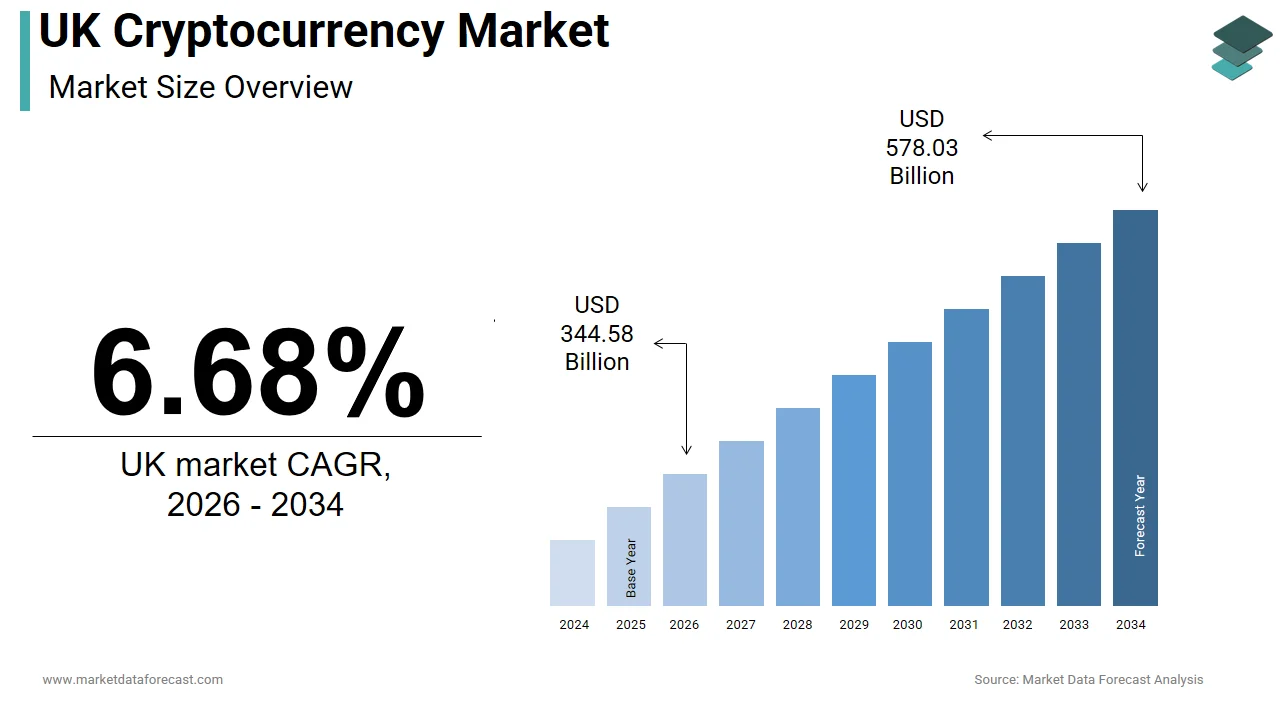
- Market Valuation: Valued at USD 323.00 billion in 2025, reaching USD 344.58 billion in 2026, and projected to expand up to USD 578.03 billion by 2034, registering a strong CAGR of 6.68% throughout the forecast period from 2026 to 2034.
- Primary Growth Drivers: Increasing institutional adoption and regulatory clarity driving traditional capital into digital assets; high inflation and macroeconomic pressure prompting demand for alternative stores of value; and widespread retail adoption backed by nearly 7 million adult crypto owners in the UK.
Key Market Segment Metrics
| Category | Leading Segment (Base Year Position) | Fastest-Growing / High-Impact Segment |
|---|---|---|
| By Component, Type, Process & Application | Software Segment (leading component), Bitcoin Segment (dominant type holding 43.4% share), Transaction Process (leading), & Trading Application (dominant with 49.8% share) | Hardware Segment (fastest component at a 14.5% CAGR), Ethereum Segment (fastest type at a 16.2% CAGR), Mining Process (fastest at a 12.8% CAGR), & Payment Application (fastest at an 18.5% CAGR) |
| By Region / Country | United Kingdom (positioned as a leading European fintech hub with robust FCA oversight, Bank of England DLT pilots, and high digital asset penetration) | London-centric fintech ecosystem alongside specialized green mining hubs expanding across Scotland and Wales. |
Major Market Players & Market Structure
Market Structure: A dynamic, highly regulated landscape integrating traditional financial giants, specialized crypto exchanges, hardware wallet manufacturers, and blockchain infrastructure developers navigating strict HMRC tax laws and FCA compliance standards.
Key Companies: Advanced Micro Devices, Inc., AlphaPoint Corporation, eToro UK Ltd., Bitfury Holding B.V., Coinbase, Inc., CryptoMove, Inc., Blockchain.com Services Ltd., Intel Corporation, Microsoft Corporation, Quantstamp, Inc., and Ripple Services Inc.
UK Cryptocurrency Market Size
The UK cryptocurrency market was valued at USD 323 billion in 2025, is estimated to reach USD 344.58 billion in 2026, and is projected to reach USD 578.03 billion by 2034, growing at a CAGR of 6.68% from 2026 to 2034.
Cryptocurrency is a sophisticated and rapidly evolving segment of the global digital asset ecosystem, characterized by the trading, holding, and utilization of decentralized cryptographic tokens. This market includes a wide array of activities, including spot trading, institutional investment, blockchain development, and the emergence of decentralized finance protocols. The UK is positioned as a leading hub for fintech innovation in Europe, supported by a robust regulatory framework established by the Financial Conduct Authority. Official research from the Financial Conduct Authority (FCA) reveals that cryptocurrency ownership in the United Kingdom reached an estimated 7 million adults in 2024, showcasing substantial market penetration among the general public. The Bank of England actively runs pilot programs and research labs alongside major global banks to explore how distributed ledger technology (DLT) can achieve atomic, real-time gross settlement for financial assets. Consumer behavior is increasingly influenced by the desire for financial autonomy and exposure to alternative asset classes amidst economic uncertainty. Information updates from HM Revenue and Customs (HMRC) show an aggressive push toward formalizing digital asset holdings, using direct exchange data matching and new dedicated self-assessment reporting fields to capture capital gains. The government’s commitment to establishing the UK as a global crypto hub through legislative clarity further stimulates market activity. Educational initiatives by universities and the private sector enhance digital literacy, fostering a more informed investor base. This dynamic environment requires participants to navigate technological complexity and regulatory compliance while leveraging opportunities for innovation and growth.
MARKET DRIVERS
Institutional Adoption and Regulatory Clarity
Institutional adoption and increasing regulatory clarity are the main factors behind the growth of the United Kingdom cryptocurrency market. They attract significant capital from traditional financial entities. The establishment of clear guidelines by the Financial Conduct Authority regarding crypto asset promotions and anti-money laundering standards has enhanced investor confidence. Research shows that an increasing number of UK asset managers are evaluating digital asset infrastructure to determine whether it can help diversify risk and enhance returns. The introduction of regulated crypto exchange-traded notes and futures allows traditional investors to gain exposure without direct custody risks. Major Banks such as HSBC and Standard Chartered have launched digital asset custody services, legitimizing the sector for high-net-worth individuals and corporate treasuries. As per a study, the clarity provided by the Financial Services and Markets Act 2023 has reduced legal uncertainties, encouraging more firms to enter the market. The integration of blockchain technology into existing financial infrastructure improves efficiency and reduces settlement times. This convergence of traditional finance and digital assets creates a robust foundation for market growth, ensuring sustained demand and liquidity. The professionalization of the sector through compliance and institutional participation drives long-term stability and expansion.
High Inflation and Demand for Alternative Stores of Value
High inflation and the consequent demand for alternative stores of value greatly drive the United Kingdom cryptocurrency market. This is because investors are seeking effective hedges against currency devaluation. With consumer price inflation remaining elevated, individuals are increasingly turning to assets with limited supply mechanisms, such as Bitcoin, to preserve purchasing power. Economic data from the Office for National Statistics (ONS) shows that while UK inflation cooled significantly over 2024, long-term price pressures continue to influence how consumers allocate their savings. The decentralized nature of cryptocurrencies appeals to those seeking financial sovereignty and protection from central bank monetary policies. Financial fund flows reveal that digital asset investment products frequently experience shifts in trading volume during periods of global macroeconomic change. The ease of access through mobile trading apps lowers the barrier to entry, allowing retail investors to participate in this trend. The narrative of digital gold has gained traction, positioning Bitcoin as a modern reserve asset. This macroeconomic pressure creates a consistent baseline demand for cryptocurrencies, driving transaction volumes and user acquisition. The perception of crypto assets as a safeguard against fiat currency instability ensures their continued relevance and adoption in the UK financial landscape.
MARKET RESTRAINTS
Stringent Regulatory Compliance and Tax Complexity
Stringent regulatory compliance and complex tax obligations are slowing down the expansion of the United Kingdom cryptocurrency market. This creates operational burdens for businesses and confusion for individual investors. The Financial Conduct Authority has implemented rigorous rules for crypto asset firms, including mandatory registration and strict advertising standards, which increase compliance costs. According to HM Revenue and Customs (HMRC), disposing of cryptoassets, such as trading one token for another or selling them for cash, is a taxable event that requires meticulous record-keeping to calculate capital gains or losses. Studies note that navigating complex and rapidly changing digital asset tax guidelines places a heavy administrative burden on small Web3 enterprises. The lack of standardized accounting practices for digital assets complicates financial reporting for companies integrating blockchain technology. As per sources, the uncertainty surrounding the classification of certain tokens as securities or utilities creates legal risks for issuers and platforms. The requirement for extensive know your customer and anti-money laundering checks slows down user onboarding and increases friction. These regulatory hurdles discourage innovation and may drive some businesses to jurisdictions with more favorable frameworks. The complexity of tax laws also deters casual investors who fear inadvertent noncompliance. This restrictive environment limits the speed of market expansion and increases the cost of doing business, restraining the overall growth potential of the UK cryptocurrency sector.
Security Concerns and Fraud Incidents
Security concerns and frequent fraud incidents are further constraining the growth of the United Kingdom cryptocurrency market. This undermines consumer trust and deters mainstream adoption. High-profile hacks, phishing attacks, and exchange collapses have resulted in substantial financial losses for UK investors. Scam tracking metrics from Action Fraud highlight that cryptocurrency-themed investment fraud accounts for massive annual losses, heavily driven by sophisticated social media and messaging app deception. The irreversible nature of blockchain transactions means that victims often have no recourse for recovering stolen funds. Data from the Financial Conduct Authority highlights that many consumers lack adequate knowledge about secure storage practices, making them vulnerable to social engineering attacks. The prevalence of unregulated platforms and fraudulent initial coin offerings further exacerbates the risk landscape. Consumer confidence polling indicates that security anxieties and a fear of digital asset theft remain prominent reasons why risk-averse individuals choose to avoid cryptocurrency markets entirely. The negative media coverage surrounding these incidents creates a perception of the market as risky and unstable. Insurance options for digital assets remain limited and expensive, leaving users exposed to significant downside risk. The need for advanced technical literacy to manage private keys securely acts as a barrier for non-technical users. These security challenges restrict market participation and necessitate costly educational and protective measures, slowing the pace of widespread adoption and limiting the market's overall potential.
MARKET OPPORTUNITIES
Integration of Blockchain in Traditional Finance
The integration of blockchain technology in traditional finance is a key growth area for the United Kingdom cryptocurrency market. This enables efficiency gains and new product offerings. Financial institutions are exploring the use of distributed ledger technology for cross-border payments, trade finance, and asset tokenization. Research from the Bank of England shows that wholesale central bank digital currency systems can speed up financial settlements and lower operational friction between major banks. Corporate banking surveys by firms like Deloitte indicate that a clear majority of financial executives view blockchain infrastructure as a scalable tool to upgrade legacy tracking systems. The tokenization of real-world assets such as real estate and equities allows for fractional ownership and increased liquidity, opening new investment avenues. As per sources, smart contracts can automate compliance and settlement processes, reducing manual intervention and error rates. The development of regulated stablecoins offers a bridge between fiat currencies and digital assets, facilitating seamless transactions. This convergence creates opportunities for fintech companies to provide innovative solutions to legacy financial problems. The UK’s strong regulatory framework supports responsible innovation, attracting global players to establish operations in the country. By leveraging blockchain technology, the financial sector can enhance competitiveness and deliver superior services to customers. This strategic alignment offers substantial growth potential for the cryptocurrency ecosystem within the broader financial services industry.
Growth of Decentralized Finance and Web3 Applications
The growth of decentralized finance (DeFi) and Web3 applications offers substantial opportunities for the United Kingdom cryptocurrency market. This fosters innovation in financial services and digital interaction. DeFi protocols enable lending, borrowing, and trading without intermediaries, providing higher yields and greater accessibility for users. Data from global trackers like DefiLlama shows that decentralized finance protocols continue to secure billions of dollars in asset value, driven by a global demand for open-source financial tools. Web3 technologies empower users with ownership of digital identities and assets, creating new economic models for content creators and gamers. Studies show that while a niche segment of UK game studios has experimented with digital assets, traditional developers remain largely cautious about integrating blockchain mechanics into mainstream gaming. The rise of decentralized autonomous organizations allows for community-driven governance and decision-making, enhancing engagement and loyalty. As per research, venture capital funding for Web3 startups in the UK has surged, supporting the development of innovative platforms and tools. The ability to create programmable money and automated financial instruments opens new possibilities for business models. This technological evolution attracts talent and investment, positioning the UK as a leader in the next generation of internet technologies. The market can embrace DeFi and Web3. In doing so, it can unlock new value streams and drive sustainable, long-term growth.
MARKET CHALLENGES
Volatility and Price Instability
Volatility and price instability is a major challenge to the United Kingdom cryptocurrency market. This creates uncertainty for investors and hinders its use as a medium of exchange. Cryptocurrency prices can fluctuate dramatically within short periods, driven by speculative trading, regulatory news, and macroeconomic factors. The volatility makes it difficult for businesses to accept crypto payments due to the risk of value erosion before conversion to fiat currency. The unpredictable nature of the market discourages long-term planning and investment for both individuals and corporations. Retail investors often suffer losses due to panic selling or buying at peaks, leading to negative experiences and reduced trust. The absence of circuit breakers or stabilization mechanisms common in traditional markets leaves crypto assets exposed to extreme movements. This inherent instability limits the practical utility of cryptocurrencies for everyday transactions and savings. Managing this risk requires sophisticated hedging strategies and financial literacy, which are not widely available to the general public.
Environmental Impact and Energy Consumption
The environmental impact and high energy consumption associated with cryptocurrency mining are significant impediments to the United Kingdom market. This attracts criticism from regulators and environmental groups. Proof-of-work consensus mechanisms, used by networks like Bitcoin, require substantial computational power and electricity. Although the UK has shifted towards renewable energy sources, the indirect impact of global mining operations remains a contentious issue. The European Union’s recent regulations on sustainable finance influence UK standards, pressuring firms to disclose environmental impacts. The transition to proof-of-stake mechanisms, as seen with Ethereum, reduces energy usage but does not eliminate the issue for all assets. Regulatory pressure may lead to stricter requirements for energy-efficient practices, increasing operational costs for miners and validators. Balancing innovation with sustainability is crucial for the long-term viability of the market. Failure to address these environmental challenges could result in reputational damage and restrictive legislation.
REPORT COVERAGE
| REPORT METRIC | DETAILS |
| Market Size Available | 2025 to 2034 |
| Base Year | 2025 |
| Forecast Period | 2026 to 2034 |
| Segments Covered | By Component, Type, Process, Application, and Country. |
| Various Analyses Covered | Global, Regional, and Country-Level Analysis, Segment-Level Analysis, Drivers, Restraints, Opportunities, Challenges; PESTLE Analysis; Porter’s Five Forces Analysis, Competitive Landscape, Analyst Overview of Investment Opportunities |
| Countries Covered | United Kingdom |
| Market Leaders Profiled | Advanced Micro Devices, Inc., AlphaPoint Corporation, eToro UK Ltd., Bitfury Holding B.V., Coinbase, Inc., CryptoMove, Inc., Blockchain.com Services Ltd., Intel Corporation, Microsoft Corporation, Quantstamp, Inc., Ripple Services Inc., and Others. |
SEGMENTAL ANALYSIS
By Component Insights
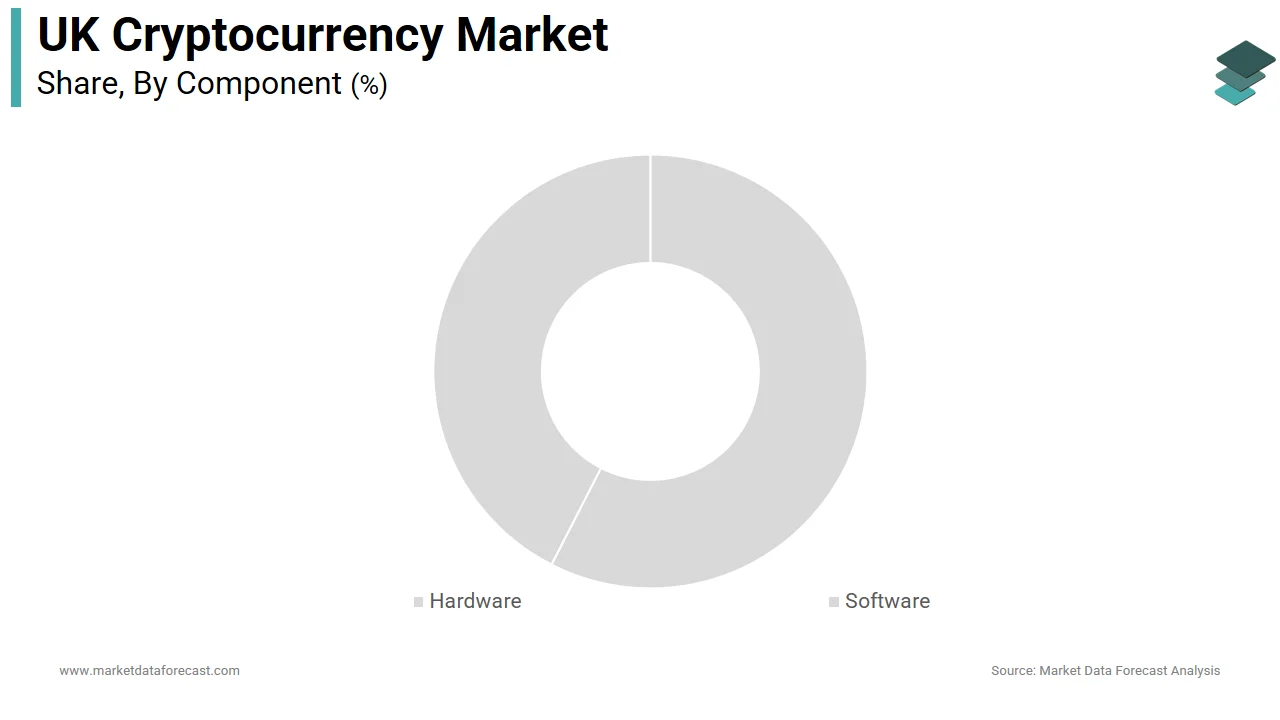
In 2025, the software segment held the majority share of the United Kingdom cryptocurrency market because of the critical reliance on digital platforms for trading, storage, and management of assets. Unlike hardware, which serves a niche security function, software solutions, including exchanges, mobile wallets, and desktop applications, are the primary interface for the majority of users. Studies show that the vast majority of UK cryptocurrency users rely on software-based platforms and mobile apps due to their highly accessible user interfaces. The proliferation of fintech apps has democratized access, allowing millions of retail investors to buy and sell digital assets with ease. The continuous innovation in software features such as staking, lending, and decentralized finance integration enhances user engagement and retention. As per sources, the low barrier to entry for software adoption compared to the technical knowledge required for hardware setup ensures its widespread usage. The scalability of software solutions allows providers to serve a global user base from the UK, generating significant economic value. This ubiquity and functional centrality secure the software segment as the dominant component, underpinning the entire ecosystem’s liquidity and activity levels.
The integration of cryptocurrency software with traditional financial services further reinforces its dominance. Banks and payment processors are increasingly adopting software solutions to facilitate crypto transactions, bridging the gap between fiat and digital currencies. Banking sector updates show that UK fintech firms use Open Banking APIs to safely bridge traditional bank accounts with registered cryptoasset exchanges. This convergence enhances the legitimacy and utility of cryptocurrency software, attracting institutional and retail users alike. Reports by Deloitte show that a strong majority of financial services executives believe blockchain infrastructure is highly scalable and will significantly improve settlement efficiency. The development of regulated software platforms that comply with anti-money laundering and know your customer regulations builds trust among conservative investors. As per studies, the availability of insured custodial software solutions has increased institutional adoption, driving volume and value in the segment. The ability of software to rapidly adapt to regulatory changes and market trends ensures its continued relevance and leadership. This seamless integration into the broader financial landscape cements the software segment as the cornerstone of the UK cryptocurrency market, facilitating widespread adoption and operational efficiency.
The hardware segment is anticipated to witness the fastest CAGR of 14.5% from 2026 to 2034 due to rising security concerns and the need for institutional-grade custody solutions. As the value of digital assets increases, so does the risk of cyber theft and hacking, prompting users to seek offline storage options. Data from Action Fraud confirms that cryptocurrency investment scams account for millions of pounds in annual losses, driven primarily by social engineering and fraudulent investment schemes rather than technical software wallet failures. This surge in security threats has led to a significant increase in demand for hardware wallets, which store private keys offline and are immune to online attacks. Financial data from hardware providers shows substantial revenue growth over recent years, driven by a global surge in consumer demand for offline self-custody solutions. Institutional investors are also driving growth by adopting specialized hardware security modules to meet regulatory compliance and insurance requirements. The perception of hardware wallets as the gold standard for asset protection ensures their rapid adoption among high-net-worth individuals and corporations. This focus on security and risk mitigation propels the hardware segment as the fastest-growing area in the market.
Technological advancements and improvements in user experience significantly accelerate the growth of the hardware segment in the UK cryptocurrency market. Modern hardware wallets now feature intuitive interfaces, Bluetooth connectivity, and mobile app integration, making them more accessible to non-technical users. The integration of biometric authentication, such as fingerprint sensors, enhances security while simplifying access, appealing to mainstream consumers. In addition, the development of open source firmware allows for greater transparency and trust, addressing concerns about supply chain attacks. These innovations lower the barrier to entry for secure storage, encouraging wider adoption. The combination of enhanced security features and improved usability ensures that the hardware segment continues to grow rapidly, capturing a larger share of the market as users prioritize the safety of their digital assets.
By Type Insights
The bitcoin segment was the largest in the regional market and occupied a 43.4% share in 2025. This prominence of the segment was supported by its established status as a store of value and unparalleled brand recognition. Often referred to as digital gold, Bitcoin is the first and most widely recognized cryptocurrency, attracting both retail and institutional investors seeking exposure to the asset class. Data from consumer research trackers confirms that Bitcoin dominates the UK market, with over 60% of crypto owners holding Bitcoin. Investors are frequently drawn to its fixed supply of 21 million coins as a structural hedge against currency devaluation. The widespread media coverage and public discourse surrounding Bitcoin enhance its visibility and legitimacy, drawing new participants into the market. As per a study, the acceptance of Bitcoin by major payment processors and corporations further solidifies its position as the primary cryptocurrency. The network effect ensures high liquidity and stability relative to other digital assets, making it the preferred entry point for newcomers. This combination of scarcity, recognition, and liquidity secures Bitcoin’s leading role, driving the majority of trading volume and market capitalization in the UK.
Institutional adoption and increasing regulatory clarity significantly reinforce Bitcoin’s dominance in the UK cryptocurrency market. The Financial Conduct Authority’s framework for crypto assets has provided a level of certainty that encourages traditional financial institutions to offer Bitcoin-related services. Research co-published by PwC highlights that a notable segment of global hedge funds incorporates digital assets into their strategies to capture diversification benefits and high return potential. The approval of Bitcoin futures and options on regulated exchanges enhances market depth and allows for sophisticated hedging strategies. As per research, the involvement of reputable custodians and auditors has reduced operational risks, making Bitcoin a viable asset for pension funds and insurance companies. The transparency of the Bitcoin blockchain and its proven track record of security further build trust among conservative investors. This institutional validation elevates Bitcoin above other cryptocurrencies, establishing it as the benchmark for the industry. The continuous influx of institutional capital ensures that Bitcoin remains the leading type, shaping market trends and driving overall growth in the UK cryptocurrency sector.
The Ethereum segment is likely to experience the fastest CAGR of 16.2% during the forecast period, owing to its smart contract functionality and the expansion of decentralized finance (DeFi). Unlike Bitcoin, Ethereum enables the creation of programmable applications, making it the foundation for a vast ecosystem of financial services, games, and digital identities. Data from global trackers like DefiLlama shows that Ethereum continues to command the largest market share of Total Value Locked (TVL) across decentralized finance protocols worldwide. The ability to execute complex transactions without intermediaries attracts developers and entrepreneurs to build on the Ethereum network. Broad technology sector data indicates that a major portion of Web3 and blockchain development in the UK is centered on the Ethereum ecosystem, fueling software innovation and specialized tech jobs. The transition to proof-of-stake consensus has reduced energy consumption, addressing environmental concerns and appealing to socially conscious investors. As per sources, the issuance of stablecoins and non-fungible tokens on Ethereum drives transaction volume and network activity. This functional versatility ensures that Ethereum continues to grow rapidly, capturing a significant share of the market as the platform for next-generation internet applications.
Enterprise adoption and the tokenization of real-world assets significantly accelerate the growth of Ethereum in the UK cryptocurrency market. Corporations and financial institutions are leveraging Ethereum’s blockchain to tokenize assets such as real estate, bonds, and equities, enhancing liquidity and reducing settlement times. The ability to create compliant digital securities on Ethereum attracts institutional interest and regulatory support. As per a study, the issuance of tokenized funds and derivatives on the Ethereum network has increased substantially, providing new investment opportunities for UK investors. The robust developer community and extensive tooling support make Ethereum the preferred choice for enterprise blockchain applications. This alignment with corporate needs and regulatory frameworks ensures that Ethereum remains the fastest-growing type, driving innovation and value creation in the UK cryptocurrency landscape.
By Process Insights
The transaction segment led the UK cryptocurrency market and captured a substantial share in 2025. This leading position was attributed to the high volume of retail and commercial payments facilitated by digital assets. As acceptance of cryptocurrencies grows among merchants and service providers, the number of daily transactions has surged. Broad merchant network logs reveal that the number of online and local UK businesses accepting cryptocurrency payments has grown steadily, though they still represent a niche segment of the overall retail market. This widespread adoption drives consistent transaction volume, making it the dominant process in the market. Payment network data from major processors like Visa highlights that consumer spending through crypto-linked payment cards has risen globally as more users integrate digital assets into day-to-day shopping. The convenience of instant cross-border transfers and lower fees compared to traditional banking systems appeals to consumers and businesses alike. As per industry analysis, the rise of stablecoins has further boosted transaction volumes by providing price stability for payments. The ability to send and receive funds globally without intermediaries enhances financial inclusion and efficiency. This practical utility ensures that transactions remain the primary use case for cryptocurrencies, driving network activity and revenue for service providers. The continuous expansion of payment infrastructure supports this dominance, making transactions the backbone of the UK cryptocurrency market.
The efficiency of remittance and cross-border transfers significantly reinforces the leading position of the transaction segment in the UK cryptocurrency market. Migrant workers and international businesses utilize cryptocurrencies to send money across borders quickly and cost-effectively. This advantage drives high transaction volumes, particularly among communities with strong international ties. The transparency and traceability of blockchain transactions also enhance trust and compliance with anti-money laundering regulations. The growing network of crypto exchanges and wallets facilitates easy conversion between fiat and digital currencies, supporting seamless transfers. This functional advantage ensures that the transaction segment remains dominant, serving a critical need in the global financial system and driving sustained market activity in the UK.
The mining segment is on the rise and is expected to be the fastest-growing segment in the market by witnessing a CAGR of 12.8 % between 2026 and 2034. This swift expansion of the segment is propelled by the shift towards sustainable and specialized mining operations. Although proof-of-work mining is energy-intensive, the UK is seeing a rise in green mining initiatives that utilize renewable energy sources such as wind and hydro power. Renewable energy deployment reports indicate that several specialized data processing centers and mining operations in Scotland and Wales run on 100% renewable electricity by co-locating near wind and hydro installations. This sustainable approach attracts investment and regulatory support, fostering growth in the sector. The development of specialized application-specific integrated circuit (ASIC) miners improves efficiency and profitability, encouraging professional mining operations. As per a study, the consolidation of small-scale miners into larger, more efficient facilities enhances competitiveness and resilience. The focus on sustainability and technological advancement ensures that the mining segment continues to grow rapidly, contributing to network security and economic activity in the UK.
The integration of cryptocurrency mining with energy grid management significantly accelerates the growth of the mining segment in the UK market. Mining operations can act as flexible loads that absorb excess renewable energy during peak production periods, stabilizing the grid and reducing waste. This symbiotic relationship between mining and energy infrastructure creates new business models and incentives for growth. The support from government policies promoting grid flexibility and renewable energy integration further boosts the sector. This innovative approach positions mining as a valuable component of the energy ecosystem, driving its rapid expansion. The alignment with national energy goals ensures that the mining segment remains the fastest-growing process, offering unique opportunities for investment and development in the UK cryptocurrency market.
By Application Insights
The trading segment dominated the United Kingdom cryptocurrency market and accounted for a 49.8% share in 2025. This dominance of the segment was driven by the strong speculative interest and high market liquidity associated with digital assets. Investors actively buy and sell cryptocurrencies to capitalize on price volatility, driving substantial trading volumes on exchanges. The availability of leveraged trading products and derivatives attracts sophisticated traders seeking higher returns. The ease of access through mobile apps and online platforms lowers barriers to entry, encouraging frequent trading among retail investors. As per sources, the presence of market makers and liquidity providers ensures tight spreads and efficient price discovery, enhancing the trading experience. The cultural narrative of cryptocurrency as a high-growth investment vehicle fuels continuous interest and activity. This speculative dynamic ensures that trading remains the primary application, generating significant revenue for exchanges and service providers. The deep liquidity and active participant base sustain the leading position of the trading segment in the UK market.
The availability of advanced trading tools and platforms significantly reinforces the dominance of the trading segment in the UK cryptocurrency market. Exchanges offer sophisticated features such as algorithmic trading, charting tools, and automated bots that appeal to professional and semi-professional traders. The integration of artificial intelligence and machine learning in trading platforms provides predictive insights and real-time analytics, giving users a competitive edge. As per sources, the availability of educational resources and demo accounts helps new traders develop skills, expanding the user base. The regulatory framework supports the operation of reputable exchanges that offer secure and reliable trading environments. This technological sophistication and user support ensure that trading remains the most popular application, driving sustained engagement and volume. The continuous innovation in trading technology cements the segment’s leadership, attracting a diverse range of participants to the UK cryptocurrency market.
The payment segment is expected to exhibit a noteworthy CAGR of 18.5% over the forecast period. This quick surge of the segment is propelled by increasing merchant adoption and consumer convenience. More businesses are accepting cryptocurrencies as a form of payment, recognizing the benefits of lower transaction fees and faster settlement times. Consumers appreciate the ability to make seamless cross-border purchases and protect their privacy through crypto transactions. The integration of crypto payment gateways with existing e-commerce platforms simplifies the process for merchants, encouraging wider adoption. As per research, the use of stablecoins for payments reduces volatility risks, making cryptocurrencies a practical medium of exchange. This growing acceptance and utility ensure that the payment segment continues to expand rapidly, capturing a larger share of the market. The convenience and efficiency of crypto payments drive this growth, positioning it as a key application for future development.
The integration of cryptocurrency payments with digital wallets and loyalty programs significantly accelerates the growth of the payment segment. Fintech companies are combining crypto capabilities with traditional banking features, allowing users to spend digital assets easily via debit cards and mobile apps. The ability to earn loyalty points in cryptocurrency adds value and encourages repeat usage. As per sources, partnerships between crypto platforms and retail brands create ecosystems that enhance user engagement and retention. The simplicity of tapping a card or scanning a code to pay with crypto removes friction, making it accessible to mainstream users. This integration with familiar financial tools ensures that the payment segment remains the fastest-growing application, driving adoption and normalizing the use of digital assets in daily life. The convergence of crypto and conventional finance supports this rapid expansion in the UK market.
COUNTRY ANALYSIS
UK Cryptocurrency Market Analysis
The United Kingdom was the top performer in the Europe cryptocurrency market and occupied a 25.1% share in 2025. This expansion of the UK market was driven by its mature regulatory environment, high level of financial literacy, and strong fintech ecosystem. According to the Financial Conduct Authority's (FCA) latest research (December 2025), UK cryptocurrency ownership declined from 12% in 2024 to 8% in 2025, representing approximately 4.5 million adults. The market is mainly driven by a supportive government stance that aims to position the country as a global hub for digital asset innovation. Studies show that the UK hosts a significant number of blockchain firms and registered crypto businesses, which actively drive local job creation and tech-sector growth. The presence of world-class financial institutions and legal frameworks enhances trust and attracts international investment. Consumer demand for alternative investments and decentralized financial services fuels market activity and innovation. The Bank of England’s exploration of central bank digital currencies further validates the sector’s importance. Regulatory clarity provided by recent legislation encourages responsible growth and protects consumers from fraud. The integration of crypto assets into traditional finance through regulated products expands accessibility and legitimacy. This combination of regulatory support, technological infrastructure, and consumer interest ensures that the UK remains a leading market for cryptocurrency in the region. The continuous evolution of the legal and economic landscape supports the sustained development and adoption of digital assets.
COMPETITIVE LANDSCAPE
The competition in the UK cryptocurrency market is intense and characterized by a mix of global exchanges, local fintech startups, and traditional financial institutions entering the digital asset space. Major players compete on regulatory compliance, security features, and user experience to build trust among cautious consumers. Price competitiveness regarding trading fees and spreads influences customer acquisition and retention rates significantly. The market is fragmented with no single dominant entity, allowing for niche specialization in areas like institutional custody or decentralized finance. Regulatory clarity provided by the Financial Conduct Authority levels the playing field but raises operational costs for all participants. Innovation in product offerings, such as staking yields and integrated wallets, drives differentiation. Traditional banks are increasingly partnering with crypto firms, blurring the lines between conventional and digital finance. Consumer protection and fraud prevention are critical competitive advantages, as security breaches can severely damage reputations. Companies must balance innovation with compliance to sustain growth. The dynamic environment requires continuous adaptation to technological advancements and shifting regulatory landscapes, driving strategic evolution among key participants in the region.
KEY MARKET PLAYERS
The major players in the UK cryptocurrency market include
- Advanced Micro Devices, Inc.
- AlphaPoint Corporation
- eToro UK Ltd
- Bitfury Holding B.V.
- Coinbase, Inc.
- CryptoMove, Inc.
- Blockchain.com Services Ltd
- Intel Corporation
- Microsoft Corporation
- Quantstamp, Inc.
- Ripple Services Inc.
TOP PLAYERS IN THE MARKET
- eToro UK Ltd is a prominent social trading and multi-asset brokerage platform that has significantly influenced the United Kingdom cryptocurrency landscape. The company allows users to trade various digital assets alongside traditional stocks and commodities within a single interface. Recently, eToro has strengthened its market position by obtaining full regulatory authorization from the Financial Conduct Authority, ensuring compliance with local laws. The firm actively promotes financial literacy through educational resources and community-driven investment strategies. It has expanded its crypto wallet services, enabling users to transfer assets securely to external addresses. These initiatives enhance user trust and engagement. By integrating social features that allow investors to copy successful traders, eToro attracts novice participants. Its focus on regulatory adherence and user experience solidifies its reputation as a reliable entry point for UK residents entering the digital asset space.
- Coinbase Europe Ltd operates as a leading cryptocurrency exchange platform serving the United Kingdom with robust infrastructure and security measures. The company provides a comprehensive suite of services, including spot trading, staking, and institutional custody solutions. Recently, Coinbase has enhanced its market presence by launching tailored products for UK customers, such as advanced trading interfaces and lower fee structures. It actively collaborates with regulators to establish clear compliance standards, fostering a safer environment for investors. The platform integrates seamlessly with traditional banking systems, facilitating easy fiat on-ramps and off-ramps. Coinbase also invests in blockchain education initiatives to promote widespread adoption. Its commitment to transparency and security builds confidence among retail and institutional clients. By prioritizing regulatory cooperation and technological innovation, Coinbase maintains a strong competitive edge in the evolving UK cryptocurrency market.
- Blockchain.com Services Ltd is a major player in the UK cryptocurrency sector, offering a popular non-custodial wallet and exchange platform. The company empowers users with full control over their private keys while providing accessible trading options. Recently, Blockchain.com has strengthened its position by expanding its institutional services arm, catering to high-net-worth individuals and corporate clients. It has introduced enhanced security features such as biometric authentication and hardware key support. The platform actively participates in policy discussions to shape favorable regulatory frameworks in the United Kingdom. Blockchain.com also focuses on improving user interface design to simplify complex transactions for mainstream audiences. Its dual approach of serving retail and institutional segments diversifies revenue streams. By emphasizing privacy, security, and ease of use, Blockchain.com continues to attract a loyal user base and reinforce its standing in the competitive UK digital asset ecosystem.
TOP STRATEGIES USED BY KEY MARKET PARTICIPANTS
Key players in the UK cryptocurrency market employ diverse strategies to maintain competitiveness and ensure sustainable growth. Regulatory compliance is paramount, with firms actively engaging the Financial Conduct Authority to secure licenses and adhere to anti-money laundering standards. Product diversification allows platforms to offer staking, lending, and non-fungible token services, attracting varied investor profiles. Strategic partnerships with traditional banks facilitate seamless fiat integration, enhancing user convenience. Educational initiatives build trust and literacy among novice investors, reducing barriers to entry. Advanced security protocols, including cold storage and multi-signature wallets, protect user assets from cyber threats. Marketing efforts focus on transparency and reliability to differentiate brands in a crowded landscape. These approaches collectively strengthen market presence and foster long-term customer loyalty in the dynamic United Kingdom cryptocurrency sector.
UK CRYPTOCURRENCY MARKET NEWS
- In March 2025, eToro UK Ltd received full regulatory authorization from the FCA to expand its service offerings and strengthen its UK cryptocurrency market presence.
- In June 2025, Coinbase Europe Ltd launched a new advanced trading platform for UK users to improve execution speeds and strengthen the UK cryptocurrency market presence.
- In September 2025, Blockchain.com Services Ltd introduced enhanced institutional custody solutions for corporate clients and strengthened the UK cryptocurrency market presence.
- In January 2026, Kraken Financial UK expanded its staking services to include additional proof of stake assets and strengthen its UK cryptocurrency market presence.
- In February 2026, Binance UK partnered with local compliance firms to enhance anti-money laundering protocols and strengthen the UK cryptocurrency market presence.
MARKET SEGMENTATION
This research report on the UK cryptocurrency market has been segmented and sub-segmented based on the following categories.
By Component
- Hardware
- Software
By Type
- Bitcoin
- Ethereum
- Bitcoin Cash
- Ripple
- Litecoin
- Dashcoin
- Others
By Process
- Mining
- Transaction
By Application
- Trading
- Remittance
- Payment
- Others