- Product Description Description
- Table of Contents TOC
- List of Table & Figure LOT
- Get Free Sample PDF Sample PDF
Market Size, 2025
$12.96 BnMarket Estimate, 2026
$13.89 BnMarket Forecast, 2034
$24.04 BnCAGR, 2026–2034
7.1%U.K. E-Learning Market Size
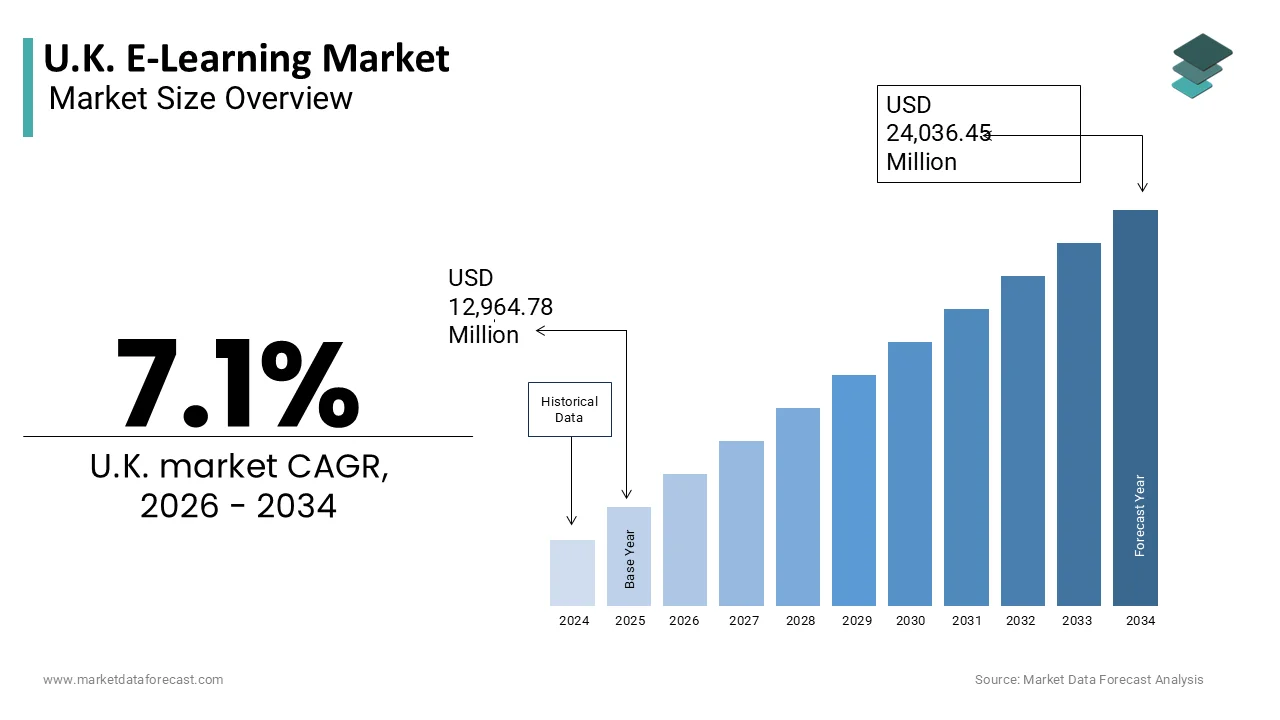
The U.K. E-Learning Market is projected to grow from USD 12,964.78 million in 2025 to USD 13,885.28 million in 2026 and reach USD 24,036.45 million by 2034, registering a CAGR of 7.1% during the forecast period from 2026 to 2034.
E-learning (or electronic learning) is the delivery of education, training, or professional development through digital platforms and the internet. This market has transcended traditional academic boundaries to encompass corporate training, professional development, and lifelong learning initiatives. The landscape is characterized by widespread broadband connectivity and high smartphone penetration, which enables seamless access to educational resources regardless of geographical location. According to the Office for National Statistics, 96% of households in Great Britain (not the United Kingdom) had internet access in 2020. As of early 2023, internet penetration for individuals in the UK was estimated to be aximately 97.8%. As per Ofcom's Online Nation report, the average UK adult spent 3 hours and 41 minutes online per day in 2023. This figure rose to 4 hours and 20 minutes in 2024, driven largely by social media and video-sharing platforms. This environment fosters innovation among educational technology providers who strive to enhance user experience through gamification, adaptive learning algorithms, and immersive simulation. The regulatory framework, including quality assurance standards for online qualifications, ensures credibility and consumer protection while encouraging institutional adoption. The shift towards modular and micro credentialing reflects changing learner preferences for flexible and stackable qualifications. Institutions increasingly prioritize blended learning models that combine face-to-face instruction with digital components to optimize outcomes. The integration of artificial intelligence allows for personalized learning paths that cater to individual pace and proficiency levels. This technological evolution supports inclusive education by providing accessibility features for learners with diverse needs. The market continues to expand as organizations recognize the cost efficiency and scalability of digital training solutions compared to traditional methods.
MARKET DRIVERS
Corporate Upskilling Initiatives Drive Enterprise Adoption
The urgent need for workforce reskilling and upskilling greatly contributes to the growth of the United Kingdom's e-learning sector. This occurs as businesses continuously adapt to rapid technological changes and evolving job requirements. Organizations increasingly view continuous learning as a strategic imperative to maintain competitiveness and retain talent in a tight labor market. According to the Open University Business Barometer 2023, 73% of UK organizations reported experiencing skills shortages, while the Department for Education's Employer Skills Survey 2022 reported that 10% of employers faced internal skills gaps. This demand drives enterprises to adopt learning management systems and online course libraries that offer flexible and scalable training solutions. The ability to deliver consistent training across geographically dispersed teams reduces logistical costs and ensures uniform compliance with industry regulations. Research by the Association for Talent Development (ATD) indicates that companies offering comprehensive training programs enjoy a 24% higher profit margin than those that spend less on training. The rise of remote and hybrid work models further accelerates this trend as digital platforms become the primary medium for employee engagement and development. Microlearning modules allow employees to acquire specific skills in short bursts, without disrupting workflow, thereby increasing completion rates and knowledge retention. Employers leverage analytics to track progress and identify skill deficiencies, enabling targeted interventions that align with business objectives. The availability of certified online courses from reputable institutions enhances the cred,,ibility of corporate training programs. This strategic focus on human capital development enterprise-level e-learning solutions.
Government Support for Digital Literacy Enhances Accessibility
Strong government initiatives aimed at improving digital literacy and expanding access to education provide substantial momentum in the United Kingdom e-learning market. Public sector policies prioritize equitable access to quality education through digital channels, particularly for underserved communities and adult learners seeking career transitions. The Department for Education has allocated approximately £550 million to expand Skills Bootcamps, which offer free, flexible courses in sectors like digital and technology. This funding supports the development of free or subsidized online courses in areas such as coding, data analysis, and digital marketing. The National Retraining Scheme encourages individuals to pursue flexible learning options that fit around existing commitments thereby increasing pa,rticipation rat,, es. According to HESA statistics for 2022/23, enrollments in distance learning courses remained relatively stable with a marginal increase of 0.5%, wh, while transnational education enrollments grew by 8%. Government partnerships with private edtech firms facilitate the creation of high-quality content that meets national standards and industry needs. The emphasis on lifelong learning aligns with economic goals to boost productivity and improve various sectors. Public libraries and community centers often serve as access points for individuals lacking home internet connections, ensuring inclusivity. The promotion of open educational resources reduces financial barriers for students and independent learners. These policy-driven efforts create a favorable environment for e-learning providers to expand their reach and impact. The alignment of public funding with private innovation accelerates the development of effective and accessible digital education solutions.
MARKET RESTRAINTS
Digital Divide Limits Reach in Underserved Communities
A persistent digital divide, despite high overall connectivity rates, restricts the full potential of the United Kingdom's e-learning market. This inequality excludes disadvantaged populations from accessing quality online education, limiting overall market growth. Socioeconomic disparities result in unequal access to reliable internet connections, suitable devices, and digital literacy skills necessary for effective online learning. According to the Good Things Foundation's Digital Nation report (2024), approximately 8.5 million adults (roughly 16%) in the UK lack basic digital skills, preventing them from fully benefiting from the digital economy and online education. This gap is particularly pronounced in rural areas and low-income households where infrastructure limitations and financial constraints hinder participation. As per data from Ofcom, 1.5 million households in the United Kingdom still do not have access to broadband internet, creating a significant barrier to entry for e-learning platforms. The lack of appropriate hardware, such as laptops or tablets, forces some learners to rely on smartphones, which are insufficient for complex educational tasks. This device limitation affects the quality of the learning experience and reduces engagement with interactive content. Schools in deprived areas often struggle to provide adequate technical support and training for students transitioning to digital learning environments. The absence of quiet study spaces at home further complicates the ability of disadvantaged learners to focus on online courses. These structural inequalities perpetuate educational disadvantage and limit social mobility. Addressing the digital divide requires coordinated efforts from government educators and technology providers to ensure equitable access. Until these barriers are removed, we cannot ignore the consequences. A significant portion of the population remains excluded from the benefits of the e-learning market.
Quality Assurance and Accreditation Concerns Persist
The proliferation of unregulated online courses and varying quality standards creates uncertainty for both learners and employers, which impedes the expansion of the United Kingdom e-learning market. As a result, there are ongoing challenges regarding the true value and recognition of e-learning credentials. The absence of universal accreditation frameworks makes it difficult to distinguish between rigorous academic programs and superficial content offerings. This lack of standardization undermines confidence in digital qualifications and limits their acceptance in the job market. Employers often hesitate to recognize certificates from unknown providers due to concerns about academic integrity and assessment rigor. The Institute of Student Employers (ISE) (formerly AGR) reports that employers increasingly prioritize skills and attributes over specific degree formats. The variability in instructional design and pedagogical approaches affects learner satisfaction and completion rates. Some platforms prioritize quantity over quality, resulting in outdated or inaccurate content that fails to meet industry standards. The challenge of verifying student identity during online assessments raises concerns about cheating and credential fraud. These issues complicate the establishment of trust in the e-learning ecosystem. Learners may invest time and money in courses that yield little professional benefit. Regulatory bodies are working to develop clearer guidelines for online education providers, but progress remains slow. The need for robust quality assurance mechanisms is critical to sustaining long-term growth and credibility in the market.
MARKET OPPORTUNITIES
Integration of Artificial Intelligence Personalizes Learning Experiences
The application of artificial intelligence and machine learning technologies paves the way to enhance the effectiveness and personalization of electronic learning platforms in the country, which is expected to boost the growth of the United Kingdom e-learning market. These advanced tools analyze learner behavior and performance data to create adaptive learning paths that cater to individual needs and preferences. Intelligent tutoring systems provide real-time feedback and support, mimicking the guidance of a human instructor. This personalized approach helps learners overcome specific challenges and progress at their own pace, thereby increasing completion rates. Natural language processing enables automated grading of written assignments and facilitates interactive conversations with virtual assistants. Predictive analytics help educators identify risks in students early, ly allowing for timely interventions and support. The automation of administrative tasks frees up instructors to focus on mentoring and curriculum development. AI-powered content recommendation engines suggest relevant resources based on learner interests and career goals, ls enhancing the overall educational experience. The ability to scale personalized instruction makes high-quality education more accessible to larger audiences. This technological advancement transforms passive learning into an active and responsive process. Providers who leverage AI capabilities gain a competitive advantage by offering superior user experiences and measurable results.
Expansion of Micro Credentialing and Stackable Qualifications
The growing demand for flexible and modular education creates new opportunities for providers within the United Kingdom learning market. They can now offer Micro-credentials and stackable qualifications that align with specific career goals. Learners increasingly prefer short,t focused courses that allow them to acquire specific skills without committing to lengthy degree programs. The bite-sized qualifications enable professionals to update their skills rapidly in response to changing industry demands. The stackable nature of these credentials allows learners to accumulate credits towards larger qualifications, providing a clear pathway for career advancement. Employers value these targeted skills as they demonstrate immediate applicability and relevance to job roles. Universities and colleges are partnering with industry leaders to co-create courses that ensure curriculum alignment with workplace needs. The flexibility of micro credentials appeals to working adults who balance education with other responsibilities. Digital badges and blockchain verification enhance the portability and credibility of these qualifications. This model supports lifelong learning by encouraging continuous skill development throughout one's career. Providers who offer diverse and recognized micro credentials can capture a significant share of the professional development market. The modularity of this approach also facilitates international recognition and mobility for learners.
MARKET CHALLENGES
Maintaining Learner Engagement and Motivation Remains Difficult
Sustaining learner engagement and motivation in online environments is a serious limitation for providers in the United Kingdom learning market. This is due to the lack of face-to-face interaction and immediate accountability. High dropout rates are a common issue as students struggle with self-discipline and isolation during remote study. Academic research on digital learning shows that the average completion rate for massive open online courses (MOOCs) is under 15%, though this is largely attributed to the open-access, casual auditing behavior of users rather than institutional disengagement. The absence of peer support and instructor presence reduces the sense of community and belonging that traditionally motivates students. Jisc's Student Digital Experience Insights surveys highlight that a lack of community engagement is a key barrier for online students. This emotional disconnect leads to decreased participation and higher attrition rates. Designing interactive and compelling content requires significant expertise and resources, which many providers lack. The monotony of video lectures and text-based materials fails to capture attention in an era of short attention spans. Technical issues such as platform glitches or poor user interface design further frustrate learners and hinder progress. The lack of immediate feedback on assignments delays the learning loop and reduces motivation. Providers must invest in gamification social learning features and regcheck-ins to combat these issues. However,r implementing these solutions increases operational complexity and cost. The challenge of balancing flexibility with structure remains a persistent obstacle to achieving high completion rates and satisfactory learning outcomes.
Cybersecurity Threats Compromise Data Integrity
The country's digital education sector faces severe cybersecurity risks due to its heavy reliance on online platforms, which puts student privacy at risk and thereby negatively impacts the expansion of the United Kingdom's learning market. Educational institutions and providers store vast amounts of personal information,mation including academic records,ecords payment details, and identification documents, making them attractive targets for cybercriminals. According to the UK government's Cyber Security Breaches Survey, cyber threats remain pervasive, with 73% of secondary schools and the vast majority of higher education colleges detecting at least one cyber breach or attack within the reporting year. These incidents undermine trust in online learning platforms and deter potential users from enrolling. Under the Information Commissioner's Office (ICO) public sector approach, the regulator has pivoted away from financial penalties for public educational institutions, relying instead on public reprimands and compliance audits to improve data security without draining public school resources. Ransomware attacks can halt operations entirely, causing significant financial and reputational damage. The complexity of securing distributed networks with multiple access points increases vulnerability to phishing and malware infections. Students and staff often lack adequate cybersecurity awareness, making them susceptible to social engineering tactics. Third-party vendors and cloud services introduce additional security dependencies that are difficult to monitor. Compliance with data protection regulations requires continuous investment in security infrastructure and staff training. Breaches can lead to legal liabilities and loss of accreditation status. Providers must prioritize robust encryption, two-factor authentication, nd regular security audits to mitigate these risks. The ongoing evolution of cyber threats necessitates proactive and adaptive security strategies to protect the integrity of the learning ecosystem.
REPORT COVERAGE
| REPORT METRIC | DETAILS |
| Market Size Available | 2025 to 2034 |
| Base Year | 2025 |
| Forecast Period | 2026 to 2034 |
| Segments Covered | By End User, Product, Deployment, and Region. |
| Various Analyses Covered | Global, Regional and Country-Level Analysis, Segment-Level Analysis, Drivers, Restraints, Opportunities, Challenges; PESTLE Analysis; Porter’s Five Forces Analysis, Competitive Landscape, Analyst Overview of Investment Opportunities |
| Countries Covered | United Kingdom |
| Market Leaders Profiled | Pearson plc, FutureLearn Limited, Learning Technologies Group plc (LTG), Babbel GmbH, Coursera, Inc., Udemy, Inc., LinkedIn Learning (LinkedIn Corporation), Skillsoft Corporation, Docebo Inc., Cornerstone OnDemand, Inc., Moodle Pty Ltd., Blackboard Inc. |
SEGMENTAL ANALYSIS
By End User Insights
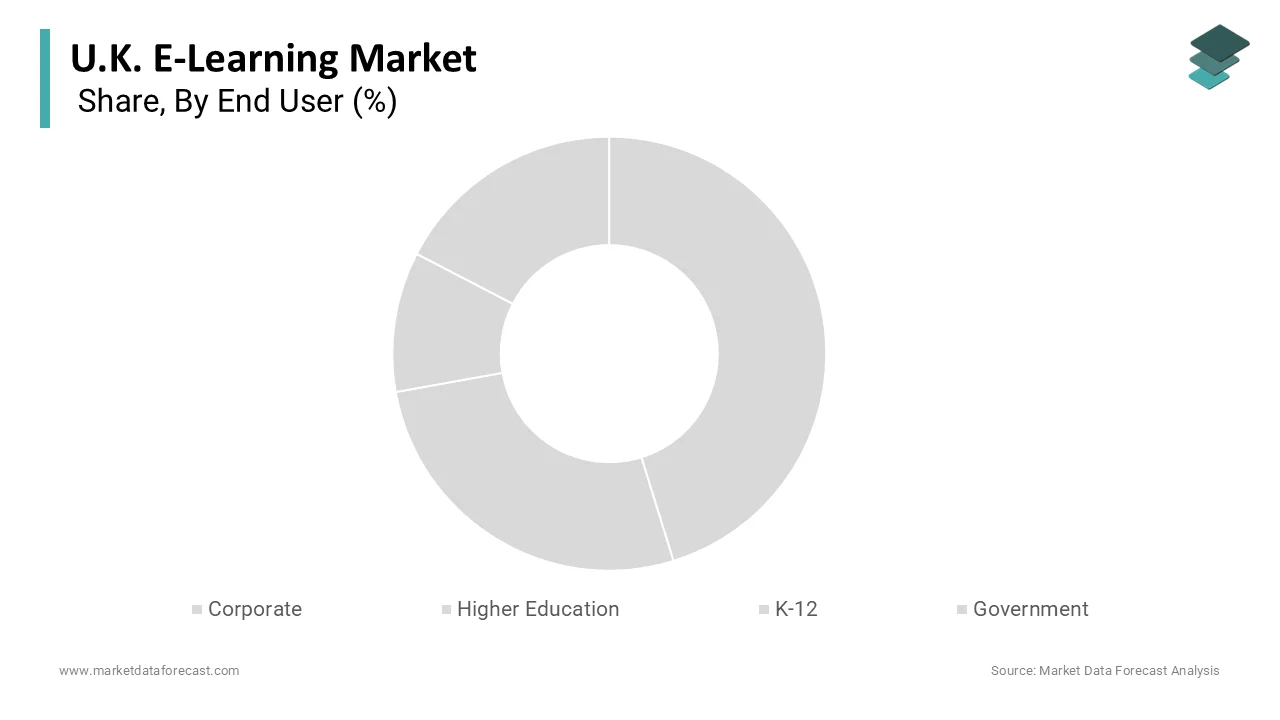
The corporate segment maintained the lead by capturing a 40.1% share of the United Kingdom learning market in 2025. This leading position in the market was attributed to the critical need for continuous employee development and compliance training in a rapidly evolving business environment. Organizations prioritize digital learning solutions to enhance workforce productivity and adapt to technological disruptions. Strict regulatory frameworks across industries such as finance, healthcare, and energy mandate regular compliance training for employees,loyee,s which drives substantial demand for standard learning modules. Companies must ensure that staff are up to date with laws regarding data protection,ection health, and money laundering to avoid severe penalties. According to the Health and Safety Executive (HSE) annual statistics, the regulator completes roughly 240 to 250 criminal prosecutions each year for serious health and safety violations, maintaining a conviction rate of around 80%. E-learning platforms provide auditable trails of completion and assessment results, results which simplify regulatory reporting and reduce administrative burdens. The ability to update content instantly ensures that training materials reflect the latest legal changes without the delay associated with printed manuals or classroom sessions. This efficiency is crucial for multinational corporations operating across different jurisdictions with varying legal requirements. The scalability of digital solutions allows organizations to train thousands of employees simultaneously while ensuring consistent messaging and understanding. Automated reminders and recertification alerts help maintain ongoing compliance without manual intervention. The cost-effectiveness of delivering mandatory training online compared to instructor-led sessions makes it the preferred choice for budget-conscious organizations. This regulatory pressure creates a steady and predictable revenue stream for learning providers specializing in compliance content.
The permanent shift towards remote and hybrid work models has fundamentally changed how organizations deliver training and professional development to their dispersed workforces. With employees no longer gathered in central offices, companies rely on digital platforms to maintain engagement and skill development. According to data from the Office for National Statistics (ONS), approximately 28% of working adults in Great Britain engaged in hybrid working, establishing a permanent, flexible baseline for the modern workforce. E-learning allows employees to access training materials at their convenience,enience fitting education around flexible schedules and diverse time zones. This flexibility improves participation rates and reduces the disruption to daily work activities. Virtual classrooms and collaborative tools enable interactive learning experiences thatface-to-faceto face inter, fostering team cohesion and knowledge sharing. The integration of social learning features allows peers to support each other and share best practices across geographical boundaries. Employers use analytics to monitor engagement and identify skill gaps within remote teams, enabling targeted interventions. The ability to onboard new hires virtually reduces time to productivity and ensures consistent cultural assimilation. This structural change in work patterns ensures that core learning remains a strategic priority for organizations aiming to remain competitivdigital-firstl first economy.
The higher education segment is on the rise and is expected to be the fastest-growing segment in the market by witnessing a CAGR of 13.5% from 2026 to 2034 due to the increasing acceptance of online degrees and the need for universities to expand their reach beyond traditional campus boundaries. Universities in the United Kingdom are increasingly leveraging learning platforms to recruit and educate international students who seek British qualifications without the high costs of relocation and living expenses. Online programs allow institutions to tap into global markets, particularly in Asia and Africa, where demand for high-quality education exceeds local supply. According to data from HESA, while overall international student numbers in the UK hit record highs in recent years, the vast majority enrolled in on-campus programmes, with distance learning options representing only a minor, steady fraction of international recruitment. Digital delivery removes geographical barriers and enables universities to scale their operations without significant infrastructure investment. These programs attract working professionals who wish to advance their careers while maintaining their current employment. The recognition of online degrees by employers is improving, further boosting enrollment numbers. Institutions partner with online program managers to handle marketing, recruitment, and student support, enhancing the overall experience. The ability to offer specialized niche courses that may not be viable on campus allows universities to differentiate themselves. Currency fluctuations make UK online degrees attractive to foreign students seeking value for money. This global outreach diversifies revenue streams for universities facing domestic funding constraints. The prestige of UK higher education, combined with the convenience of online delivery, creates a powerful value proposition for international learners.
The adoption of blended learning models that cface-to-faceto face instruction with online components is transforming the higher education landscape in the United Kingdom. This approach offers students the benefits of both traditional campus life and the flexibility of digital resources. Universities are investing in digital infrastructure to support seamless integration of online lectures, discussion forums, and virtual labs. The flipped classroom model is a model where students review materials online before attending interactive sessions, maximizing the value of contact time. This pedagogical shift requires faculty development and technical support, driving investment in learning tools and training. The availability of recorded lectures allows students to review complex topics at their own pace,wn pace enhancing understanding and retention. Digital assessments provide immediate feedback, helping students identify areas for improvement. The flexibility of blended learning accommodates diverse learning styles and needs, promoting inclusivity. Universities that effectively implement these models gain a competitive advantage in attrtech-savvyh savvy studentlong-termng term sustainability of this model depends on continued innovation in digital pedagogy and user experience design.
By Product Insights
The solutions segment was the largest in the United Kingdom market and occupied a 45.2% share in 2025. This prominence of the segment was supported by the foundational need for infrastructure to deliver and manage digital content. Organizations require robust platforms to organize, track, and report on learning activities. Organizations and educational institutions require centralized platforms to manage the complexity of delivering training to large and diverse audiences efficiently. Learning management systems provide a single source of truth for us, including data, course catalogs, and progress tracking, which is essential for operational efficiency. These systems integrate with human resource information systems to automate user enrollment and certification processes,ocesses reducing administrative overhead. The ability to generate detailed reports on learner performance and engagement helps leaderdata-driven driven decisions about training investment. Cloud-based solutions offer scalability, allowing organizations to add users and content as they grow without significant hardware upgrades. Security features include role-based access control and data encryption, protecting sensitive information. The customization capabilities of modern platforms allow brands to create tailored learning environments that reflect their corporate identity. Mobile compatibility ensures that learners can access content on any device, enhancing accessibility. The continuous evolution of these platforms with features like gamification and social learning keeps them relevant and engaging. This foundational need for infrastructure ensures steady demand for learning solutions.
The demand for highly customizable and intuitive learning solutions drives the dominance of this segment as organizations seek to align training with specific business processes and existing technology. Off-the-shelf products often fail to meet unique organizational needs requiring tailored configurations and API connections. Connections with customer relationship management, agreements,t sales, and performance management tools create a holistic view of employee development and its impact on business outcomes. Authoring tools that allow internal subject matter experts to create content empower organizations to keep training materials current and specific to their operations. The ability to brand the learning interface enhances user adoption and reinforces corporate culture. Advanced analytics dashboards provide insights into learning effectiveness and return on investment. Support for multiple languages and accessibility standards ensures inclusivity for diverse workforces. The flexibility to be on-premises or in the cloud offers choices based on security and budget requirements. Vendor support and regular updates ensure that platforms remain secure and feature-rich. This focus on tailor-made solutions addresses the specific challenges faced by different industries and organization sizes.
The packaged content segment is expected to exhibit a noteworthy CAGR of 11.2% over the forecast period, owing to the high-quality, ready-to-use courses that reduce development time and costs. Organizations are increasingly turning to off-the-shelf content libraries to address common training needs, such as compliance,e diversity, and soft skills, without the burden of internal development. A high-quality house requires significant time ex, expertise, and resources, which many companies lack. Providers offer extensive catalogs of professionally produced courses that are regularly updated to reflect changing regulations and best practices. This speed is crucial for responding to immediate business needs or regulatory changes. The quality of production, including video animation and interactive elements, enhances learner engagement and retention. Subscription-based models provide cost-effective access to vast amounts of content, allowing organizations to scale their offerings easily. The breadth of topics available ensures that employees can explore personal development interests alongside mandatory training. Expert instructors and industry leaders often create this content, adding credibility and authority. The ease of integration with existing learning management systems simplifies implementation. This convenience and quality drive the rapid adoption of packaged content solutions.
The economic advantages of purchasing packaged content over developing custom courses make it an attractive option for medium-sized enterprises with limited budgets. Developing bespoke content can cost thousands of pounds per hour of instruction, ruction whereas packaged courses are available for a fraction of that price. This cost efficiency allows organizations to allocate resources to other strategic initiatives, such as technology instructor-led workshops. The ability to license content for unlimited users provides predictable budgeting and financial planning. Regular updates included in subscription fees ensure that content remains relevant without additional charges. The variety of formats includes video, ng video audio, nd tex, catering to different learning preferences. The immediate availability of content eliminates the lead times associated with custom development projects. This agility supports rapid organizational change and expansion. The reduced risk of project failure since the content is already proven and tested further encourages adoption. These financial and operational benefits sustain the high growth rate of the packaged content segment.
By Deployment Insights
In 2025, the cloud deployment segment held the majority share of the United Ke-learning market because of its flexibility, scalability, reliability, and lower upfront costs compared to on-premises solutions. Organizations cloud-basedd based platforms for their ease of access and maintenance. Cloud-based e-learning solutions eliminate the need for significant capital expenditure on hardware, servers, and IT infrastructure, making them financially attractive for organizations of all sizes. Subscription-based pricing model cohighhighs high upfront costs into predictable operational expenses,xpenses which improves cash flow management. The vendor manages all technical aspects, including security patches, updates,pdates and backups r, relieving internal IT teams of these burdens. Also, the operational simplicity allows organizations to focus on strategic learning initiatives rather than technical troubleshooting. The automatic scaling capabilities ensure that the platform performs well during peak usage periods such as mandatory compliance deadlines. Rapid deployment means that organizations can start using the system within days rather than months. The accessibility of an internet-connected device supports remote and mobile learning scenarios. Enhanced security measures provided by major cloud vendors often exceed what individual organizations can implement on-premises. The reliability and uptime guarantees offered by service level agreements ensure business continuity. These economic and operational advantages solidify the dominance of cloud deployment in the market.
The inherent nature of cloud deployment facilitates seamless access to learning resources from anywhere at any time, which is essential for supporting remote and hybrid workforces. Employees can engage with training materials on their preferred devices without being tied to a specific office location. This ubiquity ensures that learning is integrated into the flow of work rather than being a separate activity. Social features such as discussion boards and peer reviews foster community and knowledge sharing among dispersed teams. The ability to update content centrally ensures that all users access the most current information immediately. Cloud platforms smulti-tenant tenant archit,ectures allowing for easy management of multiple departments or subsidiaries. Data analytics stored in the cloud real-timeeal time insights into learner behavior and performance. The interoperability with cloud-based business applications creates a cohesive digital ecosystem. This connectivity enhances the overall user experience and drives higher engagement rates. The flexibility of cloud deployment aligns perfectly with the modern agile work environment.
The hybrid and advanced cloud solutions segment is predicted to witness the highest CAGR of 14.8% between 2026 and 2034. This quick surge of the segment is propelled by the demand for intelligent and personalized learning experiences. The incorporation of artificial intelligence cloud-based e-learning platforms enables sophisticated personalization and predictive analytics that enhance learning outcomes. AI algorithms analyze user data to recommend relevant content and identify skill gaps automatically. These intelligent systems adapt the difficulty and pace of content based on individual learner performance,ormance ensuring optimal challenge levels. Natural language processing powers chatbots that provide instant support and answer learners'queries, reducing friction. Predictive analytics help administrators identify at-risk learners who may need additional support or intervention. The automation of administrative tasks such as grading and scheduling frees up educators to fohigh-valueh value activities. Machine learning models continuously improve recommendations based on aggregate user behavior. The ability to process large volumes of data in real time provides actionable insights for strategic decision-making. This technological sophistication differentiates advanced cloud solutions from basic hosting services. The value derived from intelligent features justifies the premium pricing and drives adoption.
Advanced cloud solutions offer unparalleled scalability that allows large enterprises to deploy learning initiatives across global workforces without performance degradation. The elastic nature of cloud infrastructure ensures that systems can handle sudden spikes in user activity seamlessly. This reliability is critical for multinational corporations that operate across different time zones and regions. The ability to localize content and interfaces for different markets enhances user adoption and engagement. Centralized management consoles provide visibility into global learning, metrics enabling standardized reporting. The integration with global human resource systems ensures data consistency and accuracy. The robust security frameworks of major cloud providers protect sensitive employee data against cyber threats. The continuous innovation cycle of cloud vendors ensures that customers always have access to the latest features and technology, and future-proofing capability reduces the risk of obsolescence. The combination of scale intelligence and security makes advanced cloud solutions the fastest-growing segment.
COUNTRY LEVEL ANALYSIS
United Kingdom E-Learning Market Analysis
The United Kingdom was the top performer in the European e-learning market and accounted for a 28.6% share in 2025. This growth of the country’s market was driven by its advanced digital infrastructure and strong educational heritage. The country serves as a testing ground for new pedagogical technologies and business models. Excellent digital infrastructure and high smartphone penetration across the UK create an ideal foundation for the widespread adoption of e-learning solutions. Reliable internet access ensures that learners can engage with rich media content without interruption. The average speed of broadband connections continues to increase,ncrease facilitating the use of high definition video and virtual reality simulations. The maturity of the technology sector in London and other major cities fosters innovation and collaboration between educators and developers. Government initiatives such as the Digital Strategy promote the use of technology in education and training. The high level of digital literacy among the population reduces barriers to entry for new users. Educational institutions are early adopters of new technologies,, ologies setting trends for the rest of the market. The presence of e-learning providers ensures competitive pricing and high-quality services. This supportive ecosystem sustains the Kingdom's position as a leader in the E-learning landscape.
The United Kingdom operates under a rigorous regulatory framework that ensures the quality and credibility of learning, thereby building trust among consumers and employers. Accreditation bodies monitor online programs to ensure they meet the same standards as traditional qualifications. The Office for Students (OfS) regulates the quality of degrees in England, while the Quality Assurance Agency (QAA) provides voluntary advice and guidance on digital delivery and assessment to support academic integrity. This regulatory oversight protects learners from substandard providers and fraudulent schemes. As per data from the Department for Ed, government-funded digital skills providers adhere to criteria using public money. The General Data Protection Regulation imposes stringent requirements on data privacy, forcing providers to implement robust security measures. This focus on compliance enhances the reputation of the United Kingdom's learning market internationally. Employers recognize and value qualifications from accredited UK pr,oviders facilitating career progression for learners. The transparency of quality assurance processes encourages continuous improvement among providers. The alignment of educational standards with industry needs ensures that graduates possess relevant skills. This commitment to quality distinguishes the United Kingdom market-regulated regions. The trust established through regulation drives sustained investment and participatory learning initiatives.
COMPETITIVE LANDSCAPE
The competitive landscape of the United Kingdom market is characterized by a diverse mix of established educational institution institutionsns specializein d technology providers, and global online learning platforms. Traditional universities compete with agile edtech startups by leveraging their brand reputation and academic credibility while adopting digital delivery models. Large multinational corporations offer comprehensive enterprise solutions, whereas niche players focus on specific subjects or pedagogical approaches. Innovation in artificial intelligence,lligence adaptive learning, and gamification serves as a key differentiator among competitors. Price competition is intense,e particularly in the corporate training segment, where organizations need cost-effective, scalable options. Partnerships between content creators and technology platforms are common as companies strive to offer integrated ecosystems. Regulatory compliance and quality assurance standards create barriers to entry for new participants lacking accreditation. The market sees continuous consolidation through mergers and acquisitions as larger entities seek to expand their capabilities. Customer retention relies heavily on user experience engagement metrics and demonstrable learning outcomes. This dynamic environment drives constant improvement in service quality and technological sophistication, benefiting learners across various sectors.
KEY MARKET PLAYERS
Some of the companies that are playing a dominating role in the U.K. E-Learning Market include
- Pearson plc
- FutureLearn Limited
- Learning Technologies Group plc (LTG)
- Babbel GmbH
- Coursera, Inc.
- Udemy, Inc.
- LinkedIn Learning (LinkedIn Corporation)
- Skillsoft Corporation
- Docebo Inc.
- Cornerstone OnDemand, Inc.
- Moodle Pty Ltd.
- Blackboard Inc.
TOP LEADING PLAYERS IN THE MARKET
- FutureLearn stands as a prominent digital education platform in the United Kingdom by partnering with leading universities and cultural institutions to deliver high-quality online courses. The company focuses on social learning experiences that encourage interaction among participants through discussion forums and peer feedback. Recent initiatives include the expanded microcredential programs and short courses designed for professional development and career advancement. FutureLearn has integrated advanced analytics to personalize learner journeys and improve completion rates. The platform continues to broaden its subject offerings to include emerging fields such as data science and sustainability. By maintaining strong academic partnerships, FutureLearn ensures content credibility and relevance. The company actively promotes lifelong learning opportunities for diverse audiences, including working professionals and retirees. User-friendliness enhances convenience for users across the region.
- Pearson leverages its extensive educational publishing heritage to provide comprehensive digital learning solutions and assessment services in the United Kingdom market. The company offers a wide range of online qualifications, educational training materials, and adaptive learning technologies for schools and corporations. Recent actions involve significant investments in artificial intelligence-driven tools that personalize study plans and preal-timeal time feedback to students. Pearson has expanded its partnership network with employers to align curriculum with industry skills requirements. The organization focuses on developing accessible content that supports diverse learning needs and abilities. By integrating digital assessments with learning platforms, at forms Pearson creates seamless ecosystems for tracking progress. The company also emphasizes teacher training and support to ensure effective implementation of digital resources. These efforts reinforce its position as a trusted provider of credible and impactful educational technology solutions.
- The Open University remains a pioneer in distance learning within the United Kingdom by offering flexible degree programs and continuous professional development courses to a global audience. It utilizes innovative pedagogical approaches and robust digital platforms to support independent study and collaborative learning. Recent strategies include the enhancement of its virtual learning environment with interactive tools and multimedia resources. The institution has increased its focus on stackable credentials and micro modules that allow learners to build qualifications incrementally. Partnerships with industry leaders ensure that course content remains relevant to current job market demands. The Open University actively promotes inclusivity by providing financial support and accessibility features for disadvantaged learners. Its researto ch led teaching mthat ethods contribute to high student satisfaction and retention rates. The university continuously adapts to technological advancements. Through this, it maintains its reputation for academic excellence and accessibility in the digital education sector.
TOP STRATEGIES USED BY KEY MARKET PARTICIPANTS
Key players in the United Kingdom market employ strategic initiatives to enhance their competitive positioning and drive growth. First, they invest heavily in artificial intelligence and machine learning to personalize learning experiences and automate administrative tasks. Seco, nd companies form strategic partnerships with universities and corporations to expand content libraries and ensure curriculurelevancevaOncece T thirdd they focus on mobile-friendly platforms to accommodate learners who prefer studying on smartphones and tablets. Fourth, providers empmicrocremploy microcredentialingable qualifications to meet the demand for flexible and modular education. Fifth,h they prioritize data security and compliance with privacy regulations to build trust among users and institutions. These strategies collectively enable organizations to dhigh-qualityquality s, scalable, and engaging educational solutions that address the evolving needs of modern learners and employers effectively.
MARKET SEGMENTATION
This research report on the U.K. e-learning market is segmented and sub-segmented as follows.
By End User
- Corporate
- Higher Education
- K-12
- Government
- Others
By Product
- Solutions
- Packaged Content
- Services
By Deployment
- Cloud
- Hybrid & Advanced Cloud Solutions
- On-Premises
By Country
- United Kingdom