- Product Description Description
- Table of Contents TOC
- List of Table & Figure LOT
- Get Free Sample PDF Sample PDF
Market Size, 2025
$25.82 BnMarket Estimate, 2026
$27.44 BnMarket Forecast, 2034
$44.66 BnCAGR, 2026–2034
6.28%UK Express Delivery Market Exeutive Summary
Market Size & Growth
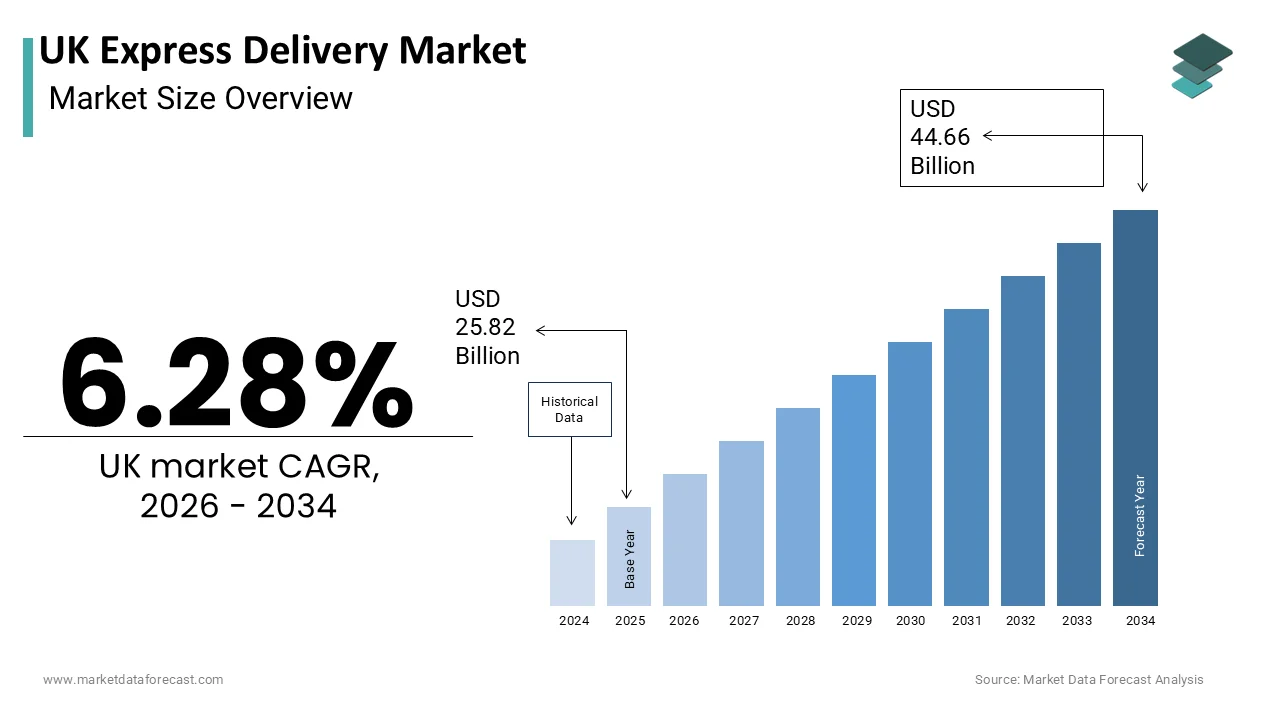
- The UK Express Delivery Market was valued at USD 25.82 billion in 2025.
- Expected to reach USD 44.66 billion by 2034, growing at a CAGR of 6.28% from 2026 to 2034.
- The market was valued at USD 27.44 billion in 2026.
- The international express delivery segment is projected to grow at a CAGR of 6.5% from 2026 to 2034.
Key Market Segments
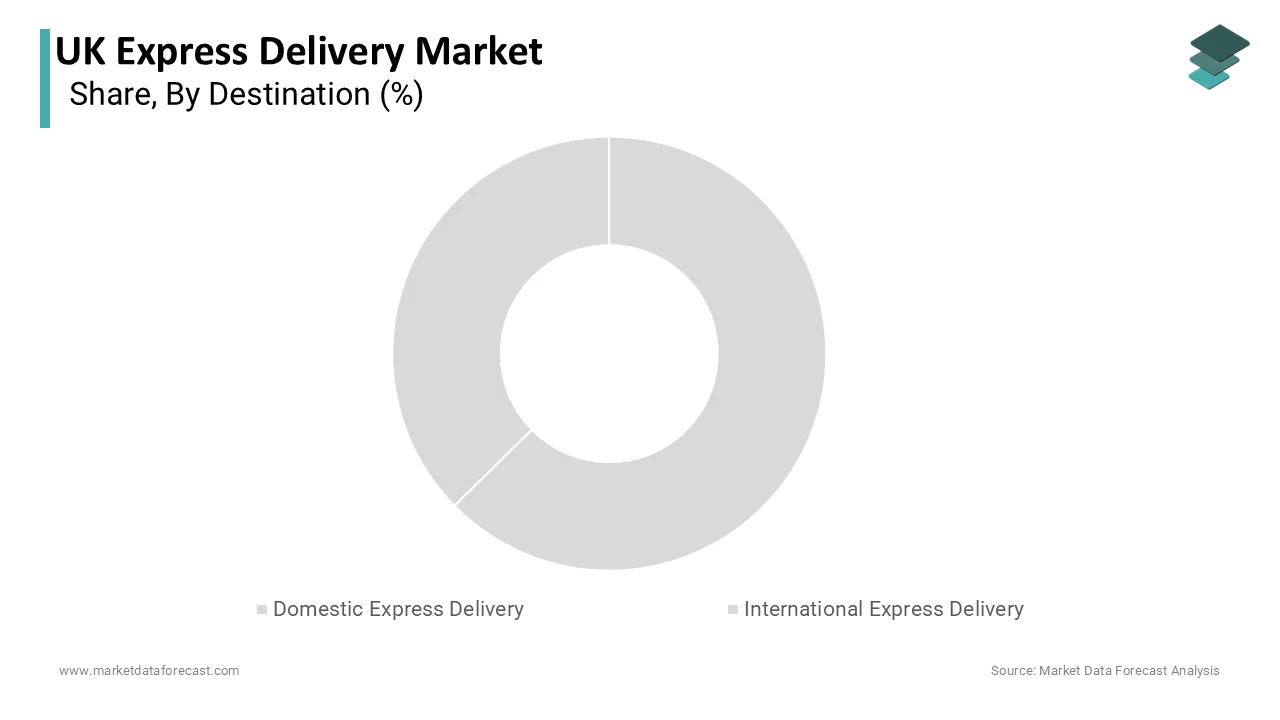
- By Destination: Domestic Express Delivery (48.2% share in 2025), International Express Delivery
- By Business Type: Business-to-Consumer (B2C, largest share), Business-to-Business (B2B, fastest at CAGR of 5.8%)
- By End-User: Retail and E-commerce (38.9% share in 2025), Pharmaceuticals (fastest at CAGR of 7.2%)
Key Drivers
- Online retail accounts for approximately 26% of total UK retail spending, creating sustained express delivery demand.
- Approximately 84% of the UK population resides in urban areas, enabling high route density and cost-efficient last-mile delivery.
- Over 80% of UK shoppers expect live parcel tracking, driving adoption of tech-enabled express carriers.
Key Players
Royal Mail Group Ltd., DPDgroup UK Ltd., DHL Express (UK) Ltd., United Parcel Service Inc. (UPS), FedEx Corporation, Evri (formerly Hermes UK), Yodel Delivery Network Ltd., Amazon Logistics, Parcelforce Worldwide, DX Group plc, CitySprint Group Ltd.
UK Express Delivery Market Size
The UK Express Delivery Market is projected to grow from USD 25.82 billion in 2025 to USD 27.44 billion in 2026 and reach USD 44.66 billion by 2034, registering a CAGR of 6.28% during the forecast period from 2026 to 2034.
Express delivery is the rapid transportation of parcels and documents, typically within 24 to 48 hours, serving both business-to-business and business-to-consumer segments. As per data from the Office for National Statistics, online retail sales account for approximately 26% of total retail spending in the UK, creating sustained demand for fast fulfillment solutions. The density of urban populations in cities like London,n Manchester, and Birmingham facilitates efficient route planning yet presents unique congestion challenges. Regulatory frameworks regarding vehicle emissions and driver working hours significantly influence operational strategies, with many providers transitioning to electric fleets. Consumer expectations have shifted toward transparency,y with over 80% of shoppers expecting live tracking updates, as indicated by e-commerce behavior studies. The integration of automated sorting hubs and artificial intelligence for route optimization has become standard practice among leading operators.
MARKET DRIVERS
Accelerated Growth of E-Commerce and Consumer Expectations
The exponential growth of e-commerce, fundamentally altering consumer behavior and logistical requirements, is a primary factor contributing to the growth of the United Kingdom express delivery market. Online shopping has transitioned from a convenience to a necessity with households increasingly relying on digital platforms for everyday essentials and luxury goods. The volume of online purchases has stabilized at levels significantly higher than pre-pandemic figures, ensuring consistent demand for delivery services. Consumers now expect next-day or even same-day delivery as a standard offering rather than a premium service. This shift forces retailers to partner with express carriers, who can guarantee tight delivery windows. The rise of mobile commerce has further accelerated this trend, with impulse buying driven by seamless app experiences requiring rapid fulfillment to maintain customer satisfaction. Retailers leverage express delivery as a key differentiator in a crowded marketplace, promising speed to secure loyalty. The proliferation of online marketplaces, such as Amazon and eBay, ay has normalized rapid turnover, thereby creating a baseline expectation across all retail sectors. Small and medium enterprises are also adopting express services to compete with larger players, utilizing third-party logistics providers to offer competitive shipping rates.
Urbanization and Density-Driven Logistics Efficiency
The high levels of urbanization create favorable conditions for efficient express delivery operations through concentrated demand and optimized route density, which is another factor accelerating the growth of the United Kingdom express delivery market. Approximately 84% of the UK population resides in urban areas, allowing carriers to maximize drop-off rates per stop, as per research. This density reduces the average cost per parcel by minimizing travel distance between deliveries and enabling batch processing of shipments. Cities like London, Birmingham, and Leeds serve as major hubs where multiple deliveries can be completed within a single neighborhood, reducing fuel consumption and labor hours. The concentration of residential apartments and office complexes facilitates centralized drop-off points, such as concierge desks and parcel lockers, which enhance first attempt delivery success rates. The presence of advanced infrastructure, including high-speed broadband and smart city initiatives, supports real-time communication between drivers and customers, improving coordination. Local authorities are increasingly supporting micro fulfillment centers in city centers to reduce congestion and emissions,s aligning with sustainability goals. These facilities allow for the rapid dispatch of goods stored closer to end users, further accelerating delivery speeds. The economic viability of express services is thus reinforced by urban density,y which lowers operational barriers and enhances scalability.
MARKET RESTRAINTS
Rising Operational Costs and Fuel Price Volatility
The volatility of fuel prices and increasing operational costs to profitability and scalability is declining the growth of the United Kingdom express delivery market. Diesel and electricity prices fluctuate due to global geopolitical tensions and supply chain disruptions, directly impacting the bottom line of logistics providers. The transition to electric vehicles, while environmentally necessary, requires substantial upfront capital investment in fleets and charging infrastructure, which strains financial resources. Maintenance costs for specialized delivery vehicles are also increasing due to the complexity of modern automotive technologies. Labor costs represent another major expense,e with the National Living Wage increases adding pressure to payroll budgets. Drivers constitute a significant portion of operational expenses, re and retention challenges necessitate competitive compensation packages. Insurance premiums for commercial fleets have risen due to higher accident rates and theft incidents in urban areas. These cumulative cost pressures limit the ability of providers to lower prices for consumers or invest in expansion. The inability to fully pass on costs to price-sensitive customers results in reduced profitability.
Regulatory Compliance and Environmental Restrictions
The stringent regulatory frameworks and environmental restrictions impose complex compliance burdens on express delivery operators, limiting operational flexibility and increasing administrative overhead. The regulatory compliance and environmental restrictions are additional factors hampering the growth of the United Kingdom express delivery market. The UK government has implemented Clean Air Zones in major cities by charging fees for old high-emission vehicles. The non-compliant vehicles face daily charges that significantly increase operational expenses for fleets that have not yet fully electrified. The Low Emission Zone standards require continuous monitoring and reporting, ensuring that only certified vehicles enter restricted areas. Additionally, regulations regarding driver working hours under the Working Time Directive limit the number of hours drivers can operate, affecting delivery capacity during peak periods. Noise pollution restrictions in residential areas constrain nighttime deliveries, which are for next-day service promises. Packaging waste regulations mandate the use of recyclable materials, requiring changes in supply chain procurement and handling processes. Compliance with data protection laws, such as GDPR, R adds layers of security requirements for customer information management. Failure to adhere to these regulations results in hefty fines and reputational damage. The fragmented nature of local council rules creates a patchwork of requirements that complicate national operations.
MARKET OPPORTUNITIES
Integration of Automation and Autonomous Delivery Technologies
The integration of automation and autonomous delivery technologies for enhancing efficiency and reducing labor dependency is likely to create new opportunities for the growth of the United Kingdom express delivery market. Automated sorting hubs equipped with robotic arms and AI-driven scanners can process thousands of parcels per hour with minimal error rates. The trials automation can reduce sorting time by up to 40% by enabling faster turnaround for express shipments. Autonomous delivery robots and drones offer innovative solutions for last-mile logistics, particularly in dense urban environments and remote rural areas. Pilot programs in cities like Milton Keynes have demonstrated the viability of sidewalk robots for small parcel last-mile, reducing congestion and carbon emissions. Drones are being tested for urgent medical supplies and high-value items, bypassing road traffic entirely. Investment in these technologies allows companies to scale operations without proportional increases in workforce size,e addressing labor shortages. Machine learning algorithms optimize route planning in real time, accounting for traffic, weather,r and delivery preferences, es improving fuel efficiency. Customers benefit from greater precision and flexibility,ity with narrow delivery windows becoming more feasible. Early adopters of automation gain a competitive edge through superior speed and reliability. The decreasing cost of sensors and computing power makes these technologies increasingly accessible. Partnerships with tech firms accelerate development and deployment,ment fostering an ecosystem of innovation.
Expansion of Green Logistics and Sustainable Practices
The growing consumer and corporate demand for sustainable logistics to differentiate themselves through green initiatives, wwillch is also fuel the growth of the United Kingdom express delivery market. Environmentally conscious shoppers prefer brands that demonstrate commitment to reducing carbon footprints, influencing retailer choice of logistics partners. Providers can capitalize on this by expanding electric vehicle fleets, installing solar-powered hubs, and using biodegradable packaging materials. Carbon offset programs allow customers to compensate for emissions generated during delivery enhancing brand loyalty. Collaboration with local authorities on green zones and low emission strategies opens access to restricted areas and potential subsidies. Reporting on sustainability metrics provides transparency and builds trust with corporate clients who have their own low-emission targets. Innovation in reverse logistics for returns reduces waste and promotes circular economy principles. Electric cargo bikes offer a zero-emission solution for inner-city deliveries, improving air quality and community relations. Government grants and incentives support the transition to green technologies lowering implementation costs. Companies that lead in sustainability attract environmentally aware talent and investors.
MARKET CHALLENGES
Last Mile Delivery Inefficiencies and Congestion
The last mile of delivery remains the most challenging and costly segment of the express logistics cchainin is to inhibit the growth of the United Kingdom express delivery market. Urban congestion in UK cities leads to unpredictable delays by making it difficult to meet strict delivery windows. Traffic bottlenecks, parking restrictions, and pedestrianized zones complicate route execution for delivery vans. Failed delivery attempts due to absent recipients further exacerbate inefficiencies requiring redelivery or collection from depots. The fragmentation of delivery addresses in rural areas increases travel time and fuel consumption per parcel. Coordinating with customers for specific time slots adds administrative complexity and reduces driver productivity. The lack of standardized secure drop-off locations in older residential properties poses security risks for valuable items. Weather conditions frequently disrupt schedules, causing cascading delays across the network. Addressing these inefficiencies requires significant investment in technology and infrastructure, which may not yield immediate returns. Customer expectations for free and fast shipping conflict with the high reality of last-mile costs, forcing providers to absorb expenses. Balancing speed, cost, and reliability in the final stretch remains a persistent operational hurdle.
Workforce Shortages and Driver Retention Issues
The express delivery sector faces acute shortages of qualified drivers and warehouse staff, threatening service reliability and growth potentiwhich willh is also impede the growth of the United Kingdom express delivery market. The aging workforce and lack of new entrants into the logistics profession have created a structural labor gap. The logistics sector faces a deficit of tens of thousands of drivers, compounded by Brexit-related changes in labor mobility. High stress levels, long hours, and physical demands contribute to a high turnover rate among delivery personnel. Retaining skilled drivers requires competitive wages and improved working conditions, which increase operational costs. The gig economy model used by some providers offers flexibility but often lacks job security and benefits, leading to dissatisfaction. Training new staff takes time and resources,ces delaying full operational capacity. Seasonal peaks, such as Black Friday and Christmas,tmas exacerbate staff pressures, requiring temporary hires who may lack experience. Language barriers and safety training requirements add complexity to recruitment processes. The negative perception of delivery job roles hinders the attraction of younger people. Companies must invest in employer branding and career development pathways to make logistics careers more appealing. Automation can alleviate some pressure, but human oversight remains essential for complex deliveries.
REPORT COVERAGE
| REPORT METRIC | DETAILS |
| Market Size Available | 2025 to 2034 |
| Base Year | 2025 |
| Forecast Period | 2026 to 2034 |
| Segments Covered | By Destination, Business Type, End-User, and Region |
| Various Analyses Covered | Global, Regional and Country-Level Analysis, Segment-Level Analysis, Drivers, Restraints, Opportunities, Challenges; PESTLE Analysis; Porter’s Five Forces Analysis, Competitive Landscape, Analyst Overview of Investment Opportunities |
| Countries Covered | United Kingdom |
| Market Leaders Profiled | Royal Mail Group Ltd., DPDgroup UK Ltd., DHL Express (UK) Ltd., United Parcel Service, Inc. (UPS), FedEx Corporation, Evri (formerly Hermes UK), Yodel Delivery Network Ltd., Amazon Logistics, Parcelforce Worldwide, TNT Express (FedEx), DX Group plc, CitySprint Group Ltd. |
SEGMENTAL ANALYSIS
By Destination Insights
The domestic express delivery segment was the largest by accounting for 48.2% of the United Kingdom express delivery market share in 2025. The growth of the segment is driven by the robust internal e-commerce ecosystem and the high density of online retail consumption within the country. The convenience of next-day and same-day delivery services has become a standard expectation for British consumers purchasing goods from domestic retailers. According to the Office for National Statistics, over 90% of internet users in the UK made an online purchase in the last year, with the majority of these transactions fulfilled domestically. The extensive network of local distribution centers and sorting hubs enables rapid turnaround times that international shipments cannot match due to customs and border controls. Domestic deliveries benefit from simplified regulatory environments as they do not require complex documentation or duty payments. The rise of local marketplaces and direct-to-consumer brands has further stimulated internal trade flows. Urban congestion challenges are offset by advanced route optimization technologies that maximize efficiency within city limits. The reliability of domestic infrastructure, including road networks and digital connectivity supports seamless tracking and communication. Consumer preference for supporting local businesses and faster return processes also favors domestic shipping.
The international express delivery segment is likely to grow at an anticipated CAGR of 6.5% from 2026 to 2034, owing to the increasing globalization of e-commerce and the demand for unique products not available domestically. British consumers are increasingly purchasing from European, Asian, and American retailers seeking variety and competitive pricing. The expansion of global marketplaces facilitates easy access to international sellers, driving demand for reliable cross-border logistics. Small and medium enterprises in the UK are also exporting more aggressively, leveraging express delivery to reach global customers quickly. Improvements in air cargo capacity and dedicated freight routes enhance speed and reliability for international shipments. Digital platforms now offer transparent pricing and real-time tracking for international parcels, reducing consumer anxiety about overseas purchases. Trade agreements and streamlined customs procedures continue to reduce friction,n making international shipping more accessible.
By Business Type Insights
The business-to-consumer delivery segment was the largest by holding a dominant share of the United Kingdom express delivery market in 2025, with the massive scale of online retail shopping among individual consumers, who prioritize speed and convenience. The habit of ordering daily essentials,s clothing, and electronics online has created a consistent and high-volume stream of residential deliveries. The expectation of free or low cost fast shipping has forced retailers to absorb logistics costs driving volume through express channels. Residential delivery networks have expanded significantly with investments in local depots and last-mile partnerships to handle the surge. The rise of social commerce and influencer marketing drives impulse purchases that require rapid fulfillment to maintain customer excitement. Return rates in the fashion sector are high, necessitating efficient reverse logistics, which further boost B2C parcel flows. Consumers prefer the flexibility of home delivery or click and collect, which express carriers facilitate through extensive coverage. The personalization of delivery experience,e s including time slot selection and tracking, ing enhances satisfaction.
The Business to Business delivery segment is projected to exhibit the fastest CAGR of 5.8% during the forecast period, owing to the adoption of just-in-time inventory management and the decentralization of supply chains across various industries. Manufacturers and retailers rely on express delivery to replenish stock quickly, reducing warehousing costs and improving cash flow. Healthcare and legal sectors require confidential and time-sensitive transport of samples and contracts, driving demand for specialized B2B services. The rise of drop shipping models, where retailers do not hold stock but rely on suppliers to ship directly to customers,s also contributes to B2B volume. Technology sectors require rapid movement of high-value IT hardware and servers for data center maintenance. Express carriers are developing tailored B2B solutions with enhanced security and proof of delivery features.
By End-User Insights
The Retail and E-commerce sector was the largest by capturing 38.9% of the United Kingdom express delivery market share in 2025, with the sheer volume of consumer goods traded online ranging from fashion to home accessories. The competitive nature of online retail forces merchants to offer fast delivery as a key differentiator,r driving widespread use of express services. The online sales in the UK continue to grow with double-digit increases in certain categories, fueling parcel demand. Major retailers operate their own logistics arms or partner closely with express carriers to ensure brand consistency and customer satisfaction. The integration of omnichannel strategies,s where online and offline stores share inventory,ry requires flexible and rapid transport solutions. Returns management is a critical component for retailers using express networks to process refunds and exchanges quickly. The proliferation of mobile shopping apps makes purchasing effortless, leading to a higher frequency of smaller orders.
The pharmaceuticals segment is estimated to grow at the fastest CAGR of 7.2% from 2026 to 2034, owing to the increasing demand for temperature-controlled delivery of medicines, vaccines,s and clinical trial materials. The aging population and rise in chronic diseases have increased the volume of prescription medications delivered directly to patients' homes. The number of repeat prescriptions ordered online has doubled in recent years, requiring secure and compliant delivery services. The growth of telemedicine and digital health platforms facilitates remote consultations followed by home delivery of treatments. Clinical trials require rapid transport of biological samples between hospitals and laboratories,s often under strict time and temperature constraints. Express carriers are investing in specialized cold chain infrastructure, re including refrigerated vehicles and monitoring sensors, to meet these needs. Regulatory requirements for traceability and security drive the use of premium express services over standard mail.
COMPETITIVE LANDSCAPE
The competition in the United Kingdom express delivery market is intense and characterized by a mix of established national carriers,s global logistics giants, ts and agile local courier firms. Major players compete on service reliability, speed, technological innovation,n and sustainability credentials rather than price alone due to rising operational costs. Differentiation is achieved through advanced tracking systems, flexible delivery options, and superior customer support capabilities. Independent couriers often compete by offering specialized services for niche sectors, such as legal documents or medical supplies, where security is paramount. Labor availability remains a competitive factor, with companies investing in employer branding to attract and retain drivers. Regulatory compliance regarding emissions and working hours creates a level playing field but also raises barriers to entry. Consolidation through mergers and acquisitions continues as larger entities seek to expand networks and achieve economies of scale. Customer retention is prioritized through consistent performance and proactive communication during disruptions.
KEY MARKET PLAYERS
Some of the companies that are playing a dominating role in the U.K. Express Delivery Market include
- Royal Mail Group Ltd.
- DPDgroup UK Ltd.
- DHL Express (UK) Ltd.
- United Parcel Service, Inc. (UPS)
- FedEx Corporation
- Evri (formerly Hermes UK)
- Yodel Delivery Network Ltd.
- Amazon Logistics
- Parcelforce Worldwide
- TNT Express (FedEx)
- DX Group plc
- CitySprint Group Ltd.
TOP LEADING PLAYERS IN THE MARKET
- Royal Mail Group serves as a cornerstone of the UK logistics infrastructure, providing a universal postal service and competitive parcel delivery across the nation. The company contributes significantly by maintaining an extensive network that reaches every address in the country, ensuring inclusive access to delivery services. Royal Mail has expanded its fleet of electric vehicles to meet environmental targets and reduce operational carbon emissions. The introduction of flexible delivery options through its app allows customers greater control over receipt times, improving satisfaction. Strategic partnerships with major retailers ensure consistent parcel flow, while diversifying revenue streams beyond traditional letter mail.
- DPDgroup UK is a leading provider of parcel delivery services known for its innovative technology and customer-centric approach in the UK. The company contributes by offering precise one-hour delivery windows and real-time tracking, which sets high standards for service transparency. Recent actions to strengthen its market position include the expansion of its Pickup Shop network,k providing convenient collection points for urban and rural customers. DPD has invested heavily in electric vans and cargo bikes to facilitate zero-emission deliveries in city centers, aligning with clean air zones. The implementation of AI-driven route optimization software improves efficiency and reduces fuel consumption across its operations. Enhanced driver training programs focus on customer interaction and safety, ensuring high-quality last-mile experiences.
- DX Network Services specializes in scheduled next-day delivery services, focusing on business-to-business and high-value business-to-consumer segments in the UK. The company contributes by providing secure and tracked delivery solutions for industries, such as healthcare, legal,l and financial services, es where reliability is important. Recent actions to strengthen its market position include the acquisition of smaller regional courier firms to expand its geographic coverage and service capacity. DX has upgraded its digital platform to offer enhanced visibility and proof of delivery features for corporate clients. The introduction of specialized handling procedures for sensitive items ensures compliance with strict regulatory requirements. Investment in depot infrastructure improves sorting efficiency and reduces transit times.
TOP STRATEGIES USED BY KEY MARKET PARTICIPANTS
Key players in the United Kingdom express delivery market prioritize fleet electrification to comply with environmental regulations and reduce operational costs associated with fuel volatility. Companies invest heavily in digital transformation by deploying artificial intelligence for route optimization and predictive analytics to enhance delivery efficiency. Expansion of alternative delivery locations, such as lockers and pickup, adds last-mile challenges and improves first attempt success rates. Strategic partnerships with e-commerce platforms ensure steady parcel volumes and integrated logistics solutions for merchants. Automation in sorting hubs increases processing speed and accuracy while reducing labor dependency during peak seasons. Customer experience enhancements through real-time tracking and flexible delivery windows drive brand loyalty and retention. Sustainability initiatives, including carbon-neutral shipping options, appeal to environmentally conscious consumers and corporate clients. Workforce development programs focus on retaining skilled drivers through better working conditions and competitive compensation packages.
MARKET SEGMENTATION
This research report on the UK express delivery market is segmented and sub-segmented into the following categories.
By Destination
- Domestic Express Delivery
- International Express Delivery
By Business Type
- Business-to-Consumer (B2C) Delivery
- Business-to-Business (B2B) Delivery
By End-User
- Retail & E-commerce
- Pharmaceuticals
- Healthcare
- Manufacturing
- Technology & Electronics
- Legal & Professional Services
- Others
By Country
- United Kingdom