- Product Description Description
- Table of Contents TOC
- List of Table & Figure LOT
- Get Free Sample PDF Sample PDF
Market Size, 2025
$3.51 BnMarket Estimate, 2026
$3.83 BnMarket Forecast, 2034
$7.74 BnCAGR, 2026–2034
9.2%UK Fleet Management Market Size, Growth, Trends & Forecast (2026–2034)
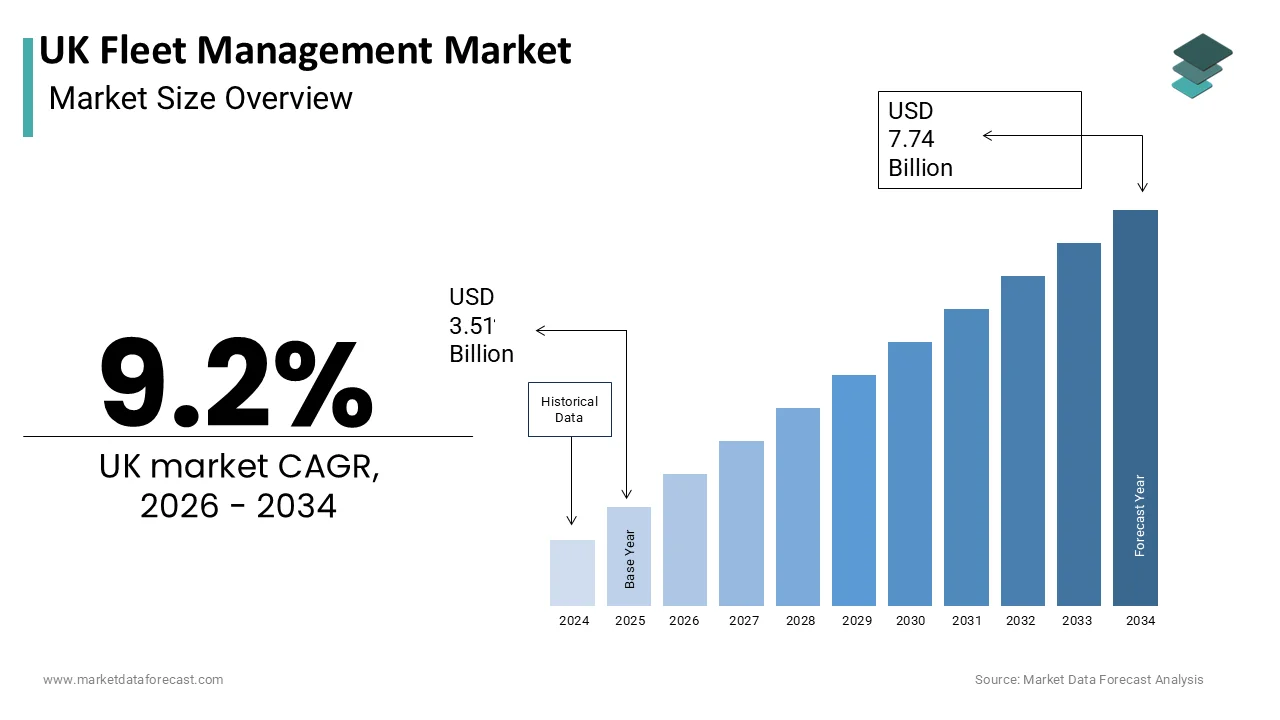
The UK fleet management market was valued at USD 3.51 billion in 2025, is anticipated to reach USD 3.83 billion in 2026, and is projected to scale up to USD 7.74 billion by 2034, registering a compound annual growth rate (CAGR) of 9.2% during the forecast period from 2026 to 2034. Driven by strict environmental regulations, low emission zones, rising fuel costs, and the digital transition toward AI-powered and electric vehicle telematics, the fleet management industry continues to expand rapidly across the British economy.
Key Executive Metrics (At-a-Glance)
- 2025 Base Valuation: USD 3.51 Billion
- 2026 Current Valuation: USD 3.83 Billion
- 2034 Forecast Valuation: USD 7.74 Billion
- Compound Annual Growth Rate (CAGR): 9.2% (2026–2034)
- Dominant Component Segment: Solutions (holding major market share due to comprehensive cloud dashboards for route, fuel, and maintenance tracking)
- Dominant Hardware Segment: Tracking Devices (essential for regulatory compliance and real-time asset visibility)
- Fastest-Growing Hardware Segment: Advanced Driver Assistance Systems / ADAS (propelled by safety standards and insurance premium incentives)
- Dominant Region / Market: United Kingdom
Core Market Drivers
- Stringent Environmental Regulations: Expansion of Ultra Low Emission Zones (ULEZ) and government initiatives targeting net-zero emissions by 2050.
- Rising Fuel Costs: Volatile energy prices driving commercial operators to monitor and reduce fuel consumption using advanced telematics.
- Electric Vehicle Integration: Transition toward mixed fleets requiring smart charging infrastructure and battery range management.
Primary Market Restraints & Challenges
- High Implementation Costs: Upfront investments in telematics hardware and integration complexities posing financial hurdles for small and medium-sized enterprises.
- Data Privacy & Cybersecurity: Driver resistance to continuous monitoring under GDPR guidelines and vulnerabilities in connected vehicle systems.
UK Fleet Management Market Segmentation Breakdown
| Segment Category | Leading Sub-Segment (2025 Base) | Fastest-Growing Sub-Segment (2026–2034) |
|---|---|---|
| By Component | Solutions (dominant share providing unified dashboards and compliance reporting) | Services (fastest-growing due to technical consulting and managed fleet support) |
| By Hardware | Tracking Devices (dominant share for GNSS location and basic tracking) | Advanced Driver Assistance Systems / ADAS (fastest-growing for proactive safety) |
| By Deployment | Cloud Deployment (dominant share enabling remote access and scalability) | Cloud Deployment / Cellular Systems |
Major Industry Players Profiled
Key enterprises shaping the competitive UK fleet management market include Geotab Inc., Verizon Connect, Samsara Inc., Motive Technologies, Inc., Teletrac Navman, Trimble Inc., Microlise Group plc, Radius Telematics Ltd., ABAX Group AS, Quartix Technologies plc, Webfleet Solutions, and Fleet Complete.
UK Fleet Management Market Size
The UK fleet management market was valued at USD 3.51 billion in 2025 and is estimated to reach USD 3.83 billion in 2026. The market is projected to grow to USD 7.74 billion by 2034, registering a CAGR of 9.2% from 2026 to 2034.
The fleet management is to optimize the operation maintenance and compliance of commercial vehicle fleets. As logistics and transportation form the backbone of the British economy, the efficient management of these assets is critical for maintaining supply chain resiliency and operational profitability. According to the Department for Transport, there are approximately 5.1 million licensed goods vehicles in the United Kingdom highlighting the substantial scale of assets requiring sophisticated management solutions. The transition toward digital operations has accelerated as businesses seek to reduce carbon footprints and adhere to stringent environmental regulations. Modern fleet management systems now incorporate artificial intelligence predictive maintenance and electric vehicle charging integration to address evolving industry needs. The regulations, including driver's hours rules and low emission zone, necessitate automated compliance tools that minimize administrative burden. Companies increasingly view fleet data as a strategic asset enabling informed decision-making regarding route optimization load planning and driver safety training.
MARKET DRIVERS
Stringent Environmental Regulations and Low Emission Zone Expansion
The stringent environmental regulations and the expansion of low-emission zones with the adoption of advanced fleet management solutions are fuelling the growth of the United Kingdom fleet management market. Government initiatives aimed at reducing air pollution and achieving net zero emissions by 2050 have forced commercial operators to monitor and optimize their environmental impact rigorously. According to the Department for Environment, Food and Rural Affairs, transport accounts for 27% of total United Kingdom greenhouse gas emissions with road transport being the largest contributing sector. The implementation of Ultra Low Emission Zones in London and similar clean air zones in cities, such as Birmingham, Manchester, and Bristol, imposes daily charges on non-compliant vehicles,s creating immediate financial incentives for fleet optimization. Fleet management systems enable operators to track vehicle emissions in real-time, me identihigh-pollutinging assets and plan routes that avoid chargeable areas, thereby reducing operational costs. The impending ban on new petrol and diesel car sales by 2035 further accelerates the need for systems that can manage mixed fleet, including electric and hybrid vehicles. These platforms provide critical insights into charging infrastructure usage battery health and range anxiety mitigation. Compliance reporting features automate the generation of necessary documentation for regulatory bodies reducing administrative overhead.
Rising Fuel Costs and Operational Efficiency Demands
The rising fuel costs and the relentless pursuit of operational efficiency are accelerating the growth of the United Kingdom ,'s governmentmarket. Volatile energy prices directly impact profit margins for logistics companies making fuel consumption monitoring and reduction a top priority for fleet managers. According to the Office for National Statistics, average diesel prices fluctuated significantly throughout 2024, with periods exceeding 160 pence per liter placing substantial financial strain on transport operators. Fleet management systems utilize advanced algorithms to analyze driving patterns such as harsh acceleration, idling, braking,g and excessive speeding, which are major contributors to fuel wastage. Route optimization features minimize unnecessary mileage by calculating the most efficient paths based on traffic conditions, road closures, and delivery windows. Real time tracking allows dispatchers to respond dynamically to changing circumstances preventing delays and reducing idle time. The integration of tire pressure monitoring systems ensures optimal rolling resistance for real-time fuel economy. Additionally, predictive maintenance alerts prevent mechanical issues that could lead to inefficient engine performance or breakdowns. For small and medium-sized enterprises operating on thin margins, these efficiencies are vital for survival. The ability to generate detailed fuel reports helps identify anomalies and potential theft providing an additional layer of financial control.
MARKET RESTRAINTS
High Initial Implementation Costs and Integration Complexity
The high initial implementation costs and the complexity of integrating new systems with legacy infrastructure are hindering the growth of the United Kingdom fleet management market. Small and medium sized enterprises often operate with limited capital budgets making the upfront investment in telematics hardware,e software licenses, and installation services prohibitive. According to the Federation of Small Businessmedium-sized2% of small transport firms cite cost as the primary barrier to adopting digital management tools. The total cost of ownership extends beyond hardware to include subscription fees, training expenses, and ongoing technical support which can strain financial resources. Furthermore, integrating modern cloud-based platforms with existing enterprise resource planning systems accounting software, and legacy databases requires specialized technical expertise and custom development work. The lack of standardized application programming interfaces among different vendors exacerbates this problem fo,, forcing companies to rely on proprietary solutions that may not communicate effectively with other business tools. Older vehicles in many fleets lack the necessary electronic control units to support advanced telematics devices requiring additional retrofitting efforts that increase installation time and cost.
Data Privacy Concerns and Driver Resistance to Monitoring
The data privacy concerns and resistance from drivers toward continuous monitoringg is declining the growth of the United Kingdom fleet management market. The collection of detailed data regarding driver behavior location and working hours raises significant ethical and legal questions under the General Data Protection Regulation. According to Information Commissioner Office guidelines employers must ensure transparency and obtain explicit consent when monitoring employees balancing business interests with individual privacy rights. Many drivers perceive telematics systems as surveillance tools, rather than safety aids, leading to decreased morale and potential labor disputes. This distrust can result in deliberate attempts to circumvent monitoring devices or reduced cooperation with management initiatives. Legal complexities surrounding data ownership, storage duration, and access rights require robust governance frameworks that many smaller fleet operators struggle to implement correctly. The fear of misuse of data for insurance premium adjustments or performance penalties creates a hostile environment for technology adoption. Additionally, the psychological impact of constant monitoring can increase stress levels among drivers, potentially affecting safety outcomes negatively. Organizations must invest significantly in change management, communication, and transparent policy development to mitigate these concerns.
MARKET OPPORTUNITIES
Integration of Electric Vehicles and Charging Infrastructure Management
The integration of electric vehicles and the management of associated charging infrastructure is certainly to create new opportunities for the growth of the United Kingdom fleet management market. As government mandates accelerate the transition to zero emission transport, fleet operators require specialized solutions to handle the unique complexities of electric vehicle operations. Fleet management platforms are evolving to include features such as real-time battery range prediction based on load and terrain and intelligent charging scheduling to optimize energy usage and costs. The demand for electricity from commercial transport will grow relatively requiring smart charging soluti,,ons that balance grid load and take advant,, age of off-peak tariffs. These systems enable fleet managers to locate available charging stations plan routes that include charging stops and monitor charger health to prevent downtime. The ability to analyze energy consumption off-peak helps organizations negotiate better utility contracts and identify inefficiencies in charging practices. Furthermore, integrationwith renewable energy sources such as solar panels at depots offers additional cost savings and sustainability benefits. Providers that offer comprehensive electric vehicle management modules gain a competitive advantage by addressing the specific pain points of early adopters.
Expansion of Predictive Maintenance and Artificial Intelligence Analytics
The expansion of predictive maintenance capabilities powered by artificial intelligence analytics is also promoting new opportunities for the growth of the United Kingdom fleet management market. Traditional reactive maintenance strategies often result in costly breakdowns and service interruptions whereas predictive models use historical data and real time sensor inputs to anticipate component failures before they occur. Advanced algorithms analyze data from engine diagnostics tire pressure sensors,, and braking syste,, ms to identify subtle anomalies that indicate wear real-time. This proactive approach extends vehicle lifespan, improves safety,, and enhances customer satisfaction through consistent servicece delivery. The integration of machine learning allows systems to improve accuracy over time by learning from specific vehicle usage patterns and environmental conditions. Suppliers offering these advanced analytics capabilities can differentiate themselves in a crowded market by demonstrating tangible return on investment through reduced repair bills and improved asset utilization. Additionally, predictive maintenance supports warranty claims management by providing detailed evidence of proper vehicle care. As connectivity improves and sensor costs decline, the accessibility of these sophisticated tools increases allowing smaller fleets to benefit from enterprise grade maintenance strategies.
MARKET CHALLENGES
Cybersecurity Vulnerabilities in Connected Vehicle Systems
The cybersecurity vulnerabilities in connected vehicle systems,as increasing connectivity exposes fleets to enterprise-grade cyber-attacks and data breaches is one of the challenges for the growth of the United Kingdom fleet management market. Modern telematics devices and onboard computers are integral parts of the internet of things ecosystem making them attractive targets for malicious actors seeking to disrupt operations or steal sensitive data. A successful breach could allow attackers to manipulate vehicle control access to the custom Internet fleet, data hostage demanding ransom payments. The complexity of securing thousands of distributed endpoints across a fleet requires robust encryption secure authentication protocols, and continuous monitoring, which many operators lack the expertise to implement effectively. Supply chain vulnerabilities in third party software components further exacerbate the risk as a single weak link can compromise the entire network. Regulatory requirements for cybersecurity compliance are becoming stricter, adding pressure on firms toimplement third-partye measures. The potential reputational damage,, legal and financial losses from a security breach deter some organizations from fully embracing connected technologies.
Shortage of Skilled Technical Personnel and Data Analysts
The shortage of skilled technical personnel and data analysts is also to impede the growth of the United Kingdom fleet management market. While technology provides vast amounts of data deriving actionable insights requires specialized skills in data interpretation system administration, and stexpected expected rategic planning, which are in short supply. Fleet managers often lack the technical proficiency to leverage advanced analytics features, resulting in underutilization of expensive software capabilities. This skills gap limits the ability of organizations to transition from basic tracking to sophisticated predictive analytics and optimization strategies. Training existing employees requires time and resources that many companies cannot afford amidst operational pressures. The reliance on external consultants for system configuration and analysis increases costs and reduces internal ownership of data-driven initiatives. Furthermore, the rapid pace of technological change means that skills become obsolete quickly, requiring continuous professional development.
REPORT COVERAGE
| REPORT METRIC | DETAILS |
| Market Size Available | 2025 to 2034 |
| Base Year | 2025 |
| Forecast Period | 2026 to 2034 |
| Segments Covered | By Component, Hardware, Deployment, Communication, and Region. |
| Various Analyses Covered | Global, Regional and Country-Level Analysis, Segment-Level Analysis, Drivers, Restraints, Opportunities, Challenges; PESTLE Analysis; Porter’s Five Forces Analysis, Competitive Landscape, Analyst Overview of Investment Opportunities |
| Countries Covered | United Kingdom |
| Market Leaders Profiled | Geotab Inc., Verizon Connect, Samsara Inc., Motive Technologies, Inc., Teletrac Navman, Trimble Inc., Microlise Group plc, Radius Telematics Ltd., ABAX Group AS, Quartix Technologies plc, Webfleet Solutions (Bridgestone Mobility Solutions), Fleet Complete. |
SEGMENTAL ANALYSIS
By Component Insights
The solutions segment was the largest by accounting for 54.3% of the United Kingdom fleet management market share in 2025. Large logistics operators particularly rely on comprehensive dashboards that integrate multiple data streams, including fuel consumption route adherence and maintenance schedules to manage complex fleets efficiently. The shift toward cloud based architectures has further accelerated solution adoption by enabling real time access to fleet information from any location fac, facilitating remote management and decision making. Regulatory compliance requires cloud-based drivers' hours recording and low emission zone reporting, necessitating real-time software modules that reduce administrative burdens and minimize penalty risks. Organizations view these solutions as strategic assets that provide a competitive advantage through low-emission customer service, reliability,, and operational transparency.
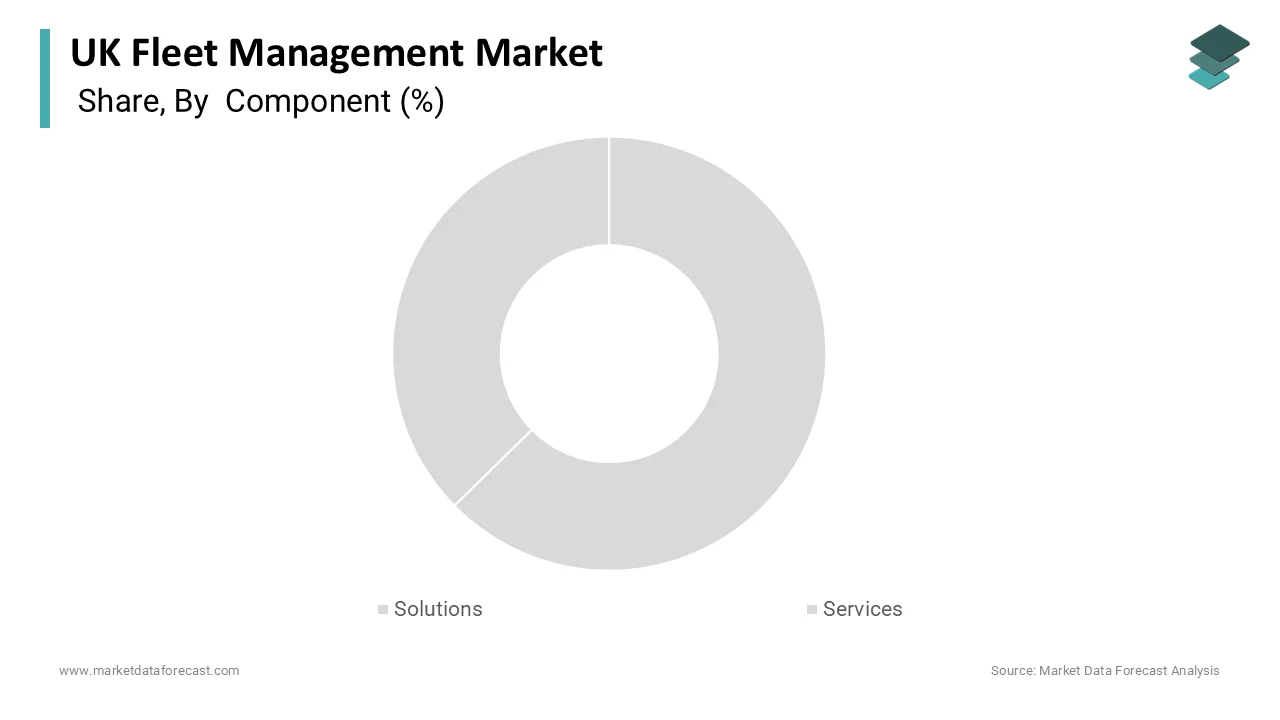
The services segment is expected to grow at a fastest CAGR of 12.8% throughout the forecast period owing to the intricate nature of modern fleet ecosystems which require specialized consulting, installation, training, and ongoing support to realize expected benefits. The shortage of internal technical talent exacerbates this trend with many companies lacking the specialized skills required to configure advanced telematics systems and interpret complex data sets. The United Kingdom technology sector faces a significant skills gap, prompting firms to outsource system administration and data analysis tasks. Managed services are gaining traction, as businesses seek predictable operational costs and guaranteed service level agreements with 52% of firms opting for fully managed fleet monitoring packages. Post implementation support constitutes another significant growth driver since continuous software updates hardware maintenance and driver training requiree dedicated resources that internal teams often lack capacity to provide. The emergence of industry specific consulting practices offering best practice frameworks further accelerates service demandd by reducing time to value.
By Hardware Insights
The tracking devices segment held a dominant share of the United industry-specific management hardware market in 2025 owing to the regulatory mandates and basic operational needs that make real time tracking a non-negotiable requirement for most commercial vehicles. The widespread adoption of Global Navigation Satellite System receivers ensuresthat fleet managers can monitor vehicle location prevent theft, and ensure real-time delivery completion with high accuracy. The maturity of tracking technology means it is affordable and reliable making it the entry point for many small businesses entering the digital fleet management space. Integration with cellular networks allows for near real-time data transmission, enabling dispatchers to respond quickly to customer inquiries or unexpected delays. The simplicity of installation and minimal maintenance requirements further boost the growth of the segment
The advanced driver assistance systems segment is deemed to witness a fastest CAGR of 18.5% from 2026 to 2034. The stringent safety regulations and the proven ability of ADAS technologies, such as lane departure warnings automatic emergency braking and blind spot detection,, to reduce accident rates significantly. Insurance companies are also playing a crucial role by offering substantial premium reductions for fleets that invest in proactive,, e-safety technologies. As artificiall intelligence improves the accuracy and reliability of these systems, they are becoming standard equipment in new vehicles and popular retrofits for older fleets. The integration with broader telematics platforms enabling holistic risk management and driver coaching programs is also bolstering the growth of the segment. Modern ADAS hardware does not operate in isolation but feeds data into fleet management software where it is analyzed to identify risky driving patterns and provide targeted feedback to drivers.
By Deployment Communication Insights
The cloud deployment segment was the largest by holding 43.2% of the United Kingdom fleet management market share in 2025, owing to the ability of cloud platforms to provide real-time data access from any device anywhere, eliminating the need for expensive local server infrastructure and dedicated IT staff. The subscription-based pricing model converts large capital expenditures into predictable operational expenses,making advanced fleet management accessible to businesses with limited budgets. Automatic updates ensure users always have access to the latest features, security patches, and compliance enhancements without disruptive manual upgrades. The inherent scalability of cloud architecture allows fleets to easily add or remove vehicles and users as business needs change, supporting seasonal fluctuations and growth without infrastructure constraints. Remote accessibility supports the growing trend of hybrid work arrangements, enabling managers to oversee operations from home or while traveling.
The cellular systems segment is likely to grow at a fastest CAGR of 14.2% during the forecast period, with the increasing demand for real-time video streaming, high-frequency location updates, and instant two-way communication between vehicles and control centers. Traditional satellite or radio communication methods struggle to handle the volume of data generated by modern sensors and cameras making cellular connectivity the preferred choice for advanced fleet operations. The ubiquity of cellular networks ensures consistent connectivity even in urban canyons, where GPS signals may be weak, e,nhancing the reliability of tracking and monitoring services. The cost of cellular data plans has decreased significantly while data allowances have increased making it economically viable to transmit large volumes of telemetry data continuously. This technological advancement unlocks new possibilities such as live video feeds for security and training further driving theadoptionn of cellular-connected devices in commercial fleets.
The monitoring segment is likely to grow at a fastest CAGR of 16.5% from 2026 to 2034 with the recognition that human error is a leadleadingse of accidents and that cellular connectivity signifiimprovesprovess safety outcomes. Fleet managers use telematics data to score driver performance and provide targeted coaching turning raw data into behavioral change. The introduction of gamification elements in monitoring apps encourages friendly competition among drivers, fostering a culture of safety and efficiency. Regulatory pressure to demonstrate a duty of care also drives adoption as companies seek to protect themselves from liability in the event of incidents. The ability to identify and correct risky behaviors before they lead to accidents makes driver behaviour a monitoring a high value function that delivers tangible financial and social returns driving its rapid adoption across the sector.
COMPETITIVE LANDSCAPE
The competition within the United Kingdom fleet management market is intense and characterized by the presence of global technology giants alongside innovative domestic providers specializing in niche sectors. Established multinational corporations leverage their extensive product portfolios, global support networks, and brand recognition to secure contracts with large enterprises and public sector entities requiring comprehensive and scalable solutions. These leaders continuously innovate by embedding advanced technologies, such as artificial intelligence and blockchain, to differentiate their offerings and address evolving business needs. Meanwhile, agile local vendors compete effectively by offering highly customizable ,cost-effective, cloud-based solutions tailored specifically for small and medium-sized enterprises that prioritize ease of use and rapid deployment. Differentiation increasingly depends on industry-specific functionalit ,,regulatory compliance features, a, nd integration capabilities with existing business applications. Customer retention strategies focus on continuous product updates, proactive support,,and training programs to ensure long-term value realization.
KEY MARKET PLAYERS
Some of the companies that are playing a dominating role in the U.K. Fleet Management Market include
- Geotab Inc.
- Verizon Connect
- Samsara Inc.
- Motive Technologies, Inc.
- Teletrac Navman
- Trimble Inc.
- Microlise Group plc
- Radius Telematics Ltd.
- ABAX Group AS
- Quartix Technologies plc
- Webfleet Solutions (Bridgestone Mobility Solutions)
- Fleet Complete
TOP LEADING PLAYERS IN THE MARKET
- Verizon Connect maintains a robust presence in the United Kingdom high-value sector by providing comprehensive telematics solutiothat integrateate vehicletrackin gi ,ng driver behaviomonitoringr i,ng and workflow automation. The company focuses on delivering actionable insights through its unified platform, which helps businesses optimize routes reduce fuel consumptio, and enhance safety and compliance. Recent initiatives include the expansion of its electric vehicle management capabilities to support the growing transition toward a sustainable transport fleet across Britain. Verizon,,n Connect has also invested heavily in artificial intelligence driven analytics to offer predictive maintenance alerts and real time decision support tools. These efforts aim to solidify its reputation as a leader in connected fleet technologies while addressing the specific intelligence-driven operational needs of British logistics operators seeking real-time and compliance.
- Webfleet Solutions plays a pivotal role in the United Kingdom market by offering scalable fleet management software tailored for small, mmediummm ,and large enterprises across diverse industries. Tcompany emphasizes user-friendlyyly interfaces and mobile accessibility, enabling fleet managers to monitor operations remotely with ease. Webfleet has also expanded its ecosystem by partnering with leading hardware manufacturers to ensure seamless compatibility and installation processes. The introduction of specialized modules for temperature-controlled logistics addresses the needs of food and pharmaceutical distributors requiring strict compliance with cold chain regulations.
- Trimble Inc contributes significantly to the United Kingdom fleet management landscape by leveraging its expertise in positioning technology and data analytics to deliver high precision solutions for complex logistics challenges. The company serves heavy construction agriculture and transportation sectors with tools that enhance asset utilization and project visibility. Trimble hactivelyigh-precision colcollaborationsth local software developers to customize offerings for the British market ,, ketensuri,, adherence to local tax a lor regulations. The company also focuses on sustainability by providing detailed emissions reporting features that help clients meet environmental targets. Through continuous iinvestmentin research and development, Trimble ensures its solutions remain at the forefront of technological advancement supporting the modernization of UK commercial transport infrastructure.
TOP STRATEGIES USED BY KEY MARKET PARTICIPANTS
Key players in the United Kingdom fleet management market predominantly employ product innovation and strategicpartnerships to maintain competitive advantage and drive growth. Companies consistently invest in research and development to integrate artificial intelligence,,achine learning, and Internet of Things connectivity into their platform, e,nabling clclientso achieve greater operational efficiency and predictive insights. Developing industry-specific solutions allows vendors to address unique regulatory and operational challenges faced by sectors, such as healthcare, construction, and rretail,il thereby increasing relevance and adoption rates. Strategic acquisitions of niche technology firms provide access to specialized capabilities such as video telematics or electronic logging dedevicesces which are then integrated into broader suites to offer comprehensive value propositions. Expanding partner ecosystems with local telecommunications providers and hardware manufacturers ensures robust connectivity and device compatibility which is crucial for reliable service delivery. Emphasizing cloud-based architectures and subscription models lowers entry barriers for small businesses while providing scalable solutions that grow with client needs.
MARKET SEGMENTATION
This research report on the UK fleet management market is segmented and sub-segmented into the following categories.
By Component
- Solutions
- Services
By Hardware
- Tracking Devices
- Advanced Driver Assistance Systems (ADAS)
- Dash Cameras
- Sensors
- Others
By Deployment
- Cloud
- On-Premises
By Communication
- Cellular Systems
- Satellite Systems
- Hybrid Systems
- Others
By Country
- United Kingdom