- Product Description Description
- Table of Contents TOC
- List of Table & Figure LOT
- Get Free Sample PDF Sample PDF
Market Size, 2025
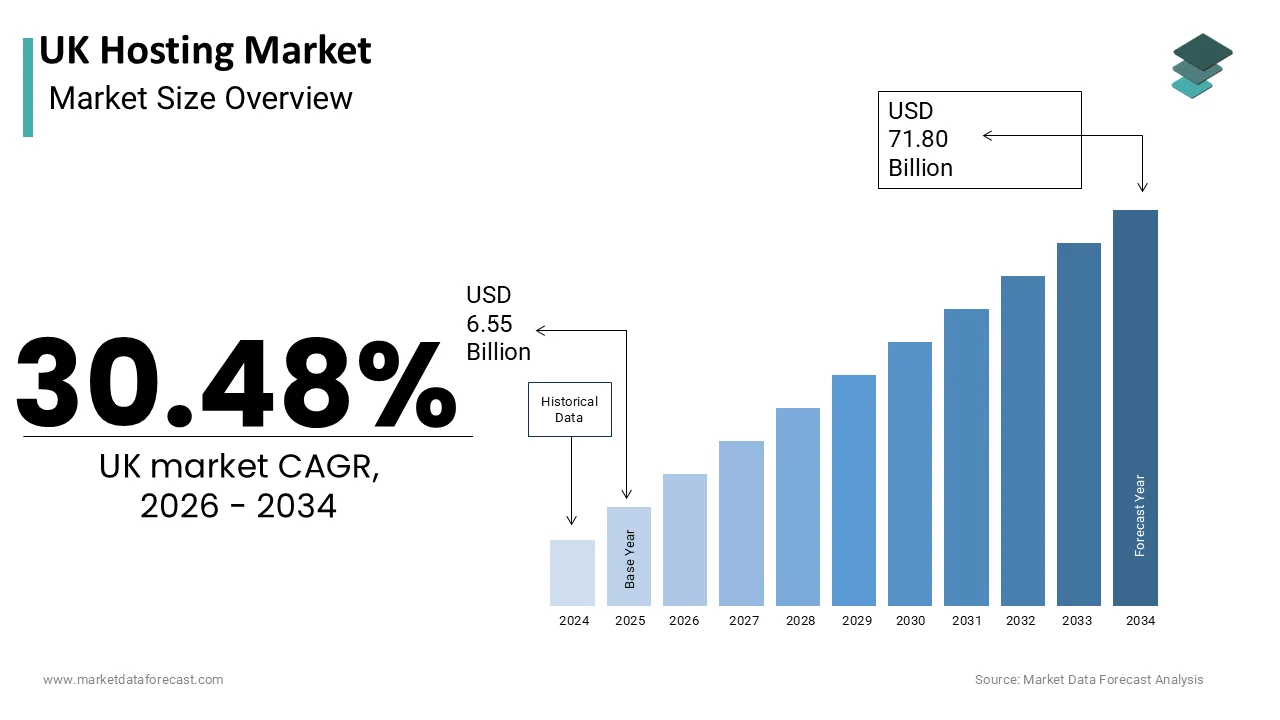
$6.55 BnMarket Estimate, 2026
$8.55 BnMarket Forecast, 2034
$71.80 BnCAGR, 2026–2034
30.48%UK Hosting Market Size
The UK Hosting Market is projected to grow from USD 6.55 billion in 2025 to USD 8.55 billion in 2026 and reach USD 71.80 billion by 2034, registering a CAGR of 30.48% during the forecast period from 2026 to 2034.
Hosting represents a critical infrastructure layer supporting the nation’s digital economy, encompassing dedicated servers, virtual private networks, cloud hosting, and colocation services. This sector provides the essential computational power, storage, and network connectivity required for businesses to operate online applications, store data, and ensure business continuity. As digital transformation accelerates across industries, the demand for reliable, secure, and scalable hosting solutions has become paramount. According to the Office for National Statistics, the final results from Wave 157 of the Business Insights and Conditions Survey, 65% of large enterprises in the UK with 250 or more employees reported utilizing cloud computing services in late May 2026. The regulatory landscape is heavily influenced by data sovereignty requirements, with organizations prioritizing local data centers to comply with General Data Protection Regulation standards. According to the Department for Scien,,ce Innovatio,, Innovation and Technology economic statistics, the digital and technology sector produced an estimated 158 billion pounds in gross value added to the UK economy in 2024. The market is characterized by a shift toward hybrid and multi-cloud architectures, a technology to balance performance, cost, and security. Energy efficiency has emerged as a key consideration, with providers investing in green technologies to meet multi-cloud goals. The proliferation of Internet of Things devices and edge computing applications further drives the need for distributed hosting capabilities. This dynamic environment requires continuous innovation in hardware, software, and network management to support the growing volume of digital transactions and data processing needs across the country.
MARKET DRIVERS
Stringent Data Sovereignty and Regulatory Compliance Requirements
Stringent data sovereignty and regulatory compliance requirements are propelling the UK hosting market forward, as organizations seek to maintain control over their data within national borders. The General Data Protection Regulation and post Brexit legal frameworks mandate that the personal data of UK citizens be stored and processed under strict jurisdictional controls to ensure privacy and security. According to the Information Commissioner's Office annual Commissioner's1,991 personal data breach cases were completed in 2024, with non-compliant entities facing significant fines, creating a strong incentive for local hosting. As per a survey conducted on behalf of cybersecurity industry reviews, 78% of financial services and healthcare organizations prefer domestic data centers to mitigate legal risks and ensure rapid response to regulatory audits. The uncertainty surrounding international data transfer agreements has further reinforced the preference for UK-based infrastructure among multinational corporations operating in the region. Local hosting providers offer guaranteed compliance with UK-specific laws, reducing the administrative burden on clients. This regulatory pressure drives demand for secure colocation and private cloud services that provide transparent audit trails and physical security measures. Organizations view local hosting not merely as a technical choice, but as a legal necessity to protect reputation and avoid penalties. The emphasis on data residency ensures sustained investment in UK data center facilities and hosting platforms that can demonstrate full adherence to national and European privacy standards.
Rapid Adoption of Cloud Computing and Digital Transformation Initiatives
The rapid adoption of cloud computing and broader digital transformation initiatives is further fuelling the expansion of the UK hosting market, as businesses modernize their IT infrastructure to enhance agility and competitiveness. Organizations are migrating legacy systems to cloud environments to leverage scalability, flexibility, and cost efficiency, enabling them to respond quickly to changing market conditions. According to a UK technology industry spending survey, cloud spending in the UK reached 15 billion pounds in 2024, reflecting a 12% annual growth rate driven by enterprise migration projects. As per cloud provider customer success data, small and medium-sized enterprises are increasingly adopting hybrid hosting models that combine on-premises security with cloud to support remote work and collaborative tools. The shift toward software as a service and platform as a service models requires a robust underlying hosting infrastructure to ensure low latency and high availability. Government initiatives, such as the Digital Strategy, encourage public sector bodies to adopt cloud-first policies, further boosting demand for secure government-compliant hosting. The integration of artificial intelligence and big data analytics into business operations necessitates high-performance computing resources that specialized hosting providers can deliver. This technological evolution creates a continuous need for upgraded servers, faster network connections, and managed services. Consequently, the hosting market expands as it becomes the foundational backbone for all digital innovation and operational efficiency improvements in the UK economy.
MARKET RESTRAINTS
High Energy Costs and Operational Expenses
High energy costs and escalating operational expenses are hampering the expansion of the UK hosting market. Data centers are energy-intensive facilities, requiring constant power for servers, cooling, and lighting, making them highly vulnerable to fluctuations in electricity prices. According to the Office for National Statistics' industrial electStatistics'ces data, average prices for extra-large industrial consumers rose significantly in recent years, placing substantial financial strain on hosting providers who operate on thin margins. As per international data center infrastructure surveys, 60% of data center operators cite energy costs as their biggest operational challenge, forcing them to pass these increases onto customers or reduce investment in new infrastructure. The volatility of energy markets makes long-term pricing strategies difficult, leading to uncertainty for both providers and clients. Smaller hosting companies struggle to compete with larger players, who can negotiate better energy contracts or invest in renewable energy sources to stabilize costs. The need for redundant power supplies and backup generators further adds to capital expenditure requirements. These financial pressures limit the ability of providers to upgrade hardware or expand capacity at the pace required by growing demand. Some organizations may delay migration projects or opt for cheaper, less reliable hosting options to save money, compromising performance and security. The high cost of power remains a persistent barrier to sustainable growth and innovation in the UK hosting sector.
Shortage of Skilled Technical Personnel
A pronounced shortage of skilled technical personnel is further impeding the UK hosting market growth. The complex nature of modern hosting environments requires professionals with expertise in cloud architecture, cybersecurity, network engineering, and system administration, yet the talent pool remains insufficient to meet escalating demand. According to a UK digital economy skills review, the technology sector faces a significant structural vacancy deficit, with data center specialists among the most critically short occupations. This scarcity drives up labor costs, with average tech industry salaries growing notably each year, making recruitment prohibitively expensive for many providers. The lack of qualified staff leads to longer resolution times for technical issues, increased risk of human error, and delays in deploying new services. Training existing employees requires significant time and resources that smaller firms often cannot afford. The talent competition is intense, not only from other hosting companies but also from big tech firms and financial institutions offering attractive compensation packages. This brain drain exacerbates the skills gap and limits the capacity of hosting providers to innovate or scale operations effectively. Without a sufficient workforce to manage and maintain complex infrastructure, the quality of service may suffer, affecting customer satisfaction and retention rates in a competitive market.
MARKET OPPORTUNITIES
Expansion of Edge Computing Infrastructure
The expansion of edge computing infrastructure presents substantial opportunities for the UK hosting market, as businesses seek to reduce latency and improve real-time data processing capabilities. Edge computing involves placing computing resources closer to the source of data generation, such as IoT devices and mobile users, rather than relying solely on centralized data centers. According to telecommunications sector technology forecasts, the global edge computing market is projected to grow significantly, with the UK being a key adopter due to its dense urban population and advanced telecommunications network. As per connectivity infrastructure development updates, the rollout of 5G networks has accelerated the demand for edge hosting solutions to support applications requiring ultra-low latency, such as autonomous vehicles, smart cities, and augmented reality. Hosting providers can capitalize on this trend by establishing micro data centers in strategic locations across the country to serve local markets more efficiently. This decentralized approach reduces bandwidth costs and improves user experience for latency-sensitive applications. Industries, such as manufacturing, healthcare, and retail, are increasingly investing in edge solutions to enable real-time analytics and decision-making. By offering managed edge hosting services, providers can attract new customers looking to optimize performance for next-generation technologies. This shift towards distributed computing creates new revenue streams and strengthens the strategic value of hosting infrastructure in the digital ecosystem.
Integration of Artificial Intelligence for Managed Services
The integration of artificial intelligence for managed services offers significant opportunities for the UK hosting market. AI-driven tools can automate routine tasks, such as server monitoring, threat detection, and resource allocation, reducing the workload on technical staff and minimizing human error. According to enterprise software implementation case studies, organizations implementing AI-powered IT operations report a 30% reduction in downtime and a 25% improvement in incident response times. As per enterprise technology adoption studies, AI-enabled managed hosting services allow providers to offer predictive maintenance, identifying potential hardware failures before they occur and ensuring continuous availability for clients. Machine learning algorithms can analyze traffic patterns to optimize load balancing and energy usage, leading to cost savings and improved performance. Customers benefit from enhanced security features, such as automated anomaly detection that identifies and mitigates cyber threats in real time. The ability to provide intelligent insights into application performance helps businesses make informed decisions about their IT strategy. Hosting providers that embed AI into their service offerings can differentiate themselves from competitors by delivering superior reliability and proactive support. This technological advancement transforms hosting from a commodity utility into a strategic partner for digital innovation, driving customer loyalty and long-term growth.
MARKET CHALLENGES
Cybersecurity Threats and Data Breach Risks
Cybersecurity threats and the risk of data breaches are challenging the expansion of the UK hosting market, as providers become prime targets for sophisticated cyber-attacks seeking to exploit vulnerabilities in interconnected systems. Hosting companies store vast amounts of sensitive client data, making them attractive targets for ransomware, phishing, and distributed denial of service attacks. According to the National Cyber Security Centre, the number of significant cyber incidents reported by UK organizations increased markedly in recent reporting cycles, with the technology sector being heavily targeted. As per corporate cyber risk financial models, the average cost of a data breach for technology companies can comfortably exceed 3 million pounds, including recovery expenses, legal fees, and reputational damage. The complexity of securing hybrid and multi-cloud environments introduces multiple entry points for attackers, requiring robust and continuous monitoring. Clients expect hosting providers to guarantee absolute security, but the evolving nature of threats makes this difficult to achieve without constant investment in advanced defense mechanisms. A single successful attack can lead to loss of customer trust, contractual penalties, and regulatory fines under the General Data Protection Regulation. The shortage of cybersecurity experts further complicates efforts to maintain robust defenses. Providers must balance accessibility for legitimate users with strict access controls, which can impact usability. These persistent security challenges require ongoing vigilance and substantial financial commitment, threatening the stability and reputation of hosting businesses.
Environmental Sustainability and Carbon Footprint Reduction
Environmental sustainability and the pressure to reduce carbon footprints are further challenging the expansion of the UK hosting market, as stakeholders demand greener operations and greater transparency regarding energy usage. Data centers are significant consumers of electricity and water, contributing to environmental impact, which conflicts with corporate net-zero commitments and regulatory expectations. According to the Committee on Climate Change, the technology sector must significantly reduce its emissions to meet the UK’s 2050 net zero target, prompting scrutiny of data center energy sources. As per environmental non-governmental organization investigations, many hosting providers still rely on non-renewable energy sources despite public claims of sustainability, leading to accusations of greenwashing. Implementing energy-efficient cooling systems and transitioning to renewable energy requires substantial capital investment and technical expertise. Clients are increasingly requesting detailed environmental impact assessments and carbon reporting as part of their procurement processes, adding administrative burden. The lack of standardized metrics for measuring sustainability makes it difficult to compare providers and verify claims. Regulatory pressures may soon mandate stricter energy efficiency standards, forcing older facilities to undergo costly upgrades or face closure. Balancing the growing demand for computing power with environmental responsibility is a complex challenge that requires innovation in hardware design, facility management, and energy sourcing. Failure to address these concerns effectively risks losing environmentally conscious customers and facing regulatory sanctions.
REPORT COVERAGE
| REPORT METRIC | DETAILS |
| Market Size Available | 2025 to 2034 |
| Base Year | 2025 |
| Forecast Period | 2026 to 2034 |
| Segments Covered | By Type, Application, Deployment, and Region. |
| Various Analyses Covered | Global, Regional and Country-Level Analysis, Segment-Level Analysis, Drivers, Restraints, Opportunities, Challenges; PESTLE Analysis; Porter’s Five Forces Analysis, Competitive Landscape, Analyst Overview of Investment Opportunities |
| Countries Covered | United Kingdom |
| Market Leaders Profiled | Amazon Web Services, Inc., Microsoft Corporation, Google LLC, IONOS Group SE, GoDaddy Inc., OVHcloud, Host Europe Group, Fasthosts Internet Ltd., Krystal Hosting Ltd., 20i Ltd., Liquid Web, LLC, DigitalOcean Holdings, Inc. |
SEGMENTAL ANALYSIS
By Type Insights
The managed hosting segment dominated the market by holding the major share of the UK hosting market in 2025 as organizations increasingly prioritize operational efficiency and seek to offload the complexities of server management to specialized providers. This dominance is further driven by the critical need for businesses to focus on their core competencies, rather than maintaining an intricate IT infrastructure, which requires constant monitoring, patching, and security updates. According to enterprise hosting procurement surveys, over 65% of medium to large enterprises in the UK prefer managed hosting solutions to ensure high availability and reduce the burden on internal IT teams. The shortage of skilled technical personnel exacerbates this trend, with technology workforce data reporting a notable deficit of tech professionals, forcing companies to rely on external experts for system administration. As per information technology performance benchmarks, organizations utilizing managed hosting services report a 30% reduction in unplanned downtime due to proactive maintenance and expert oversight. Managed hosting providers offer service level agreements that guarantee performance metrics, providing peace of mind for mission-critical applications. The inclusion of security management, backup services, and disaster recovery in managed packages creates comprehensive value propositions that standalone hosting cannot match. Financial services, healthcare, and e-commerce sectors particularly drive this demand, due to strict regulatory compliance requirements that managed providers are better equipped to handle. This reliance on specialized support ensures that managed hosting remains the preferred choice for businesses seeking reliability and scalability, without the overhead of extensive internal staffing.
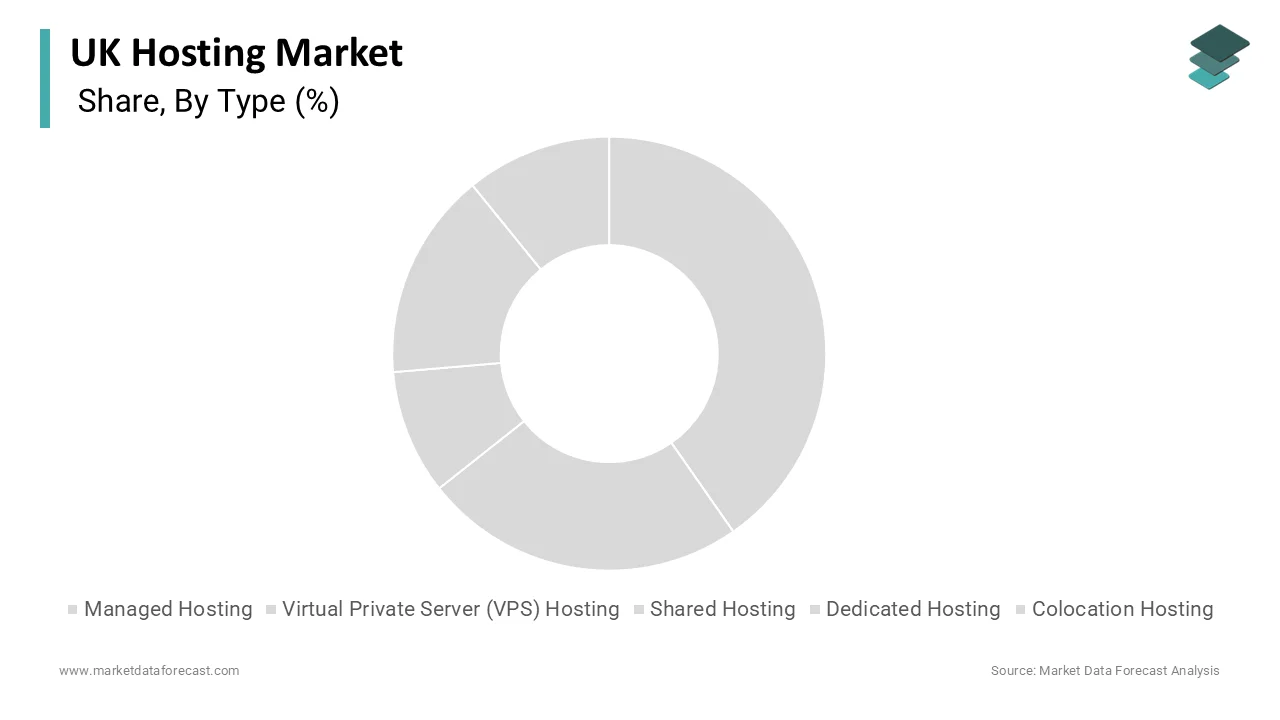
On the other side, the virtual private server hosting segment is predicted to showcase a CAGR of 12.4% during the forecast period as small and medium-sized enterprises seek affordable yet powerful hosting solutions and the growing need for dedicated resources and root access without the high costs associated with dedicated physical servers. According to small business digital hosting data, the number of small businesses in the UK adopting virtual private server hosting increased by 18% in 2024, reflecting the democratization of enterprise-grade hosting capabilities. Virtual private servers offer isolated environments that prevent resource contention from other users, ensuring consistent performance for web applications and databases. As per hosting platform commercial benchmarks, the average cost of virtual private server hosting is 40% lower than dedicated hosting, making it an attractive option for startups and growing companies with limited budgets. The flexibility to scale CPU, RAM, and storage resources on demand allows businesses to adjust to traffic fluctuations without significant capital expenditure. Cloud-based virtual private server offerings further enhance this agility by enabling instant provisioning and geographic distribution of resources. The ease of migration from shared hosting to virtual private servers encourages upgrades, as websites grow in complexity and traffic volume. This balance of performance, control, and affordability ensures that virtual private server hosting continues to capture market share from both entry-level and high-end segments.
By Application Insights
The public website segment held the largest share of the UK hosting market in 2025 due to the universal necessity for an online presence in today’s digital economy, where consumers rely on websites for product discovery, brand engagement, and transactions. According to the Office for National Statistics, 96% of large enterprises and 82% of small businesses in the UK maintain active public websites, demonstrating near universal adoption. The growth of e-commerce has further amplified this demand, with online retail sales accounting for 26% of total retail spending, as per Office for National Statistics retail trade figures. Public websites require reliable hosting to ensure fast load times and high availability, which directly impact search engine rankings and user conversion rates. Content management systems, such as WordPress, power a significant portion of these sites, requiring optimized hosting environments for plugins, themes, and media files. Marketing initiatives, including search engine optimization and social media campaigns, drive traffic to public websites, necessitating scalable hosting resources to handle spikes in visitor numbers. The role of public websites as the central node for digital marketing, customer support, and brand identity ensures their continued leadership in hosting application usage. Businesses invest heavily in hosting performance to maintain a competitive advantage and deliver seamless user experiences.
However, the mobile segment is projected to witness a promising CAGR of 14.1% during the forecast period in the UK market,t owing to the rising preference for mobile apps over websites for frequent tasks, due to their superior performance, offline capabilities, and push notification features. According to Ofcom comm the communications market data, 96% of adults in the UK owned a smartphone in 2024, creating a massive installed base for mobile applications. As per mobile app data tracking systems, UK users spend a high number of hours per day on mobile apps, spanning categories such as banking, shopping, gaming, and social media. Mobile applications require backend hosting infrastructure to manage user authentication, data synchronization, and real-time updates, necessitating scalable and low-latency server environments. The rise of super apps that combine multiple services into a single platform further increases the complexity and resource demands on hosting providers. Developers prefer cloud native hosting solutions that support continuous integration and deployment pipelines for rapid app updates. The monetization potential of mobile apps, through in-app purchases and subscriptions, incentivizes businesses to invest in high-quality hosting to ensure smooth user experiences. This shift toward mobile-first strategies ensures that the hosting requirements for mobile applications will continue to outpace other segments.
By Deployment Insights
The public cloud segment had the major share of the UK hosting market in 2025, as it offers unparalleled scalability, cost efficiency, and accessibility for businesses of all sizes. Public cloud providers operate massive global infrastructures that allow customers to rent computing resources on a pay-as-you-go basis, eliminating the need for significant upfront capital investment in hardware. According to cloud infrastructure expenditure statistics, public cloud spending in the UK reached 12 billion pounds in 2024, representing the largest share of cloud infrastructure investment. As per corporate software deployment surveys, 80% of startups and small businesses prefer public cloud hosting due to its low barrier to entry and immediate availability of resources. The ability to scale resources up or down instantly in response to demand fluctuations ensures optimal performance without over-provisioning. Public cloud providers also offer a wide range of managed services, including databases, artificial intelligence, and analytics tools that accelerate application development. The geographic distribution of public cloud data centers ensures low-latency access for users across the country. Regulatory certifications obtained by major public cloud providers reassure customers regarding security and compliance standards. The ecosystem of third-party applications and integrations available on public cloud platforms further enhances their value proposition. This combination of economic and operational benefits ensures that public cloud remains the default choice for most hosting requirements.
However, the hybrid cloud segment is estimated to grow at a prominent CAGR of 13.8% during the forecast period as organizations seek to balance the benefits of public cloud with the control of private infrastructure. This accelerated growth is driven by the need to keep sensitive data on-premises for regulatory compliance, while leveraging public cloud resources for less critical workloads and burst capacity. According to multinational business consulting surveys, 54% of large enterprise organizations have adopted hybrid cloud strategies to address data sovereignty concerns following Brexit and General Data Protection Regulation requirements. As per cloud ecosystem operational reviews, hybrid cloud environments allow businesses to integrate legacy systems with modern cloud applications, extending the life of existing investments while enabling digital innovation. The ability to move workloads seamlessly between private and public environments provides flexibility and resilience against vendor lock-in. Financial services and healthcare sectors particularly favor hybrid deployments to maintain strict control over patient and customer data while benefiting from cloud scalability for analytics and customer-facing applications. The complexity of managing hybrid environments has led to the development of unified management platforms that simplify operations. This strategic balancing act ensures that hybrid cloud continues to gain momentum as the preferred architecture for complex enterprise IT landscapes.
COUNTRY LEVEL ANALYSIS
UK Hosting Market Analysis
The UK held the largest share of the European market in 2025 and is anticipated to solidify its position as Europe’s premier digital infrastructure hub, demonstrating steady advancements in hybrid architectures and significant green technology investments over the next few years. The market status is defined by a high concentration of data centers, particularly in London and Manchester, which serve as key connectivity hubs for international traffic. According to the Department for Science, Innovation, and Technology's economic statistics, the digital and technology sector produced an estimated 158 billion pounds in gross value added to the UK economy in 2024, underscoring the critical role of hosting infrastructure in national productivity. The UK benefits from robust fiber optic networks and emerging 5G coverage that support high-speed data transmission and low-latency applications. As per Office for National Statistics data, 96% of households have access to broadband internet, creating a vast user base for hosted services. The regulatory environment, influenced by the General Data Protection Regulation and post-Brexit data laws, drives demand for local hosting solutions that ensure data sovereignty. Major global cloud providers have established a significant presence in the region, investing billions in data center construction to meet local demand. The government’s Digital Strategy promotes cloud adoption in the public sector, further stimulating market growth. The UK serves as a gateway for US and Asian tech companies entering the European market, leveraging its legal stability and English language advantage. Despite challenges related to energy costs and skills shortages, the market remains resilient and innovative, continuing to lead in the adoption of emerging technologies such as edge computing and artificial intelligence hosting.
COMPETITIVE LANDACAPE
The competition within the UK hosting market is intense and characterized by the presence of global hyperscalers alongside specialized regional providers and telecommunications companies. Major cloud vendors leverage their extensive global infrastructure and broad service portfolios to secure contracts with large enterprises and government bodies requiring scalable and resilient solutions. These leaders continuously innovate by integrating artificial intelligence, machine learning,g and edge computing capabilities to differentiate their offerings and address complex business needs. Meanwhile, local hosting providers compete effectively by offering personalized customer support, data sovereignty guarantees, and customized managed services that appeal to small and medium-sized enterprises. The medium-sized strategic collaborations between infrastructure providers and software vendors to create integrated solutions that simplify deployment and management. Price, competition remains significant, particularly in commodity hosting services, where standardization allows for easy comparison. Differentiation increasingly depends on security compliance, sustainability credentials, ls andindustry-specific expertisee. Customer retention strategies focus on long-term contracts, bundled services, and proactive technical support. The dynamic nature of technological advancement requires constant adaptation, forcing competitors to balance innovation with reliability to maintain trust and credibility among discerning UK clients seeking robust digital foundations.
KEY MARKET PLAYERS
Some of the companies that are playing a dominating role in the U.K. Hosting Market include
- Amazon Web Services, Inc.
- Microsoft Corporation
- Google LLC
- IONOS Group SE
- GoDaddy Inc.
- OVHcloud
- Host Europe Group
- Fasthosts Internet Ltd.
- Krystal Hosting Ltd.
- 20i Ltd.
- Liquid Web, LLC
- DigitalOcean Holdings, Inc.
TOP LEADING PLAYERS IN THE MARKET
- Amazon Web Services maintains a dominant presence in the UK hosting market by providing a comprehensive suite of cloud computing services that cater to enterprises, startups, and public sector organizations. The company operates multiple availability zones in the UK region,n ensuring low latency and high availability for critical applications. Recent strategic initiatives include significant investments in renewable energy sources to power its data centers,s aligning with national sustainability goals. AWS has also expanded its local partner network to provide specialized consulting and migration support for British businesses. By introducing advanced artificial intelligence and machine learning tools tailored for the UK market,t the company helps clients innovate faster. These efforts reinforce its position as a trusted infrastructure provider capable of supporting complex digital transformation journeys across various industries while maintaining strict compliance with local data protection regulations.
- Microsoft Azure plays a pivotal role in the UK hosting landscape by offering integrated cloud solutions that seamlessly connect with widely used enterprise software such as Office 365 and Dynamics 365. The company has established several data center regions in the UK to ensure data residency and meet stringent regulatory requirements for government and financial clients. Recent actions involve enhancing its hybrid cloud capabilities, enablingorganizations too manage on-premises and cloud resources through a unified interface. Azure has also invested heavily in cybersecurity features and compliance certifications to build trust among sensitive sectors. By providing extensive developer tools and open source support,t Microsoft encourages innovation and agility. These strategies strengthen its appeal to large corporations seeking scalability, security,ure and familiar hosting environments that support their existing IT ecosystems and future growth ambitions.
- Google Cloud Platform contributes significantly to the UK hosting market by leveraging its expertise in data analytics, artificial intelligence, cloud,e and open source technologies to deliver high-performance hosting solutions. The company operates cloud regions in London and other locations, providing robust infrastructure for data-intensive applications. Recent developments include partnerships with leading UK telecommunications providers to enhance edge computing capabilities and reduce latency for end users. Google Cloud has also focused on sustainability by committing to operate on carbon-free energy within its UK data centers. By offering specialized industry solutions for healthcare retail and financial services,s the platform addresses unique sector challenges. These initiatives help Google Cloud attract customers who prioritize innovation, data insights, ts, and environmental responsibility, thereby strengthening its competitive position in the rapidly evolving British hosting sector.
TOP STRATEGIES USED BY KEY MARKET PARTICIPANTS
Key players in the UK hosting market predominantly employ infrastructure expansion and sustainability initiatives to maintain a competitive advantage and meet growing demand. Companies invest heavily in building new data centers and upgrading existing facilities to ensure low latency, high availability, and redundancy for critical business operations. Adopting green energy sources and implementing efficient cooling technologies helps providers reduce their carbon footprint and comply with environmental regulations. Developing specialized industry solutions allows vendors to address specific regulatory and operational needs of sectors such as finance, e-healthcaandan d public service. Strategic partnerships with local telecommunications firms and system integrators enhance connectivity and provide comprehensive support services to clients. Enhancing cybersecurity measures through advanced threat detection and compliance certifications builds trust and protects sensitive data. Offering flexible pricing models and managed services lowers barriers to entry for small businesses while providing scalability for larger enterprises. These combined strategies enable participants to differentiate their offerings and capture diverse segments within the dynamic UK hosting landscape.
MARKET SEGMENTATION
This research report on the UK hosting market is segmented and sub-segmented into the following categories.
By Type
- Managed Hosting
- Virtual Private Server (VPS) Hosting
- Shared Hosting
- Dedicated Hosting
- Colocation Hosting
- Others
By Application
- Public Website
- Mobile Applications
- E-Commerce Platforms
- Enterprise Applications
- Media & Entertainment
- Others
By Deployment
- Public Cloud
- Private Cloud
- Hybrid Cloud
By Country
- United Kingdom