- Product Description Description
- Table of Contents TOC
- List of Table & Figure LOT
- Get Free Sample PDF Sample PDF
Market Size, 2025
$35.24 BnMarket Estimate, 2026
$36.77 BnMarket Forecast, 2034
$51.69 BnCAGR, 2026–2034
4.35%UK Internet of Things Market Size, Growth, Trends & Forecast (2026–2034)
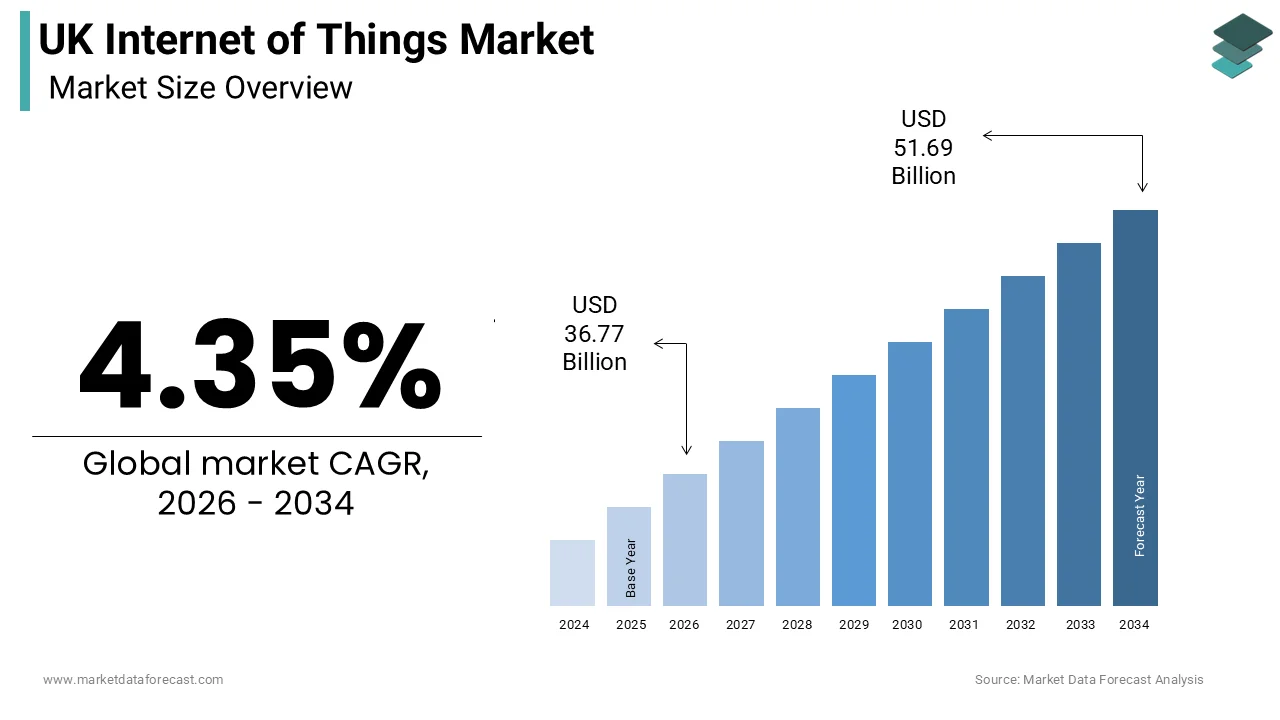
The UK Internet of Things market size was valued at USD 35.24 billion in 2025, is anticipated to reach USD 36.77 billion in 2026, and is projected to be worth USD 51.69 billion by 2034, registering a compound annual growth rate (CAGR) of 4.35% during the forecast period from 2026 to 2034. Driven by the expansion of 5G network infrastructure, government-led smart city initiatives, and rising enterprise adoption of Industry 4.0 applications, the market continues steady expansion.
Key Executive Metrics (At-a-Glance)
- 2025 Base Valuation: USD 35.24 Billion
- 2026 Current Valuation: USD 36.77 Billion
- 2034 Forecast Valuation: USD 51.69 Billion
- Compound Annual Growth Rate (CAGR): 4.35% (2026–2034)
- Dominant Component Segment: Hardware segment (holding 44.5% of the market share in 2025)
- Fastest-Growing Component Segment: Software segment (anticipating a CAGR of 18.5% from 2026 to 2034)
- Dominant Application Segment: Smart Home applications segment (holding 37.3% of the market share in 2025)
- Fastest-Growing Application Segment: IoT Connected Healthcare segment (estimating a CAGR of 22.3% from 2026 to 2034)
- Dominant Vertical Segment: Energy vertical segment (holding 59.1% of the market share in 2025)
- Fastest-Growing Vertical Segment: Healthcare vertical segment (exhibiting a CAGR of 21.8% from 2026 to 2034)
Core Market Drivers
- 5G Deployment: Rollout of 5G infrastructure providing high-speed, low-latency connectivity essential for massive machine-type communications.
- Smart City Initiatives: Local authorities deploying IoT solutions for smart lighting, energy grids, and optimized waste management.
Primary Market Restraints & Challenges
- Security & Interoperability: Cyber vulnerabilities, data privacy concerns, and a fragmented standards landscape hindering seamless device integration.
UK Internet of Things Market Segmentation Breakdown
| Segment Category | Leading Sub-Segment (Base Year) | Fastest-Growing Sub-Segment |
|---|---|---|
| By Component | Hardware (44.5% share in 2025) | Software (CAGR of 18.5%) |
| By Application | Smart Home (37.3% share in 2025) | IoT Connected Healthcare (CAGR of 22.3%) |
| By Vertical | Energy (59.1% share in 2025) | Healthcare (CAGR of 21.8%) |
Major Industry Players Profiled
Key market leaders shaping the United Kingdom Internet of Things industry include Vodafone UK, BT Group, Vodafone Business, Cisco Systems, IBM, Microsoft, Amazon Web Services (AWS), Siemens, Schneider Electric, Bosch, Intel Corporation, Qualcomm Technologies, Oracle, SAP, Huawei Technologies, Arm Holdings, PTC, Hitachi Vantara, Ericsson, and Nokia.
UK Internet of Things Market Size
The UK Internet of Things market size was valued at USD 35.24 billion in 2025, and is projected to reach USD 51.69 billion by 2034 from USD 36.77 billion in 2026, growing at a CAGR of 4.35%.
The Internet of Things is an interconnected network of devices, sensors, and software platforms that facilitate data exchange and automated decision-making across industrial and consumer sectors. This digital infrastructure is pivotal in driving the nation’s productivity agenda and supporting the transition towards smart cities and Industry 4.0. As per data from the Office for National Statistics, approximately 86% of households in the UK have access to broadband internet, which serves as the foundational layer for widespread IoT adoption. The government’s Digital Strategy emphasizes the importance of connectivity with full fiber broadband coverage reaching over 75% of premises according to Ofcom, enabling high-speed, low-latency connections required for advanced IoT applications. The manufacturing sector, which contributes around 10% to the national GDP, is increasingly integrating smart sensors to optimize production lines and reduce downtime. Regulatory frameworks such as the Product Security and Telecommunications Infrastructure Act aim to secure connected devices against cyber threats, ensuring consumer trust. The healthcare sector is also leveraging IoT for remote patient monitoring, with the National Health Service piloting various digital health initiatives to alleviate pressure on hospital resources. Urban centers like London and Manchester are implementing smart traffic management and energy grid solutions to enhance sustainability. The convergence of 5G networks and edge computing further accelerates the deployment of real-time analytics capabilities.
MARKET DRIVERS
Expansion of 5G Network Infrastructure Enables High Speed Low Latency Connectivity
The rollout of 5G network infrastructure by providing the necessary bandwidth and low latency required for important applications is primarily propelling the growth of the United Kingdom's Internet of Things market. Unlike previous generations, 5G technology supports massive machine type communications, allowing thousands of devices to connect simultaneously without congestion. The enhanced speed and reliability of 5G enable real-time data processing, which is essential for industrial automation and smart city initiatives. Manufacturing firms utilize 5 G-enabled IoT sensors to monitor equipment health and predict maintenance needs, reducing unplanned downtime by up to 30% according to industry benchmarks. The logistics sector benefits from improved tracking capabilities, allowing for precise location monitoring and condition assessment of goods in transit. Healthcare providers leverage 5G connectivity for telemedicine and remote patient monitoring, ensuring timely interventions and improved outcomes. The government’s commitment to achieving nationwide 5G coverage by 2030 further incentivizes businesses to invest in IoT solutions that rely on this advanced connectivity. The ability to slice networks allows enterprises to prioritize critical traffic, ensuring consistent performance for sensitive applications.
Government Initiatives Promoting Smart City Development Accelerate IoT Adoption
The government initiatives aimed at promoting smart city development by encouraging the integration of digital technologies into urban infrastructure are also leveraging the growth of the United Kingdom's Internet of Things market. Local authorities are increasingly adopting IoT solutions to improve public services, enhance sustainability, and optimize resource management. Several UK cities have received funding to implement smart lighting, waste management, and traffic control systems. These initiatives help reduce energy consumption and carbon emissions, aligning with the national net-zero targets. Smart streetlights equipped with sensors can adjust brightness based on pedestrian activity, leading to energy savings of up to 40%, according to recent studies. Intelligent traffic systems analyze real-time data to optimize signal timing, reducing congestion and improving air quality. Waste management companies use IoT-enabled bins to monitor fill levels, optimizing collection routes and reducing fuel usage. The integration of IoT in public transportation enhances passenger experience through real-time updates and predictive maintenance. The government’s support for digital innovation hubs fosters collaboration between public and private sectors, accelerating the deployment of scalable solutions. These efforts create a favorable environment for IoT providers to develop and test new applications. The focus on improving quality of life and operational efficiency drives widespread adoption of IoT technologies in urban environments.
MARKET RESTRAINTS
Security Vulnerabilities and Data Privacy Concerns Hinder Widespread Adoption
The security vulnerabilities and data privacy concerns are creating hesitation among consumers and enterprises regarding the safety of connected devices, which is hampering the growth of the United Kingdom Internet of Things market. The proliferation of IoT devices increases the attack surface for cybercriminals who exploit weak security protocols to gain unauthorized access to networks. As per alerts from the National Cyber Security Centre, millions of IoT devices in the UK remain vulnerable to common attacks such as default passwords and unpatched software. High-profile data breaches involving smart home devices and industrial sensors have eroded trust in the technology, prompting stricter regulatory scrutiny. The General Data Protection Regulation imposes stringent requirements on data handling and consent management, which can be complex to implement across diverse IoT ecosystems. Enterprises face challenges in securing endpoints, especially when dealing with legacy systems that lack modern security features. The cost of implementing robust security measures such as encryption and identity management can be prohibitive for small and medium-sized businesses. Consumers are increasingly aware of privacy risks, leading to reluctance in adopting smart home technologies that collect personal data. The lack of standardized security frameworks across manufacturers complicates efforts to ensure uniform protection.
Interoperability Issues and Lack of Standardization Limit Device Integration
The interoperability issues and the lack of universal standardization with seamless integration between devices from different manufacturers are also hindering the growth of the United Kingdom Internet of Things market. The fragmented landscape of IoT protocols and communication standards creates compatibility challenges that prevent devices from communicating effectively. The absence of a unified framework forces enterprises to invest in custom middleware and gateways to bridge disparate systems. This complexity increases deployment costs and extends implementation timelines, reducing the return on investment for IoT projects. Smart home users often face difficulties in connecting devices from different brands, leading to a fragmented user experience and reduced satisfaction. Industrial environments struggle with integrating legacy machinery with modern IoT sensors due to proprietary interfaces and closed ecosystems. The lack of interoperability limits the scalability of IoT solutions, as adding new devices requires extensive configuration and testing. Manufacturers are hesitant to adopt open standards, fearing loss of competitive advantage, which perpetuates the siloed nature of the market. Efforts to establish common standards, such as Matter, are gaining traction, but widespread adoption remains slow.
MARKET OPPORTUNITIES
Integration of Artificial Intelligence and Edge Computing Creates New Value Propositions
The integration of artificial intelligence and edge computing by enabling real-time data analysis and intelligent decision-making at the device level is expected to fuel new opportunities for the expansion of the United Kingdom's Internet of Things market. Edge computing reduces latency by processing data closer to the source rather than relying on centralized cloud servers. As per research, IoT, combining AI with edge devices, allows for immediate response to events, such as equipment failure or security breaches. This capability is particularly valuable in industries like manufacturing and healthcare, where milliseconds matter. AI algorithms can identify patterns and anomalies in large datasets generated by IoT sensors, providing actionable insights for predictive maintenance and optimization. Retailers use edge AI to analyze customer behavior in real time, enhancing personalized shopping experiences and inventory management. The energy sector leverages these technologies to balance grid loads and integrate renewable sources efficiently. The reduction in data transmission costs associated with edge computing makes IoT solutions more economically viable for large-scale deployments. The ability to operate offline or with limited connectivity ensures reliability in remote locations. This technological convergence opens new avenues for innovation and service differentiation.
Growth of Industrial IoT and Industry 4.0 Initiatives Drives Enterprise Demand
The growth of Industrial Internet of Things and Industry 4.0 initiatives by transforming traditional manufacturing processes into smart connected operations, which is to leverage the growth of the United Kingdom Internet of Things market. Enterprises are increasingly adopting IoT solutions to enhance productivity, reduce waste, and improve supply chain visibility. The adoption of digital technologies in the manufacturing sector has increased significantly, with many firms investing in smart factories and automated systems. IoT sensors monitor production lines in real time, enabling predictive maintenance and minimizing downtime. Digital twins allow manufacturers to simulate and optimize processes before physical implementation, reducing costs and errors. The integration of IoT with robotics and automation enhances flexibility and precision in production. Supply chain managers use IoT tracking to monitor goods from origin to destination, ensuring transparency and compliance. The government’s Made Smarter initiative supports small and medium-sized enterprises in adopting digital technologies, fostering a culture of innovation. The shift towards servitization, where manufacturers offer outcomes rather than products, is facilitated by IoT data.
MARKET CHALLENGES
Fragmented Regulatory Landscape and Compliance Complexities Increase Operational Burdens
The fragmented regulations and compliance complexities are imposing varying requirements on device manufacturers and service providers, which is likely to pose as a major challenge for the growth of the United Kingdom Internet of Things market. The lack of harmonized standards for IoT security and data privacy complicates efforts to ensure consistent protection across borders. Companies must stay updated with evolving laws such as the Product Security and Telecommunications Infrastructure Act, which mandates specific security features for connected devices. Non-compliance can result in hefty fines and reputational damage. The complexity of managing compliance for diverse IoT ecosystems spanning multiple jurisdictions strains resources, particularly for smaller firms. The ambiguity in liability frameworks for autonomous IoT systems adds legal risks for developers and users. These regulatory hurdles slow down innovation and deter investment in new IoT projects.
Skills Gap and Talent Shortage in Specialized IoT Roles Hinder Innovation
The skills gap and talent shortage in specialized Internet of Things roles, by limiting the capacity of organizations to develop and deploy advanced solutions, is also expected to slow down the growth of the United Kingdom Internet of Things market. The rapid evolution of IoT technologies requires expertise in areas such as embedded systems, data analytics, cybersecurity, and cloud computing, which are in short supply. There is a growing mismatch between the skills possessed by the workforce and the demands of the industry. Employers struggle to find qualified professionals who can design secure and scalable IoT architectures. The competition for talent drives up salary costs, making it difficult for small and medium-sized enterprises to compete with larger tech giants. The lack of comprehensive training programs in educational institutions exacerbates the problem, leaving graduates ill-prepared for practical IoT challenges. Existing employees require continuous upskilling to keep pace with technological advancements, which requires significant investment in training. The shortage of skilled personnel delays project timelines and compromises the quality of implementations. This human capital constraint hinders innovation and slows down the adoption of IoT technologies.
REPORT COVERAGE
| REPORT METRIC | DETAILS |
| Market Size Available | 2025 to 2034 |
| Base Year | 2025 |
| Forecast Period | 2026 to 2034 |
| CAGR | 4.35% |
| Segments Covered | By Component, Application, Vertical, and Region. |
| Various Analyses Covered | Global, Regional and Country-Level Analysis, Segment-Level Analysis, Drivers, Restraints, Opportunities, Challenges; PESTLE Analysis; Porter’s Five Forces Analysis, Competitive Landscape, Analyst Overview of Investment Opportunities |
| Market Leaders Profiled | Vodafone UK, BT Group, Vodafone Business, Cisco Systems, IBM, Microsoft, Amazon Web Services (AWS), Siemens, Schneider Electric, Bosch, Intel Corporation, Qualcomm Technologies, Oracle, SAP, Huawei Technologies, Arm Holdings, PTC, Hitachi Vantara, Ericsson, Nokia |
SEGMENTAL ANALYSIS
By Component Insights
The hardware segment accounted in holding 44.5% of the United Kingdom Internet of Things market share in 2025 due to the foundational requirement for physical devices such as sensors, actuators, gateways, and embedded systems to enable connectivity. The widespread adoption of smart meters, industrial sensors, and consumer electronics necessitates substantial investment in hardware infrastructure. As per data from the Department for Business, Energy and Industrial Strategy, over 29 million smart meters have been installed in homes and small businesses across Great Britain, creating a massive base of connected hardware. This extensive deployment forms the backbone of the IoT ecosystem, allowing for data collection at the source. The manufacturing sector also contributes significantly with factories upgrading legacy machinery with IoT-enabled sensors to monitor performance and predict maintenance needs. The cost of hardware components has decreased over time, making it more accessible for large-scale deployments. The diversity of hardware applications, ranging from agricultural soil sensors to wearable health monitors, ensures consistent demand across various industries. The physical nature of these devices requires regular replacement and upgrade, driving recurring revenue streams for manufacturers. The integration of advanced chips and microcontrollers enhances device capabilities, further stimulating hardware sales.
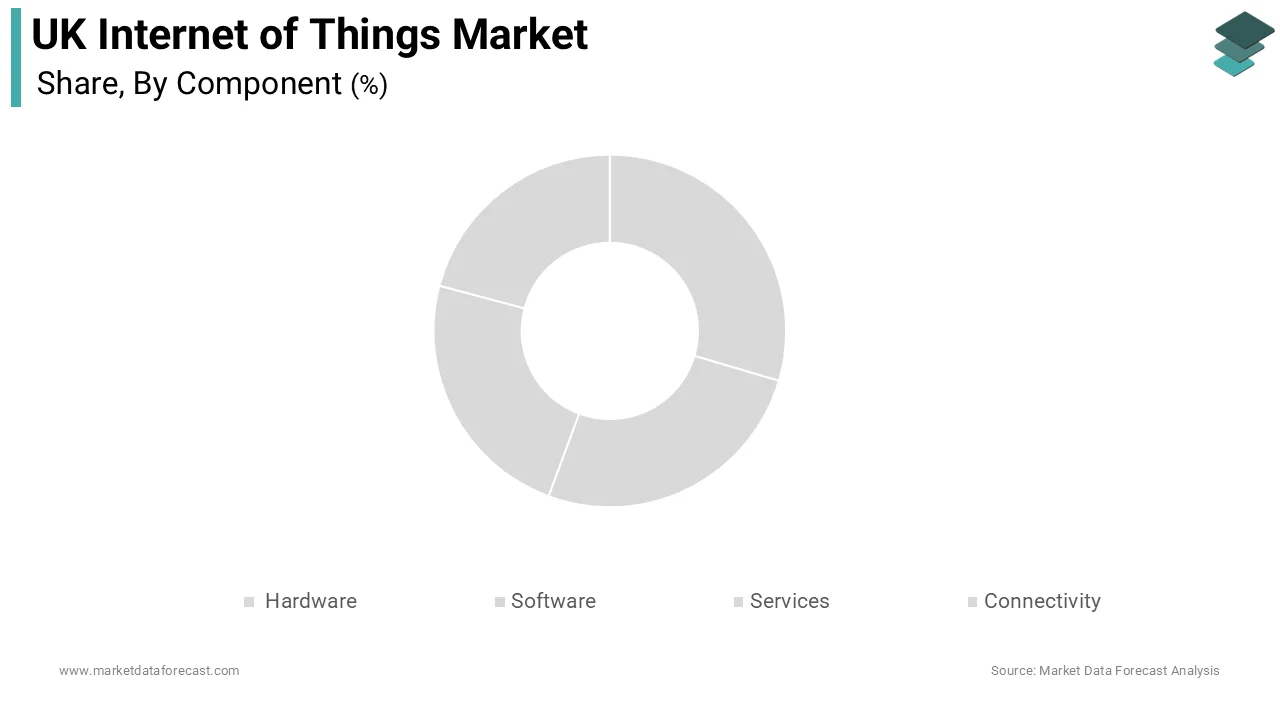
The software segment is expected to grow at an anticipated CAGR of 18.5% from 2026 to 2034, with the increasing need for data analytics, device management, and application enablement platforms. As the number of connected devices expands, the volume of generated data grows exponentially, requiring sophisticated software solutions to process and derive insights. UK tech companies are increasingly focusing on AI-driven analytics platforms to handle big data from IoT sources. These platforms enable businesses to visualize data, identify trends, and make informed decisions in real time. The shift from simple connectivity to intelligent decision-making places software at the center of value creation. Cloud-based IoT platforms offer scalability and flexibility, allowing enterprises to manage large fleets of devices efficiently. The integration of machine learning algorithms enhances predictive capabilities, making software indispensable for operational optimization. Enterprises are prioritizing software investments to unlock the full potential of their hardware deployments.
By Application Insights
The Smart Home applications segment was the largest by holding 37.3% of the United Kingdom Internet of Things market share in 2025 due to high consumer adoption of connected devices such as smart speakers, lighting systems, and security cameras. The convenience, energy efficiency, and enhanced security offered by these devices appeal to a broad demographic of homeowners and renters. The penetration of smart home devices in UK households has increased significantly, with millions of users actively engaging with connected technologies. The availability of affordable and user-friendly products from major tech companies has lowered barriers to entry. Voice-activated assistants serve as central hubs for controlling various devices, making the technology accessible to non-technical users. The growing awareness of energy conservation prompts consumers to install smart thermostats and plugs to monitor and reduce consumption. Retailers and online platforms offer an extensive range of smart home products, fostering competition and innovation. The integration of smart home systems with mobile applications allows for remote monitoring and control, enhancing user experience. The cultural shift towards connected living spaces supports sustained demand for smart home solutions.
The IoT Connected Healthcare segment is estimated to grow at the fastest CAGR of 22.3% from 2026 to 2034, owing to the aging population and the increasing demand for remote patient monitoring solutions. The National Health Service faces pressure to manage chronic conditions and reduce hospital admissions, leading to the adoption of digital health technologies. As per data from the King’s Fund, the number of people aged 65 and over in the UK is projected to reach 16 million by 204,0 increasing the need for efficient care delivery models. Wearable devices and remote monitoring sensors allow healthcare providers to track vital signs and detect anomalies in real time. This proactive approach improves patient outcomes and reduces the burden on emergency services. The pandemic accelerated the acceptance of telehealth and remote monitoring technologies among both patients and clinicians. Government initiatives prioritize digital transformation and the integration of IoT in care pathways. The ability to provide personalized and continuous care outside traditional settings appeals to patients seeking greater autonomy. Investors are pouring capital into health tech startups developing innovative IoT solutions.
By Vertical Insights
The energy vertical segment accounted in holding 59.1% of the United Kingdom Internet of Things market share in 2025 due to extensive smart grid modernization efforts and the integration of renewable energy sources. The transition towards a low-carbon economy requires intelligent management of electricity distribution and consumption. The rollout of smart meters and grid automation technologies is a key component of the UK’s energy strategy. IoT sensors monitor grid stability, detect faults, and optimize energy flow, ensuring a reliable supply. The proliferation of distributed energy resources, such as solar panels and wind turbines, necessitates real-time monitoring and control capabilities. IoT enables demand response programs where consumers adjust usage based on grid conditions, reducing peak load stress. The implementation of advanced metering infrastructure provides detailed consumption data, helping utilities improve efficiency and customer service. Government mandates and incentives support the adoption of IoT in the energy sector, accelerating deployment.
The healthcare segment is likely to exhibit the fastest CAGR of 21.8% from 2026 to 2034, with the digital transformation initiatives and the shift towards personalized medicine. The National Health Service is actively pursuing digital strategies to improve efficiency and patient care quality. The billions of pounds are being invested in technology infrastructure, including IoT devices for remote monitoring and diagnostics. The move towards value-based care encourages the use of data-driven insights to tailor treatments to individual patients. IoT enables continuous health tracking, allowing for early intervention and preventive care. The integration of IoT with electronic health records facilitates better care coordination and reduces medical errors. Hospitals are adopting asset tracking solutions to improve operational efficiency and resource management. The rise of private healthcare providers also contributes to growth as they invest in advanced technologies to differentiate their services. Patient empowerment through access to personal health data drives demand for consumer-facing IoT devices.
COMPETITION OVERVIEW
The competitive landscape of the United Kingdom Internet of Things market is characterized by a diverse mix of telecommunications providers, technology giants, specialized IoT platform vendors, and hardware manufacturers. Telecommunications companies leverage their extensive network infrastructure to offer connectivity and managed services, while tech firms focus on software platforms and data analytics. Competition is intense as players strive to differentiate themselves through unique value propositions such as enhanced security, interoperability, and industry-specific solutions. The market sees frequent collaborations and partnerships as no single entity can provide all components of the IoT value chain independently. Startups and niche players introduce innovative applications and devices, challenging established incumbents with agile and specialized offerings. Price competition is evident in the hardware segment, whereas service providers compete on quality, reliability, and customer support. Regulatory compliance and data privacy standards act as barriers to entry, ensuring that only reputable firms sustain long-term success. The rapid pace of technological change requires continuous investment in research and development to maintain a competitive advantage.
KEY MARKET PLAYERS
A few major players of the UK Internet of Things market include
- Vodafone UK
- BT Group
- Vodafone Business
- Cisco Systems
- IBM
- Microsoft
- Amazon Web Services (AWS)
- Siemens
- Schneider Electric
- Bosch
- Intel Corporation
- Qualcomm Technologies
- Oracle
- SAP
- Huawei Technologies
- Arm Holdings
- PTC
- Hitachi Vantara
- Ericsson
- Nokia
Top Strategies Used by Key Market Participants
Key players in the United Kingdom Internet of Things market primarily focus on developing end-to-end solutions that integrate connectivity hardware and software to simplify adoption for enterprises. Companies invest heavily in cybersecurity measures to protect connected devices and data, addressing growing concerns about privacy and safety. Strategic partnerships with technology providers and industry consortia enable the creation of interoperable standards and ecosystems that enhance device compatibility. Providers leverage artificial intelligence and machine learning to offer advanced analytics and predictive maintenance capabilities, adding value beyond basic connectivity. Expansion of low-power wide-area networks supports the deployment of massive IoT applications in remote and hard-to-reach locations. Customer-centric approaches involve offering managed services and consulting to guide businesses through digital transformation journeys. Continuous innovation in 5G and edge computing technologies ensures low latency and high reliability for mission-critical applications.
Leading Players in the United Kingdom Internet of Things Market
- Arm Holdings serves as a foundational pillar in the United Kingdom Internet of Things market by designing energy-efficient processor architectures that power billions of connected devices globally. The company’s technology is embedded in a vast array of sensors, wearables, and industrial equipment, enabling low power consumption and high performance. Recent strategic initiatives include the development of specialized IoT subsystems and enhanced security features, such as Platform Security Architecture, to address growing cybersecurity concerns. Arm actively collaborates with semiconductor manufacturers and software developers to create standardized ecosystems that accelerate device deployment. Their continuous investment in research and development ensures that their architectures remain at the forefront of technological advancement.
- Vodafone UK plays a pivotal role in the United Kingdom Internet of Things market by providing robust connectivity solutions and managed services for enterprise clients. The company offers comprehensive IoT platforms that enable businesses to connect, manage, and analyze data from diverse devices across various sectors, including logistics, automotive, and healthcare. Recent actions involve the expansion of its Narrowband Internet of Things network coverage to support low-power wide area applications effectively. Vodafone has also launched enhanced security suites to protect connected devices from cyber threats, addressing a major customer concern. The organization partners with technology providers to deliver end-to-end solutions that simplify IoT adoption for small and medium-sized enterprises. These efforts enhance operational efficiency for clients and reinforce Vodafone’s leadership in delivering reliable and secure IoT connectivity services throughout the region.
- BT Group contributes significantly to the United Kingdom Internet of Things market through its advanced connectivity infrastructure and integrated digital services. The company leverages its extensive fiber and mobile networks to support large-scale IoT deployments across smart cities, industrial automation, and public services. BT has strengthened its cybersecurity offerings to ensure the integrity of connected ecosystems, building trust among enterprise customers. The group actively collaborates with government bodies and local authorities to implement smart infrastructure projects that enhance urban living standards. Their focus on sustainability drives the development of energy-efficient IoT solutions that help organizations reduce carbon footprints. This holistic approach positions BT as a key driver of digital transformation and innovation in the UK IoT landscape.
MARKET SEGMENTATION
This research report on the UK Internet of Things market is segmented and sub-segmented into the following categories.
By Component
- Hardware
- Software
- Services
- Connectivity
By Application
- Smart Home
- Smart Wearables
- Smart Cities
- Smart Grid
- IoT Industrial Internet
- IoT Connected Cars
- IoT Connected Healthcare
- Others
By Vertical
- Healthcare
- Energy
- Public and Services
- Transportation
- Retail
- Individuals
- Others