- Product Description Description
- Table of Contents TOC
- List of Table & Figure LOT
- Get Free Sample PDF Sample PDF
Market Size, 2025
$28.5 BnMarket Estimate, 2026
$33.57 BnMarket Forecast, 2034
$124.5 BnCAGR, 2026–2034
17.80%UK Renewable Energy Market Report Summary
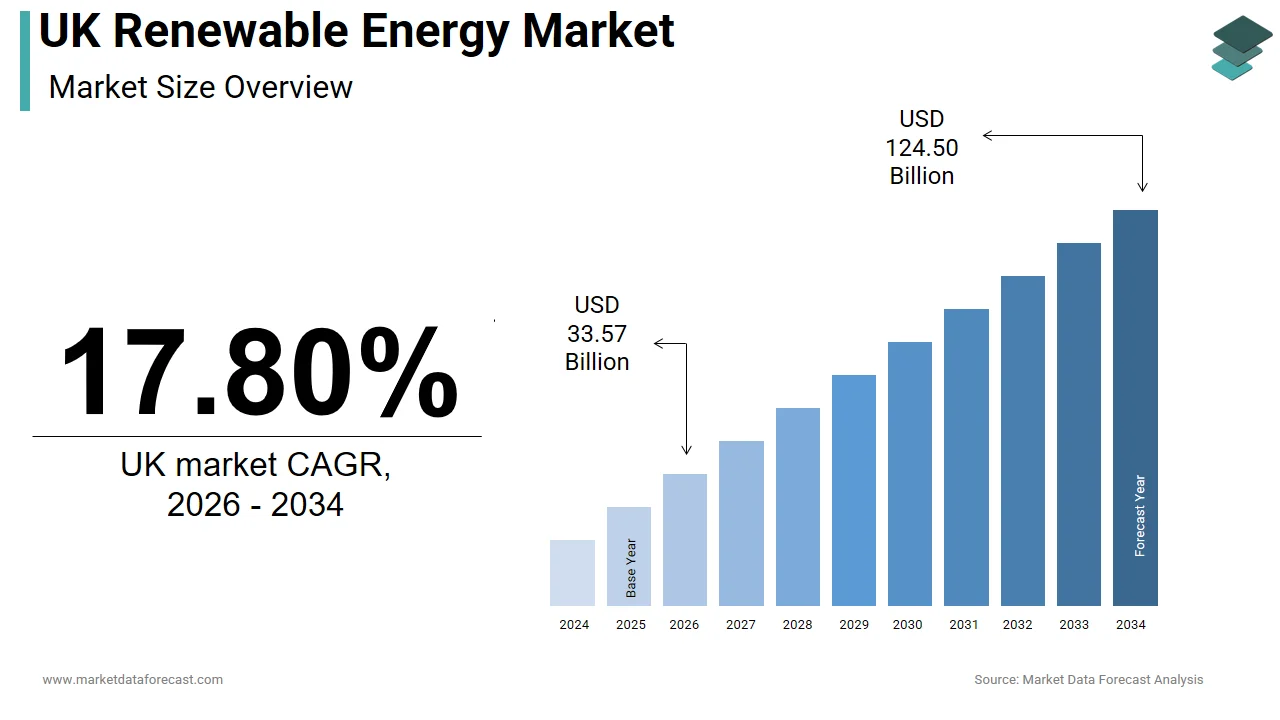
The UK renewable energy market was valued at USD 28.50 billion in 2025 and is projected to grow from USD 33.57 billion in 2026 to USD 124.50 billion by 2034, registering a CAGR of 17.80% from 2026 to 2034. Market growth is driven by the United Kingdom’s ambitious decarbonization targets, increasing investments in clean energy infrastructure, and strong government support for renewable power generation. The transition toward net-zero emissions, rising electricity demand, and the growing adoption of sustainable energy sources are accelerating renewable energy deployment across the country. Significant advancements in offshore wind, solar power, energy storage technologies, and grid modernization initiatives are further supporting market expansion.
Key Market Trends
- Rapid expansion of offshore wind energy projects across the United Kingdom.
- Increasing investments in solar power generation and energy storage systems.
- Growing focus on achieving net-zero carbon emissions targets.
- Rising deployment of smart grid infrastructure and renewable integration technologies.
- Expansion of public and private sector investments in clean energy projects.
Segmental Insights
- Based on technology, the wind energy segment dominated the UK renewable energy market in 2025, driven by the country's global leadership in offshore wind development, favorable government policies, and large-scale investment in wind power infrastructure.
- Based on end user, the utility-scale segment held the largest share of the market in 2025, supported by extensive investments from energy utilities and independent power producers in large wind farms and solar parks that supply electricity directly to the national grid.
Regional Insights
- The United Kingdom held the leading position within the European renewable energy market in 2025 and is expected to further strengthen its market presence over the forecast period. Market growth is supported by substantial investments in offshore wind projects, supportive regulatory frameworks, and national commitments to renewable energy expansion. The country's continued focus on clean energy generation, grid modernization, and carbon reduction initiatives positions it as one of the most advanced renewable energy markets in Europe.
Competitive Landscape
The UK renewable energy market is characterized by the presence of major energy developers, utility companies, and renewable power producers competing through capacity expansion, technological innovation, and strategic partnerships. Market participants are focusing on offshore wind development, renewable energy integration, energy storage deployment, and long-term sustainability initiatives to strengthen their market position. Investments in large-scale renewable projects and government-supported clean energy programs continue to shape the competitive landscape.
Prominent companies operating in the UK renewable energy market include SSE Renewables, Ørsted A/S, ScottishPower Renewables, RWE Renewables, and Vattenfall AB.
UK Renewable Energy Market Size
The UK renewable energy market was valued at USD 28.50 billion in 2025, is estimated to reach USD 33.57 billion in 2026, and is projected to reach USD 124.50 billion by 2034, growing at a CAGR of 17.80% from 2026 to 2034.
According to the Department for Energy Security and Net Zero, renewable sources generated a record 46.4% of the nation’s electricity in recent years, marking a historic shift away from fossil fuels. As per data from the Office for National Statistics, the UK has reduced its greenhouse gas emissions by nearly 50% compared to 1990 levels, demonstrating the tangible impact of green energy adoption. The nation's geographic advantages, particularly its extensive coastline and shallow seabeds, provide ideal conditions for offshore wind development, which currently ranks first in global capacity. Regulatory frameworks such as the Climate Change Act 2008 legally bind the government to achieve net zero emissions by 2050, creating a stable policy environment for investors. Public support for clean energy remains high, with surveys indicating that a majority of citizens prioritize environmental sustainability in energy choices. The market operates within a complex interplay of grid modernization requirements, supply chain dynamics, and international energy trade agreements. This transition is not merely environmental but economic, aiming to position the UK as a global leader in green technology exports and sustainable industrial practices.
MARKET DRIVERS
Legally Binding Net Zero Targets and Government Policy Support
The commitment to achieving net-zero greenhouse gas emissions by 2050 is fuelling the growth of the UK renewable energy market, which is underpinned by robust legislative frameworks and consistent government support. The Climate Change Act 2008 was the first of its kind globally to set long-term, legally binding carbon reduction targets, compelling successive governments to implement policies that favor renewable deployment. According to the Committee on Climate Change, the Sixth Carbon Budget requires a 78% reduction in emissions by 2035 compared to 1990 levels, and this requires an accelerated rollout of wind and solar infrastructure. Data from the Department for Energy Security and Net Zero indicates that the British Energy Security Strategy aims to increase offshore wind capacity to 50 gigawatts by 2030, which provides clear direction for industry investment. Contracts for Difference schemes offer financial stability to developers by guaranteeing strike prices for low-carbon electricity, reducing the risk associated with volatile wholesale markets. These policy mechanisms have attracted billions of pounds in private sector funding, ensuring a steady pipeline of projects. The phasing out of coal-fired power stations further creates immediate demand for renewable alternatives to maintain grid reliability. This regulatory certainty, combined with ambitious national goals, ensures that renewable energy remains at the forefront of the UK’s strategic economic and environmental agenda, driving sustained market growth.
Energy Security Concerns and Geopolitical Instability
Recent geopolitical tensions and the resulting volatility in global fossil fuel markets have significantly intensified the drive for domestic renewable energy production in the UK as a matter of national security, which is further boosting the expansion of the UK renewable energy market. The reliance on imported natural gas exposed the nation to price shocks and supply disruptions, prompting a strategic pivot toward indigenous energy sources that are immune to international political leverage. According to National Grid ESO, the diversification of the energy mix through renewables reduces exposure to global commodity fluctuations, enhancing the resilience of the national grid. Data from the Office for Budget Responsibility highlights that increasing domestic renewable generation can mitigate the economic impact of energy price spikes on households and businesses. The war in Ukraine accelerated this trend, with the government fast-tracking planning permissions for onshore wind and solar farms to reduce dependence on foreign suppliers. Public opinion has shifted strongly in favor of energy independence, with polls showing increased support for local renewable projects despite previous aesthetic concerns. The economic argument for renewables has strengthened as the levelized cost of wind and solar becomes competitive with or cheaper than imported gas. This convergence of security imperatives and economic rationale creates a powerful driver for rapid expansion of renewable infrastructure across the nation, ensuring long-term stability and affordability.
MARKET RESTRAINTS
Grid Infrastructure Limitations and Connection Delays
The existing electricity transmission and distribution infrastructure in the UK faces significant constraints that hinder the efficient integration of new renewable energy projects, creating bottlenecks and delays. The grid was originally designed for centralized fossil fuel generation rather than decentralized and variable renewable sources located in remote areas, such as offshore wind farms in Scotland or solar parks in the south. According to National Grid ESO, there is a substantial backlog of renewable projects waiting for grid connection approvals, with some queues extending several years into the future. Data from RenewableUK indicates that over 100 gigawatts of renewable capacity are stuck in the connection pipeline due to insufficient transmission capacity and outdated network architecture. Upgrading the grid requires massive capital investment and complex planning permissions, which often face local opposition and regulatory hurdles. The lack of adequate interconnectors and storage facilities exacerbates the issue, leading to curtailment where generated renewable energy is wasted because it cannot be transmitted to demand centers. These infrastructural deficiencies increase project costs and uncertainty, discouraging potential investors. Until significant upgrades are completed, the full potential of the UK’s renewable resources will remain constrained, limiting the speed of the energy transition and affecting the reliability of supply during peak demand periods.
High Initial Capital Costs and Supply Chain Volatility
The substantial upfront capital expenditure required for renewable energy projects, combined with volatile supply chain costs, acts as a significant restraint on market expansion in the UK. While operational costs for wind and solar are low, the initial investment in turbines, panels, installation, and grid connection is considerable, making projects sensitive to interest rates and material prices. According to the British Wind Energy Association, the cost of raw materials such as steel, copper, and rare earth metals has fluctuated wildly due to global demand and trade disruptions, impacting project viability. Data from the Office for National Statistics shows that inflation in the construction sector has risen sharply, increasing the overall cost of developing renewable infrastructure. Supply chain bottlenecks, particularly for specialized components like turbine blades and power electronics, have led to delivery delays and increased procurement costs. The reliance on international suppliers for critical minerals and manufacturing exposes the market to geopolitical risks and trade barriers. Financing these projects has become more challenging as rising interest rates increase the cost of debt, reducing internal rates of return for developers. These financial pressures force companies to delay final investment decisions or cancel projects altogether, slowing down the pace of deployment. Without stable supply chains and accessible financing, the growth of the renewable energy sector may fall short of national targets.
MARKET OPPORTUNITIES
Expansion of Offshore Wind and Floating Technology
The vast potential of offshore wind energy, particularly through the adoption of floating turbine technology, presents a promising opportunity for the UK renewable energy market. The nation possesses some of the best wind resources in the world, with deep waters off the coast of Scotland and Wales suitable for floating platforms that can access stronger and more consistent winds. According to the Crown Estate, leasing rounds for offshore wind have attracted record-breaking bids, indicating strong investor confidence in the sector’s growth trajectory. Data from the Department for Energy Security and Net Zero suggests that floating offshore wind could contribute up to 10 gigawatts of capacity by 2030, unlocking previously inaccessible areas. This technology allows for larger turbines with higher capacity factors, improving the economics of wind energy. The development of a domestic supply chain for floating structures and mooring systems creates jobs and stimulates regional economies in coastal communities. Partnerships between energy companies and engineering firms are driving innovation in design and installation methods, reducing costs over time. As the technology matures, it offers a scalable solution to meet increasing electricity demand while maintaining visual and environmental standards. This expansion positions the UK as a global leader in offshore wind innovation, attracting international investment and expertise.
Integration of Green Hydrogen and Energy Storage Solutions
The emergence of green hydrogen as a versatile energy carrier and the integration of advanced storage solutions offer significant opportunities for the expansion of the UK renewable energy market. Green hydrogen, produced using excess renewable electricity through electrolysis, can store energy for long durations and decarbonize hard-to-abate sectors such as heavy industry and transport. According to the UK Hydrogen Strategy, the government aims to develop 5 gigawatts of low-carbon hydrogen production capacity by 2030, creating a new market for renewable energy producers. Data from the Energy Systems Catapult indicates that combining renewable generation with battery storage and hydrogen production can optimize grid stability and reduce curtailment losses. Projects such as the HyNet cluster in the North West demonstrate the feasibility of integrating hydrogen into existing gas networks and industrial processes. Energy storage technologies, including pumped hydro and compressed air, provide additional flexibility, allowing renewable energy to be dispatched when needed. This synergy between generation, storage, and conversion enhances the value proposition of renewable assets, enabling them to provide ancillary services to the grid. By investing in these complementary technologies, the UK can create a resilient and flexible energy system that maximizes the utilization of clean power.
MARKET CHALLENGES
Planning Permission Complexities and Local Opposition
Navigating the complex planning permission process and addressing local opposition remain major challenges for renewable energy developers in the UK, causing significant delays and project cancellations. While national policy supports renewable expansion, local planning authorities often face pressure from community groups concerned about visual impact, noise, and effects on wildlife. According to the Campaign to Protect Rural England, many onshore wind and solar farm applications are rejected or delayed due to objections regarding landscape character and biodiversity loss. Data from the Ministry of Housing, Communities and Local Government shows that the average time to secure planning consent for large-scale renewable projects has increased, leading to higher development costs and uncertainty. The inconsistency in decision-making across different local councils creates a fragmented regulatory landscape that complicates national strategy implementation. Community benefit schemes have had mixed success in gaining a social license to operate, with some residents feeling excluded from the decision-making process. The need for extensive environmental impact assessments further prolongs the timeline, requiring detailed studies on bird migration, marine life, and soil quality. These administrative and social hurdles deter investment and slow the deployment of necessary infrastructure. Streamlining the planning process while ensuring meaningful community engagement is critical to overcoming this challenge and accelerating the energy transition.
Workforce Skills Gap and Talent Shortages
The rapid expansion of the renewable energy sector in the UK is increasingly constrained by a shortage of skilled workers and technical expertise required to design, build, and maintain new infrastructure, which is another significant challenge for the UK market. The transition from fossil fuels to renewables demands a workforce with specialized skills in electrical engineering, marine operations, data analytics, and project management, which are currently in short supply. According to the Renewable Energy Association, thousands of new jobs will be created in the sector over the next decade, but existing training pipelines are insufficient to meet this demand. Data from the Office for National Statistics highlights a mismatch between the skills possessed by the current labor force and those required by emerging green technologies. The retirement of experienced workers from the oil and gas sector offers a potential talent pool, but retraining programs are not yet scaled to facilitate a smooth transition. Competition for scarce talent drives up wages and project costs, affecting the financial viability of developments. Educational institutions are struggling to update curricula quickly enough to reflect industry needs, leading to a gap in practical competencies. Addressing this skills deficit requires coordinated efforts between government, industry, and academia to invest in vocational training and apprenticeships. Without a qualified workforce, the UK risks failing to meet its renewable energy targets due to labor bottlenecks.
REPORT COVERAGE
| REPORT METRIC | DETAILS |
| Market Size Available | 2025 to 2034 |
| Base Year | 2025 |
| Forecast Period | 2026 to 2034 |
| Segments Covered | By Technology, End-User, and Region. |
| Various Analyses Covered | Global, Regional, and Country-Level Analysis, Segment-Level Analysis, Drivers, Restraints, Opportunities, Challenges; PESTLE Analysis; Porter’s Five Forces Analysis, Competitive Landscape, Analyst Overview of Investment Opportunities |
| Countries Covered | United Kingdom |
| Market Leaders Profiled | SSE Renewables, Ørsted A/S, ScottishPower Renewables, RWE Renewables, Vattenfall AB, and Others. |
SEGMENTAL ANALYSIS
By Technology Insights
The wind energy segment led the market by holding the dominant share of the UK market in 2025. The growth of the wind energy segment in the UK market is attributed to the nation’s exceptional geographic advantages and decades of strategic investment in both onshore and offshore infrastructure. The UK possesses some of the strongest and most consistent wind resources in Europe, particularly in the North Sea, which has enabled it to become a global leader in offshore wind capacity. According to the Department for Energy Security and Net Zero, wind power generated a record 29.4% of the country’s electricity in recent years, surpassing all other renewable sources combined. Data from RenewableUK indicates that the UK is home to more than half of the world’s installed offshore wind capacity, with major projects such as Hornsea and Dogger Bank contributing significantly to the national grid. The scalability of modern turbines allows for massive energy output from single installations, making wind the most cost effective source of new electricity generation. Government support through Contracts for Difference auctions has provided financial stability, encouraging private sector investment in large-scale farms. The technological maturity of wind technology ensures reliable performance and lower maintenance costs compared to emerging alternatives. This established infrastructure, combined with favorable natural conditions, cements wind energy as the backbone of the UK’s decarbonization strategy and the primary contributor to clean energy targets.
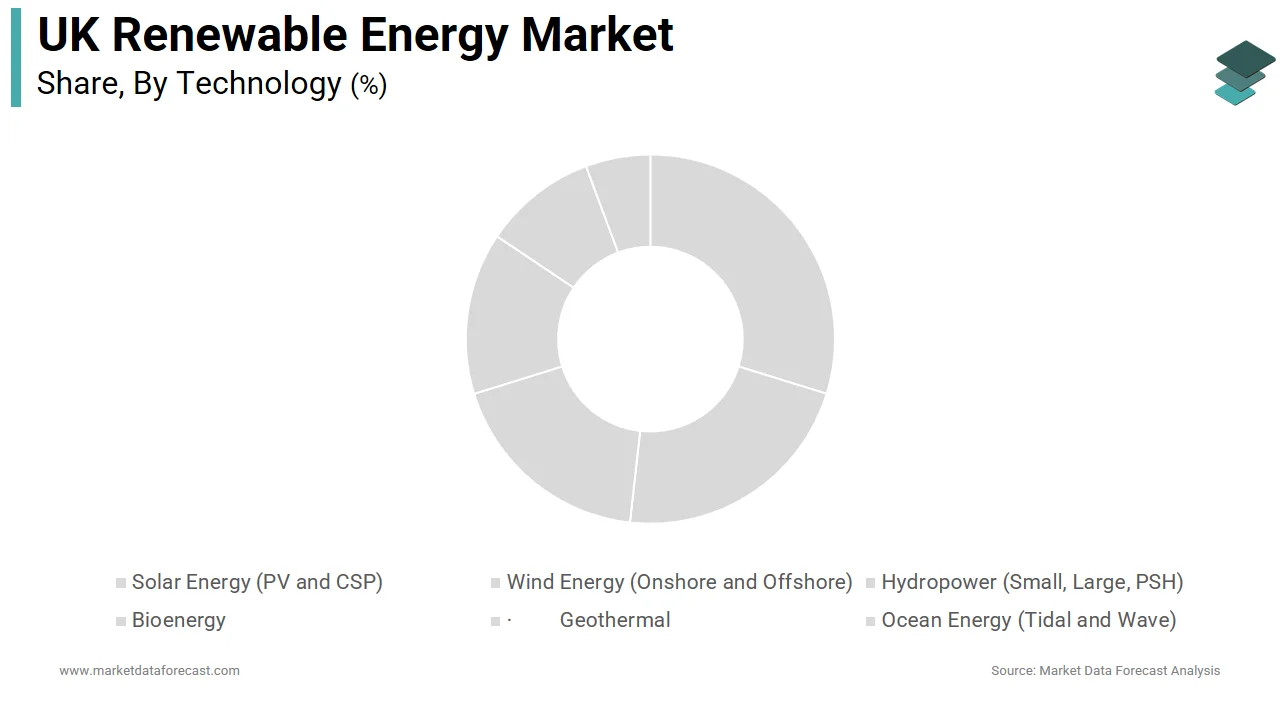
On the other side, the solar energy segment is predicted to record a CAGR of 9.2% during the forecast period, owing to the declining technology costs and widespread adoption across residential and commercial sectors. Although the UK has less solar irradiance than southern European nations, advancements in photovoltaic efficiency and battery storage have made solar a viable and attractive option for diverse applications. According to the Solar Trade Association, the total installed solar capacity in the UK has surpassed 15 gigawatts, with a significant portion added in recent years due to improved economic viability, yielding a record share of 4.9% of the country's total generation. Data from the Office for National Statistics shows that household installations have surged as consumers seek to reduce electricity bills amidst rising energy prices. The removal of restrictive planning permissions for smaller solar arrays has accelerated deployment on residential roofs and commercial buildings. Innovations in bifacial panels and building-integrated photovoltaics allow for seamless integration into urban environments without compromising aesthetics. Government initiatives such as the Smart Export Guarantee provide financial incentives for exporting excess energy back to the grid, enhancing the return on investment. The modular nature of solar systems allows for rapid deployment compared to large infrastructure projects, enabling quick capacity additions. This combination of affordability, accessibility, and policy support drives the rapid expansion of solar energy in the UK.
By End User Insights
The utility scale segment led the market by accounting for the largest share of the UK market in 2025, as large energy suppliers and independent power producers develop massive wind farms and solar parks to feed electricity directly into the national transmission grid. This segment accounts for the majority of renewable generation capacity due to the economies of scale achieved by industrial-sized installations, which can produce power at competitive rates. According to National Grid ESO, utility-scale projects contribute over 80% of the nation’s renewable electricity, ensuring a baseline supply for millions of households and businesses. Data from the Department for Energy Security and Net Zero highlights that major offshore wind farms are classified under this segment, representing billions of pounds in infrastructure investment. These projects benefit from long-term government contracts that guarantee revenue streams, reducing financial risk for developers. The centralization of generation allows for efficient grid management and integration with high-voltage transmission lines. Utility companies are mandated to increase their share of green energy to meet regulatory obligations, driving continuous procurement of large-scale renewable assets. The ability to deploy advanced technologies such as floating wind turbines and grid-scale battery storage further enhances the viability of this segment. This structural dominance ensures that utility-scale projects remain the primary engine for achieving national net-zero targets.
However, the residential segment is estimated to exhibit a CAGR of 10.3% during the forecast period owing to the increasing consumer awareness, desires for energy independence, and supportive government schemes for homeowners. Individuals are increasingly installing rooftop solar panels, heat pumps, and home battery systems to reduce reliance on the grid and lower monthly utility bills. According to the Energy Saving Trust, the number of homes with microgeneration technologies has doubled in four years, reflecting a major shift toward decentralized energy production. Data from the Microgeneration Certification Scheme indicates that thousands of new residential installations are certified each month as homeowners take advantage of grants and tax incentives. The rise of smart home technology allows residents to monitor and optimize their energy usage in real time, enhancing the appeal of self-generation. Rising electricity prices have shortened the payback period for residential renewable investments, making them financially attractive even without subsidies. Community energy projects also fall under this category, enabling neighborhoods to collectively invest in local renewable assets. This grassroots movement empowers consumers to participate actively in the energy transition, driving rapid adoption and creating a distributed network of clean energy generators across the country.
COUNTRY ANALYSIS
UK Renewable Energy Market Analysis
The UK occupied the highest share of the European market in 2025 and is likely to expand its renewable energy infrastructure rapidly and strengthen its global market position over the next few years, particularly in offshore wind technology, leveraging its extensive coastline and strong policy framework to drive decarbonization. The nation holds a dominant position in the European market, accounting for a significant share of the region’s total renewable capacity and setting benchmarks for regulatory innovation and project execution. According to the International Renewable Energy Agency, the UK ranks among the top countries worldwide for installed offshore wind capacity, demonstrating its technical expertise and resource advantage. Data from the Committee on Climate Change confirms that the UK has reduced its carbon emissions faster than any other G7 nation since 1990, largely due to the displacement of coal by renewable sources. The legally binding nature of the Climate Change Act provides unparalleled policy certainty, attracting massive international investment and fostering a robust domestic supply chain. The Crown Estate plays a unique role in managing seabed leases, facilitating the orderly development of marine energy projects. The UK also leads in green finance, with London serving as a hub for sustainable investment instruments. This combination of natural resources, legislative strength, and financial infrastructure positions the UK not just as a participant but as an architect of the global renewable energy transition, influencing standards and practices across Europe and beyond.
COMPETITIVE LANDSCAPE
The UK renewable energy market features intense competition characterized by the presence of global energy giants, specialized developers, and utility companies vying for prime locations and government contracts. Established corporations leverage extensive balance sheets, technical expertise, and operational experience to dominate large-scale offshore wind tenders while agile independents focus on niche technologies or community-based projects. Competitive dynamics are shaped by the rigorous Contracts for Difference auction process, where price competitiveness is paramount, driving continuous cost reduction innovations. The race to secure grid connection points creates additional pressure as infrastructure constraints limit available capacity. Brand reputation for reliability and sustainability influences stakeholder trust and investor confidence. Collaboration often emerges as a key strategy, with joint ventures formed to share risks and capital requirements for massive infrastructure projects. Regulatory compliance and environmental stewardship are critical differentiators as projects face scrutiny from planners and local communities. Success depends on balancing cost efficiency with technological excellence and social responsibility while navigating a complex policy landscape to deliver scalable clean energy solutions.
KEY MARKET PLAYERS
Some of the companies that are playing a dominating role in the UK renewable energy market include
- SSE Renewables
- Ørsted A/S
- ScottishPower Renewables
- RWE Renewables
- Vattenfall AB
TOP PLAYERS IN THE MARKET
- SSE Renewables maintains a dominant presence in the UK through its extensive portfolio of onshore and offshore wind farms, hydroelectric plants, and solar projects. The company is leading the development of the Coire Glas pumped storage hydro project, which will provide critical long-duration energy storage for the national grid. Recent actions include securing final investment decisions for major offshore wind developments in Scotland and England to expand clean energy capacity. SSE actively collaborates with local communities to ensure social license and economic benefits from its projects. The brand invests heavily in innovation to reduce costs and improve the efficiency of renewable assets. By focusing on large-scale infrastructure and grid stability solutions, SSE strengthens its reputation as a key enabler of the net-zero transition. Their commitment to sustainability and reliability ensures sustained growth and leadership in the competitive UK market.
- Ørsted contributes significantly to the UK renewable energy market as a global leader in offshore wind development with several operational and under-construction projects across the nation. The company operates major farms such as Hornsea and is developing the world’s largest offshore wind farm, Dogger Bank. Recent efforts involve partnering with UK suppliers to strengthen the domestic supply chain and create local jobs in coastal communities. Ørsted invests in green hydrogen initiatives to decarbonize hard-to-abate sectors and enhance energy system integration. The company prioritizes biodiversity protection by implementing measures to support marine life around its installations. By leveraging its technical expertise and financial strength, Ørsted delivers reliable clean energy at scale. Their strategic focus on innovation and community engagement reinforces their position as a trusted partner in the UK’s journey toward energy independence and sustainability.
- ScottishPower Renewables plays a pivotal role in the UK market by operating a diverse mix of wind, hydro, and solar assets that contribute substantially to the national electricity supply. The company is expanding its offshore wind portfolio with new projects in the Irish Sea and North Sea to meet growing demand. Recent actions include investing in battery storage facilities to complement renewable generation and provide grid balancing services. ScottishPower integrates its renewable assets with smart grid technologies to optimize energy distribution and reduce waste. The company supports skills development through training programs for workers transitioning from fossil fuel industries. By focusing on integrated energy solutions and customer-centric services, ScottishPower enhances its market position. Their dedication to delivering affordable and clean energy ensures they remain a central figure in the UK’s renewable energy landscape.
TOP STRATEGIES USED BY KEY MARKET PARTICIPANTS
Key players in the UK renewable energy market employ several strategic approaches to maintain competitiveness and drive growth. Portfolio diversification is central as companies invest in offshore wind, onshore solar, and energy storage to balance risk and maximize resource utilization. Strategic partnerships with local supply chains enhance domestic manufacturing capabilities and reduce dependency on imports. Regulatory advocacy focuses on shaping favorable policies, such as Contracts for Difference, to ensure long-term revenue stability. Technological innovation involves adopting advanced turbine designs and digital monitoring systems to improve efficiency and reduce maintenance costs. Community engagement initiatives build social license to operate by ensuring local economic benefits and environmental protection. Sustainability commitments include biodiversity action plans and circular economy practices. These combined strategies allow market participants to navigate complex regulatory environments and capitalize on the urgent demand for clean energy solutions.
MARKET SEGMENTATION
This research report on the UK renewable energy market has been segmented and sub-segmented based on the following categories.
By Technology
- Solar Energy (PV and CSP)
- Wind Energy (Onshore and Offshore)
- Hydropower (Small, Large, PSH)
- Bioenergy
- Geothermal
- Ocean Energy (Tidal and Wave)
By End-User
- Utilities
- Commercial and Industrial
- Residential