- Product Description Description
- Table of Contents TOC
- List of Table & Figure LOT
- Get Free Sample PDF Sample PDF
UK Self-Storage Market Size
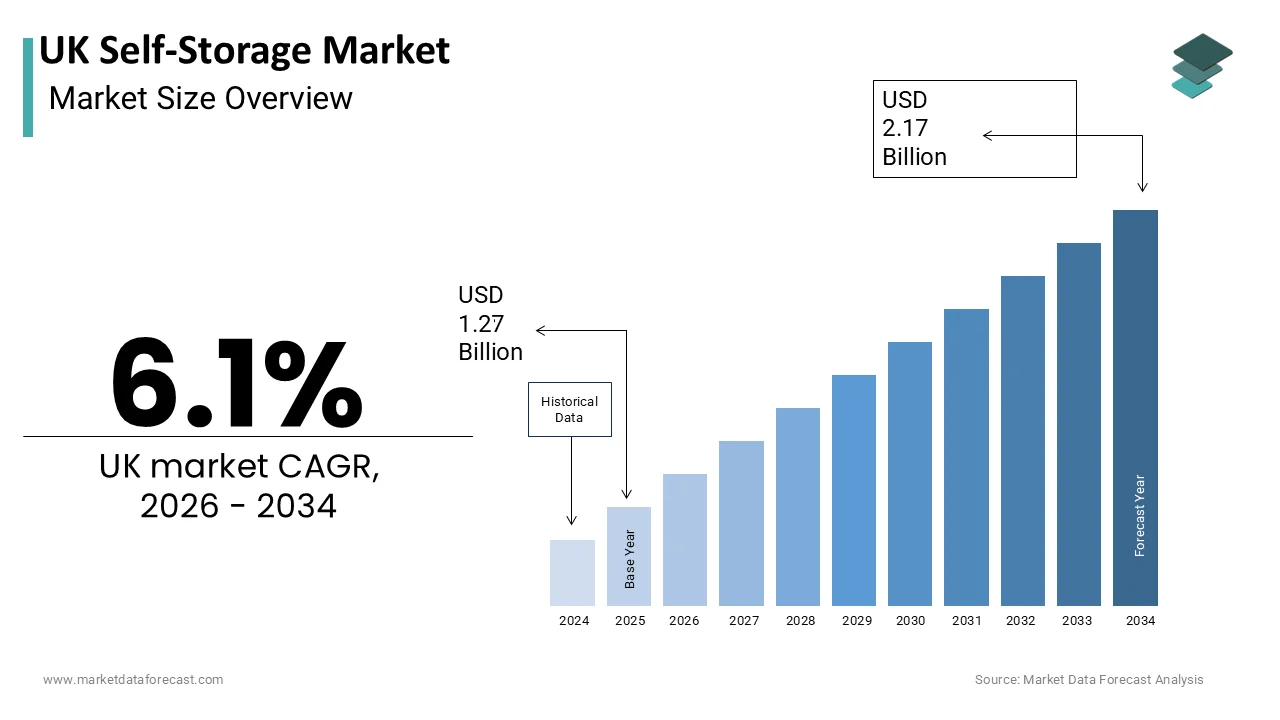
The UK Self Storage Market is projected to grow from USD 1.27 billion in 2025 to USD 1.35 billion in 2026 and reach USD 2.17 billion by 2034, registering a CAGR of 6.1% during the forecast period from 2026 to 2034.
Self-storage is a service where individuals and businesses can rent flexible spaces, such as warehouse units or lockers, to store their belongings. This market has evolved from a niche service for household moves to an e-commerce supporting e-commerce logistics business expansion and urban living solutions. The market comprises a mix of large institutional operators,s independent local providers,s and hybrid models offering flexible lease terms and advanced security features. According to government housing data, the average usable floor area for private rented homes in England stands at 76 square meters, while new build homes across the UK average closer to 1,000 square feet (around 93 square meters), depending on the region and property type. As per the Ministry of Housing, Communities and Local Government, the private rented sector accounts for 4.6 million households in England, representing a diverse demographic that increasingly includes long-term families alongside traditionally mobile tenants. Regulatory frameworks emphasize strict fire safety standards and data protection for customer information,n ensuring operational compliance and consumer trust. The market benefits from high digital penetration, with online booking platforms enabling seamless access and account management. Consumer behavior is increasingly influenced by convenience and accessibility,ity with demand for 24-hour access and climate-controlled units rising significantly. Sustainability initiatives are gaining traction, with energy-efficient adopters adopting energy-efficient lighting 24-hour24-hourar panels to reduce carbon footprints. Innovation in security technology, real-time access, and real-time monitoring enhances user confidence. This dynamic market continues to adapt to economic shifts and changing lifestyle patterns,s driving continuous facility development and service diversification across major urban centers and suburban locations.
MARKET DRIVERS
Urbanization and Declining Residential Space Availability
Rapid urbanization and the consequent reduction in average residential property sizes are the main reasons behind the growth of the United Kingdom self-storage market. Consequently, households are increasingly seeking supplementary space for their belongings. The concentration of population in major cities like London, Manchester,r and Birmingham has led to a premium on living space,e forcing residents to optimize their home environments. While urban centers see a higher density of multi-family complexes, official UK housing statistics confirm that houses continue to outnumber apartments in overall new build completions nationally. This spatial constraint drives individuals to utilize self-storage units for seasonal items, hobby equipment,t and sentimental possessions that cannot be accommodated within their primary residence. The rise of minimalist self-storage paradoxically supports his demand as individuals declutter their homes but wish to retain valuable items rather than discard them. The Self Storage Association shows that while moving house remains one of the largest drivers for domestic storage usage, only a modest fraction of overall property sellers utilize units explicitly for home staging. The flexibility of short-term leases appeals to renters who move frequently and cannot commit to long-term storage contracts. Developers are increasingly integrating storage facilities into short-term residential complexes, recognizing them as a value-added amenity. The clutter-free long-term benefit of a clutter-free living environment contributes to mental well-being, further motivating uptake. This shift in the value-added dynamics ensures sustained demand for self-storage services as urban density continues to increase, well-being, and e-commerce.
Growing E-Commerce and Small Business Logistics Needs
The exponential growth of the self-storage commerce sector and the proliferation of small businesses significantly boost the expansion of the United Kingdom self-storage market. This is because entrepreneurs require flexible and cost-effective inventory solutions. Online retailers and start-ups often lack the capital for large warehouses, making self-storage units an attractive alternative for stock management and order fulfillment. According to Ofstart-upsNational Statistics retail data, internet sales accounted for approximately 25% self-storage market share in 2024, fueling a broader logistics shift toward localized and decentralized distribution networks. Self-storage facilities offer strategic locations near urban centers, enabling faster last-mile delivery and reduced transportation costs for small businesses. The ability to scale self-storage space up or down based on seasonal demand provides operational agility that traditional last-mile does not match. Many operators now provide business-specific services such as mail handling, packing supplies, and loading bay, catering to commercial clients. The gig economy and freelance workforce also contribute to business-specific needs, with professionals storing tools and equipment securely when not in use. Tax incentives for business expenses allow companies to deduct storage costs, further enhancing affordability. The security and accessibility of modern facilities ensure that inventory is protected and available for immediate dispatch. This commercial segment offers higher revenue stability for operators compared to residential users who may vacate during economic downturns. The integration of business needs into the self-storage model expands the market beyond personal use into essential supply chain infrastructure.
MARKET RESTRAINTS
High Operational Costs And Energy Price Volatility
Fluctuating energy prices and high operational costs are restricting the growth of the United Kingdom self-storage market. This affects profitability and pricing strategies for operators. Facilities require continuous electricity for lighting, security systems, climate control, and automated access points,s making them vulnerable to energy market volatility. Following severe spikes in prior years, wholesale industrial energy costs in the UK experienced a downward trend during 2024, alleviating some operational cost pressures for large commercial facility operators. These increased expenses often force operators to raise rental rates, which can deter price-sensitive customers, particularly in a cost-of-living crisis. Smaller independent operators struggle to absorb these costs compared to larger chains with economies of scale, leading to potential market consolidation. The need to maintain specific temperature and humidity levels for climate-controlled units further exacerbates energy consumption. Investment in energy-efficient technologies such as LED lighting and solar panels requires upfront capital,pital which may be prohibitive for some businesses. Regulatory requirements for fire safety and building maintenance also place a financial burden on ensuring compliance with strict standards. Customers may delay renting units or downsize their space usage in response to price hikes,s reducing occupancy rates. The uncertainty surrounding future energy policies makes long-term financial planning difficult for operators. Balancing affordability for customers with sustainable operational margins remains a critical challenge. This economic pressure limits the ability of companies to expand or upgrade facilities, es constraining overall market growth potential.
Stringent Planning Regulations And Land Scarcity
Strict planning regulations and land scarcity in key urban areas are substantial barriers to the expansion of the United Kingdom self-storage market. This limits new facility development. Local authorities often prioritize residential and commercial developments over self-storage facilities, viewing them as less beneficial to the community in self-storage. The high cost of land in urban centers makes it economically challenging to acquire suitable sites for large-scale storage complexes. Operators face lengthy approval processes and community opposition regarding traffic congestion and aesthetic impacts, which delay large-scale projects. The conversion of existing industrial buildings into storage facilities is often restricted by heritage preservation laws and changes in use policies. This regulatory environment forces operators to locate facilities in peripheral areas, which may be less convenient for urban customers. The lack of available land drives up acquisition costs, reducing return on investment for new projects. Existing op,,erators must maximize efficiency within their current footprints rather than expanding physically. The complexity of navigating local planning frameworks requires specialized expertise and resources,s adding to operational overheads. This constraint limits the supply of new storage space, potentially leading to saturation in accessible locations while underserving high-demand areas. The tension between urban development goals and storage needs requires strategic advocacy and innovative site utilization.
MARKET OPPORTUNITIES
In high-demand Smart Technology and Automated Access Systems
The adoption of smart technology and automated access systems offers a significant opportunity for the United Kingdom self-storage market. This helps to enhance operational efficiency and customer experience. Digital platforms enable seamless online booking, payment, and account management, eliminating administrative burdens and staffing costs. Smart locks and biometric entry systems provide enhanced security and convenience, allowing customers to access their units at any time without physical keys. Operators can monitor facility usage in real time, optimizing maintenance and security responses. The integration of Internet of Things sensors allows for proactive detection of issues such as leaks or temperature fluctuations, preventing damage to stored goods. Data analytics derived from user behavior helps operators tailor marketing campaigns and optimize pricing strategies dynamically. Automated chatbots provide instant customer support,t improving satisfaction and retention rates. The ability to offer contactless services appeals to health-conscious consumers and reduces operational friction. Investment in technology differentiates providers in a competitive market, attracting tech savvy demogrhealth-conscioushealth-consciousps with software developers to facilitate continuous innovation and system upgrades. This digital transformation lowers long-term operational costs while increasing revenue through improved occupancy and customer loyalty. The scalability of smart systems allows operators to manage multiple sites efficiently from a long-term hub.
Expansion Into Specialized and Climate-Controlled Storage Solutions
The growing demand for specialized storage solutions, such as wine art vehicles and document archive, provides a substantial grand Climate-Controlledand Climate-Controlled United Kingdom self-storage market. Consumers and businesses are increasingly seeking secure environments with precise temperature and humidity control to protect valuable and sensitive items. According to data from the Wine and Spirit Trade Association, wine consumption remains a massive segment of the UK alcohol market, which supports secondary boutique industries, including specialist climate-controlled collectors' storage. Similarly, the art and antique trade requires specialized facilities to prevent degradation of materials due to environmental fluctuations. Businesses storing legal documents, medical records,,ords or electronic data need compliant, secure spaces that meet regulatory standards for data protection. Operators can command premium prices for these specialized units due to the higher value of stored items and the technical requirements involved. Marketing these services to specific professional sectors, such as law firms, galleries, and collectors, builds targeted customer bases. The addition of value-added services, such as insurance valuation and conservation advice,ce enhances the offering. Retrofitting existing facilities with climate control systems allows operators to tap into this lucrative segment without new construction. The recession-resistant nature of high-value item storage provides stable revenue streams. This diversification reduces reliance on standard household storage and positions operators as specialists in asset protection. The trend toward preserving heritage and luxury goods supports long-term demand for these premium services.
MARKET CHALLENGES
Intense Competition from Peer-to-Peer Storage Platforms
The emergence of peer-to-peer storage platforms poses a significant challenge to the traditional self-storage segment in the United Kingdom. These platforms succeed by offering much cheaper and more localized alternatives. These digital marketplaces connect individuals with spare space in their homes, garages, or sheds to those needing storage, often at lower rates than commercial facilities. The decentralized nature of these platforms allows for greater geographic coverage,e including residential neighborhoods where commercial facilities are absent. Traditional operators struggle to compete on price due to higher overheads related to security insurance and facility maintenance. The perceived personal touch and flexibility of peer-to-peer arrangements appeal to users seeking informal agreements. However, issues regarding liability insurance and security standards remain concerns for some customers. Traditional operators must emphasize their professional guarantees and advanced security features to differentiate themselves. The fragmentation of the market through peer-to-peer options dilutes brand loyalty and makes customer acquisition more expensive. Regulatory ambiguity surrounding peer-to-peer operations creates an uneven playing field. Established companies face pressure to lower prices or enhance value propositions to retain market share. Adapting to this disruptive model requires strategic innovation and potentially the development of hybrid offerings. The threat of substitution remains a persistent challenge requiring continuous monitoring and response.
Cybersecurity Risks And Data Privacy Concerns
The increasing reliance on digital systems for access control and customer management exposes operators to significant cybersecurity risks and data privacy issues, which slows down the expansion of the United Kingdom self-storage market. As facilities adop,,t smarcloud-basedcloud-basedine payments and management software, they become targets for cyber attacks and data breaches. The National Cyber Security Centre identifies ransomware as one of the most prominent operational threats to UK small and medium-sized enterprises, prompting many digital service sectors to drastically heighten their cloud security. A breach can compromise sensitive customer information such as identity documents, payment details, and inventory lists,s leading to legal liabilities and reputational damage. Compliance with the General Data Protection Regulation requires robust data protection measures, which can be costly and complex to implement. Smaller operators may lack the resources for advanced cybersecurity infrastructure, making them vulnerable to exploits. Customers are becoming more aware of data privacy rights and may hesitate to use services with poor security records. Any disruption to digital access systems can prevent customers from retrieving their belongings, causing significant inconvenience and dissatisfaction. Operators must invest continuously in security updates,s staff training, and incident response plans. The cost of cyber insurance is rising, adding to operational expenses. Ensuring the integrity and confidentiality of customer data is critical for maintaining trust in an increasingly digital market. Failure to address these risks can result in severe financial and operational consequences.
REPORT COVERAGE
| REPORT METRIC | DETAILS |
| Market Size Available | 2025 to 2034 |
| Base Year | 2025 |
| Forecast Period | 2026 to 2034 |
| Segments Covered | By User Type, Storage Type, Unit Size, and Region |
| Various Analyses Covered | Global, Regional and Country-Level Analysis, Segment-Level Analysis, Drivers, Restraints, Opportunities, Challenges; PESTLE Analysis; Porter’s Five Forces Analysis, Competitive Landscape, Analyst Overview of Investment Opportunities |
| Countries Covered | United Kingdom |
| Market Leaders Profiled | Safestore Holdings plc, Big Yellow Group plc, Lok’nStore Group plc, Storage King UK, Shurgard Self Storage Ltd., Access Self Storage Ltd., Ready Steady Store Ltd., StorageMart, Warren Self Storage Ltd., Titan Self Storage Ltd., Space Station Self Storage Ltd., The Self Storage Company. |
SEGMENTAL ANALYSIS
By User Type Insights
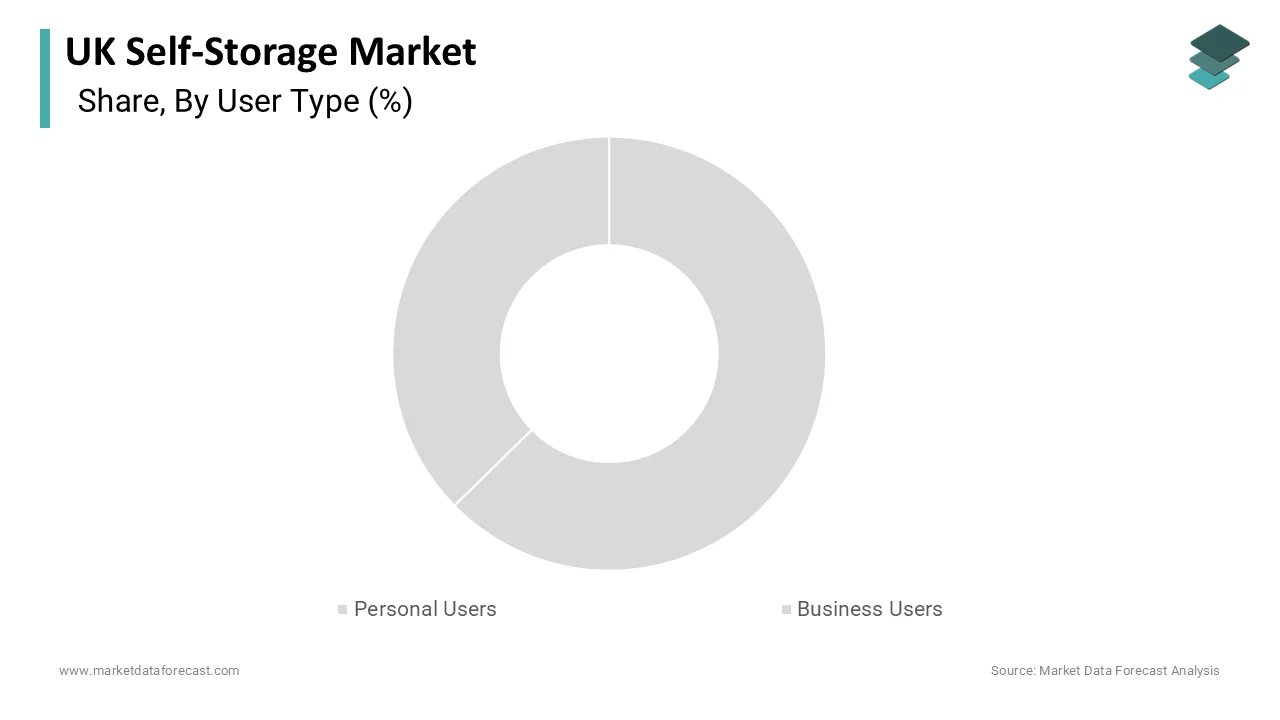
The personal users segment was the largest in the United Kingdom self-storage market and occupied a 65.4% share in 2025. This prominence of the segment is largely supported by the high fluidity of the housing market and the frequent transitional life events that necessitate temporary storage solutions. Moving home remains one of the most stressful life experiences, and self-storage provides a crucial buffer during the gap between selling one property and purchasing another. The rise in private renting also contributes significantly. Long-term tenants often lack long-term security and require flexible storage options during lease transitions. Downsizing trends among the aging population further fuel this segment as older adults move from larger family homes to smaller apartments but wish to retain sentimental items and furniture for family visits. The emotional attachment to possessions makes disposal difficult, making storage a preferred alternative. Real estate agents frequently recommend storage services to help sellers declutter properties for viewings, enhancing sale potential. The affordability of small units allows individuals to store seasonal items such as winter clothing or sports equipment, freeing up valuable living space. This segment benefits from the recurring nature of life changes,s ensuring a steady influx of new customers. The personalization of service and ease of access are key factors influencing choice among individual consumers.
The accumulation of consumer goods and the expansion of lifestyle hobbies significantly drive the domination of the personal user segment in the self-storage market. Modern consumption patterns have led to households possessing more belongings than their living spaces can accommodate, particularly in urban areas with compact housing. Hobbies such as cycling, camping, golf, and collecting require specialized equipment that is used intermittently but requires secure storage when not in use. Self-storage facilities offer a cost-effective alternative to expanding home size or renting larger properties. The rise of home renovations also drives demand as homeowners need safe places to store furniture and belongings during construction work. Students contribute to this trend by storing items during summer breaks or study abroad periods. The flexibility of month-to-month contracts appeals to individuals who do not want long-term commitments. Marketing campaigns often target specific life stages such as university entry, marriage, or retirement, highlighting the convenience of storage. The ability to access units on demand allows users to treat storage as an extension of their home. This lifestyle integration ensures that personal storage remains a habitual service rather than a one-off transaction.
The business users segment is expected to exhibit a noteworthy CAGR of 8.5% between 2026 and 2034. This rapid growth is fueled by the expansion of e-commerce and the need for micro logistics among small and medium-sized enterprises. Retail startups require flexible inventory storage that scales with demand without the high overheads of traditional warehousing. According to the Office for National Statistics retail indexes, e-commerce continues to command a major share of total UK retail value, incentivising the logistics sector to establish fulfillment points closer to metropolitan areas. Self-storage units serve as ideal fulfillment centers for small businesses, allowing them to manage stock pick orders and handle returns efficiently. The gig economy and freelance professionals also contribute to this trend by storing tools, equipment, and materials securely. Business-specific businesses now offer business-specific amenities such as mail handling, meeting rooms, and high-speed internet, enhancing the utility of storage units for commercial use. The tax deductibility of storage expenses for business purposes further incentivizes adoption. The ability to maintain multiple units across different locations allows businesses to optimize distribution networks. This segment offers higher revenue stability for operators as business contracts tend to be longer-term and less price-sensitive than personal ones. The integration of business services into self-storage models transforms facilities into essential infrastructure for the modern digital economy.
The cost efficiency and operational flexibility provided by self-storage make it an attractive option for small and medium-sized enterprises, driving its rapid growth. Traditional commercial leases often require long-term commitments and large minimum spaces, which are prohibitive for growing businesses. Self-storage offers scalable solutions where companies can rent exactly the amount of space they need and adjust as required. Data from the Federation of Small Businesses confirms that a vast majority of UK small enterprises struggle with escalating overhead costs, leading many business models to seek out highly flexible workspace and stock solutions. Startups can minimize initial capital expenditure by using storage units instead of investing in dedicated office or warehouse space. The security features of modern facilities, including 24-hour surveillance and controlled access, protect valuable business assets and documents. Archives and records storage also drive demand as companies comply with data retention regulations requiring secure physical storage. The proximity of storage facilities to business districts reduces transportation time and costs for retrieving items. Operators are increasingly marketing directly to business sectors such as construction, retail, and professional services, highlighting these benefits. The agility afforded by self-storage allows businesses to respond quickly to market changes and seasonal fluctuations. This strategic advantage supports the sustained expansion of the business user segment in the self-storage market.
By Storage Type Insights
In 2025, the non-climate-controlled segment held the majority share of the United Kingdom self-storage market because of the lower rental costs associated with these units, making them accessible to a broader range of customers. Most household goods, such as furniture, clothing, books, and kitchenware, are durable enough to withstand normal temperature and humidity fluctuations without damage. Price-sensitive consumers and students prioritize affordability over environmental precision, choosing standard units to minimize expenses. The simplicity of non-climate-controlled facilities also translates to lower operational costs for providers who do not need to invest in expensive HVAC systems. These units are often located on ground floors or in drive-up configurations, offering greater convenience for loading and unloading heavy items. The majority of short-term storage needs, such as moving or renovation projects, do not require strict environmental controls. Marketing efforts often highlight the value proposition of appealing to budget-conscious renters. The widespread availability of non-climate-controlled space ensures that supply meets the bulk of market demand. This segment remains the backbone of the industry, providing stable occupancy rates and consistent revenue streams.
The wide availability and standardized infrastructure of non-climate-controlled units further reinforce their market in self-storage. Most existing self-storage facilities were originally built with standard units as the primary offering, g resulting in a larger supplyclimate-controlledclimate-controlledecialized climate controlled options. Retrofitting older buildings with climate control systems is costly and technically challenging,g limiting the conversion rate. non-climate-controlled for non climate controlled unitsallow operatorss to keep them in service with minimal downtime. Customers appreciate the straightforward nature of these units without the complexity of monitoring temperature settings. The versatility of standard units allows them to accommodate a wide variety of items from vehicles to business archives. Retailers and distributors often use these units for overflow stock that does not require specific environmental connon-climate-controllednon-climate-controlledty of non climate controlled storage facilities to enter for first-time users. Educational materials provided by operators help customers understand which items are suitable for standard storage, addressing concerns about damage. This established infrastructure suppornon-climate-controlledance of non climate controllclimate-controlledrket.
The climate-controlled segment is predicted to witness the highest CAGR of 9.2% during the forecast period due to the high-value need to preserve high-value antique items such as antique artwork, electronics, cs, and important documents. Fluctuations in temperature an,d humidi,, ty can cause warping,c racking crackingnd corrosion, damaging valuable possessions. Wine enthusiasts also contribute to this trend, requiring precise temperature control for proper aging and storage. Businesses storing medical records and climate-controlled electronic data need climate-controlled spaces to comply with regulatory standards for data integrity and safety. The rise in luxury consumption means more individuals possess items that require careful handling and storage. Operators market these units as premium products, ts emphasizing peace of mind and asset protection. The ability to guarantee specific environmental conditions differentiates these units from standard offerings. This segment attracts customers who are less price sensitive and more focused on quality and security. The growth reflects a maturing market where consumers are willing to pay for specialized services.
Technological advancements in heating ven, ventilation, and air conditioning have made climate-controlled storage more energy-efficient and affordable to operate, te driving its expansion. Modern HVAC systems use smart sensors and automated controls to maintain optimal conditions while minimizing energy consumption. The integration of renewable energy sources such as solar panels further enhances sustainability and reduces operational expenses. Customers are increasingly aware of environmental impacts and prefer facilities that demonstrate green credentials. The improved reliability of climate control systems reduces the risk of equipment failure and potential damage to stored goods. Marketing campaigns highlight the technological sophistication, appealing to tech-savvy and environmentally conscious consumers. The ability to monitor conditions remotely via apps provides added assurance for users. Operators are investing in new builds with integrated climate control rather than retrofitting older structures. This strategic shift in climate-controlled options in key markets. The combination of technological efficiency and consumer demand for quality ensures sustained growth in this segment.
By Unit Size Insights
The medium units self-storage market in the United Kingdom self-storage market and captured a 45.1% share in 2025. This leading position of the segment was attributed to its versatility in accommodating the average household storage needs of a one- or two-bedroom apartment. Medium units typically range from 50 to 100 square feet, et providing enough space for furniture boxes and appliances without being excessively large or expensive. These units are ideal for life transitions, ns such as moving,oving renovating, or downsizing, where a significant but manageable amount of items needs to be stored. The price point of medium units offers a balance between affordability and capacity, appealing to a broad demographic. Customers find them easy to pack and organize, maximizing space utilization. Operators promote medium, unit,s as the most popular choice,e helping guide undecided customers toward this option. The standardization of medium unit dimensions across facilities simplifies comparison shopping for consumers. This segment benefits from consistent demand regardless of economic cycles, as household moves remain frequent. The practicality of medium sizes ensures they remain the cmost suitablefor most self storage providers.
The optimal revenue yield generated by medium units further reinforces their market leadership from an operator perspective. These units often command a higher price per square foot compared to larger units due to their high demand and efficient use of space. The turnover rate,, for medium units is balanced,ced providing regular opportunities for price adjustments and customer acquisition. Operators can fit more medium units into a given facility compared to large units,s maximizing total revenue potential. The marketing effort required to fill medium units is lower due to their broad appeal and standard sizing. Promotional offers often focus on medium units to attract new customers who may then upgrade or refer others. The operational costs associated with maintaining medium unarer are proportional to their size,e making them efficient to manage. The popularity of medium units allows operators to optimize layout and design for maximum density. This financial efficiency encourages developers to prioritize medium unit construction in new projects. The alignment of customer needs with operator profitability ensures the continued dominance of medium units in the market.
The small units segment is estimated to register the fastest CA, R of 7.8% from 2026 to,20,34 owing to the trend toward urban living in compact apartments where every square foot counts. Residents in cities like London and Manchester often lack closet and cupboard space, driving demand for small lockers or cabinets to store seasonal items, documents, and valuables. Small units are affordable and accessible ma, making them attractive to students, young professionals, and seniors with minimalist lifestyles encourag, encouraging people to only essential items bu, but still requires secure storage for occasional use goods. Small units are also popular for storing business records and inventory for online sellers operating from home. The low entry price allows customers to try self-storage without a significant financial commitment. Operators are converting underutilized spaces into small unit clusters to meet this demand. The convenience of small units for quick drop off and pick up aligns with busy urban lifestyles. This segment captures a niche but rapidly expanding customer for cost-effective solutions.
The high density and operational efficiency of small units contribute to their rapid growth and appeal to operators. Facilities can maximize revenue per square foot by installing numerous small units in areas th,,atthat oththat wouldunused such as hallways or upper levels. The low maintenance requirements of small units reduce operational burdens for staff. Automated access systems work particularly well for small units,s as customers often visit briefly to drop off or retrieve small items. The turnover rate of products can be higher, providing opportunities for dynamic pricing and revenue optimization. Marketing small units as securelock security-consciouappeals toss consumers. The scalability of small unit offerings allows operators to adjust inventory mix based on locker-style introduction of locker-style units with digital locks, which enhances security and convenience. This segment allows operators to diversify their product portfolio and attract a wider range of customers. The efficiency of small units supports sustainable growth in dense urban markets where land is scarce.
COUNTRY LEVEL ANALYSIS
UK Self Storage Market Analysis
The United Kingdom was the dominant player in the Europe self storage market and accounted for a 40.6% share in 2025. This position of the UK market was driven by high penetration rates and sophisticated consumer awareness. High urbanization rates and a mobile population drive consistent demand for flexible storage solutions across major cities and suburban areas. According to the Office for National Statistics, the private rented sector has seen substantial long-term growth and accommodates a highly mobile demographic. The Self-Storage Association UK further indicates that these frequent tenant moves and lease transitions serve as major demand drivers for consumer self-storage utilization. The presence of major international operators alongside strong local brands creates a competitive landscape that fosters innovation in service delivery and technology. Regulatory standards regarding fire safety and building compliance ensure high operational quality and trust. The well-developed transport infrastructure facilitates easy access to storage facilities from residential and commercommercial areasptancee of self sself-storagenormal part of life, reducing stigma and encouraging usage. Economic stability supports consistent spending on storage services, although inflationary pressures occasionally impact discretionary choices. The market ben ef, i it'sfhigh digitaladoptionn enabling seamless online booking and management. Sustainability initiatives are becoming standard practice, investing in energy-efficient facilities. The United Kingdom serves as a benchmark for besself-storagein the Eu,ropean self storage industry influencing trends and standards across the continent. Continued urban development and lifestyle changes ensure sustained growth and evolution of the market.
COMPETITIVE LANDSCAPE
The competition in the United Kingdom self-storage market is characterized by intense rivalry among established national chains, independent local operators, and emerging peer-to-peer platforms. Major players in self-storage use their scale and brand recognition to dominate prime urban locations, while smaller firms price on price and personalize service. The market sees peer-to-peer investment in technology, with operators adopting smart locks and digital booking systems to improve efficiency and customer satisfaction. Consolidation through mergers and acquisitions is common as larger groups seek to expand their footprint and achieve economies of scale. Private equity interest remains strong, driving capital inflows for new developments and refurbishments. Differentiation strategies focus on security features,s climate control, and specialized business services to capture higher value segments. Price competition is moderate but intensifies in saturated areas where supply exceeds demand. Regulatory compliance regarding fire safety and planning permissions creates barriers to entry, protecting incumbent operators. The rise of e-commerce drives demand for business storage, creating new competitive dynamics. Operators must balance cost management with service quality to retain customers in a mature yet evolving market.
KEY MARKET PLAYERS
Some of the companies that are playing a dominating role in the U.K. Self-Storage Market include
- Safestore Holdings plc
- Big Yellow Group plc
- Lok’nStore Group plc
- Storage King UK
- Shurgard Self Storage Ltd.
- Access Self Storage Ltd.
- Ready Steady Store Ltd.
- StorageMart
- Warren Self Storage Ltd.
- Titan Self Storage Ltd.
- Space Station Self Storage Ltd.
- The Self Storage Company
TOP LEADING PLAYERS IN THE MARKET
- Big Yellow Group plc maintains a leading position in the United Kingdom self-storage sector through its extensive network of urban and suburban facilities. The company focuses on providing secure, convenient, and customer-centric storage solutions for both personal and self-storage clients. Recent actions include expanding its portfolio through strategic acquisitions of premier estates, Tes. It has invested heavily in digital infrastructure,ure enabling seamless online booking and contactless access for users. The company prioritizes sustainability by implementing energy-efficient lighting and solar panels in its estates. Their commitment to superior customer service and facility maintenance reinforces brand loyalty. These initiatives strengthen the energy efficiency and ensure continued growth in the dynamic British property market while adapting to evolving consumer needs for flexible storage options.
- Safestore Holdings plc leverages its robust operational platform and strong brand recognition to maintain a significant presence in the United Kingdom self-storage market. The company emphasizes organic growth through development projects and targeted acquisitions of independent operators. Recent actions include launching enhanced security features such as biometric access systems and improved CCTV coverage at key locations. Safestore has expanded its business storage offerings with dedicated services for e-commerce retailers,s including mail handling and packing supplies. The group actively pursues sustainability goals by reducing carbon emissions and optimizing energy usage in its technology-driven e-commerce platform, which rationalizes margins and customer experience. These strategic moves consolidate their long-term position and drive long-term value creation for stakeholders in the competitive storage landscape.
- Access Self Storage Ltd contributes significantly to the United Kingdom market by operating a diverse range of facilities that cater to varied customer requirements. The company distinguishes itself through flexible lease terms and personalized customer support tailored to local community needs. Recent actions include upgrading existing sites wiclimate-controlledclimate-controlleds such as climate controlled units and improved loading bays. Access SelStorage has enhanced its user-friendly presence with apps for account management and unit access control. The company invests in staff training to ensure high standards of service and safety compliance. Partnerships with local businesses help drive commercial referrals and increase occupancy rates. These efforts reinforce its reputation as a reliable and accessible storage provider. Access Self Storage strengthens its position against larger national competitors. This is achieved by focusing heavily on customer satisfaction and facility quality.
TOP STRATEGIES USED BY KEY MARKET PARTICIPANTS
Key players in the United Kingdom self-storage market employ several strategic approaches to maintain competitiveness and drive growth. Digital transformation remains central with companiesin investinggg inself-storages systems and online management platforms to enhance user convenience. Strategic acquisitions of independent operena are able to rapidly expand into new geographic areas and increase market density. Sustainability initiatives are widely adopted to reduce operational costs and appeal to environmentally conscious consumers through energy-efficient facilities. Customer experience improvements include enhanced security measures and flexible leasing options to attract both personal and business users. Energy-efficiententicing models utilize data analytics to optimize revenue based on demand fluctuations and occupancy levels. Marketing efforts focus on local search visibility and partnerships with moving companies to generate leads. These combined strategies allow market participants to navigate economic uncertainties while capitalizing on urbanization trends and changing lifestyle needs in the British storage sector.
MARKET SEGMENTATION
This research report on the UK self-storage market is segmented and sub-segmented as follows.
By User Type
- Personal Users
- Business Users
By Storage Type
- Non-Climate Controlled Storage
- Climate-Controlled Storage
By Unit Size
- Smaas foas followss
By Country
- United KingdomA