UK Waste Management Market Size, Share, Trends & Growth Forecast Report By Source, By Service Type, and By Country (United Kingdom) – Industry Analysis and Forecast, 2026 to 2034
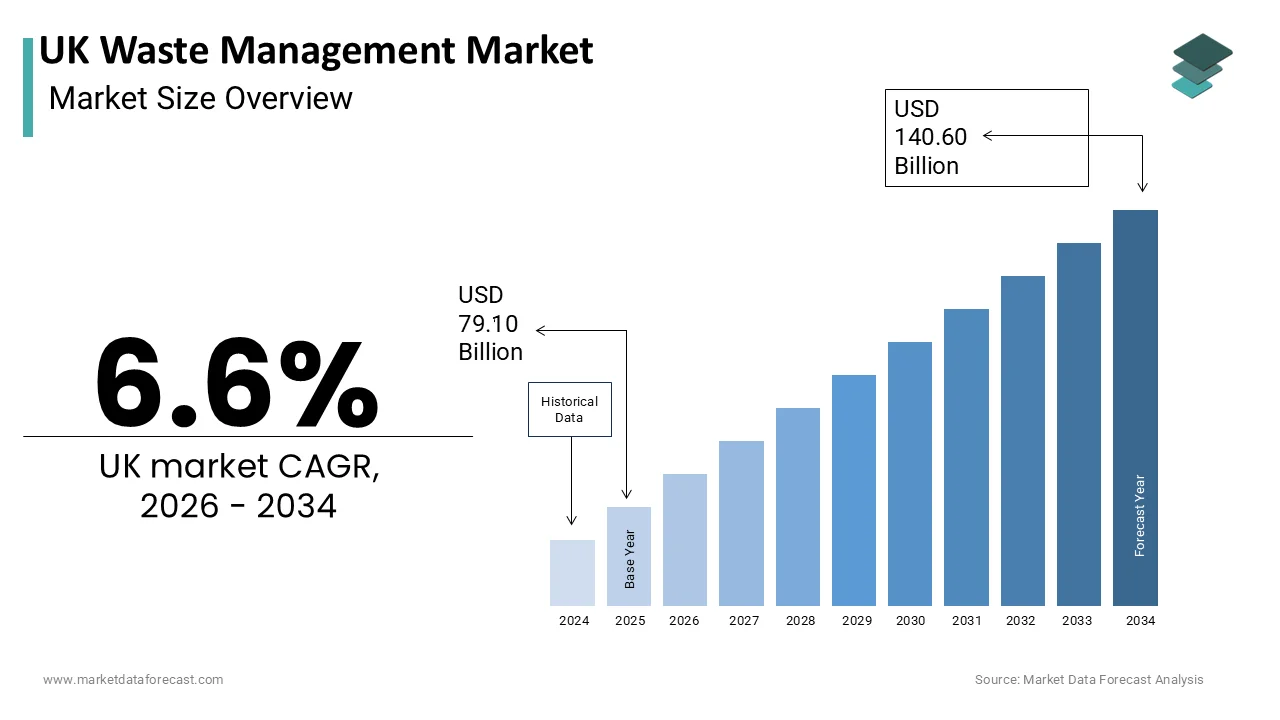
Market Size, 2025
$79.10 BnMarket Estimate, 2026
$84.32 BnMarket Forecast, 2034
$140.60 BnCAGR, 2026–2034
6.6%UK Waste Management Market Size
The UK Waste Management Market is projected to grow from USD 79.10 billion in 2025 to USD 84.32 billion in 2026 and reach USD 140.60 billion by 2034, registering a CAGR of 6.6% during the forecast period from 2026 to 2034.
Warehousing is the process of safely and systematically storing goods in a designated facility until they are ready to be sold, distributed, or used in production. The country's market is undergoing a significant transformation. This market operates under stringent regulatory frameworks designed to minimize environmental impact and promote circular economy principles. The Department for Environment, Food and Rural Affairs (DEFRA) shows that the United Kingdom generated a total baseline of 222.2 million tonnes of waste in 2018. Over the subsequent years, total annual waste from UK households has steadily tracked between 23 and 27 million tonnes, framing the core focus of municipal waste reduction initiatives. Recycling rates have shown gradual improvement. The landfill tax remains a critical economic instrument driving waste diversion, with rates increasing annually to discourage the disposal of recoverable materials. Local authorities manage municipal waste contracts while private companies handle commercial and industrial streams, creating a mixed operational landscape. Technological advancements in sorting facilities and energy from waste plants enhance recovery efficiency and reduce reliance on fossil fuels. The transition towards extended producer responsibility schemes shifts financial burdens onto manufacturers, encouraging sustainable product design. Public awareness regarding plastic pollution and climate change influences consumer behavior and policy direction. As the nation strives to meet net-zero targets by 2050, the waste management sector plays a pivotal role in resource conservation and carbon reduction. Infrastructure investment focuses on modernizing treatment facilities and expanding anaerobic digestion capabilities to handle organic waste effectively, while ensuring alignment with national sustainability goals.
MARKET DRIVERS
Stringent Environmental Regulations and Landfill Tax Increases
Stringent environmental regulations and progressive landfill tax increases are contributing to the growth of the United Kingdom's waste management market. These factors compel businesses and local authorities to adopt alternative waste treatment methods. The landfill tax, which stands at over 100 pounds per tonne for standard waste, acts as a powerful financial disincentive against disposal in landfills, according to HM Revenue and Customs data. This fiscal pressure forces waste producers to seek cheaper and more sustainable options, such as recycling, incineration with energy recovery, or anaerobic digestion. The Environment Agency enforces strict permitting requirements for waste facilities, ensuring high operational standards and minimizing pollution risks. Regulatory mandates under the Resources and Waste Strategy aim to eliminate avoidable waste growth and increase resource efficiency across all sectors. Local councils face statutory obligations to meet recycling targets, prompting investment in separate collection systems and public education campaigns. The introduction of consistent household recycling collections legislation requires uniformity in accepted materials, reducing confusion and improving contamination rates. Compliance with these regulations drives demand for advanced sorting technologies and processing infrastructure capable of handling complex waste streams. Companies that fail to adapt face significant penalties and reputational damage, incentivizing proactive waste minimization strategies. The regulatory landscape continues to evolve with tighter restrictions on single-use plastics and packaging waste, further stimulating innovation in material recovery. These legislative measures create a stable framework for long-term investment in sustainable waste management solutions, ensuring continuous market growth and environmental protection.
Growing Emphasis on Circular Economy Principles
The growing emphasis on circular economy principles fuels substantial transformation in the United Kingdom's waste management market. Consequently, stakeholders are prioritizing resource retention and material reuse over linear disposal models. The Waste and Resources Action Programme estimates that adopting circular economy practices could save UK businesses up to 23 billion pounds annually by reducing material costs and improving efficiency. This economic incentive encourages manufacturers to design products for durability, repairability, and recyclability, reducing waste generation at the source. Retailers and brands are increasingly committing to using recycled content in packaging,g driven by consumer demand and corporate social responsibility goals. Extended producer responsibility schemes require producers to cover the full net cost of managing packaging waste, te shifting financial incentives towards sustainable design. Industrial symbiosis initiatives facilitate the exchange of materials between companies, turning one entity’s waste into another’s raw material, thereby closing resource loops. Government support through grants and innovation funds accelerates the development of new recycling technologies for difficult-to-process materials such as composite plastics and electronics. The construction sector adopts modular building techniques and material passports to facilitate future deconstruction and reuse. Educational programs raise awareness among consumers about the benefits of repairing and sharing goods rather than discarding them. This systemic shift creates new business models and revenue streams within the waste management sector, fostering innovation and resilience while reducing environmental footprint and dependence on virgin resources.
MARKET RESTRAINTS
High Capital Costs for Infrastructure Development
High capital costs for infrastructure development remain a significant barrier to the United Kingdom's waste management market. This limits the pace of modernization and expansion of treatment facilities. Constructing advanced material recovery facilities, anaerobic digestion plants,s and energy from waste incinerators requires substantial upfront investment, often exceeding hundreds of millions of pounds. Securing financing for these projects is challenging due to long payback periods and regulatory uncertainties regarding future waste policies and subsidy regimes. Local authorities facing budget constraints struggle to fund upgrades to existing collection and processing systems, ms leading to inefficiencies and higher operational costs. The complexity of planning permissions and environmental impact assessments adds time and expense to project development, delaying implementation. Small and medium-sized enterprises in the waste sector often lack the financial resources to invest in state-of-the-art technology, hindering their competitiveness against larger integrated operators. Rising interest rates further exacerbate borrowing costs, making capital-intensive projects less attractive to investors. The need for specialized equipment and skilled labor increases construction expenses, while supply chain disruptions can cause delays and cost overruns. Without adequate financial support mechanisms, such as government guarantees or green bonds, many viable projects remain stalled. This financial barrier slows the adoption of innovative waste treatment technologies and limits the capacity to handle growing waste volumes effectively, thereby impeding progress towards national recycling and recovery targets.
Public Resistance to New Waste Facilities
Public resistance to new waste facilities further restricts the growth of the United Kingdom waste management market. This is because community opposition often delays or prevents the construction of essential infrastructure. The Not In My Back Yard phenomenon manifests when residents oppose the establishment of landfills, incinerators, or recycling centers near their homes due to concerns about odor, noise, traffic,c and potential health impacts. Planning inquiries for waste management projects frequently encounter vigorous objections from community groups and local politicians, prolonging approval processes for years. Negative media coverage of past incidents involving pollution or mismanagement erodes public trust in waste operators and regulatory bodies. The lack of transparent communication and meaningful community engagement during the planning phase exacerbates tensions and fosters misinformation. Visual impact and property value concerns also contribute to opposition, making it difficult to secure suitable sites for new facilities. This resistance forces developers to consider less optimal locations, increasing transportation distances and costs while reducing overall system efficiency. Some projects are ultimately abandoned due to sustained local campaign efforts, leaving gaps in regional waste treatment capacity. Overcoming this barrier requires robust stakeholder engagement strategies,s educational initiatives, and demonstrable commitments to high environmental standards and community benefits. The deployment of necessary infrastructure will remain constrained until public acceptance improves. Therefore, this hinders the sector’s ability to meet evolving waste management demands and regulatory obligations.
MARKET OPPORTUNITIES
Advancements In Artificial Intelligence and Robotics
Advancements in artificial intelligence and robotics pave the way for the growth of the United Kingdom's waste management market. This enhances sorting accuracy, operational efficiency, and worker safety. AI-powered optical sorters can identify and separate different types of plastics, metals,s and papers with greater precision than manual methods, ds increasing the quality and value of recovered materials. Robotics equipped with computer vision systems automates the picking process, essentially reducing reliance on human labor in hazardous and repetitive tasks. Studies indicate that AI-driven sorting can improve recovery rates by up to 20 percent, maximizing resource extraction from mixed waste streams. Machine learning algorithms analyze data from sensors to optimize plant operation, predict maintenance needs, and adjust processing parameters in real time. These technologies enable facilities to handle complex and contaminated waste streams more effectively, thereby supporting higher recycling targets. Investment in digital twins allows operators to simulate and test process improvements virtually before implementing them physically, thereby reducing risk and cost. Startups and technology providers collaborate with established waste companies to pilot innovative solutions, fostering a culture of innovation within the sector. Government funding for research and development supports the commercialization of these technologies, accelerating their adoption. As labor shortages persist, automation offers a viable solution to maintain productivity and service levels. The integration of smart technologies positions the UK waste management sector at the forefront of global innovation, driving sustainability and economic value through enhanced resource recovery capabilities.
Expansion Of Bioenergy and Anaerobic Digestion
The expansion of bioenergy and anaerobic digestion offers substantial opportunities for the United Kingdom's waste management market. These processes convert organic waste into renewable energy and nutrient-rich fertilizers. Anaerobic digestion facilities process food waste, agricultural residue,s and sewage sludge to produce biogas, which can be upgraded to biomethane for injection into the gas grid or used as vehicle fuel. The Department for Energy Security and Net Zero shows that biomethane production has grown significantly, contributing to national energy security and decarbonization goals. Digestat,e the byproduct of the process, serves as a sustainable alternative to chemical fertilizers, rs supporting agricultural productivity and soil health. Policy incentives such as the Renewable Heat Incentive and green gas certificates provide financial support for anaerobic digestion projects,cts encouraging investment in this technology. The separation of food waste from general refuse mandated by new legislation increases the feedstock availability for digestion plants, improving their economic viability. Co-digestion of multiple organic waste streams enhances gas yields and operational flexibility. Partnerships between waste managers, energy companies, and farmers create integrated value chains that maximize resource utilization. Technological improvements in pre-treatment and gas upgrading increase efficiency and reduce operational costs. Waste-derived bioenergy has become an increasingly important part of the UK's transition away from fossil fuels. It provides a scalable, sustainable approach that manages organic waste while producing clean power and bolstering rural economies.
MARKET CHALLENGES
Complexity Of Regulatory Compliance and Reporting
The complexity of regulatory compliance and reporting is a major impediment to the United Kingdom waste management market. This imposes significant administrative burdens on operators and local authorities. Navigating the intricate web of environmental permits, waste duty of care regulations,s and transboundary shipment rules requires specialized legal and technical expertise. The Environment Agency mandates detailed record keeping and regular reporting on waste quantities, es ty, and destinations, ensuring transparency and accountability. Changes in legislation, such as the introduction of extended producer responsibility schemes, require frequent updates to operational procedures and IT systems, increasing compliance costs. Inconsistent interpretation of regulations by different regulatory bodies creates uncertainty and risk for businesses operating across multiple regions. The need to track hazardous waste movements through electronic consignment notes adds another layer of complexity,y requiring robust digital infrastructure. Non-compliance can result in severe penalties, including fines, es license revocation,n and criminal prosecution, necessitating rigorous internal audit processes. Small operators often struggle to keep pace with evolving requirements, lacking the resources for dedicated compliance teams. The administrative workload diverts attention and resources from core operational activities and innovation initiatives. Harmonizing regulations and simplifying reporting processes through digital platforms could alleviate some of these challenges, but until then, the burden remains a significant operational hurdle affecting efficiency and profitability within the sector.
Volatility In Secondary Material Markets
Volatility in secondary material landscapes provides a significant challenge for the United Kingdom waste management market. This affects the economic stability of recycling operations. Prices for recycled plastics, cs p a, per glass, and metals fluctuate widely based on global supply and demand dynamics, geopolitical events,s and changes in manufacturing trends. The closure of export markets such as China’s National Sword policy disrupted traditional disposal routes for UK recyclables, forcing domestic processors to find alternative buyers or absorb lower prices. Contamination levels in collected materials further depress values as reprocessors require high-purity inputs to maintain product quality. Fluctuating oil prices influence the cost competitiveness of recycled plastics against virgin materials, impacting demand from manufacturers. Uncertainty in revenue streams makes it difficult for waste management companies to plan investments and secure long-term contracts. Local authorities reliant on income from the sale of recyclables face budget shortfalls when market prices drop unexpectedly. The lack of stable domestic demand for certain recycled materials exacerbates vulnerability to global market shocks. Developing end markets for recycled content through procurement policies and product standards could mitigate this volatility, but progress has been slow. Financial viability for recycling services remains precarious until more resilient and localized markets are established. Consequently, this threatens the sustainability of the collection and processing infrastructure essential for achieving circular economy objectives.
REPORT COVERAGE
| REPORT METRIC | DETAILS |
| Market Size Available | 2025 to 2034 |
| Base Year | 2025 |
| Forecast Period | 2026 to 2034 |
| Segments Covered | By Source, Service Type, and Region |
| Various Analyses Covered | Global, Regional and Country-Level Analysis, Segment-Level Analysis, Drivers, Restraints, Opportunities, Challenges; PESTLE Analysis; Porter’s Five Forces Analysis, Competitive Landscape, Analyst Overview of Investment Opportunities |
| Countries Covered | United Kingdom |
| Market Leaders Profiled | Biffa plc, Veolia UK Ltd., SUEZ Recycling and Recovery UK Ltd., FCC Environment (UK) Ltd., Viridor Limited, Grundon Waste Management Ltd., Enva Group, WasteCare Group Ltd., Renewi plc, European Metal Recycling (EMR) Ltd., Cory Group Ltd., Business Waste Ltd. |
SEGMENTAL ANALYSIS
By Source Insights
In 2025, the industrial waste segment held the majority share of 50.1% of the United Kingdom waste management market because of the substantial volume of materials generated by manufacturing, construction, and mining activities. The Department for Environment, Food and Rural Affairs (DEFRA) states that the combined commercial and industrial sectors produce roughly 40 million tonnes of annual waste, which comprises approximately 19% of the United Kingdom's baseline waste inventory. This dominance is underpinned by the sheer scale of industrial operations, which produce heavy inert materials such as concrete bricks and soil alongside hazardous substances requiring specialized handling. Sources show that Construction, Demolition, and Excavation (CD&E) projects form the single largest waste generator in the nation, accounting for over 60% of the aggregate UK waste profile due to persistent urban development and infrastructure modifications. Regulatory frameworks mandate strict segregation and disposal protocols for industrial waste, thereby ensuring compliance with environmental standards and minimizing landfill usage. Large manufacturing facilities often implement recycling initiatives to recover metals, plastics, and packaging materials, reducing disposal costs and enhancing sustainability credentials. The complexity of industrial waste streams necessitates advanced treatment technologies such as incineration with energy recovery and chemical neutralization, driving investment in specialized processing infrastructure. Economic incentives,s including landfill tax exemptions for certain recycled industrial materials, ls further encourage diversion from disposal sites. As industries strive to meet corporate social responsibility goals and regulatory requirements,nts the demand for efficient and compliant industrial waste management services remains robust, solidifying this segment's position as the largest contributor to the national waste management ecosystem.
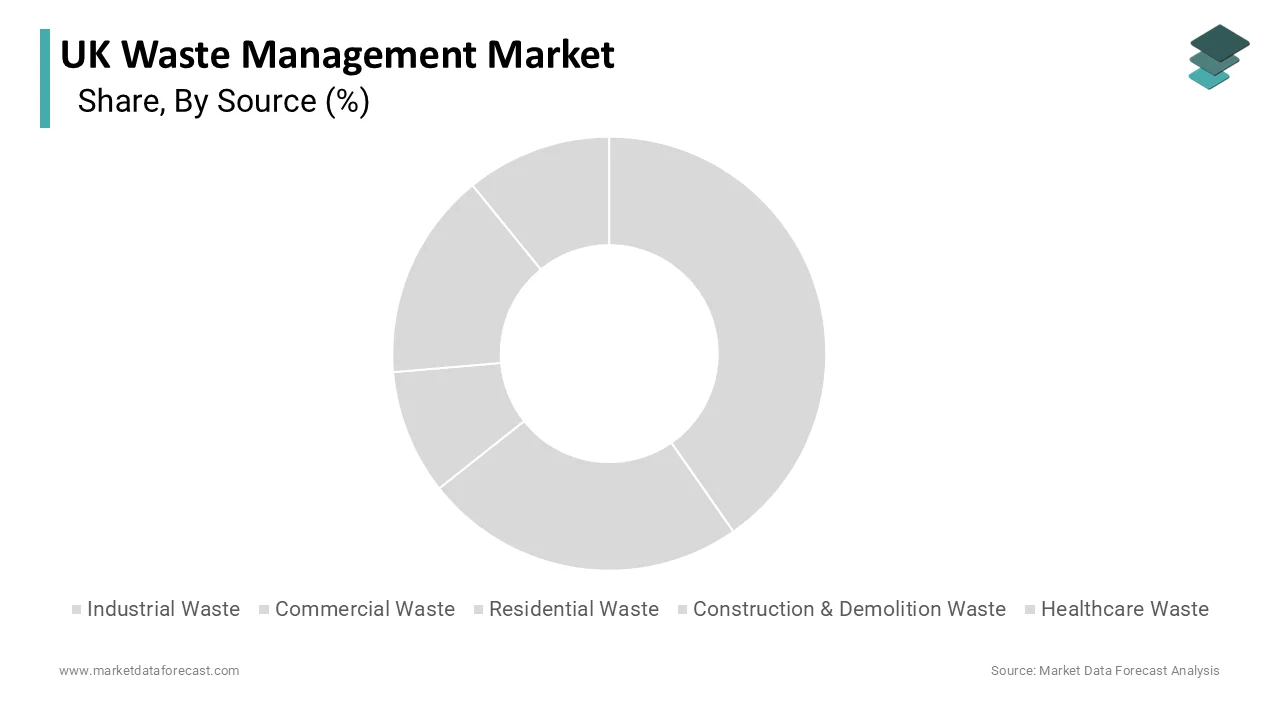
On the other hand, the commercial waste segment is anticipated to witness the fastest CAGR of 6.3% between 2026 and 2034. Retail, hospitality, and office-based businesses are driving rapid acceleration in this segment. Therefore, these service sectors generate significant amounts of packaging paper and organic waste. The rise of e-commerce has dramatically increased cardboard and plastic packaging waste from distribution centers and retail outlets, requiring enhanced collection and recycling capabilities. Office environments contribute large volumes of paper and electronic waste,e prompting businesses to adopt secure shredding and IT asset disposal services. Hospitality venues generate substantial food waste,ste leading to increased demand for anaerobic digestion and composting services to convert organic matter into energy and fertilizer. Regulatory press, ures such as mandatory separate collection of recyclables and food waste for commercial entities, drives adoption of comprehensive waste management solutions. Businesses are increasingly prioritizing sustainability to enhance brand reputation and meet stakeholder expectations, investing in waste audits and reduction strategies. The fragmentation of the commercial sector means many small and medium-sized enterprises rely on third-party providers for efficient waste handling, creating opportunities for specialized service operators. Heightened environmental consciousness among consumers has led to increased scrutiny of corporate waste practices. As a result, businesses are increasingly outsourcing to waste management experts to maintain regulatory compliance and highlight their sustainability initiatives.
By Service Type Insights
The collection services segment was the largest in the United Kingdom waste management market and occupied a 60.5% share in 2025. It achieved this by serving as the primary interface between waste generators and the management system. Local authorities and private contractors operate extensive fleets of vehicles to collect municipal,l commercial, and industrial wasteona regular schedules,s ensuring hygiene and public health standards are maintained. The Department for Environment, Food and Rural Affairs (DEFRA) confirms that the UK's municipal infrastructure successfully manages and collects roughly 26 to 27 million tonnes of household waste annually, relying on an extensive regional logistical framework to process the volume. The complexity of modern recycling mandates,s which require separate collection of paper, glass,s plastics, and organics, has increased the frequency and specialization of collection operations. Investment in automated side-loading trucks and route optimization software enhances operational efficiency and reduces fuel consumption and emissions. Contractual agreements between councils and waste management companies often span multiple years, providing stable revenue streams for service providers. The introduction of consistent household recycling collections legislation necessitates upgrades to collection infrastructure and vehicles to handle new material streams effectively. Public expectation for reliable and convenient waste removal drives continuous improvement in service quality and customer engagement. Collection services form the backbone of the waste hierarchy,y enabling subsequent sorting, recycling, ing and treatment processes by ensuring materials are captured and transported safely. Without an efficient collection system, the entire waste management chain would collapse, making this segment indispensable and the largest by operational scope and employment within the industry.
However, the sorting and segregation segment is on the rise and is expected to be the fastest-growing segment in the market by witnessing a CAGR of 8.6% over the forecast period, owing to the increasing complexity of waste streams and the need for high-purity recycled materials to meet manufacturer specifications and regulatory standards. Advanced Material Recovery Facilities equipped with optical sorters, artificial intelligence,e and robotic arms enable precise separation of different plastic types ,metals, and papers, maximizing recovery rates. The introduction of extended producer responsibility schemes places greater emphasis on the quality of recycled output, incentivizing investment in sophisticated sorting technologies. Contamination reduction is a key driver, as mixed waste streams often contain non-recyclable items that degrade the value of recovered materials. Automated sorting systems can process materials at higher speeds and with greater accuracy than manual labor, addressing labor shortages and improving worker safety. The demand for food-grade recycled plastics requires stringent segregation protocols to remove contaminants and odors, driving innovation in cleaning and separation techniques. Regulatory targets for recycling rates compel operators to extract more value from each tonne of waste processed, making efficient sorting economically vital. Partnerships between technology providers and waste managers facilitate the deployment of cutting-edge sorting solutions, enhancing overall system performance. As circular economy principles gain traction,n the ability to produce high-quality secondary raw materials through effective sorting becomes a critical competitive advantage, fostering rapid expansion in this specialized service sector.
COUNTRY LEVEL ANALYSIS
United Kingdom Waste Management Market Analysis
The United Kingdom was positioned second in the European waste management market, accounting for a 15.4% share in 2025. This prominent position is supported by a mature regulatory framework and strong commitment to sustainability goals,s including net zero emissions by 2050. The market status reflects a transition from landfill dependency towards recycling and energy recovery,ry with landfill rates dropping below 10 percent for municipal waste. The Department for Environment, Food and Rural Affairs confirms that the UK recycles over 44 percent of its household waste, demonstrating significant progress in resource efficiency. Strategic initiatives such as the Resources and Waste Strategy provide clear direction for industry development,nt encouraging investment in advanced treatment infrastructure. The presence of major global waste management companies fosters competition and innovation in service delivery and technology adoption. High population density in urban areas facilitates efficient collection networks, while rural challenges are addressed through targeted government funding. Public awareness campaigns promote responsible waste disposal behaviors, contributing to higher participation rates in recycling programs. The implementation of deposit return schemes for beverage containers and extended producer responsibility for packaging further strengthens the circular economy framework. Cross-border collaboration on waste trade and technology sharing enhances regional cooperation and best practice exchange. As the UK continues to refine its waste policies and invest in green infrastructure, it maintains its leadership role in driving sustainable waste management practices across Europe, serving as a model for regulatory effectiveness and operational excellence.
COMPETITIVE LANDSCAPE
The competitive landscape in the United Kingdom waste management market features intense rivalry among large integrated multinational corporations and specialized regional operators. Major players compete for service reliability, technological capability, and sustainability credentials to secure long-term contracts with local authorities and commercial clients. Differentiation is achieved through advanced recycling technologies, energy recovery efficiency,nc,y, and comprehensive circular economy solutions. Price competition remains significant,n not particularly for basic collection services but value-added offerings, such as data analytics and waste minimization consulting, which provide competitive advantages. Regulatory compliance acts as a barrier to entry, favoring established firms with resources to manage complex permitting and reporting requirements. Consolidation trends continue as larger companies acquire smaller specialists to expand geographic reach and technical expertise. Innovation in plastic recycling and organic waste processing drives differentiation as stakeholders prioritize environmental impact. Customer retention depends on transparent reporting and demonstrable progress towards sustainability targets. The market demands continuous investment in green infrastructure and digital tools to maintain operational efficiency and meet evolving legislative standards in a dynamic regulatory environment.
KEY MARKET PLAYERS
Some of the companies that are playing a dominating role in the U.K. Waste Management Market include
- Biffa plc
- Veolia UK Ltd.
- SUEZ Recycling and Recovery UK Ltd.
- FCC Environment (UK) Ltd.
- Viridor Limited
- Grundon Waste Management Ltd.
- Enva Group
- WasteCare Group Ltd.
- Renewi plc
- European Metal Recycling (EMR) Ltd.
- Cory Group Ltd.
- Business Waste Ltd.
TOP LEADING PLAYERS IN THE MARKET
- Biffa operates as a leading integrated waste management company in the United Kingdom, om providing comprehensive services for households, businesses, and local authorities. The company manages the entire waste lifecycle from collection and sorting to recycling and energy recovery,ery ensuring sustainable disposal solutions. Recent strategic initiatives include significant investments in advanced material recovery facilities equipped with artificial intelligence sorting technology to improve recycling purity and efficiency. Biffa has expanded its organic waste processing capabilities through anaerobic digestion plants, converting food waste into renewable biogas and fertilizer. The organization actively partners with brands to develop closed-loop recycling systems for plastics and packaging materials. These actions strengthen its market position by enhancing operational sustainability and meeting stringent regulatory requirements while delivering value to customers through innovative resource recovery solutions.
- Veolia UK contributes significantly to the national waste management sector by offering specialized environmental services, including hazardous waste treatment,t water management,nt and energy recovery. The company leverages global expertise to implement cutting-edge technologies for complex industrial and municipal waste streams. Recent actions involve the expansion of its energy from waste infrastructure with new incineration facilities designed to generate electricity and heat for local communities. Veolia has intensified its focus on circular economy projects, collaborating with manufacturers to recycle difficult materials such as composite plastics and electronic waste. The firm also invests in digital platforms for real-time waste tracking and compliance monitoring, improving transparency for clients. These efforts reinforce its reputation as a trusted partner in achieving net-zero goals and driving sustainable resource management across the United Kingdom.
- Suez Recycling and Recovery UK plays a pivotal role in managing municipal and commercial waste through efficient collection networks and advanced processing facilities. The company operates numerous material recovery centers and energy from waste plants, contributing to national recycling targets and carbon reduction objectives. Recent strategic moves include the modernization of existing infrastructure with automated sorting systems to handle increasing volumes of recyclable materials effectively. Suez has strengthened partnerships with local councils to implement consistent household recycling collections, aligning with government legislation. The organization also focuses on community engagement programs to educate residents on proper waste segregation and contamination reduction. Suez enhances its competitive edge by prioritizing technological innovation and customer service excellence. This strategic focus directly supports the transition towards a more sustainable and circular waste management economy in the region.
TOP STRATEGIES USED BY KEY MARKET PARTICIPANTS
Key players in the United Kingdom waste management market employ strategies focused on technological innovation and infrastructure modernization to enhance recycling efficiency and resource recovery. Companies invest heavily in artificial intelligence and robotics for automated sorting to improve material purity and reduce labor costs. Expansion of energy from waste facilities allows operators to generate renewable electricity and heat,i diversifying revenue streams beyond traditional disposal fees. Strategic partnerships with local authorities and commercial clients ensure long-term contracts and stable operational volumes. Adoption of digital tracking systems improves compliance, transparency, and customer engagement throughout the waste lifecycle. Investment in anaerobic digestion technologies supports organic waste processing and biogas production,n aligning with national decarbonization goals. Continuous training programs address workforce skills gaps in operating advanced machinery. These multifaceted approaches enable participants to navigate regulatory complexities and drive sustainable growth in a competitive environmental services landscape.
MARKET SEGMENTATION
This research report on the UK waste management market is segmented and sub-segmented into the following categories.
By Source
- Industrial Waste
- Commercial Waste
- Residential Waste
- Construction & Demolition Waste
- Healthcare Waste
- Others
By Service Type
- Collection Services
- Sorting & Segregation
- Recycling Services
- Disposal Services
- Composting & Anaerobic Digestion
- Waste-to-Energy Services
By Country
- United Kingdom
Related Reports
Access the study in MULTIPLE FORMATS
Purchase options starting from
$ 1200
Didn’t find what you’re looking for?
TALK TO OUR ANALYST TEAM
Need something within your budget?
NO WORRIES! WE GOT YOU COVERED!
Call us on: +1 888 702 9696 (U.S Toll Free)
Write to us: sales@marketdataforecast.com