- Product Description Description
- Table of Contents TOC
- List of Table & Figure LOT
- Get Free Sample PDF Sample PDF
Market Size, 2025
$2.69 BnMarket Estimate, 2026
$2.88 BnMarket Forecast, 2034
$4.93 BnCAGR, 2026–2034
6.94%Executive Summary: U.S. Recruitment Market
- Market Scope: Comprehensive analysis of the U.S. recruitment sector, covering service types, recruitment channels, regional breakdowns, and competitive industry landscapes. *(Note: Market valuation metrics reflect the benchmark dataset provided).*
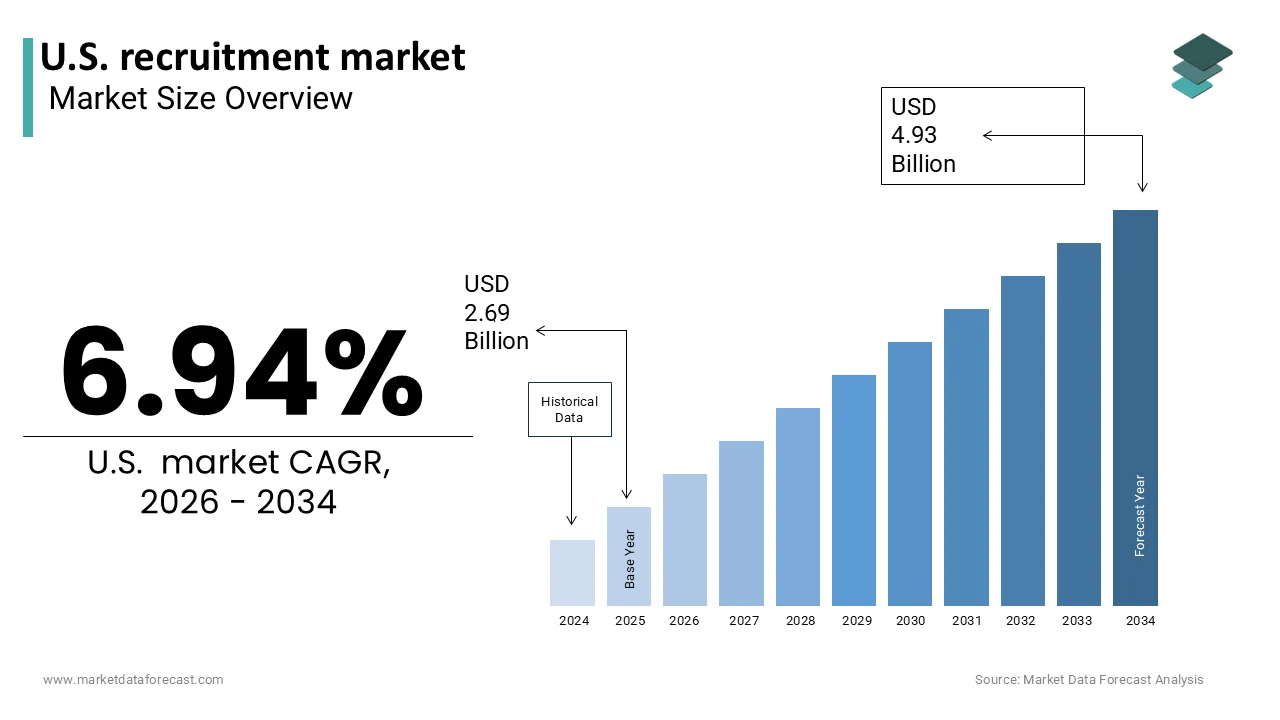
- Market Valuation: Valued at USD 2.69 billion in 2025, reaching USD 2.88 billion in 2026, and projected to expand to USD 4.93 billion by 2034, growing at a robust CAGR of 6.94% from 2026 to 2034.
- Primary Growth Drivers: Persistent labor shortages in specialized sectors (such as healthcare and tech) and the widespread adoption of artificial intelligence in talent acquisition.
Key Market Segment Metrics
| Category | Leading Segment (Base Position) | Fastest-Growing / High-Growth Segment |
|---|---|---|
| By Service Type | Permanent Staffing (dominated in 2025 due to core organizational needs for stable workforces and institutional knowledge) | Temporary & Contract Staffing (fastest CAGR of 8.3% driven by workforce flexibility and project-based demand) |
| By Recruitment Channel | Online Platforms & Job Boards (held a 34.8% share in 2025 via unparalleled reach and digital candidate filtering) | Social Media & Professional Networking Sites (fastest CAGR of 12.3% propelled by passive candidate engagement) |
| By Region / Country | United States (mature national employment market with extensive corporate and digital recruitment infrastructures) | California, Washington, Oregon & New York (high-growth hubs driving tech talent acquisition and remote work adoption) |
Major Market Players & Industry Landscape
Market Structure: Highly competitive landscape balancing global staffing giants, regional boutique firms, and technology-driven recruitment platforms vying for corporate contracts.
Key Companies: Robert Half International Inc., ManpowerGroup Inc., Randstad USA, Adecco Group North America, Allegis Group, Inc., Kforce Inc., Kelly Services, Inc., ASGN Incorporated, Korn Ferry, Hays plc, ADP, Inc., and TrueBlue, Inc.
 Download Free Sample Report
U.S. Recruitment Market Size
The U.S. Pet Care Market was valued at USD 2.69 billion in 2025, is estimated to reach USD 2.88 billion in 2026, and is projected to reach USD 4.93 billion by 2034, growing at a CAGR of 6.94% from 2026 to 2034.
The recruitment is to identify, attract,t screen, and hire talent for organizations across diverse industries. The labor force demographics and economic cycles dictate hiring velocity and candidate availability. Furthermore, the Society for Human Resource Management notes that the average time to fill a position has increased to over 40 days in recent assessments, reflecting the increasing difficulty of securing qualified candidates. The proliferation of remote work arrangements has expanded the geographical scope of recruitment, allowing employers to access national talent pools rather than being confined to local markets. Technological advancements, such as artificial intelligence and applicant tracking systems, ms have streamlined screening processes but also introduced new complexities regarding bias and data privacy. Regulatory frameworks governing employment equality and wage transparency that further shape operational strategy require recruiters to maintain rigorous compliance standards.
MARKET DRIVERS
Persistent Labor Shortages in Specialized Sectors
The persistent labor shortages in specialized sectors, such as healthcare technology and skilled trades, are compelling organizations to rely on external expertise to fill vacancies, which is majorly boosting the growth of the United States recruitment market. The mismatch between available skills and job requirements creates intense competition for qualified candidates, forcing companies to engage recruitment agencies for their extensive networks and sourcing capabilities. As per the United States Bureau of Labor Statistics, there were approximately 8.9 million job openings in recent months,s while the number of unemployed persons remained significantly low,, er indicating a tight labor market. In the healthcare sector, specifically the American Hospital Association projects a shortage of up to 124000 physicians by 2034, driving hospitals to partner with specialized staffing firms to secure medical professionals. Similarly, the technology industry faces a deficit of cybersecurity and software engineering talent,, prompting firms to offer premium fees to recruiters who can identify passive candidates. This scarcity empowers candidates to demand higher wages and better benefits, increasing the complexity of negotiations. Recruiters add value by conducting market analysis and advising clients on competitive compensation packages. The urgency to maintain operational continuity despite staffing gaps ensures sustained demand for recruitment services.
Adoption of Artificial Intelligence in Talent Acquisition
The widespread adoption of artificial intelligence in talent acquisition by enhancing efficiency, accuracy, and scalability in the hiring process is majorly fuelling the growth of the United States recruitment market. AI-powered tools automate repetitive tasks, such as resume screening, candidate sourcing, and initial assessments, allowing recruiters to focus on strategic engagement and relationship building. The spending on cognitive and AI systems in human resources is projected to grow substantially, likely reflecting the industry's shift to data-driven decision-making. These technologies utilize natural language processing to match candidate profiles with job descriptions more effectively, reducing time to hire and improving quality of hire. Predictive analytics help identify candidates likely to succeed and stay long-term, lowering turnover rates and associated costs. Chatbots provide immediate responses to applicant inquiries, enhancing candidate experience and maintaining engagement throughout the pipeline. The ability to process vast amounts of data enables recruiters to uncover passive talent pools that were previously inaccessible. Furthermore, AI helps mitigate unconscious bias by focusing on skills and qualifications rather than demographic factors,s although careful monitoring is required. The competitive advantage gained through faster and more precise hiring processes motivates organizations to invest in advanced recruitment technologies.
MARKET RESTRAINTS
Economic Uncertainty and Hiring Freezes
The economic uncertainty and periodic hiring freeze are causing fluctuations in demand for staffing services and creating volatility in the revenue stream, hindering the growth of the United States recruitment market. During periods of economic downturn or inflationary pressure, organizations often reduce headcount or pause recruitment to control costs, directly impacting the volume of placements made by agencies. The economic indicators, such as interest rate hikes and consumer spending declines, influence corporate confidence, leading to cautious hiring practices. In the technology sector, several major companies implemented layoffs and hiring freezes in recent years,s resulting in a surplus of available talent but a sharp decrease in job openings. This contraction reduces the need for external recruitment support as internal teams manage remaining workflows or rely on existing employee referrals. Temporary staffing volumes also decline as companies delay expansion projects or reduce operational hours. The unpredictability of economic conditions makes it difficult for recruitment firms to forecast demand and allocate resources effectively. Long-term contracts may be renegotiated or cancelled, further destabilizing income. Additionally, the shift toward contingent workforce models during uncertain times may offer some resilience but often at lower margins.
Regulatory Compliance and Data Privacy Concerns
The stringent regulatory compliance and data privacy concerns, imposed by complex legal obligations that increase operational costs and liability risks, are also hindering the growth of the United States recruitment market. Recruiters must navigate a web of federal and state laws governing equal employment opportunity, wage transparency,y and background checks, ensuring that hiring practices do not discriminate against protected groups. The thousands of discrimination charges are filed annually, requiring organizations to maintain meticulous records and adhere to strict procedural standards. The introduction of salary history bans in multiple states restricts the information recruiters can request during initial screenings, complicating compensation negotiations. Furthermore, data privacy regulations such as the California Consumer Privacy Act mandate secure handling of candidate personal information, including resumes and contact details. Non-compliance can result in severe fines and reputational damage, discouraging aggressive data collection practices. The need for regular audits and legal consultations adds to the administrative burden,s particularly for smaller agencies with limited resources. Cross-border recruitment efforts face additional hurdles due to varying international privacy laws. The complexity of maintaining compliant algorithms in AI-driven tools also poses challenges, as biases must be continuously monitored and corrected.
MARKET OPPORTUNITIES
Expansion of Remote and Hybrid Work Models
The expansion of remote and hybrid work models by eliminating geographical barriers and expanding the talent pool to a national scale is setting up new opportunities for the growth of the United States recruitment market. Organizations are no longer restricted to hiring candidates within commuting distance by allowing them to access diverse skill sets. As per a study, approximately 40% of employees in the United States work at least part of the time remotely, creating a sustained demand for recruiters who specialize in virtual onboarding and distributed team management. This shift enables recruitment firms to offer broader search mandates and connect employers with niche talent in regions with lower labor costs. Remote work also appeals to candidates seeking flexibility, increasing the attractiveness of roles and improving acceptance rates. Recruiters can leverage digital platforms to conduct virtual interviews and assessments, streamlining the process and reducing time to hire. The need for specialized skills in managing remote teams,s such as digital collaboration and communication, further drives demand for targeted recruitment services. Additionally, the rise of digital nomad visas and international hiring possibilities opens new avenues for global talent acquisition.
Growth in Diversity, Equity, and Inclusion Initiatives
The growth in diversity,rsity equity, and inclusion initiatives by driving demand for specialized sourcing strategies that prioritize underrepresented talent is also to create new opportunities for the growth of the United States recruitment market. Organizations are increasingly committed to building diverse workforces to enhance innovation and reflect customer demographics, leading to dedicated budgets for DEI-focused recruitment. Recruiters play a crucial role in identifying and engaging diverse candidates through targeted outreach partnerships with minority professional organizations and unbiased screening techniques. The development of blind recruitment processes and diverse interview panels helps mitigate bias and ensures fair evaluation. Training programs for hiring managers on inclusive practices further embed DEI principles into the recruitment lifecycle. Agencies that demonstrate expertise in delivering diverse slates of candidates gain a competitive advantage and build long-term partnerships with progressive employers. The emphasis on transparency and accountability in hiring metrics creates opportunities for data-driven consulting services.
MARKET CHALLENGES
Candidate Experience and Engagement Retention
The candidate experience and engagement retention by influencing employer brand reputation and offer acceptance rates is to act as a major challenge for the growth of the United States recruitment market. The candidates often evaluate potential employers based on the responsiveness, transparency, and professionalism of the recruitment process. As per CareerBuilder, nearly 60% of job seekers report having a poor experience during the application process, which can lead to negative reviews and withdrawal from consideration. Lengthy approval processes, as well as a lack of feedback and impersonal communication, frustrate applicants,s causing them to accept competing offers. Recruiters struggle to maintain consistent engagement with passive candidates who may be simultaneously exploring multiple opportunities. The high volume of applications generated by online job boards requires efficient filtering without sacrificing personal touch. Automated systems sometimes fail to recognize qualified candidates, leading to missed opportunities and dissatisfaction. Building trust and rapport in a virtual environment is difficult,t requiring recruiters to invest significant time in relationship building. Negative candidate experiences can damage an organization's employer brand, nd making future recruitment efforts more challenging. Additionally, the expectation for immediate responses and seamless digital interactions raises the bar for service quality.
Skills Mismatch and Rapid Technological Obsolescence
The skills mismatch and rapid technological obsolescence, by creating a gap between candidate capabilities and employer requirements, are also impeding the growth of the United States recruitment market. The pace of technological advancement means that specific technical skills become outdated quickly, requiring continuous learning and adaptation from the workforce. As per the World Economic Forum, half of all employees will need reskilling by 2025 as adoption of new technologies increases the difficulty in finding candidates with current relevant expertise. Recruiters face the challenge of identifying individuals who possess not only technical proficiency but also the agility to learn new tools rapidly. Traditional qualification metrics such as degrees may no longer accurately predict job performance, leading to reliance on practical assessments and portfolios. The scarcity of experts in emerging fields such as artificial intelligence, blockchain, and quantum computing drives up salary expectations and extends the time to fill. Employers often have unrealistic expectations regarding candidate readiness, leading to prolonged search cycles. Recruiters must educate clients on market realities and advocate for flexible hiring criteria that prioritize potential over exact experience. The need for ongoing upskilling partnerships with educational institutions adds complexity to the recruitment ecosystem.
REPORT COVERAGE
| REPORT METRIC | DETAILS |
| Market Size Available | 2025 to 2034 |
| Base Year | 2025 |
| Forecast Period | 2026 to 2034 |
| Segments Covered | By Service Type, Recruitment Channel, and Region. |
| Various Analyses Covered | Global, Regional and Country-Level Analysis, Segment-Level Analysis, Drivers, Restraints, Opportunities, Challenges; PESTLE Analysis; Porter’s Five Forces Analysis, Competitive Landscape, Analyst Overview of Investment Opportunities |
| Countries Covered | California, Washington, Oregon, New York, United States |
| Market Leaders Profiled | Robert Half International Inc., ManpowerGroup Inc., Randstad USA, Adecco Group North America, Allegis Group, Inc., Kforce Inc., Kelly Services, Inc., ASGN Incorporated, Korn Ferry, Hays plc, ADP, Inc., TrueBlue, Inc. |
SEGMENTAL ANALYSIS
By Service Type Insights
The permanent staffing segment accounted for a dominant share of the United States recruitment market in 2025, with the fundamental organizational need to build stable, long-term workforces that foster institutional knowledge and cultural cohesion. Companies prioritize permanent hires for core roles to ensure continuity and reduce the administrative burden associated with frequent turnover. As per the research, the average cost per hire for permanent employees is significant, yet organizations view this investment as essential for sustaining competitive advantage and operational stability. Employers in sectors such as healthcare, education, and professional services rely heavily on permanent staff to maintain consistent service delivery and client relationships. The emotional and financial commitment involved in permanent hiring encourages rigorous screening processes, where recruitment agencies add substantial value through vetting and assessment. Additionally, tax incentives and regulatory frameworks often favor established employment relationships over contingent arrangements. The prevalence of leadership and specialized technical roles that require deep integration into company strategy also drives demand for permanent placement services. Consequently, the strategic importance of retaining top talent and building a dedicated workforce cements permanent staffing as the largest revenue-generating segment in the recruitment industry.
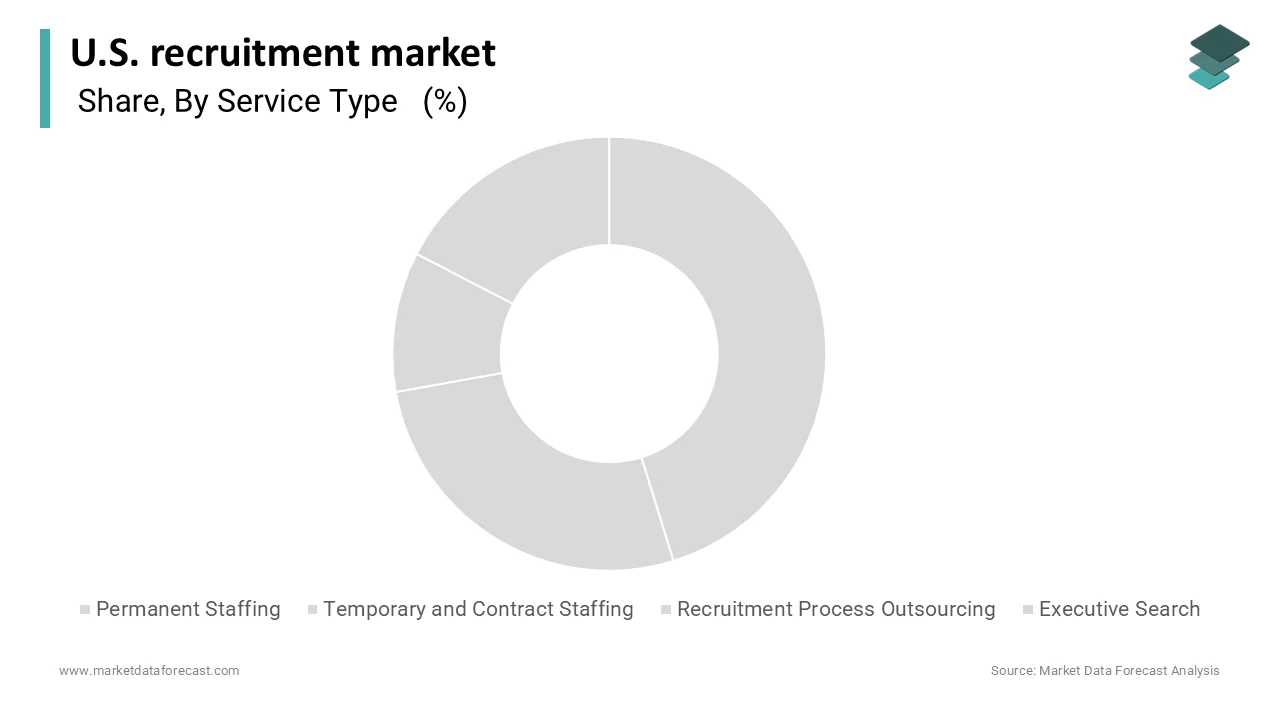
The temporary and contract staffing segment is growing at an anticipated CAGR of 8.3% during the forecast period, with the increasing flexibility required by modern businesses to manage workload fluctuations and project-based demands. Organizations are shifting toward agile workforce models that allow them to scale labor up or down without the long-term commitments of permanent hires. The staffing industry employs millions of temporary and contract workers daily, reflecting the role these professionals play in maintaining operational efficiency. The rise of the gig economy and remote work has normalized short-term engagements, making it easier for companies to access specialized skills for specific durations. This model reduces overhead costs related to benefits and training while providing immediate expertise in areas such as information technology, creative services,s and logistics. Economic uncertainty encourages firms to prefer variable labor costs over fixed salaries, allowing them to adapt quickly to market changes. Furthermore, the difficulty in finding permanent talent for niche roles leads companies to engage contractors for a trial period before potential conversion. The ability to bridge skill gaps rapidly during peak seasons or digital transformation projects drives sustained demand.
By Recruitment Channel Insights
The online platforms and job boards segment was the largest by holding 34.8% of the United States recruitment market share in 2025 due to their unparalleled reach, accessibility,lity and ability to connect employers with a vast pool of active and passive candidates instantly. The digitalization of job search behaviors has made online portals the primary method for individuals to discover opportunities and for recruiters to source talent efficiently. These platforms offer advanced filtering capabilities, allowing recruiters to narrow searches by location, skill, experience,ce and education level, vel thereby reducing time spent on manual screening. The integration of applicant tracking systems with major job boards streamlines the application process by enabling seamless data transfer and candidate management. Large aggregators such as Indeed and LinkedIn provide extensive databases that enhance visibility for job postings across diverse industries. The cost-effectiveness of digital advertising compared to traditional media allows even small businesses to compete for talent. Mobile optimization ensures that candidates can apply from anywhere, increasing engagement rates. The ability to analyze metrics, such as click-through rates and application sources, helps optimize recruitment strategies.
The social media and professional networking sites segment is expected to witness the fastest CAGR of 12.3% from 2026 to 2034, with the ability to engage passive candidates and build employer brands through interactive content. Unlike traditional job boards, these platforms facilitate direct communication and relationship building,g allowing recruiters to tap into talent pools that are not actively seeking new roles. As per LinkedIn data, over 70% of the global workforce consists of passive candidates, who are more likely to respond to personalized outreach on professional networks than to generic job advertisements. The visual and narrative nature of social media enables companies to showcase company culture values and employee testimonials, creating an attractive image that resonates with potential applicants. Features, such as targeted advertising, allow recruiters to reach specific demographics based on interests, behaviors, and professional backgrounds. The viral potential of employee referral programs shared on social platforms amplifies reach organically. Real-time engagement through comments and messages fosters a sense of community and trust.
COMPETITIVE LANDSCAPE
The competition in the United States recruitment market is intense and characterized by a mix of global staffing giants, regional boutique firms,s and emerging technology-driven platforms vying for client contracts and candidate attention. Major players compete on the breadth of their service offerings, speed of placement, and quality of candidate vetting processes. Differentiation is achieved through specialized industry expertise and the ability to provide flexible workforce solutions such as temporary staffing and recruitment process outsourcing. Price competition is significant in high-volume, low-skill segments, while value-added services dominate in executive search and specialized technical roles. The rise of direct hiring platforms and professional networking sites poses a threat to traditional agencies by enabling companies to source candidates independently. To counter this, agencies are investing heavily in technology to offer superior data insights and automation capabilities. Customer retention relies on building strong relationships and demonstrating consistent performance in meeting hiring targets. Regulatory compliance and ethical recruitment practices also influence competitive dynamics as clients prioritize risk mitigation.
KEY MARKET PLAYERS
Some of the companies that are playing a dominating role in the U.S. recruitment market include
- Robert Half International Inc.
- ManpowerGroup Inc.
- Randstad USA
- Adecco Group North America
- Allegis Group, Inc.
- Kforce Inc.
- Kelly Services, Inc.
- ASGN Incorporated
- Korn Ferry
- Hays plc
- ADP, Inc.
- TrueBlue, Inc.
TOP LEADING PLAYERS IN THE MARKET
- Randstad North America Inc is a prominent player in the United States recruitment market, offering comprehensive staffing solutions across various industries,s including technology,gy healthcare, and finance. The company leverages its extensive global network to connect employers with qualified candidates for both temporary and permanent positions. Recent actions include significant investments in digital platforms and artificial intelligence tools to enhance candidate matching and streamline the hiring process. Randstad has expanded its managed services programs to help large enterprises optimize their contingent workforce strategies. The company focuses on upskilling initiatives to prepare workers for evolving job requirements,s ensuring a steady supply of talent.
- Adecco Group North America contributes significantly to the United States recruitment market by providing workforce solutions that address the dynamic needs of modern businesses. The company specializes in temporary staffing, permanent placement,t and outplacement services, catering to diverse sectors such as manufacturing, logistics, and professional services. Recent actions involve the development of innovative digital ecosystems that facilitate seamless interaction between clients and candidates. Adecco has launched specialized training programs to bridge skills, particularly in technology and engineering fields. The company emphasizes diversity and inclusion initiatives to help organizations build equitable workforces. Strategic partnerships with educational institutions enable an early talent pipeline, ensuring a continuous flow of qualified applicants.
- ManpowerGroup Inc plays a vital role in the United States recruitment market through its flagship brand Manpower and specialized subsidiaries like Experis and Talent Solutions. The company offers expert guidance in talent discovery, coverage assessment, and development,t helping organizations navigate complex hiring challenges. Recent actions include the expansion of its right talent, right time methodology, which uses predictive analytics to anticipate workforce needs. ManpowerGroup has invested heavily in reskilling and upskilling programs to support career transitions and lifelong learning. The company focuses on creating inclusive workplaces by promoting diverse hiring practices and supporting underrepresented groups. Its global insights and local expertise allow for tailored solutions that meet specific industry demands.
TOP STRATEGIES USED BY KEY MARKET PARTICIPANTS
Key players in the United States recruitment market primarily focus on leveraging artificial intelligence and machine learning to automate screening processes and improve candidate matching accuracy. Companies are increasingly investing in employer branding services to help clients attract top talent through compelling narratives and social media engagement. Strategic acquisitions of niche staffing firms allow organizations to expand their specialized offerings in high-demand sectors such as technology and healthcare. Development of proprietary digital platforms enhances user experience by providing seamless application tracking and communication tools. Emphasis on diversity, equity, and inclusion initiatives helps clients build representative workforces and meet regulatory standards. Upskilling and reskilling programs are integrated into service offerings to address skills gaps and ensure long-term employability.
MARKET SEGMENTATION
This research report on the U.S. recruitment market is segmented and sub-segmented into the following categories.
By Service Type
- Permanent Staffing
- Temporary and Contract Staffing
- Recruitment Process Outsourcing
- Executive Search
By Recruitment Channel
- Online Platforms and Job Boards
- Social Media and Professional Networking Sites
- Recruitment Agencies
- Company Career Websites
- Employee Referral Programs
By Country
- California
- Washington
- Oregon
- New York
- Rest of the United States