- Product Description Description
- Table of Contents TOC
- List of Table & Figure LOT
- Get Free Sample PDF Sample PDF
Market Size, 2025
$668.38 BnMarket Estimate, 2026
$706.54 BnMarket Forecast, 2034
$1,101.71 BnCAGR, 2026–2034
5.71%U.S. Pharmaceutical Market Size, Growth, Trends & Forecast (2026–2034)
The U.S. Pharmaceutical market size was valued at USD 668.38 billion in 2025, is anticipated to reach USD 706.54 billion in 2026, and is projected to reach USD 1,101.71 billion by 2034, registering a compound annual growth rate (CAGR) of 5.71% during the forecast period from 2026 to 2034. Driven by the escalating burden of chronic diseases, precision medicine advancements, and surging demand for advanced therapeutics, the domestic market continues to expand steadily.
Key Executive Metrics (At-a-Glance)
- 2025 Base Valuation: USD 668.38 Billion
- 2026 Current Valuation: USD 706.54 Billion
- 2034 Forecast Valuation: USD 1,101.71 Billion
- Compound Annual Growth Rate (CAGR): 5.71% (2026–2034)
- Dominant Molecule Type Segment: Conventional Drugs / Small Molecules (capturing 58.4% of the market share in 2025)
- Fastest-Growing Molecule Type Segment: Biologics & Biosimilars (projected at a CAGR of 11.9% during the forecast period)
- Dominant Product Segment: Branded Pharmaceuticals (holding a significant market share in 2025)
- Fastest-Growing Product Segment: Generics (projected at a CAGR of 9.4% throughout the forecast period)
- Dominant Type Segment: Prescription Pharmaceuticals (holding a dominant share in 2025)
- Fastest-Growing Type Segment: Over-the-Counter (OTC) (projected at a CAGR of 8.7% during the forecast period)
- Dominant Disease Segment: Oncology Therapeutics (holding 21.3% of the market share in 2025)
- Fastest-Growing Disease Segment: Obesity Therapeutics (projected at an estimated CAGR of 34.2% during the forecast period)
- Regional Highlights: Major state-level activity spanning across key pharmaceutical hubs including New York, California, Massachusetts, and Texas.
Core Market Drivers
- Chronic Disease Prevalence: High polypharmacy rates and continuous pharmacotherapy demands resulting from aging populations and lifestyle shifts.
- Precision Medicine & Orphan Drugs: Accelerated approvals and targeted therapies addressing rare diseases and oncology with premium outcomes-based models.
- Digital & AI Integration: Breakthroughs in AI-driven drug repurposing, target discovery, and real-world evidence (RWE) adoption.
Primary Market Restraints & Challenges
- Pricing Pressures & Exclusions: Intensive scrutiny from federal legislation, PBM formulary exclusions, and strict rebate demands.
- Patent Expiry & Revenue Cliffs: Loss of exclusivity on major blockbuster molecules triggering generic and biosimilar market erosion.
- Clinical & Reimbursement Hurdles: Trial recruitment inefficiencies, diversity gaps, and infrastructure disconnects for seven-figure advanced therapies.
U.S. Pharmaceutical Market Segmentation Breakdown
| Segment Category | Largest Segment in 2025/2026 | Fastest Growing Segment / Growth Rate |
|---|---|---|
| By Molecule Type | Conventional Drugs / Small Molecules (58.4% in 2025) | Biologics & Biosimilars (11.9% CAGR) |
| By Product | Branded Pharmaceuticals | Generics (9.4% CAGR) |
| By Type | Prescription Pharmaceuticals | Over-the-Counter / OTC (8.7% CAGR) |
| By Disease | Oncology Therapeutics (21.3% in 2025) | Obesity Therapeutics (34.2% CAGR) |
Major Industry Players Profiled
Key prominent companies operating in the U.S. pharmaceutical market include Pfizer Inc., Johnson & Johnson, Merck & Co., Inc., Bristol Myers Squibb, AbbVie Inc., Amgen Inc., Gilead Sciences, Inc., Eli Lilly and Company, Moderna, Inc., Biogen Inc., Vertex Pharmaceuticals Incorporated, Regeneron Pharmaceuticals, Inc., Novartis AG, AstraZeneca PLC, and GlaxoSmithKline PLC.
U.S. Pharmaceutical Market Size
The U.S. Pharmaceutical market size was valued at USD 668.38 billion in 2025 and is anticipated to reach USD 706.54 billion in 2026 and USD 1,101.71 billion by 2034, growing at a CAGR of 5.71% during the forecast period from 2026 to 2034
The pharmaceutical is a biomedical innovation, regulatory governance, and payer-mediated access, functioning as the world’s largest therapeutic consumption engine. As per the Centers for Disease Control and Prevention, American physicians wrote 4.5 billion drug prescriptions in 2023 by averaging 13.7 prescriptions per capita annually.
MARKET DRIVERS
Rising Chronic Disease Prevalence Driving Sustained Pharmaceutical Demand
The escalating burden of chronic disease, which mandates continuous pharmacotherapy and expands addressable patient pools beyond acute interventions, is majorly propelling the growth of the U.S. pharmaceutical market. This epidemiological shift translates into polypharmacy patients with five or more chronic conditions fill an average of 14 prescriptions monthly, according to data from the Agency for Healthcare Research and Quality. The structural inevitability of chronic disease progression ensures recurring revenue streams, which anchor long-term commercial viability irrespective of short-term pricing pressures or generic erosion.
Precision Medicine and Orphan Drugs Accelerating Market Expansion
The accelerated approval and adoption of precision therapeutics in oncology and rare diseases, where molecular targeting justifies premium pricing and payer coverage, is also escalating the growth of the U.S. pharmaceutical market. Simultaneously, the Orphan Drug Act has catalyzed development for ultra-rare conditions. Over 600 orphan-designated therapies have reached the market since 2010. Payers increasingly accept outcomes-based contracts for these agents. Precision medicine transforms clinical need into commercially sustainable niches insulated from volume competition.
MARKET RESTRAINTS
Pricing Pressures and Payer Exclusions Constraining Market Growth
The intensifying scrutiny over drug pricing, manifesting in federal legislation and payer formulary exclusions that compress margins and delay uptake, is restricting the growth of the U.S. pharmaceutical market. Simultaneously, pharmacy benefit managers like Express Scripts and CVS Caremark excluded 127 branded drugs from 2025 national formularies, which are demanding rebates off list price, according to Drug Channels Institute analysis.
Clinical Trial Inefficiencies and Diversity Gaps Hindering Market Expansion
The clinical trial recruitment inefficiencies and demographic misalignment, which inflate development costs and delay regulatory timelines, are additionally degrading the growth of the U.S. pharmaceutical market. The NIH Revitalization Act mandates inclusion of women and minorities, yet compliance remains inconsistent; only 38% of Phase III trials published in 2023 met federal diversity benchmarks, per a Journal of the American Medical Association audit. Inefficient and non-representative trials erode regulatory confidence and payer willingness to reimburse at premium tiers.
MARKET OPPORTUNITIES
Real-World Evidence Integration: Unlocking New Market Opportunities
The integration of real-world evidence into regulatory and reimbursement decision-making by enabling post-launch label expansions and risk-sharing agreements is gearing up with new opportunities for the growth othe f the U.S. pharmaceutical market. UnitedHealthcare’s adoption of RWE to validate Novo Nordisk’s Wegovy for cardiovascular risk reduction exemplifies payer alignment.
AI-Driven Drug Repurposing Accelerating Pharmaceutical Innovation
The repurposing of shelved or failed compounds using AI-driven target rediscovery, circumventing early-phase attrition and compressing development timelines, is another attribute anticipated to fuel the growth of the U.S. pharmaceutical market. BenevolentAI’s identification of baricitinib for COVID-19, later granted EUA by the FDA, demonstrates clinical viability. Insilico Medicine reduced preclinical target-to-clinical candidate time to 18 months for its fibrosis drug, compared to the industry average of 4.5 years.
MARKET CHALLENGES
Patent Expiry and Generic Competition Intensifying Revenue Pressures
The erosion of patent exclusivity for blockbuster molecules, triggering abrupt revenue cliffs and forcing premature pipeline dependency, is greatly influencing the growth of the U.S. pharmaceutical market. As per the U.S. Patent and Trademark Office, 23 top-selling drugs with combined 2023 sales of $89 billion face generic or biosimilar competition between 2025 and 2026, including AbbVie’s Humira and Bristol Myers Squibb’s Eliquis. Legal maneuvers like patent thickets delay but rarely prevent competition. Federal Trade Commission litigation blocked 17 “product hop” strategies in 2023 alone. The imperative to replace legacy cash cows accelerates high-risk bets on early-stage modalities, which is increasing R&D volatility and investor awareness during transition periods.
Reimbursement Challenges for Advanced Therapies Hindering Market Growth
The misalignment between innovation velocity and reimbursement infrastructure for gene and cell therapies requiring single-dose cures with seven-figure price tags is likely to degrade the growth of the U.S. pharmaceutical market. Medicaid programs in 14 states still classify these therapies as “experimental” despite FDA approval, per a National Academy for State Health Policy survey. The disconnect between curative science and fee-for-service payment models forces manufacturers into installment billing or outcome annuities, commercially fragile constructs that deter investment.
REPORT COVERAGE
| REPORT METRIC | DETAILS |
| Market Size Available | 2025 to 2034 |
| Base Year | 2025 |
| Forecast Period | 2026 to 2034 |
| CAGR | 5.71% |
| Segments Covered | By Molecular Type, Product, Type, Disease, and Region |
| Various Analyses Covered | Global, Regional, and Country Level Analysis; Segment-Level Analysis; DROC; PESTLE Analysis; Porter’s Five Forces Analysis; Competitive Landscape; Analyst Overview of Investment Opportunities |
| Regions Covered | New York, Massachusetts, Pennsylvania, Illinois, Ohio, Michigan, Texas, Florida, Georgia, California, Washington, Colorado |
| Market Leaders Profiled | Pfizer Inc., Johnson & Johnson, Merck & Co., Inc., Bristol Myers Squibb, AbbVie Inc., Amgen Inc., Gilead Sciences, Inc., Eli Lilly and Company, Moderna, Inc., Biogen Inc., Vertex Pharmaceuticals Incorporated, Regeneron Pharmaceuticals, Inc., Novartis AG, AstraZeneca PLC, GlaxoSmithKline PLC. |
SEGMENTAL ANALYSIS
By Molecule Type Insights
The molecule segment was the largest by capturing 58.4% of the U.S. pharmaceutical market share in 2025. The Food and Drug Administration approved 37 small-molecule new chemical entities in 2023, more than any other modality, with many targeting kinase pathways in oncology or GPCRs in CNS disorders. Additionally, 74% of prescriptions filled in U.S. retail pharmacies involve small molecules, according to the National Council for Prescription Drug Programs, reflecting prescriber familiarity and insurance formulary breadth. Their synthetic reproducibility also enables rapid genericization, sustaining volume even post-patent, unlike biologics constrained by biosimilar lag and cold-chain complexity.
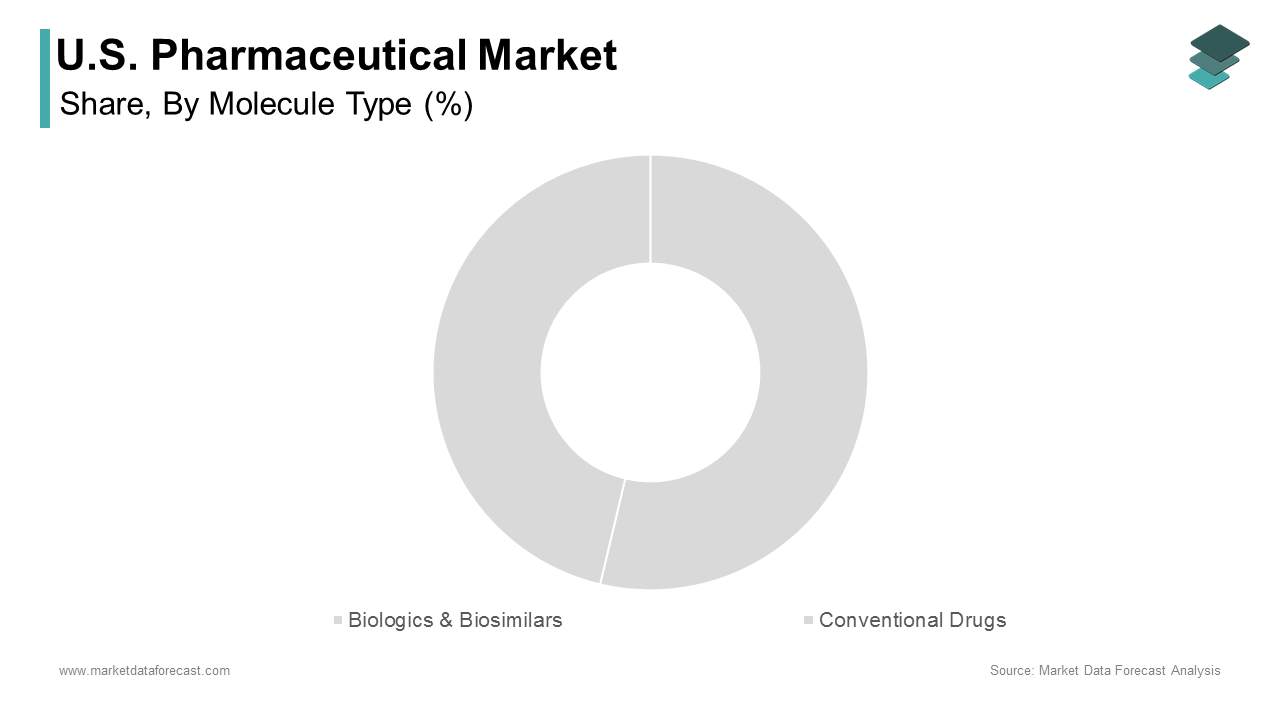
The biologics & biosimilars segment is likely to gain huge traction with an expected CAGR of 11.9% during the forecast period. According to the Centers for Medicare & Medicaid Services, 42% year-over-year increase in biologic claims for autoimmune conditions in 2023, driven by Humira biosimilar entry, lowering payer resistance. Platform versatility by extending into bispecifics, antibody-drug conjugates, and gene therapies ensures this trajectory outpaces legacy chemical entities.
By Product Insights
The branded pharmaceuticals segment held a significant share of the U.S. pharmaceutical market in 2025, with its pricing power and therapeutic novelty. Payers tolerate premium pricing through outcomes-based contracts. UnitedHealthcare’s agreement covering Novo Nordisk’s Wegovy, contingent on 10% body weight loss, exemplifies this. Patent thickets and REMS programs delay generic entry, preserving exclusivity.
The generics segment is likely to grow with an expected CAGR of 9.4% throughout the forecast period, with the patent expirations of mega-blockbusters. Medicaid programs in 42 states now mandate generic substitution unless medically contraindicated, per the National Academy for State Health Policy. Volume expansion is structural, not discretionary, anchored in policy, not promotion.
By Type Insights
The prescription pharmaceuticals segment was the largest with a dominant share of the U.S. pharmaceutical market in 2025. This supremacy stems from regulatory gatekeeping and clinical necessity, where 87% of FDA-approved drugs since 2020 require physician authorization due to safety profiles or diagnostic prerequisites. Prescriber influence, prior authorization mandates, and REMS protocols collectively ensure that therapeutic innovation flows almost exclusively through controlled, reimbursed, clinician-mediated channels.
The over-the-counter segment is growing lucratively with an expected CAGR of 8.7% throughout the forecast period, with FDA category switches, prescription-to-OTC reclassifications that expand consumer access without compromising safety. Simultaneously, 68% of U.S. consumers now self-treat minor ailments before consulting physicians, per a National Retail Federation survey, accelerating OTC adoption for allergy, pain, and digestive health. Retailers like CVS and Walmart expanded in-store pharmacist consultations to guide OTC selection, bridging clinical trust with consumer convenience. Digital symptom checkers and AI-powered chatbots further de-medicalize minor care, positioning OTC as the frontline of a consumer-directed healthcare revolution.
By Disease Insights
The oncology therapeutics segment held 21.3% of the U.S. pharmaceutical market share in 2025, with the scientific breakthroughs and demographic inevitability. The average cost of oncology regimens exceeds $150,000 annually, that sustained by biomarker-directed therapies like Enhertu and CAR-T platforms such as Yescarta. Medicare Part B reimbursed $28 billion for anticancer drugs in 2023, the highest of any disease category.
The obesity therapeutics segment is likely to grow with an estimated CAGR of 34.2% during the forecast period, with the velocity stemming from GLP-1 receptor agonists like semaglutide and tirzepatide, which demonstrated 15–22% mean body weight reduction in Phase III trials, per data published in The New England Journal of Medicine. Payer coverage is rapidly evolving: as of early 2025, 68% of commercial plans cover anti-obesity medications for BMI ≥30, up from 29% in 2021, according to the Obesity Society. The American Heart Association now classifies obesity as a chronic disease requiring long-term pharmacotherapy, legitimizing reimbursement.
KEY MARKET PLAYERS
A few of the dominating players in the U.S. Pharmaceutical Market include
- Pfizer Inc.
- Johnson & Johnson
- Merck & Co., Inc.
- Bristol Myers Squibb
- AbbVie Inc.
- Amgen Inc.
- Gilead Sciences, Inc.
- Eli Lilly and Company
- Moderna, Inc.
- Biogen Inc.
- Vertex Pharmaceuticals Incorporated
- Regeneron Pharmaceuticals, Inc.
- Novartis AG
- AstraZeneca PLC
- GlaxoSmithKline PLC
LEADING PLAYERS OF THE MARKET
Pfizer Inc.
Pfizer Inc. remains a cornerstone of global pharmaceutical innovation, leveraging its vaccine and oncology portfolios to anchor therapeutic dominance. It reinforced its position by securing FDA approval for elranatamab in multiple myeloma and expanding its biosimilar portfolio with a high-yield adalimumab alternative. The company invested $500 million in AI-driven drug discovery partnerships with BioNTech and CytoReason, accelerating target identification. Its direct contracting with Medicare under the Inflation Reduction Act’s negotiation framework demonstrates an adaptive pricing strategy. Pfizer also expanded manufacturing for GLP-1 analogs, anticipating obesity market growth.
Novo Nordisk A/S
Novo Nordisk A/S dominates metabolic disease globally, propelled by clinical superiority in diabetes and obesity therapeutics. Its GLP-1 agonist semaglutide achieved 86% payer coverage in U.S. commercial plans by Q1 2025, per internal disclosures. The company commissioned a $4.1 billion U.S. manufacturing expansion in North Carolina to meet surging demand. It launched a digital adherence platform integrating CGM data with dosing recommendations, enhancing real-world outcomes. Collaborations with the American Medical Association on obesity education legitimize pharmacotherapy as a standard of care. Novo Nordisk also initiated outcomes-based contracts with major PBMs, tying reimbursement to sustained weight loss. Its science-led branding, manufacturing scale, and ecosystem integration position it as the architect of the modern metabolic care paradigm.
Merck & Co., Inc.
Merck & Co., Inc. commands global influence through oncology and vaccine leadership, anchored by Keytruda’s unparalleled label breadth and Gardasil 9’s pediatric adoption. It also partnered with the Gates Foundation to distribute HPV vaccines in low-income countries, reinforcing global access infrastructure. Domestically, it implemented AI-powered prior authorization tools to accelerate payer approvals. Its investment in real-world evidence generation via Flatiron Health partnerships ensures label expansions are data-driven.
MARKET SEGMENTATION
This research report on the U.S. pharmaceutical market is segmented and sub-segmented into the following categories.
By Molecule Type
- Biologics & Biosimilars (Large Molecules)
- Monoclonal Antibodies
- Vaccines
- Cell & Gene Therapy
- Others
- Conventional Drugs (Small Molecules)
By Product
- Branded
- Generics
By Type
- Prescription
- OTC
By Disease
- Oncology
- Oncology
By Region
- New York
- Massachusetts
- Pennsylvania
- Illinois
- Ohio
- Michigan
- Texas
- Florida
- Georgia
- California
- Washington
- Colorado