- Product Description Description
- Table of Contents TOC
- List of Table & Figure LOT
- Get Free Sample PDF Sample PDF
Market Size, 2025
$19.06 BnMarket Estimate, 2026
$31.93 BnMarket Forecast, 2034
$31.93 BnCAGR, 2026–2034
5.90%U.S. Refrigerator Market Report Summary
The U.S. refrigerator market was valued at USD 19.06 billion in 2025 and is projected to grow from USD 31.93 billion in 2026 to USD 31.93 billion by 2034, registering a CAGR of 5.90% from 2026 to 2034. Market growth is driven by steady residential construction, mandatory appliance integration in new housing, and accelerated replacement of outdated units due to tightening energy-efficiency regulations. Refrigerators remain a non-discretionary household appliance in the U.S., supported by food safety regulations, long replacement cycles, and rising adoption of energy-efficient and smart refrigeration technologies.
Key Market Trends
- Rising replacement demand driven by federal and state energy-efficiency mandates.
- Increasing adoption of smart refrigerators with connectivity, food management, and energy analytics.
- Strong demand for double-door and large-capacity models in single-family homes.
- Growing preference for compact and modular refrigerators in urban and multifamily housing.
- Expansion of builder-direct and multifamily developer partnerships among manufacturers.
Segmental Insights
-
Based on product:
-
The double-door refrigerator segment dominated the market by holding 52.2% share, driven by optimal capacity, affordability, and compatibility with standardized U.S. kitchen layouts.
-
-
Based on structure:
-
The freestanding segment accounted for a significant share due to installation flexibility, cost efficiency, and ease of replacement in existing homes.
-
-
Based on capacity:
-
The more than 15 cubic feet segment held the largest share, supported by bulk purchasing behavior and larger household storage requirements.
-
-
Based on end user:
-
The residential segment dominated the market, reflecting refrigeration’s essential role in household food safety and daily consumption.
-
Regional Insights
The U.S. refrigerator market is witnessing steady growth across key states, supported by population growth, housing activity, and regulatory-driven appliance upgrades.
- California led the market, driven by high population density, strict energy-efficiency mandates, and large-scale utility rebate programs.
- Texas is expected to grow at a strong pace, supported by rapid population inflow, high housing starts, and climate-driven refrigeration needs.
- Florida and Georgia continue to see steady demand due to residential expansion and replacement cycles.
Competitive Landscape
The U.S. refrigerator market is highly competitive, characterized by the presence of global appliance manufacturers and strong private-label offerings. Competition centers on energy efficiency, smart technology integration, modular design, and compliance with evolving regulatory standards. Manufacturers are strengthening builder partnerships, expanding connected appliance ecosystems, and optimizing distribution and installation networks to enhance customer experience and reduce delivery lead times.
Prominent companies operating in the U.S. refrigerator market include Samsung Electronics, LG Electronics, Whirlpool Corporation, Godrej Appliances, and Haier Smart Home Co., Ltd.
U.S. Refrigerator Market Size
The size of the U.S. refrigerator market was USD 19.06 billion in 2025. The market is projected to grow at a CAGR of 5.90% from 2026 to 2034, increasing from USD 31.93 billion in 2026 to USD 31.93 billion by 2034.
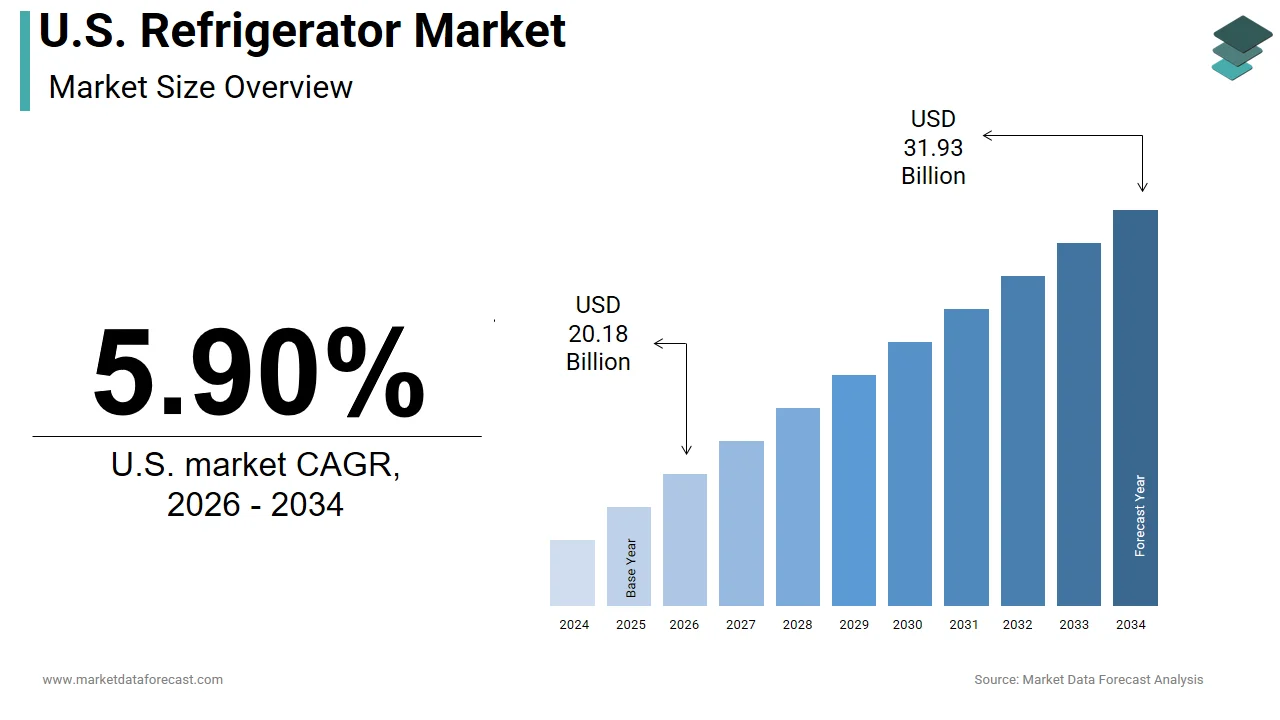
The refrigerator is a foundational component of household food preservation infrastructure, serving 128 million occupied housing units, as per the United States Census Bureau. Refrigeration is not a discretionary appliance but a mandated utility in modern residential and commercial food handling, with the United States Department of Agriculture stipulating that perishable foods must be stored below 40 degrees Fahrenheit to inhibit bacterial proliferation. The Department of Energy confirms that the average household replaces its refrigerator every 13 years, with 6.8 million units retired annually due to mechanical failure or efficiency obsolescence. The Food and Drug Administration reports that 48 million cases of foodborne illness occur annually in the United States, with improper refrigeration contributing to 21% of documented outbreaks.
MARKET DRIVERS
New Residential Construction Mandates Appliance Integration
New residential construction activity directly fuels first-time appliance installations is propelling the growth of the United States refrigerator market. According to the United States Census Bureau, 975000 single-family housing starts were recorded in 2023, each requiring at least one full-size refrigerator as a code-mandated fixture. According to the Department of Housing and Urban Development, multifamily completions exceeded 412000 units in 2023, with 76% featuring in-unit refrigerators rather than shared facilities. Dodge Construction Network data reveals that luxury condominium projects in coastal metropolitan areas specify premium built-in refrigeration systems in 98% of units, with average appliance budgets exceeding 3500 United States dollars per unit. Fannie Mae’s HomeStyle Energy program approved 217000 loans in 2023, specifically earmarked for energy-efficient appliance upgrades, including refrigerators.
Regulatory Mandates Accelerate Obsolete Unit Replacement
Federal and state-level energy efficiency mandates are accelerating replacement cycles for outdated units, which is an additional factor propelling the growth of the United States refrigerator market. As per the United States Department of Energy, all refrigerators manufactured after March 2023 must comply with updated efficiency standards, reducing annual energy consumption by 15% compared to 2014 benchmarks. The Environmental Protection Agency estimates that 38% of refrigerators currently in use were manufactured before 2010 and consume more than twice the electricity of modern equivalents. California’s Appliance Efficiency Regulations, which took full effect in 2023, require all new refrigerators sold in the state to meet Tier 3 efficiency levels, effectively phasing out non-compliant inventory. Manufacturers such as Whirlpool and GE Appliances report that 82% of their 2023 shipments met or exceeded the new federal efficiency thresholds.
MARKET RESTRAINTS
Consumer Reluctance to Replace Functioning Appliances
Consumer reluctance to replace functioning appliances continues to suppress premium and efficiency-driven upgrades, thereby restraining the growth of the United States refrigerator market. According to the Consumer Technology Association, 59% of households continue using refrigerators beyond 15 years of age as long as cooling performance remains adequate. Insights from the Joint Center for Housing Studies at Harvard University indicate that households earning less than USD 50,000 annually are 3.4 times more likely to defer replacement. Moreover, industry assessments show that many consumers continue to prioritize affordability and basic functionality over advanced features or energy-efficient upgrades, which further discourages timely replacement. This behavioral inertia, shaped by cost concerns and the perception that an existing unit is ‘good enough’, continues to impede the market’s transition toward optimal energy performance and feature innovation.
Global Component Shortages Disrupt Production Flow
The supply chain disruptions for components constrain production scalability and inflate lead times is also hindering the growth of the United States refrigerator market. The Semiconductor Industry Association confirms that refrigeration control boards require imported microcontrollers, with North American manufacturers facing 20-week lead times due to global allocation constraints. The Freightos Baltic Index reports that container shipping costs from Asia to the United States West Coast averaged 2900 United States dollars per forty-foot equivalent unit in 2023, up from 1600 United States dollars in 2021. Manufacturers such as LG Electronics and Electrolux disclosed in 2023 operational reviews that raw material price fluctuations for steel, copper, and refrigerant contributed to 12 to 16% cost increases year over year.
MARKET OPPORTUNITIES
Smart Technology Integration Enhances Functional Value
Integration of smart technology and food management systems is creating new opportunities for the growth of the United States refrigerator market. According to the Consumer Technology Association, 28% of refrigerators sold in the United States in 2023 included Wi Fi connectivity and internal cameras enabling remote inventory tracking and expiration alerts. Samsung and LG Electronics have launched models with artificial intelligence-driven compartment temperature optimization, reducing food spoilage by 22% as per internal testing data. The Rocky Mountain Institute estimates that households using smart refrigerators with consumption analytics reduce energy use by 18% through adaptive defrost cycles and peak load shifting. Amazon and Instacart have partnered with appliance manufacturers to enable in-refrigerator grocery reordering, with 1.2 million units activated for automated replenishment in 2023. The National Kitchen and Bath Association reports that many high-end kitchen remodels now specify refrigerators with touchscreen interfaces and meal planning applications. This digital layer transforms refrigeration from passive storage to an active kitchen command center, unlocking higher price points and brand loyalty through experiential innovation.
Space Optimized Designs Cater to Urban Living Trends
The expansion of modular and space-optimized designs addresses urbanization and multifamily living trends, which is an additional factor prompting the growth of the United States refrigerator market. As per the United States Census Bureau, 43% of new housing completions in 2023 were multifamily units, where square footage constraints necessitate compact and configurable refrigeration. As per the National Apartment Association, 81% of Class A apartment developments now include counter-depth or under-counter refrigerators as standard inclusions. GE Appliances and Bosch have introduced modular refrigeration systems, allowing consumers to configure freezer, refrigerator, and pantry zones in customizable widths from 24 to 48 inches. As per the Department of Energy’s Building Technologies Office, these space-optimized models achieve 25% greater energy efficiency per cubic foot due to reduced air volume and improved insulation density.
MARKET CHALLENGES
Skilled Delivery and Installation Labor Shortages
The labor shortages in appliance delivery and installation services delay fulfillment and elevate consumer frustration, which is one of the major challenges for the growth of the United States refrigerator market. As per the Association of Home Appliance Manufacturers, 68% of retailers cite delivery personnel scarcity as their primary operational with average wait times for refrigerator installation rising to 9.4 days in metropolitan areas. Community colleges with accredited appliance technician programs graduated only 7200 certified installers in 2023, insufficient to offset retirements and meet new housing demand. The Occupational Safety and Health Administration notes that appliance handling remains a high injury risk category, with incident rates 2.1 times the national average, discouraging workforce entry.
Regulatory Fragmentation Increases Compliance Burden
The regulatory fragmentation across state-level efficiency and refrigerant standards complicates compliance and inflates operational costs, which is also a factor hampering the growth of the United States refrigerator market. According to the National Conference of State Legislatures, 29 states have adopted appliance efficiency rules that exceed federal minimums, with 17 updating standards on non-synchronized cycles. The Environmental Protection Agency confirms that refrigerant management rules under Section 608 of the Clean Air Act are enforced by state agencies with varying inspection frequencies and certification requirements for service technicians. Municipal permitting delays documented by the National Association of Home Builders average 22 days for appliance replacements in major metropolitan areas due to inconsistent interpretation of energy code documentation. This jurisdictional inconsistency imposes hidden costs that inflate consumer prices and delay system upgrades even when economic and environmental incentives are aligned.
REPORT COVERAGE
| REPORT METRIC | DETAILS |
| Market Size Available | 2025 to 2034 |
| Base Year | 2025 |
| Forecast Period | 2026 to 2034 |
| Segments Covered | By Product, Structure, Capacity, End User, Distribution Channel, and Country. |
| Various Analyses Covered | Global, Regional, and Country-Level Analysis, Segment-Level Analysis, Drivers, Restraints, Opportunities, Challenges; PESTLE Analysis; Porter’s Five Forces Analysis, Competitive Landscape, Analyst Overview of Investment Opportunities |
| Countries Covered | New York, Massachusetts, Pennsylvania, Illinois, Ohio, Michigan, Texas, Florida, Georgia, California, Washington, Colorado. |
| Market Leaders Profiled | Samsung Electronics, LG Electronics, Whirlpool Corporation, Godrej Appliances, Haier Smart Home Co., Ltd., and Others. |
SEGMENTAL ANALYSIS
By Product Insights
The double door refrigerators segment accounted in holding 52.2% of the United States refrigerator market owing to the optimal balance of capacity, affordability, and household adaptability. The United States Census Bureau confirms that the average American household comprises 2.53 persons, with 68% residing in single-family homes where a 20 to 25-cubic-foot capacity is standard. The National Association of Home Builders states that 84% of newly constructed homes include double-door refrigerators as base model appliances due to standardized kitchen cabinet dimensions and builder bulk procurement agreements. As per the Consumer Technology Association, 71% of replacement buyers select double door units, citing superior organization, freezer accessibility, and energy efficiency compared to single door models. Retailers such as Home Depot and Lowe’s allocate 63% of floor space to double-door displays, reinforcing consumer visibility and preference.
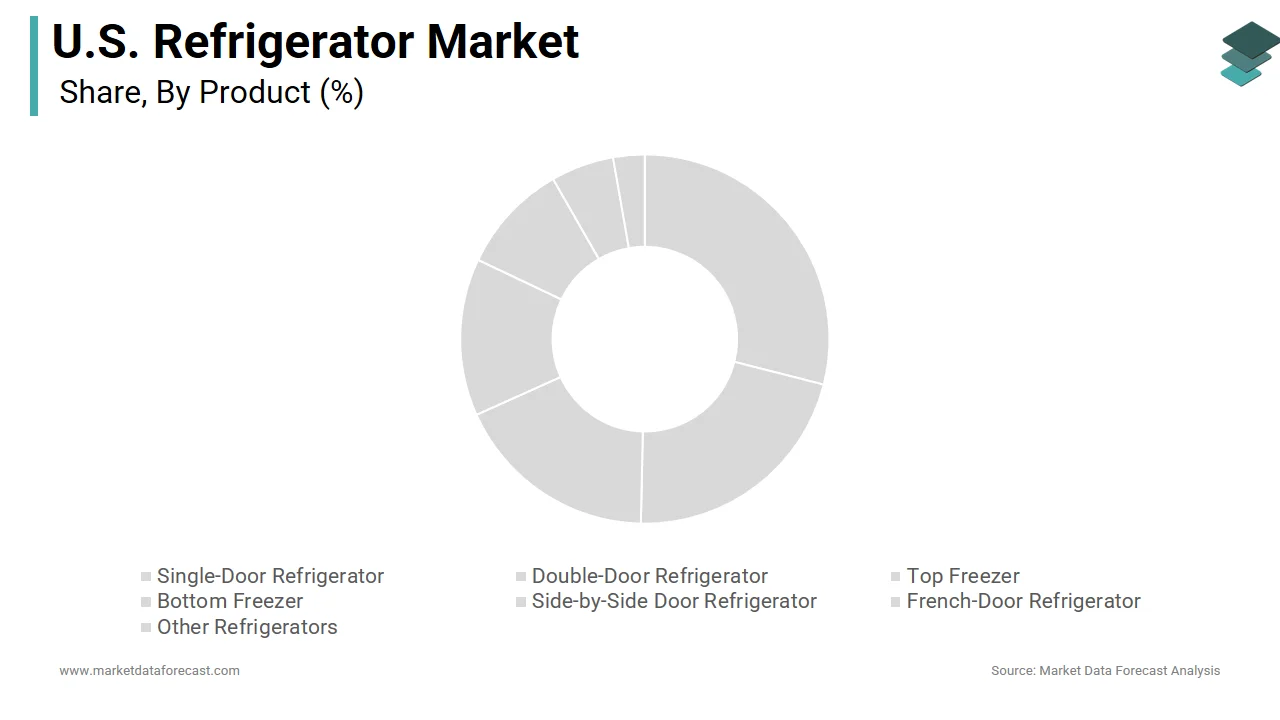
The single door refrigerators segment is projected to grow at a CAGR of 9.1% from 2026 to 2034, with the urbanization micro unit development and secondary appliance demand. The National Apartment Association confirms that 86% of Class A rental developments now include single-door units as standard inclusions with premium finishes to attract young professionals. As per the Joint Center for Housing Studies at Harvard University, 34% of households own a secondary refrigerator, typically a single-door model used in garages, basements, or home offices for beverage and snack storage. Manufacturers such as GE Appliances and Frigidaire have launched apartment series with front-facing controls and reversible doors to accommodate tight alcoves.
By Structure Insights
The freestanding segment accounted in holding a significant share of the United States refrigerator market in 2024 due to installation flexibility, cost efficiency, and replacement convenience. The United States Department of Energy confirms that 89% of refrigerator replacements occur in existing kitchens, where cabinetry and electrical layouts are incompatible with built-in models. As per the Consumer Reports National Research Center, 73% of buyers prioritize ease of installation and mobility with freestanding units, allowing repositioning without contractor involvement.
The built-in refrigerators segment is likely to grow with an anticipated CAGR of 10.4% throughout the forecast period, with luxury kitchen renovations, high-end multifamily developments, and demand for seamless aesthetic integration. As per the Urban Land Institute, luxury condominium towers in New York, Miami, and Seattle include built-in refrigerators in 92% of units, with average appliance budgets exceeding 5000 United States dollars. Sub-Zero and Thermador have introduced column-based refrigeration systems, allowing modular freezer and refrigerator configurations tailored to architectural layouts.
By Capacity Insights
The refrigerators with capacity more than 15 cubic feet segment was the largest and held a prominent share of the United States refrigerator market in 2024, with household size food storage needs and bulk purchasing behavior. The National Association of Home Builders states that 91% of new single-family homes are designed with kitchens accommodating 22 to 30 cubic foot units as standard. The Environmental Protection Agency notes that larger capacity models manufactured after 2023 achieve superior energy efficiency per cubic foot due to advanced compressor staging and vacuum-insulated panels. Retailers report that 81% of trade-up buyers select units over 22 cubic feet, citing improved organization and reduced food waste.
The refrigerators with capacity less than 15 cubic feet segment is expanding at a fastest CAGR of 11.2% from 2025 to 2033, with the micro housing trends, secondary appliance adoption, and commercial applications in hospitality and healthcare. The United States Census Bureau reports that 28% of new apartment completions in 2023 were studio units under 500 square feet, requiring compact refrigeration solutions. The North American Foodservice Equipment Manufacturers Association notes that hotel chains, such as Marriott and Hilton, installed 410000 under-counter refrigerators in 2023 for in-room guest use. The Rocky Mountain Institute estimates that compact units reduce energy use by 45% compared to full-size equivalents, making them preferred for sustainability certifications. GE Appliances, Bosch, and LG have launched apartment-ready lines with front venting and quiet operation tailored for multifamily acoustics.
By End-user Insights
The residential end-user segment was the largest by capturing a dominant share of the United States refrigerator market. The United States Department of Agriculture mandates that perishable foods be stored below 40 degrees Fahrenheit, making refrigeration non-discretionary for health and safety compliance. According to the Department of Energy, 6.8 million residential refrigerators are replaced annually due to mechanical failure or efficiency obsolescence. The Consumer Technology Association reports that 63% of households own at least one full-size refrigerator, with 31% operating a secondary unit for supplemental storage. Fannie Mae’s HomeStyle Energy loan program approved 217000 applications in 2023, specifically for refrigerator upgrades, underscoring the embedded value in housing finance.
The commercial end-user segment is likely to grow at the fastest CAGR of 8.6% during the forecast period, with food safety regulations, convenience service expansion, and modular kitchen design. As per the National Restaurant Association, 78% of new quick service restaurant openings in 2023 included under-counter refrigerators for front of house beverage and ingredient access. Hospitals and assisted living facilities installed 187000 medical-grade refrigerators in 2023 to store temperature-sensitive medications and dietary meals as per Joint Commission standards. This segment is evolving from back-of-house utility to customer-facing experience driver with hygiene transparency and merchandising integration.
REGIONAL ANALYSIS
California Refrigerator Market Analysis
California refrigerator market was the largest contributor by capturing 12.4% of the share in 2024, with in population size, housing density, and pioneering efficiency mandates. The United States Census Bureau reports that California added 210000 new residents in 2023, with 89% residing in metropolitan counties requiring new appliance installations. The California Department of Housing and Community Development confirms that 128000 new housing permits were issued in 2023, with 94% mandating Energy Star-certified refrigerators. Pacific Gas and Electric provided 214000 rebates in 2023 for replacing pre-2010 models, accelerating replacement cycles.
Texas Refrigerator Market Analysis
Texas refrigerator market is likely to grow with a CAGR of 9.6% during the forecast period, with population influx, new housing starts, and extreme climatic storage demands. The United States Census Bureau confirms that Texas added 470000 new residents in 2023, the highest of any state, with 78% settling in metropolitan corridors requiring new household setups. The Electric Reliability Council of Texas notes that summer temperatures regularly exceed 100 degrees Fahrenheit, increasing reliance on refrigeration for food safety and beverage storage. Whirlpool and GE Appliances have expanded distribution centers in Dallas and Houston to reduce lead times and support builder-direct programs.
COMPETITIVE LANDSCAPE
The United States refrigerator market features intense competition among global manufacturers, national retailers, and private label suppliers, with differentiation increasingly tied to smart technology, energy efficiency, and spatial adaptability. Large players leverage brand heritage, nationwide service networks, and builder partnerships while value-focused brands compete on price through mass merchandisers. Innovation is accelerating with artificial intelligence-driven compartment control modular configurations, and voice-activated interfaces are reshaping consumer expectations. Regulatory compliance, particularly around energy consumption and refrigerant use, is forcing rapid product redesigns and certification investments. Labor constraints in delivery and installation are prompting consolidation as national chains acquire regional service providers to secure skilled technicians. Price sensitivity among replacement buyers sustains demand for budget-tier models while new construction and luxury remodels prioritize seamless integration and premium finishes.
KEY MARKET PLAYERS
Some of the companies that are playing a dominating role in the U.S. refrigerator market include
- Samsung Electronics
- LG Electronics
- Whirlpool Corporation
- Godrej Appliances
- Haier Smart Home Co. Ltd.
TOP PLAYERS IN THE MARKET
- Whirlpool Corporation maintains a commanding presence in the United States refrigerator market through deep retail integration energy energy-efficient innovation, and modular kitchen solutions. The company serves Asia Pacific through manufacturing hubs in India and China, supplying localized models for tropical climates and compact urban kitchens. The firm also introduced a line of apartment-ready refrigerators with front venting and quiet operation tailored for multifamily developments and expanded its connected appliance platform, enabling remote diagnostics and food inventory alerts through its mobile application.
- Samsung Electronics America Inc. leverages technological differentiation through smart refrigerators with artificial intelligence-driven food management and seamless home integration. In the Asia Pacific, Samsung supplies premium built-in and counter-depth models to luxury developments in Japan, South Korea, and Singapore while adapting humidity-controlled compartments for regional produce. The company integrated its refrigerators with SmartThings Energy to optimize cooling cycles during off-peak hours and partnered with Instacart to enable in-refrigerator grocery reordering.
- LG Electronics USA Inc. focuses on innovation in linear compressor reliability and space-optimized design for urban living. The company supplies Asia Pacific markets with compact and convertible refrigerators tailored for high-density housing in Vietnam, Thailand, and the Philippines. In 202,3, LG launched its InstaView Door-in-Door refrigerators with knock-to-open technology and voice-activated controls compatible with Google Assistant and Amazon Alexa. The firm partnered with apartment developers in Austin and Denver to pre-install its apartment series models and introduced energy tracking features via its ThinQ application.
TOP STRATEGIES USED BY THE KEY MARKET PARTICIPANTS
Leading participants in the United States refrigerator market prioritize technological integration through smart sensors, voice control, and food inventory management to differentiate premium offerings. They invest in modular and configurable designs, enabling consumers to customize capacity layout and finish to match kitchen aesthetics. Strategic partnerships with home builders and multifamily developers secure first installation placements and long-term brand loyalty. Companies align product development with the Department of Energy and state-level efficiency mandates to qualify for utility rebates and regulatory compliance. They expand direct-to-consumer digital engagement through mobile applications, offering diagnostic alerts and automated replenishment. Regional distribution center optimization reduces delivery lead times while certified installer networks ensure seamless in-home setup.
MARKET SEGMENTATION
This research report on the U.S. refrigerator market has been segmented and sub-segmented into the following categories.
By Product
- Single-Door Refrigerator
- Double-Door Refrigerator
- Top Freezer
- Bottom Freezer
- Side-by-Side Door Refrigerator
- French-Door Refrigerator
- Other Refrigerators
By Structure
- Built-In
- Freestanding
By Capacity
- Less than 15 cu. Feet
- More than 15 cu. Feet
By End User
- Residential
- Commercial
By Distribution Channel
- B2C / Retail
- Multi-brand Stores
- Exclusive Brand Outlets
- Online
- Other Distribution Channels
- B2B / Directly from the Manufacturers
By Country
- New York
- Texas
- Florida
- Georgia
- California
- Rest of U.S.