- Product Description Description
- Table of Contents TOC
- List of Table & Figure LOT
- Get Free Sample PDF Sample PDF
Market Size, 2025
$3.70 BnMarket Estimate, 2026
$3.78 BnMarket Forecast, 2034
$4.44 BnCAGR, 2026–2034
2.03%Executive Summary: U.S. Residential Real Estate Market Report (2026–2034)
- Market Scope: Comprehensive analysis of the U.S. residential real estate market covering property types, price bands, business models, regional performance, demographic shifts, mortgage interest rates, and housing inventory constraints.
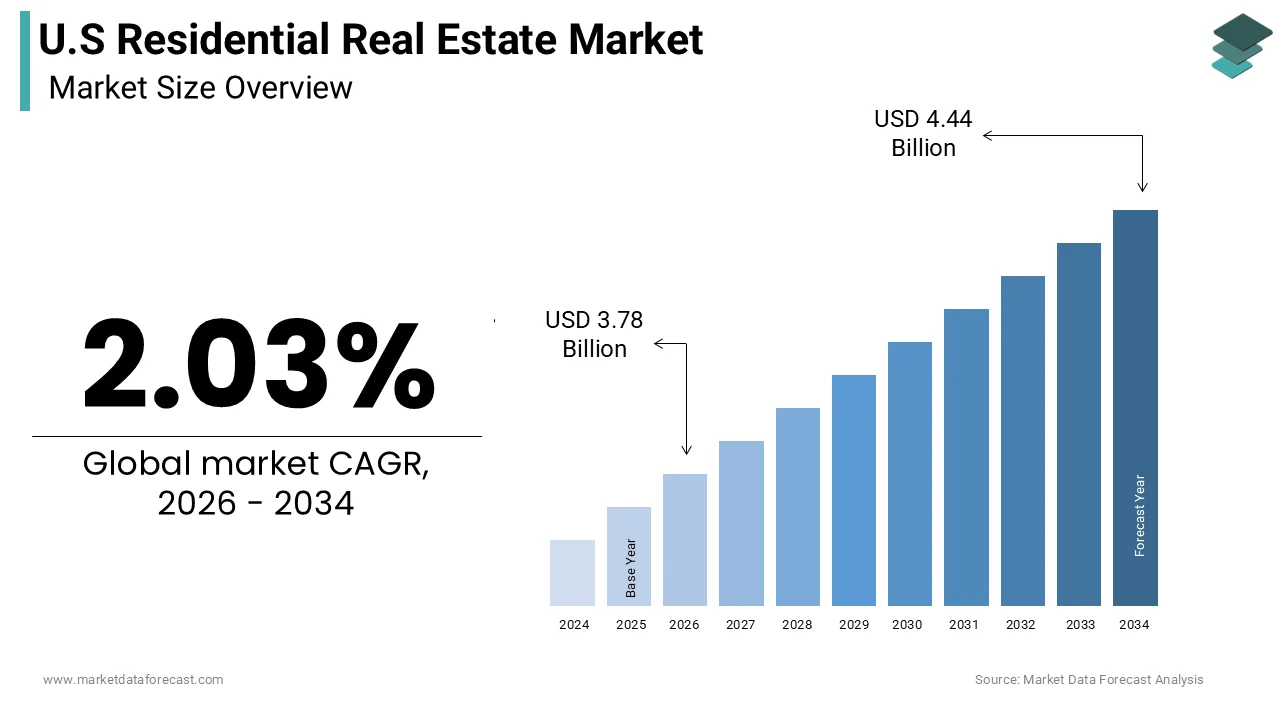
- Market Valuation: Valued at USD 3.70 billion (2025), estimated at USD 3.78 billion (2026), and projected to reach USD 4.44 billion by 2034, registering a stable CAGR of 2.03% (2026–2034).
- Primary Growth Drivers: Demographic shifts and Millennial household formation, alongside chronic housing inventory limitations and structural supply constraints.
Key U.S. Residential Real Estate Market Segment Metrics (2026–2034)
| Category | Leading Segment (2025 Position) | Fastest-Growing Segment |
|---|---|---|
| By Property Type | Villas and landed houses (52.6% share in 2025) | Apartments and condominiums (projected at a 6.5% CAGR) |
| By Price Band | Mid-market segment (45.1% majority share in 2025) | Luxury segment (projected at an 8.7% CAGR) |
| By Business Model | Sales business model (held a substantial share in 2025) | Rental business model (projected at a 7.8% CAGR) |
| By Region | United States (dominated North American market with 90.4% share in 2025) | High-growth state-level and regional sub-markets |
Major Industry Players & Market Structure
Market Structure: Intense and competitive landscape featuring large national homebuilders, regional developers, and digital platforms navigating supply constraints, elevated interest rates, and affordability challenges.
Key Real Estate Companies: D.R. Horton Inc., Lennar Corporation, PulteGroup Inc., NVR Inc., Toll Brothers Inc., KB Home, Taylor Morrison Home Corporation, Meritage Homes Corporation, Century Communities Inc., LGI Homes Inc., Redfin Corporation, Zillow Group Inc., Compass Inc., Realogy Holdings Corp., and Keller Williams Realty Inc.
U.S Residential Real Estate Market Size
The U.S. residential real estate market size was calculated to be USD 3.70 billion in 2025 and is anticipated to be worth USD 4.44 billion by 2034, from USD 3.78 billion in 2026, growing at a CAGR of 2.03% during the forecast period.
Residential real estate refers to property used specifically for housing individuals or families, including single-family homes, apartments, villas, and condos. These properties are designed for living purposes rather than business, industrial, or commercial activity. This sector serves as a fundamental component of the national economy, influencing consumer wealth construction activity and financial stability. The market dynamics are shaped by demographic trends, mortgage interest rates, and housing inventory levels, which collectively determine affordability and transaction volume. According to the U.S. Census Bureau's report released in late April 2026, the homeownership rate declined to 65.3% in the first quarter of 2026, down from 65.7% in the previous quarter. Furthermore, data from the U.S. Census Bureau indicates that new housing construction remains insufficient to meet demand, with recent industry analysis estimating a supply deficit of over 4 million homes as household formation outpaces completion rates. The Federal Reserve monitors housing costs closely as they constitute a significant portion of the Consumer Price Index, impacting broader inflationary pressures. Regulatory frameworks such as zoning laws and building codes vary by jurisdiction, affecting development timelines and costs. The integration of digital technologies in property transactions has streamlined processes but also introduced new competitive dynamics. This evolving environment reflects a market grappling with structural imbalances between supply and demand, where affordability challenges persist despite a strong underlying desire for homeownership. The interplay of economic policy, demographic shifts, and construction capacity defines the current state of the industry, requiring stakeholders to navigate complex conditions with strategic agility.
MARKET DRIVERS
Demographic Shifts and Millennial Household Formation
Demographic shifts, particularly the entry of millennials into their prime home-buying years, are a key driver of the United States residential real estate market. This generates sustained demand for housing units. This large cohort is transitioning from renting to owning as they reach financial stability and form families, creating a robust base of first-time buyers. As per the Pew Research Center, Millennials comprise the largest living generation in the United States; however, according to the National Association of Realtors (2025), the median age of a first-time homebuyer has shifted significantly upward to 40 years old, surpassing the historical average of roughly 30 to 33 years. This demographic wave creates a structural demand for starter homes and entry-level properties, which are currently in short supply. The desire for suburban living, driven by remote work flexibility, has further expanded the geographic scope of this demand beyond urban centers. Household formation rates have remained steady, indicating that individuals are establishing independent residences rather than doubling up with roommates or family members. This trend is supported by increasing wages and improved credit profiles among younger buyers who have recovered from previous economic downturns. The cultural emphasis on homeownership as a wealth-building tool continues to motivate this demographic to enter the market despite affordability hurdles. Hence, the sheer size and life stage progression of the millennial generation provide a powerful and enduring tailwind for residential real estate activity, ensuring consistent demand across various regions.
Limited Housing Inventory and Supply Constraints
Limited housing inventory and structural supply constraints are the main reasons for the growth of the United States residential real estate market. This creates a seller’s market environment that supports price stability and growth. The chronic undersupply of homes for sale results from years of underbuilding following the 2008 financial crisis, combined with labor shortages and material cost increases in the construction sector. As per the National Association of Realtors, the months supply of inventory often remains below the balanced market threshold of six months, frequently hovering around three to four months in recent periods. This scarcity intensifies competition among buyers, leading to multiple offer situations and quicker sales cycles. Existing homeowners are reluctant to list their properties due to the lock-in effect of low mortgage rates obtained in previous years, further restricting available stock. New construction has struggled to keep pace with population growth due to regulatory hurdles and land availability issues in desirable areas. The imbalance between the number of active buyers and available listings drives pressure on prices upward, making real estate an attractive asset class for investors seeking appreciation. Builders focus on higher-end segments to maintain margins, exacerbating the shortage of affordable entry-level homes. Thus, the persistent lack of inventory ensures that demand outstrips supply, sustaining market activity and value retention even in fluctuating economic conditions.
MARKET RESTRAINTS
Elevated Mortgage Interest Rates and Affordability Crisis
Elevated mortgage interest rates and the resulting affordability are a notable restriction on the United States residential real estate market. This reduces purchasing power and limits access to homeownership for many potential buyers. When interest rates rise, the monthly cost of borrowing increases substantially, requiring higher incomes to qualify for the same loan amount. As per Freddie Mac, average 30-year fixed mortgage rates have fluctuated significantly, reaching levels above 7% in recent periods, which drastically reduces the maximum loan size a buyer can afford. This dynamic prices out first-time buyers and forces some existing owners to stay in their current homes rather than trading up. The affordability index has declined to historic lows, indicating that a median-income family struggles to qualify for a median-priced home. High rates also dampen refinancing activity, reducing the equity extraction that often fuels consumer spending and home improvements. Sellers may resist lowering prices, expecting rates to drop, leading to a standoff that reduces transaction volume. The combination of high prices and high borrowing costs creates a barrier to entry that slows market turnover and liquidity. Potential buyers may choose to rent indefinitely, delaying their entry into the ownership market. Therefore, the financial burden of elevated interest rates acts as a brake on market growth by constraining demand and reducing the pool of qualified purchasers.
Construction Costs and Labor Shortages
High construction costs and persistent labor shortages are major constraints on the United States residential real estate market. This hinders the development of new housing supply and increases the final price of homes. The cost of building materials such as lumber, steel, and concrete has experienced volatility and overall increases due to supply chain disruptions and inflationary pressures. As per the Associated General Contractors of America, the construction industry faces a significant workforce gap with hundreds of thousands of unfilled positions resulting from an aging workforce and a lack of new entrants. These labor shortages lead to project delays and increased wages, which are passed on to buyers in the form of higher home prices. Developers may postpone or cancel projects if profitability margins are squeezed by rising input costs, reducing the pipeline of future inventory. Regulatory requirements and permitting processes add further time and expense to new developments, discouraging small builders from entering the market. The inability to build affordable housing at scale exacerbates the supply deficit, particularly in high-demand urban areas. Higher construction costs also limit the feasibility of renovating existing stock, which could otherwise add to the available inventory. So, the economic and operational challenges in the construction sector restrict the ability of the market to respond to demand with adequate supply, limiting growth and accessibility.
MARKET OPPORTUNITIES
Adoption of PropTech and Digital Transaction Platforms
The adoption of property technology (PropTech) and digital transaction platforms offers a prime opportunity for the United States residential real estate market. This enhances efficiency, transparency, and accessibility in buying and selling processes. Digital tools such as virtual tours, automated valuations, and online closing services streamline transactions, reducing the time and cost associated with traditional methods. As per the National Association of Realtors' 2025 Profile of Home Buyers and Sellers, a plurality (47%) of home buyers begin their search online, though 100% use online tools at some point during the process, increasingly expecting digital capabilities throughout the purchasing journey. Blockchain technology offers potential for secure and transparent record keeping, reducing fraud and speeding up title transfers. Artificial intelligence enables more accurate pricing models and personalized property recommendations, improving match quality between buyers and sellers. iBuying platforms provide instant liquidity for sellers, although they face scrutiny regarding valuation accuracy. Digital mortgage platforms simplify the lending process, allowing for faster pre-approvals and closings. These innovations appeal to tech-savvy millennials and Gen Z buyers who prioritize convenience and speed. Real estate agents who embrace these tools can enhance their service offerings and reach broader audiences. The integration of data analytics helps investors identify emerging markets and trends more effectively. Hence, the digitization of real estate processes creates opportunities for innovation and improved customer experience, driving market modernization and efficiency.
Expansion of Build to Rent Communities
The expansion of build-to-rent (BTR) communities creates a high-value prospect for the United States residential real estate market. This addresses the needs of renters who seek high-quality single-family living without the commitment of ownership. BTR developments consist of purpose-built single-family homes or townhouses designed specifically for long-term rental, providing professional management and community amenities. As per the Urban Land Institute, institutional investment in BTR has surged as developers recognize the demand for flexible housing options among mobile workers and those priced out of the buying market. This model appeals to individuals who desire the space and privacy of a detached home but prefer the maintenance-free lifestyle of renting. BTR communities often feature shared amenities such as pools, fitness centers, and coworking spaces, enhancing the value proposition for tenants. The stability of long-term leases provides predictable cash flows for investors compared to traditional multifamily apartments. Demographic trends such as delayed marriage and student debt burdens support the growth of this segment as young adults postpone homeownership. Institutional landlords can achieve economies of scale in management and maintenance, improving operational efficiency. Thus, the rise of build-to-rent communities diversifies the housing landscape and captures a growing segment of the rental market, offering a viable alternative to traditional ownership.
MARKET CHALLENGES
Climate Change Risks and Insurance Availability
Climate change risks and the resulting impact on insurance availability are a major impediment to the United States residential real estate market. This increases costs and limits insurability in vulnerable regions. The rising frequency of extreme weather events such as hurricanes, wildfires, and floods has led insurers to raise premiums or withdraw coverage entirely in high-risk areas. As per the Insurance Information Institute, several major insurers have paused or limited new policies in states like California and Florida due to escalating wildfire and hurricane risks. This reduction in insurance availability makes it difficult for buyers to secure mortgages since lenders require proof of coverage. Higher insurance costs increase the total cost of ownership, reducing affordability and potentially depressing property values in affected zones. Homeowners face uncertainty regarding future insurability, which can deter investment and lead to market instability. Local governments struggle to balance development pressures with environmental resilience requirements. The lack of affordable insurance options forces some buyers to rely on state-backed insurers of last resort, which may offer limited coverage. Climate risk disclosure requirements are becoming more stringent, adding complexity to transactions. Hence, the intersection of climate change and insurance markets creates a significant hurdle for residential real estate stability and growth in vulnerable regions, threatening long-term asset viability.
Regulatory Zoning and Land Use Restrictions
Regulatory zoning and land use restrictions hamper the expansion of the United States residential real estate market. This limits the density and type of housing that can be built in high-demand areas. Strict zoning laws often mandate single-family only districts, minimum lot sizes, and parking requirements, which constrain the supply of affordable and diverse housing options. As per the Brookings Institution, restrictive zoning practices in many metropolitan areas have contributed to housing shortages and increased prices by preventing the construction of multifamily and higher-density developments. Local opposition known as NIMBYism frequently blocks new projects, delaying approvals and increasing development costs. These regulations hinder the ability of developers to respond to market demand with appropriate housing types such as townhouses or accessory dwelling units. Inconsistent regulations across jurisdictions create uncertainty for builders and investors, complicating planning and financing. The lack of flexible zoning prevents the efficient use of land near transit hubs and employment centers, exacerbating sprawl and transportation costs. Reform efforts face political hurdles as existing homeowners often resist changes that might alter neighborhood character or perceived property values. Therefore, rigid regulatory frameworks impede the creation of sufficient housing supply, contributing to affordability crises and limiting market responsiveness to demographic needs.
REPORT COVERAGE
| REPORT METRIC | DETAILS |
| Market Size Available | 2025 to 2034 |
| Base Year | 2025 |
| Forecast Period | 2026 to 2034 |
| CAGR | 2.03% |
| Segments Covered | By Property Type, Price Band, Business Model, And Region |
| Various Analyses Covered | Global, Regional & Country Level Analysis; Segment-Level Analysis; DROC, PESTLE Analysis; Porter’s Five Forces Analysis; Competitive Landscape; Analyst Overview of Investment Opportunities |
| Regions Covered | New York, Massachusetts, Pennsylvania, Illinois, Ohio, Michigan, Texas, Florida, Georgia, California, Washington, Colorado. |
| Market Leaders Profiled | D.R. Horton Inc., Lennar Corporation, PulteGroup Inc., NVR Inc., Toll Brothers Inc., KB Home, Taylor Morrison Home Corporation, Meritage Homes Corporation, Century Communities Inc., LGI Homes Inc., Redfin Corporation, Zillow Group Inc., Compass Inc., Realogy Holdings Corp., Keller Williams Realty Inc. |
SEGMENTAL ANALYSIS
By Property Type Insights
The villas and landed houses segment remained the largest segment in the United States residential real estate market and occupied a 52.6% share in 2025. This prominence of the segment is supported by the cultural preference for single-family detached homes that offer privacy, space, and autonomy. In addition, this segment dominates because it aligns with the traditional American dream of homeownership, which emphasizes yard ownership and separation from neighbors. As per the United States Census Bureau, single-family homes account for approximately 60 to 67% of all housing units in the country, comprising the majority of the national housing stock. The main driver for this domination is the desire for larger living spaces, particularly among families with children who require room for growth and activities. The shift toward remote work has further amplified this demand as homeowners seek dedicated office spaces and quieter environments that are often difficult to find in multi-unit buildings. Suburban areas with good school districts attract buyers willing to commute for a better quality of life, ensuring consistent demand for detached properties. Additionally, single-family homes have historically appreciated more steadily than condominiums, making them attractive long-term investments. The scarcity of land in urban centers pushes development outward, where landed houses are the primary form of new construction. Consequently, the combination of cultural preference, spatial requirements, and investment potential cements villas and landed houses as the dominant property type in the market.
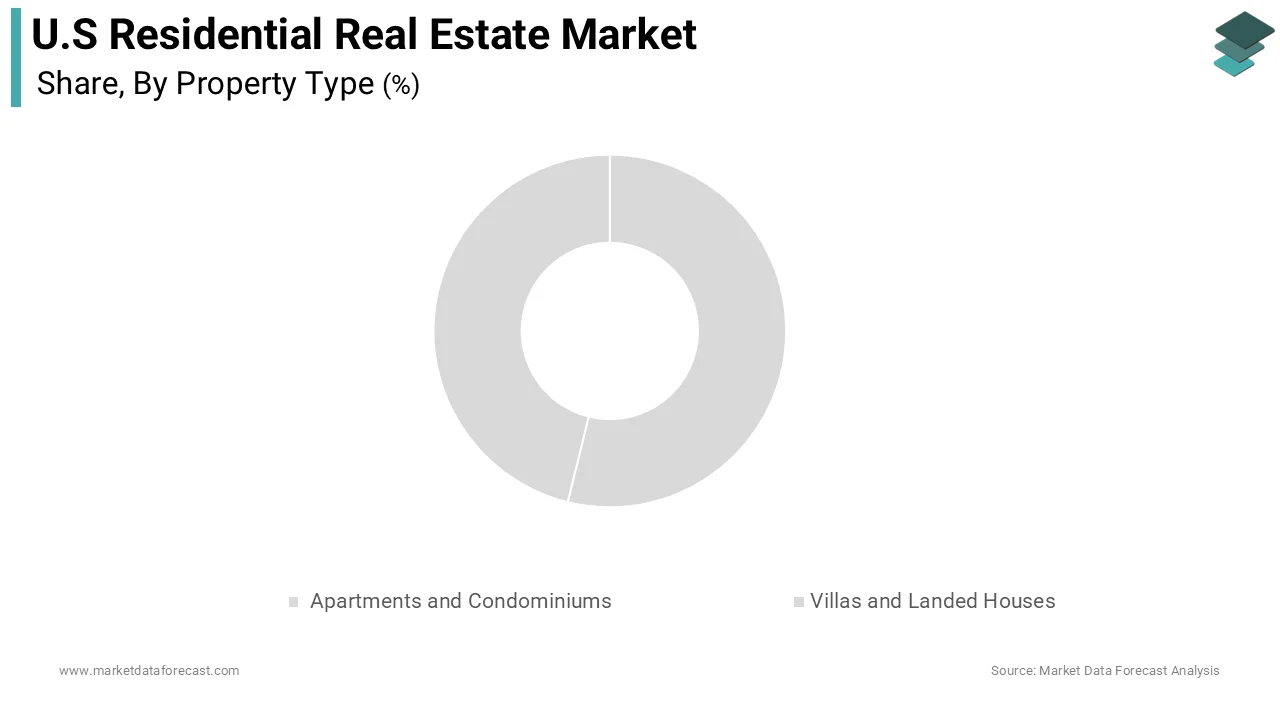
The apartments and condominiums segment is anticipated to witness the fastest CAGR of 6.5% between 2026 and 2034. This quick surge of the segment is fueled by urbanization trends and affordability constraints in the single-family sector. Many first-time buyers and young professionals are turning to multifamily units as home prices rise. These units offer a more accessible entry point into the housing market. As per the National Multifamily Housing Council (and RealPage data), the demand for rental apartments remains stable, though occupancy rates have normalized to approximately 94.6% (below the 95% peak) in major metropolitan areas as new supply enters the market. A key reason for rapid acceleration is the increasing concentration of jobs in urban centers where high-density living is necessary to accommodate workforce proximity. Millennials and Gen Z consumers often prefer the lifestyle amenities offered by modern apartment complexes, such as fitness centers, coworking spaces, and social lounges, which reduce the need for private space. Additionally, the rising cost of maintenance and property taxes for single-family homes makes condominiums an attractive alternative for those seeking homeownership with shared responsibility for exterior upkeep. Developers are responding by building luxury multifamily projects that cater to downsizing baby boomers and young professionals alike. The flexibility of renting or buying condos allows residents to adapt to changing life circumstances without the burden of selling a detached home. So, the convenience, affordability, and lifestyle benefits of apartments and condominiums drive their rapid expansion.
By Price Band Insights
The mid-market segment held the majority share of 45.1% of the United States residential real estate market in 2025 because of its alignment with the financial capabilities of the median household and the broad availability of inventory in this price range. This segment serves the largest demographic of homebuyers, including first-time families and move-up buyers who seek a balance between affordability and quality. As per the Federal Reserve's Survey of Consumer Finances (2022), the median net worth of households in the United States increased to approximately $192,900, providing a capital base that supports homeownership, though specific purchasing power depends heavily on income and prevailing mortgage rates. A powerful booster for the segment is the sheer volume of transactions occurring within this band, as it represents the standard for suburban single-family homes in most states. Mortgage programs such as those backed by the Federal Housing Administration are frequently utilized by buyers in this segment, facilitating access to credit with lower down payments. Builders focus heavily on this segment to maximize sales volume, ensuring a steady supply of new construction that meets mainstream needs. The stability of the mid-market provides a buffer against economic volatility as demand remains relatively consistent compared to the luxury sector, which is more sensitive to wealth fluctuations. Additionally, government initiatives aimed at promoting homeownership often target middle-income earners, further supporting activity in this band. Hence, the central role of the mid-market in fulfilling the housing needs of the majority of Americans establishes it as the dominant price segment.
The luxury segment is likely to experience the fastest CAGR of 8.7% over the forecast period. This swift growth of the segment is propelled by wealth accumulation among high-net-worth individuals and the demand for exclusive amenities. Despite economic uncertainties, the upper echelon of the market remains resilient as affluent buyers are less dependent on mortgage financing and more influenced by asset preservation strategies. As per the Institute for Luxury Home Marketing, luxury home sales have outpaced the broader market in recent quarters, although inventory levels have begun to rise (increasing by over 17% in some reports) as supply normalizes in desirable locations. The main reason this segment is growing is the flight to quality, where buyers seek properties with superior construction, smart home technology, and private facilities such as pools and home theaters. The rise of remote work has enabled wealthy individuals to relocate to second-home markets, driving up prices in vacation destinations. Limited supply of true luxury properties creates competition among buyers, leading to rapid appreciation in value. Additionally, international investors view US luxury real estate as a haven for capital diversification, further boosting demand. Developers are responding by creating ultra-high-end communities with concierge services and security features that appeal to elite buyers. Hence, the unique dynamics of wealth-driven demand and scarce supply propel the luxury segment to grow faster than the broader market.
By Business Model Insights
The sales business model led the United States residential real estate market and captured a substantial share in 2025. This leading position of the segment is attributed to the strong cultural and financial emphasis on homeownership as a primary vehicle for wealth accumulation. Buying a home allows individuals to build equity over time, benefit from tax deductions, and secure stable housing costs compared to renting. As per the National Association of Realtors, existing home sales typically number around 4 to 5 million units annually, representing the bulk of residential real estate transactions in the country. A key driver for this dominance is the long-term financial advantage of owning versus renting, which appeals to families planning to stay in one location for several years. Mortgage interest deductibility and property tax deductions provide additional incentives for buyers to enter the sales market. The availability of government-backed loans with low down payment requirements facilitates access for a wide range of buyers. Real estate agents and brokers primarily focus on sales transactions, which generate higher commissions per deal compared to rental placements. The emotional attachment to owning a permanent residence reinforces the preference for buying over renting. Furthermore, the historical appreciation of real estate values encourages investors and individuals to purchase properties for long-term gain. Thus, the financial and psychological benefits of ownership establish sales as the leading business model in the residential sector.
The rental business model segment is on the rise and is expected to be the fastest-growing segment in the market by witnessing a CAGR of 7.8% between 2026 and 2034. This rapid expansion of the segment is supported by shifting demographics and affordability challenges in the sales market. Many individuals are choosing to rent due to the inability to qualify for mortgages or the desire for flexibility in a changing job market. As per the Joint Center for Housing Studies of Harvard University, the number of renter households has increased significantly, reaching record highs as younger generations delay homeownership. The biggest factor propelling this segment is the rising cost of home prices and interest rates, which make buying prohibitively expensive for many potential entrants. Institutional investors are increasingly entering the rental market, purchasing single-family homes to convert them into long-term rentals, providing professional management and consistent quality. This trend expands the rental inventory beyond traditional apartments to include detached homes. The gig economy and remote work arrangements encourage mobility, making renting a more practical option for workers who may need to relocate frequently. Landlords benefit from steady cash flows and the ability to adjust rents according to market conditions. Therefore, the combination of economic barriers to ownership and lifestyle preferences for flexibility drives the rapid expansion of the rental segment.
REGIONAL ANALYSIS
The United States dominated the North American residential real estate market and accounted for a 90.4% share in 2025 because of its vast land area, large population, and mature financial systems. The country’s market status is characterized by a diverse range of housing types and price points reflecting varied geographic and economic conditions across states. As per the Federal Housing Finance Agency (FHFA) House Price Index released in April 2026 (covering data through February 2026), U.S. house prices were unchanged month-over-month and rose 1.7% year-over-year, reflecting a significant deceleration driven by affordability challenges and high mortgage rates rather than strong demand, although limited housing supply continues to prevent steeper price declines. The presence of established mortgage markets and government-sponsored enterprises like Fannie Mae and Freddie Mac provides liquidity and stability to the housing finance system. Cultural factors such as the emphasis on individual property rights and suburban living shape consumption patterns and development trends. Regulatory frameworks at the local, state, and federal levels influence zoning construction standards and taxation, affecting market dynamics. The United States serves as a global benchmark for real estate investment trusts and property technology innovations, influencing international practices. High levels of household formation and immigration sustain long-term demand for housing units. The combination of economic scale, financial depth, and demographic diversity solidifies the United States' position as the dominant force in the regional residential real estate landscape.
COMPETITION OVERVIEW
The competition in the United States residential real estate market is intense and characterized by a mix of large national homebuilders, regional developers, and individual sellers vying for buyer attention in a supply-constrained environment. Major players compete on price, location, design, quality, and customer service to differentiate their offerings in a crowded marketplace. National builders leverage economies of scale to offer competitive pricing and standardized features, while regional developers focus on local market knowledge and customized designs. The shortage of existing home inventory has shifted demand toward new construction, increasing rivalry among builders for available land and resources. Price competition is moderate as builders balance affordability with rising construction costs and labor shortages. Innovation in smart home technology and sustainable materials serves as a key differentiator, attracting tech-savvy and eco-conscious buyers. Customer retention relies on delivering high-quality homes and seamless purchasing experiences. Regulatory compliance and zoning restrictions also influence competitive dynamics as companies navigate complex local laws. The market sees continuous adaptation to economic conditions, with builders adjusting production levels and marketing strategies to match demand. Success depends on operational efficiency, strategic land positioning, and the ability to meet evolving consumer preferences.
KEY MARKET PLAYERS
A few major players of the United States residential real estate market include
- D.R. Horton Inc
- Lennar Corporation
- PulteGroup Inc
- NVR Inc
- Toll Brothers In
- KB Home
- Taylor Morrison Home Corporation
- Meritage Homes Corporation
- Century Communities In
- LGI Homes In
- Redfin Corporation
- Zillow Group In
- Compass Inc
- Realogy Holdings Corp
- Keller Williams Realty Inc
Top Strategies Used by Key Market Participants
Key players in the United States residential real estate market primarily focus on strategic land acquisition and development in high-growth regions to ensure long-term inventory availability. Companies are increasingly adopting digital technologies such as virtual reality and online customization tools to enhance the customer buying experience and streamline operations. Diversification into multifamily and rental properties helps builders mitigate risks associated with single-family home sales volatility. Emphasis on energy efficiency and sustainable building practices appeals to environmentally conscious buyers and reduces operational costs. Partnerships with local governments and community developers facilitate smoother permitting processes and access to prime locations. Cost management through supply chain optimization and modular construction techniques improves profit margins. Customer-centric approaches, including flexible financing options and personalized design services, drive brand loyalty. These strategies collectively enable companies to navigate market fluctuations and maintain competitive advantages.
Leading Players in the US Residential Real Estate Market
- D R Horton Inc is the largest homebuilder in the United States by volume, contributing significantly to the residential real estate market through its extensive portfolio of entry-level and move-up homes. The company operates in numerous states, offering affordable housing solutions that cater to first-time buyers and growing families. Recent actions include strategic land acquisitions in high-growth suburban markets to secure future development pipelines. D R Horton has also invested in construction technology to improve efficiency and reduce building costs. The company focuses on maintaining a diverse product mix to adapt to changing consumer preferences and economic conditions. By prioritizing operational excellence and customer satisfaction, D R Horton strengthens its market position. These initiatives enable the company to deliver quality homes at competitive prices, ensuring sustained demand and leadership in the new construction sector.
- Lennar Corporation is a leading homebuilder in the United States known for its innovative Everything’s Included approach, which bundles popular features into the base price of homes. This strategy simplifies the buying process and provides value to customers, driving strong sales performance across various markets. Recent actions involve expanding its multifamily and rental housing divisions to diversify revenue streams beyond traditional single-family sales. Lennar has leveraged digital tools to enhance the customer experience from online home selection to virtual tours. The company actively pursues joint ventures and land banking strategies to control inventory costs and mitigate risk. By focusing on design innovation and sustainable building practices, Lennar appeals to modern buyers. These efforts reinforce its reputation as a forward-thinking leader in the residential real estate industry capable of adapting to market dynamics.
- KB Home plays a vital role in the United States residential real estate market by specializing in built-to-order homes that allow buyers to customize their living spaces. The company serves first-time and move-up buyers in major metropolitan areas across the country, offering flexible floor plans and personalization options. Recent actions include the expansion of its digital platform, which enables customers to design and visualize their homes online before construction begins. KB Home has focused on energy-efficient building techniques, reducing utility costs for homeowners and appealing to environmentally conscious consumers. The company maintains a lean inventory model to minimize carrying costs and respond quickly to market trends. By emphasizing customer choice and affordability, KB Home differentiates itself from competitors. These strategies strengthen its market presence by meeting the specific needs of diverse buyer segments in a competitive landscape.
MARKET SEGMENTATION
This research report on the US residential real estate market has been segmented and sub-segmented based on property type, price band, business model & region.
By Property Type
- Apartments and Condominiums
- Villas and Landed Houses
By Price Band
- Affordable
- Mid-Market and Luxury
By Business Model
- Sales
- Rental
By Region
- New York
- Texas
- Florida
- Georgia
- California
- Rest of U.S