U.S. Telematics Market Size, Share, Trends & Growth Forecast Report By Technology, By Service, By Application, and By Country (California, Texas, Florida, New York, Illinois & Rest of the United States) – Industry Analysis and Forecast, 2026 to 2034
Market Size, 2025
$37.29 MnMarket Estimate, 2026
$42.21 MnMarket Forecast, 2034
$113.81 MnCAGR, 2026–2034
13.2%U.S. Telematics Market Size
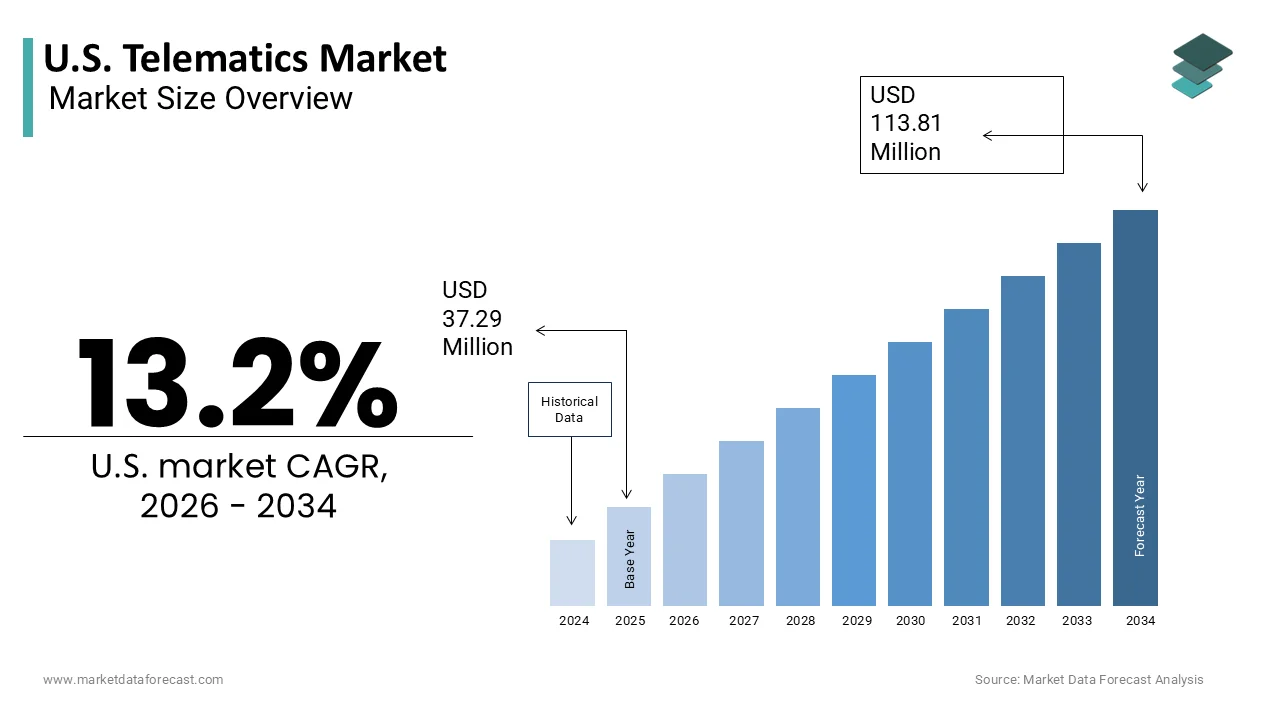
The U.S. Telematics Market is projected to grow from USD 37.29 million in 2025 to USD 42.21 million in 2026 and reach USD 113.81 million by 2034, registering a CAGR of 13.2% during the forecast period from 2026 to 2034.
The telematics are the integrated use of telecommunications and informatics to transmit, receive, and store data related to vehicle operations, driver behavior, and fleet management. This technology serves as the digital backbone for modern logistics by enabling real-time monitoring of assets through global positioning systems, cellular networks, and onboard diagnostics. The definition extends beyond simple tracking to include predictive analytics, fuel management, and safety compliance automation. As per the Federal Highway Administration, there were approximately 290 million registered vehicles in the United States in 2024, providing a vast installed base for telematics adoption across commercial and consumer segments. Furthermore, the National Highway Traffic Safety Administration reported that 40,990 people died in motor vehicle crashes in 2023, with the urgent need for safety-oriented telematics solutions that monitor harsh braking and acceleration. The shift toward connected vehicle technologies is also supported by the Department of Transportation’s ongoing initiatives to enhance vehicle-to-infrastructure communication.
MAREKT DRIVERS
Mandatory Electronic Logging Device Compliance Regulations
The implementation of federal mandates requiring electronic logging devices for the widespread adoption of advanced technologies among commercial fleet operators is ascribed to boosting the growth of the United States telematics market. The Federal Motor Carrier Safety Administration enforced rules that require commercial drivers to use automated systems to record hours of service, replacing paper logs that were prone to falsification and errors. As per industry compliance data, over 3 million commercial drivers are subject to these regulations, creating a baseline demand for telematics hardware and software that can accurately track driving time and rest periods. This regulatory framework forces carriers to invest in telematics platforms that not only meet legal requirements but also offer additional functionalities such as GPS tracking and fuel monitoring. The necessity to avoid substantial fines and out-of-service orders drives fleets to adopt robust systems that ensure continuous compliance. Consequently, telematics providers have expanded their offerings to include seamless integration with dispatch systems, allowing companies to manage compliance alongside operational efficiency. The strict enforcement of these rules ensures that even small fleet operators must participate in the digital ecosystem, thereby expanding the total addressable market for telematics vendors who provide certified and reliable recording devices.
Insurance Industry Shift Toward Usage-Based Models
The transformation of the auto insurance industry toward usage-based insurance models has significantly accelerated the adoption of telematics devices among both commercial and private vehicle owners. The shifting trend towards the usage of the based models by insurance companies is also bolstering the growth of the United States telematics market. Insurers are increasingly leveraging real-time data on driving behavior, such as speed, braking patterns, and mileage, to calculate premiums more accurately rather than relying solely on historical demographic data. As per the Insurance Information Institute, personal auto insurance premiums in the United States rose by 16.8% in 2023 due to increased repair costs and claim frequencies, prompting consumers to seek discounts through telematics programs. Major insurance carriers now offer discounts of up to 30% for drivers who install telematics devices and demonstrate safe driving habits by creating a strong financial incentive for adoption. This trend is particularly evident in the commercial sector, where fleets can reduce liability costs by proving driver safety through objective data. The National Association of Insurance Commissioners notes that usage-based insurance programs have grown substantially, with millions of policies now incorporating telematics data into their underwriting processes. This shift encourages vehicle owners to view telematics not just as a tracking tool but as a cost-saving mechanism. The proliferation of smartphone-based telematics applications further lowers the barrier to entry by allowing insurers to collect data without requiring specialized hardware, thus broadening the reach and impact of telematics technologies in the risk management landscape.
MARKET RESTRAINTS
Data Privacy Concerns and Regulatory Uncertainty
The growing concerns regarding data privacy and the lack of uniform federal regulations governing the collection and use of vehicle data are degrading the growth of the United States telematics market. Consumers and fleet employees are increasingly wary of continuous monitoring, fearing that location and behavior data could be misused by employers or third parties. As per the study, 81% of Americans feel they have little or no control over the data that companies collect about them, leading to resistance against intrusive tracking technologies. This sentiment is amplified by the absence of a comprehensive federal data privacy law in the United States,y resulting in fragmented regulations where state laws, such as the California Consumer Privacy Act, impose varying compliance burdens. Telematics providers must navigate these complex legal requirements, which increase operational costs and create uncertainty regarding data ownership and consent. Such incidents make organizations hesitant to fully deploy telematics solutions, particularly in states with stricter privacy protections. The fear of litigation and reputational damage discourages some fleet managers from implementing aggressive monitoring strategies, limiting the depth of data utilization.
High Implementation Costs for Small Fleet Operators
The substantial initial investment required for hardware installation, software subscription, and training is limiting the growth of the United States telematics market. While large enterprises can absorb these costs through economies of scale, smaller businesses often operate on thin margins and struggle to justify the upfront expenditure. As per the Small Business Administration, small firms with fewer than 100 employees account for 99.9% of all US businesses, yet many lack the capital reserves for extensive technology upgrades. The cost of advanced telematics units, which can range from 200 to 500 dollars per vehicle, combined with monthly service fees, represents a significant operational expense. Additionally, the complexity of integrating telematics data with existing legacy systems requires specialized IT support, further increasing the total cost of ownership. Many small fleet owners perceive telematics as a discretionary expense rather than a critical necessity, especially when immediate return on investment is not clearly visible. The economic volatility in the transportation sector, characterized by fluctuating fuel prices and freight rates, makes businesses reluctant to commit to long-term contracts with telematics providers.
MARKET OPPORTUNITIES
Integration with Electric Vehicle Infrastructure Management
The rapid electrification of commercial fleets to develop specialized solutions that manage charging schedules, battery health, and range optimization is creating new opportunities for the growth of the United States telematics market. As companies transition to electric vehicles to meet sustainability goals, they require advanced telematics systems that can integrate with charging infrastructure to minimize downtime and energy costs. As per the Edison Electric Institute, there were over 150,000 public electric vehicle charging ports in the United States in 2024, a number that is expected to grow exponentially as federal investments take effect. Telematics platforms that offer real-time visibility into battery status and nearby charging availability can help fleet managers optimize routes and prevent range anxiety. This integration allows for smart charging strategies that leverage off-peak electricity rates, significantly reducing operational expenses. The General Services Administration reported that the federal government aims to replace its entire fossil fuel fleet with zero-emission vehicles by 2035, creating a massive demand for EV-ready telematics solutions. Providers who can offer seamless connectivity between vehicles and charging networks will gain a competitive advantage in this emerging niche. Furthermore, predictive maintenance features tailored for electric powertrains can extend vehicle life and improve reliability.
Expansion into Predictive Maintenance and AI Analytics
The advancement of artificial intelligence and machine learning technologies to transition from descriptive reporting to predictive maintenance services is another factor promoting the growth of the United States telematics market. By analyzing vast amounts of vehicle data, AI algorithms can identify patterns that indicate impending mechanical failures before they occur, allowing fleets to schedule repairs proactively. As per the Technology Council of State Governments, the adoption of AI in transportation is expected to reduce maintenance costs by up to 25% by preventing unexpected breakdowns and extending vehicle lifespan. This capability is particularly valuable for heavy-duty trucks and specialized equipment, where downtime can result in substantial revenue loss. Telematics providers can offer premium analytics services that provide actionable insights into engine health, tire pressure, and other critical components. The Internet of Things ecosystem enables continuous data streaming, which enhances the accuracy of predictive models over time. Companies like Cummins and Paccar are already integrating such technologies into their connected vehicle platforms, demonstrating the commercial viability of this approach. By offering predictive maintenance, telematics firms can deepen their relationships with customers and increase retention rates through demonstrated value. This shift transforms telematics from a tracking tool into a strategic asset management solution, appealing to fleet operators who prioritize efficiency and reliability.
MAREKT CHALLENGES
Interoperability Issues with Legacy Vehicle Systems
The lack of standardization and interoperability between modern telematics devices and older vehicle onboard diagnostic systems, which is one of the major challenges for the growth of the United States telematics market. Many commercial fleets operate mixed ages of vehicles, with older models lacking the standardized OBD II ports or compatible communication protocols required for seamless data extraction. As per the Bureau of Transportation Statistics, the average age of light trucks and cars in the United States reached 12.5 years in 2024, indicating a significant portion of the vehicle population may have limited connectivity capabilities. This heterogeneity forces telematics providers to develop multiple hardware variants and software adapters, increasing complexity and cost. Inconsistent data formats and proprietary manufacturer restrictions further complicate the integration process, leading to gaps in data coverage and reliability. Fleet managers struggle to achieve a unified view of their operations when different vehicles transmit data in incompatible ways. The Society of Automotive Engineers has noted that while standards exist, implementation varies widely across manufacturers, hindering universal plug-and-play functionality. This fragmentation limits the effectiveness of telematics solutions and frustrates users who expect consistent performance across their entire fleet.
Cybersecurity Vulnerabilities in Connected Vehicles
The increasing connectivity of vehicles through telematics systems introduces significant cybersecurity risks that pose a challenge to the expansion of the United States telematics market. As vehicles become more integrated with cloud-based platforms and mobile applications, they become attractive targets for cyberattacks that can compromise sensitive data or even control vehicle functions. The complaints related to identity theft and data breaches have risen sharply, with the automotive sector emerging as a new frontier for cybercriminals seeking to exploit vulnerabilities in connected devices. Telematics devices often serve as entry points for hackers to access internal vehicle networks, potentially allowing remote manipulation of steering, braking, or acceleration systems. The National Highway Traffic Safety Administration has issued guidelines for automotive cybersecurity, but compliance remains voluntary and inconsistent across manufacturers. High-profile security breaches involving location data theft or unauthorized access to fleet databases damage reputations and lead to costly litigation. Fleet operators are increasingly demanding robust encryption and authentication measures, which raise development costs for telematics providers. The constant evolution of cyber threats requires continuous software updates and monitoring, straining resources for smaller vendors.
REPORT COVERAGE
| REPORT METRIC | DETAILS |
| Market Size Available | 2025 to 2034 |
| Base Year | 2025 |
| Forecast Period | 2026 to 2034 |
| Segments Covered | By Technology, Service, Application and Region. |
| Various Analyses Covered | Global, Regional and Country-Level Analysis, Segment-Level Analysis, Drivers, Restraints, Opportunities, Challenges; PESTLE Analysis; Porter’s Five Forces Analysis, Competitive Landscape, Analyst Overview of Investment Opportunities |
| Countries Covered | California, Texas, Florida, New York, Illinois, and the rest of the United States |
| Market Leaders Profiled | Verizon Connect, Geotab Inc., Samsara Inc., Motive Technologies, Inc., Trimble Inc., Omnitracs, LLC, Teletrac Navman, Oracle Corporation, MiX Telematics Limited, Zonar Systems, Inc., CalAmp Corp., Spireon, Inc. |
SEGMENTAL ANALYSIS
By Technology Insights
The embedded segment was the largest by holding 44.3% of the United States telematics market share in 2025. The strategic shift among original equipment manufacturers to integrate connectivity modules directly into the vehicle design rather than relying on aftermarket additions is fuelling the growth of the segment. As per industry manufacturing data, over 80% of new light vehicles sold in the United States in 2024 came equipped with factory-installed telematics hardware, reflecting a standardization of connected features. This pre-installation ensures that the hardware is optimized for the specific electrical and communication architecture of the vehicle, resulting in higher reliability and lower failure rates compared to portable devices. Automakers view embedded systems as a core component of the digital cockpit experience by enabling features such as over-the-air software updates, remote start, and emergency assistance services. The Federal Communications Commission has allocated spectrum for dedicated short-range communications, further encouraging manufacturers to embed compatible hardware in new models. This regulatory support accelerates the adoption of embedded solutions as they are better positioned to leverage upcoming vehicle-to-infrastructure technologies. Fleet managers prefer embedded systems for their plug-and-play nature, which eliminates the need for complex installation processes and reduces downtime.
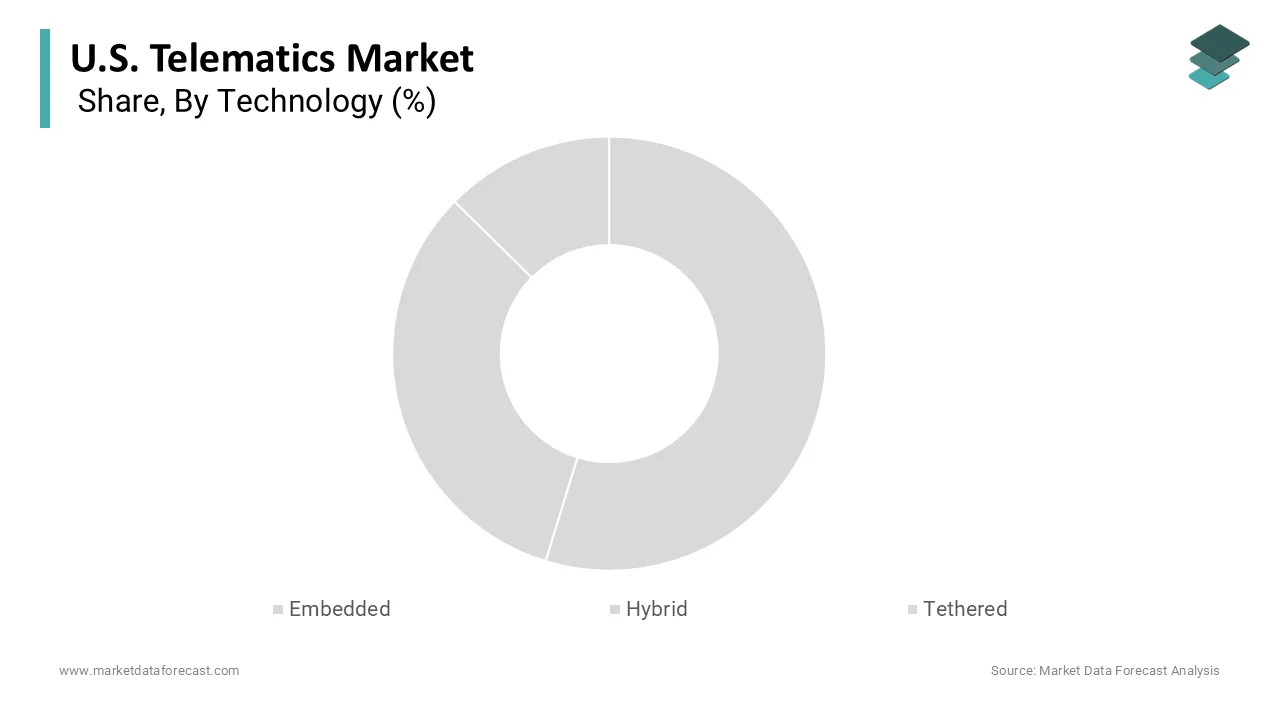
The hybrid telematics segment is anticipated to grow at the fastest CAGR of 14.2% during the forecast period, with its ability to serve fleets with diverse vehicle ages and types, offering a versatile solution that combines the benefits of embedded and portable systems. Many commercial operators manage mixed fleets consisting of newer vehicles with factory-installed systems and older assets that require aftermarket devices. Hybrid systems allow managers to unify data from both embedded and portable sources into a single platform by providing a holistic view of operations without requiring immediate replacement of older vehicles. This scalability is particularly valuable for small and medium-sized businesses that grow incrementally and cannot afford to upgrade their entire fleet simultaneously. The ability to switch between cellular and satellite connectivity in hybrid devices also enhances coverage in remote areas by addressing connectivity gaps that pure embedded systems may face. This adaptability reduces the total cost of ownership for fleet operators, who can extend the life of existing assets while gradually transitioning to newer technologies.
By Service Insights
The navigation services segment was the largest by accounting for 43.2% of the United States telematics market share in 2025, as they provide immediate and measurable improvements in logistics efficiency, directly reducing fuel consumption and delivery times for commercial operators. Real-time traffic data and dynamic routing algorithms allow fleets to avoid congestion, road closures, and accidents, ensuring timely arrivals and reduced idle time. Telematics enabled navigation systems integrate with dispatch platforms to adjust routes on the fly, maximizing asset utilization and driver productivity. For last mile delivery services, which have surged in volume due to e commerce growth, precise navigation is essential for meeting tight delivery windows. The United States Postal Service and private carriers rely heavily on these services to optimize thousands of daily routes by reducing mileage and wear on vehicles. Furthermore, navigation data helps in planning multi-stop routes that minimize left turns and unnecessary stops, which further enhances efficiency. The tangible return on investment from fuel savings and improved delivery performance makes navigation services a non-negotiable component of telematics packages.
The diagnostic services segment is likely to witness the fastest CAGR of 15.5% during the forecast period with the industry-wide shift toward predictive maintenance, which uses real-time vehicle data to anticipate mechanical issues before they cause breakdowns. Modern vehicles generate vast amounts of data from sensors monitoring engine performance, transmission health, and emissions systems. Telematics diagnostic services analyze this data to identify early warning signs of component failure, allowing managers to schedule repairs during planned maintenance windows. This approach extends vehicle lifespan and improves safety by preventing catastrophic failures on the road. The increasing complexity of electronic control units in modern trucks and cars makes manual inspection insufficient, which is necessitating automated diagnostic tools. Fleet managers rely on these services to maintain compliance with safety regulations and avoid costly roadside repairs. The ability to monitor vehicle health in real time also enhances resale value by providing a documented history of maintenance and care.
By Application Insights
The commercial application segment was the largest by occupying 51.2% of the United States telematics market share in 2025. Fleet operators use telematics to monitor fuel usage, driver behavior, and route efficiency, directly impacting their bottom line. Telematics enables the identification of inefficient driving habits such as idling and harsh acceleration, which contribute to excessive fuel consumption. Additionally, telematics helps in optimizing load factors and reducing empty miles, further enhancing profitability. The ability to track assets in real time allows for better resource allocation and improved customer service through accurate delivery estimates. Commercial entities also benefit from reduced insurance premiums through usage-based programs that demonstrate safe driving practices. The direct correlation between telematics adoption and improved financial performance drives widespread implementation in the commercial sector, securing its dominant market share.
The healthcare application segment is growing at a fast CAGR of 16.8% throughout the forecast period, owing to the increasing need for efficient non-emergency medical transportation services, which transport patients to medical appointments and treatments. An aging population and the prevalence of chronic diseases have increased the volume of medical trips, requiring coordinated and reliable transportation solutions. As per the National Alliance for Medical Transportation Coordination, non-emergency medical transportation serves over 3 million patients annually in the United States, a number that is expected to grow with demographic shifts. Telematics enables providers to optimize scheduling, track vehicle locations, and ensure timely arrivals, improving patient satisfaction and health outcomes. Real-time tracking allows caregivers and family members to monitor the status of patients in transit, providing peace of mind and enhancing safety. Healthcare facilities use telematics data to analyze transportation patterns and reduce no-show rates by sending automated reminders and updates. The integration of telematics with electronic health records facilitates seamless coordination between medical providers and transportation services.
COMPETITIVE LANDSCAPE
The competition in the United States telematics market is intense and characterized by a mix of established telecommunications giants, specialized software providers, and emerging technology startups. Major players differentiate themselves through innovative features such as artificial intelligence-driven analytics, video safety monitoring, and seamless electric vehicle integration. Interoperability with existing fleet management systems is a critical factor, prompting providers to develop open platforms that support third-party applications. Cybersecurity concerns have elevated the importance of data protection measures, with vendors competing on the strength of their security protocols. The shift toward subscription-based models creates recurring revenue streams but increases pressure to demonstrate continuous value and retention. Regulatory compliance capabilities also serve as a key differentiator, particularly for commercial fleets subject to strict federal mandates.
KEY MARKET PLAYERS
Some of the companies that are playing a dominating role in the U.S. Telematics Market include
- Verizon Connect
- Geotab Inc.
- Samsara Inc.
- Motive Technologies, Inc.
- Trimble Inc.
- Omnitracs, LLC
- Teletrac Navman
- Oracle Corporation
- MiX Telematics Limited
- Zonar Systems, Inc.
- CalAmp Corp.
- Spireon, Inc.
TOP LEADING PLAYERS IN THE MARKET
- Verizon Connect maintains a strong presence in the United States telematics market by offering comprehensive fleet management solutions that integrate hardware and software for real-time visibility. The company leverages its robust telecommunications infrastructure to provide reliable connectivity for commercial vehicles across the nation. Verizon Connect has recently enhanced its platform with advanced artificial intelligence capabilities that analyze driver behavior and predict maintenance needs more accurately. These innovations help fleet managers reduce operational costs and improve safety compliance efficiently. The organization actively partners with original equipment manufacturers to embed telematics technology directly into new vehicles, ensuring seamless integration and data accuracy. Their commitment to cybersecurity ensures that sensitive fleet data remains protected against emerging digital threats. s
- Geotab Inc is a key contributor to the United States telematics market through its open platform approach that allows for extensive customization and third-party integrations. The company provides detailed data analytics that enable fleets to optimize routes, monitor fuel usage, and enhance driver safety effectively. Geotab has recently expanded its electric vehicle support features, helping organizations manage the transition to sustainable transportation with precision. Their marketplace ecosystem connects users with hundreds of add-on applications, creating a versatile solution for various industry requirements. The firm invests heavily in research and development to ensure its devices remain compatible with the latest vehicle models and communication standards. Geotab also emphasizes data security and privacy, adhering to strict regulatory guidelines to build trust with enterprise clients.
- Samsara Inc has rapidly grown in the United States telematics market by combining Internet of Things hardware with cloud-based software to offer real-time operational visibility. The company focuses on improving safety and efficiency for industrial and commercial fleets through intuitive dashboards and actionable insights. Samsara has recently introduced AI-powered video safety solutions that detect risky driving behaviors and provide immediate coaching opportunities for drivers. This technology helps companies reduce accidents and lower insurance premiums significantly. The organization also integrates environmental monitoring sensors to track temperature and humidity for sensitive cargo, expanding its utility beyond traditional vehicle tracking. Samsara’s plug-and-play installation process simplifies deployment for customers, reducing downtime and technical barriers.
TOP STRATEGIES USED BY KEY MARKET PARTICIPANTS
Key players in the United States telematics market primarily focus on product innovation and strategic partnerships to maintain a competitive advantage. Companies invest heavily in artificial intelligence and machine learning to enhance predictive analytics and driver safety features. Integration with electric vehicle ecosystems is another major strategy, allowing providers to support the growing demand for sustainable fleet management solutions. Many firms are expanding their service offerings to include video telematics and cybersecurity protections, addressing broader operational needs. Collaborations with original equipment manufacturers enable deeper vehicle integration and access to real-time diagnostic data. Providers also emphasize user experience improvements through intuitive software interfaces and mobile applications. Diversification into adjacent markets, such as healthcare e-transportationi,n and construction equipment monitoring,ing helps capture new revenue streams. Continuous investment in cloud infrastructure ensures scalable and reliable data processing capabilities for large fleets. These strategies collectively drive growth and resilience in a rapidly evolving technological landscape.
U.S. TELEMATICS MARKET NEWS
In March 2024, Samsara Inc launched new AI-powered video safety features for fleets. This launch is anticipated to help customers reduce accidents and strengthen the US telematics market.
MARKET SEGMENTATION
This research report on the U.S. telematics market is segmented and sub-segmented into the following categories.
By Technology
- Embedded
- Hybrid
- Tethered
By Service
- Navigation Services
- Diagnostic Services
- Safety & Security Services
- Information & Entertainment Services
- Fleet Management Services
By Application
- Commercial
- Healthcare
- Government
- Transportation & Logistics
- Insurance
- Others
By Country
- California
- Texas
- Florida
- New York
- Illinois
- Rest of the United States
Related Reports
Access the study in MULTIPLE FORMATS
Purchase options starting from
$ 1200
Didn’t find what you’re looking for?
TALK TO OUR ANALYST TEAM
Need something within your budget?
NO WORRIES! WE GOT YOU COVERED!
Call us on: +1 888 702 9696 (U.S Toll Free)
Write to us: sales@marketdataforecast.com