U.S. Transportation Market Size, Share, Trends & Growth Forecast Report By Purpose, Destination, Type, and By Country (California, Washington, Oregon, New York & Rest of the United States) – Industry Analysis and Forecast, 2026 to 2034
Market Size, 2025
$741.52 BnMarket Estimate, 2026
$794.39 BnMarket Forecast, 2034
$1,378.23 BnCAGR, 2026–2034
7.13%U.S. Transportation Market Report Summary
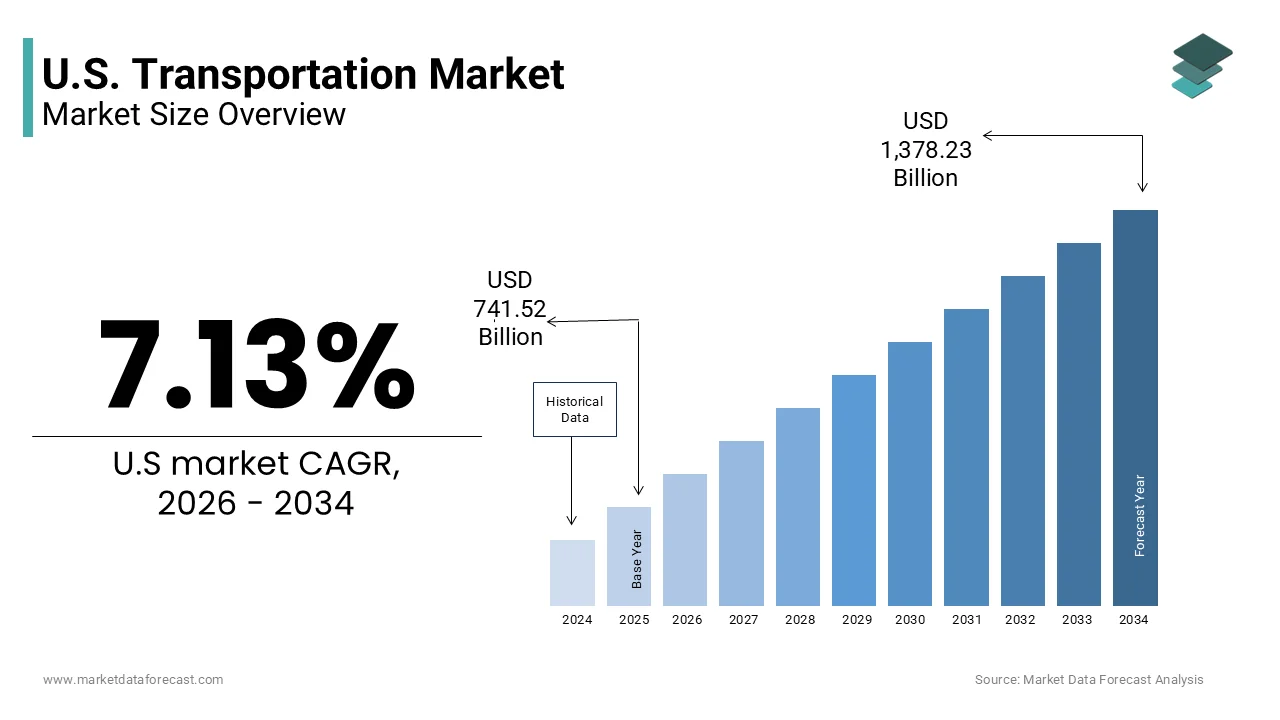
The U.S. transportation market was valued at USD 741.52 billion in 2025, is estimated to reach USD 794.39 billion in 2026, and is projected to reach USD 1,378.23 billion by 2034, growing at a CAGR of 7.13% during the forecast period. Market growth is driven by increasing freight transportation demand, rising e commerce activities, expanding urban mobility solutions, and ongoing investments in transportation infrastructure. The transportation sector plays a critical role in logistics, passenger mobility, and supply chain operations across the United States. The growing adoption of digital logistics platforms, smart mobility solutions, and sustainable transportation technologies is further supporting strong market expansion.
Key Market Trends
- Rising demand for freight and logistics services is driving market growth.
- Increasing e commerce activities are boosting transportation and delivery volumes.
- Growing investments in public transportation and infrastructure are supporting market expansion.
- Expansion of ride sharing and smart mobility platforms is enhancing urban transportation services.
- Innovation in electric vehicles, autonomous transportation, and digital logistics is influencing market development.
Segmental Insights
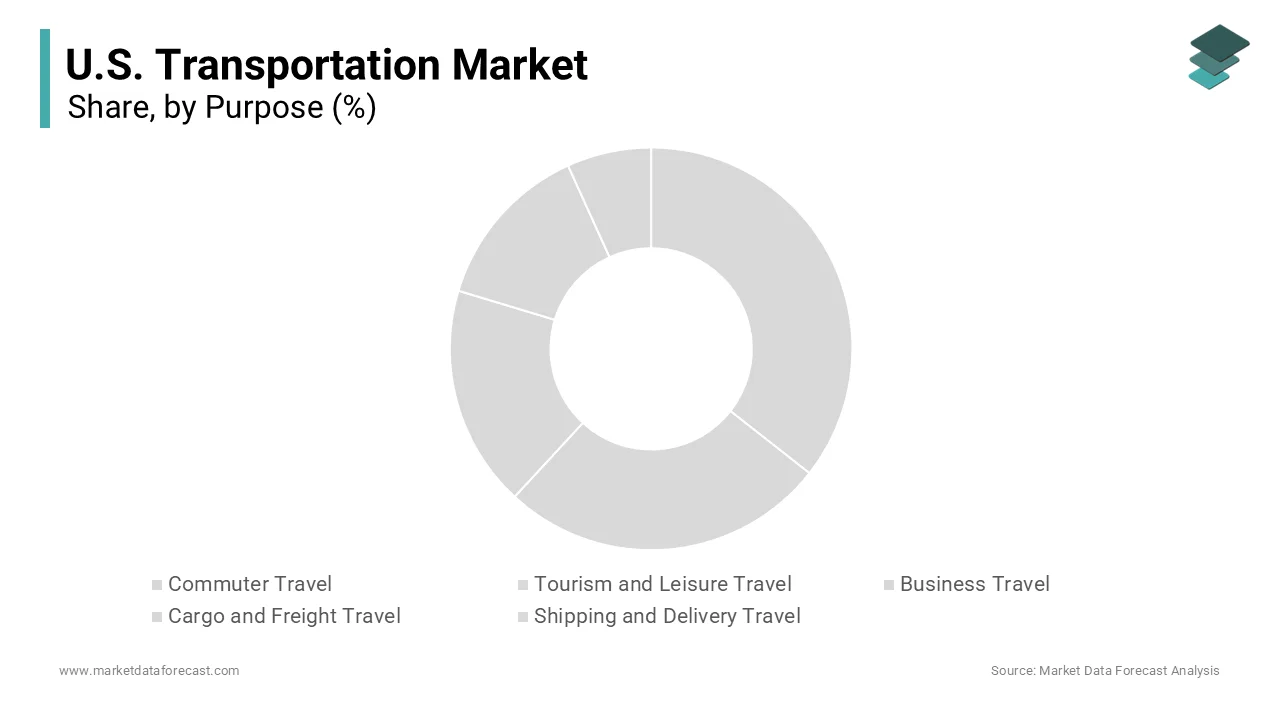
- Based on purpose, the cargo and freight travel segment accounted for 34.2% of the U.S. transportation market share in 2025. This dominance is attributed to increasing freight movement driven by industrial production, retail distribution, and e commerce growth.
- Based on type, the public buses segment held 54.8% of the U.S. public transportation market share in 2026, supported by affordability, extensive transit networks, and growing urban commuter demand.
Regional Insights
- The U.S. transportation market is experiencing steady growth across freight, passenger, and public transportation sectors, supported by infrastructure modernization, urbanization, and increasing mobility demand. Government investments in transportation systems and logistics infrastructure are further strengthening market development.
Competitive Landscape
The U.S. transportation market is highly competitive, with key players focusing on logistics optimization, fleet expansion, digital transportation platforms, and sustainable mobility solutions to strengthen their market position. Companies are investing in automation, route optimization technologies, and integrated transportation services. Prominent players in the U.S. transportation market include United Parcel Service, Union Pacific Corporation, FedEx Corporation, Union Pacific Railroad, CSX Corporation, Norfolk Southern Corporation, BNSF Railway, J.B. Hunt Transport Services, Inc., XPO Logistics, C.H. Robinson Worldwide, Inc., Schneider National, Inc., Ryder System, Inc., Old Dominion Freight Line, Knight-Swift Transportation Holdings Inc., Landstar System, Inc., Delta Air Lines, American Airlines Group Inc., United Airlines Holdings, Inc., Uber Technologies, Inc., Lyft, Inc., and Amtrak.
U.S. Transportation Market Size
The U.S. transportation market size was valued at USD 741.52 billion in 2025, is estimated to reach USD 794.39 billion in 2026, and is projected to reach USD 1,378.23 billion by 2034, growing at a CAGR of 7.13% from 2026 to 2034.
The transportation is the vast network of infrastructure and services facilitating the movement of people and goods across land, air, and water. The physical infrastructure supporting this system includes over 4 million miles of public roads and more than 140,000 miles of railroad track, according to the Federal Highway Administration and the Association of American Railroads respectively. Aviation plays an important role with the Federal Aviation Administration reporting that US carriers transported over 900 million passengers annually prior to recent global disruptions. Urban transit systems also contribute significantly with the American Public Transportation Association noting that billions of trips are taken on public transit each year. The integration of digital technologies into logistics and fleet management is transforming operational efficiency. Furthermore, the geographic diversity of the country necessitates a multimodal approach to connectivity. The reliance on freight transport is evident in data from the Census Bureau which indicates that e commerce sales continue to grow driving demand for last mile delivery solutions.
MARKET DRIVERS
Expansion of E Commerce and Last Mile Delivery Demand
The exponential growth of electronic commerce by creating unprecedented demand for freight and last mile delivery services is escalating the growth of the United States transportation market. Consumers increasingly rely on online platforms for retail purchases necessitating robust logistics networks to ensure timely delivery. As per the United States Census Bureau, e-commerce sales accounted for 15.6% of total retail sales in the fourth quarter of 2023 representing a significant shift in consumer behavior. This trend requires transportation providers to expand their capacity for small parcel shipping and urban distribution. This volume pressures carriers to optimize routes and increase fleet sizes to meet tight delivery windows. The rise of same day and next day delivery options that further intensifies the need for efficient local transportation infrastructure. According to the Journal of Commerce, the volume of less than truckload shipments has grown steadily as retailers distribute inventory closer to consumers. Transportation companies invest heavily in sorting facilities and delivery vehicles to handle this surge. The proliferation of mobile shopping apps ensures continuous order flow throughout the year rather than just during peak seasons.
Infrastructure Investment and Modernization Initiatives
The federal and state investments in transportation infrastructure is also greatly influencing the growth of the United States transportation market. The enactment of major legislative packages has allocated substantial funding for the repair and modernization of roads bridges and transit systems. As per the Federal Highway Administration, the Infrastructure Investment and Jobs Act authorized 1.2 trillion dollars in spending over five years with significant portions dedicated to surface transportation projects. This influx of capital enables the construction of new highways and the improvement of existing corridors reducing congestion and travel times. Improved infrastructure reduces vehicle operating costs and enhances safety for commercial fleets. According to the Department of Transportation, modernizing rail networks increases the capacity for freight movement thereby alleviating pressure on highway systems. State governments also contribute funds for local transit improvements which support workforce mobility and economic development. The Bureau of Labor Statistics notes that construction employment in the transportation sector rises in correlation with federal funding cycles. These investments stimulate demand for construction materials and heavy machinery while creating long term benefits for logistics providers. Enhanced infrastructure allows for heavier loads and faster transit times improving the competitiveness of US manufacturing and agriculture. The commitment to modernization ensures that the transportation network can accommodate future growth and technological advancements.
MARKET RESTRAINTS
Driver Shortages and Labor Market Constraints
The shortage of qualified commercial drivers with limiting capacity and increasing operational costs are limiting the growth of the United States transportation market. The aging workforce and high turnover rates create challenges for trucking companies seeking to maintain adequate staffing levels. This scarcity forces carriers to increase wages and benefits to attract and retain talent, which raises freight rates for shippers. The Bureau of Labor Statistics reports that the median age of heavy truck drivers is over 45 indicating a lack of younger entrants into the profession. Regulatory requirements such as hours of service rules that further constrain driver availability by limiting the number of hours they can operate daily. According to the Federal Motor Carrier Safety Administration, compliance with safety regulations is strict but necessary leading to reduced flexibility in scheduling. The demanding nature of the job including long periods away from home contributes to high attrition rates. The labor disputes and strikes can occasionally disrupt supply chains and exacerbate capacity issues. Training programs and recruitment initiatives struggle to keep pace with demand leaving many trucks idle due to lack of operators. This labor constraint limits the ability of the transportation sector to fully capitalize on growing freight volumes.
Regulatory Compliance and Environmental Standards
The stringent regulatory requirements and evolving environmental standards by increasing compliance costs and operational complexity is additionally hampering the growth of the United States transportation market. Government agencies enforce strict emissions standards and safety protocols that require carriers to invest in newer cleaner vehicles and advanced monitoring systems. As per the Environmental Protection Agency, new greenhouse gas emission standards for heavy duty vehicles mandate significant reductions in carbon output by 2032. Compliance with these rules necessitates the adoption of expensive technologies such as selective catalytic reduction and diesel particulate filters. The California Air Resources Board has implemented even stricter regulations requiring zero emission trucks for certain drayage operations which impacts national carriers serving the state. Safety regulations from the Federal Motor Carrier Safety Administration also require electronic logging devices which monitor driver hours and vehicle performance adding to administrative burdens. The Department of Transportation mandates regular inspections and maintenance records which increase downtime and operational costs. The regulatory uncertainty can delay investment decisions and hinder long term planning. Smaller carriers often struggle to absorb the costs of compliance leading to market consolidation. The push for sustainability while beneficial for the environment creates short term financial pressures on transportation providers. Balancing regulatory adherence with profitability remains a complex challenge for the industry.
MARKET OPPORTUNITIES
Adoption of Autonomous Vehicles and Automation
The integration of autonomous vehicles and automation technologies to enhance efficiency and safety is setting up new opportunities for the growth of the United States transportation market. Self-driving trucks and delivery robots have the potential to address labor shortages and reduce human error in logistics operations. Companies are testing autonomous semi-trucks for long haul routes where consistent driving conditions allow for reliable operation. According to the American Trucking Associations, pilot programs have demonstrated that autonomous vehicles can operate for longer durations without rest breaks improving asset utilization. The use of drones for last mile delivery offers a solution for remote or congested areas reducing delivery times and costs. Warehousing automation including automated guided vehicles and robotic sorting systems complements transportation improvements by streamlining loading and unloading processes. The International Federation of Robotics reports that the adoption of service robots in logistics is growing rapidly. These technologies enable real time tracking and predictive maintenance reducing downtime and improving fleet management. Investors are pouring capital into startups developing autonomous solutions indicating strong confidence in their potential. The gradual deployment of these technologies will reshape the competitive landscape and offer new service models for transportation providers.
Electrification of Commercial Fleets
The transition to electric vehicles in commercial fleets to reduce operating costs and meet sustainability goals is additionally to leverage new opportunities for the growth of the United States transportation market. Electric trucks and vans have lower maintenance requirements and fuel costs compared to traditional internal combustion engine vehicles. The total cost of ownership for electric medium duty trucks is becoming competitive with diesel equivalents due to savings on fuel and repairs. Government incentives, such as tax credits and grants that further encourage the adoption of electric commercial vehicles. The Inflation Reduction Act provides substantial funding for the installation of charging infrastructure which supports fleet electrification. According to the Department of Energy the number of public charging stations for heavy duty vehicles is expanding rapidly facilitating long distance electric transport. Major logistics companies are committing to zero emission targets driving demand for electric delivery vans and trucks. The development of battery technology with higher energy density and faster charging capabilities enhances the viability of electric fleets for longer routes. Utilities are working with transportation providers to manage grid load and offer off peak charging rates. This shift not only reduces carbon footprints but also insulates companies from volatile fossil fuel prices.
MARKET CHALLENGES
Cybersecurity Threats to Connected Infrastructure
The increasing connectivity of transportation systems to significant cybersecurity threats that can disrupt operations and compromise safety is likely to limit the growth of the United States transportation market. Modern vehicles and infrastructure rely on digital networks for navigation communication and control by making them vulnerable to hacking and malware attacks. The cyberattacks on the transportation sector have increased in frequency and sophistication targeting both private companies and public agencies. Ransomware attacks can shut down logistics platforms and halt freight movement causing substantial economic losses. The Colonial Pipeline incident demonstrated how cyber vulnerabilities can impact fuel supply chains and broader transportation networks. According to the Department of Homeland Security the transportation and logistics sector is considered a critical infrastructure target for state sponsored and criminal actors. The integration of Internet of Things devices in fleets expands the attack surface requiring robust security protocols. As per the Insurance Information Institute cyber insurance premiums for transportation companies are rising due to heightened risk exposure. The lack of standardized cybersecurity regulations across different modes of transport creates inconsistencies in protection levels. Investing in cybersecurity infrastructure and training is essential but adds to operational costs. The potential for large scale disruptions necessitates continuous vigilance and collaboration between government and industry stakeholders.
Supply Chain Volatility and Geopolitical Instability
The supply chain volatility and geopolitical instability by creating unpredictability in freight flows and costs is another factor to inhibit the growth of the United States transportation market. Disruptions such as port congestion labor strikes and international conflicts can severely impact the availability of shipping containers and vessel capacity. The fluctuations in ocean freight rates have been extreme with prices spiking during periods of high demand and low capacity. The Red Sea crisis and other geopolitical tensions have forced rerouting of ships increasing transit times and fuel consumption. The Bureau of Transportation Statistics notes that import and export volumes can fluctuate wildly based on global economic conditions affecting domestic trucking and rail demand. Trade policies and tariffs also influence transportation patterns by altering the volume and direction of goods movement. According to the World Trade Organization protectionist measures can lead to sudden shifts in sourcing strategies requiring rapid adjustments in logistics networks. The reliance on just in time inventory systems leaves little buffer for disruptions causing cascading delays across the supply chain. As per the National Association of Supply Chain Professionals companies are struggling to predict demand and secure transportation capacity in an uncertain environment. Fuel price volatility driven by global events further complicates cost management for carriers.
REPORT COVERAGE
| REPORT METRIC | DETAILS |
| Market Size Available | 2025 to 2034 |
| Base Year | 2025 |
| Forecast Period | 2026 to 2034 |
| CAGR | 7.13% |
| Segments Covered | By Purpose, Destination, Type, and Region. |
| Various Analyses Covered | Global, Regional and Country-Level Analysis, Segment-Level Analysis, Drivers, Restraints, Opportunities, Challenges; PESTLE Analysis; Porter’s Five Forces Analysis, Competitive Landscape, Analyst Overview of Investment Opportunities |
| Countries Covered | California, Washington, Oregon, New York, United States |
| Market Leaders Profiled | United Parcel Service (UPS), Union Pacific Corporation, FedEx Corporation, Union Pacific Railroad, CSX Corporation, Norfolk Southern Corporation, BNSF Railway, J.B. Hunt Transport Services, Inc., XPO Logistics, C.H. Robinson Worldwide, Inc., Schneider National, Inc., Ryder System, Inc., Old Dominion Freight Line, Knight Swift Transportation Holdings Inc., Landstar System, Inc., Delta Air Lines, American Airlines Group Inc., United Airlines Holdings, Inc., Uber Technologies, Inc., Lyft, Inc., and Amtrak |
SEGMENTAL ANALYSIS
By Purpose Insights
The cargo and freight travel segment was accounted in holding a significant share of the United States transportation market due to its indispensable role in sustaining national supply chains and facilitating e-commerce fulfilment. The movement of goods is the backbone of economic activity ensuring that raw materials reach manufacturers and finished products reach consumers. The rise of online shopping has intensified demand for reliable freight services with the United States Census Bureau reporting that e-commerce sales reached 1.1 trillion dollars in 2023. This surge necessitates efficient trucking rail and air cargo networks to handle increased parcel volumes. Retailers rely on just in time inventory systems which require precise and timely freight delivery to minimize storage costs. According to the National Retail Federation the holiday season alone generates billions of dollars in sales requiring robust freight capacity to meet consumer demand. The integration of advanced logistics technologies such as real time tracking and automated warehousing further enhances the efficiency of freight operations.
The shipping and delivery travel segment is likely to grow at an anticipated CAGR of 8.5% from 2026 to 2034 with the expansion of last mile logistics and the increasing consumer expectation for on demand delivery services. The last mile delivery costs account for a significant portion of total shipping expenses prompting companies to innovate with faster and more efficient solutions. The proliferation of mobile apps has made same day and next day delivery standard expectations for consumers. The retailers are investing heavily in local distribution centers to reduce delivery times and enhance customer satisfaction. The rise of gig economy platforms has also contributed to this growth by providing flexible delivery options for food groceries and retail items. The volume of deliveries through these platforms continues to rise significantly year over year. Consumers value convenience and speed driving demand for specialized delivery services that operate outside traditional freight networks.
By Type Insights
The public buses segment was the largest by holding 45.6% of the United States transportation market share in 2025 due to their extensive network coverage and affordability for urban commuters. Bus systems provide essential connectivity in cities and rural areas where other forms of public transit may be limited or unavailable. The bus transit accounts for the largest share of public transportation trips in the United States with billions of unlinked passenger trips annually. The flexibility of bus routes allows for frequent adjustments to meet changing demographic and employment patterns. Municipalities invest in bus infrastructure because it requires lower capital investment compared to rail systems. According to the Federal Transit Administration bus systems serve a diverse population including low-income individuals students and elderly citizens who rely on affordable transportation options. The widespread availability of bus stops and frequent service intervals make buses a convenient choice for daily commutes. Many cities have implemented bus rapid transit systems that offer faster and more reliable service by dedicating lanes for buses. As per the Institute for Transportation and Development Policy bus rapid transit systems can achieve ridership levels comparable to light rail at a fraction of the cost.
The electric buses segment is projected to witness a fastest CAGR of 14.2% from 2026 to 2034 with the regulatory mandates requiring transit agencies to transition to zero emission fleets. Federal and state laws are increasingly stringent regarding greenhouse gas emissions from public transportation. The new standards encourage the adoption of clean energy technologies in the transit sector. The Federal Transit Administration offers grants specifically for the purchase of low or no emission buses making them financially viable for many agencies. California has led the way with mandates requiring all new bus purchases to be zero emission by 2029 influencing other states to follow suit. The electrifying bus fleets can significantly reduce carbon emissions and improve public health in urban areas. Transit agencies are responding by replacing aging diesel buses with electric models that offer lower maintenance and fuel costs. The Inflation Reduction Act provides additional tax incentives for manufacturing and purchasing electric buses accelerating market adoption. These regulatory pressures create a strong imperative for agencies to modernize their fleets.
COMPETITIVE LANDSCAPE
The competition in the United States transportation market is intense and characterized by a diverse mix of traditional carriers logistics providers and technology driven disruptors. Major railroad companies compete on efficiency and reliability for long haul freight while trucking firms offer flexibility and last mile connectivity. Air cargo carriers vie for speed and global reach serving high value and time sensitive shipments. The rise of e commerce has intensified competition in the parcel delivery sector with established giants facing challenges from regional carriers and gig economy platforms. Ride sharing services have disrupted traditional taxi markets by offering convenient and cost effective urban mobility solutions. Technology plays a central role in differentiation with companies investing in automation data analytics and electric vehicles to reduce costs and improve service quality. Regulatory compliance and labor availability remain critical factors influencing competitive dynamics. Mergers and acquisitions are common as firms seek to expand their networks and capabilities.
KEY MARKET PLAYERS
A few of the dominating market players that are in the U.S transportation market are
- Chicago Transit Authority
- Union Pacific Corporation
- FedEx Corporation
- Uber Technologies Inc
- Bay Area Rapid Transit (BART)
- Cosmatis
- Consat
- Digigroup
- Cubic Transportation Systems
- GMV
- GIRO
- GrupoEtra
- Goal Systems
- Indra
- Guangzhou Metro
- IVU Traffic Technologies
- INIT
- Madrid Metro
- Link Technologies
- Metropolitan Transportation Authority
Top Players In The Market
- Union Pacific Corporation operates one of the largest railroad networks in the United States connecting major hubs across the western two thirds of the country. The company plays a vital role in freight transportation by moving agricultural industrial and consumer goods efficiently. Recent actions include significant investments in precision scheduled railroading to improve operational efficiency and service reliability. Union Pacific has also focused on sustainability by investing in alternative fuel technologies and optimizing locomotive performance to reduce emissions. The company continues to upgrade its infrastructure to handle increasing freight volumes and enhance safety standards. These strategic initiatives strengthen its position as a critical link in the national supply chain. The company actively collaborates with customers to develop tailored logistics solutions that meet evolving market demands. This customer centric approach ensures long term partnerships and sustained growth in the competitive freight sector.
- FedEx Corporation is a global leader in express transportation e commerce and supply chain management services within the United States. The company provides reliable delivery solutions for packages and freight through an extensive network of air and ground operations. Recent strategies involve expanding its automated sorting facilities and integrating advanced robotics to enhance processing speed and accuracy. FedEx has also invested heavily in electric vehicle fleets to support sustainable last mile delivery operations. The company focuses on improving digital customer experiences through enhanced tracking and delivery management tools. The integration of technology into logistics operations allows for real time visibility and efficient route planning. These efforts reinforce its reputation for speed and reliability in the transportation market. FedEx continues to innovate its service offerings to meet the growing demands of e commerce and global trade.
- Uber Technologies Inc has transformed urban mobility in the United States through its ride sharing and delivery platforms. The company connects drivers with passengers and delivers food and goods through its mobile application ecosystem. Recent actions include expanding its advertising business and enhancing its subscription services to increase user retention and revenue diversity. Uber has also invested in autonomous vehicle technology partnerships to future proof its transportation network. The company focuses on improving driver earnings and benefits to attract and retain a robust workforce. By integrating public transit options into its app Uber offers multimodal transportation solutions for urban commuters. The expansion of Uber Freight leverages its technology to streamline trucking logistics and connect shippers with carriers. These initiatives strengthen its market position by offering comprehensive mobility and logistics services. Uber continues to innovate its platform to enhance user experience and operational efficiency in the dynamic transportation sector.
Top Strategies Used By Key Market Participants
Key players in the United States transportation market primarily focus on digital transformation to enhance operational efficiency and customer experience. Companies invest heavily in artificial intelligence and machine learning to optimize routing predict demand and manage fleet maintenance proactively. Sustainability initiatives drive the adoption of electric and alternative fuel vehicles to meet regulatory requirements and environmental goals. Strategic partnerships with technology firms enable the integration of autonomous driving capabilities and advanced logistics software. Expansion of last mile delivery networks addresses the growing e commerce demand for rapid and reliable shipping services. Investment in infrastructure modernization improves capacity and reduces congestion for freight and passenger transport. Data analytics are utilized to personalize services and improve safety standards across all modes of transportation. Diversification into multimodal logistics solutions allows companies to offer end to end supply chain services. These strategies collectively enhance competitiveness and resilience in a rapidly evolving market landscape.
MARKET SEGMENTATION
This research report on the U.S transportation market is segmented and sub-segmented into the following categories.
By Purpose
- Commuter Travel
- Tourism and Leisure Travel
- Business Travel
- Cargo and Freight Travel
- Shipping and Delivery Travel
By Destination
- Domestic
- International
By Type
- Public Buses
- Electric Buses
- Subways
- Taxis
- Auto Rickshaws
- Ferries
- Other Public Transport Vehicles
By Country
- California
- Washington
- Oregon
- New York
- Rest of the United States
Frequently Asked Questions
1. What is the U.S. transportation market?
The U.S. transportation market includes the movement of goods and passengers through roadways, railways, airways, waterways, and logistics networks across the country.
2. What factors are driving growth in the U.S. transportation market?
Growth is driven by expanding e commerce, rising freight demand, infrastructure investments, technological advancements, and increasing urban mobility needs.
3. Which transportation segment dominates the U.S. transportation market?
Road transportation dominates the market due to the extensive trucking network and high demand for freight and passenger mobility services.
4. How is e commerce influencing the U.S. transportation industry?
E commerce is increasing demand for last mile delivery, warehousing, freight transportation, and logistics optimization services.
5. What role does technology play in the U.S. transportation market?
Technologies such as artificial intelligence, IoT, telematics, autonomous vehicles, and route optimization improve operational efficiency and safety.
6. Which region leads the U.S. transportation market?
The Southern and Western regions lead the market due to strong industrial activity, trade operations, and growing population centers.
7. What are the major challenges facing the U.S. transportation market?
Key challenges include rising fuel costs, driver shortages, regulatory compliance, traffic congestion, and infrastructure limitations.
8. How is sustainability impacting the U.S. transportation sector?
Companies are increasingly adopting electric vehicles, alternative fuels, and carbon reduction strategies to meet sustainability goals.
9. Who are the key players in the U.S. transportation market?
Major companies include UPS, FedEx, Union Pacific Railroad, XPO Logistics, Uber Technologies, and Delta Air Lines.
10. What is the future outlook for the U.S. transportation market?
The market is expected to witness steady growth due to digital transformation, smart mobility solutions, and rising transportation demand across industries.
Related Reports
Access the study in MULTIPLE FORMATS
Purchase options starting from
$ 1200
Didn’t find what you’re looking for?
TALK TO OUR ANALYST TEAM
Need something within your budget?
NO WORRIES! WE GOT YOU COVERED!
Call us on: +1 888 702 9696 (U.S Toll Free)
Write to us: sales@marketdataforecast.com