- Product Description Description
- Table of Contents TOC
- List of Table & Figure LOT
- Get Free Sample PDF Sample PDF
Market Size, 2025
$45.1 MnMarket Estimate, 2026
$50.92 MnMarket Forecast, 2034
$134.42 MnCAGR, 2026–2034
12.9%Executive Summary: Europe Smart Transportation Market
- Market Scope: Comprehensive European smart transportation industry analysis covering solution types, service categories, application sectors, country leadership frameworks, strategic corporate developments, and competitive landscapes.
- Market Valuation: Valued at USD 45.10 million (2025), estimated at USD 50.92 million (2026), and projected to reach USD 134.42 million by 2034, registering a strong CAGR of 12.90% (2026–2034).
- Primary Growth Drivers: EU urban decarbonization mandates (Sustainable Urban Mobility Plans), high urban congestion costs, AI-driven predictive maintenance for rail, Mobility as a Service (MaaS) expansion, 5G V2X communication corridors, and Connecting Europe Facility funding. Restraints include fragmented national interoperability standards and high capital intensity for legacy modernization.
Key Market Segment Metrics (2026–2034)
| Category | Leading Segment (2024 Position) | Fastest-Growing Segment |
|---|---|---|
| By Solution Type | Traffic management solutions (led market with a 33.5% share in 2024) | Smart ticketing (fastest-growing solution segment expanding at a CAGR of 17.1%) |
| By Service Category | Professional services (captured 59.5% of the service market in 2024) | Cloud services (experiencing the highest growth rate at a CAGR of 20.2%) |
| By Application | Public transport (dominated applications with a 35.8% share in 2024) | Mobility as a Service (fastest-growing application at a CAGR of 25.1%) |
| By Region / Country | Germany (held largest regional share at 23.5% in 2024 supported by the Deutschlandticket) | European advanced digital road and multimodal transport networks |
Major Market Players & Market Structure
Market Structure: Highly competitive European intelligent transport ecosystem driven by multimodal platform integration, journey planning deployments, V2X edge computing platforms, and cloud-based MaaS expansions across secondary cities.
Key Companies: Siemens AG, Thales Group, Hitachi Ltd., Alstom SA, Cisco Systems, Inc., IBM Corporation, Huawei Technologies Co., Ltd., Nokia Corporation, Ericsson AB, Alphabet Inc., Bosch Mobility Solutions, ATS Automation Tooling Systems Inc., PTV Group, Trimble Inc., Kapsch TrafficCom AG, TomTom International BV, Hexagon AB, Accenture plc, and Capgemini SE.
Europe Smart Transportation Market Size
The Europe Smart Transportation Market is projected to grow from USD 45.10 million in 2025 to USD 50.92 million in 2026 and reach USD 134.42 million by 2034, registering a CAGR of 12.9% from 2026 to 2034.

Smart transportation includes integrated digital and physical systems that enhance mobility, efficiency,cy safety and sustainability through real-time data connectivity, automation and intelligent infrastructure. This includes intelligent traffic management,t adaptive signalling and connected vehicle platforms, or forms multimodal mobility apps and automated public transit solutions. The market is propelled by Europe’s urban density, aging transport asset,s, and binding decarbonization mandates. According to the European Environment Agency, more than 75% of the EU population resides in urban areas where congestion costs exceed €100 billion annually in lost productivity and emissions. As per Eurostat, public transport networks across the EU serve over 16 million passenger journeys each weekday,y yet continue to face challenges from fragmented ticketing and scheduling. The European Commission’s Sustainable and Smart Mobility Strategy targets a 90% reduction in transport emissions by 2050 and requires all urban centers with more than 100,000 inhabitants to implement Sustainable Urban Mobility Plans by 2025. These policy imperatives, combined with the rising adoption of 5G vehicle‑to‑everything communication and AI‑driven analytics, are transforming Europe’s transportation landscape from siloed operations into an interoperable and intelligent ecosystem.
MARKET DRIVERS
EU Mandates for Urban Decarbonization and Digitalization Drive System Integration
The European Union’s binding policy framework for sustainable urban mobility serves as a primary catalyst for smart transportation deployment, which is primarily driving the smart transportation market growth in Europe. According to the European Commission’s Urban Mobility Framework, all cities with populations above 100,000 must adopt Sustainable Urban Mobility Plans by 2025, which prioritize integrated ticketing, real-time data sharing, and low-emission zones. This has triggered widespread investment in smart infrastructure such as contactless fare systems, adaptive traffic signals, and mobility as a service platforms. As per the European Investment Bank, more than €12 billion was allocated to urban mobility projects in 2024, with a majority directed toward digital and clean transport integration, underscoring financial commitment. Cities like Helsinki, Paris, and Barcelona have launched unified mobility apps that combine public transit, bike sharing, ride hailing, and micromobility into single payment ecosystems. Furthermore, the EU’s Digital Europe Programme has funded dozens ocross-borderer smart corridor initiatives, including the Baltic Sea and Rhine Alpine corridor, where cooperative intelligent transport systems enable platooning and dynamic routing. These regulatory and financial levers convert policy ambition into tangible infrastructure modernizat i, on, acceleratingcontinent-widee adoption of smart transportation technologies.
Rising Urban Congestion and Demand for Mobility Efficiency Fuel Technology Adoption
Persistent traffic congestion across European cities is intensifying demand for intelligent traffic management and demand-responsive transit solutions, whicareis further contributing to the smart transportation market expansion in Europe. According to the European Environment Agency, commuters in major EU cities spend significant time annually in traffic congestion, with average delays rising compared to 2015 levels, reflecting worsening urban mobility. This inefficiency not only degrades the quality of life but also contributes to around one-fifth of urban CO₂ emissions as per the International Transport Forum, highlighting environmental costs. In response, cities are deploying AI-powered traffic signal optimization systems that reduce intersection delays, as demonstrated in pilot programs in Milan and Copenhagen. Meanwhile, demand-responsive bus services using dynamic routing algorithms have expanded in secondary cities like Grenoble and Utrecht, serving large passenger volumes with higher vehicle utilization than fixed route systems. The proliferation of smartphone-based mobility apps further enables real-time rerouting and multimodal journey planning. These innovations address the core urban pain point of time loss while aligning with EU goals for modal shift and emission reduction, making congestion relief a powerful market driver.
MARKET RESTRAINTS
Fragmented National Standards and Interoperability Barriers
A major restraint in the European smart transportation market stems from the absence of harmonized technical and data standards across member states, impeding cross-border interoperability. While the EU promotes cooperative intelligent transport systems through the C-ITS Delegated Act, individual countries implement divergent communication protocols, data formats, and certification requirements. According to the European Conference of Ministers of Transport, only a minority of EU nations fully comply with the common C-ITS specification for vehicle-to-infrastructure messaging, underscoring uneven adoption. This fragmentation forces technology providers to customize solutions for each market, increasing development costs and delaying deployment. For example, a smart tolling system operational in Germany may not interface with France’s telepeage network due to incompatible backend architectures. Similarly, mobility as a service platforms struggle to integrate payment and scheduling data across national public transport operators because of proprietary data silos. Until the European Committee for Standardization enforces binding interoperability mandates, the vision of a seamless European smart transport network will remain constrained by technical balkanization.
High Capital Intensity and Uncertain Public Sector Budgeting
The significant upfront investment required for smart transportation infrastructure presents a persistent barrier, particularly amid fiscal constraints in many European municipalities, which further hinders the regional market expansion. According to the International Association of Public Transport, deploying a city-wide intelligent traffic management system can cost tens of millions of euros,s depending on scale, highlighting capital intensity. These expenditures compete with other urgent urban priorities such as housing and healthcare, straining already tight local budgets. Eurostat data shows that many EU cities reported reduced capital expenditure allocations for transport in 2023, reflecting post pandemic debt and energy crisis pressures. Furthermore, the European Court of Auditors has documented that average project approval cycles for major transport investments exceed 18 months, slowing implementation. This uncertainty deters private sector participation ipublic-privatete partnerships, which are essential for scaling smart mobility solutions. Without stable multiyear funding mechanisms and streamlined approval pathways, many promising pilot projects fail to transition to city-wide implementation, limiting market scalability.
MARKET OPPORTUNITIES
Expansion of Mobility as a Service in Secondary and Rural Regions
A significant opportunity lies in extending the Mobility as a Service platform beyond major metropolitan centers to secondary cities and rural communities where public transport is sparse, but car dependency remains high. According to the European Commission,n more than 100 million EU citizens live in regions with limited scheduled transit options, highlighting the scale of underserved mobility. Digital platforms integratinon-demandnd shuttles, bike sharing, and ride pooling can bridge this gap while reducing vehicle ownership. Finland’s Whim model now operates in Antwerp and Vienna, offering subscription-based access to multiple transport modes, with European research showing measurable reductions in private car use among users, supporting modal shift. As per the EU Cohesion Policy, funding of billions of euros has been allocated through 2027 for digital mobility solutions in less developed regions, ensuring financial support. Startups like Via and Moovit are partnering with regional authorities to deploAI-optimizeded shared shuttles that adapt routes in real time based on demand. This democratization of smart mobility not only enhances social inclusion but also unlocks new revenue streams for technology providers.
Deployment of AI-Driven Predictive Maintenance for Rail and Transit Assets
The integration of artificial intelligence for predictive maintenance of rail and public transit infrastructure is a high-value opportunity for the European smart transportation market. According to the European Union Agency for Railways, a majority of rail delays in 2023 were linked to infrastructure failure,s including track defects and signalling malfunctions, underscoring the need for modernization. AI-powered systemanalyzingng sensor data from trains, tracks, and overhead lines can predict component failures days in advance, reducing unplanned downtime as demonstrated by Deutsche Bahn’s pilot on the Rhine Ruhr network. Similarly, Transport for London uses machine learning models to forecast escalator and elevator failures in subway stations, improving service reliability. As per the European Investment Bank, billions of euros have been committed through 2026 for digital rail modernization under its Rail Freight Corridors initiative, supporting predictive technologies. Companies like Siemens, Alstom, and Thales are embedding AI analytics into their asset management platforms, ms enabling transit authorities to shift from reactive to predictive maintenance. This not only enhances operational efficiency but also extends the lifespan of aging infrastructure, aligning with EU sustainability objectives.
MARKET CHALLENGES
Data Privacy and Cybersecurity Risks in Connected Mobility Ecosystems
The proliferation of connected vehicles and smart infrastructure introduces significant data privacy and cybersecurity vulnerabilities that challenge public trust and regulatory compliance, which is one of the major challenges to the regional market. Smart transportation systems collect vast amounts of personally identifiable data,ata including location, travel patterns, and payment information, raising concerns under the General Data Protection Regulation. According to the European Data ProtectioBoard B,oard hundredmobility-relatedlated data processing activities were flagged for non-compliance in 2024, primarily due to insufficient anonymization and third-party sharing. Simultaneously, the attack surface for cyber threats expands with each connected node, as highlighted by ransomware incidents that disrupted ticketing systems across German transit operators in 2023, demonstrating systemic risk. The European Union Agency for Cybersecurity has issued new guidelines for intelligent transport systems, but implementation remains voluntary. Until binding security certification and transparent data governance frameworks are universally adopted, consumer skepticism and regulatory penalties will constrain the scalability of connected mobility services across Europe.
Legacy Infrastructure Incompatibility with Modern Digital Systems
The incompatibility of aging physical infrastructure with new digital technologies is another major challenge to the growth of the European market. Much of Europe’s road, rail, and signalling network was built decades before the advent of sensors, 5G, or cloud computing, creating integration bottlenecks. According to the European Court of Auditors, more than two-thirds of EU rail lines still rely on analogue signalling systems, which limit support for automatic train operation or real-time diagnostics. Similarly, urban traffic management centers in cities like Athens and Lisbon operate on legacy software that lacks APIs for modern data ingestion. Retrofitting these assets requires not only capital but complex engineering to avoid service disruption. As per European Commission estimates, full digitalization of the Trans European Transport Network would require hundreds of billions of euros in upgrades by 2040, reflecting the scale of investment needed. Until phased modernization programs with dedicated funding and technical standards are implemented, the performance gains promised by smart transportation will remain unevenly distributed and technologically fragmented across the continent.
REPORT COVERAGE
| REPORT METRIC | DETAILS |
| Market Size Available | 2024 to 2033 |
| Base Year | 2024 |
| Forecast Period | 2025 to 2033 |
| Segments Covered | By Solution, Service, Applicationand Region. |
| Various Analyses Covered | Global, Regional, and Country-Level Analysis, Segment-Level Analysis, Drivers, Restraints, Opportunities, Challenges; PESTLE Analysis; Porter’s Five Forces Analysis, Competitive Landscape, Analyst Overview of Investment Opportunities |
| Countries Covered | UK, France, Spain, Germany, Italy, Russia, Sweden, Denmark, Switzerland, Netherlands, Turkey, Czech Republic, and the Rest of Europe |
| Market Leaders Profiled | Siemens AG, Thales Group, Hitachi Ltd., Alstom SA, Cisco Systems, Inc., IBM Corporation, Huawei Technologies Co., Ltd., Nokia Corporation, Ericsson AB, Alphabet Inc. (Google – Waymo / Verily), Bosch Mobility Solutions (Robert Bosch GmbH), ATS Automation Tooling Systems Inc., PTV Group, Trimble Inc., Mobility as a Service providers (e.g., Whim / MaaS Global), HUB Parking Technology, Kapsch TrafficCom AG, TomTom International BV, Hexagon AB, Accenture plc, Capgemini SE |
SEGMENTAL ANALYSIS
By Solution Insights
The traffic management solutions segment led the market by accounting for 33.5% of the European market share in 2024. The dominance of the traffic management solutions segment in this regional market is majorly driven by urgent urban congestion pressures and binding EU mandates for intelligent transport system deployment. According to the European Environment Agency, commuters in major European cities lose more than 150 hours annually to traffic delays, with economic costs exceeding €100 billion per year. In response, cities are implementing AI‑powered adaptive signal control, real‑time incident detection, and dynamic lane management systems. The European Commission’s Cooperative ITS Delegated Act requires all new road infrastructure projects funded by the Connecting Europe Facility to integrate cooperative traffic‑management capabilities. Germany’s Urban Traffic Management Berlin system now coordinates more than 1,500 intersections using real‑time data from connected vehicles and cameras, reducing average journey times significantly. Paris has also deployed a city‑wide traffic prediction engine that anticipates congestion 30 minutes in advance, enabling proactive diversion. Traffic management solutions are expected to remain dominant as EU policy mandates and measurable efficiency gains continue to drive adoption.
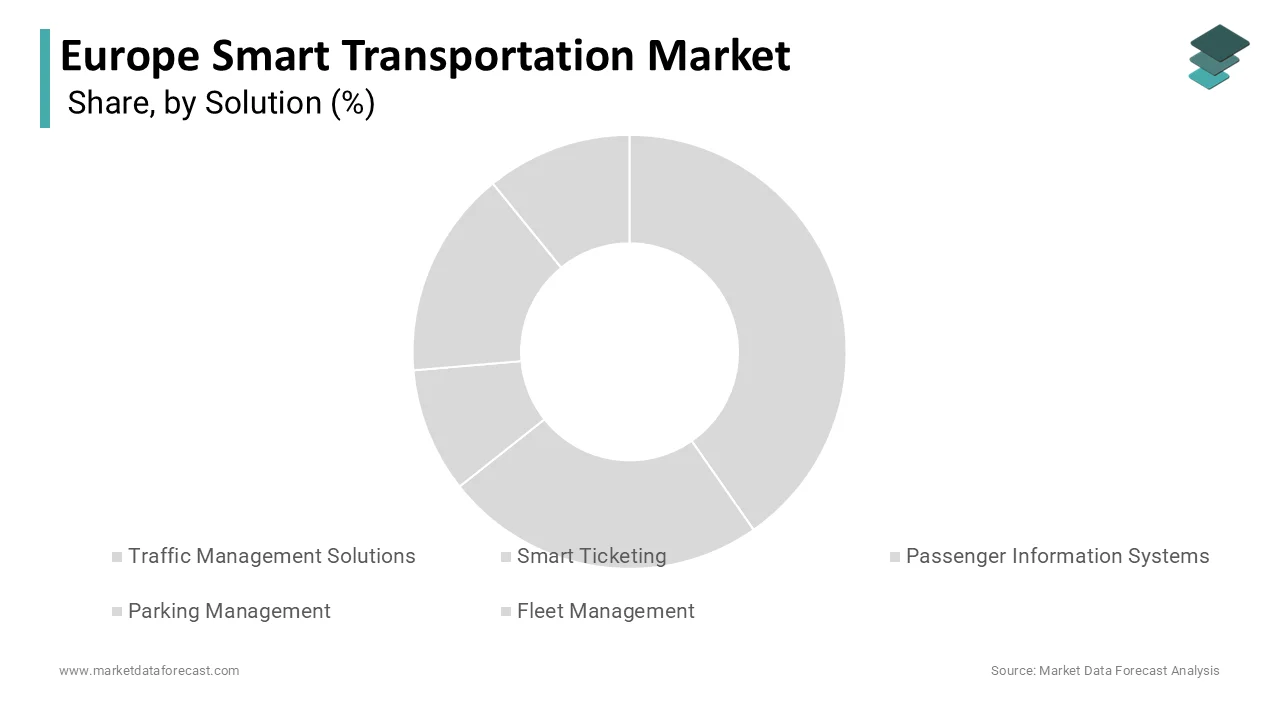
The smart ticketing segment is another major segment and is expected to register a CAGR of 17.1% over the forecast period in this region,t owing to the European Commission’s Urban Mobility Framework, which requires multimodal interoperability and mandates contactless, account‑based ticketing in cities with more than 100,000 inhabitants by 2026. According to Eurostat, more than 78% of EU public‑transport users now carry smartphones, creating a ready platform for mobile ticketing adoption. London’s contactless system processes tens of millions of weekly tap‑ins, while Stockholm’s SL Access platform has achieved over 90% digital penetration among commuters. The European Payment Services Directive also facilitatethe s secure integration of transport tickets into digital wallets. National initiatives such as France’s Pass Transport and Germany’s Deutschlandticket further accelerate standardization. Smart ticketing is expected to grow rapidly as regulation, technology, and consumer behaviour converge to enable seamless multimodal journeys.
By Service Insights
The professional services segment captured 59.5% of the European market share in 2024. The leading position of the professional services segment in this regional market is attributed to the complex nature of smart‑transport deployment, which demands system integration, consulting, cybersecurity validation, and change management beyond software licensing. According to the European Court of Auditors, more than 65% of smart‑mobility projects require external consultants for feasibility studies, procurement support, and post‑deployment optimization. Major consultancies provide end‑to‑end services from Sustainable Urban Mobility Plan formulation to legacy‑system modernization. The European Commission’s Digital Europe Programme allocates a significant share of smart‑transport grants to professional‑service contracts, ensuring technical quality and regulatory alignment. Rollout of Mobility as a Service platforms in cities such as Helsinki and Vienna has also required extensive stakeholder coordination between transit operators, micromobility providers, and payment processors, as these tasks are inherently dependent on specialized service providers. Professional services are expected to remain the backbone of smart‑transport implementation as EU cities scale complex, multimodal systems.
The cloud services segment is the fastest-growing segment and is estimated to expand at a CAGR of 20.2% over the forecast period, owing to the shift toward data‑intensive mobility applications requiring scalable, secure computing environments. Mobility as a Service platforms process millions of real‑time trip requests daily, while AI traffic‑prediction engines analyze vast sensor and GPS datasets. According to Eurostat, more than 70% of new public‑transport IT projects in 2024 adopted hybrid‑cloud architectures to balance performance and data residency. The European Commission’s GAIA‑X initiative promotes sovereign cloud environments compliant with GDPR and the Data Governance Act, making regional providers attractive partners. The rollout of 5G‑enabled vehicle‑to‑everything communication also generates continuous data streams that cloud platforms ingest for dynamic routing and safety alerts. Cloud services are expected to grow rapidly as cities transition from pilot projects to full‑scale smart‑mobility operations.
By Application Insights
The public transport segment dominated the market and occupied 35.8% of the regional market share in 2024. Europe’s dense transit networks that serve millions of passenger journeys daily are majorly contributing to the dominance of the public transport segment in this regional market. According to Eurostat, EU public transport systems handle more than 16 million daily trips, which indicates their central role in mobility. The European Commission’s Urban Mobility Framework mandates modernization of fare collection, real‑time information, and fleet telematics by 2026 to qualify for cohesion funding. Cities such as Berlin, Madrid, and Amsterdam have deployed unified scheduling systems that synchronize metro, bus, and tram arrivals, reducing wait times significantly. The EU’s Green Public Procurement criteria also require new buses to include predictive‑maintenance and passenger‑counting connectivity. National recovery plans, such as Italy’s €5 billion allocation for electrifying and digitizing bus fleets, further amplify investment. Public transport is expected to remain the dominant application as EU policy and funding reinforce its role as the backbone of sustainable mobility.
The mobility as a service segment is the fastest-growing application and is predicted to grow at a CAGR of 25.1% over the forecast period, owing to the policy mandates, user demand for seamless journeys, and technological maturity. According to the European Commission’s Sustainable and Smart Mobility Strategy, all major EU cities must offer integrated mobility platforms by 2027. MaaS platforms bundle planning, booking, and payment across public transit, bike sharing, ride hailing, and car sharing into unified interfaces. Helsinki’s Whim service covers the majority of urban trips, while Vienna’s SMartTIKET integrates multiple providers with hundreds of thousands of active users. A 2024 study by the Technical University of Berlin found that MaaS users reduce private car ownership by 15% and increase public‑transport use by 28%. National governments are accelerating adoption through subsidies and pilot funding. Mobility as a Service is expected to grow rapidly as 5G connectivity, open‑data standards, and EU mandates transform it into essential infrastructure for decarbonized mobility.
COUNTRY LEVEL ANALYSIS
Germany Smart Transportation Market Analysis
Germany led the smart transportation market in Europe with a 23.5% share in 2024. The dominating position of Germany in the European markeis mainlyyy attributed to its advanced public‑transport systems, aggressive digitalization of road infrastructure, and strong industrial alignment between automotive and mobility‑tech sectors. The country operates one of Europe’s largest rail and bus networks, increasingly equipped with real‑time tracking and contactless payment. The nationwide Deutschlandticket introduced in 2023 has accelerated digital adoption by offering affordable monthly access to public transport. Germany also pioneers cooperative intelligent‑transport systems, with thousands of kilometres of digitally enabled highways. The federal government continues to invest heavily in AI‑driven traffic management and Mobility‑as‑a‑Service pilots. With its scale, policy coherence, and technological integration, Germany is expected to remain Europe’s most advanced smart‑transportation market.
United Kingdom Smart Transportation Market Analysis
The United Kingdom was a promising regional segment in the European smart transportation market in 2024. The growth of the UK in the European market is driven by its centralized National Health Service, strong urban mobility programs, and regulatory flexibility post‑Brexit. London remains a global benchmark with its contactless payment system and integrated traffic‑management dashboard. Regional cities such as Manchester and Birmingham are deploying MaaS platforms under national funding programs, reinforcing multimodal integration. The UK also leads in insurance telematics, with millions of usage‑based policies supporting connected mobility. Independent data‑governance frameworks allow faster deployment of AI and analytics compared with EU neighbours, which is enabling rapid piloting of autonomous shuttles and predictive‑maintenance systems. With its regulatory agility and dense urban demand, the UK is positioned as a high‑innovation smart‑mobility market.
France Smart Transportation Market Analysis
France held a prominent share of the European smart transportation market in 2024. The centralized mandates that standardize mobility across thousands of communes are primarily propelling the French market expansion. National legislation requires large urban areas to implement integrated ticketing and MaaS platforms by 2025. Initiatives such as Pass Transport provide a single digital identity for public‑transport users, enabling seamless cross‑regional travel. Paris has deployed one of the world’s largest real‑time traffic‑prediction systems, while Lyon operates autonomous electric shuttles. France’s investment plans allocate billions of euros to AI traffic control and 5G vehicle‑to‑infrastructure corridors. The national rail operator SNCF is digitizing thousands of stations with dynamic passenger information and biometric access. With its top‑down approach, France is expected to remain a model of policy‑led smart‑transportation rollout.
Netherlands Smart Transportation Market Analysis
The Netherlands is anticipated to showcase a healthy CAGR in the European smart transportation market over the forecast period, due to its seamless integration of cycling, walking, public transport, and shared mobility. A majority of urban trips are made by bike or foot, requiring smart infrastructure such as adaptive traffic signals and real‑time parking for e‑bikes. The national OVpay system enables contactless travel across all modes of public transport. Amsterdam and Rotterdam operate advanced MaaS platforms that include cargo‑bike delivery and water‑taxi services. The Dutch government funds cooperative vehicle‑to‑infrastructure projects, while open‑data policies mandate real‑time API publication by transport operators. With its human‑scale focus and digital openness, the Netherlands is expected to remain a global exemplar of inclusive smart transportation.
Sweden Smart Transportation Market Analysis
Sweden is predicted to account for a notable share of the European smart transportation market during the forecast period due to the strong public‑sector leadership and a national commitment to fossil‑free mobility by 2030. Stockholm’s congestion‑charging system has significantly reduced inner‑city traffic, while the national rail operator has digitized its long‑distance fleet with occupancy displays and dynamic pricing. Gothenburg operates one of Europe’s most advanced electric‑shuttle networks, serving thousands of passengers weekly. Sweden also leads in ethical data governance, requiring algorithmic impact assessments for smart‑mobility projects. National innovation agencies continue to fund MaaS and AI traffic initiatives, ensuring continuous technological advancement. With its blend of environmental ambition, public investment, and ethical oversight, Sweden is positioned as a socially responsible smart‑transportation leader.
COMPETITIVE LANDSCAPE
Competition ithe Europeanpe smart transportation market is shaped by the intersection of public policy, technological innovation and urban sustainability mandates. The landscape features a mix of large industrial conglomerates, specialized technology vendors,s and agile startups, ps each vying to deliver integrated solutions for traffic management, enhanced public transport digitization and multimodal mobility. Differentiation hinges on system interoperability,lity data governance, and the ability to modernize legacy infrastructure without service disruption. Unlike consumer markets, competition is driven by public procurement, where technical compliance, regulatoralignmentten,t and long-term service support outweigh price considerations. Major players leverage decades of rail and road domain expertise while newcomers competthrough AI-drivenen analytics and user-centric app design. Fragmentation across national standards remains a barrier, yet also creates opportunities for localized adaptation. As cities transition from pilot projectto city-wideee deployments, the market rewards vendors that combine proven reliability with open architecture and ethical data practice,s ensuring only the most adaptable and institutionally trusted players achieve sustained scale.
KEY MARKET PLAYER
Some of the companies that are playing a dominating role in the global European smart transportation market include
- Siemens AG
- Thales Group
- Hitachi Ltd.
- Alstom SA
- Cisco Systems, Inc.
- IBM Corporation
- Huawei Technologies Co., Ltd.
- Nokia Corporation
- Ericsson AB
- Alphabet Inc. (Google – Waymo / Verily)
- Bosch Mobility Solutions (Robert Bosch GmbH)
- ATS Automation Tooling Systems Inc.
- PTV Group
- Trimble Inc.
- Mobility as a Service providers (e.g., Whim / MaaS Global)
- HUB Parking Technology
- Kapsch TrafficCom AG
- TomTom International BV
- Hexagon AB
- Accenture plc
- Capgemini SE
TOP LEADING PLAYERS IN THE MARKET
- Siemens Mobility is a leading European provider of intelligent transportation systems with global influence in rail automation, multimodal marketing,g and traffic management. The compandelivers end-to-endnd solutions, including digital interlocking system AI-powereddd rail control centers and cloud-based mobility platforms across over 60 countries. In Europe, Siemens supports major urban projects such as Berlin’s integrated fare system and the Rhine Alpine digitacorridordo,r enabling real-time train coordination and predictive maintenance. In 2024, Siemens launched its OneMobility platform, which unifies public transport, bike sharing and on-demand shuttles into a single user interface compliant with the EU Mobility as a Service guidelines. The company also enhanced its Railigent X analytics suite to support predictive asset management for aging European infrastructure. These innovations reinforce Siemens Mobility’s role as a key enabler of sustainable and interoperable transport networks worldwide.
- Thales plays a critical role in theEuropeane smart transportation market through its advanced digital rail signallingcybersecurityit,y and fare collection technologies. The company supplies communications-based train control systems for high-speed and urban rail networks across FranceGermanyan,y and the Netherlands, ds while its Ground Transportation Systems division manages over 100 ticketing platforms globally. Thales contributes to the global market by integrating secure biometric authentication and contactless payment into public transport systems that comply with European data protection standards. In 2,024 Thales deployed its TopMove multimodal platform in Lyo,n enabling seamless journey planning across metro buses and shared mobility services. It also partnered with SNCF to impleAI-drivenriven predictive maintenance for French national rail assets. These actions underscore Thales’s commitment to secure resilient and user-centric mobility solutions aligned with Europe’s digital and green transitions.
- Kapsch TrafficCom, headquartered in Austria, is a major European innovator in intelligent road traffic ssolutionsns including electronic tolling, i ng smart city traffic management,ment and cooperative vehicle infrastructure systems. The company operates over 50 tolling systems worldwide and supports digital corridors across the Trans European Transport NetworkEuropepe E,urope Kapsch delAI-based traffic control centers in cities like Vienna and Prague that optimize signal timinreal-timeeal time vehicle data. Globally, it enables congestion pricing and emission-based tolling in alignment with urban sustainability goals. In ea,rly 2024 Kapsch launched its V2X edge computing pplatformm whicprocesses vehicle-to-infrastructurere messages locally to reduce latency for safety applications. It also expanded its cloud-based Mobility Platform to support Mobility as a Service integration in secondary European cities. These developments position Kapsch as a pivotal player in the convergence of road digitalizatclimate-responsivesponsive transportation policy.
TOP STRATEGIES USED BY THE KEY MARKET PARTICIPANTS
Key playersEuropeane Europe smart transportation markets pursue deep integration of multimodal data platforms to enable seamless Mobility as a Service experience across public and shared transport. They invest in artificial intelligence and cloud analytics to deliver predictive traffic management and asset maintenance for aging infrastructure. Strategic partnerships with public transport authorities and automotive manufacturers accelerate deployvehicle-to-everythingerything communication systems. Companies prioritize compliance with EU data privacy and interoperability regulations tocross-borders border scalability. Geographic expansion into secondary cities and rural regions through modular, scalable solutions broadens market reach beyond major metropolitan hubs. These strategies collectivelyenhancee system efficiencyficiency user adoption, and regulatory alignment across Europe’s diverse mobility landscape.
MARKET SEGMENTATION
This research report on the europe smart transportation market is segmented and sub-segmented into thefollowing categoriess
By Solution
- Traffic Management Solutions
- Smart Ticketing
- Passenger Information Systems
- Parking Management
- Fleet Management
- Others
By Service
- Professional Services
- Cloud Services
- Managed Services
By Application
- Public Transport
- Mobility as a Service (MaaS)
- Roadways
- Railways
- Airways
- Maritime
By Country
- Germany
- United Kingdom
- France
- Netherlands
- Sweden
- Rest of Europe