- Product Description Description
- Table of Contents TOC
- List of Table & Figure LOT
- Get Free Sample PDF Sample PDF
Market Size, 2025
$162 BnMarket Estimate, 2026
$168.77 BnMarket Forecast, 2034
$234.19 BnCAGR, 2026–2034
4.18%U.S. Wind Energy Market Size, Share, Trends & Forecast (2026–2034)
- Market Scope: Comprehensive analysis of the U.S. wind energy market covering locations, turbine capacity classes, application sectors, manufacturing supply chains, and evolving regulatory frameworks.
- Market Valuation: Valued at USD 162.00 billion in 2025, estimated at USD 168.77 billion in 2026, and projected to reach USD 234.19 billion by 2034, registering a steady CAGR of 4.18% from 2026 to 2034.
- Primary Growth Drivers: Long-term federal tax incentives (including the Inflation Reduction Act's PTC and ITC) driving financial certainty; and abundant domestic wind resources providing cost-effective generation potential.
Key U.S. Wind Energy Market Segment Metrics (2026–2034)
| Category | Leading Segment (2025 Position) | Fastest-Growing Segment |
|---|---|---|
| By Location | Onshore wind segment (led in 2025 due to mature technology, low costs, and extensive existing infrastructure) | Offshore wind segment (expected to be the fastest-growing with a CAGR of 15.2% from 2026 to 2034) |
| By Turbine Capacity | 3 to 6 megawatt segment (occupied a 49.2% share in 2025, offering an optimal balance of output and reliability) | Above 6 megawatt segment (expected to exhibit a noteworthy CAGR of 12.8% over the forecast period) |
| By Application | Utility-scale application segment (held the majority share in 2025, accounting for over 99% of wind-generated electricity) | Commercial and industrial application segment (predicted to witness the highest CAGR of 9.5% from 2026 to 2034) |
Major U.S. Wind Energy Market Players & Competitive Structure
Market Structure: Intense rivalry among established utility operators, independent power producers, and global turbine manufacturers competing on project development efficiency, technical innovation, and cost competitiveness.
Key U.S. & Global Wind Energy Companies: NextEra Energy Resources, General Electric Vernova, Berkshire Hathaway Energy, Invenergy LLC, Vestas Wind Systems, Avangrid Renewables, Ørsted North America, and others.
U.S. Wind Energy Market Size
The U.S. wind energy market reached USD 162 billion in 2025, is expected to grow to USD 168.77 billion in 2026, and is anticipated to touch USD 234.19 billion by 2034, at a CAGR of 4.18% from 2026 to 2034.
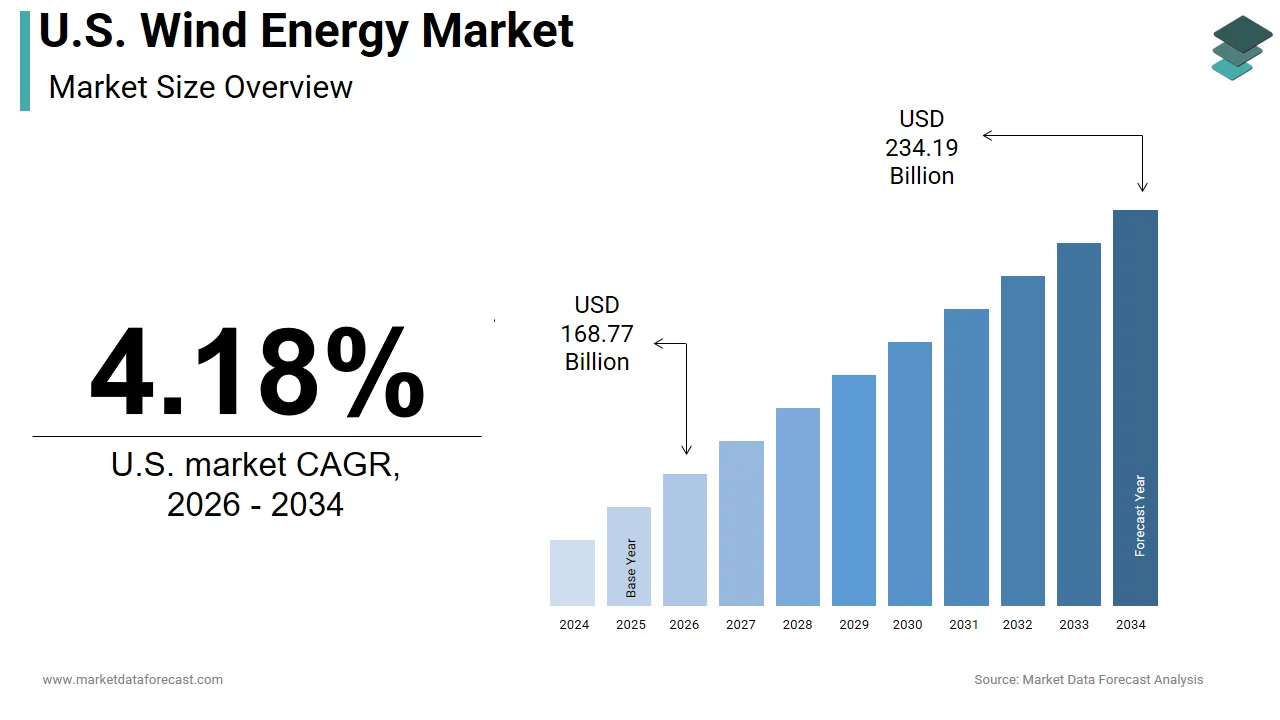
Wind energy is a renewable, clean, and sustainable power source that harnesses the kinetic energy of moving air to generate electricity. This market in the United States has evolved from a niche alternative into a mainstream utility-scale power source, driven by technological advancements in turbine efficiency and supportive federal policies. As per the United States Energy Information Administration, wind energy accounted for approximately 10 percent of total utility-scale electricity generation in recent years, establishing it as the largest source of renewable energy in the country. The market definition includes the entire value chain, including manufacturing, development, operation, and maintenance of wind farms across diverse geographic regions. According to the American Clean Power Association, the United States possesses vast wind resources, particularly in the Great Plains and along coastal areas, which provide consistent and high-velocity winds suitable for energy production. The industry operates within a complex regulatory framework that includes state-level renewable portfolio standards and federal tax incentives such as the Production Tax Credit. These mechanisms encourage investment and facilitate the integration of wind power into the existing grid infrastructure. The market is also defined by its contribution to rural economic development, as wind farms often provide lease payments to landowners and tax revenue to local communities. The ongoing expansion of offshore wind projects further diversifies the market, offering proximity to major population centers on the East and West coasts. This dynamic landscape positions wind energy as a critical component of national energy security and environmental sustainability goals.
MARKET DRIVERS
Federal Tax Incentives and Policy Stability Drive Investment
The implementation of long-term federal tax incentives is the driving force behind the expansion of the United States wind energy market. This provides financial certainty for developers and investors. The Inflation Reduction Act extended and enhanced the Production Tax Credit and Investment Tax Credit for wind energy projects, allowing developers to claim significant tax benefits for electricity generated or capital invested. As per the Internal Revenue Service, the Production Tax Credit provides a per-kilowatt-hour credit for electricity generated by qualified wind facilities, which substantially improves project economics and competitiveness against fossil fuels. This legislative support reduces the levelized cost of energy for wind power, making it an attractive option for utilities and independent power producers. According to the Clean Energy Buyers Association, corporate demand for wind energy has surged following these policy announcements, with hundreds of companies committing to procurement targets to meet sustainability goals. The availability of transferable tax credits further broadens the investor base, allowing entities without significant tax liability to participate in the market. These fiscal mechanisms lower the barrier to entry for new projects, encouraging rapid deployment of capacity across resource-rich regions. The policy framework also includes provisions for domestic manufacturing, aiming to strengthen the supply chain and reduce reliance on imported components. This holistic approach to incentive design ensures that both deployment and production benefit from federal support, creating a robust ecosystem for growth. The resulting influx of capital into the sector demonstrates the profound impact of stable policy environments on market dynamics, driving sustained expansion across onshore and offshore wind technologies.
Abundant Domestic Wind Resources Enhance Economic Viability
The vast availability of high-quality wind resources across the country is fuelling the growth of the United States wind energy market. This enables cost-effective electricity generation at scale. The Great Plains region, often referred to as the wind corridor, possesses some of the strongest and most consistent wind speeds in the world, making it ideal for large-scale wind farm development. As per the National Renewable Energy Laboratory, the technical potential for wind energy in the United States is multiple times greater than current annual electricity consumption, indicating immense untapped capacity. This abundance allows developers to select sites with optimal capacity factors, ensuring maximum energy output and revenue generation. According to the Department of Energy, advances in turbine technology, including taller towers and longer blades, have expanded the range of viable sites, allowing for efficient energy capture in areas with moderate wind speeds. The economic viability of wind energy is further enhanced by the declining cost of turbine components and installation due to economies of scale and technological innovation. The ability to generate electricity at competitive prices without subsidies in many regions attracts private investment and encourages utilities to integrate wind power into their generation mix. The geographic diversity of wind resources also supports grid stability by distributing generation across different weather patterns and time zones. This structural advantage ensures that wind energy remains a reliable and affordable component of the national energy portfolio, sustaining long-term market growth.
MARKET RESTRAINTS
Grid Interconnection Bottlenecks Restrict Project Deployment
The limited capacity of the existing electrical transmission grid is a major barrier to the United States wind energy market. This causes delays and increased costs for new projects. The majority of high-quality wind resources are located in remote areas far from major population centers, requiring extensive transmission infrastructure to deliver electricity to consumers. As per the Federal Energy Regulatory Commission, there is a substantial backlog of interconnection requests for new wind projects, with many facing wait times of several years due to grid congestion and upgrade requirements. According to the Princeton University REPEAT Project, achieving national climate goals will require a significant expansion of transmission capacity, which is currently hindered by regulatory fragmentation and permitting challenges. The lack of coordinated planning among regional transmission organizations results in inefficient use of resources and delayed project completion. Additionally, the aging distribution grid requires modernization to handle the variable nature of wind energy integration. These infrastructure bottlenecks increase the financial risk for developers, discouraging investment and slowing the pace of deployment. Without substantial investment in transmission expansion and streamlined interconnection processes, the full potential of wind energy resources cannot be realized, limiting market growth and compromising grid reliability. The complexity of navigating multiple jurisdictional requirements further exacerbates these challenges, creating a persistent barrier to market expansion.
Supply Chain Volatility and Material Costs Impact Profitability
The reliance on global supply chains for critical wind turbine components, such as blades, gearboxes, and rare earth magnets, is also a significant impediment to the United States wind energy market. This dependency limits market stability and profitability. Disruptions in international trade, geopolitical tensions, and raw material shortages can lead to delays and cost increases for project developers. As per the International Energy Agency, the United States depends heavily on imports for certain wind turbine components, exposing the market to trade policy fluctuations and logistics challenges. According to the American Clean Power Association, inflationary pressures on steel, copper, and other essential materials have increased the capital cost of wind projects, impacting their economic viability. The scarcity of rare earth elements used in permanent magnet generators further exacerbates supply chain risks, creating vulnerabilities in production schedules. Additionally, labor shortages in the manufacturing and construction sectors contribute to project delays and increased operational expenses. These supply chain vulnerabilities highlight the need for a more resilient and diversified sourcing strategy, prompting efforts to boost domestic manufacturing. However, building local capacity takes time and investment, leaving the market exposed to external shocks in the interim. The unpredictability of material costs complicates long-term planning and financing for wind projects, restricting market growth and affecting the competitiveness of wind energy against other sources. Ensuring secure and stable access to critical components remains a persistent challenge for industry stakeholders.
MARKET OPPORTUNITIES
Expansion of Offshore Wind Unlocks Coastal Potential
The development of offshore wind energy provides a significant opportunity for the United States wind energy market. This leverages the strong and consistent wind resources available along the Atlantic and Pacific coasts. Offshore wind offers higher capacity factors and proximity to major population centers, reducing the need for long-distance transmission and enhancing grid efficiency. As per the Department of Energy, the technical potential for offshore wind in the United States is vast, with recent lease auctions generating billions of dollars in bids demonstrating strong industry interest. According to the Bureau of Ocean Energy Management, several large-scale offshore wind projects are in advanced stages of development, with expectations to contribute gigawatts of clean energy to the grid in the coming decade. State mandates, particularly in New York, New Jersey, and Massachusetts, require utilities to procure specific amounts of offshore wind energy, creating a guaranteed market for developers. The establishment of a domestic supply chain for turbine manufacturing and port infrastructure further strengthens the economic case for offshore wind. Federal tax credits and funding for workforce training programs support this growth, positioning offshore wind as a cornerstone of future clean energy strategy. The United States can diversify its renewable portfolio and enhance energy security by tapping into this abundant resource. Furthermore, this approach will drive innovation and investment in marine-based wind technologies.
Integration of Hybrid Wind and Storage Systems
The integration of energy storage systems with wind farms opens new pathways for the United States wind energy market. This addresses intermittency issues and enhances grid reliability. Hybrid systems allow for the storage of excess energy generated during peak wind periods for use during low wind conditions or peak demand times. As per the Energy Information Administration, the cost of battery storage has declined significantly, making it economically feasible to pair with wind projects to provide dispatchable power. According to the National Renewable Energy Laboratory, hybrid wind and storage facilities can participate in ancillary services markets such as frequency regulation and voltage support, generating additional revenue streams. The Inflation Reduction Act provides separate tax credits for energy storage, further improving the financial viability of these integrated systems. Utilities and grid operators increasingly value the flexibility and reliability offered by hybrid plants, facilitating greater penetration of wind energy into the grid. The ability to smooth out power output and reduce curtailment enhances the overall value proposition of wind energy. As technology matures and regulatory frameworks evolve, the adoption of hybrid systems is expected to accelerate, driving growth in the wind energy sector. This synergy between wind and storage positions the industry to play a more central role in a resilient and decarbonized electricity grid.
MARKET CHALLENGES
Permitting and Regulatory Delays Hinder Project Timelines
Complex and lengthy permitting processes at federal, state, and local levels present a major challenge to the timely development of wind energy projects, which in turn constrains the growth of the United States wind energy market. Developers must navigate a maze of environmental reviews, zoning laws, and land use regulations that can extend project timelines by years. As per the Department of Energy, the average time to permit and build a wind project has increased due to rigorous environmental impact assessments and legal challenges. According to the Sabin Center for Climate Change Law, litigation related to wildlife protection, visual impacts, and land rights frequently stalls wind developments, creating uncertainty for investors. The National Environmental Policy Act requires detailed reviews for federal projects, which can be cumbersome and slow. Additionally, local opposition, often referred to as Not In My Backyard sentiment, can lead to restrictive ordinances that prohibit wind installations. These regulatory hurdles increase development costs and risk, making it difficult for projects to reach financial close. The lack of streamlined permitting procedures contrasts with the urgency of climate goals, creating a mismatch between policy ambition and implementation reality. The pace of wind energy deployment will remain constrained by bureaucratic inefficiencies and legal uncertainties. This will continue until permitting reforms are enacted to expedite approvals while maintaining environmental safeguards.
Workforce Shortages Impede Construction and Maintenance
A shortage of skilled labor is hindering the expansion of the United States wind energy market. This impacts both project construction and maintenance. There is a pressing need for technicians, engineers, and construction workers with specialized expertise in wind turbine technology. As per the National Renewable Energy Laboratory, the wind energy workforce needs to expand significantly to meet deployment targets, yet training programs and educational pipelines are not keeping pace with demand. According to the Interstate Renewable Energy Council, many regions face shortages of qualified technicians, leading to project delays and increased labor costs. The transition from fossil fuels to renewables requires retraining of existing energy workers, but structured programs for this transition are limited. Additionally, the geographic distribution of wind resources often places projects in remote areas where local labor pools are small, requiring travel and accommodation expenses that increase project budgets. The lack of standardized certification and licensing requirements across states further complicates workforce mobility and quality assurance. Addressing this skills gap requires coordinated efforts from industry, academia, and government to develop comprehensive training initiatives and apprenticeship programs. Labor shortages will remain a barrier that hinders the speed and efficiency of wind energy deployment in the United States. This will continue until the workforce capacity is expanded.
REPORT COVERAGE
| REPORT METRIC | DETAILS |
| Market Size Available | 2025 to 2034 |
| Base Year | 2025 |
| Forecast Period | 2026 to 2034 |
| Segments Covered | By Location, Turbine Capacity, Application, Component, and Country. |
| Various Analyses Covered | Global, Regional, and Country-Level Analysis, Segment-Level Analysis, Drivers, Restraints, Opportunities, Challenges; PESTLE Analysis; Porter’s Five Forces Analysis, Competitive Landscape, Analyst Overview of Investment Opportunities |
| Countries Covered | New York, Massachusetts, Pennsylvania, Illinois, Ohio, Michigan, Texas, Florida, Georgia, California, Washington, Colorado. |
| Market Leaders Profiled | NextEra Energy Resources, General Electric Vernova, Berkshire Hathaway Energy (MidAmerican/PPM), Invenergy LLC, Vestas Wind Systems, Avangrid Renewables, Ørsted North America, and Others. |
SEGMENTAL ANALYSIS
By Location Insights
The onshore wind segment led the United States wind energy market and captured a substantial share in 2025. This leading position of the segment was attributed to its mature technology base, lower installation costs, and extensive existing infrastructure across the Great Plains and Midwest regions. It benefits from decades of operational experience and a well-developed supply chain that supports efficient project deployment. As per the United States Energy Information Administration, onshore wind facilities accounted for the vast majority of wind-generated electricity in the country, leveraging high capacity factors in resource-rich states like Texas and Iowa. According to the National Renewable Energy Laboratory, the levelized cost of energy for onshore wind remains one of the lowest among all new generation sources, making it economically attractive for utilities and independent power producers. The availability of vast open land areas with consistent wind patterns allows for the construction of large-scale farms that achieve economies of scale. Furthermore, established transmission lines in these regions facilitate easier grid interconnection compared to remote or offshore locations. State-level renewable portfolio standards often prioritize cost-effective solutions, further favoring onshore developments. The regulatory permitting process for onshore projects, while complex, is more streamlined than for offshore initiatives due to fewer environmental and maritime constraints. This combination of economic viability, technical maturity, and regulatory familiarity ensures that onshore wind continues to dominate the market share, providing a stable foundation for the nation’s renewable energy goals.
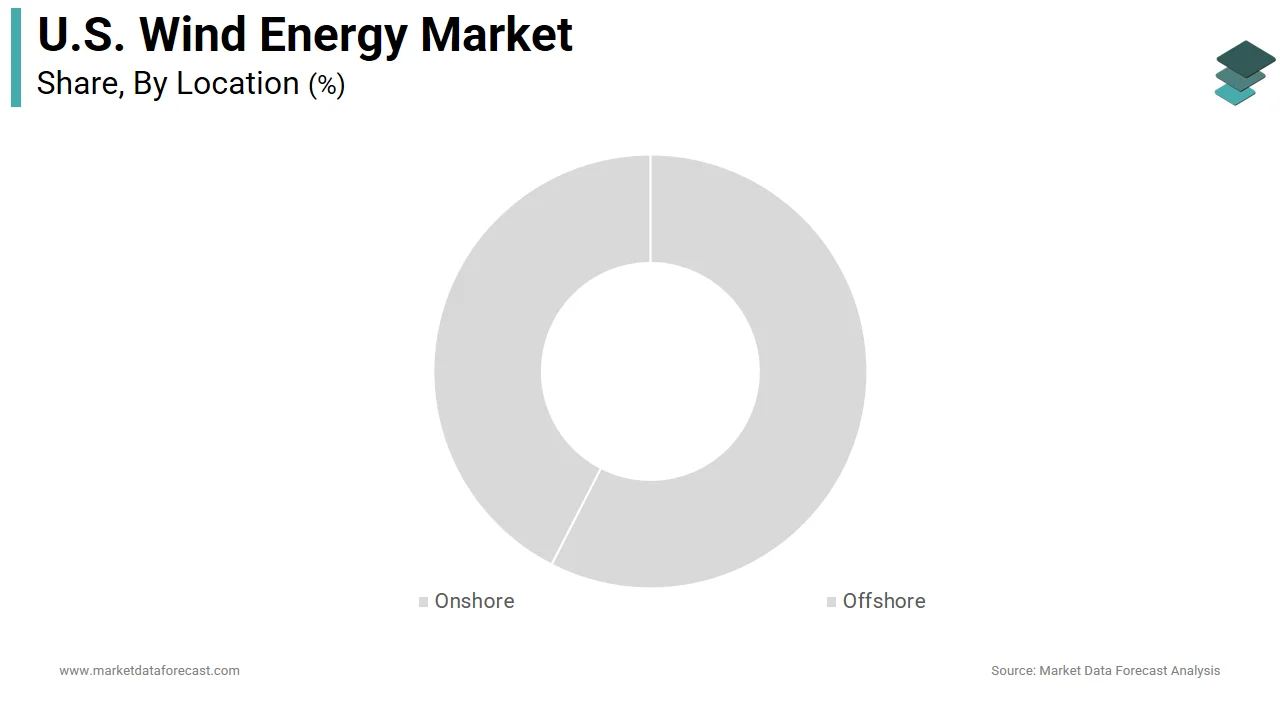
On the other hand, the offshore wind segment is on the rise and is expected to be the fastest-growing segment in the market by witnessing a CAGR of 15.2% between 2026 and 2034 due to aggressive federal and state targets to deploy offshore capacity, driven by the need to supply clean energy to densely populated coastal cities. As per the Department of Energy, the United States has set a goal of installing 30 gigawatts of offshore wind capacity by 2030, catalyzing significant investment in port infrastructure and supply chain development. According to the Bureau of Ocean Energy Management, recent lease auctions for offshore wind areas along the Atlantic Coast have generated billions of dollars in bids, demonstrating strong industry commitment. The proximity of offshore resources to major load centers in the Northeast reduces transmission losses and alleviates congestion on inland grids. State mandates in New York, New Jersey, and Massachusetts require utilities to procure specific amounts of offshore wind energy, creating a guaranteed market for developers. Additionally, advancements in floating turbine technology are opening up deeper waters off the West Coast, expanding the potential geographic footprint. Federal tax credits under the Inflation Reduction Act further enhance project economics, encouraging rapid deployment. These factors collectively position offshore wind as the most dynamic growth engine, offering substantial opportunities for job creation and technological innovation in the marine energy sector.
By Turbine Capacity Insights
The 3 to 6 megawatt turbine capacity segment was the largest by occupying a 49.2% share of the United States wind energy market in 2025 because of its optimal balance between energy output, manufacturing maturity, and operational reliability. These turbines are widely deployed in both repowering projects and new installations where site constraints or grid limitations favor moderate capacity units. As per the American Clean Power Association, a significant portion of the existing installed base consists of turbines in the 2.0 to 3.0 megawatt range, reflecting their widespread adoption over the past decade. According to the National Renewable Energy Laboratory, turbines in the 2.0 to 3.0 megawatt capacity class offer proven performance records with manageable maintenance requirements, making them attractive to investors seeking stable returns. The supply chain for components such as blades and gearboxes is well established for this size, ensuring competitive pricing and shorter lead times. Additionally, many onshore sites with moderate wind resources achieve optimal capacity factors with 3 to 6 megawatt units, avoiding the structural complexities associated with larger models. The regulatory approval process for these turbines is often streamlined due to their familiar environmental footprint and noise profiles. Utilities and independent power producers prefer this segment for its predictability and ease of integration into existing grid infrastructure. The continued demand for reliable and cost-effective solutions ensures that the 3 to 6 megawatt segment remains the backbone of the US wind fleet, supporting consistent energy generation across diverse geographic regions.
But the above 6 megawatt turbine capacity segment is expected to exhibit a noteworthy CAGR of 12.8% over the forecast period, owing to the pursuit of higher efficiency and the emergence of offshore wind projects. Larger turbines capture more energy per unit due to increased rotor diameters and hub heights, resulting in higher capacity factors and reduced levelized cost of energy. As per the Department of Energy, newer offshore wind projects are exclusively utilizing turbines exceeding 6 megawatts, with some models reaching 12 to 15 megawatts, to maximize output in limited lease areas. According to the International Energy Agency, the trend towards upsizing is also penetrating the onshore sector, particularly in high wind resource areas where larger rotors can significantly boost annual energy production. The economic advantage of installing fewer but more powerful turbines reduces foundation and installation costs per megawatt, enhancing project profitability. Technological advancements in materials and control systems have improved the reliability of these massive structures, addressing previous concerns about mechanical stress. Federal incentives for domestic manufacturing of large components further support this shift. The adoption of turbines exceeding 6 megawatts is accelerating as developers aim to optimize land use and increase revenue. These units are positioned as the future standard for high-performance wind energy generation in the United States.
By Application Insights
The utility-scale application segment held the majority share of the United States wind energy market in 2025. This supremacy of the segment was credited to the ability to generate large volumes of electricity at competitive prices through economies of scale. These projects typically involve hundreds of megawatts of capacity and sell power directly to utilities or through long-term power purchase agreements. As per the U.S. Energy Information Administration (EIA), utility-scale wind farms account for over 99% of wind-generated electricity in the country, providing variable renewable energy to the grid. According to the American Clean Power Association, the cost per kilowatt hour for utility-scale wind is significantly lower than for smaller distributed applications, making it the preferred choice for meeting state renewable portfolio standards. Utilities favor these projects for their ability to diversify generation portfolios and reduce reliance on fossil fuels. The established transmission infrastructure in key wind regions facilitates the integration of large-scale outputs into the broader grid. Federal tax credits are particularly impactful for these large investments, improving financial viability and attracting institutional capital. The standardized development process and proven technology reduce execution risk, encouraging continuous investment. Furthermore, corporate power purchase agreements with tech giants and industrial firms often target utility-scale projects to meet sustainability goals. This dominance is reinforced by the critical role utility-scale wind plays in national decarbonization strategies, ensuring sustained growth and market leadership.
On the contrary, the commercial and industrial application segment is predicted to witness the highest CAGR of 9.5% from 2026 to 2034. This rapid expansion of the segment is supported by increasing corporate commitments to sustainability and energy independence. Businesses are increasingly installing on-site wind turbines or entering into virtual power purchase agreements to offset their carbon footprints and stabilize energy costs. As per the Environmental Protection Agency, the EPA Green Power Partnership lists hundreds of corporate partners who have committed to sourcing significant amounts of renewable energy, including wind, to power their operations. According to the World Wildlife Fund, corporate renewable energy procurement has surged, with wind energy being a primary source due to its cost competitiveness and availability. Companies in sectors such as manufacturing, data centers, and retail are leveraging wind energy to meet environmental, social, and governance criteria and enhance brand reputation. State-level incentives and net metering policies further improve the economics for commercial installations. The desire to hedge against volatile electricity prices motivates businesses to invest in local wind resources. Additionally, advancements in smaller turbine technologies make it feasible for industrial facilities with limited space to generate meaningful power. This trend reflects a broader shift towards decentralized energy solutions, empowering commercial entities to play an active role in the clean energy transition and driving rapid growth in this segment.
COUNTRY ANALYSIS
U.S. Wind Energy Market Analysis
The United States dominated the global wind energy market and accounted for a 20.3% share in 2025. This dominance of the US market was driven by its vast land area, favorable wind resources, and robust policy support. The country’s market status is characterized by a mature onshore sector and an emerging offshore industry, driven by federal incentives and state-level mandates. As per the Global Wind Energy Council, the United States has installed over 140 gigawatts of wind capacity, demonstrating its leadership in renewable energy deployment. The driving factors behind this prominent position include the Production Tax Credit and Investment Tax Credit, which provide long-term financial certainty for developers. According to the Department of Energy, the United States possesses some of the best wind resources in the world, particularly in the Great Plains and along coastal regions, enabling high capacity factors and efficient energy generation. The presence of a strong manufacturing base and skilled workforce supports the supply chain, although challenges remain in scaling up for offshore components. State-level renewable portfolio standards compel utilities to procure wind energy, creating a stable demand base. Additionally, corporate power purchase agreements drive significant investment, with major technology and industrial firms committing to clean energy targets. The ongoing expansion of transmission infrastructure and regulatory reforms aims to address interconnection bottlenecks, further supporting growth. This combination of natural advantages, policy support, and market demand ensures that the United States remains a pivotal leader in the global wind energy landscape.
COMPETITIVE LANDSCAPE
The competition in the United States wind energy market is characterized by intense rivalry among established utility companies, independent power producers, and global turbine manufacturers. Market participants compete based on project development efficiency, technology innovation, and cost competitiveness. The landscape is dominated by a few key players who control significant installed capacity and development pipelines. Leading firms differentiate themselves through proprietary turbine designs, advanced digital services, and comprehensive maintenance offerings. Price competition is fierce, particularly in utility-scale procurement auctions where margins are tight. Access to prime wind resources and transmission infrastructure provides strategic advantages. Regulatory compliance and the ability to navigate complex permitting processes are critical success factors. The emergence of offshore wind introduces new competitors with specialized marine expertise. Corporate power purchase agreements drive demand for reliable and scalable solutions, favoring large developers. Supply chain resilience and domestic manufacturing capabilities are becoming increasingly important differentiators. Overall, the market demands continuous innovation and operational excellence to succeed in delivering cost-effective and sustainable wind energy solutions to diverse customers across the country.
KEY MARKET PLAYERS
Some of the companies that are playing a dominating role in the U.S. wind energy market include
- NextEra Energy Resources
- General Electric Vernova
- Berkshire Hathaway Energy (MidAmerican/PPM)
- Invenergy LLC
- Vestas Wind Systems
- Avangrid Renewables
- Ørsted North America
TOP PLAYERS IN THE MARKET
- NextEra Energy Resources is a leading developer and operator of wind energy projects in the United States with a vast portfolio of onshore and offshore assets. The company leverages its extensive experience to identify high-potential sites and execute large-scale developments efficiently. NextEra Energy recently announced significant investments in battery storage systems paired with wind farms to enhance grid reliability. The company utilizes advanced digital technologies to optimize turbine performance and reduce maintenance costs. By securing long-term power purchase agreements with utilities and corporations, NextEra ensures stable revenue streams. Its commitment to sustainability and innovation strengthens its position as a key driver of clean energy adoption. The company continues to expand its capacity through strategic acquisitions and organic growth initiatives across multiple states.
- General Electric Vernova is a major manufacturer of wind turbines and a provider of comprehensive services for the US wind energy market. The company offers a wide range of onshore and offshore turbine models designed for diverse weather conditions and site requirements. General Electric has recently focused on enhancing the efficiency and durability of its turbines through technological advancements. The company invests heavily in research and development to improve blade design and control systems. GE provides operational support and maintenance services to maximize asset uptime and energy production. By collaborating with developers and utilities, General Electric strengthens its supply chain and customer relationships. Its global expertise and local manufacturing capabilities enable it to deliver reliable and cost-effective solutions.
- Vestas Wind Systems is a prominent supplier of wind energy solutions in the United States, offering turbines and service packages. The company has a strong presence in the onshore market and is expanding its offshore capabilities through strategic partnerships. Vestas recently secured several large contracts for turbine supply and installation across various states. The company focuses on sustainable manufacturing practices and circular economy principles to minimize environmental impact. Vestas provides digital monitoring tools that help operators optimize performance and predict maintenance needs. By investing in local workforce training and community engagement, Vestas builds strong relationships with stakeholders. Its commitment to quality and reliability ensures long-term success in the competitive US wind energy landscape.
TOP STRATEGIES USED BY KEY MARKET PARTICIPANTS
Key players in the United States wind energy market primarily focus on securing long-term power purchase agreements to ensure revenue stability and attract investment. Companies are increasingly integrating energy storage systems with wind farms to address intermittency and enhance grid reliability. Strategic partnerships with local manufacturers help strengthen supply chains and comply with domestic content requirements. Participants are investing in digital technologies such as artificial intelligence and predictive maintenance to optimize turbine performance and reduce operational costs. Expansion into offshore wind development allows firms to tap into new resources and meet coastal demand. Lobbying efforts aim to influence favorable policies and streamline permitting processes. Mergers and acquisitions enable companies to acquire specialized technologies and expand geographic reach. These strategies allow participants to navigate regulatory challenges and maintain competitiveness in a rapidly evolving market.
MARKET SEGMENTATION
This research report on the U.S. wind energy market has been segmented and sub-segmented into the following categories.
By Location
- Onshore
- Offshore
By Turbine Capacity
- Up to 3 MW
- 3 to 6 MW
- Above 6 MW
By Application
- Utility-scale
- Commercial and Industrial
- Community Projects
By Component
- Nacelle/Turbine
- Blade
- Tower
- Generator and Gearbox
- Balance-of-System
By Country
- New York
- Texas
- Florida
- Georgia
- California
- Rest of U.S.