- Product Description Description
- Table of Contents TOC
- List of Table & Figure LOT
- Get Free Sample PDF Sample PDF
Market Size, 2025
$25.59 BnMarket Estimate, 2026
$27.05 BnMarket Forecast, 2034
$42.14 BnCAGR, 2026–2034
5.7%Executive Summary: Global Urban Pest Management Market
- Market Scope: Comprehensive analysis of the global urban pest management sector, evaluating applications (commercial vs. residential), pest categories (mosquitoes, bed bugs, termites, cockroaches), and regional adoption across North America, Europe, APAC, Latin America, and MEA.
- Market Valuation: Valued at USD 25.59 billion in 2025, reaching USD 27.05 billion in 2026, and projected to expand to USD 42.14 billion by 2034, registering a steady CAGR of 5.70% during the forecast period from 2026 to 2034.
- Primary Growth Drivers: Escalating urbanization, overcrowding, rising demand for insurance-based pest control solutions in commercial sectors (hospitality, food processing, healthcare), and increasing international travel driving bed bug and insect infestations.
Key Market Segment Metrics
| Category | Leading Segment (Base Year Position) | Fastest-Growing / High-Impact Segment |
|---|---|---|
| By Application | Residential Segment (dominant baseline share driven by urban housing growth, crowding, and standard household pest maintenance) | Commercial Segment (high-impact sector driven by hospitality, food processing, and the adoption of specialized insurance-based pest services) |
| By Type of Pest | General Pests & Cockroaches / Termites (leading baseline categories requiring routine extermination and structural protection) | Bed Bugs & Mosquitoes (fast-expanding segments fueled by international travel and climate change patterns) |
| By Region | North America (leading regional market share anchored by a mature service industry, preventative standards, and thousands of professional providers) | Asia-Pacific (fastest-growing regional market offsetting mature slowdowns through massive urbanization and rising commercial investments) |
Major Market Players & Market Structure
Market Structure: Highly fragmented service environment coexisting with a concentrated chemical manufacturing industry, where global chemical leaders dominate product supply while specialized corporate providers handle enterprise accounts.
Key Companies: Syngenta AG, Bayer CropScience, Bell Laboratories Inc., PelGar International, Corteva Agriscience, ADAMA, Sumitomo Chemical Co. Ltd., FMC Corporation, and BASF.
 Download Free Sample Report
Global Urban Pest Management Market Size
The global urban pest management market size was valued at USD 25.59 billion in 2025 and is anticipated to reach USD 27.05 billion in 2026 to reach USD 42.14 billion by 2034, growing at a CAGR of 5.7% during the forecast period from 2026 to 2034.
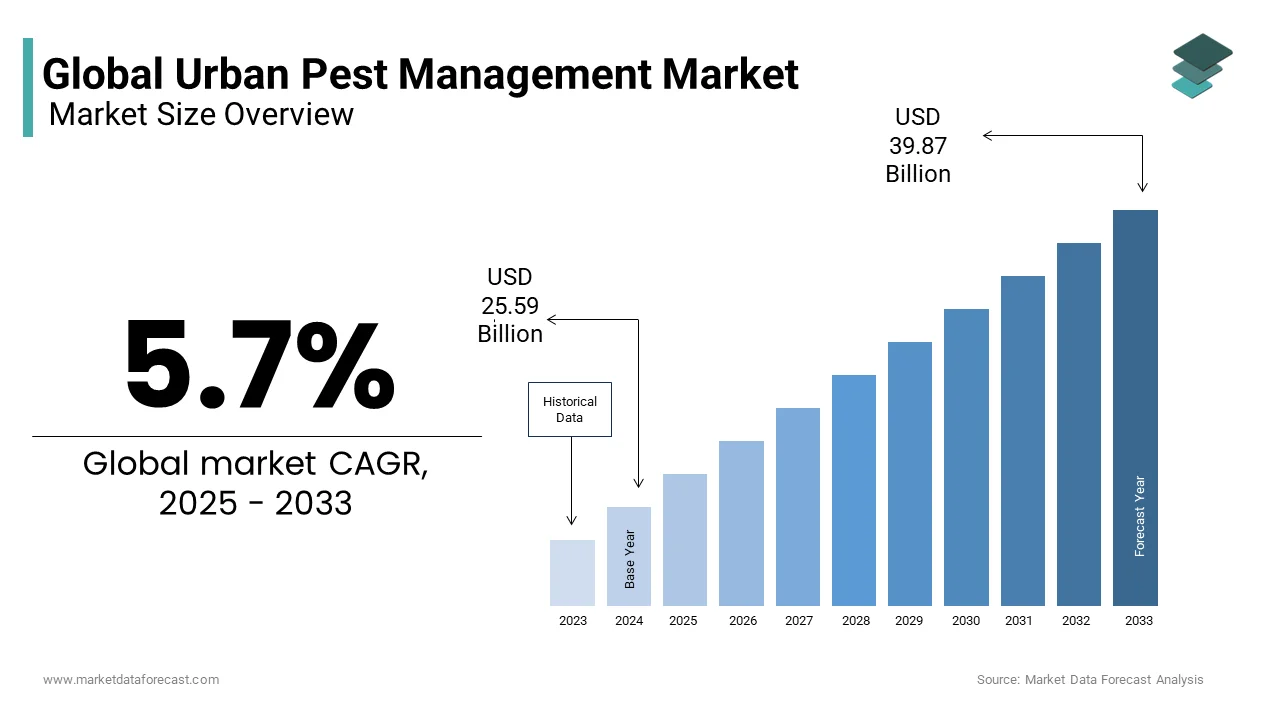
Pest control includes companies involved in the professional management of pests, termites, rodents, and other species that can cause health problems or an undesirable quality of life for humans.
The industry serves both residential customers and commercial establishments. The primary function of pest control services is to maintain a hygienic environment free from pests that may harm business interests or endanger health. The urban pest management market is primarily driven by chemical pest control techniques due to the high demand for insecticide solutions worldwide from service providers.
MARKET DRIVERS AND RESTRAINTS
The urban pest control market is driven by the rise of insurance-based pest control services and the growth of the hotel, pharmaceutical, and food processing industries. Due to the significant costs associated with pest control, there are many market players offering insurance-based pest control services, especially for commercial clients. Large hotels and other companies opt for these pest control services. Terminix, for example, has partnered with Aon (an insurance provider) to provide insurance coverage against bed bug infestations, primarily for commercial customers such as hotels, community developments, and other businesses. Since the standard insurance policies provided for commercial properties do not include extermination costs, a pest control campaign can require a considerable investment. The increasing availability of specialized insurance policies will allow clients to control their expenses and access a reliable service provider. However, the implementation of strict regulations and the consequent costs for service providers and pressure on pricing strategies could hamper the market growth. The industry is regulated by various state and federal authorities and must comply with environmental laws.
The market is very fragmented, and there are many small providers that are not fully monitored operating in the space. The quality of the pesticides used can be compromised to keep costs down. Penalties imposed for non-compliance include license revocation, fines, and other corrective actions. The introduction of regulations such as REACH and the Biocides Regulation in Europe is of considerable importance in this market. Pest control products are designed to damage the central nervous system of insects, disrupt mating, or kill infestations. The amount of product used must be controlled effectively by a qualified professional to reduce its accumulation in the surrounding environment. The registration process for pesticide products may differ from country to country. For example, in the United States, the registration process involves meeting the standards required by the Federal Insecticide, Fungicide, and Rodenticide Act and the Federal Food, Drug, and Cosmetic Act. Due to the multiple tests and approvals required, the costs of registering pest control products are high. Lengthy testing procedures are also a barrier for manufacturers, as the long approval period can affect the prospects for patents for companies.
REPORT COVERAGE
| REPORT METRIC | DETAILS |
| Market Size Available | 2025 to 2034 |
| Base Year | 2025 |
| Forecast Period | 2026 to 2034 |
| CAGR | 5.7% |
| Segments Covered | By Application, By Types of Pest |
| Various Analyses Covered | Global, Regional & Country Level Analysis, Segment-Level Analysis, DROC, PESTLE Analysis, Porter’s Five Forces Analysis, Competitive Landscape, Analyst Overview on Investment Opportunities |
| Regions Covered | North America, Europe, APAC, Latin America, Middle East & Africa |
| Market Leaders Profiled | Bell Laboratories Inc., Syngenta AG, Bayer CropScience, PelGar International, Corteva, ADAMA, Sumitomo Chemicals Co. Ltd., FMC Corporation, and BASF |
SEGMENTAL ANALYSIS
By Application Insights
Urbanization is one of the key factors in the demand for pest control in the residential segment. Proximity to homes in most urban centers allows pests to spread easily. The spread of pests is compounded by factors such as overcrowding, ineffective waste disposal, water saturation during the rainy season, and poor quality of buildings, which are common in large cities. The residential segment mainly requires services such as bird protection, rodent extermination, fumigation, and eradication of mosquitoes, bed bugs, ants, and cockroaches. Commercial clients include the hospitality, retail, healthcare, and educational and institutional sectors.
By Type of Pest Insights
General pest control includes the eradication of ants, flies, cockroaches, fleas, bed bugs, spiders, mosquitoes, moths, wasps and bees, ticks, rodents, beetles, gnats, silverfish, stink bugs, centipedes, weevils, and mites in advertising and residential areas. It also provides antifungal treatment, disinfection, and extermination of viruses and bacteria using safe chemicals and techniques.
REGIONAL ANALYSIS
North America Market Analysis
North America is the leading segment of the global urban pest control market. An estimated 20,000 pest control companies were operating in North America alone in 2016. The UK market for pest control services is growing at a rate of around 6% per year. Increased international travel has fueled the spread of pests such as bed bugs, while climate change has led to the spread of insects such as the oak processionary, which can cause serious health problems and serious damage to oak trees. Although slow economic growth in the region, particularly in the United States, has affected demand in some end-user markets, increased demand for pest management services from countries in the APAC region has offset the effects of the slowdown in North America. Although the nature of the business is seasonal, North America is a mature market where customers prioritize prevention and surveillance over reactive measures. Brazil, Chile, Colombia, Argentina, and Peru are among the main countries in South America.
LEADING COMPANY
Syngenta AG had the largest share of the Urban Pest Management Market in terms of sales revenue in 2021.
KEY MARKET PLAYERS
The Urban Pest Management Market is concentrated with well-established players. Key players in the Urban Pest Management Market include
- Bell Laboratories Inc
- Syngenta AG
- Bayer Cropscience
- PelGar International
- Corteva
- ADAMA
- Sumitomo Chemicals Co., Ltd.
- FMC Corporation
- BASF.
RECENT MARKET NEWS
- In March 2019, DowDuPont's board of directors approved the previously announced separation of its Agriculture division, which will become Corteva Agriscience, on June 1. The division includes DuPont Crop Protection, Pioneer, and Dow AgroSciences. To effect the separation, the board declared a prorated dividend on all of Corteva's outstanding common shares payable. Each DowDuPont shareholder will receive one Corteva share for every three DowDuPont common shares.
- In January 2019, Control Solutions Inc., a Pasadena, Texas-based solutions provider for the professional, ornamental, and pest control markets, announced the closing of its previously announced acquisition of Bonide Products Inc. upon satisfaction of the customary closing conditions and receipt of the required regulatory approvals.
- In July 2018, Rollins, Inc., a leading global consumer and business services company, announced that it had purchased the shares of Aardwolf Pestkare (Singapore) Pte Ltd. Founded in 1997, Aardwolf Pestkare is a long-established pest control company with a history of providing high-quality pest control and specialized services to residential and commercial customers.
MARKET SEGMENTATION
This research report on the global autonomous urban pest management market is segmented and sub-segmented into the following categories.
By Application
- Commercial
- Residential
- Others
By Type of Pest
- Mosquitoes
- Bed bugs
- Termites
- Cockroaches
- Others
By Region
- North America
- Europe
- Asia Pacific
- Latin America
- Middle East & Africa