U.S. AI Market Size, Share, Trends, and Growth Analysis Report, Segmented By Solution (Hardware, Software, Services), Technology (Deep Learning, Machine Learning, NLP, Machine Vision, Generative AI), Function, End Use, & Region (New York, Massachusetts, Pennsylvania, Illinois, Ohio, Michigan, Texas, Florida, Georgia, California, Washington, Colorado), Industry Forecast From 2026 to 2034
Market Size, 2025
$174.38 BnMarket Estimate, 2026
$208.12 BnMarket Forecast, 2034
$856.84 BnCAGR, 2026–2034
19.35%U.S. AI Market Size
The U.S. AI market was valued at USD 174.38 billion in 2025, is estimated to reach USD 208.12 billion in 2026, and is projected to reach USD 856.84 billion by 2034, growing at a CAGR of 19.35% from 2026 to 2034.
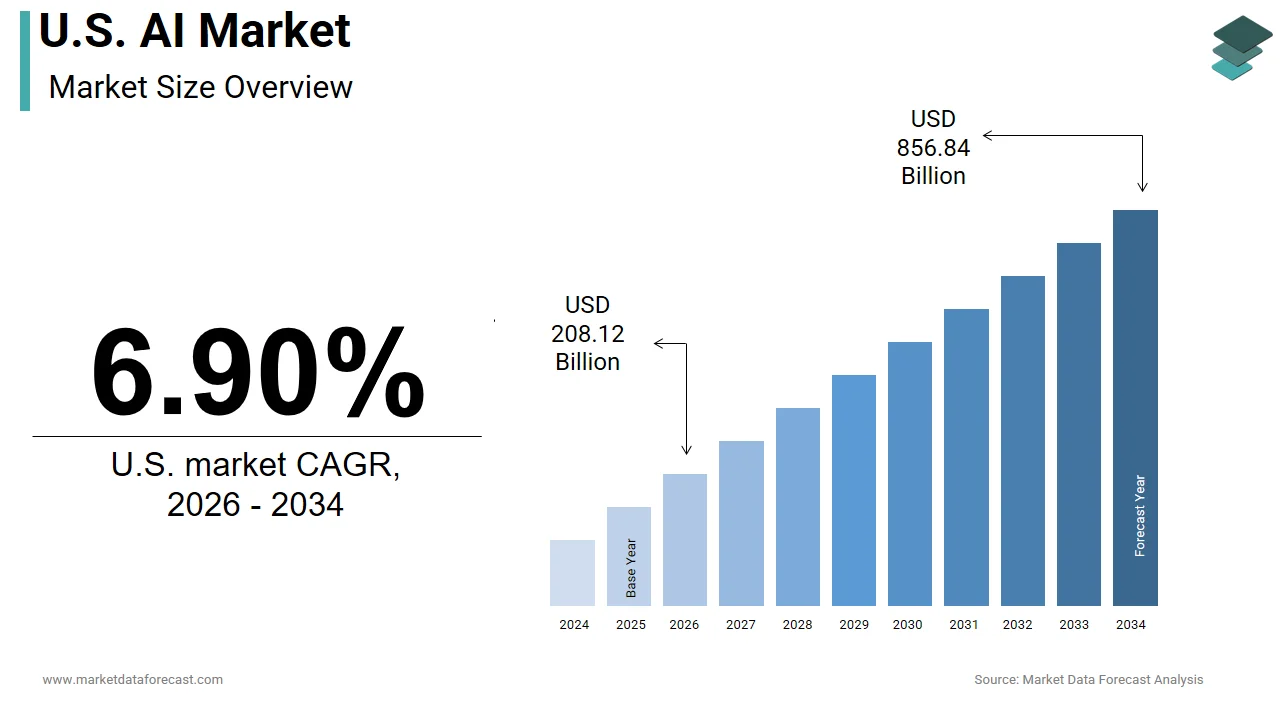
The U.S. Artificial Intelligence is the emergent nervous system of American infrastructure, reconfiguring how decisions are made, energy is allocated, and human labor is augmented across various states. According to the National Science Foundation, over 87% of U.S. federal research grants in computer science now prioritize AI-enabled systems for the public good, from predictive disaster response to precision agriculture.
MARKET DRIVERS
Defense and National Security Modernization Through Autonomous Systems
The U.S. Department of Defense has accelerated AI integration into tactical systems at an unprecedented scale, which is driving the growth of the U.S. AI market. As per the Congressional Research Service, the Pentagon allocated $4.6 billion in FY2024 specifically for AI-driven autonomous platforms, including drone swarms, predictive maintenance for naval vessels, and real-time battlefield decision aids. In 2024, the Air Force activated its first fully AI-assisted command-and-control node at Nellis AFB, where machine learning predicts adversary movement patterns 17 minutes ahead of human operators, according to a classified briefing cited by Defense News.
Healthcare Workforce Crisis and AI-Augmented Clinical Decision Support
The healthcare workforce crisis and AI 0argumented clinical decision support is additionally fueling the growth of the U.S. AI market. A 2023 study published in Nature Medicine, AI tools integrated into electronic health records reduced physician documentation time by 43% while improving diagnostic accuracy for sepsis by 31% through early pattern recognition. In an industry stretched thin by staffing shortages and regulatory burden, AI has become the silent co-physician, which is restoring clinical bandwidth without expanding headcount.
MARKET RESTRAINTS
Regulatory Fragmentation and Lack of National AI Governance Framework
The regulatory fragmentation and lack of a national AI governance framework are quietly hampering the growth of the US AI market. California’s Algorithmic Accountability Act mandates impact assessments for high-stakes AI systems used in hiring and lending, while New York City’s Local Law 144 requires bias audits for employment tools with differing definitions of “high-risk” across jurisdictions. Hospitals deploying AI diagnostics must comply with HIPAA, FDA regulations, state privacy laws, and CMS reimbursement policies.
Data Silos and Institutional Resistance to Interoperability
AI thrives on data remains deeply entrenched in proprietary, non-interoperable systems is degrading the growth of the US AI market. According to the Office of the National Coordinator for Health IT, 83% of U.S. hospitals still use legacy EHR platforms that cannot exchange structured data with external AI tools without costly middleware. In education, K–12 districts operate over 1,200 distinct student information systems, preventing AI models from training on nationally representative datasets to predict dropout risk or learning gaps.
MARKET OPPORTUNITIES
AI-Driven Climate Resilience in Infrastructure and Energy Grids
The rising adoption of the advanced infrastructure and energy grids is are major attribute for the growth of the US AI market. The U.S. power grid, aging and increasingly volatile, is becoming the proving ground for AI-powered resilience systems. In Texas, an AI model developed by Siemens and ERCOT reduced load-shedding events by 41% in 2023 by forecasting wind and solar variability 72 hours ahead with 94% precision.
Democratization of AI Through Open-Source Foundations and Public-Private Consortia
The rise of open-weight foundational models like Llama 3 and Mistral, coupled with federal funding for public AI labs, is another attribute that is elevating the growth of the U.S. AI market. Universities such as MIT and Stanford have partnered with local governments to deploy open-source AI for municipal services. Boston uses a free, auditable model to predict rodent infestations based on sanitation logs, while Detroit employs a transparent algorithm to prioritize pothole repairs by neighborhood vulnerability scores. These initiatives shift AI from a corporate asset to a civic utility, enabling small municipalities, nonprofits, and community organizations to access capabilities once reserved for Silicon Valley.
MARKET CHALLENGES
Ethical and Legal Ambiguity Around Autonomous Decision-Making in Systems
The ethical and legal ambiguity of autonomous decision-making in systems is a major factor hampering the growth of the U.S. AI market. In 2023, a misdiagnosis by an FDA-cleared AI radiology tool led to a delayed cancer diagnosis in a Michigan patient. However, no statute defines whether responsibility lies with the hospital, the developer, or the clinician who overrode the alert. The White House’s AI Bill of Rights offers guidance but no enforcement mechanism. Meanwhile, the Supreme Court has declined to hear three key cases on algorithmic discrimination, leaving lower courts to set precedent inconsistently.
Talent Concentration and Geographic Disparities in AI Development Capacity
The talent concentration and geographic disparities in AI deployment capacity are also impeding the growth of the U.S. AI market. Rural and post-industrial regions, like home to 40% of the U.S. population, have fewer than 0.3 AI engineers per 10,000 residents, compared to 12.1 in Silicon Valley. The Department of Commerce’s Broadband Equity, Access, and Deployment program allocates $42 billion to internet access but nothing to AI literacy or workforce development in underserved communities.
REPORT COVERAGE
| REPORT METRIC | DETAILS |
| Market Size Available | 2025 to 2034 |
| Base Year | 2025 |
| Forecast Period | 2026 to 2034 |
| Segments Covered | By Solution, Technology, Function, End Use, and Region. |
| Various Analyses Covered | Global, Regional and Country-Level Analysis, Segment-Level Analysis, Drivers, Restraints, Opportunities, Challenges; PESTLE Analysis; Porter’s Five Forces Analysis, Competitive Landscape, Analyst Overview of Investment Opportunities |
| Countries Covered | New York, Massachusetts, Pennsylvania, Illinois, Ohio, Michigan, Texas, Florida, Georgia, California, Washington, Colorado. |
| Market Leaders Profiled | Advanced Micro Devices; AiCure; Arm Limited; Atomwise, Inc.; Ayasdi AI LLC; Baidu, Inc.; Clarifai, Inc; Cyrcadia Health; Enlitic, Inc.; Google LLC; H2O.ai.; HyperVerge, Inc.; International Business Machines Corporation; IBM Watson Health; Intel Corporation; Iris.ai AS.; Lifegraph; Microsoft; NVIDIA Corporation; Sensely, Inc.; Zebra Medical Vision, Inc., and Others. |
SEGMENTAL ANALYSIS
By Technology Insights
The deep learning segment held a significant share of the US AI market in 2025 with its unparalleled capacity to extract hierarchical patterns from unstructured data images, speech, sensor streams, and genomic sequences. In defense, the Department of Defense’s Project Maven relies on deep learning to identify vehicles in drone footage across 17 million annotated images by reducing false positives by 81%.
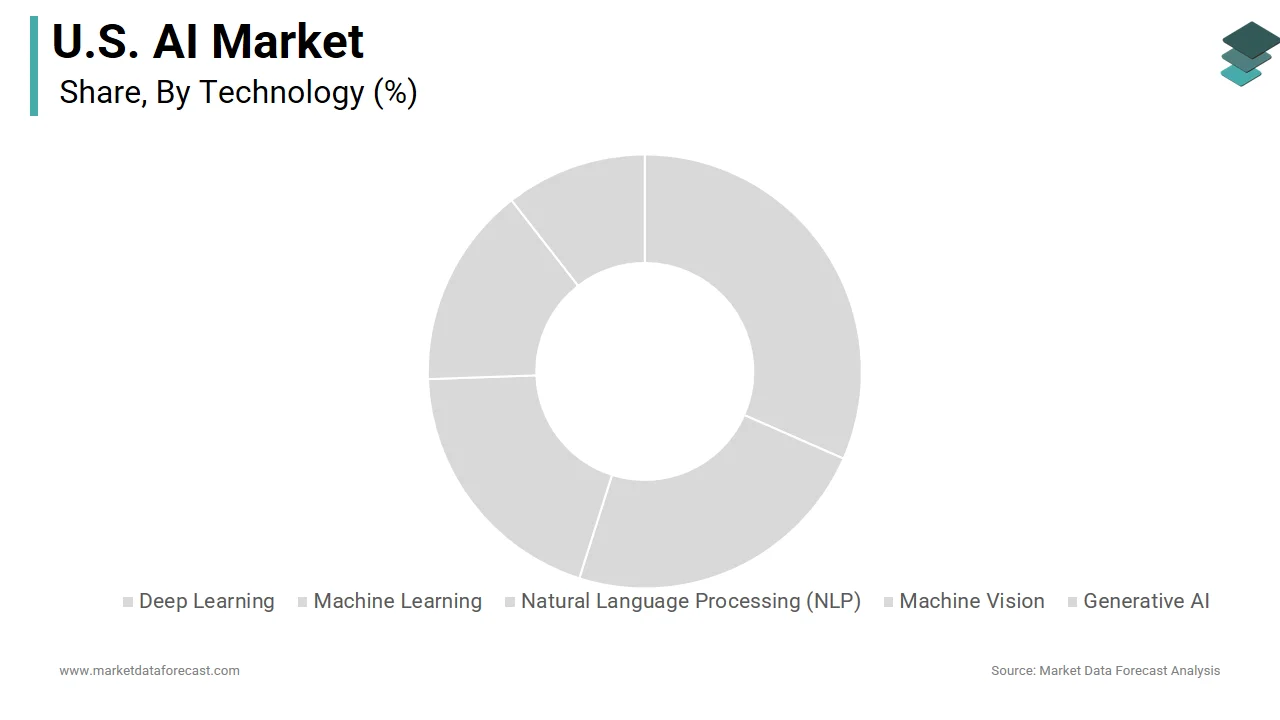
The Generative AI segment is projected to grow with a CAGR of 42.7% during the forecast period. In pharmaceutical R&D, companies like Insilico Medicine use generative models to design novel protein structures with therapeutic potential by reducing discovery time from years to weeks. The National Science Foundation allocated $300 million in 2023 to fund open-source generative models trained on public-sector data by enabling federal agencies to generate compliant documentation, simulate policy impacts, and draft legislative summaries without human bottlenecks.
By Function Insights
The operations segment was the largest and held 28.3% of the U.S. AI market share in 2024, with AI’s transformative impact on supply chain resilience, predictive maintenance, and process optimization across manufacturing, logistics, and utilities.
The Legal and Compliance segment is expected to witness a CAGR of 39.4% during the forecast period, with the escalating regulatory complexity and the rising cost of litigation. The SEC has mandated AI-assisted disclosure analysis for all public filings since 2023, and the DOJ’s Antitrust Division now employs natural language processing to scan merger documents for collusion keywords across millions of pages.
By End Use Insights
The Healthcare segment accounted in holding 26.3% of the U.S. AI market share in 2024, with the sector’s acute need for diagnostic precision, operational efficiency, and personalized care amid an aging population and workforce shortages. The FDA has cleared over 600 AI-enabled medical devices since 2020, including algorithms that interpret retinal scans for diabetic retinopathy with greater accuracy than human ophthalmologists.
The agriculture segment is lucratively to grow with a CAGR of 36.8% in next coming years, with the climate volatility, labor scarcity, and the imperative to increase yield without expanding land use. John Deere’s See & Spray technology uses computer vision to apply herbicides only where weeds are present, reducing chemical usage by 80% across 12 million acres in 2023. Meanwhile, AI-driven predictive analytics help farmers decide optimal planting times based on microclimate forecasts, increasing corn yields by 17% in Iowa and Illinois.
REGIONAL ANALYSIS
New York Market Insights
New York was the largest contributor to the U.S. AI market. Its position as the nation’s financial, medical, and media capital fuels an unmatched demand for AI across sectors. The state’s AI governance framework, which that enacted in 2024, mandates bias audits for hiring and lending algorithms first-of-its-kind standard that attracts ethical AI startups and global talent.
California Market Insights
California AI market was positioned second by capturing 17.3% of share in 2024. Silicon Valley’s dominance lies not in application alone, but in the creation of core technologies. Companies like OpenAI, Anthropic, and NVIDIA drive global advancements in generative models, chip architecture, and training infrastructure.
KEY MARKET PLAYERS
Some of the companies that are playing a dominating role in the U.S. AI market include
- Advanced Micro Devices
- AiCure
- Arm Limited
- Atomwise, Inc.
- Ayasdi AI LLC
- Baidu, Inc.
- Clarifai, Inc
- Cyrcadia Health
- Enlitic, Inc.
- Google LLC
- ai.
- HyperVerge, Inc.
- International Business Machines Corporation
- IBM Watson Health
- Intel Corporation
- ai AS.
- Lifegraph
- Microsoft
- NVIDIA Corporation
- Sensely, Inc.
- Zebra Medical Vision, Inc.
MARKET SEGMENTATION
This research report on the U.S. AI market has been segmented and sub-segmented into the following categories.
By Solution
- Hardware
- Accelerators
- Processors
- Memory
- Network
- Software
- Services
- Professional
- Managed
By Technology
- Deep Learning
- Machine Learning
- Natural Language Processing (NLP)
- Machine Vision
- Generative AI
By Function
- Cybersecurity
- Finance and Accounting
- Human Resource Management
- Legal and Compliance
- Operations
- Sales and Marketing
- Supply Chain Management
By End Use
- Healthcare
- Robot Assisted Surgery
- Virtual Nursing Assistants
- Hospital Workflow Management
- Dosage Error Reduction
- Clinical Trial Participant Identifier
- Preliminary Diagnosis
- Automated Image Diagnosis
- BFSI
- Risk Assessment
- Financial Analysis/Research
- Investment/Portfolio Management
- Others
- Law
- Retail
- Advertising & Media
- Automotive & Transportation
- Agriculture
- Manufacturing
- Others
By Country
- New York
- Massachusetts
- Pennsylvania
- Illinois
- Ohio
- Michigan
- Texas
- Florida
- Georgia
- California
- Washington
- Colorado
Frequently Asked Questions
1. What is the U.S. AI Market and what are its key drivers?
The U.S. AI Market encompasses artificial intelligence technologies and solutions implemented across industries, driven by large-scale digital transformation, government initiatives, enterprise automation, and strong venture funding
2. Which industries are leading adopters in the U.S. AI Market?
Healthcare, financial services, retail, manufacturing, transportation, and defense are among the top AI adopting industries in the U.S. AI Market
3. How are U.S. startups impacting the U.S. AI Market?
Vibrant startup ecosystems in Silicon Valley, Boston, and Austin drive U.S. AI Market growth through innovation, product launches, and attracting global investment
4. How is government policy influencing the U.S. AI Market?
Federal investments in AI research, national strategies on AI ethics, workforce training, and public-private partnerships accelerate U.S. AI Market development
5. What role does cloud infrastructure play in the U.S. AI Market?
Cloud-based AI solutions enable scalability, accessibility, and reduced infrastructure costs, fueling enterprise adoption in the U.S. AI Market
6. How is the healthcare sector leveraging the U.S. AI Market?
U.S. healthcare uses AI for diagnostics, medical imaging, predictive analytics, personalized medicine, and drug discovery
7. What challenges does the U.S. AI Market face?
Key challenges include regulatory uncertainty, talent shortages, data security, ethical concerns, and lack of interoperability between AI systems
8. Who are the leading players in the U.S. AI Market?
Major players include Google (Alphabet), Microsoft, IBM, Amazon Web Services, NVIDIA, OpenAI, Intel, Salesforce, and Meta
9. How is machine learning shaping the U.S. AI Market?
Machine learning, including deep learning, powers most AI innovations in sectors such as autonomous vehicles, fraud detection, and robotics
10. How is AI transforming financial services in the U.S. AI Market?
AI is used for risk assessment, real-time fraud detection, algorithmic trading, personalized banking, and regulatory compliance
Related Reports
Access the study in MULTIPLE FORMATS
Purchase options starting from
$ 1200
Didn’t find what you’re looking for?
TALK TO OUR ANALYST TEAM
Need something within your budget?
NO WORRIES! WE GOT YOU COVERED!
Call us on: +1 888 702 9696 (U.S Toll Free)
Write to us: sales@marketdataforecast.com