- Product Description Description
- Table of Contents TOC
- List of Table & Figure LOT
- Get Free Sample PDF Sample PDF
Market Size, 2025
$52.15 BnMarket Estimate, 2026
$64.52 BnMarket Forecast, 2034
$354.17 BnCAGR, 2026–2034
23.72%North America AI Chipsets Market Size
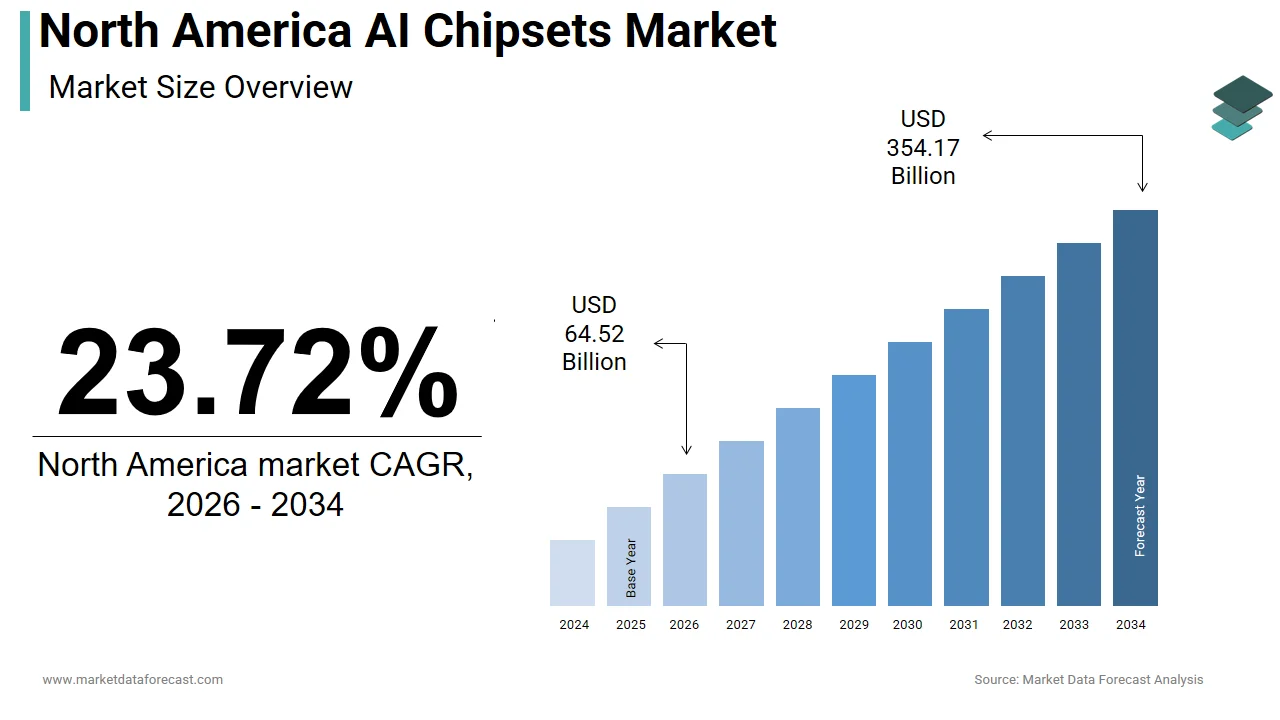
The size of the North America AI chipsets market was worth USD 52.15 billion in 2025. The market is anticipated to grow at a CAGR of 23.72% from 2026 to 2034 and be worth USD 354.17 billion by 2034 from USD 64.52 billion in 2026.
The AI chipsets are specialized semiconductor architectures engineered to accelerate artificial intelligence workloads, including machine learning inference, neural network processing, and real-time data analytics across devices and data centers. These chipsets range from GPUs and TPUs to custom ASICs and neuromorphic processors that differ fundamentally from general-purpose CPUs by optimizing for parallel computation, low-latency response, and energy-efficient throughput in AI-driven applications. AI chipsets power medical diagnostics, autonomous vehicle decision-making, fraud detection in financial systems, and predictive maintenance in industrial operations.
MARKET DRIVERS
Expansion of Edge AI Applications in Industrial and Consumer Devices
The proliferation of edge AI(artificial intelligence) processed locally on devices rather than in centralized data centers is solely prompting the growth of the North America AI chipsets market. The need for real-time decision-making in latency-sensitive environments such as autonomous vehicles, smart manufacturing, and home security systems fuels this shift. According to the National Institute of Standards and Technology, over 70% of new industrial robots deployed in U.S. manufacturing facilities in 2023 were equipped with on-board AI processors capable of vision-based quality inspection and predictive maintenance, reducing production downtime by up to 40%. In consumer electronics, smart home devices like Amazon Echo and Google Nest rely on low-power AI chipsets such as the Google Edge TPU to process voice commands locally, enhancing privacy and responsiveness.
Federal and Private Sector Investment in AI Research and National Security Infrastructure
The sustained investment in artificial intelligence by both government and private entities is also to fuel the growth of the North America AI chipsets market. The U.S. National Artificial Intelligence Initiative Office allocated over $2.2 billion in federal funding for AI research and development in 2023, with a significant portion directed toward high-performance computing infrastructure reliant on advanced AI processors. In the private sector, hyperscalers like Google, Microsoft, and Meta have built custom AI chip TPUs, Azure Maia, and MTIA, respectively, to handle massive workloads in search, advertising, and generative AI models.
MARKET RESTRAINTS
Geopolitical Constraints and Semiconductor Supply Chain Vulnerabilities
The fragility of the global semiconductor supply chain, with the dependence on foreign fabrication for advanced process nodes, is quietly limiting the growth of the North America AI chipsets market. This concentration poses strategic risks, as demonstrated by the 2022–2023 chip shortages that delayed AI server deployments at major cloud providers. The Department of Commerce’s Bureau of Industry and Security has identified AI chipsets as dual-use technologies subject to export controls, complicating international collaboration and limiting access to certain markets.
High Power Consumption and Thermal Management Challenges in AI Chip Design
The escalating power demands of AI chipsets present a significant technical and operational barrier for the growth of the North America AI chipsets market. High-performance AI processors are those used in data centers and autonomous systems that can consume over 700 watts per unit, comparable to a commercial microwave oven, according to the U.S. Department of Energy’s Advanced Research Projects Agency-Energy (ARPA-E). Cooling systems alone can double the total cost of ownership for AI server racks, limiting scalability for smaller enterprises and public institutions. In edge applications, such as drones or mobile robots, thermal dissipation constraints restrict the size and duration of AI processing tasks. According to the National Renewable Energy Laboratory, thermal throttling reduces AI inference performance by up to 35% in uncooled embedded systems. Additionally, environmental regulations in states like California and provinces like Quebec are imposing stricter energy efficiency standards, which is pushing manufacturers to redesign architectures for lower wattage without sacrificing throughput.
MARKET OPPORTUNITIES
Integration of AI Chipsets in Healthcare Diagnostics and Precision Medicine
The integration of AI chipsets into medical devices and diagnostic platforms is anticipated to showcase huge opportunities for the growth of the North America AI chipsets market, where healthcare systems are increasingly reliant on real-time, data-driven decision-making. AI-powered imaging systems such as those used in mammography, pathology, and neuroimaging require dedicated inference chips to process high-resolution scans with sub-second latency. According to the Food and Drug Administration, over 500 AI/ML-based medical devices have received clearance since 2015, the majority of which rely on embedded AI processors for on-site analysis. GE Healthcare’s Critical Care Suite, for example, runs on Intel-powered edge AI chips to detect pneumothorax in chest X-rays directly on mobile radiography units by reducing diagnosis time by 75%, as documented in a 2023 Mayo Clinic study.
Growth of On-Device Generative AI and Personalized User Experiences
The emergence of generative AI models capable of running directly on consumer devices is to expand the growth of the North America AI chipsets market. According to Apple’s 2023 developer documentation, the A17 Bionic chip can execute 35 trillion operations per second for machine learning tasks by enabling real-time text summarization, image generation, and voice synthesis on iPhones. This shift is driven by consumer demand for personalized, responsive experiences in messaging, photography, and productivity apps. According to the U.S. Consumer Product Safety Commission, 68% of smartphone users expressed concern about data privacy in cloud AI services.
MARKET CHALLENGES
Talent Shortage in AI-Specific Semiconductor Design and Verification
The acute shortage of engineers with specialized expertise in AI-centric semiconductor architecture, verification, and system integration is likely to degrade the growth of the North America AI chipsets market. Designing AI chips requires multidisciplinary knowledge in machine learning algorithms, low-power circuit design, and parallel computing skills that are not adequately covered in traditional electrical engineering curricula. According to the IEEE, the U.S. faces a deficit of over 30,000 qualified semiconductor design engineers, with AI-specific roles among the hardest to fill. According to the Semiconductor Industry Association, 78% of member companies experienced delays in AI chip development due to staffing gaps in 2023.
Rapid Obsolescence Due to Accelerating AI Model Evolution
The model development, which renders hardware obsolete faster than traditional semiconductor cycles, is additionally hampering the growth of the North America AI chipsets market. Modern large language models double in size every 3–6 months, according to research from Stanford University’s Institute for Human-Centered Artificial Intelligence, while AI chips typically take 18–24 months to design, fabricate, and deploy. This misalignment means that by the time a new AI processor reaches the market, it may already struggle to efficiently run the latest models. For example, chips optimized for transformer-based inference in 2022 are less effective for the Mixture-of-Experts architectures emerging in 2024. The U.S. Department of Energy’s National Labs report that 40% of their AI hardware upgrades between 2021 and 2023 were driven by model compatibility issues rather than performance degradation. Additionally, software frameworks like PyTorch and TensorFlow evolve rapidly, requiring frequent firmware updates and architectural adaptations.
REPORT COVERAGE
| REPORT METRIC | DETAILS |
| Market Size Available | 2025 to 2034 |
| Base Year | 2025 |
| Forecast Period | 2026 to 2034 |
| Segments Covered | By offering, network, technology, function, end-user, and country. |
| Various Analyses Covered | Global, Regional and Country-Level Analysis, Segment-Level Analysis, Drivers, Restraints, Opportunities, Challenges; PESTLE Analysis; Porter’s Five Forces Analysis, Competitive Landscape, Analyst Overview of Investment Opportunities |
| Countries Covered | United States, Canada, Mexico, Rest of North America |
| Market Leaders Profiled | NVIDIA Corporation (US), Intel Corporation (US), Advanced Micro Devices, Inc. (US), Micron Technology, Inc. (US), Google (US), Samsung (South Korea), SK HYNIX INC. (South Korea), Qualcomm Technologies, Inc. (US), Huawei Technologies Co., Ltd. (China), Apple Inc. (US), Imagination Technologies (UK), Graphcore (UK), and Cerebras (US), and others. |
SEGMENTAL ANALYSIS
By Offerings Insights
The GPU segment dominated the North America AI chipsets market by capturing 48.3% of the share in 2024, with the architectural suitability of GPUs for parallel processing, a fundamental requirement for training deep neural networks and executing large-scale AI workloads. NVIDIA’s data center GPUs, particularly the A100 and H100, have become the de facto standard in AI infrastructure, powering over 95% of large-scale AI model training in North American hyperscale data centers, according to the Department of Energy’s Office of Science. The National Science Foundation notes that 14 of the 16 federally funded AI research institutes rely exclusively on GPU clusters for their computational needs. Additionally, the CUDA software ecosystem provides a mature, well-documented framework that lowers the barrier to AI development, with over 3 million developers trained in CUDA as of 2023, according to NVIDIA’s developer network.
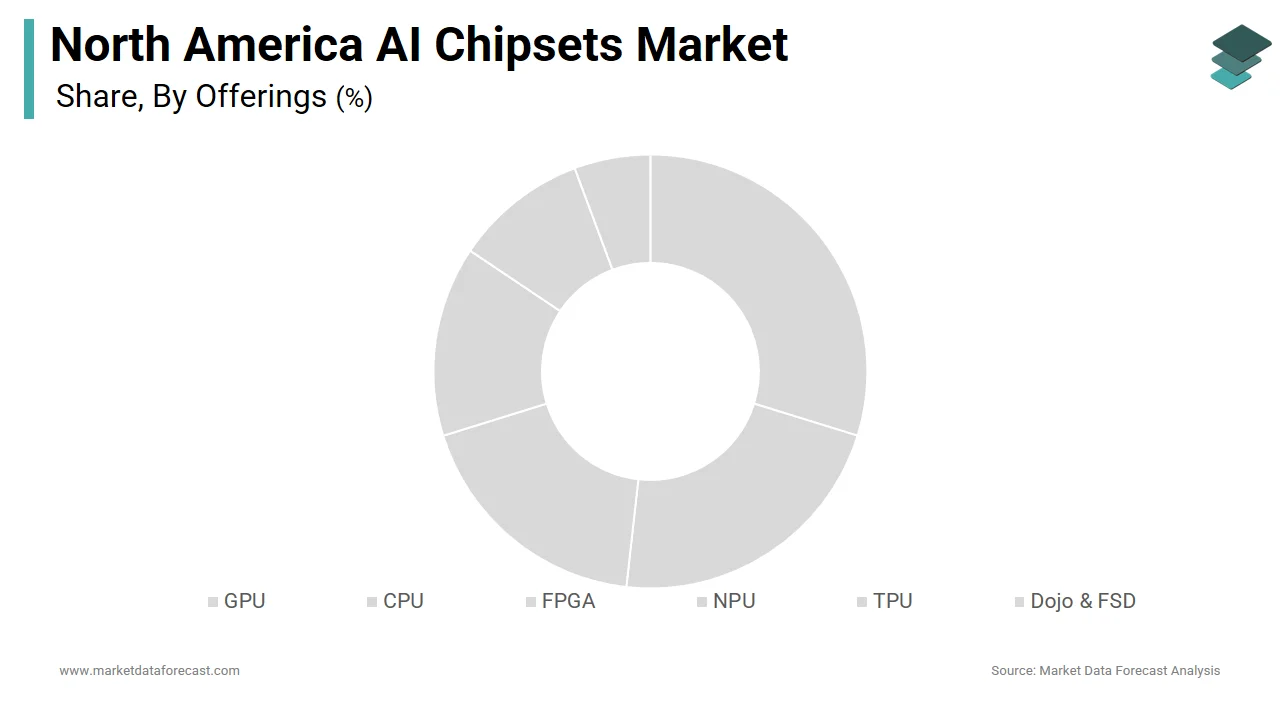
The NPU segment is anticipated to grow with a CAGR of 28.4% from 2026 to 2034 with the proliferation of on-device AI in consumer electronics, where NPUs enable efficient, low-latency inference without relying on cloud connectivity. Apple’s Neural Engine, integrated into every iPhone and iPad since 2017, now handles over 30 trillion operations per second, powering features like real-time photo enhancement, voice recognition, and augmented reality, as detailed in Apple’s 2023 Machine Learning Journal.
By Network Insights
The interconnects segment was the largest by occupying 57.4% of the North America AI chipsets market share in 2024, with the extreme bandwidth and ultra-low latency requirements of AI clusters, where thousands of GPUs or TPUs must communicate seamlessly during model training. NVIDIA’s NVLink and InfiniBand technologies, which deliver data transfer speeds of up to 400 Gbps between processors, are now standard in AI supercomputers, including those at the U.S. Department of Energy’s national labs. According to Oak Ridge National Laboratory, interconnect latency below 1 microsecond is essential to prevent bottlenecks in exascale AI workloads, making high-speed interconnects a non-negotiable component of system design. The National Center for Supercomputing Applications reports that 80% of new AI cluster deployments in 2023 included at least 200 Gbps per node interconnect capacity. Additionally, the integration of smart network interface controllers (SmartNICs) with embedded processing capabilities allows offloading communication tasks from CPUs, further enhancing efficiency.
The NICs (Network Interface Cards) and advanced network adapters segment is lucratively to grow with an expected CAGR of 22.6% from 2026 to 2034 with the increasing deployment of SmartNICs and DPUs (Data Processing Units) that offload AI-related networking, security, and storage tasks from the CPU, improving overall system efficiency. NVIDIA’s BlueField DPUs, for example, are now deployed in over 500,000 server instances across AWS, Oracle Cloud, and financial institutions, handling encryption, virtualization, and AI telemetry with minimal CPU overhead, as confirmed by NVIDIA’s 2023 Data Center Report. The Federal Aviation Administration reports that AI-powered air traffic management systems rely on high-performance NICs to process radar and flight data within 50 milliseconds. In healthcare, hospitals use SmartNICs to stream AI-analyzed medical imaging from operating rooms to cloud platforms without latency-induced errors.
By Function Insights
The inference segment accounted in holding 54.3% of the North America AI chipsets market share in 2024, with a vast number of AI models being deployed in production environments across consumer, industrial, and public sectors. According to the Food and Drug Administration, over 400 AI-enabled medical devices in clinical use rely on inference chips for real-time diagnostics, including ECG analysis and tumor detection. In retail, Walmart’s AI-powered inventory systems use inference processors in over 4,700 stores to monitor shelf stock via camera feeds, reducing out-of-stock incidents by 30%, as documented in its 2023 Sustainability Report. The rise of edge AI has further amplified inference demand. Apple’s on-device Siri processing, Google’s Live Caption, and Tesla’s Autopilot all depend on low-latency inference chips.
The training segment is expected to witness a CAGR of 25.8% during the forecast perio,d owing to the exponential growth in AI model complexity, where models like GPT-4 and Gemini require weeks of computation on thousands of high-performance chips. The Lawrence Berkeley National Laboratory reports that the computational demand for training large language models has doubled every 10 months since 2020, necessitating ever-larger GPU and TPU clusters. Federal initiatives are also fueling demand: the National Science Foundation’s AI Institutes program has funded 25 centers, each requiring multi-petaflop training systems.
COUNTRY-LEVEL ANALYSIS
United States AI Chipsets Market Insights
The United States was the top performer of the North America AI chipsets market with 89.3% of the share in 2024. The Department of Defense’s Replicator initiative, which aimed at fielding thousands of AI-powered drones, relies entirely on domestically developed chipsets, underscoring national security integration. Silicon Valley’s ecosystem of venture capital, talent, and R&D institutions enables rapid prototyping and commercialization, with over 70% of global AI chip patents filed by U.S.-based entities, according to the U.S. Patent and Trademark Office. Federal policies, including the CHIPS and Science Act, have allocated $52 billion to bolster domestic semiconductor manufacturing, with a focus on AI-optimized nodes.
Canada AI Chipsets Market Insights
Canada was positioned next with 11.2% of the North America AI chipsets market share in 2024. While lacking domestic semiconductor fabrication, Canada has established itself as a global leader in AI research, with institutions like the Vector Institute, Mila, and Amii pioneering advancements in deep learning that directly influence chipset requirements. The federal government’s Pan-Canadian AI Strategy, backed by $440 million, supports AI hardware-software co-design projects at universities and startups. Canadian firms like Untether AI and Mythic are developing ultra-efficient inference chips optimized for edge applications in healthcare and industrial automation. The country’s bilingual and privacy-conscious regulatory environment has made it a testbed for ethical AI deployment, influencing chipset design for on-device processing. Natural Resources Canada reports that AI chipsets are now standard in mining and forestry automation systems across remote regions, where connectivity is limited.
COMPETITIVE LANDSCAPE
The competition in the North America AI chipsets market is characterized by a dynamic interplay between technological innovation, ecosystem control, and strategic positioning across public and private sectors. While NVIDIA maintains a dominant foothold through its GPU supremacy and CUDA ecosystem, rivals are challenging its dominance through architectural differentiation and vertical specialization. Intel leverages its manufacturing scale and enterprise relationships to promote open, interoperable AI solutions, while Google and Amazon are deploying custom ASICs to optimize their cloud-native AI services. Startups and specialized firms are carving niches in edge inference, low-power design, and neuromorphic computing, introducing disruptive alternatives to conventional architectures. The battlefield extends beyond raw performance to include software compatibility, energy efficiency, security, and ease of integration. Hyperscalers, automakers, and federal agencies are increasingly acting as co-design partners, demanding chipsets tailored to their unique operational needs. Regulatory emphasis on domestic semiconductor production and AI ethics further influences competitive dynamics, favoring companies with U.S.-based R&D and transparent data practices.
KEY MARKET PLAYERS
Noteworthy Companies dominating the North America AI chipsets market profiled in the report are
- NVIDIA Corporation
- Intel Corporation
- Advanced Micro Devices, Inc.
- Micron Technology, Inc.
- Samsung
- SK HYNIX INC.
- Qualcomm Technologies, Inc.
- Huawei Technologies Co., Ltd.
- Apple Inc.
- Imagination Technologies
- Graphcore
- Cerebras
TOP LEADING PLAYERS IN THE MARKET
- NVIDIA has emerged as the defining force in the North America AI chipsets market by transforming from a graphics-focused semiconductor company into the cornerstone of global artificial intelligence infrastructure. Its GPUs, particularly the data center-grade A100 and H100, have become the de facto standard for training large-scale AI models, powering the majority of hyperscale cloud platforms and research institutions. The company’s CUDA parallel computing platform has created an entrenched ecosystem, enabling developers worldwide to optimize AI workloads efficiently. Beyond hardware, NVIDIA provides end-to-end solutions including AI software stacks, simulation environments, and networking technologies that integrate seamlessly across cloud and edge deployments. Its influence extends into autonomous vehicles, healthcare, and digital twins, where its chipsets enable real-time decision-making.
- Intel has strategically repositioned itself as a comprehensive AI chipset provider, leveraging its legacy in semiconductor manufacturing and enterprise integration to compete in both training and inference domains. Through its Gaudi AI accelerators and integrated AI features in Xeon processors, Intel delivers scalable solutions tailored for data centers, edge computing, and hybrid cloud environments. The company emphasizes openness and interoperability, promoting its oneAPI initiative to reduce dependency on proprietary ecosystems and attract developers seeking vendor-neutral AI development platforms. Intel’s extensive fabrication capabilities and U.S.-based manufacturing investments under the CHIPS Act strengthen its role in national technology security. It also targets specialized markets such as industrial automation and defense, where reliability and long-term support are also important.
- Google has redefined AI hardware innovation through its development of the Tensor Processing Unit (TPU), a custom ASIC designed explicitly for accelerating machine learning workloads within its global infrastructure. Unlike general-purpose chips, TPUs are optimized for the massive matrix operations central to neural network training and inference, enabling Google to run its search, translation, and generative AI services at unprecedented scale and efficiency. The company has extended TPU access to external developers via Google Cloud, influencing the design principles of cloud-native AI computing. Google’s vertical integration by aligning chip architecture with its TensorFlow framework and AI models ensures maximum performance and energy efficiency. Additionally, its Edge TPU enables on-device AI in consumer products, emphasizing privacy and low latency.
TOP STRATEGIES USED BY KEY MARKET PARTICIPANTS
One major strategy employed by leading players is vertical integration of hardware, software, and cloud infrastructure, allowing for end-to-end optimization of AI workloads. Companies like NVIDIA and Google design chipsets in tandem with their software frameworks and cloud platforms by ensuring seamless performance and reducing dependency on third-party tools. This integration enhances developer experience, locks in ecosystem loyalty, and differentiates offerings in a crowded market.
Another key approach is investment in specialized architectures tailored for specific AI functions, such as training, inference, or edge processing. Rather than relying solely on general-purpose processors, firms are developing domain-specific accelerators, TPUs, NPUs, and DPUs that deliver superior efficiency and throughput for targeted applications. This focus on purpose-built silicon enables breakthroughs in power efficiency, latency, and scalability, particularly in data centers and autonomous systems.
The strategic collaboration with government, academia, and industry consortia to shape standards and secure funding is also an important strategy followed by the market key players. Companies influence policy, gain early access to emerging use cases, and position themselves as trusted providers in sectors such as healthcare, defense, and energy by participating in national AI initiatives, open computing projects, and research partnerships.
RECENT MARKET DEVELOPMENTS
- In February 2023, NVIDIA launched the H100 Tensor Core GPU with fourth-generation NVLink, significantly enhancing multi-node AI training performance and expanding its position in data center AI infrastructure.
- In June 2023, Intel began volume production of its Gaudi 2 AI accelerators at its Oregon fabrication plant, which is expanding domestic supply and reinforcing its commitment to U.S.-based AI semiconductor manufacturing.
- In September 2023, Google introduced the TPU v5e, a cost-optimized AI processor for cloud customers with broadening access to its custom silicon and strengthening its position in scalable AI cloud services.
- In January 2024, Amazon Web Services launched Trainium2-powered instances on AWS, offering improved training efficiency for large language models and deepening its AI hardware integration within its cloud ecosystem.
MARKET SEGMENTATION
This North America AI chipsets market research report is segmented and sub-segmented into the following categories.
By Offerings
- GPU
- CPU
- FPGA
- NPU
- TPU
- Dojo & FSD
- Trainium & Inferentia
- Athena ASIC
- T-head
- MTIA
- LPU
- Other ASIC
- Memory
- DRAM
- HBM
- DDR
By Network
- NIC / Network Adapters
- InfiniBand
- Ethernet
- Interconnects
By Technology
- Generative AI
- Rule-Based Models
- Statistical Models
- Deep Learning
- Generative Adversarial Networks (GANs)
- Autoencoders
- Convolutional Neural Networks (CNNs)
- Transformer Models
- Machine Learning
- Natural Language Processing (NLP)
- Computer Vision
By Function
- Training
- Inference
By End-User
- Consumer
- Data Center
- CSP (Cloud Service Providers)
- Enterprises
- Healthcare
- BFSI
- Automotive
- Retail & E-Commerce
- Media & Entertainment
- Government Organizations
- Others
By Country
- United States
- Canada
- Mexico
- Rest of North America