- Product Description Description
- Table of Contents TOC
- List of Table & Figure LOT
- Get Free Sample PDF Sample PDF
Market Size, 2025
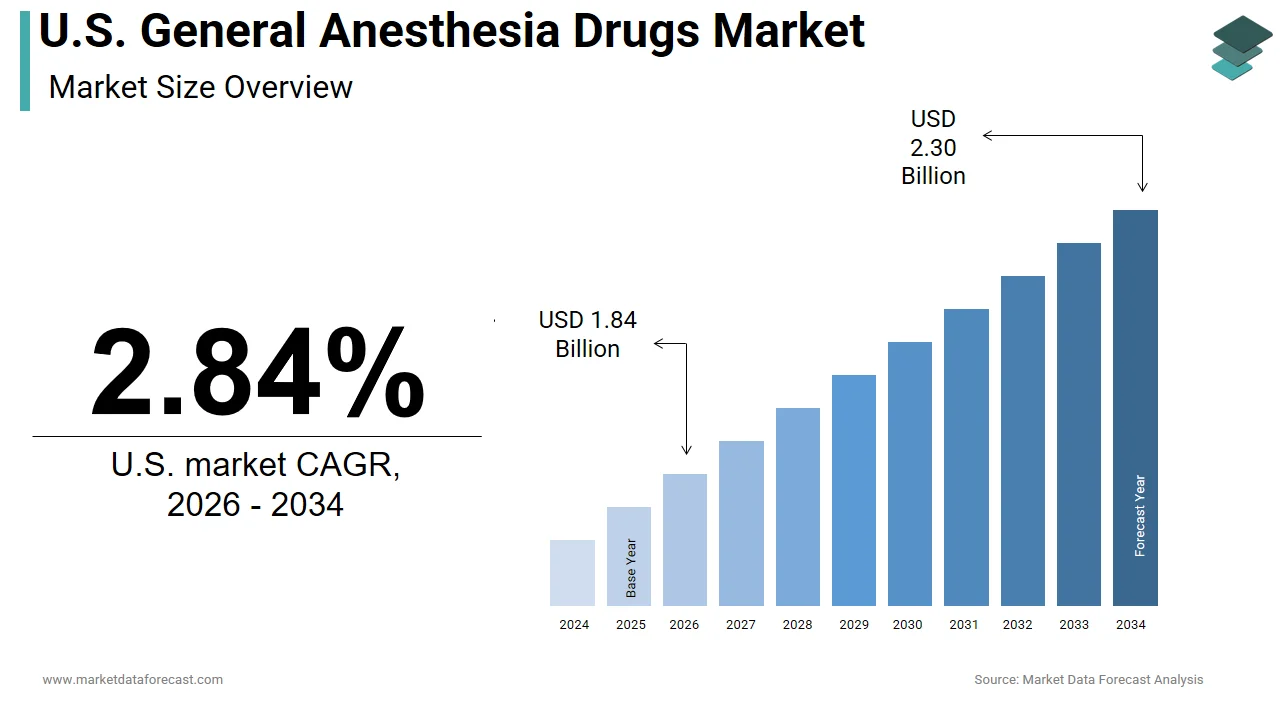
$1.79 BnMarket Estimate, 2026
$1.84 BnMarket Forecast, 2034
$2.30 BnCAGR, 2026–2034
2.84%U.S. General Anesthesia Drugs Market Size
The size of the U.S. general anesthesia drugs market was worth USD 1.79 billion in 2025. The market is anticipated to grow at a CAGR of 2.84% from 2026 to 2034 and be worth USD 2.30 billion by 2034 from USD 1.84 billion in 2026.
General anesthesia drugs are pharmaceutical agents administered to induce reversible loss of consciousness during surgical and diagnostic procedures, ensuring patient immobility, analgesia, and amnesia. These agents, ranging from inhalational gases like sevoflurane to intravenous propofol, are governed by stringent FDA protocols and integrated within hospital formularies across acute care settings. As per the Centers for Disease Control and Prevention, millions of inpatient surgeries were performed in American hospitals, which establishes a foundational clinical volume that directly correlates with anesthetic consumption. According to the Agency for Healthcare Research and Quality, a portion of operating room procedures require general anesthesia, which emphasizes its non-discretionary clinical role. This market operates within a tightly regulated, high-stakes environment where drug efficacy, onset time, and hemodynamic stability dictate clinical preference.
MARKET DRIVERS
Rising Ambulatory Surgical Volumes Fuel Demand for Short-Acting Anesthetic Agents
The escalating volume of ambulatory surgical procedures, which necessitates rapid-onset, short-acting anesthetic agents, accelerates the growth of the U.S. general anesthesia drugs market. According to the American Society of Anesthesiologists, outpatient surgeries now constitute over 70% of all surgical interventions in the United States, a structural shift propelled by cost containment and technological advancements in minimally invasive techniques. This procedural migration demands pharmacokinetic precision: drugs like desflurane and remifentanil, which offer titratable depth and swift emergence, have seen preferential adoption. As per the Ambulatory Surgery Center Association, millions of procedures were conducted in freestanding ambulatory centers in 2022, which intensifies demand for anesthesia agents compatible with same-day discharge protocols. Consequently, manufacturers are reformulating existing molecules and investing in next-generation ultra-short-acting compounds to capture this expanding procedural segment.
Aging Population Increases Surgical Demand and Sustains Anesthesia Drug Utilization
The aging demographic profile of the American population, which inherently elevates surgical susceptibility, boosts the expansion of the U.S. general anesthesia drugs market. As per the U.S. Census Bureau, individuals aged 65 and older constituted a portion of the national population in 2022, a cohort projected to increase by 2040. This segment demonstrates disproportionately higher rates of joint replacements, cardiovascular interventions, and oncological resections, all procedures requiring general anesthesia. As per sources, adults over 65 undergo surgery at a rate higher than younger cohorts, with anesthesia exposure often repeated across multiple episodes. This demographic inevitability compels hospitals to maintain robust inventories of geriatric-compatible anesthetics, those with minimal residual effects and low cardiopulmonary risk, and thereby sustaining consistent procurement volumes and influencing formulary decisions toward agents with superior safety profiles in comorbid populations.
MARKET RESTRAINTS
Supply Chain Fragility and Drug Shortages Hamper Market Growth
The persistent shortage of vital anesthesia agents, driven by fragile, concentrated manufacturing ecosystems, inhibits the growth of the U.S. general anesthesia drugs market. According to the Food and Drug Administration’s Drug Shortage Program, seven distinct general anesthetic drugs experienced active shortages in 2023, including propofol and sevoflurane, owing to raw material scarcity, facility inspections, and logistical disruptions. As per the University of Utah Drug Information Service, a portion of U.S. hospitals reported modifying anesthetic protocols due to supply constraints in the past fiscal year, which forces substitutions that may compromise clinical outcomes or extend recovery times. These shortages are exacerbated by the fact that fewer than five manufacturers dominate production for key molecules, creating systemic vulnerability. Consequently, institutional procurement teams face rationing, price volatility, and operational unpredictability, which affects procedural scheduling and elevates anesthesia-related risk profiles across surgical departments.
Stringent Regulatory and Environmental Compliance Burdens Limit Market Expansion
The intensifying regulatory and pharmacovigilance burden imposed on anesthetic drug manufacturers, particularly concerning post-marketing surveillance and environmental impact, further restricts the expansion of the U.S. general anesthesia drugs market. As per the Environmental Protection Agency, volatile anesthetic gases such as desflurane and isoflurane are classified as potent greenhouse gases, with global warming potentials exceeding 2,000 times that of carbon dioxide per unit mass. Consequently, the American Society of Anesthesiologists mandates waste gas scavenging systems in a portion of operating rooms, which increases facility compliance costs. Simultaneously, the FDA’s Risk Evaluation and Mitigation Strategy program has expanded post-approval monitoring for intravenous anesthetics linked to rare but severe adverse events, including propofol infusion syndrome. These dual burdens elevate operational overhead for manufacturers and hospitals alike, which dampens innovation velocity and constrains formulary flexibility.
MARKET OPPORTUNITIES
Pharmacogenomic Integration Enables Personalized Anesthesia and Precision Medicine
The integration of pharmacogenomic profiling to personalize anesthetic selection reduces adverse event incidence and optimizes recovery kinetics, which in turn opens new opportunities for the U.S. general anesthesia drugs market. According to the National Institutes of Health’s Pharmacogenomics Research Network, genetic polymorphisms in the CYP2B6 and RYR1 genes significantly alter propofol metabolism and susceptibility to malignant hyperthermia, respectively. Institutions such as the Mayo Clinic now routinely screen high-risk surgical candidates for these variants, enabling preemptive drug substitution. As per the Personalized Medicine Coalition, genotype-guided anesthesia could reduce perioperative complications by up to 34% in genetically susceptible subpopulations. This paradigm shift opens avenues for companion diagnostics bundled with proprietary anesthetic formulations, which allows manufacturers to differentiate products through precision medicine claims and secure premium reimbursement under value-based care models emerging across integrated delivery networks.
AI-Enabled and Closed-Loop Anesthetic Delivery Systems Driving Market Expansion
The digitization of intraoperative anesthetic management via closed-loop delivery systems and AI-driven hemodynamic optimization provides fresh opportunities for the expansion of the U.S. anesthesia drugs market. As per the Anesthesia Patient Safety Foundation, real-time titration algorithms integrated with bispectral index monitoring have demonstrated a 27% reduction in intraoperative awareness events and a 19% decrease in postoperative nausea in controlled trials at Massachusetts General Hospital. These systems, which autonomously adjust infusion rates based on neurophysiological feedback, are gaining regulatory traction—with three such platforms receiving FDA 510(k) clearance since 2021. The convergence of machine learning and pharmacokinetic modeling enables predictive dosing that minimizes residual sedation, directly supporting enhanced recovery after surgery protocols. Manufacturers investing in algorithm-enabled delivery devices or partnering with medtech firms stand to capture margin expansion beyond molecule sales, embedding their agents within proprietary digital ecosystems that lock in institutional adoption.
MARKET CHALLENGES
Clinical Inertia and Formulary Resistance Slowing Adoption of New Anesthetic Agents
The clinical inertia surrounding the adoption of newer anesthetic agents due to entrenched formulary preferences and training gaps among anesthesia providers hinders the growth of the U.S. general anesthetic drugs market. According to a survey by the American Association of Nurse Anesthetists, a portion of CRNAs reported institutional resistance to transitioning from legacy agents like isoflurane to newer alternatives such as remimazolam, despite superior pharmacokinetic profiles, due to perceived training burdens and protocol revalidation costs. As per the sources, formulary updates in academic medical centers take several months from FDA approval to broad clinical implementation. This lag not only stifles innovation diffusion but also exposes institutions to suboptimal outcomes, as outdated agents may lack compatibility with modern recovery protocols or carry higher environmental burdens, creating a misalignment between clinical evidence and operational practice.
Pricing Misalignment and Value-Based Reimbursement Constraints
The misalignment between anesthesia drug pricing models and value-based reimbursement frameworks, now dominant in U.S. healthcare, degrades the growth rate of the U.S. general anesthesia drugs market. As per the Health Care Payment Learning & Action Network, a share of surgical episodes were reimbursed under bundled payment models that do not distinguish between anesthetic agents based on clinical outcomes or recovery efficiency. Consequently, hospitals prioritize the lowest acquisition cost over total episode cost, which disincentivizes the adoption of premium-priced agents with superior recovery profiles. This structural disconnect suppresses manufacturer investment in outcome-differentiated molecules and perpetuates volume-driven pricing competition, which affects the market’s capacity to reward innovation tied to enhanced recovery and reduced system-wide resource utilization.
REPORT COVERAGE
| REPORT METRIC | DETAILS |
| Market Size Available | 2025 to 2034 |
| Base Year | 2025 |
| Forecast Period | 2026 to 2034 |
| Segments Covered | By Drug, Route of Administration, Packaging Format, End Use, Application, and Country. |
| Various Analyses Covered | Global, Regional, and Country-Level Analysis, Segment-Level Analysis, Drivers, Restraints, Opportunities, Challenges; PESTLE Analysis; Porter’s Five Forces Analysis, Competitive Landscape, Analyst Overview of Investment Opportunities |
| Countries Covered | New York, Massachusetts, Pennsylvania, Illinois, Ohio, Michigan, Texas, Florida, Georgia, California, Washington, Colorado. |
| Market Leaders Profiled | Baxter International Inc., AstraZeneca, AbbVie Inc., B. Braun Melsungen AG, Fresenius SE & Co. KGaA, Pfizer, Hospira Inc., Aspen Pharmacare Holdings Limited, Hikma Pharmaceuticals plc, Abbott Laboratories, and others. |
SEGMENTAL ANALYSIS
By Drug Insights
The propofol segment dominated the U.S. general anesthesia drugs market by accounting for 58.5% share in 2024. Its unmatched pharmacokinetic profile, rapid onset (under 40 seconds), and ultra-short duration (5–10 minutes), which makes it the gold standard for both induction and maintenance in high-turnover procedural environments, drives the growth of the propofol segment in the global market. According to sources, a portion of outpatient surgeries in hospital-affiliated centers utilize propofol-based regimens due to its titratability and minimal hangover effect. Its dominance is further entrenched by generic availability since 2018, which reduced per-dose cost.
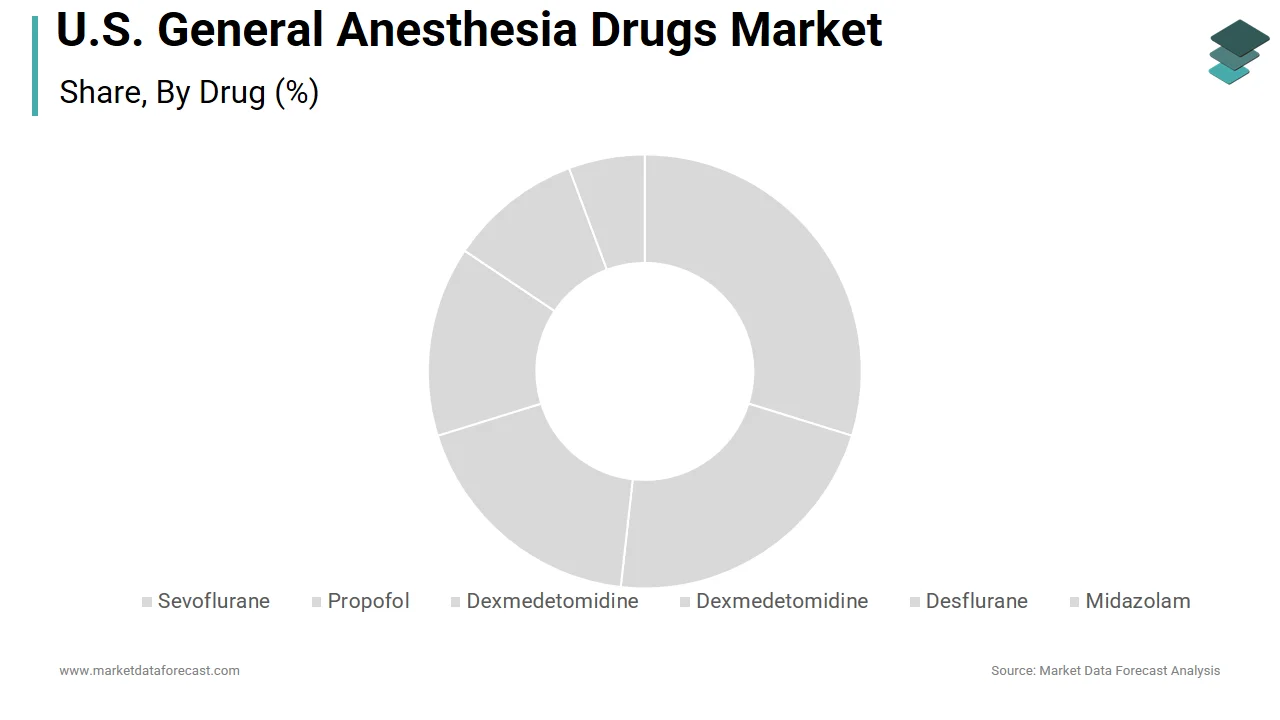
The sevoflurane segment is likely to experience the fastest CAGR of 6.8% from 2025 to 2033 due to factors such as expanding pediatric and geriatric applications, where inhalational induction remains clinically preferred. As per the Journal of the American Medical Association Pediatrics, a portion of pediatric anesthesiologists select sevoflurane for mask induction due to its non-pungent odor and hemodynamic stability, an important factor in children under 6, who constitute a share of anesthesia cases annually, as per the CDC. Furthermore, the Veterans Health Administration mandated sevoflurane as first-line for veterans undergoing non-cardiac surgery by citing reduced delirium incidence compared to IV agents. This institutional endorsement, coupled with next-generation low-flow vaporizer compatibility, reducing agent waste as measured by the Anesthesia Quality Institute, fuels its accelerated adoption trajectory.
By Route of Administration Insights
The intravenous administration segment was the largest segment and held a significant share of the U.S. general anesthesia drugs market in 2024. The growth of the intravenous administration segment is primarily due to its seamless integration into modern procedural workflows, particularly in ambulatory and minimally invasive settings. As per research, a portion of ASCs use IV-based total intravenous anesthesia protocols, citing faster turnover times. Besides, as per research, a lower incidence of postoperative nausea and vomiting with IV propofol versus volatile agents, which strengthens clinical preference. The logistical advantage is equally decisive: IV agents require no capital-intensive vaporizers or scavenging systems, which reduces facility setup costs per OR suite.
The inhaled anesthesia segment is on the rise and is expected to be the fastest-growing segment in the global market by witnessing a CAGR of 7.1% during the forecast period. Technological innovation in low-flow and closed-circuit delivery systems that mitigate environmental and cost concerns is boosting the expansion of the inhaled anesthesia segment in the global market. The Environmental Protection Agency’s 2023 Greenhouse Gas Inventory attributes a reduction in OR-related anesthetic gas emissions since 2019 to the adoption of these systems, which cut agent consumption by up to 70%. Simultaneously, the Society for Ambulatory Anesthesia’s Clinical Guidelines endorse sevoflurane for specific high-risk populations, such as morbidly obese patients, where IV access is challenging and inhalational titration offers superior hemodynamic control. According to sources, there has been a year-over-year increase in sevoflurane utilization for bariatric procedures.
By End-Use Insights
In 2024, the hospitals segment led the U.S. general anesthesia drugs market by occupying a substantial share 2024. The dominance of the hospitals segment is propelled by the hospitals handling a notable share of all inpatient surgeries, including high-acuity cases like cardiothoracic, neurosurgical, and trauma interventions that mandate complex as well as multi-agent general anesthesia. The Agency for Healthcare Research and Quality’s 2023 Procedure Volume Report confirms that hospitals performed 38.2 million anesthesia-supported procedures last year, more than triple the volume of ASCs. Furthermore, hospital pharmacies maintain formulary control over high-cost reversal agents and adjuvant narcotics, such as sugammadex and remifentanil, that are rarely stocked in freestanding centers. The Joint Commission’s 2024 Medication Management Standards also mandate hospital-specific anesthesia protocols for ICU-intubated patients, adding another 12% to institutional drug utilization unrelated to ORs, as per the Society of Critical Care Medicine’s National ICU Drug Utilization Audit.
The Ambulatory Surgical Centers segment is expected to exhibit a noteworthy CAGR of 8.3% over the forecast period. The rapid expansion of the Ambulatory Surgical Centers segment is fueled by payer-driven migration of orthopedic, ophthalmic, and gastrointestinal procedures out of hospitals. UnitedHealthcare’s 2023 Site-of-Service Policy Update mandates 30% lower reimbursement for hospital-based colonoscopies versus ASCs, directly incentivizing procedural shifts. As per the GI Society’s 2024 Benchmarking Study, ASCs perform 61% of all screening colonoscopies in the U.S., up from 44% in 2019, each requiring short-acting IV anesthesia. Furthermore, Medicare’s ASC Covered Procedures List expanded in 2023 to include total knee arthroplasty, triggering a 200% YoY increase in joint replacement volume at certified centers, as per the Medicare Payment Advisory Commission. This procedural expansion, coupled with CRNA-led anesthesia models reducing per-case cost, as per the American Association of Nurse Anesthetists, supports ASCs’ disproportionate growth in anesthesia drug demand.
REGIONAL ANALYSIS
The U.S. general anesthesia drugs market remained dominant in 2024. The prominence of the U.S. is primarily driven by structural healthcare intensity. Large numbers of both inpatient and outpatient surgeries contribute to the consistent need for anesthesia across the healthcare system, according to studies. Premium reimbursement policies for newer drug options further strengthen demand in the U.S., as per research. No other country in the region matches its scale of medical operations, regulatory depth, or speed of adopting innovations.
COMPETITIVE LANDSCAPE
The U.S. general anesthesia drugs market exhibits oligopolistic intensity, where a handful of vertically integrated players compete not on price alone but through clinical differentiation, supply chain reliability, and digital integration. Competition centers on pharmacokinetic superiority, environmental sustainability, and seamless interoperability with hospital systems. Players increasingly bypass traditional sales models by co-developing protocols with anesthesia groups and embedding analytics into delivery devices. Regulatory agility separates leaders from followers; those who preempt FDA and EPA mandates gain institutional trust during shortages or safety crises. Innovation is no longer confined to molecules; it spans delivery mechanisms, waste reduction, and outcome prediction, transforming anesthesia from a commodity service into a data-optimized clinical pathway governed by strategic partnerships rather than transactional procurement.
KEY MARKET PLAYERS
Some of the companies that are playing a dominating role in the U.S. general anesthesia drugs market include
- Baxter International Inc.
- AstraZeneca
- AbbVie Inc.
- Braun Melsungen AG
- Fresenius SE & Co. KgaA
- Pfizer
- Hospira Inc.
- Aspen Pharmacare Holdings Limited
- Hikama Pharmaceuticals plc
- Abbott Laboratories
Top Players in the U.S. General Anesthesia Drugs Market
- Fresenius Kabi remains deeply embedded in the anesthesia ecosystem through its vertically integrated portfolio spanning propofol emulsions, neuromuscular blockers, and infusion systems. The company introduced a new lipid emulsion platform that improves propofol stability and patient comfort. It also expanded its U.S. manufacturing capacity to address potential supply chain issues. Fresenius collaborated with technology firms to integrate drug libraries into smart pumps, which helps streamline clinical workflows and minimize dosing errors in busy surgical settings.
- Pfizer, via its legacy Hospira acquisition, commands influence through branded and generic injectables including its flagship propofol formulation. The company supported its dominance by launching advanced clinical trials for a next-generation sedative option in the United States. It also enhanced its manufacturing facility to align with updated regulatory standards for sterile production. Working with surgical centers, Pfizer introduced cost-efficient bundled anesthesia solutions that support value-based care models and deepen long-term institutional partnerships.
- Baxter International sustains relevance through its anesthesia delivery systems and complementary drug portfolio, notably sevoflurane and adjuvant analgesics. The company integrated real-time pharmacokinetic technology into its infusion platform in the United States to enable personalized anesthetic control. It also received regulatory approval for an eco-friendly vaporizer adapter designed to lower environmental emissions in operating rooms. Baxter’s educational programs have trained clinicians on precision dosing methods by strengthening its relationships with healthcare institutions. In partnership with rural hospital networks, the company ensures consistent product availability during supply disruptions, which supports reliability across the system.
Top Strategies Used by Key Market Participants
Leading anesthesia drug manufacturers deploy precision lifecycle management, extending product relevance through formulation enhancements and delivery innovations rather than relying solely on patent cliffs. They embed clinical decision support directly into hospital workflows via interoperable smart pump and EHR integrations, reducing substitution risk. Strategic facility investments target regulatory resilience, preempting FDA actions through upgraded aseptic manufacturing and environmental controls. Collaborative pharmacoeconomic modeling with payers and providers justifies premium pricing by quantifying total episode cost savings. Finally, proactive pharmacovigilance and provider education programs mitigate safety-related formulary exclusions, which ensures uninterrupted clinical adoption even amid safety alerts or black box warnings.
MARKET SEGMENTATION
This research report on the U.S. general anesthesia drugs market has been segmented and sub-segmented into the following categories.
By Drug
- Sevoflurane
- Propofol
- Dexmedetomidine
- Remifentanil
- Desflurane
- Midazolam
- Others (Sufentanil, Fentanyl, Ketamine, Isoflurane, Thiopental, etc.)
By Route of Administration
- Intravenous
- Inhaled
By End Use
- Hospitals
- Ambulatory Surgical Centers
- Others
By Application
- Heart Surgeries
- Cancer
- General Surgery
- Knee and Hip Replacements
- Others
By Country
- New York
- Massachusetts
- Pennsylvania
- Illinois
- Ohio
- Michigan
- Texas
- Florida
- Georgia
- California
- Washington
- Colorado