- Product Description Description
- Table of Contents TOC
- List of Table & Figure LOT
- Get Free Sample PDF Sample PDF
Market Size, 2025
$1.42 TnMarket Estimate, 2026
$1.50 TnMarket Forecast, 2034
$2.26 TnCAGR, 2026–2034
5.30%U.S. Infrastructure Market Report Summary
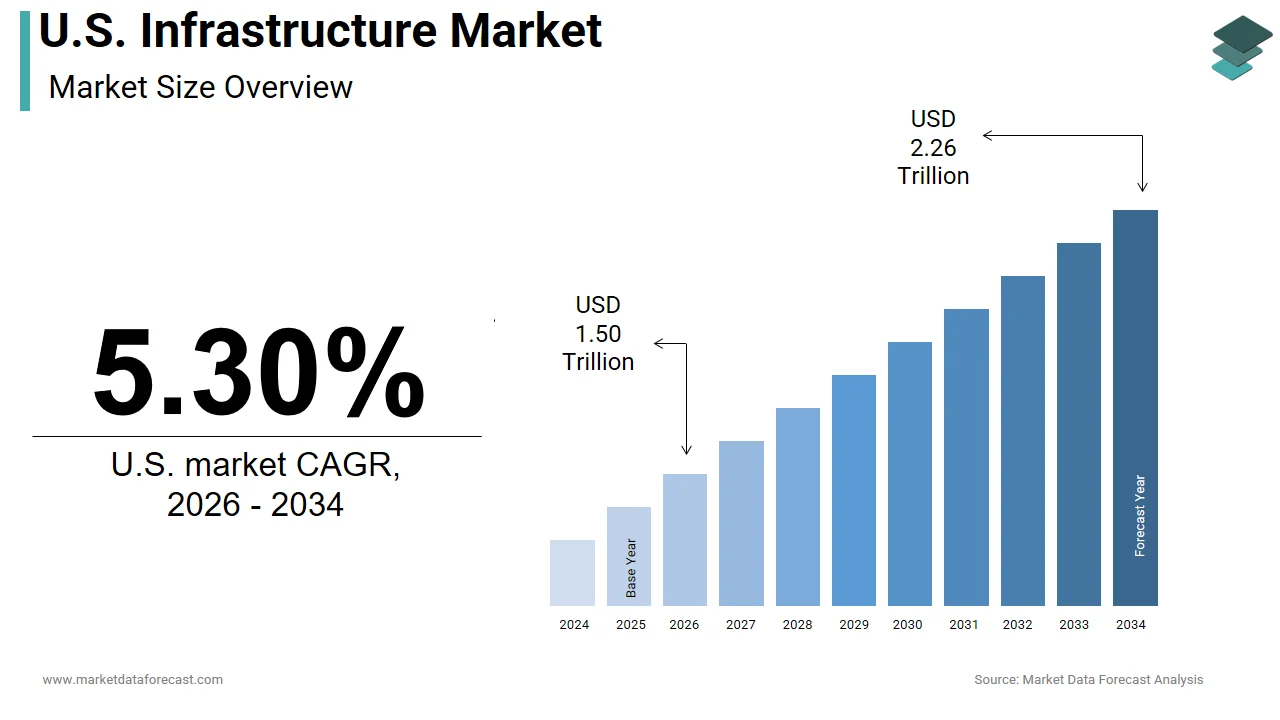
The U.S. infrastructure market was valued at USD 1.42 trillion in 2025, is estimated to reach USD 1.50 trillion in 2026, and is projected to reach USD 2.26 trillion by 2034, growing at a CAGR of 5.30% from 2026 to 2034. The growth of the U.S. infrastructure market is driven by rising government investments in transportation and energy projects, advancements in construction technology, and federal funding initiatives such as the Infrastructure Investment and Jobs Act (IIJA) aimed at revitalizing the nation’s aging infrastructure.
Key Market Trends
- Increased federal and state-level funding allocations for transportation, renewable energy, and water systems.
- Growing adoption of digital construction technologies such as BIM (Building Information Modeling) and IoT-based project monitoring.
- Rising demand for sustainable and climate-resilient infrastructure to mitigate environmental impacts.
- Expansion of public-private partnerships (PPP) to accelerate infrastructure modernization.
- Strong focus on smart city development and integration of green construction materials and renewable energy solutions.
Segmental Insights
- Based on infrastructure, the transportation infrastructure segment held the largest share of the U.S. infrastructure market in 2024, driven by substantial investments in roads, bridges, airports, and rail systems under national infrastructure improvement programs.
- Based on construction type, the new construction segment accounted for 58.6% of the U.S. infrastructure market share in 2024, supported by large-scale projects in renewable energy facilities, commercial complexes, and logistics infrastructure.
- Based on investment source, the public funding segment dominated the market in 2024, as federal and state governments continue to prioritize long-term economic resilience and job creation through large infrastructure investments.
Competitive Landscape
The U.S. infrastructure market is dominated by major engineering, construction, and project management firms that focus on large-scale and high-value projects across transportation, energy, and utility sectors. These companies are increasingly integrating digital technologies, modular construction, and sustainability-focused strategies to enhance project delivery efficiency. Key players in the U.S. infrastructure market include Bechtel Corporation, AECOM, Fluor Corporation, Kiewit Corporation, American Tower Corporation, and Quanta Services, Inc.
U.S. Infrastructure Market Size
The U.S. infrastructure market was valued at USD 1.42 trillion in 2025, is estimated to reach USD 1.50 trillion in 2026, and is projected to reach USD 2.26 trillion by 2034, growing at a CAGR of 5.30% from 2026 to 2034.
The infrastructure is foundational physical and institutional systems that enable economic activity, ensure public safety, and sustain societal well-being. As per the Federal Highway Administration, more than one in four bridges in the national inventory are classified as either structurally deficient or functionally obsolete.
MARKET DRIVERS
Accelerating Climate Resilience Investment Is Driving Infrastructure Modernization
The escalating incidence of extreme weather events is driving infrastructure planning and capital allocation priorities across federal and state agencies is driving the growth of the U.S. infrastructure market. The White House Council on Environmental Quality affirms that each dollar invested in resilience measures prior to disaster occurrence yields an average return of six dollars in avoided recovery expenditures.
Emergence of Advanced Materials and Modular Construction Techniques Presents Transformative Potential
The deployment of next-generation materials and prefabricated structural systems is expected to boost the growth of the U.S. infrastructure market. The Department of Energy confirms that asphalt mixes embedded with self-healing polymers have decreased pavement maintenance frequency by 32% in field trials conducted across five states. These technological advancements are transitioning from experimental pilots to institutionalized best practices, which is empowering public agencies to maximize the impact of constrained budgets while simultaneously elevating performance standards and sustainability outcomes.
MARKET RESTRAINTS
Public Sector Workforce Shortages Are Constraining Project Execution Capacity
The shortage of skilled labor across engineering, construction, and maintenance disciplines is emerging as a primary impediment to the timely execution of infrastructure initiatives, which is restraining the growth of the U.S. infrastructure market. As per the National Institute of Building Sciences, workforce gaps have contributed to an average delay of eighteen months in commencing federally funded infrastructure projects.
Persistent Regulatory Fragmentation Across Jurisdictions Impedes Project Scalability
The lack of standardized permitting, environmental review, and procurement protocols across federal, state, and local authorities imposes substantial delays and cost overruns on infrastructure development, which is significantly degrading the growth of the U.S. infrastructure market. As per the U.S. Chamber of Commerce, regulatory inefficiencies inflate total project costs by an average of twenty-nine % due to prolonged financing, labor standby, and redesign obligations. This institutional dissonance is not an operational inefficiency but a systemic constraint that undermines national productivity, discourages private investment, and dilutes the effectiveness of federal appropriations by stretching project timelines beyond viable economic and political planning horizons.
REPORT COVERAGE
| REPORT METRIC | DETAILS |
| Market Size Available | 2025 to 2034 |
| Base Year | 2025 |
| Forecast Period | 2026 to 2034 |
| Segments Covered | By Infrastructure, Construction Type, Investment Source, and Region. |
| Various Analyses Covered | Global, Regional, and Country-Level Analysis, Segment-Level Analysis, Drivers, Restraints, Opportunities, Challenges; PESTLE Analysis; Porter’s Five Forces Analysis, Competitive Landscape, Analyst Overview of Investment Opportunities |
| Countries Covered | New York, Massachusetts, Pennsylvania, Illinois, Ohio, Michigan, Texas, Florida, Georgia, California, Washington, Colorado. |
| Market Leaders Profiled | China State Construction Engineering Corp., China Railway Group Ltd, China Railway Construction Corp., VINCI SA, ACS Group, and Others. |
SEGMENTAL ANALYSIS
By Infrastructure Insights
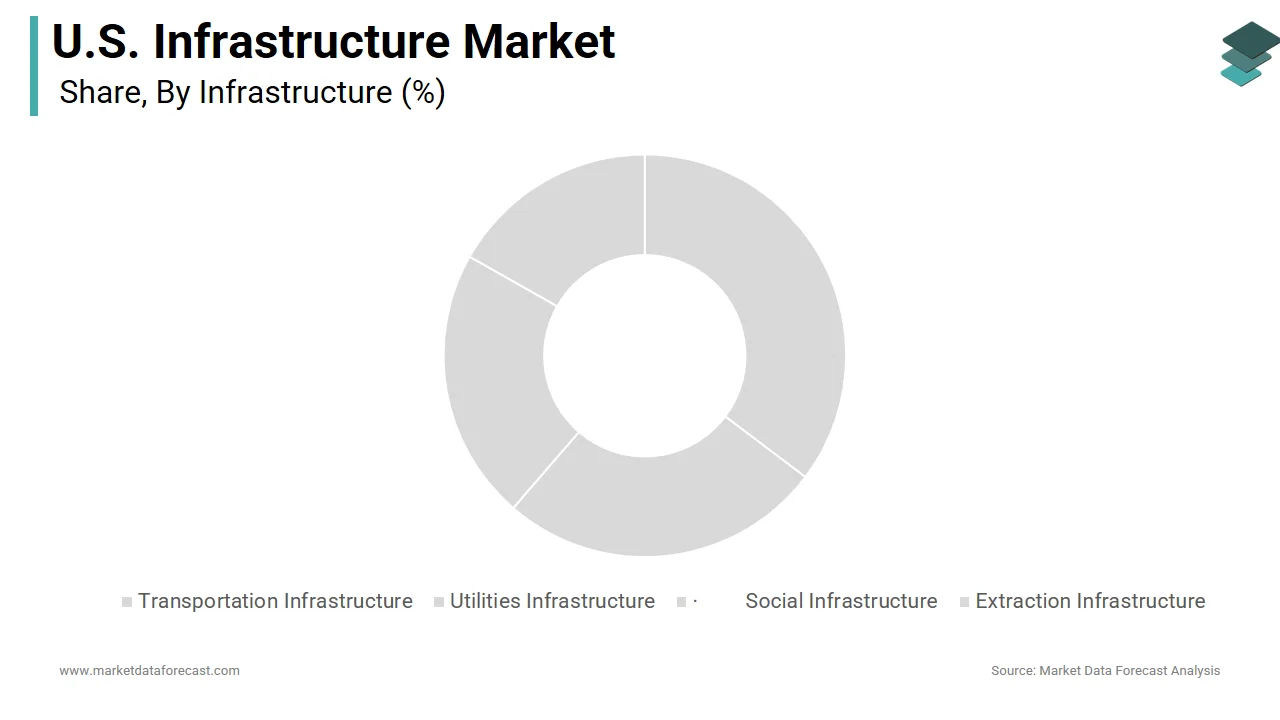
The transportation infrastructure segment was the largest and held a significant share of the U.S. infrastructure market in 2025, with the statutory prioritization of surface transportation networks under federal law. Many states have raised fuel taxes or implemented vehicle mileage fees since fifteen to supplement federal funding, which is demonstrating bipartisan consensus on transportation as the anchor of infrastructure investment.
The utilities infrastructure segment is expected to grow with an anticipated CAGR of 7.8% in next coming years. Simultaneously, the North American Electric Reliability Corporation mandates that utilities deploy advanced grid monitoring systems by 2027 to meet new resilience benchmarks, triggering a wave of digital infrastructure investment.
By Construction Type Insights
The new construction segment accounted in holding 58.6% of the U.S. infrastructure market share in 2024, with the federally backed mega projects such as the Gateway Tunnel between New York and New Jersey. Additionally, the Bureau of Economic Analysis confirms that greenfield industrial and logistics infrastructure investment rose by 21% year over year, spurred by reshoring initiatives and e-commerce logistics demand.
The renovation segment is lucratively growing with an esteemed CAGR of 9.2% from 2025 to 2033, with systemic deterioration, legal obligations, and resilience mandates that transform renovation from a cost center to a strategic investment imperative.
By Investment Source Insights
The public funding segment held a dominant share of the U.S. infrastructure market in 2024, with the constitutional and statutory obligations that designate infrastructure as a core function of government in transportation, water, and public safety systems. These institutional, legal, and fiscal mechanisms ensure that public investment remains the primary engine of infrastructure development.
The private infrastructure investment segment is on the rise and expected to grow with a CAGR of 12.4% in next coming years with the proliferation of public-private partnerships and the monetization of toll-based and user fee-supported assets. Additionally, the National League of Cities documents that municipalities are increasingly leasing or selling underutilized public assets such as parking systems and broadband networks to private operators, generating upfront capital for reinvestment.
COMPETITIVE LANDSCAPE
KEY MARKET PLAYERS
Some of the companies that are playing a dominating role in the U.S. infrastructure market include
- Bechtel Corporation
- AECOM
- Fluor Corporation
- Kiewit Corporation
- American Tower Corporation
- Quanta Services, Inc.
Top Players in the Market
- AECOM operates as a leading infrastructure consulting and engineering firm across the United States with deep involvement in transportation, water, and energy systems. The company has expanded its footprint in the Asia Pacific region by securing major contracts for metro rail systems in India and flood resilience projects in Indonesia. It also established a regional innovation center in Singapore to develop digital twin technologies for urban infrastructure. These actions reinforce its technical dominance and regional responsiveness while aligning global expertise with localized execution needs in rapidly urbanizing Asia Pacific economies.
- Bechtel maintains a formidable presence in U.S. infrastructure through mega projects in transportation, nuclear energy, and water treatment. In the Asia Pacific, it is actively engaged in constructing high-speed rail in Taiwan and modernizing port facilities in Australia. These initiatives reflect its strategy of embedding institutional knowledge within regional markets while leveraging U.S.-based project management excellence to deliver complex, capital-intensive infrastructure programs across the Pacific Rim.
- Fluor Corporation delivers large-scale infrastructure projects in the United States focused on transportation, power generation, and government facilities. In the Asia Pacific, Fluor supports liquefied natural gas terminals in Papua New Guinea and renewable energy grid integration in South Korea. It also formed a joint venture with a Thai engineering firm to bid on upcoming mass transit contracts in Bangkok. These moves demonstrate its commitment to technological standardization and local partnership models that strengthen execution reliability and deepen market penetration in high-growth Asia Pacific infrastructure corridors.
MARKET SEGMENTATION
This research report on the U.S. infrastructure market has been segmented and sub-segmented into the following categories.
By Infrastructure
- Transportation Infrastructure
- Utilities Infrastructure
- Social Infrastructure
- Extraction Infrastructure
By Construction Type
- New Construction
- Renovation
By Investment Source
- Public
- Private
By Country
- New York
- Texas
- Florida
- Georgia
- California
- Rest of U.S.