- Product Description Description
- Table of Contents TOC
- List of Table & Figure LOT
- Get Free Sample PDF Sample PDF
Market Size, 2025
$2.46 BnMarket Estimate, 2026
$2.63 BnMarket Forecast, 2034
$4.45 BnCAGR, 2026–2034
6.8%Executive Summary: U.S. Mass Spectrometry Market
- Market Scope: Comprehensive market assessment of the U.S. mass spectrometry sector, tracking hybrid and single-system technologies, diverse application verticals, and country-level regulatory frameworks.
- Market Valuation: Valued at USD 2.46 billion in 2025, estimated at USD 2.63 billion in 2026, and projected to reach USD 4.45 billion by 2034, registering a robust CAGR of 6.8% from 2026 to 2034.
- Primary Growth Drivers: Escalating global pharmaceutical R&D spending, stringent medication safety regulations, rigorous food quality controls, expansion in shale gas and crude oil output, and broadened government pollution monitoring initiatives.
Key Market Segment Metrics (2026–2034)
| Category | Leading Segment Position | Fastest-Growing / Key Growth Segment |
|---|---|---|
| By Technology | Hybrid Mass Spectrometry (led by Triple Quadrupole/Tandem & Q-TOF systems optimized for complex biomolecular analysis) | Single Mass Spectrometry (expanding via compact Ion Trap, Quadrupole, and TOF configurations for routine workflows) |
| By Application | Pharmaceutical Applications (anchored by drug discovery, quality assurance, and clinical proteomic testing) | Environmental Testing & Food Safety (surging due to strict pollution controls and public health directives) |
| By Country | The United States (held the majority market share supported by advanced analytical infrastructure and FDA guidelines) | Shale gas, crude oil production hubs, and clinical diagnostic labs deploying rapid MALDI-MS platforms |
Major Market Players & Market Structure
Market Structure: Highly competitive landscape defined by leading technological innovators delivering advanced resolution systems, high-throughput clinical diagnostic tools, and specialized industrial monitoring equipment.
Key Companies: Thermo Fisher Scientific, Sciex, Agilent Technologies, Waters Corporation, Shimadzu Corporation, Bruker, PerkinElmer, Jeol, Flir Systems, MKS Instruments, Analytik Jena, Hiden Analytical, Dani Instruments, Rigaku, Leco, Kore Technology, Extrel CMS, Masstech, Ametek Process Instruments, and Advion.
 Download Free Sample Report
U.S. Mass Spectrometry Market Size
The U.S. mass spectrometry market was valued at USD 2.46 billion in 2025. The market is estimated at USD 2.63 billion in 2026 and is projected to reach USD 4.45 billion by 2034, growing at a CAGR of 6.8% from 2026 to 2034.
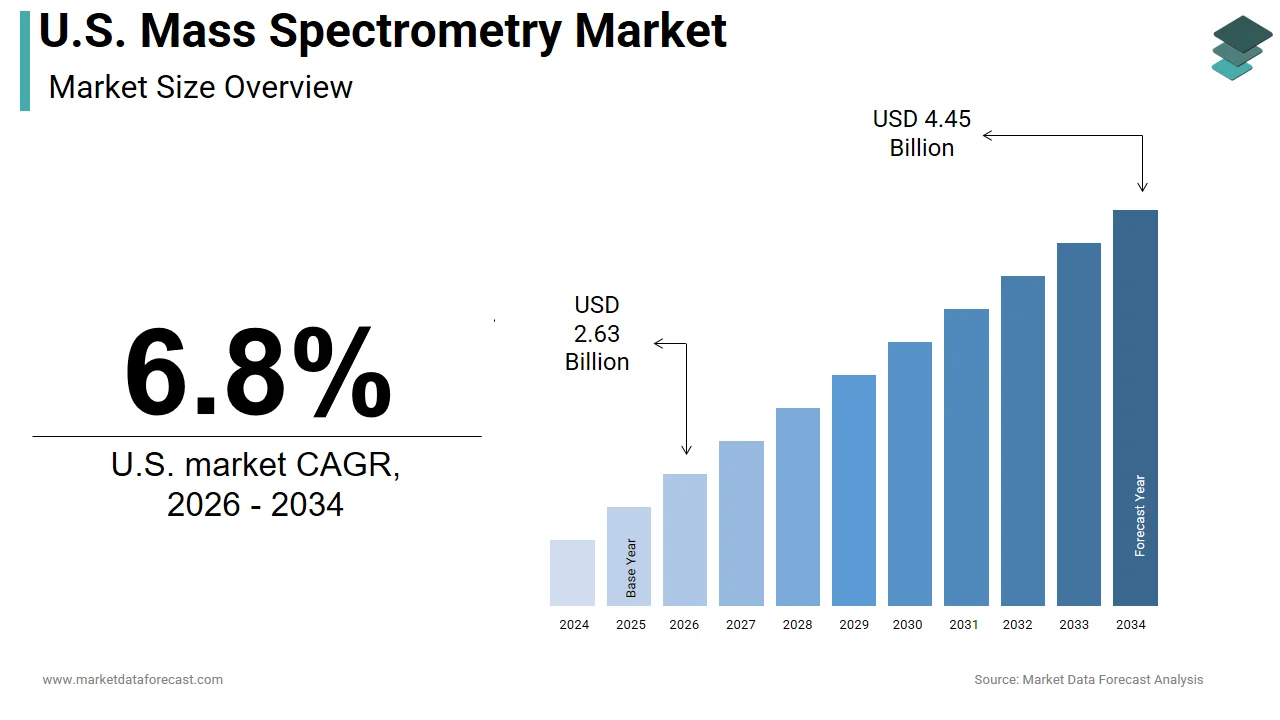
Increasing global spending on pharmaceutical R&D, government restrictions on medication safety, a rising focus on food quality, a rise in crude and shale gas production, and expanding government programs for pollution control and environmental testing are all growth factors for the U.S. Mass spectrometry market throughout the forecast period. In addition, increased research & development investment is predicted to boost demand for mass spectrometers in drug development, proteomics, and pharmaceuticals propelling the market forward. MALDI-ToF mass spectrometry is a clinical diagnostic platform that uses an advanced approach to protein pattern recognition to identify diseases. As a result, the U.S. Mass Spectrometry Market will likely increase throughout the forecast period, owing to rising technological improvements.
COVID-19 Impact on the U.S. Mass Spectrometry Market:
The COVID-19 virus outbreak began in December 2019 and has spread to more than 100 nations worldwide, prompting the World Health Organization to declare it a public health emergency. The unexpected COVID-19 outbreak has had a substantial impact on the mass spectrometry market. Mass spectroscopy is widely used for testing in the healthcare and pharmaceuticals, biological research, and food and beverage sectors. The pharma industry's need for safety and quality standards has grown due to new drug research, drug repurposing, and increased manufacturing of pharma formulations. Government requirements and a growing requirement for quality maintenance in these industries drive mass spectrometry adoption. One of the most powerful technologies for analyzing chemical and biological substances is mass spectrometry. As a result, the market is driven by the increased demand for COVID-19 from the biotechnology and pharmaceutical sectors.
This market research report on the U.S. mass spectrometry market has been segmented and sub-segmented into the following categories.
By Technology:
- Hybrid mass Spectrometry
- Triple Quadrupole (Tandem)
- Quadrupole TOF (Q-TOF)
- FTMS (Fourier Transform Mass Spectrometry)
- Single Mass Spectrometry
- Ion Trap
- Quadrupole
- Time-Of-Flight (TOF)
- Other Mass Spectrometry
By Application:
- Pharmaceutical Applications
- Biotech Applications
- Petrochemical Applications
- Environmental Testing
- Food & Beverage Testing
- Other Applications
By Country:
- The United States
With the presence of advanced technology and advantageous government funding programs for research studies that employ mass spectrometry, the United States holds the majority of its share. The Food and Drug Administration (FDA) in the United States supports using analytical tools to guarantee that pharmaceutical items on the market meet quality standards. With far more oil fields, the United States has experienced a large growth in shale gas and crude oil production, which has led to a rise in analytical equipment such as mass spectrometers. Inadequate testing resources have hampered responding to the COVID-19 epidemic in the United States. As a result, technologies like matrix-assisted laser desorption /ionization coupled with mass spectrometry (MALDI-MS) are employed to give faster and less expensive diagnoses, which is expected to increase demand throughout the forecast period.
KEY MARKET PLAYERS:
A few of the leading companies operating in the U.S. mass spectrometry market profiled in this report are Thermo Fisher Scientific, Sciex, Agilent Technologies, Waters Corporation, Shimadzu Corporation, Bruker, PerkinElmer, Jeol, Flir Systems, MKS Instruments, Analytik Jena, Hiden Analytical, Dani Instruments, Rigaku, Leco, Kore Technology, Extrel CMS, Masstech, Ametek Process Instruments, and Advion.