- Product Description Description
- Table of Contents TOC
- List of Table & Figure LOT
- Get Free Sample PDF Sample PDF
Market Size, 2025
$34.54 BnMarket Estimate, 2026
$36.42 BnMarket Forecast, 2034
$55.64 BnCAGR, 2026–2034
5.44%U.S. Plywood Market Report Summary
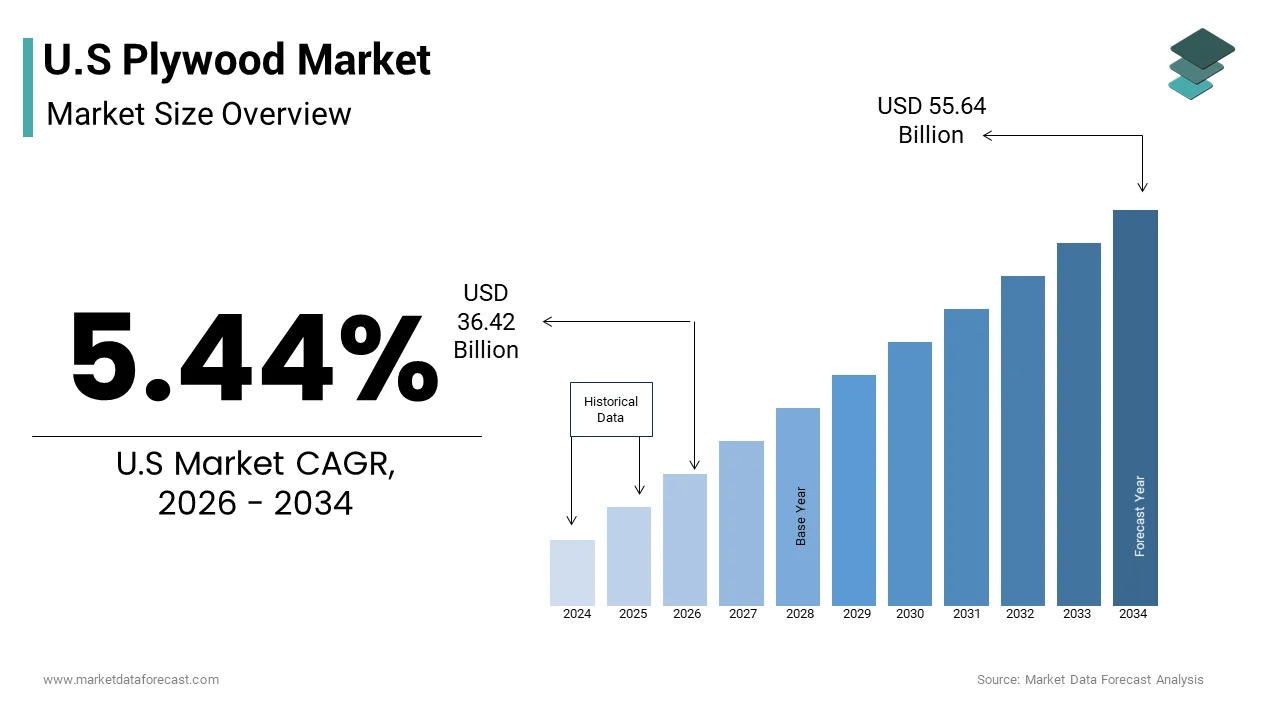
The U.S. plywood market size was valued at USD 34.54 billion in 2025, is anticipated to reach USD 36.42 billion in 2026, and is projected to reach USD 55.64 billion by 2034, growing at a CAGR of 5.44% during the forecast period from 2026 to 2034. The growth of the U.S. plywood market is driven by rising residential and commercial construction activity, increasing demand for sustainable and durable building materials, and the expansion of the furniture and interior design sectors across the country.
Key Market Trends
- Rising demand for eco-friendly and formaldehyde-free plywood to meet green building standards.
- Increasing use of engineered wood panels in modern residential construction and modular furniture.
- Growing preference for lightweight yet durable plywood in furniture, cabinetry, and interior design.
- Expansion of DIY and home renovation activities boosting plywood consumption in household projects.
- Technological advancements in plywood manufacturing processes, improving quality and structural performance.
Segmental Insights
- Based on type, the softwood segment held the largest share of the U.S. plywood market in 2024, attributed to its widespread use in residential and commercial construction, as well as packaging and industrial applications, due to its strength, affordability, and ease of availability.
- Based on application, the construction segment dominated the market in 2024, driven by increasing demand for plywood in flooring, roofing, wall sheathing, and formwork applications across both new builds and renovation projects.
Competitive Landscape
The U.S. plywood market is moderately consolidated, with key players focusing on expanding production capacity, improving product sustainability, and developing value-added engineered wood panels. Strategic initiatives include investments in technology upgrades, product innovation, and distribution network expansion to strengthen market presence. Prominent players in the U.S. plywood market include Georgia Pacific LLC, Potlatch Corporation, Weyerhaeuser, Boise Cascade Company, UPM-Kymmene Corporation, Sveza, Metsa Wood, Austral Plywoods Pty Ltd, Eksons Corporation Bhd, Greenply Industries Ltd., Century Plyboards Ltd., and Austin Ply.
U.S Plywood Market Size
The U.S plywood market size was valued at USD 34.54 billion in 2025 and is anticipated to reach USD 36.42 billion in 2026 to reach USD 55.64 billion by 2034, growing at a CAGR of 5.44% during the forecast period from 2026 to 2034.
MARKET OVERVIEW
Plywood is an engineered wood manufactured by stacking and gluing together thin sheets of wood veneer. This structural material serves as a fundamental component in residential construction, commercial building, and industrial packaging due to its high strength to weight ratio and dimensional stability. The market is intrinsically linked to the health of the housing industry and broader infrastructure development initiatives. According to the United States Census Bureau, residential building activity continues to hold steady, with monthly single-family and multi-family housing starts fluctuating near a seasonally adjusted annual rate of 1.35 million to 1.50 million units. This volume sustains consistent downstream demand for structural sheathing and subflooring materials like softwood plywood. The American Wood Council indicates that wood products account for nearly 90 percent of new single family homes built in the country, underscoring the material's dominance in framing and sheathing. Regulatory frameworks such as the Voluntary Product Standard PS 1 established by the Department of Commerce ensure consistent quality and performance metrics across manufacturers. Environmental considerations are increasingly shaping production practices, with the Environmental Protection Agency enforcing strict limits on formaldehyde emissions from composite wood products. The availability of domestic timber resources, particularly Douglas fir and Southern pine, supports local manufacturing capabilities. According to the United States Department of Agriculture Forest Service, timber harvest levels remain stable, providing a reliable raw material base for mills. According to the Joint Center for Housing Studies (JCHS) at Harvard University, total annualized spending on residential remodeling and repair remained robust, exceeding $520 billion. This massive ongoing investment in existing home infrastructure serves as a major secondary driver for plywood and wood panel products utilized in structural renovations. These factors collectively define a mature yet dynamic market environment.
MARKET DRIVERS
Robust Residential Construction and Housing Starts
The residential construction sector is a major growth engine for the United States plywood market. This trend is driven by the continuous need for new housing units to accommodate population growth and household formation. Plywood is essential for roof sheathing, wall sheathing, and subflooring in wood framed structures, which constitute the majority of new homes. According to the United States Census Bureau, new residential building activity has remained resilient in 2026, maintaining a steady, seasonally adjusted annual pace of 1.35 million to 1.38 million units. This consistent building floor guarantees robust ongoing consumption of industrial sheathing and subflooring materials. The National Association of Home Builders (NAHB) indicates that despite macroeconomic headwinds, single-family construction retains a steady floor, with permits holding at an annualized pace of 875,000 to 895,000 units. This volume secures a stable project pipeline for structural wood panels and dimensional lumber. According to U.S. Census Bureau data, the average footprint of a new single-family home has shrunk due to affordability constraints, moving downward to approximately 2,036 to 2,100 square feet. Despite this shrinking trend, each build still requires substantial amounts of structural plywood for roofing, wall framing, and subfloor applications. Additionally, the shortage of existing home inventory has compelled buyers to consider new constructions, further bolstering demand. Regional variations in building codes often mandate the use of specific plywood grades for wind and seismic resistance, particularly in coastal and earthquake prone areas. This regulatory requirement ensures that high quality structural panels remain the preferred choice over alternative materials. The labor efficiency associated with installing large plywood sheets also appeals to contractors facing skilled labor shortages. Urbanization and suburban expansion are continually driving steady consumption volumes across the nation. Thus, plywood secures its position as a critical construction material due to its foundational role in residential framing.
Growth in Home Renovation and Remodeling Activities
Home renovation and remodeling activities are a significant driver of the expansion of the United States plywood market. This expansion is fueled by an aging housing stock and increasing consumer investment in property improvements. Many homeowners choose to upgrade rather than relocate due to high mortgage rates and limited inventory in the existing home market. According to the Joint Center for Housing Studies (JCHS) at Harvard University, total nationwide spending on home improvements and architectural repairs reached an all-time record of $522 billion. This massive investment in the existing housing stock serves as a powerful catalyst for secondary wood panel demand. Plywood is extensively used in kitchen and bathroom remodels for cabinetry, vanities, and underlayment, as well as in floor replacements and wall repairs. Data maintained by the National Association of the Remodeling Industry (NARI) confirms that a substantial portion of home improvement expenditures is funneled directly into additions, structural repairs, and roofing replacements, all of which rely on high-grade plywood substrates. Older homes, particularly those built before 1980, often require extensive retrofitting to meet modern energy efficiency and safety standards, necessitating the replacement of outdated sheathing and flooring materials. DIY trends have also contributed to demand, with retail sales of building materials remaining robust as homeowners undertake smaller scale projects. The versatility of plywood allows it to be used in diverse applications ranging from decorative paneling to functional storage solutions. This broad applicability ensures that even during periods of slower new construction, the renovation sector provides a stable and substantial demand base for plywood manufacturers, sustaining market vitality.
MARKET RESTRAINTS
Volatility in Raw Material and Lumber Prices
Volatility in raw material and lumber prices is a serious impediment to the United States plywood market. This creates uncertainty for manufacturers and consumers alike. The cost of logs and veneer is subject to fluctuation based on timber supply, logging regulations, and transportation costs. According to the Random Lengths publication, lumber prices have experienced sharp swings in recent years, with spot prices varying by more than 30 percent within short periods. These fluctuations directly impact the production costs of plywood, forcing manufacturers to adjust pricing frequently and complicating long term contracting with builders. High material costs can deter potential homebuyers and remodelers, leading to project delays or cancellations. The reliance on specific tree species such as Douglas fir and Southern pine means that any disruption in supply, whether due to weather events or pest infestations, can exacerbate price instability. Additionally, trade policies and tariffs on imported wood products influence domestic pricing structures, adding another layer of complexity. Manufacturers struggle to maintain profit margins when input costs are unpredictable, often passing these increases on to customers who may then seek cheaper alternatives. This price sensitivity can shift demand toward oriented strand board or other engineered wood products that offer lower cost options. The inability to guarantee stable pricing undermines confidence in plywood as a budget friendly material, restraining market growth and encouraging substitution in price sensitive segments of the construction industry.
Competition from Alternative Engineered Wood Products
Competition from alternative engineered wood products, particularly the oriented strand board, is a major constraint to the United States plywood market. Oriented strand board is often perceived as a cost effective substitute for plywood in many structural applications such as sheathing and subflooring. According to the Engineered Wood Association, oriented strand board accounts for a significant portion of the structural panel market due to its lower manufacturing costs and efficient use of fast growing small diameter trees. Builders and developers increasingly specify oriented strand board for projects where budget constraints are paramount, reducing the market share available to plywood. The performance characteristics of oriented strand board have improved over time, making it comparable to plywood in terms of strength and durability for many standard applications. Additionally, the availability of oriented strand board is often more consistent, as its production is less dependent on large diameter logs required for plywood veneers. Marketing efforts by oriented strand board producers emphasize sustainability and cost efficiency, appealing to environmentally conscious and budget aware consumers. This competitive pressure forces plywood manufacturers to compete on niche attributes such as moisture resistance and aesthetic appeal, which may not be sufficient to retain volume in mass market construction. The steady gain of market share by substitutes limits the growth potential of plywood, requiring manufacturers to innovate and differentiate their products to maintain relevance in a crowded marketplace.
MARKET OPPORTUNITIES
Development of High Performance and Treated Plywood
The development of high-performance and treated plywood offers a strong opening for manufacturers to differentiate their products and capture value-added market segments within the United States plywood market. Advanced treatments such as fire retardancy, moisture resistance, and termite protection enhance the functionality of plywood, making it suitable for specialized applications in commercial and industrial construction. According to the American Wood Council, the demand for fire rated assemblies in multi family and commercial buildings is increasing due to stricter building codes and safety regulations. Plywood treated with fire retardant chemicals can achieve higher fire resistance ratings, opening opportunities in sectors where safety is paramount. Similarly, moisture resistant plywood is gaining traction in outdoor applications and high humidity environments, addressing concerns about delamination and decay. The integration of nanotechnology and advanced adhesives allows for the creation of lighter yet stronger panels, appealing to engineers and architects seeking innovative materials. Prefabricated construction methods also favor high precision plywood components that can be easily assembled on site, reducing labor costs and construction time. Manufacturers who invest in research and development to create these specialized products can command premium prices and build brand loyalty. By moving beyond commodity grade plywood, companies can tap into niche markets with higher margins and less competition. This strategic shift towards value added products aligns with industry trends towards sustainability and performance, offering a pathway for growth and differentiation.
Expansion in Sustainable and Certified Wood Products
The expansion in sustainable and certified wood products provides a clear path for the United States plywood market. Environmental consciousness is growing among consumers and regulators. Certification programs such as the Forest Stewardship Council and the Sustainable Forestry Initiative provide verification that wood comes from responsibly managed forests. According to the Forest Stewardship Council, the amount of certified forest land in the United States has increased significantly, providing a robust supply of sustainable raw materials. Builders and developers are increasingly prioritizing green building certifications such as LEED, which reward the use of certified wood products. Plywood manufacturers who obtain these certifications can access a growing segment of the market that values environmental stewardship and transparency. Corporate sustainability goals also drive demand for eco friendly materials, with many large construction firms committing to sourcing only certified wood. Marketing plywood as a renewable and biodegradable material enhances its appeal compared to synthetic alternatives. Additionally, the use of low formaldehyde or no added formaldehyde adhesives addresses health concerns and meets stringent indoor air quality standards. This focus on sustainability not only attracts environmentally conscious customers but also mitigates regulatory risks associated with deforestation and emissions. By aligning with global sustainability trends, plywood producers can enhance their brand reputation and secure long term contracts with major developers. This opportunity allows the industry to position plywood as a responsible choice for modern construction.
MARKET CHALLENGES
Supply Chain Disruptions and Logistics Constraints
Supply chain disruptions and logistics constraints are persistent challenges to the United States plywood market. This affects the timely delivery of raw materials and finished products. The transportation of logs to mills and plywood to distribution centers relies heavily on trucking and rail networks, which have faced capacity issues and labor shortages. According to the American Trucking Associations, driver shortages and increased freight costs have impacted the efficiency of wood product distribution. Delays in receiving raw logs can halt production lines, leading to inventory shortages and missed delivery deadlines for customers. Port congestion and equipment shortages further complicate the import of specialized adhesives and machinery parts needed for manufacturing. These logistical bottlenecks increase operational costs and reduce reliability, causing frustration among builders who depend on just in time delivery schedules. Weather events such as hurricanes and wildfires can also disrupt supply chains by damaging infrastructure and closing transportation routes. The geographic concentration of plywood mills in specific regions means that distant markets are particularly vulnerable to transportation delays. Manufacturers must invest in diversified logistics strategies and inventory buffers to mitigate these risks, but this increases capital requirements. The unpredictability of supply chain performance undermines customer confidence and can lead to loss of business to competitors with more robust distribution networks. Addressing these logistical challenges requires coordinated efforts across the industry and investment in infrastructure resilience.
Regulatory Compliance and Environmental Standards
Regulatory compliance and environmental standards impose significant constraints on the United States plywood market. These constraints require continuous adaptation and investment. The Environmental Protection Agency enforces strict regulations on formaldehyde emissions from composite wood products under the Formaldehyde Standards for Composite Wood Products Act. Manufacturers must ensure that their adhesives and production processes meet these stringent limits, which often requires costly testing and certification. According to the Composite Panel Association, compliance with these standards involves regular audits and documentation, adding administrative burdens to operations. State level regulations such as those in California often exceed federal requirements, creating a complex regulatory landscape that manufacturers must navigate. Changes in environmental laws regarding air quality and wastewater discharge also necessitate upgrades to manufacturing facilities. The cost of compliance can be prohibitive for smaller mills, potentially leading to consolidation in the industry. Additionally, sourcing wood from certified forests adds another layer of complexity to supply chain management. Failure to comply with regulations can result in hefty fines and reputational damage, discouraging innovation and expansion. The industry must balance economic viability with environmental responsibility, which often involves trade offs in production efficiency. Keeping pace with evolving regulations requires dedicated resources and expertise, diverting attention from other strategic initiatives. This regulatory pressure constrains operational flexibility and increases the cost of doing business for plywood manufacturers.
REPORT COVERAGE
| REPORT METRIC | DETAILS |
| Market Size Available | 2025 to 2034 |
| Base Year | 2025 |
| Forecast Period | 2026 to 2034 |
| CAGR | 5.44% |
| Segments Covered | By Type, Application, Use, and Country |
| Various Analyses Covered | Global, Regional, and Country Level Analysis, Segment-Level Analysis; DROC, PESTLE Analysis; Porter’s Five Forces Analysis; Competitive Landscape; Analyst Overview of Investment Opportunities. |
| Regions Covered | US, Canada, and the Rest of North America |
| Market Leaders Profiled | Georgia Pacific LLC, Potlatch Corporation, Weyerhaeuser, Boise Cascade Company, UPM-Kymmene Corporation, Sveza, Metsa Wood, Austral Plywoods Pty Ltd, Eksons Corporation Bhd, Greenply Industries Ltd., Century Plyboards Ltd., Austin Ply |
REGIONAL ANALYSIS
West Region Plywood Market Analysis
The West region is a key region in the United States plywood market and accounted for a 25.5% share in 2025. This region is a major production hub due to the abundance of softwood timber in the Pacific Northwest. States like Washington and Oregon host numerous plywood mills that supply both domestic and international markets. The construction sector in California and other western states drives demand for structural and fire resistant plywood, influenced by strict building codes and seismic requirements. The presence of major ports facilitates export activities, enhancing the region’s market influence. Environmental regulations in the West also promote the use of certified sustainable wood products, shaping production practices. The region’s combination of resource availability and high construction activity sustains its prominent position in the national market.
South Region Plywood Market Analysis
The South region was the top performer in the United States plywood market and captured a 35.8% share in 2025. This dominance is driven by the extensive softwood forests in states like Georgia, Alabama, and Mississippi, which support a robust manufacturing base. The South is a leading producer of Southern pine plywood, widely used in residential construction across the country. Rapid population growth and housing development in states like Texas and Florida further boost regional consumption. The concentration of mills and distribution centers in the South ensures efficient supply to national markets. The region’s favorable climate for year round construction also supports steady demand. Additionally, the presence of major furniture manufacturers in the Southeast drives consumption of hardwood plywood. This integrated supply chain and high activity level make the South the cornerstone of the United States plywood industry.
Northeast Region Plywood Market Analysis
The Northeast region is another key player in the United States plywood market due to high demand for renovation and remodeling projects. States like New York, Pennsylvania, and Massachusetts have aging housing stocks that require frequent upgrades, driving consumption of both structural and decorative plywood. The region relies on imports from the South and West due to limited local timber resources. Strict energy efficiency and fire safety codes in urban areas like New York City influence the preference for specialized plywood grades. The dense population and high property values support a robust market for high end furniture and cabinetry made from hardwood plywood. Transportation networks facilitate the inflow of materials from producing regions. The Northeast’s focus on quality and compliance sustains its steady contribution to the national market.
Midwest Region Plywood Market Analysis
The Midwest region grew steadily in the United States plywood market owing to a mix of residential construction and industrial applications. States like Illinois, Ohio, and Michigan have active housing markets and a strong manufacturing base that consumes plywood for packaging and automotive interiors. The region benefits from central location and logistics hubs that distribute plywood from southern and western producers. Agricultural and industrial facilities in the Midwest also utilize plywood for flooring and structural repairs. The presence of furniture manufacturing clusters in certain areas drives demand for hardwood plywood. Seasonal construction patterns influence demand fluctuations, but overall activity remains stable. The Midwest’s diverse end use profile ensures a balanced and resilient market presence within the national landscape.
COMPETITVE LANDSCAPE
The competition in the United States plywood market is characterized by the presence of large integrated forest products companies and regional manufacturers vying for dominance in construction and industrial segments. Market leaders compete primarily on product quality price reliability and sustainability credentials. The high capital requirements for establishing and maintaining plywood mills create significant barriers to entry limiting new competitors but fostering intense rivalry among existing players. Companies differentiate themselves through technological innovations that enhance panel performance and manufacturing efficiency. Price competition remains fierce in commodity structural grades where buyers are sensitive to cost fluctuations. However premium segments focus on specialized attributes such as fire resistance and aesthetic appeal attracting niche customers. Supply chain resilience has become a key competitive advantage as manufacturers strive to mitigate logistical disruptions and ensure timely delivery. Environmental compliance and certification play crucial roles in securing contracts with green building projects. The threat of substitution from oriented strand board and other engineered wood products persists prompting plywood producers to highlight their superior strength and versatility. Overall the market requires continuous adaptation to regulatory changes material costs and construction trends to sustain competitive advantage and profitability in a mature industry landscape.
KEY MARKET PLAYERS
- Georgia Pacific LLC
- Potlatch Corporation
- Weyerhaeuser
- Roseburg Forest Products
- Boise Cascade Company
- UPM-Kymmene Corporation
- Sveza
- Metsa Wood
- Austral Plywoods Pty Ltd
- Eksons Corporation Bhd
- Greenply Industries Ltd.
- Century Plyboards Ltd.
- Austin Ply
Top Players In The Market
- Georgia Pacific LLC operates as a leading manufacturer of building products including a wide range of plywood solutions for residential and commercial construction. The company leverages its extensive network of mills across the United States to ensure consistent supply and quality control. Recent actions include significant investments in modernizing production facilities to enhance efficiency and reduce environmental impact. Georgia Pacific has also expanded its portfolio of engineered wood products to meet evolving building code requirements and customer preferences. The company focuses on sustainable forestry practices and holds various certifications that appeal to environmentally conscious builders. By integrating advanced technology into manufacturing processes Georgia Pacific improves product consistency and strength. These strategic initiatives strengthen its reputation for reliability and innovation. The company actively collaborates with industry associations to promote best practices in wood construction. This comprehensive approach ensures Georgia Pacific remains a key supplier in the domestic plywood market while addressing sustainability and performance demands.
- Weyerhaeuser Company is a major participant in the United States plywood market known for its integrated timberland and wood products operations. The company produces high quality softwood plywood used extensively in structural applications such as sheathing and subflooring. Weyerhaeuser has recently focused on optimizing its supply chain to improve delivery times and reduce costs for customers. The company invested in upgrading its manufacturing equipment to increase output capacity and product precision. Weyerhaeuser emphasizes sustainable forest management ensuring a renewable source of raw materials for its plywood production. The company also engages in research and development to create stronger and more durable wood panels. These efforts enhance its competitive position by offering superior value to builders and contractors. Weyerhaeuser actively participates in community initiatives and environmental stewardship programs. By prioritizing operational excellence and sustainability Weyerhaeuser maintains a strong presence in the market. The company’s commitment to quality and responsible sourcing reinforces its leadership in the engineered wood sector.
- Roseburg Forest Products is a prominent manufacturer of engineered wood products including a diverse range of plywood panels for construction and industrial use. The company operates multiple facilities across the United States allowing for regional distribution and reduced transportation costs. Roseburg has recently launched new product lines featuring enhanced moisture resistance and fire retardant properties to meet specific market needs. The company invested in advanced drying and pressing technologies to improve the quality and consistency of its plywood. Roseburg focuses on providing customized solutions for architects and engineers requiring specialized performance characteristics. The company also emphasizes safety and employee training to maintain high operational standards. Roseburg actively supports industry education initiatives to promote the benefits of wood construction. These strategic moves enhance its brand recognition and customer loyalty. By focusing on innovation and customer service Roseburg strengthens its market position. The company’s ability to adapt to changing regulatory and consumer demands ensures its continued relevance in the competitive plywood landscape.
Top Strategies Used By Key Market Participants
Key players in the United States plywood market employ several strategic initiatives to maintain competitiveness and drive growth. Vertical integration is a common strategy where companies control timberlands manufacturing and distribution to optimize costs and ensure supply stability. Investment in technological advancements such as automated scanning and sorting systems enhances production efficiency and product quality. Manufacturers focus on product differentiation by developing specialized plywood grades with improved moisture resistance fire retardancy and structural strength. Sustainability initiatives including certified sourcing and reduced emissions are central to corporate strategies to meet regulatory and consumer expectations. Expansion into value added segments such as prefabricated components and custom panels allows firms to capture higher margins. Strategic partnerships with builders and distributors strengthen market access and brand loyalty. Companies also invest in workforce training to address labor shortages and improve operational safety. Cost management through energy efficiency and waste reduction further supports profitability. These combined strategies enable participants to navigate market challenges and capitalize on emerging opportunities in the construction and industrial sectors.
MARKET SEGMENTATION
This research report on the U.S plywood market is segmented and sub-segmented into the following categories.
By Type
- Hardwood
- Industrial
- Construction
- Softwood
- Industrial
- Construction
By Application
- Construction
- Roofing
- Subflooring
- Wall Sheathing
- Sliding
- Finish Flooring
- Others
- Industrial
- Material Handling Products
- Transport Equipment
- Other Industrial Applications
By Use
- New Construction
- Rehabilitation
By Country
- USA
- Canada
- Mexico