- Product Description Description
- Table of Contents TOC
- List of Table & Figure LOT
- Get Free Sample PDF Sample PDF
Market Size, 2025
$10.10 BnMarket Estimate, 2026
$11.32 BnMarket Forecast, 2034
$28.23 BnCAGR, 2026–2034
12.1%Executive Summary: Global Wheat Seed Treatment Market
- Market Scope: In-depth evaluation of the global wheat seed treatment market, mapping product types, application methods, functions, crop classifications, and regional performance across North America, Europe, Asia-Pacific, Latin America, and the Middle East & Africa.
- Market Valuation: Valued at USD 10.10 billion in 2025, reaching USD 11.32 billion in 2026, and projected to expand up to USD 28.23 billion by 2034, surging at a strong CAGR of 12.1% over the forecast period (2026–2034).
- Primary Growth Drivers: Rising global wheat trade and underlying food demand, growing pest and disease infestations (such as Rhizoctonia and Fusarium strains), and the shift toward seed treatments as a cost-effective, precise alternative to broad foliar pesticide spraying.
Key Market Segment Metrics
| Category | Leading Segment (Base Year Position) | Fastest-Growing / High-Impact Segment |
|---|---|---|
| By Type, Application, & Function | Chemical Seed Treatment (high efficacy and availability), Seed Dressing (widespread industrial and on-farm method), & Seed Protection (dominant functional segment against soil-borne pathogens) | Grains and Pulses Segment (fastest-growing crop category driven by staple food demands and high agrochemical consumption in Asia and North America) |
| By Region | North America (leading market share due to extensive pesticide commercialization and advanced agriculture) & Europe (contributing ~30% share via robust industrial development) | Latin America (growing at an accelerated pace, poised to challenge North America) & Middle East & Africa (expanding at a steady 9.33% annual rate) |
Major Market Players & Market Structure
Market Structure: Highly competitive landscape characterized by major life-science and chemical corporations investing heavily in formulation advancements, biological integrations, and proprietary hybrid seed rollouts (such as BASF’s Ideltis hybrid wheat).
Key Companies: Syngenta AG, BASF SE, Bayer AG, Corteva Agriscience, Novozymes A/S, FMC Corporation, Adama Ltd, UPL Ltd, Nufarm, Croda International, and Eastman Chemicals.
 Download Free Sample Report
Global Wheat Seed Treatment Market Size
The global wheat seed treatment market size was valued at USD 10.10 billion in 2025 and is anticipated to reach USD 11.32 billion in 2026 to reach USD 28.23 billion by 2034, growing at a CAGR of 12.1% durig the forecast period from 2026 to 2034.

Due to the increase in wheat trade, due to the underlying increase in demand, and the emergence of pests and diseases, there is a need to improve wheat yields, resulting in the larger use of seed treatment in wheat seed, thus driving the global wheat seed treatment market. With the increase in new developments in seed treatments, several innovative product developments could enter the market over the next five years on a global level.
Seed treatment is the practice of coating seeds with crop protection chemicals, primarily fungicides and insecticides. Seeds sold in the market are processed in-house by seed companies and supplied to farmers or farmers who perform seed treatment on the farm. Wheat is a crop with low commercial use of hybrid seeds; hence,e the majority of wheat seed treatment occurs in the farmers' fields. Seed treatment is increasingly viewed by farmers as a way to protect investments in good-quality seeds due to growing regulatory issues related to the spraying and foliar application of pesticides.
Crop productivity is primarily determined by climatic conditions, as ideal temperatures and precipitation are expected to be within the growing range of wheat. In addition to climatic conditions, increased infestation of pests and diseases has resulted in severe crop losses in wheat-growing areas. Therefore, considering the high cost of seed quality, farmers are increasingly practicing seed treatment to protect crops from adverse conditions. This is driving the growth of the global wheat seed treatment market.
MARKET DRIVERS
The global wheat seed treatment market has had tremendous success in terms of seed coating product development and reaching early-stage sowing cultivation efficiency. These seed treatments now help to safeguard seeds and act as seed enhancers, resulting in higher agricultural yields. The early seed treatment's primary goals were to reduce certain soil diseases that impair seed yield. In addition, advances in formulations and active ingredients have resulted in seed treatments that provide a broad range of insect, disease, and nematode protection using a combination of insecticides, fungicides, and inoculants. To make a profit, producers limited the adoption of good agricultural practices, such as controlled application of pesticides at dose limits and crop rotation.
MARKET RESTRAINTS
The main challenge faced by the wheat seed treatment market is the Limited shelf life of the treated seed. Seed treatments can only protect seeds and plants during plant growth and establishment from moderate to weak insect attacks for a limited duration of time. Due to the limited shelf life of treated seeds, germination and seed vigorares relatively reduced, especially in seeds such as soybeans. The survival of microbes is affected by the physical and chemical properties of their formulation. Maintaining the viability of coated microbes on seeds can be difficult and, therefore, shorten their shelf life.
Impact of COVID-19 on the Wheat Seed Treatment Market
The COVID-19 pandemic has had a minor influence on the global wheat seed treatment market owing to shipping constraints. The government has exempted the impact of blockages or outages for all types of farming activities, so there was no such effect from the coronavirus outbreak. In fact, agrochemical companies made double-digit profits from last year due tothe panic-buyingg behavior of farmers. The companies had sufficient stocks so that the farmers could purchase the seed treatment products as needed.
REPORT COVERAGE
| REPORT METRIC | DETAILS |
| Market Size Available | 2025 to 2034 |
| Base Year | 2025 |
| Forecast Period | 2026 to 2034 |
| CAGR | 12.1% |
| Segments Covered | By Type, Application, Function, Crop Type And By Region |
| Various Analyses Covered | Global, Regional & Country Level Analysis, Segment-Level Analysis, DROC, PESTLE Analysis, Porter’s Five Forces Analysis, Competitive Landscape, Analyst Overview on Investment Opportunities |
| Regions Covered | North America, Europe, APAC, Latin America, Middle East & Africa |
| Market Leaders Profiled | Syngenta AG, BASF SE, Bayer AG, Corteva Agriscience, Novozymes A/S, FMC Corporation, Adama Ltd, UPL Ltd, Nufarm, Croda International, and Eastman Chemicals. |
SEGMENTAL ANALYSIS
By Type Insights
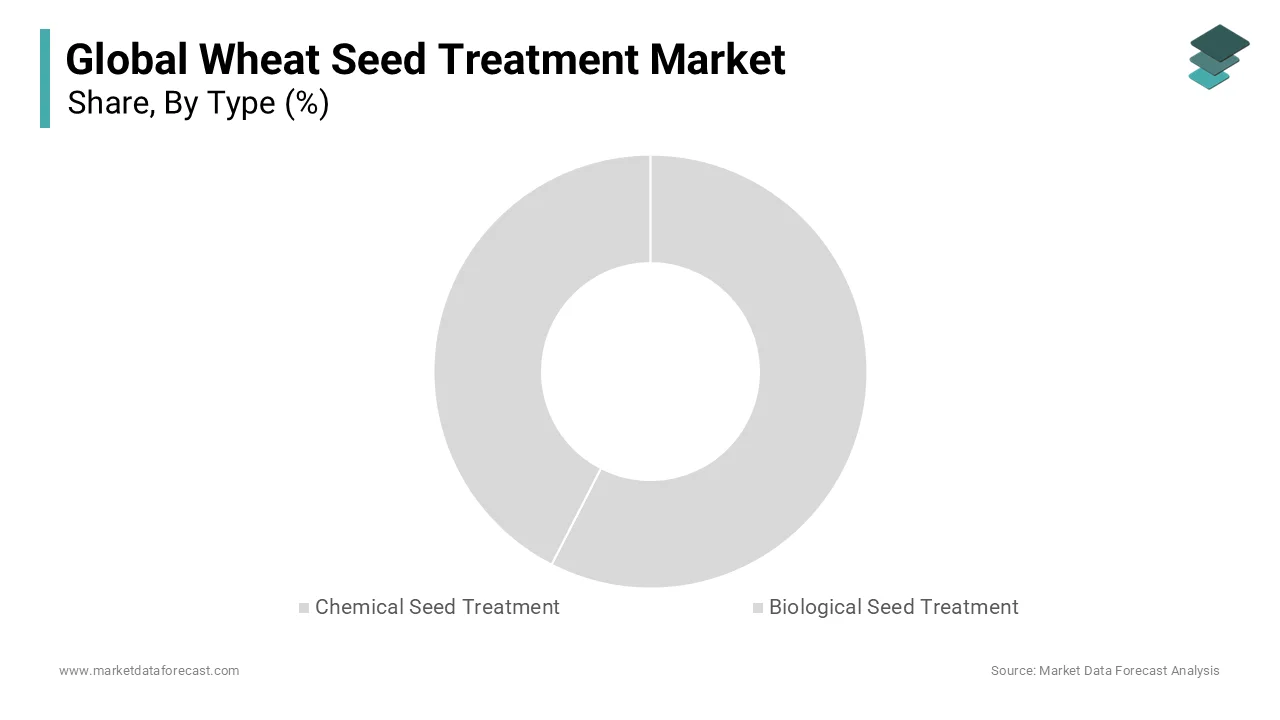
Chemical Seed Treatment is expected to dominate the Global Wheat Seed Treatment market during the forecast period. Due to its efficacy, availability, and simpler administration techniques, chemical seed treatment demonstrates higher popularity for farmers. Manufacturers of pesticides assisted tin moldingseed processors into chemical mixes.
By Application Insights
The dressing is the most widespread method used and can be performed by both industries and individual farmers.
By Function Insights
The seed protection sector of the global wheat seed treatment market is predicted to be the largest sector during the forecast period. Seed treatment fungicides are also used to protect crops against seed and soil-borne pathogens, particularly Rhizoctonia spp. and Fusarium spp. The ability of seeds to resist pests has enabled farmers to increase the production of their crops.
By Crop Insights
The grains and pulses segment is the fastest-growing segment in the global wheat seed treatment market. The predominance of the grains and grains segment is attributed to the increasing consumption of agrochemicals for these crops, especially in countries in Asia and North America. Developed countries like the United States are focusing on animal feed and the use of improved conventional technologies, such as hybrids, and biotechnology applications are expected to increase dramatically. The trend in the consumption of grains and pulses is more global, as it is considered a staple food in most countries, and this trend is expected to continue in the years to come.
REGIONAL ANALYSIS
In the Asia Pacific, Factors driving the wheat seed treatment market growth are growing agricultural practices and requirements for quality agricultural products.
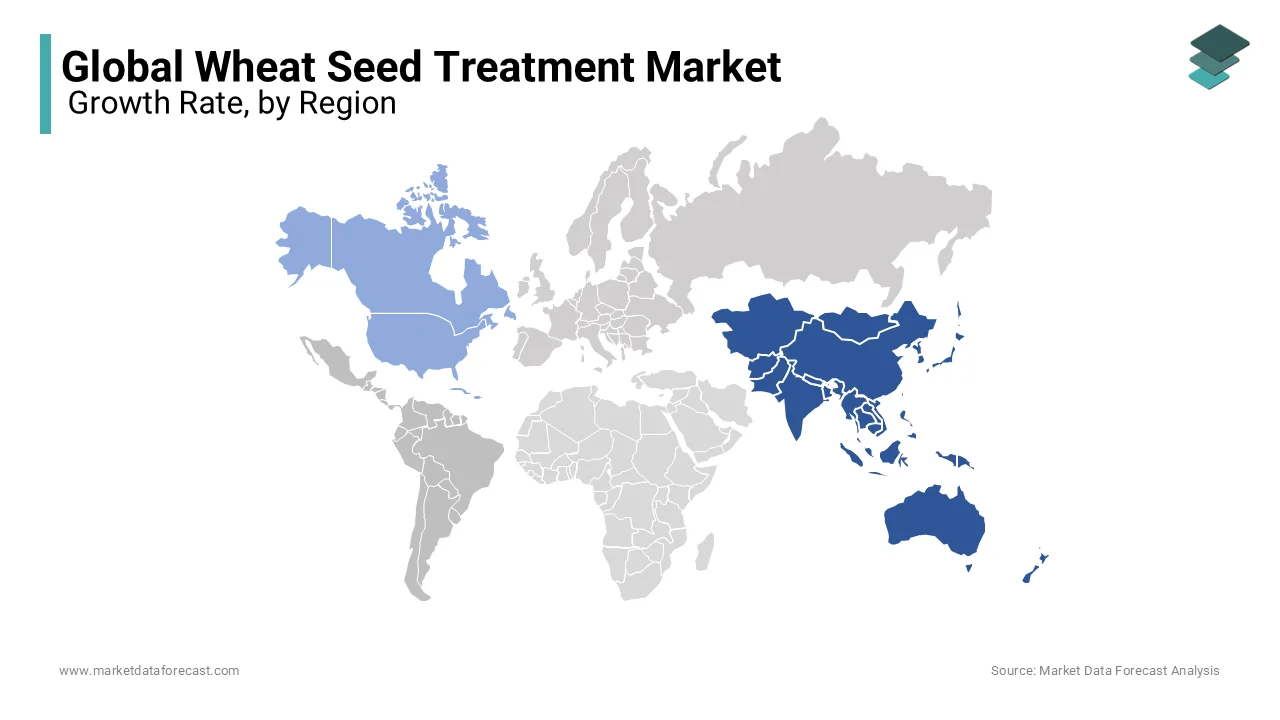
- The North American market is expected to account for the greatest market share because of the commercialization of pesticides in the region.
- Europe contributes to 30% of the global wheat seed treatment market, as many companies are present in the region, and new developments take place.
- The Latin American market is also growing at a high pace and is likely to outpace the North Americanmarkets.
- The Middle-East and Africa wheat seed treatment market is expected to grow at an annual rate of 9.33 percent during the forecast period.
KEY MARKET PLAYERS
Some of the market players that are dominating the global wheat seed treatment market.
- Syngenta AG
- BASF SE
- Bayer AG
- Corteva Agriscience
- Novozymes A/S
- FMC Corporation
- Adama Ltd
- UPL Ltd
- Nufarm
- Croda International
- Eastman Chemicals
RECENT MARKET NEWS
- In 2024, BASF SE presented its new brand of hybrid wheat seeds, Ideltis. BASF's hybrid wheat is intended to provide farmers with a higher yield and more stable yield and quality to promote one of the most important crops in the world
MARKET SEGMENTATION
This research report on the global wheat seed treatment market is segmented and sub-segmented into the following categories.
By Type
- Chemical Seed Treatment
- Biological Seed Treatment
By Application
- Coating
- Dressing
- Pelleting
By Function
- Seed Protection
- Seed Enhancement
By Crop Type
- Cereals & Grains
- Oilseeds
- Fruits & Vegetables
- Others
By Region
- North America
- Latin America
- Europe
- Asia Pacific
- Middle East & Africa